Behind the $1 Billion Revenue: How Long Can Pump.fun's Money Printer Keep Running?

比推Опубліковано о 2026-03-17Востаннє оновлено о 2026-03-17

Анотація

Pump.fun, a leading meme coin launch platform on Solana, has surpassed $1 billion in cumulative revenue, becoming the first on the chain to reach this milestone. Despite a broader market downturn in 2026, its dominance has solidified, capturing over 90% of daily trading volume and token creation on Solana. While its daily metrics remain strong, a significant portion of its revenue is shared with creators and LPs or used for token buybacks, which hasn't prevented its native token's price from falling over 76% from its peak. The analysis extends to other major players, revealing a market consolidation where traffic and profits are increasingly concentrated among top platforms. GMGN saw a five-fold quarterly revenue increase, primarily driven by activity on BSC, while Four.meme, BSC's main launchpad, operates at a fraction of its peak income. In contrast, platforms like Axiom, Photon, BullX, and BONKbot show steeper, sustained declines in revenue. The conclusion is that the meme coin sector is not disappearing but is undergoing a rapid shakeout. The survivors are platforms with robust, full-cycle ecosystems for token launches, trading, and liquidity. If another meme wave emerges, these established players are poised to capture the majority of the gains.

Author: Frank, PANews

Original Title: Pump.fun Joins the Billion-Dollar Club, How Much Business Does the "MEME Cash Machine" Have Left?


On March 8, Pump.fun's cumulative revenue exceeded $1 billion, making it the first platform on Solana to reach this milestone and solidifying its position as the most prominent money printer in the MEME sector. However, after the hype subsided, the question is no longer just "who made the most money," but rather how much business these MEME-driven platforms still have left.

Looking at top ecosystem projects like Pump.fun, GMGN, Four.meme, Axiom, as well as Photon, BullX, and BONK, the answer is becoming increasingly clear: MEME hasn't disappeared, but the business is increasingly concentrated among the top players, and the divergence between chains and platforms is becoming more pronounced.

Pump.fun: The "Absolute Oligarch" Across Bull and Bear Markets, Billions in Profits but Hard to Retain

If the last wave of MEME frenzy was a non-stop gold rush, then Pump.fun was undoubtedly the most profitable toll booth in this gold rush town. Public data shows that as of March 2026, Pump.fun's cumulative total revenue has exceeded $1 billion. Of this, 2024 contributed approximately $321 million, and 2025 further increased to about $664 million. Starting in 2026, the MEME industry experienced a significant downturn, but Pump.fun seemed relatively unaffected, still generating about $98.3 million in revenue to date.

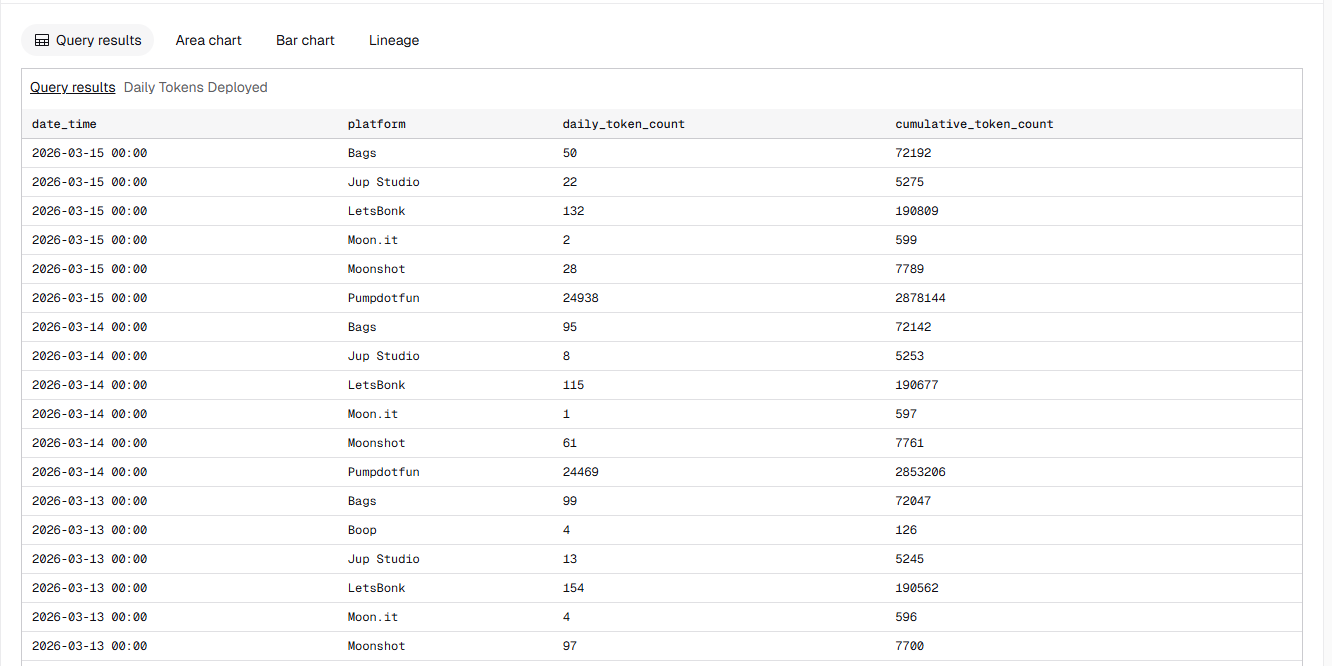
In terms of market structure, Pump.fun's dominant position in the Solana ecosystem has further strengthened. Taking data from March 15 as an example, Pump.fun's token creation share reached 99.1%, the graduation rate of tokens was 94.8%, and its daily trading volume share was about 93%. That day, Pump.fun launched 24,938 tokens, while LetsBonk had only 132, Bags had 50, and Moonshot had 28. The daily volume of other token launch platforms is no longer competitive with Pump.fun.
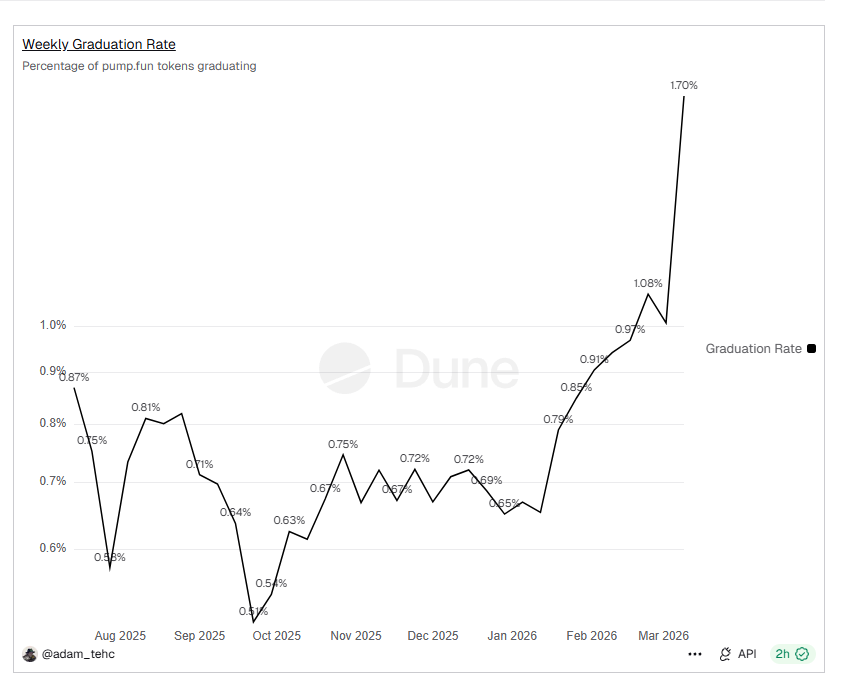
Looking back at Pump.fun's own data, it has also maintained a surprisingly high standard. Rough calculations based on visible data from the past two weeks show that Pump.fun currently averages about 29,700 token launches per day, with approximately 157,700 daily active wallets, a daily trading volume of about $93.65 million, and daily revenue of about $870,000. At the same time, the graduation rate, long seen as a weakness of the platform, has shown signs of recovery, recently even surging to around 1.70%. Although the specific reason behind this short-term peak is not yet clear, Pump.fun's graduation efficiency is indeed improving.
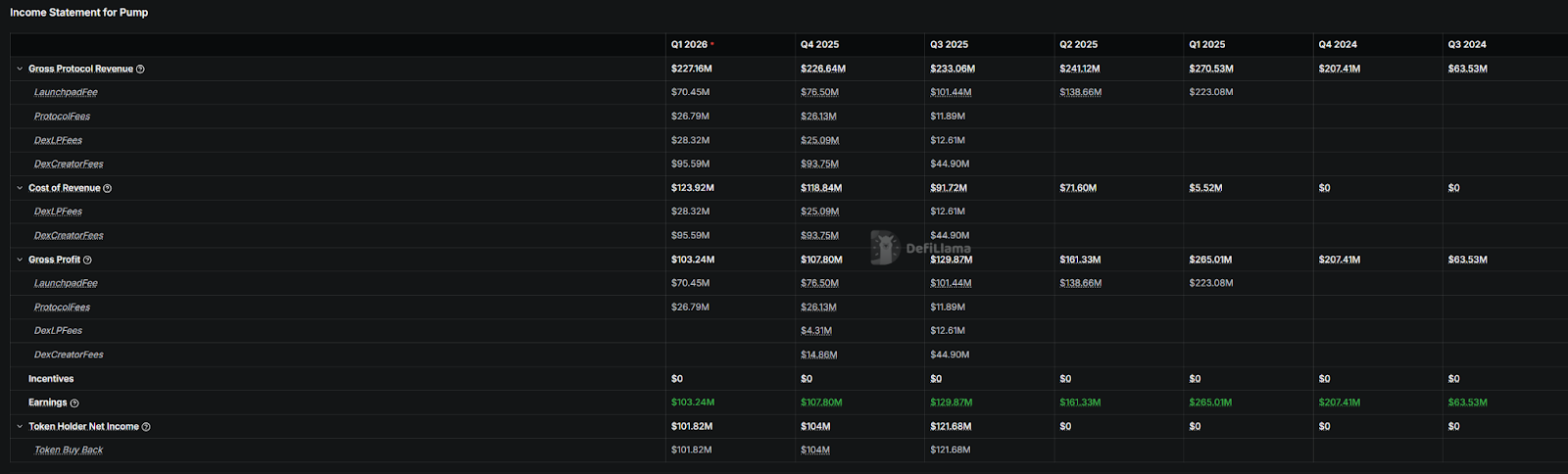
However, although fee generation remains robust, for Pump.fun, it does not mean that all this revenue can be fully converted into protocol profits. First, more than half of the fees are given to creators and LPs. Second, the remaining revenue is also used for token buybacks. In the first quarter of 2026, Pump.fun generated a total of $227 million in fees, of which $123 million was distributed to creators and LPs, and the remaining $100 million was almost entirely used for token buybacks.
The problem is that the buybacks did not automatically translate into a rise in token price. As of March 16, the price of PUMP was about $0.002, still about 76.21% lower than its all-time high of $0.0088. A more reasonable explanation is that buybacks can only provide support and maintain the narrative but are insufficient to reverse the overall compression of valuations in the MEME sector. In other words, Pump.fun's cash flow machine is still running at high speed, but the market is no longer willing to give it higher valuation multiples simply because it "makes money," as it did during the last hype cycle.

In summary, for Pump.fun, the market structure remains relatively stable. Although the entire meme coin sector is experiencing a decline, it's mostly the competitors that have died off,反而 making Pump.fun's dominance even stronger. If this market can explode again, Pump.fun is likely to capture even greater红利.

GMGN: Quarterly Revenue Grows Fivefold, BSC Becomes the "New Traffic Hotspot"

GMGN's revenue saw another explosive growth in the first quarter of 2026. Total revenue for Q1 2026 reached $25.31 million, a nearly fivefold increase compared to $5.64 million in Q4 2025. This quarter's revenue also became the second-highest quarterly revenue in GMGN's history (only lower than Q1 2025's $40.81 million).

A closer look at this revenue structure shows that it is mainly driven by the BSC chain. Starting in October 2025, GMGN's trading volume on the BSC chain began to significantly exceed that on Solana, and by 2026 this trend had stabilized. To date, the trading share on the BSC chain on GMGN is nearly three times that of the Solana chain.

From an overall trading volume perspective, user activity and trading volume on GMGN improved somewhat in Q1 2026, but the increase is not as high as the revenue change suggests. Therefore, from this angle, the revenue improvement in Q1 2026 is real, but the explosive growth is likely a statistical issue with DefiLlama (BSC chain revenue data was empty before October 2025).

However, this growth was primarily driven by a surge in MEME trading volume on the BSC chain in January, which generated $16.34 million in cross-chain revenue that month. This number dropped to $5.18 million in February and is about $3.77 million so far in March. The overall level for Q1 this year is similar to that of the same period in 2025.

Four.meme: The "Face" of BSC, Daily Revenue Only a Fraction of Its Peak

If Pump.fun has almost absorbed most of the traffic on Solana launch platforms, then on BSC, the closest to a similar role is Four.meme.

DeFiLlama data shows that as of March 16, Four.meme's protocol revenue for Q1 2026 has reached $16 million, significantly lower than the $54.24 million in Q4 2025. However, looking at the monthly revenue changes this year, there has been a slight recovery.
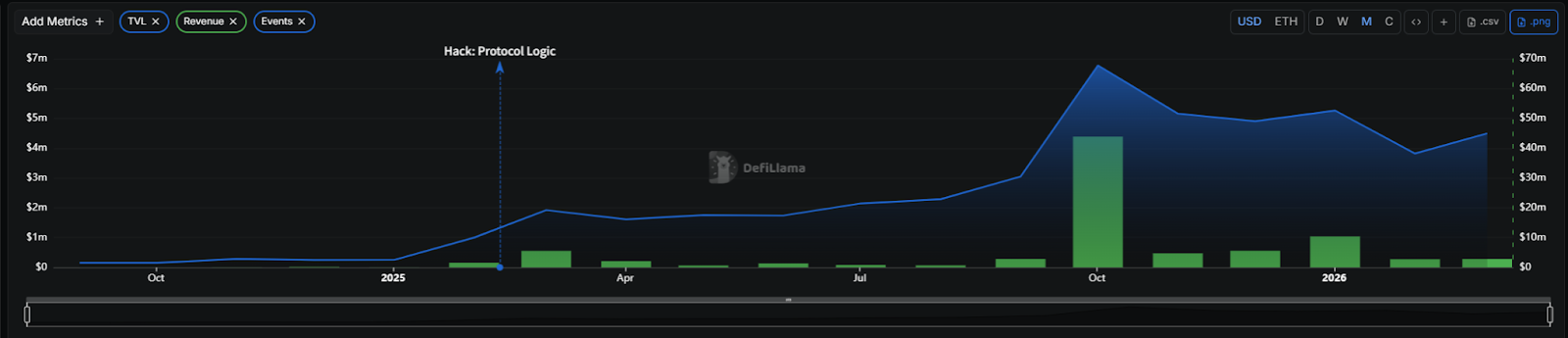
According to visible data tracked by Dune for the last 10 days, Four.meme averages about 4,858 token launches per day, with approximately 5,749 daily users. Only about 25.7 tokens are listed on the DEX Pancake daily, and the short-term graduation rate has further dropped to around 0.53%. Judging from these data changes, the current Four.meme is also operating at a low level. Compared to the peak daily revenue of $4.22 million in October 2025, current revenue has fallen to the $200,000-$300,000 level.
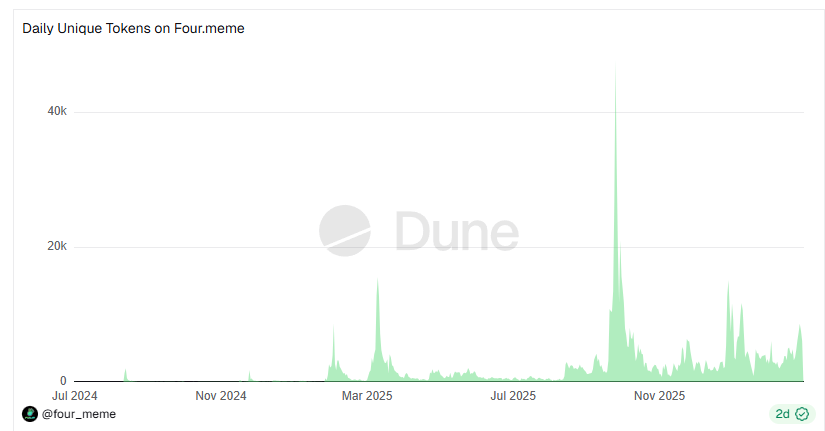
For comparison, estimates based on Pump.fun's data from the past two weeks show it still averages about 29,700 token launches per day and a daily trading volume of about $93.65 million. Clearly, as the main platforms for MEME coins on Solana and BSC respectively, there is a significant gap in scale and token quality between Four.meme and Pump.fun, reflecting the development of MEME on these two chains.

Axiom: Farewell to High Growth, Stuck in a Continuous Volume Contraction Quagmire

If GMGN's growth in Q1 2026 was more like catching the红利 of the BSC rotation, then Axiom's situation is almost the opposite.

According to DeFiLlama data, as of now, the protocol's revenue in Q1 2026 is approximately $29.03 million, higher than GMGN's $25.31 million for the same period.
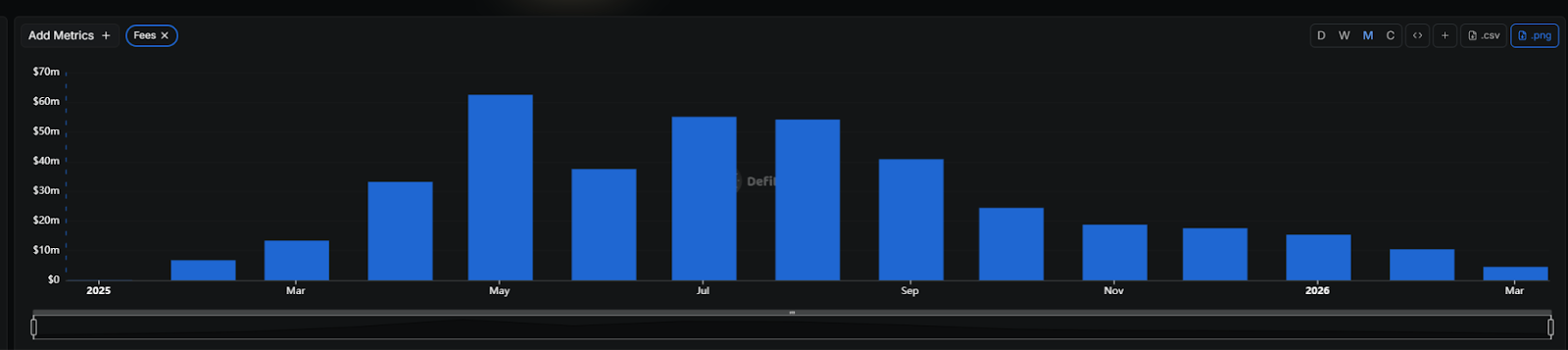
However, Axiom's current problem is that its business is in a state of continuous decline. According to DeFiLlama's quarterly revenue data, Axiom's protocol revenue reached highs of $133 million and $150 million in Q2 and Q3 2025 respectively, but fell to $60.66 million in Q4 2025, and is currently $29.03 million for Q1 2026. Compared to the most疯狂 phase last year, the business volume has significantly contracted. Comparing this with GMGN reveals that although both are in a post-peak decline phase, GMGN's revenue still has occasional阶段性 rebounds, while Axiom seems unable to regain its momentum.

For Axiom, it is no longer just a tool reliant on MEME hype bursts but更像是一台经历过多轮行情检验的成熟交易机器 (more like a mature trading machine that has been tested through multiple market cycles). Compared to GMGN, which is still talking about growth elasticity, Axiom's imagination space seems to be shrinking.

Photon, BullX, and BONK: The "Stragglers" After the Tide Recedes

Compared to GMGN, which still has rebounds, and Axiom, which maintains a leading scale, the revenue curves of Photon, BullX, and BONKbot have more clearly entered a downward trend in 2026.

According to DeFiLlama data as of March 16, Photon's cumulative revenue is approximately $438 million, but its quarterly revenue has declined from $122.8 million in Q1 2025, to $32.31 million in Q2, $18.99 million in Q3, $5.29 million in Q4, and is only $4.52 million so far in Q1 2026, showing a nearly阶梯式坠落 (stepped decline) trend.
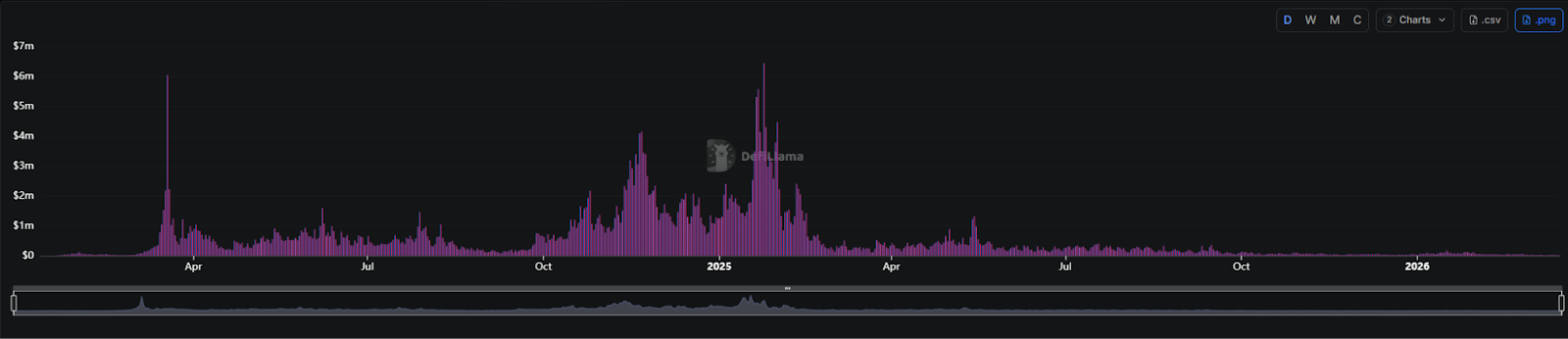
BullX's cumulative revenue is about $203 million, but it also experienced rapid contraction. Quarterly revenue dropped from $87.37 million in Q1 2025 to $14.25 million in Q2, $3.86 million in Q3, $878,000 in Q4, and is only $491,000 so far in Q1 2026.
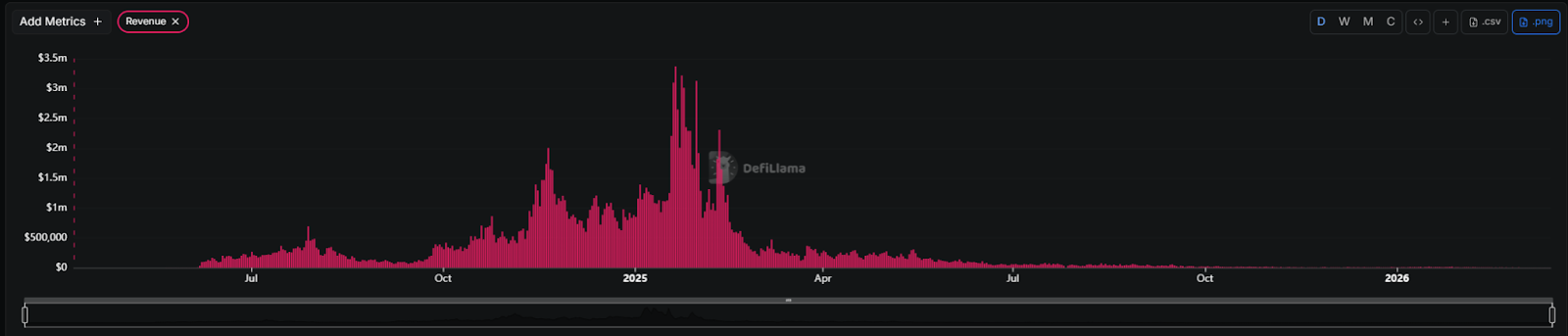
BONKbot's decline is relatively less steep but has also clearly receded. According to DeFiLlama data, its cumulative revenue is about $93.57 million. Quarterly revenue was $12.61 million in Q1 2025, then fell to $3.40 million in Q2, $2.85 million in Q3, $1.85 million in Q4, and is $1.84 million so far in Q1 2026.
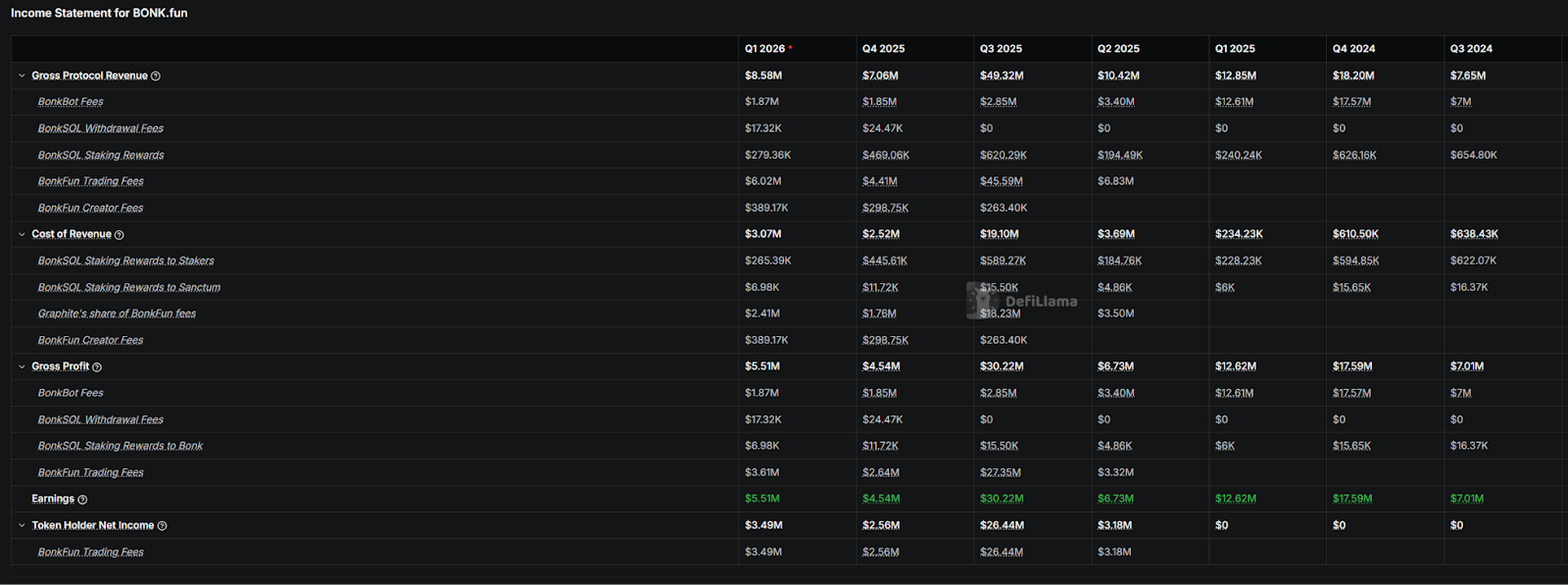
However, the BONK ecosystem itself has not simultaneously熄火 (fizzled out). As of now, BONK.fun's protocol revenue for Q1 2026 is approximately $8.51 million, already higher than the $7.06 million in Q4 2025. Of this current quarter's revenue, about $6 million comes from Bonk.Fun, and about $1.84 million comes from BonkBot.

Looking at this MEME coin battle royale, it's not hard to draw a conclusion: the MEME track is not dying out; it's just that the era of wild competition has彻底终结 (completely ended), and the reshuffling speed has far exceeded everyone's expectations.

After the tide receded, the platforms that truly remained are no longer just the fastest runners but those that have built a complete closed loop encompassing launch, trading, liquidity, and fee collection. If the next wave of MEME行情 (market trend) starts again, they are most likely the ones to benefit first.


Twitter:https://twitter.com/BitpushNewsCN

Bitpush TG Discussion Group:https://t.me/BitPushCommunity

Bitpush TG Subscription: https://t.me/bitpush

Original link:https://www.bitpush.news/articles/7620497

Пов'язані питання

QWhat is Pump.fun's total cumulative revenue as of March 8th, and why is this milestone significant?

APump.fun's cumulative revenue reached $1 billion as of March 8th, making it the first platform on Solana to achieve this milestone. It solidifies its position as the most prominent revenue generator in the MEME sector.

QHow has Pump.fun's revenue distribution changed, and what happens to the fees collected?

AA significant portion of Pump.fun's fees are distributed to creators and liquidity providers (LPs). For example, in Q1 2026, out of $227 million in fees, $123 million was given to creators and LPs, and the remaining $100 million was almost entirely used for token buybacks.

QWhich platform experienced a nearly 5x quarter-over-quarter revenue growth in Q1 2026, and on which blockchain was this growth primarily driven?

AGMGN experienced a nearly 5x quarter-over-quarter revenue growth in Q1 2026, reaching $25.31 million. This growth was primarily driven by a surge in activity on the BSC (Binance Smart Chain), which now accounts for nearly three times the trading volume of its Solana chain.

QHow does the current daily revenue of Four.meme compare to its peak, and what does this indicate about the BSC MEME market?

AFour.meme's current daily revenue has fallen to the $200,000-$300,000 range, which is only a fraction of its peak daily revenue of $4.22 million in October 2025. This indicates a significant cooling off and lower activity levels in the BSC MEME market compared to its previous highs.

QWhich MEME-related platforms are described as 'laggards' with clearly declining revenue curves in 2026?

AThe platforms described as 'laggards' with clearly declining revenue curves in 2026 are Photon, BullX, and BONKbot. Their quarterly revenues have shown a consistent and significant downward trend throughout 2025 and into 2026.

Пов'язані матеріали

Must-Watch Events Next Week|CLARITY Act Could Face Senate Vote; SpaceX, Circle to Report Earnings (8.3-8.9)

**Summary: Key Events and Developments to Watch (August 3-9)** The upcoming week is marked by significant financial disclosures, key legislative deadlines, and notable product updates. **Major Financial Events:** Several companies are scheduled to release their Q2 2026 earnings. American Bitcoin (ABTC) will report on August 3, followed by SpaceX and Hut 8 Mining Corp. on August 4, and Circle on August 5. Notably, a significant portion of SpaceX shares (up to 12% of total shares) will be unlocked on August 6 following their earnings release. **Key Legislative Deadline:** The U.S. Senate faces an August 7 deadline to secure 60 votes for the CLARITY Act, a bipartisan bill aiming to establish a federal regulatory framework for cryptocurrencies. The Senate may hold a full vote on the bill during the week. **Economic Data:** The U.S. July Non-Farm Payrolls report will be released on August 7, providing crucial labor market data. **Technology & Product Updates:** * **Shutdowns:** DeFi portfolio tracker Zapper and wallet app Ctrl Wallet will cease operations on August 3. * **Upgrades:** LayerZero will deprecate its v1 relayers on August 3. XRP Ledger's new version 3.3.0, featuring five new functions, is expected next week. * **AI:** Elon Musk announced that the advanced Grok 4.6 AI model is set for release around August 7. * **Bitcoin:** The BIP-110 forced signaling for a potential Bitcoin network change is scheduled to begin around August 8. **Other Notable Events:** Chinese robotics firm Unitree Tech has set its preliminary price inquiry for its IPO for August 5. South Korean exchange Upbit will delist AQT and AERGO tokens on August 3.

marsbit37 хв тому

Must-Watch Events Next Week|CLARITY Act Could Face Senate Vote; SpaceX, Circle to Report Earnings (8.3-8.9)

marsbit37 хв тому

Stocks Are Plummeting More Sharply Than Cryptocurrencies. Where Has the Money Gone?

Stock Markets Plunge Deeper Than Cryptocurrencies: Where Did the Money Go? In late July, Seoul's Kospi index triggered circuit breakers for two consecutive days, plummeting over 40% from its June high. The collapse was led by heavyweight stocks like SK Hynix, whose record profits still disappointed investors, and devastating leveraged ETFs, with one major product losing over 83% of its value. This signaled a global, forced deleveraging targeting the most crowded trades. Interestingly, while stocks exhibited extreme volatility akin to crypto markets, Bitcoin rose nearly 15% in July after a prior steep drop. Analysis shows the money fleeing equities did not flow into Bitcoin. Instead, Bitcoin had already absorbed its sell-off in May-June, when U.S. spot Bitcoin ETFs saw historic outflows. The true safe-haven beneficiary was gold, whose price rose over 20% year-on-year, highlighting a decoupling between Bitcoin and gold as "digital gold." The sell-off was a targeted unwinding of leveraged positions in tech and semiconductors, accelerated by broker-dealer risk management and shifts in the AI narrative, including new competition from Chinese memory chipmakers. The retreat path was clear: from high-valuation tech stocks to cash and U.S. Treasuries, then to gold. For Bitcoin to attract sustained institutional inflows, conditions like eased global liquidity pressure, a "soft-landing" Fed rate cut, and U.S. regulatory clarity via legislation like the stalled CLARITY Act are needed. Currently, Bitcoin is not a safe haven but an already-cleared asset. Its low correlation with tech stocks, however, makes it a potential diversification play for institutional portfolios once the storm passes. The money isn't here yet, but the positioning is underway.

marsbit37 хв тому

Stocks Are Plummeting More Sharply Than Cryptocurrencies. Where Has the Money Gone?

marsbit37 хв тому

In Conversation with Ray Dalio: We Are Currently in an AI Bubble, with 1% of My Portfolio in Bitcoin

Ray Dalio, founder of Bridgewater Associates, warns in an interview that the current AI boom shows classic bubble characteristics, which could lead to significant economic downturns as seen in past cycles like 1929 or 2000. He explains that speculative enthusiasm, fueled by debt and overvaluation, often precedes a crash when rising rates or taxation force asset sales, causing widespread losses and recession. Dalio also outlines his "Big Cycle" theory, describing an approximate 80-year pattern where widening wealth gaps, massive government deficits, and shifting geopolitical power (like China's rise) create internal conflict and global instability. He emphasizes that we are in a late-cycle, transitional phase where traditional powers like the US and UK face decline. For personal wealth protection, Dalio advises diversification beyond cash into assets like stocks, bonds, real estate, and particularly gold, which he prefers over Bitcoin. While he holds about 1% of his portfolio in Bitcoin as a non-printable hard asset, he views gold as more secure from technological or governmental threats. Regarding AI's impact, Dalio believes it will disproportionately benefit capital owners, worsening inequality by replacing both physical and cognitive labor. He suggests that human intuition and emotional intelligence, combined with AI, will be key for future workers. On taxation, Dalio argues that wealth taxes are impractical and risk triggering asset sell-offs, reducing productive investment. He points to the UK as a cautionary example of debt, low productivity, and political strife. Geopolitically, Dalio foresees a more regionalized world, with the US showing weakness in prolonged conflicts like with Iran, akin to past imperial declines. The ideal outcome, he suggests, is coexisting powerful blocs (e.g., Americas, China-Asia Pacific) without major war.

marsbit4 год тому

In Conversation with Ray Dalio: We Are Currently in an AI Bubble, with 1% of My Portfolio in Bitcoin

marsbit4 год тому

Daily 7.2 Trillion KRW: Foreign Capital's Record Net Buying on Friday! Wall Street Says Headwinds for Korean Stock Fund Flows Have Subsided

South Korean stock market sees a dramatic shift in fund flows. On July 31, foreign investors made a record net purchase of approximately KRW 7.2 trillion in KOSPI stocks, marking a fundamental reversal from the persistent large-scale net outflows seen in previous months. This contributed to a significant narrowing of foreign net selling in July to KRW 9.8 trillion, down sharply from KRW 48.4 trillion in June and KRW 44.5 trillion in May. Simultaneously, domestic institutional pressure eased. South Korean pension funds and asset managers turned to a net buying position in July, purchasing KRW 1.0 trillion worth of KOSPI shares, contrasting with net sales in May and June. Market volatility is expected to be dampened by new financial regulations. Effective July 31, the Financial Services Commission tightened access for retail investors to single-stock leveraged ETFs by raising the minimum cash deposit requirement. Trading volumes for these products subsequently dropped to about 50% of their monthly average. Citigroup Research maintains its year-end KOSPI target of 10,000 points. The firm cites several supportive factors: the substantial easing of headwinds from capital outflows, a robust fundamental outlook for the semiconductor sector, historically low market valuations, strong economic fundamentals, and the potential for policy support from financial authorities if needed.

marsbit4 год тому

Daily 7.2 Trillion KRW: Foreign Capital's Record Net Buying on Friday! Wall Street Says Headwinds for Korean Stock Fund Flows Have Subsided

marsbit4 год тому

Торгівля

Спот
活动图片





