Original Author: Lawyer Shao Jiadian
Recently, Bloomberg-related reports (cited by multiple media outlets) mentioned: Hong Kong-based stablecoin payment platform RedotPay is considering an IPO in the US, with a potential fundraising scale of over $1 billion and a target valuation of over $4 billion, and has engaged with several leading investment banks; the report also emphasized that related discussions are still ongoing, and the scale and valuation may be adjusted. (Bloomberg Legal News)

The reason why such news deserves serious attention from legal and compliance practitioners is not just because of the "large financing scale," but because it touches on a more critical issue: When stablecoin payment platforms begin to enter mainstream capital markets, the market will not only ask about growth data but will more deeply question whether the business structure, responsibility boundaries, and regulatory adaptation are sufficiently clear.
Judging by the official website pages and terms system, RedotPay externally presents not just a single product form like a "card" or "wallet," but rather a comprehensive platform centered around accounts, including modules for payments, earnings, lending, remittances, etc. Its official website's Earn page also directly showcases the "Earn and Spend" scenario and displays a user scale statement of "6 million+".
This article does not make investment judgments. We only discuss, from a lawyer's perspective and based on the official terms and publicly verifiable information, a more fundamental but also more practical question:
How does RedotPay, in terms of legal structure, stitch together the product experience of a "payment platform" with the regulatory reality of a "quasi-financial institution."
From Stablecoin Card to Quasi-Financial Account: The Product Structure Is Already More Than Just "Payment"
If you only look at the first impression, RedotPay is most easily understood as a "crypto card payment" product: users hold stablecoins or other digital assets and complete payments and exchanges in consumption scenarios.
But as long as you open its General Terms, you will find that the platform actually covers a significantly wider range of services. The terms directory and service scope include not only the RedotPay Card but also Custodian Account, Swap, Virtual Assets Loan Services, Crypto Earn, P2P, Fiat Remittance, Crypto Transfer, etc.
This means that, from a legal structure perspective, it is no longer a single-point payment tool but an "account-based comprehensive product interface":
- Payments (Card / Remittance / Transfer)
- Asset Conversion (Swap)
- Accounts and Custody (Custodian / Wallet / Virtual Account)
- Earnings (Earn)
- Credit and Lending (Credit / Virtual Assets Loan Services)
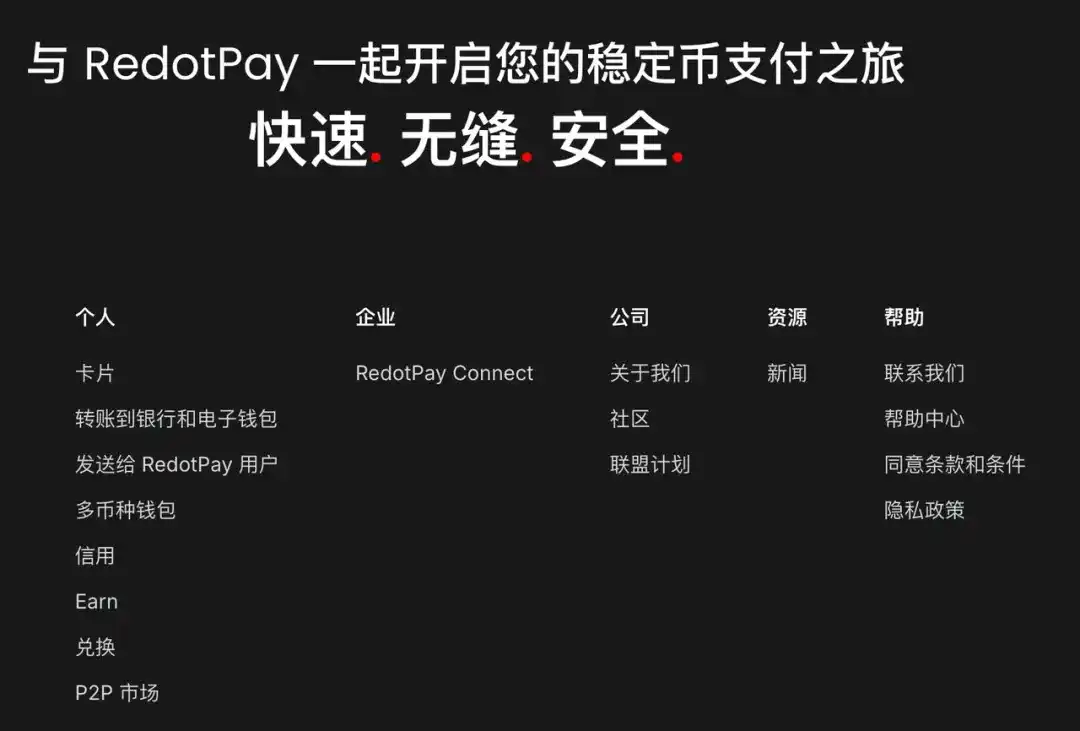
(The above image is a screenshot from the Redotpay official website)
For users, this is certainly an improvement in experience: a more unified entry point, easier fund flow within the same platform. But from a regulatory perspective, this type of product combination will naturally lead to one result: Regulatory agencies will often not understand it solely as a "payment product" but will examine it item by item based on its actual functions.
Especially when payments, earnings, and credit are integrated, the platform's legal identity can hardly remain entirely within the narrative of a "technology service provider." Even if the terms maintain cautious expressions, the financial nature of the business itself will gradually strengthen.
From an entrepreneurial perspective, this is a more difficult but also more valuable route: not creating a "functional point" but building an "account system." From a lawyer's perspective, the more this route is taken, the more important it is to clarify legal relationships and responsibility boundaries in advance; otherwise, the smoother the product, the harder it is to resolve subsequent disputes.
Entity Structure and Jurisdictional Mapping: Not "Evading Regulation" but "Rearranging Regulatory Responsibilities"
One of the most noteworthy aspects of RedotPay is not that it has many functions, but how it uses a multi-entity structure to carry these functions. In Article 1.1 of its General Terms, the RedotPay Group lists multiple jurisdictional entities, including Hong Kong entities, Panama entities, Argentina entities, US entities, etc., and specifies the registration information of some entities and the MSB registration information of the US entity.
At the same time, in Articles 2.2 and 3.1 of the General Terms, the platform further maps different modules and service entities. For example:
- Crypto Earn Services are exclusively provided by RedotX Panama;
- Fiat Remittance Services, Crypto Transfer Services are exclusively provided by Red Dot Payment;
- Other modules are undertaken by different entities under the group or applicable entities.
The significance of this structure in legal engineering is very clear: Different functions → Different entities → Different jurisdictions/licenses/regulatory obligations.
This is not a design exclusive to the crypto industry; similar ideas can be seen in cross-border payments, internet brokerages, and some fintech platforms. The real difference lies in the quality of execution—that is, whether the "paper structure" can be aligned with "actual operations."
Additionally, RedotPay's official news also disclosed that the group completed the acquisition of a licensed MSO entity in Hong Kong in 2024, explicitly stating that this entity holds an MSO license issued by Hong Kong Customs and can provide currency exchange and remittance services. This step is crucial from a lawyer's perspective because it shows that the platform does not rely entirely on external partners but is gradually placing some critical links within its own compliant entities.
The advantages of such arrangements are obvious:
1. Clearer functional layering: Different businesses are undertaken by different entities, facilitating compliance management.
2. More flexible regional adaptation: The scope of opening can be adjusted according to regulatory changes in various regions.
3. More complete capital market narrative: Compared to relying entirely on third-party cooperation, a structure with clear entity mapping is easier to due diligence and review.
But this type of structure also naturally raises management thresholds. The reasons are:
- Users see the unified brand "RedotPay," but the legal relationships are actually distributed across multiple entities;
- The more detailed the terms are, the more they require customer service, risk control, clearing, product configuration, and internal authorization chains to operate strictly according to entity boundaries;
- Once disputes or regulatory inquiries arise, external agencies will not ask "Do you have a structure chart?" but "Does your structure chart truly reflect the business?"
Therefore, a multi-jurisdictional structure does not equate to less risk. More accurately, it transforms risk from "single-point regulatory risk" into "cross-entity coordination risk, disclosure risk, and boundary interpretation risk." For companies preparing for an IPO, these risks are not lighter, just more professional.
Key Regulatory Issues in Business Terms: What's Really Worth Looking at Is How Funds, Earnings, and Credit Are Defined
If the previous part looked at the "shell," this part looks at "how the blood flows." For platforms like RedotPay, regulatory judgments often do not depend on a brand slogan but on how the terms define fund usage rights, sources of earnings, credit mechanisms, account nature, and platform permissions. The following points are observations that I believe are valuable for RedotPay (and similar PayFi projects). Here it is emphasized: The following are legal observations, not definitive conclusions.
1. Earn Module: The Core Is Not "Having Earnings" but "How Funds Are Used"
RedotPay's Crypto Earn terms have several particularly noteworthy points.
First, it clearly states at the beginning of the terms: Crypto Earn Services are not provided to the Hong Kong public, and requires users to state that they are not Hong Kong residents, and to notify RedotX Panama if the situation changes.
This type of term arrangement itself shows that the platform is not unaware of regulatory differences across regions but is using regional scope and entity arrangements to control boundaries.
Second, the arrangements for fund usage and segregation are written relatively directly. The Crypto Earn terms clearly state:
- Digital assets used by users to subscribe to Earn will not be segregated from others' assets;
- Relevant assets may be commingled and managed on a pooled basis with RedotX Panama and the group's global client assets;
- The platform may, at its discretion, allocate to different earnings strategies without seeking user consent case by case;
- Users have no right to demand the return of a specific digital asset.
The terms also state that pooled assets may be deployed to staking, liquidity pools, other platforms, or subscriptions to funds and other earnings scenarios. At the same time, the risk disclosure in the terms also mentions that in extreme circumstances, there may be risks of delayed return or even asset loss. From the perspective of legal text design, this type of writing at least accomplishes several things:
- First, clearly stating the characteristics of fund pooling and non-segregation;
- Clarifying that the platform has strong autonomy in fund allocation;
- Managing user expectations in advance regarding "funds must be fully and immediately returnable";
- Handling some legal dispute points upfront at the contract level.
This is not "light" in terms of compliance design; on the contrary, it is a path of "heavy terms." But precisely because the terms are written clearly, external regulators or capital markets, when understanding this module, are likely to further focus on how its legal attributes are interpreted: in different jurisdictions, is it closer to a "platform function," an earnings product, or another regulatory category? This question may not have a unified answer, which is also an important background for RedotPay's use of specific entities and regional boundary designs.
2. Credit Function: The Terms Level Has Clearly Entered the "Credit Card/Credit" Logic
There is a very key point in the expression of RedotPay's Hong Kong card terms: the terms state that the card is "intended to function and operate as a credit card" and that it is classified as a credit card under Hong Kong laws and regulations, with usage depending on the credit limit allocated by the platform and other card limits. This means that, at least in the context of its Hong Kong card program terms, the platform has not simply packaged the product as a prepaid card or pure exchange channel but has acknowledged the existence of credit limits and credit card function logic.
Looking further at its virtual asset lending terms (Crypto Loan / Virtual Assets Loan Services), the relevant terms clearly state:
- Loan usage is subject to Loan Limits, including single, daily cumulative, and monthly cumulative limits;
- Whether to grant a loan is determined by RFTL;
- There are Stable Rate Loans and Card Automatic Loans;
- There are specific mechanisms such as 24-hour terms, automatic rollovers, interest calculations, and repayment order.
This shows that "Credit" is not just a functional marketing name but has a relatively complete credit/lending structure at the terms level. From a legal perspective, this does not necessarily mean there is a problem; on the contrary, it shows that its product design is closer to the contract expression of mature financial products; but it does bring a practical consequence:
External markets and regulators, when understanding RedotPay, can hardly see it only as a "payment entry."
When payment and credit are integrated, the platform needs to simultaneously face the observational perspectives of payment regulatory logic and credit regulatory logic. Standards vary across jurisdictions, and how the platform continuously adapts in terms of terms, product opening scope, customer segmentation, and risk control rules will be a long-term task.
3. Account Nature and "Non-Bank/Non-Stored Value Tool" Expressions: Necessary, but Not the Final Answer
RedotPay states very clearly in Article 4.3 of the General Terms: The establishment and maintenance of relevant accounts are solely for the purpose of providing services and should not be construed as banking services or any form of stored value facility under any circumstances.
Such terms are common in the industry, and I believe they are necessary. They serve at least three purposes:
- Managing user expectations to avoid misunderstanding the platform as a bank;
- Reducing the risk of disputes due to inconsistency between promotion and actual services;
- Establishing a contract position for the platform that can be referenced.
But from a regulatory law perspective, regulatory agencies will ultimately look at "functional facts"—including fund flows, customer outreach methods, marketing expressions, actual clearing arrangements, risk-bearing methods, etc. Therefore, the value of such terms is not "exemption once written" but to allow the platform to first clarify its position in the legal narrative.
From a lawyer's perspective, RedotPay's characteristic in this regard is not "absolute safety" but relatively emphasizing the translation of complex business into term language. This is actually very instructive for similar projects, because the problem with many platforms is not that the business is complex, but that the business is complex while the terms still remain at the "generic template" level.
What Will Really Be Repeatedly Questioned in the IPO Context: Not "Whether There Is Risk" but "Whether the Risk Can Be Continuously Explained"
Since it is a "potential IPO," what is more worth discussing is not vague regulatory trends, but a more practical question: If it enters the IPO preparation stage, internal risk control of underwriters, external lawyer due diligence, and investor communication, what is RedotPay's structure most likely to be repeatedly questioned about?
No predictive judgments are made here, only a few high-probability "disclosure and explanation priorities" are given from the perspective of legal work methods.
1. Whether Entity—Function—Fund Flow Are Truly Aligned
The biggest problem for many cross-border platforms in the early stages is not that they lack entities, but that three charts are inconsistent:
- The legal entity chart is one set;
- The user terms are another set;
- The actual fund flow/clearing flow is yet another set.
Judging from the existing public terms, one advantage of RedotPay is that it has already clearly written the correspondence between major service modules and entities in the General Terms. This will significantly lower the external understanding threshold and is also conducive to basic due diligence in the capital market. But if deeper scrutiny is entered, it will usually continue to ask:
- Which modules are self-operated, and which rely on partners;
- Which fees are recognized as revenue by which entity;
- How risks are shared within the group;
- Whether cross-entity service agreements, settlement agreements, and authorization chains are closed-loop.
These questions may not all be publicly disclosed on the official website, but for the IPO stage, they often determine whether "the structure looks clear" can be upgraded to "the structure can withstand verification."
2. Customer Asset-Related Disclosures: The Focus Is Not Just on "Safety" but on "Rights Boundaries"
For platforms that include both payments, Earn, and Credit, customer assets are not a single concept. Under different modules, users' legal status, the nature of asset rights, and platform permissions may differ.
Taking the Crypto Earn terms as an example, the platform has provided relatively clear prompts regarding pooling, non-segregation, platform allocation rights, and risks of delayed return or loss in extreme circumstances. From the perspective of contract completeness, this expression is relatively candid and professional; but in the context of capital markets, it often leads to new questions:
- Whether the front-end product presentation is consistent with the back-end legal relationships;
- Whether users can clearly distinguish the differences between "payment account usage" and "earnings account participation";
- Whether risk disclosures have been fully adapted to changes in regions and products;
- In extreme event scenarios, whether the platform's internal disposal mechanisms are consistent with the terms commitments.
An IPO does not require a company to have "no risk," but it usually requires that its risk expression be consistent, verifiable, and sustainable. This is why the terms system, risk control processes, customer service scripts, and marketing copy are viewed from the same perspective during the IPO stage—they together constitute the external evidence chain of "how the company defines itself."
3. Whether the Growth Narrative and Compliance Narrative Support Each Other Rather Than Conflict
Media citing Bloomberg reports mentioned that RedotPay had a large financing scale in 2025 and disclosed user scale and other growth information. At the same time, RedotPay's official external communications have also continuously released its compliance actions, such as the acquisition related to the Hong Kong MSO license. For capital markets, both narratives (growth and compliance) are important, but what is more important is whether they can prove each other, not conflict.
If growth mainly comes from functions that are more sensitive in terms of regulatory boundaries, and compliance explanations remain at a general level, external scrutiny will naturally intensify; conversely, if the platform can prove that its growth is based on the orderly advancement of "divided entities, divided regions, divided functions," then the compliance narrative will instead become a valuation support, not just a cost item.
From the current public information, RedotPay at least shows a positive signal: it has not completely avoided structural and licensing issues in its public expressions but is gradually putting compliance actions in front of the stage. This is usually a plus for subsequent capital market communication—provided that the internal operational logic can keep up with the terms and external narrative.
4. The Terms System Itself May Be the "First Sample" of External Due Diligence
Many teams treat user terms as "necessary documents for launch," but for cross-border platforms like RedotPay, the terms actually serve a greater function:
It is a low-cost entry point for external lawyers, investors, and regulatory observers to understand the platform's structure.
RedotPay's current terms system shows several characteristics:
- Relatively detailed module breakdown;
- Relatively clear service entity mapping;
- Relatively full risk disclosure;
- Some products have clear regional boundary expressions (e.g., the restrictive description of Crypto Earn regarding the Hong Kong public).
This does not mean that the terms are already "perfect," nor does it mean that no adjustments will be needed in the future; but it at least shows that the platform is doing something correct and difficult: describing complex business clearly in contract language first. For Web3 enterprises preparing to enter the mainstream capital market, this point is often more important than many people imagine. Because capital markets are usually not afraid of complexity; they are afraid of "complexity but an unstable explanation system."
Conclusion: The Next Stage of PayFi Competition Is Not About Feature Stacking but About the Explainability of the Responsibility Structure
If you only see RedotPay as a card, an App, it is easy to underestimate it. If you only see it as a "license story," it is easy to miss the point. A more accurate statement is: RedotPay represents a type of company that is taking shape—they表面上 do payments, but actually operate a set of financial function combinations centered around digital asset accounts; they pursue smooth experience at the product level, but must simultaneously handle the coordination of multiple entities, multiple jurisdictions, and multiple regulatory logics at the legal level.
The next stage of competition for such companies may not first be "who has more functions" but who can clearly explain their responsibility structure and continue to explain it clearly during business growth. From a lawyer's perspective, this includes at least three layers of capabilities:
- Product capability: Functions can run, scenarios can be implemented;
- Structural capability: Entities, fund flows, and contractual relationships match each other;
- Governance capability: When risks arise, the responsibility path is identifiable, and disposal mechanisms are executable.
The industry significance of RedotPay's potential IPO may not lie in "whether it will go public or what the final valuation is" but in that it puts a question on the table in advance:
When PayFi hopes to be understood by the capital market as a "candidate for financial infrastructure," it must also be prepared to accept the penetration scrutiny at the level of financial infrastructure.
This is not bad news. On the contrary, it usually means the industry is maturing. The true sign of maturity has never been just user growth, but that companies begin to be willing and able to put the legal relationships, fund logic, and responsibility boundaries behind growth on the table for inspection.
For practitioners, what is most worth learning from cases like RedotPay may not be a certain license or a certain jurisdiction choice, but a more fundamental methodology:
First, break down the business clearly, then write the legal relationships clearly, and finally talk about规模化 replication.
Because in the next round of competition, the product is the entry, growth is the result, and the structure that can be commonly understood by regulators, capital markets, and partners is the long-term moat.