Behind NEAR's Doubling: Three Major Trends Fueling Its Price Surge

链捕手Опубліковано о 2026-05-26Востаннє оновлено о 2026-05-26

Анотація

NEAR's price has recently doubled, driven by three key catalysts. First, its strong AI narrative: co-founder Illia Polosukhin co-authored the foundational Transformer paper, and NEAR has integrated AI into its super-app, positioning it as decentralized AI infrastructure. Second, it has evolved into a privacy-focused chain, launching features like Confidential Payments to enable private cross-chain transfers, balancing privacy with usability for institutional and DeFi users. Third, its tokenomics are bolstered by a buyback mechanism: with full circulation achieved and inflation halved, fees from the NEAR Intents layer are used to repurchase NEAR tokens, reducing sell pressure. Combined with a recovering TVL exceeding $80 million, these factors are fueling NEAR's current market outperformance.

Author: Ma He, Foresight News

On May 25, the price of NEAR, the native token of the NEAR protocol, stands at $2.37. Since early May, NEAR has surged from a low of $1.24 to a high of $2.5, with its market capitalization returning above $3 billion. While mainstream crypto assets like Bitcoin have been fluctuating, NEAR has charted its own independent upward trajectory, emerging as one of the brightest performing tokens alongside others like ZEC, ONDO, and HYPE. What are the underlying reasons for this breakout?

The AI Narrative

NEAR co-founder Illia Polosukhin is a seasoned professional in the AI field. Illia is one of the eight co-authors of the seminal Transformer paper, alongside others like Ashish Vaswani and Noam Shazeer from Google Brain / Google Research. This paper introduced the Transformer architecture, which relies entirely on attention mechanisms, significantly improving parallel training efficiency and model scale. It is the foundational framework for all major contemporary large models like ChatGPT, Claude, and Gemini.

NEAR has made AI a core strategy from its early days. In February of this year, NEAR officially launched the Near.com super-app, integrating cross-chain swaps, privacy tools, and smart contract management into one platform with built-in AI capabilities, supporting autonomous agent application scenarios. In November 2023, Illia also formally assumed the role of NEAR Foundation CEO, focusing the strategy primarily around the AI narrative.

In May, Nvidia's earnings report spurred a broader recovery in the AI sector, with NEAR being viewed as a representative of decentralized AI infrastructure, alongside tokens like TAO.
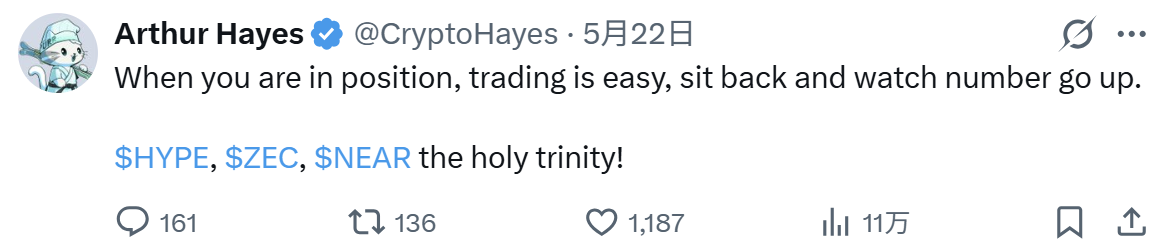
On May 22, BitMEX co-founder Arthur Hayes, in an article, grouped NEAR with HYPE and ZEC in a call for attention, directly igniting market sentiment.

Privacy-Focused Blockchain

Blockchain has long faced the privacy dilemma where 'transparency equals publicity.' The sharp rise of privacy coins like ZEC and XMR has refocused the industry's attention on the privacy sector, leading various protocols, including public blockchains, to start incorporating privacy features.

NEAR was founded in 2018. Its initial core positioning was not AI, but scalability. Its earliest progress primarily revolved around continuously optimizing sharding technology, making it one of the hot 'Ethereum killer' public blockchains at the time.
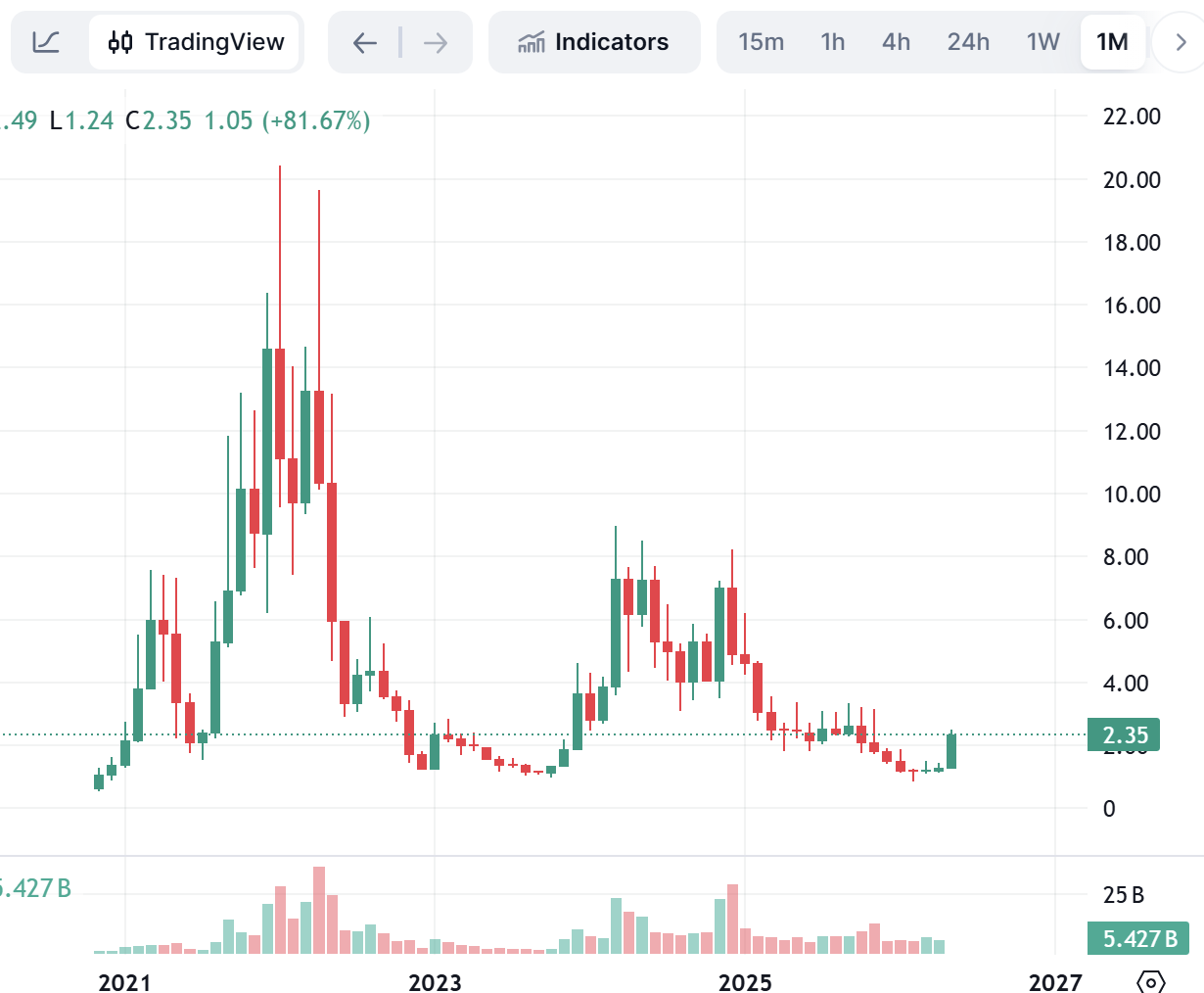
Because of this, NEAR's public sale on CoinList once crashed the latter's website. During the 2020-2021 bull cycle, NEAR soared from $0.5 to a peak of $20.59, becoming one of the most watched star tokens that year.

However, fast-forwarding to this cycle, the vast majority of older tokens and new VC-backed tokens have been shunned by the market. Therefore, even in this bull cycle, NEAR only reached a high of around $9 in 2024 before declining steadily, hitting a low of $0.84 in 2026.

With the official launch of NEAR Intents, privacy requirements have become critically important. Intents are core to cross-chain transactions, allowing users to execute actions simply by expressing intent. However, large on-chain transactions are vulnerable to MEV (Maximal Extractable Value) attacks when public, a significant drawback for institutions, large holders, and ordinary DeFi users alike.

The NEAR team began planning privacy as a crucial complement to Intents. In late May this year, the NEAR Intents team launched Confidential Payments and Confidential Intents features, supporting private cross-chain transfers for assets like ETH, BTC, SOL, and USDC across 35+ chains. The sender, amount, and path are all hidden, with only the result visible on the target chain, utilizing a private shard + TEE (Trusted Execution Environment) bridge at the underlying layer.
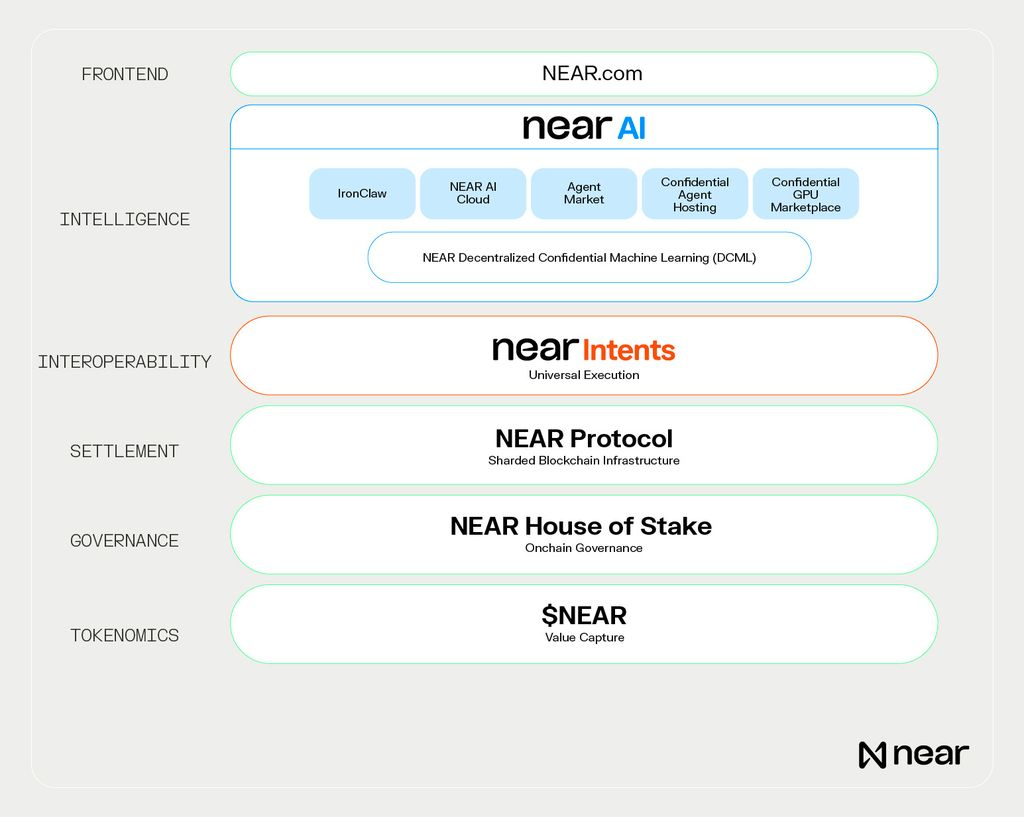
NEAR also opened a privacy mode, where user balances, transfers, and transaction activities are private by default. Whether for ordinary users, enterprise users, or AI agents executing complex strategies, this prevents data leakage. The Confidential Treasuries (Trezu) launched around the same time further supports private multi-signature wallets, payroll, and cross-chain payments, having already processed $68 million in confidential transactions.

Compared to pure privacy coins like Zcash, NEAR's balance between privacy, usability, and cross-chain functionality is more practical, directly addressing enterprise-level demand and driving a recovery in TVL and developer activity.

NEAR Intents Fee Buyback

In October 2025, NEAR completed the unlocking of its final batch of initial supply, bringing its circulating supply close to 100%.
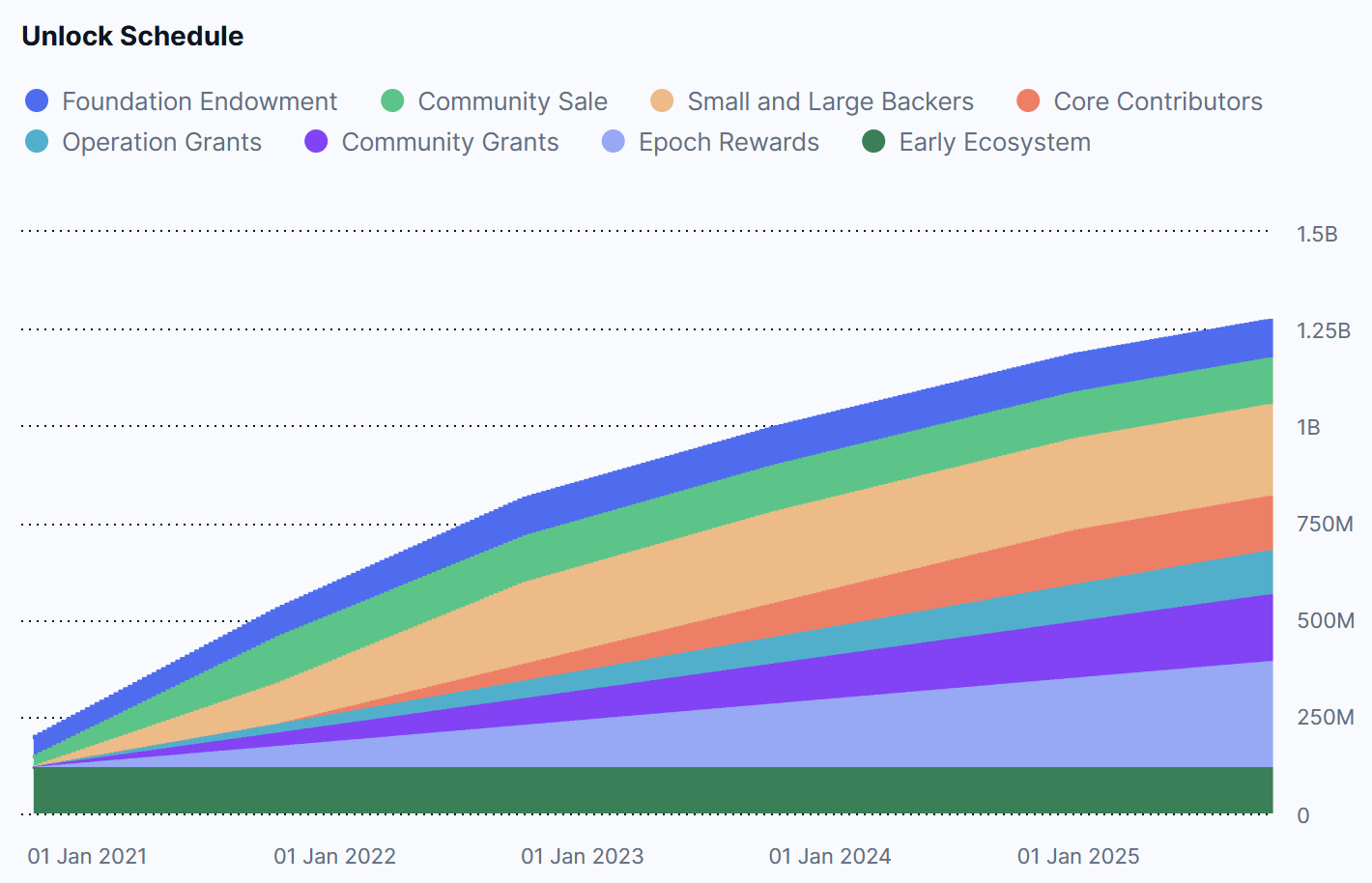
NEAR designed a dual mechanism of inflation + burning from its mainnet's early days: a maximum annual inflation of 5% (permanently halved to 2.5% via an upgrade in October 2025), with 90% going to validators as rewards and 10% entering the protocol treasury. Entering 2026, the project has no major unlock events or linear unlocks remaining, only the regular epoch reward emissions (approximately 5.4 million NEAR released in the last 30 days, about 0.4% of total supply).

In addition, the fee revenue generated by NEAR Intents is used to directly buy back NEAR tokens on the market, also creating significant buying pressure.

NEAR's intent-driven cross-chain transaction layer on the protocol allows users to simply express their desired outcome (e.g., swapping BTC for SOL), and it provides the optimal execution path, supporting multiple chains without the need for bridging/wrapped assets and featuring low fees.

NEAR Intents previously had two fee components: protocol fees and distribution fees (shared with third-party integrators). However, protocol fees now entirely go into the buyback path. The repurchased NEAR isn't necessarily burned immediately; instead, after being bought back, it is staked, locked, or removed from liquidity. It still counts towards the total supply but reduces circulating supply pressure while also earning staking rewards.
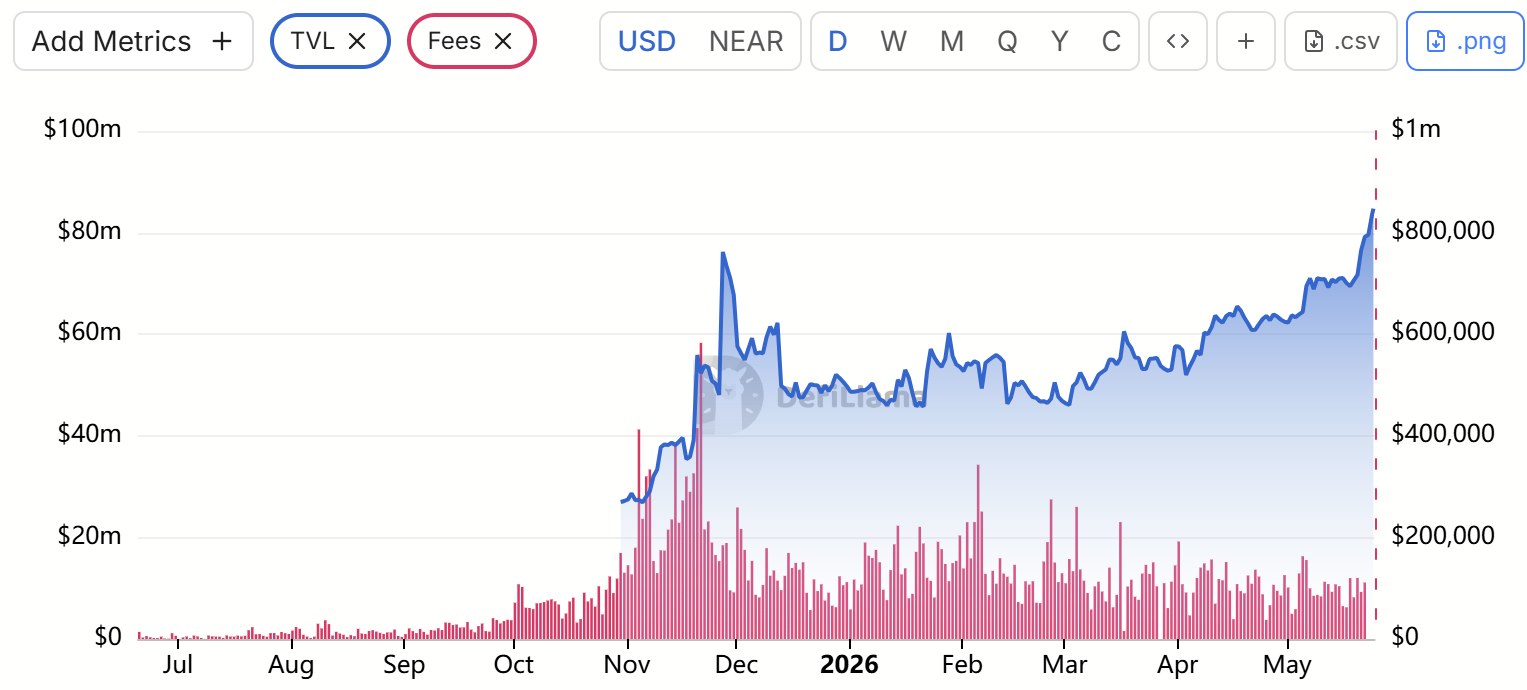
According to the latest data from defiLlama, the TVL of NEAR Intents has exceeded $80 million, with its daily generated fees fluctuating around $100,000, translating to a monthly buyback amount of approximately $3 million.

At the end of this month, its core development team, Near One, also announced the latest technical progress. The team plans to release dynamic resharding by the end of Q2 2026 to significantly enhance scalability. Additionally, the team will introduce NEAR's post-quantum secure signature scheme and perform upgrades in June this year, improving its resistance to quantum computing.

Пов'язані питання

QWhat are the three main catalysts driving NEAR's recent price surge according to the article?

AThe three main catalysts are: 1) AI Narrative, due to co-founder Illia Polosukhin's AI background and NEAR's strategic focus. 2) Privacy Public Chain, through features like Confidential Payments and Intents. 3) NEAR Intents fee buybacks, which reduce circulating supply.

QWho is Illia Polosukhin and what is his significance in the AI field?

AIllia Polosukhin is a co-founder of NEAR. He is one of the eight co-authors of the seminal Transformer paper, which introduced the Transformer architecture that forms the foundation of modern large language models like ChatGPT, Claude, and Gemini.

QWhat specific privacy features did NEAR Intents launch in May, and what problem do they solve?

AIn May, NEAR Intents launched Confidential Payments and Confidential Intents features. They solve the privacy problem for cross-chain transfers by hiding the sender, amount, and transaction path across 35+ chains, protecting users from MEV attacks and data leaks during large or complex transactions.

QHow does the NEAR Intents fee buyback mechanism work and what is its impact?

AFees generated by the NEAR Intents protocol are used to buy back NEAR tokens from the market. These bought-back tokens are then staked, locked, or removed from liquidity. This reduces selling pressure on the circulating supply and creates consistent buy-side demand, with current monthly buybacks estimated around $3 million.

QWhat are the key upcoming technical upgrades mentioned for NEAR in the article?

AThe key upcoming upgrades are: 1) Dynamic Resharding, to be released at the end of Q2 2026, which will significantly improve scalability. 2) A post-quantum secure signature scheme, planned for introduction and upgrade in June of this year, to enhance its resistance to quantum computing attacks.

Пов'язані матеріали

Buyback and Burn: Just Empty Promises? The Unbridgeable Rights Gap Between Tokens and Equity

"Token Repurchase and Burn: An Empty Promise? The Unbridgeable Rights Gap Between Tokens and Equity" Holding company stock grants shareholders residual claim rights - a legally enforceable entitlement to remaining assets after all other obligations are paid. This comes with rights like voting, dividends, and a share in sale proceeds. Crypto protocols have long promised token holders similar benefits: governance participation and a share of future growth. However, this narrative is fundamentally flawed and built on voluntary promises, not enforceable legal rights. The core difference is that token holders lack any legally enforceable claim to a protocol's underlying value or revenues. Common mechanisms like using protocol revenue to buy back and burn tokens are purely discretionary; the team can alter or stop the policy at any time. Token holders have no legal recourse. This rights gap becomes critically apparent when protocols introduce traditional equity alongside tokens, as seen with Venice AI's $65M funding round. Equity investors hold legal contracts with rights to company assets and profits, while token holders' benefits depend entirely on the continued goodwill of the protocol's management. The acquisition of Houdini Swap, where equity holders were paid while token holders received nothing, starkly illustrates this disparity. Upcoming legislation like the CLARITY Act threatens to eliminate the regulatory gray area that has allowed this ambiguous "pseudo-equity" narrative. The Act would classify tokens as either digital commodities (regulated by CFTC) or investment contract assets/securities (regulated by SEC). Protocols aiming for the "digital commodity" classification would be explicitly prohibited from granting token holders any legal claim to corporate revenue, profits, or assets. Promising that tokens will appreciate from protocol profits would likely classify them as securities. Projects like Aave are attempting technical solutions, such as its automated, on-chain "Aavenomics 3.0" buyback mechanism. However, this remains code that the governance body could still vote to change, not an immutable legal contract. The industry faces a clear fork: either acknowledge tokens as digital commodities and stop promising economic rights tied to corporate profits, or formally register tokens as securities and bear the associated compliance burden. The decade-long narrative equating tokens with ownership is built on unenforceable promises. The entry of traditional equity investors with real legal rights exposes this foundational weakness, which may unravel with the next major funding deal.

Foresight News1 год тому

Buyback and Burn: Just Empty Promises? The Unbridgeable Rights Gap Between Tokens and Equity

Foresight News1 год тому

Navigating the World of Event Trading: Top 5 Prediction Markets for Every Type of User

The prediction market industry has grown significantly, with trading volumes exceeding $20 billion monthly by mid-2026, driven by sports, politics, and macroeconomics. Success now depends heavily on platform choice and execution logistics. This guide compares five leading networks: **Polymarket**: A high-volume, decentralized platform on Polygon, using USDC for international and crypto-native users. It offers diverse markets but lacks built-in risk tools. **Kalshi**: A CFTC-regulated U.S. exchange for institutional traders, using direct fiat. It leads in regulated volume, especially for major sports and economic events, but has limited contract listings. **Outpoll**: A CeDeFi platform for advanced traders, focusing on professional tools. It uniquely features built-in stop-loss/take-profit orders, 0.1% fees, and full API support, with settlement in USDC. **OG Predictive**: A CFTC-regulated, sports-focused platform from Crypto.com. It offers granular player props and a flat fee structure, appealing to long-term position traders. **Manifold Markets**: A play-money, no-KYC platform for casual users and developers. It allows user-generated markets on any topic with zero fees, serving as a sandbox for strategy testing. Key differentiators include regulatory models (regulated vs. decentralized), funding (fiat vs. crypto), order types, risk management features, API access, and mobile support. The conclusion emphasizes that in today's event trading, profitability hinges not just on accurate predictions but on optimizing execution through platform infrastructure, liquidity, fees, and risk tools.

TheNewsCrypto2 год тому

Navigating the World of Event Trading: Top 5 Prediction Markets for Every Type of User

TheNewsCrypto2 год тому

Торгівля

Спот
活动图片