Behind NEAR's Doubling: Three Major Catalysts Driving the Token Price

marsbitОпубліковано о 2026-05-26Востаннє оновлено о 2026-05-26

Анотація

NEAR token's price surged from $1.24 to over $2.5 in May 2026, significantly outperforming the broader market. This rally is driven by three key factors: 1) A strong AI narrative, bolstered by co-founder Illia Polosukhin's background as a co-author of the seminal Transformer paper and NEAR's strategic focus on decentralized AI infrastructure. 2) The launch of privacy features like Confidential Payments and Confidential Intents within the NEAR Intents layer, enabling private cross-chain transfers for major assets and addressing MEV concerns. 3) A sustainable tokenomics model with nearly 100% circulation unlocked and a new buyback mechanism where all protocol fees from the growing NEAR Intents ecosystem (with TVL exceeding $80M) are used to repurchase and stake NEAR tokens, reducing sell-side pressure.

Author: Ma He, Foresight News

On May 25, the price of the NEAR blockchain token stood at $2.37. Since early May, NEAR has surged from a low of $1.24 to a high of $2.5, with its market cap returning to over $3 billion. While mainstream crypto assets like Bitcoin experienced volatility, NEAR charted an independent course, emerging as one of the most outstanding performers alongside tokens like ZEC, ONDO, and HYPE. What exactly are the reasons behind its explosive growth?

The AI Narrative

NEAR co-founder Illia Polosukhin is a seasoned figure in the AI field. Illia is one of the eight co-authors of the seminal Transformer paper, alongside others including Ashish Vaswani and Noam Shazeer, who were from Google Brain / Google Research. This paper introduced the Transformer architecture, which relies entirely on attention mechanisms, greatly enhancing parallel training efficiency and model scale. This is the origin of today's mainstream large model frameworks like ChatGPT, Claude, and Gemini.

NEAR has made AI a core strategy from its early days. In February this year, NEAR officially launched the Near.com super-app, integrating cross-chain swaps, privacy tools, and smart contract management into one platform, with built-in AI capabilities supporting autonomous agent application scenarios. In November 2023, Illia officially assumed the role of CEO of the NEAR Foundation, primarily focusing on the core AI narrative.

In May, Nvidia's earnings report spurred a resurgence in the overall AI sector, with NEAR being viewed as a representative of decentralized AI infrastructure, alongside projects like TAO.
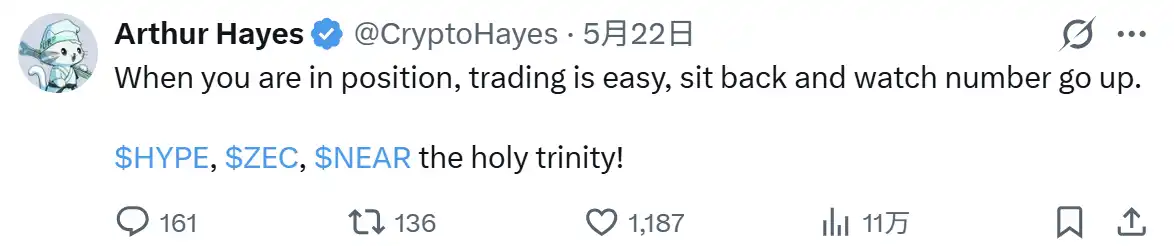
On May 22, BitMEX co-founder Arthur Hayes, in an article, listed NEAR alongside HYPE and ZEC, directly igniting market sentiment.

Privacy-Focused Blockchain

Blockchain has long faced the privacy dilemma of "transparency equals publicity." The surge of privacy coins like ZEC and XMR has refocused industry attention on the privacy sector, prompting various protocols, including public chains, to integrate privacy features.

Founded in 2018, NEAR's initial core positioning was not AI, but scalability. Its earliest progress also centered on continuously optimizing sharding technology, positioning itself as one of the hot "Ethereum killer" public chains of that time.
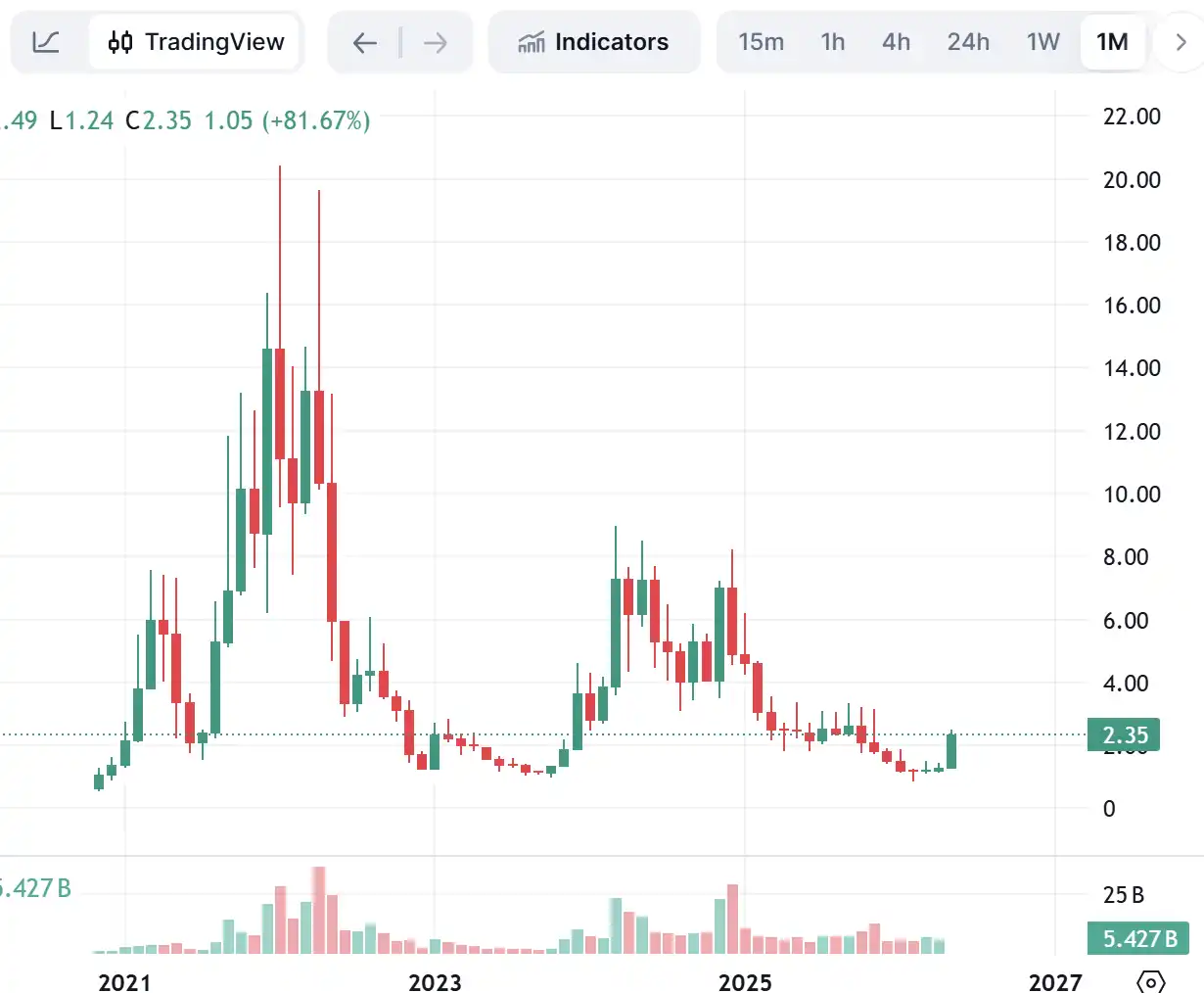
Because of this, NEAR's public sale on CoinList once crashed the platform's website. During the 2020-2021 bull cycle, NEAR skyrocketed from $0.5 to a peak of $20.59, becoming one of the most eye-catching star tokens of that era.

However, fast-forwarding to the current cycle, the vast majority of older tokens and new VC tokens have been shunned by the market. Therefore, even in this bull cycle, NEAR only peaked at $9 in 2024 before declining steadily, hitting a low of $0.84 in 2026.

After the official launch of NEAR Intents, privacy demand became crucial. Intents are core to cross-chain transactions, allowing users to express their intent for execution. However, public on-chain large transactions are vulnerable to MEV (Maximum Extractable Value) attacks, a significant drawback for institutions, large holders, and ordinary DeFi users alike.

The NEAR team began planning privacy as a key complement to Intents. In late May this year, the NEAR Intents team launched Confidential Payments and Confidential Intents features, supporting private cross-chain transfers of assets like ETH, BTC, SOL, and USDC across 35+ chains. The sender, amount, and path are all hidden, with only the result displayed on the target chain, utilizing private sharding and TEE (Trusted Execution Environment) bridging.
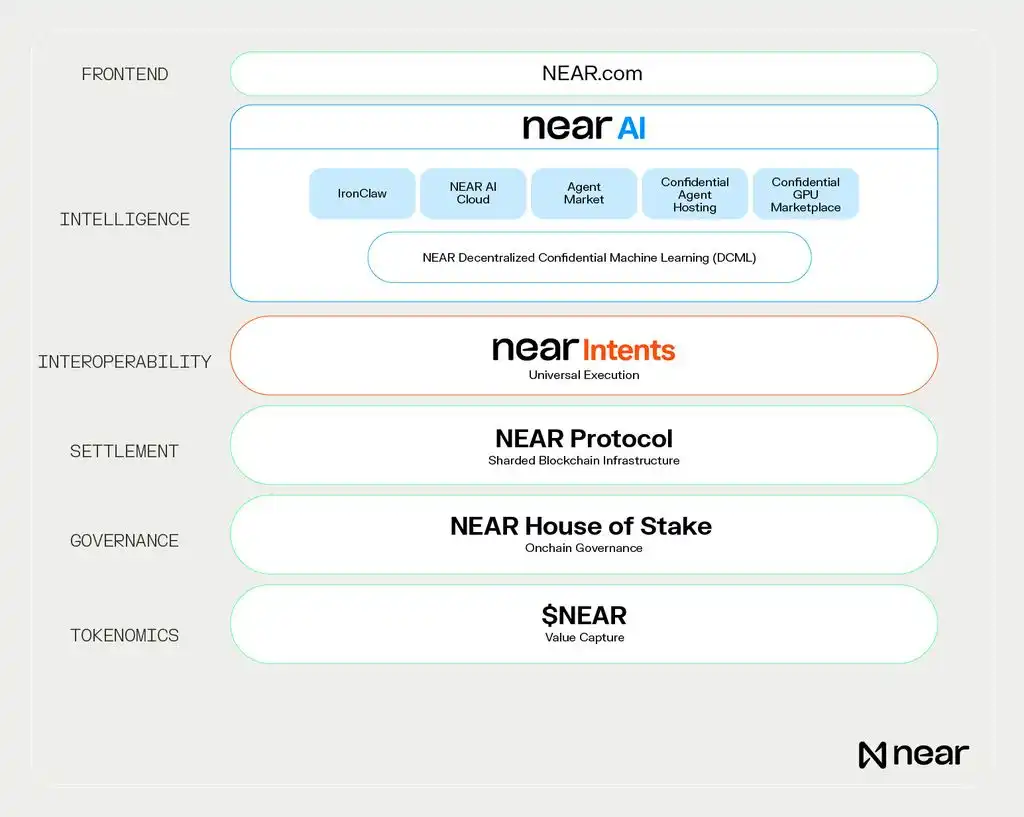
NEAR also opened a privacy mode, where user balances, transfers, and transaction activities are privatized by default. This ensures data doesn't leak, whether for ordinary users, enterprise users, or AI agents executing complex strategies. Concurrently launched Confidential Treasuries (Trezu) further support private multi-sig, payroll, and cross-chain payments, having cumulatively processed $68 million in confidential transactions.

Compared to pure privacy coins like Zcash, NEAR strikes a more practical balance between privacy, usability, and cross-chain capabilities, directly targeting enterprise-level demand and driving a recovery in TVL and developer activity.

NEAR Intents Fee Buyback

In October 2025, NEAR completed the unlocking of the final batch of its initial supply, achieving nearly 100% circulation.
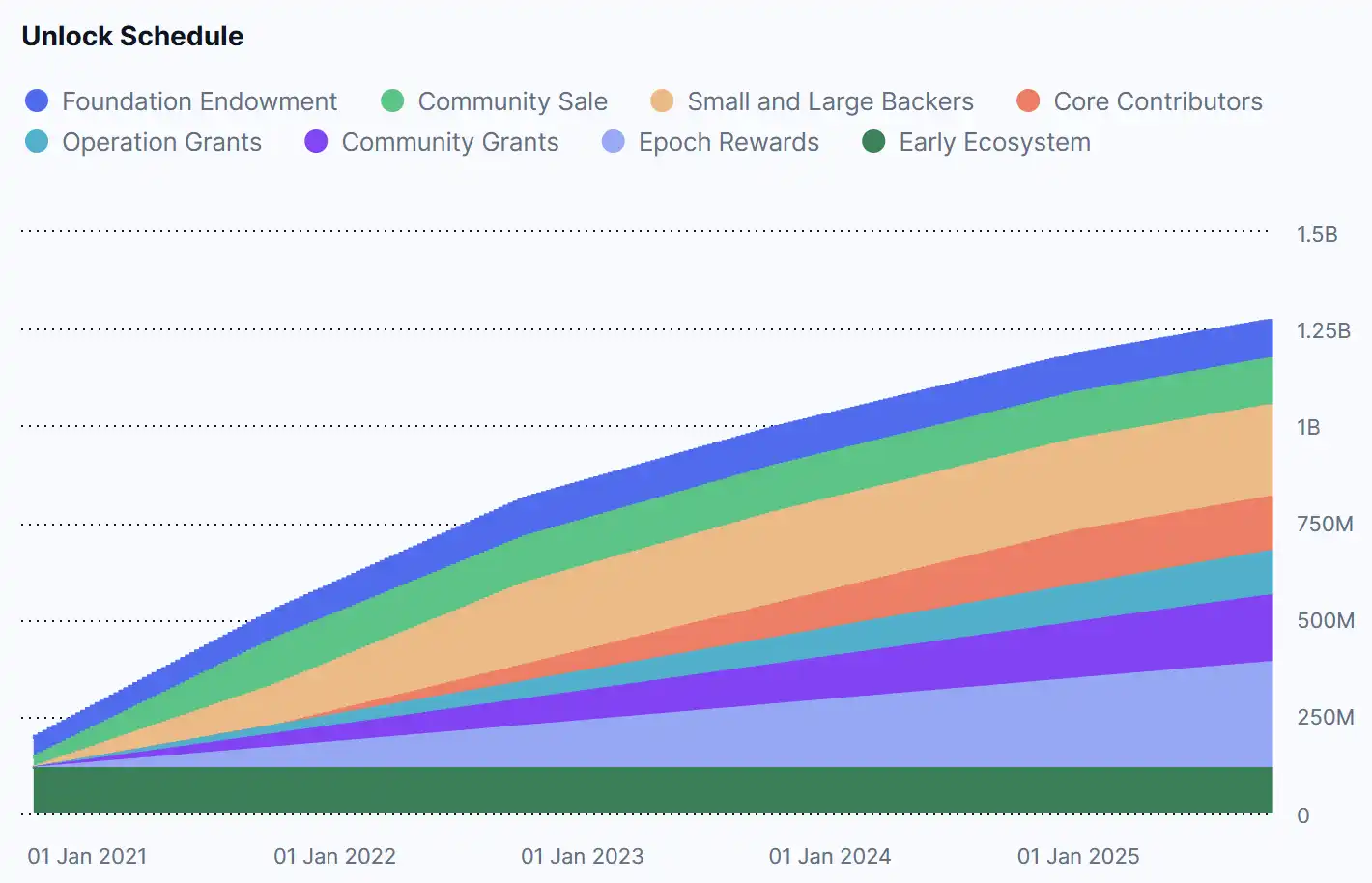
NEAR implemented a dual mechanism of inflation and burning from its mainnet's early days: a maximum annual inflation of 5% (permanently halved to 2.5% via an upgrade in October 2025), with 90% allocated as rewards to validators and 10% going to the protocol treasury. Entering 2026, the project has no more major or linear unlock events, only regular epoch reward emissions (approximately 5.4 million NEAR released in the last 30 days, about 0.4% of total supply).

Additionally, the fee revenue generated by NEAR Intents is directly used to buy back NEAR tokens in the market, providing significant buying pressure.

The Intent-driven cross-chain transaction layer on the NEAR protocol allows users to simply express their desired outcome (e.g., swap BTC for SOL), and it provides the optimal execution path, supporting multiple chains, no bridging/wrapped assets, and low fees.

NEAR Intents previously had two fee components: protocol fees and distribution fees (shared with third-party integrators), but protocol fees now all go through the buyback path. The repurchased NEAR is not necessarily burned immediately; instead, it can be staked, locked, or removed from liquidity after repurchase. While still counted in total supply, this reduces circulating supply pressure and can also generate staking rewards.
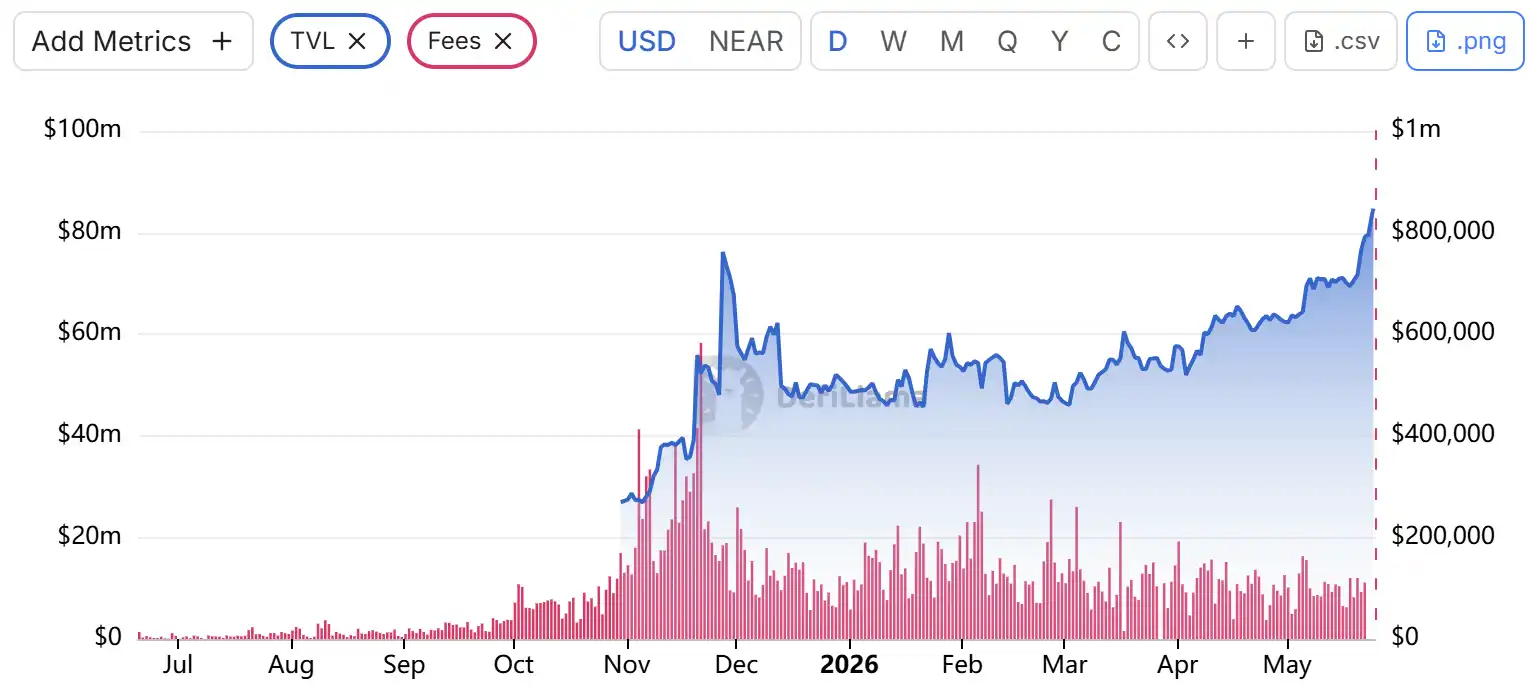
According to the latest data from defiLlama, NEAR Intents' TVL has exceeded $80 million, generating daily fees fluctuating around $100,000, translating to a monthly buyback amount near $3 million.

At the end of this month, its core development team, Near One, also announced the latest technical progress. By the end of Q2 2026, the team will release dynamic re-sharding, significantly improving scalability. Additionally, the team will introduce and upgrade NEAR's post-quantum secure signature scheme in June this year, enhancing its resistance to quantum computing.

Пов'язані питання

QWhat are the three main factors mentioned in the article driving NEAR's recent price surge?

AThe three main factors are: 1) AI Narrative, leveraging the co-founder's AI background and NEAR's strategic focus on decentralized AI. 2) Privacy-Focused Public Chain features, enhancing cross-chain privacy for users and institutions. 3) NEAR Intents fee buyback mechanism, which uses protocol fees to purchase NEAR tokens, reducing selling pressure.

QWho is Illia Polosukhin, and what is his connection to the AI field?

AIllia Polosukhin is a co-founder of NEAR. He is a seminal figure in AI, being one of the eight co-authors of the original Transformer paper from Google Brain/Research. This paper introduced the Transformer architecture, which is the foundation for all major large language models like ChatGPT, Claude, and Gemini.

QHow does NEAR's privacy technology, specifically Confidential Intents, work to protect user transactions?

ANEAR's Confidential Intents and Confidential Payments functions hide the sender, amount, and transaction path during cross-chain transfers of assets like ETH, BTC, SOL, and USDC across 35+ chains. Only the final result is visible on the destination chain. This privacy is achieved using a combination of private sharding and TEE (Trusted Execution Environment) bridging.

QWhat is the NEAR Intents fee buyback mechanism and how does it impact the token's supply?

AThe NEAR Intents protocol uses its fee revenue to buy back NEAR tokens from the open market. These bought-back tokens are then typically staked, locked, or have their liquidity removed. This action reduces the circulating supply and selling pressure on the token, while the staked tokens can also generate yield.

QAccording to the article, what is the current approximate monthly buyback amount driven by NEAR Intents fees?

ABased on data from defiLlama cited in the article, NEAR Intents generates approximately $300,000 in fees per month, which is used for the token buyback program.

Пов'язані матеріали

STRC Breaks Below $95: Why Does It Continue to Depeg? Is There Default Risk?

"STRC Falls Below $95: Why the Persistent Depegging and Is There Default Risk?" The article discusses the recent decline in the price of STRC, a perpetual preferred stock issued by Strategy (MSTR) designed to trade around a $100 par value. As of publication, STRC traded at $94.65, raising market concerns. STRC is described as a high-yield cash flow product, offering an 11.50% annual dividend paid monthly. Its "preferred" status grants it priority over common stock for dividends and in liquidation. Key reasons cited for the price depegging include: 1. **Bitcoin's Price Drop:** MSTR's assets are heavily tied to Bitcoin (BTC), which fell over 21% from its recent high, pressuring all Strategy-related products. 2. **Competitive Pressure:** Rival Strive Asset Management's similar product, SATA, offers daily dividends and has maintained its $100 par value with a ~13% yield. In response, Strategy has proposed changing STRC's dividend frequency from monthly to bi-weekly, pending shareholder vote. 3. **Technical Selling:** A break below $100 may have triggered algorithmic selling and stop-losses, exacerbating the decline. Regarding default risk, the analysis suggests it is currently low. Strategy founder Michael Saylor confirmed the June 2026 dividend rate remains at 11.50% with no cuts or suspensions. The company's massive reserve of 843,706 BTC provides a significant backstop for its obligations. Industry opinions are mixed. Some analysts view the BTC holdings as reliable support for dividends, while critics like Peter Schiff warn of potential dividend cuts leading to price crashes and lawsuits. Others highlight inflation risk and the company's ability to reduce dividends without a formal default. In summary, STRC's drop is attributed to BTC volatility, competition, and technical factors. While immediate default risk appears contained, the product faces challenges from market conditions and competitive dynamics.

marsbit44 хв тому

STRC Breaks Below $95: Why Does It Continue to Depeg? Is There Default Risk?

marsbit44 хв тому

AI Trading Cools, South Korean Stocks Plunge 1.8%, Spot Gold Rises 1%, Bitcoin Dives

A sell-off in AI-related stocks, triggered by Broadcom's disappointing earnings forecast, sent shockwaves through global markets. South Korea's KOSPI led Asia's decline, plunging 1.8% as the risks from concentrated chip stock gains and surging leveraged investments came to the fore. The tech-heavy Nasdaq 100 futures fell 0.5% following Broadcom's 14% after-hours plunge, which signaled a slower-than-expected transition to AI clients. This pullback extended Wall Street's weakness, halting the S&P 500's nine-day rally amid hawkish Fed signals and renewed Middle East tensions. South Korean authorities convened an emergency meeting, pledging "immediate measures" against market volatility and warning of record-high stock margin debt. The adjustment rippled across assets: Bitcoin fell to around $64,000, its lowest since February, while safe-haven gold rose 1% on bargain hunting. Oil prices dipped on Middle East ceasefire news. Market analysts noted the sell-off was driven by profit-taking after massive gains, particularly in chip stocks like Samsung and SK Hynix, which now dominate the KOSPI. Wall Street banks are divided on Korea's outlook, with Goldman Sachs raising its target while Citigroup and others warn of overvaluation and a potential bubble. Bridgewater's Ray Dalio noted that great technological shifts often create bubbles. Meanwhile, Fed officials' hints at potential future rate hikes added to the cautious mood ahead of key U.S. jobs data.

华尔街日报1 год тому

AI Trading Cools, South Korean Stocks Plunge 1.8%, Spot Gold Rises 1%, Bitcoin Dives

华尔街日报1 год тому

Seeking Alpha's Hot Article: Why Might the U.S. Stock Market Crash in June?

In a recent Seeking Alpha article, financial professor and analyst Damir Tokic argues that the US stock market may be poised for a significant crash in June 2026. The core thesis centers on a "mega-bubble" in equities, particularly within the technology sector, which has driven the S&P 500 to near-record valuations, with a Shiller P/E ratio exceeding 40—a level comparable to the 2000 dot-com bubble. Tokic identifies two primary catalysts for a potential collapse. First, he points to unsustainable market exuberance fueled by what he terms the "Trump Stimulus"—massive AI capital expenditure by tech giants, which he believes is politically driven and cannot last. Second, and more urgently, he highlights the escalating Iran war as a critical threat. The ongoing closure of the Strait of Hormuz has created a severe global energy supply crunch. Strategic petroleum reserves are projected to hit critically low operational levels by June, potentially causing oil prices to spike above $200 per barrel and triggering a severe, supply-driven inflationary shock. This scenario, Tokic warns, would force the Federal Reserve's hand. Despite currently maintaining a dovish bias, the Fed would likely be compelled to officially pivot to a hawkish stance at its June FOMC meeting to combat soaring inflation and bond yields. He contends that such a shift—or even a failure to act, which would destroy Fed credibility—could be the trigger that punctures the market bubble. The resulting downturn, he concludes, could rival the bear markets of 2000 and 2008, advising investors to prepare for a major correction.

marsbit1 год тому

Seeking Alpha's Hot Article: Why Might the U.S. Stock Market Crash in June?

marsbit1 год тому

Торгівля

Спот
Ф'ючерси
活动图片