Behind Changxin Technology, Stands a Group of A-Share Companies

marsbitОпубліковано о 2026-05-28Востаннє оновлено о 2026-05-28

Анотація

Changxin Technology, a leading Chinese DRAM (Dynamic Random Access Memory) manufacturer, has passed the review by the STAR Market listing committee, moving closer to an IPO. The company, seeking to raise 29.5 billion yuan, is the first to utilize the new "pre-review mechanism" on the STAR Market, expediting its approval process within five months. As China's largest and most technologically advanced integrated DRAM company, Changxin has achieved mass production of mainstream DDR5 and LPDDR5X products. It holds the fourth-largest global market share and ranks first in China, though it still trails behind industry leaders Samsung, SK Hynix, and Micron in areas like HBM technology. The company reported its first annual profit in 2025, with net profit surging to 24.762 billion yuan in Q1 2026, driven by booming AI-related demand. The IPO has drawn significant market attention due to Changxin's extensive and prestigious shareholder base. This includes state-backed funds like the National Integrated Circuit Industry Investment Fund II, industrial partner GigaDevice, internet giants (Xiaomi, Alibaba, Tencent), and several securities firms and A-share listed companies such as InfoMotion, Shangfeng Cement, and Hefei Urban Construction, which stand to benefit from the listing. The company's founder, Zhu Yiming, a pivotal figure in China's semiconductor industry who also founded GigaDevice, has committed to an unprecedented long-term lock-up of his shares and a massive personal equit...

Source: Cailian Press

Today (May 27), the domestic DRAM (Dynamic Random-Access Memory) leader—Changxin Technology Group Co., Ltd. (hereinafter referred to as "Changxin Technology")—successfully passed the review by the STAR Market listing committee and is about to enter the capital market.
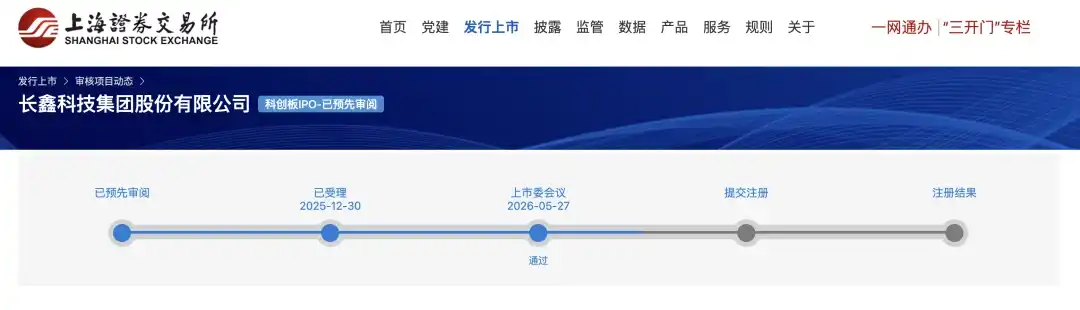
As the first "pre-review" project on the STAR Market and a hard-tech behemoth aiming to raise 29.5 billion yuan, Changxin Technology's passage of the review coincides with its tenth anniversary. This is not only a milestone for the company's own development but also marks a crucial step for China's memory chip industry in breaking the long-term overseas monopoly and moving towards self-reliance and controllability.

From Acceptance to Passing Review: Less Than 5 Months

It took Changxin Technology less than five months from IPO acceptance on the STAR Market to passing the review.

As the first company to apply for listing using the IPO "Pre-Review Mechanism" after the STAR Market reform policy in July 2025, Changxin Technology's listing review process was special and high-priority, significantly shortening the listing cycle while avoiding targeted competition from peers due to early disclosure of business and technical information.

Judging from previous rounds of inquiries by the exchange, concerns primarily focused on three core issues: the industry cycle, technological gap, and sustainability of profitability, all directly addressing the pain points of the DRAM industry and key aspects of the company's development.

In response, Changxin Technology stated in its inquiry replies that the DRAM industry is significantly influenced by market supply-demand fluctuations and exhibits pronounced cyclical characteristics. Furthermore, as the supply side of the DRAM market is highly concentrated, with Samsung Electronics, SK Hynix, and Micron Technology holding the vast majority of market share, their capital expenditures are relatively concentrated. Decisions to add or reduce capacity are often released simultaneously, thereby intensifying the industry's cyclical nature and causing significant volatility in DRAM market prices. DRAM products have a high degree of standardization, and the company sets product prices with reference to market prices. Fluctuations in market prices directly affect the company's product unit prices and revenue, thereby impacting its profits.

Samsung Electronics, SK Hynix, and Micron Technology have developed over several decades, possessing first-mover technological advantages and cost advantages, making them more resilient to risks and market shocks. In contrast, Changxin Technology started its development relatively late and is still in the capacity construction and ramp-up phase. Ramping up production capacity for new production lines typically takes multiple quarters, and building a new wafer fab from capital expenditure to capacity release can take several years. Consequently, at this stage, the company still lags behind international leading manufacturers in terms of revenue scale, production capacity scale, and product portfolio. Not only are its production costs relatively higher, but it is also more prone to negative product gross margins or increased inventory write-downs when market competition intensifies and product prices fall compared to leading manufacturers.

In the 2024 global DRAM market, Samsung Electronics, SK Hynix, and Micron Technology held market shares of 40.35%, 33.19%, and 20.73% respectively. Changxin Technology ranked fourth globally and first in China in terms of global market share.

In its inquiries, the exchange also focused on the technological gap between Changxin Technology and the aforementioned overseas leaders, as well as the progress of industry localization.

Changxin Technology has achieved mass production of DDR5/LPDDR5X, filling the domestic gap for general-purpose DRAM. However, a gap still exists in HBM (High Bandwidth Memory) compared to Samsung and SK Hynix.

Changxin Technology stated that after years of development, it has become China's largest, most technologically advanced, and most comprehensively positioned DRAM research, design, and manufacturing integrated enterprise. It has established product portfolios covering the two major mainstream product series: DDR and LPDDR. Moreover, each series can provide the most advanced DDR5, LPDDR5/5X products currently on the market. Its products are widely used in markets such as servers, mobile devices, personal computers, and smart vehicles. The performance of its main products has reached internationally advanced levels, demonstrating strong product competitiveness.

Starting from the second half of 2025, the AI computing power explosion drove a surge in memory prices, allowing Changxin Technology to achieve its first annual profit turnaround. For the full year 2025, the company achieved a net profit attributable to shareholders of 1.875 billion yuan. By the first quarter of 2026, its net profit attributable to shareholders reached 24.762 billion yuan, with a daily profit exceeding 275 million yuan.

In the SSE's inquiry, Changxin was required to disclose its future profit prospects and uncertainties regarding its future development.

Changxin Technology stated that DRAM, as the core hub of artificial intelligence computing power systems, has seen explosive growth in market demand driven by the rapid development of AI and high-speed growth in related infrastructure investment. This was one of the main reasons for the company's performance growth since the second half of 2025.

However, the performance of companies in the DRAM industry is susceptible to cyclical fluctuations. Represented by Samsung Electronics, SK Hynix, and Micron Technology, these companies started relatively early and, after years of development and accumulation, have built strong scale, product, and technological advantages, equipping them with a certain degree of resilience against cyclical fluctuations.

Nevertheless, Changxin Technology also stated, "As production capacity continues to be released, the company's production capacity scale is rapidly catching up with the top three international manufacturers, and its competitiveness continues to strengthen. Meanwhile, with product sales achieving rapid growth, the company has developed strong resilience against cyclical fluctuations. Therefore, under the current favorable market expectations, the company expects to achieve profitability in 2026 or 2027, which is reasonable and prudent."

Luxurious Shareholder List, Many A-Share Companies May Benefit

Due to the extremely high upfront production and R&D investments required for storage chip manufacturers using the IDM model, Changxin Technology's development has undergone multiple rounds of financing, ultimately forming a large-scale and diverse shareholder base.

Changxin Technology has no controlling shareholder or actual controller. Its largest shareholder is Hefei Qinghui Jidian Enterprise Management Partnership (Limited Partnership), directly holding 21.67% of the company's shares.

Among Changxin Technology's shareholders are state-backed investors such as the National Integrated Circuit Industry Investment Fund Phase II (Big Fund II), Anhui Provincial Investment Group, and Guotiao Fund.

Simultaneously, industrial capital like Gigadevice is deeply bound with it, and internet and consumer electronics giants such as Midea Capital, Xiaomi, Alibaba, and Tencent also appear on the shareholder list.

Furthermore, Changxin Technology's early-stage investors include a host of well-known market-oriented investment institutions such as China Merchants Capital, Legend Capital, An Yuan Fund, Cornerstone Capital, Yanchuang Capital, Lanpu Investment, Yunfeng Capital, Yan Yuan Venture Capital, Mingsheng Capital, Qianhai Fund of Funds, and Huafu Jiaye.

On the eve of Changxin Technology's listing, as several listed companies' affiliated funds had previously invested in Changxin, the market derived a related concept sector for Changxin Technology. Every time its listing progress was updated, from its tutoring filing to the review meeting, it attracted high market attention.

In Changxin Technology's latest prospectus, five brokerages—China Merchants Securities, Huaan Securities, China Securities Co., Ltd., Founder Securities, and China International Capital Corporation Limited—appeared, having invested in Changxin Technology through their subsidiaries or participating funds respectively. Considering that Changxin Technology's market capitalization may reach trillions of yuan upon listing, the book value of these brokerages' equity holdings is expected to significantly boost their net profit figures. Brokerage stocks have also been sought after by market funds due to the progress of Changxin's IPO.

Additionally, since the beginning of this year, several listed companies have disclosed their equity investment ties with Changxin Technology through channels such as investor interaction platforms.

Apart from Gigadevice, multiple A-share companies including Infusion, Shangfeng Cement, Hefei Urban Construction, Hefei Department Store Group, and Zhongshan Public Utilities have successively revealed that they had invested in Changxin Technology through their affiliated private equity funds.

According to an announcement disclosed by Gigadevice in 2024, after participating in Changxin Technology's financing with 1.5 billion yuan of its own funds, its shareholding increased to approximately 1.88% post-investment. Infusion indicated on an interactive platform as early as July 2025 that it had made early-stage investments in Changxin Storage. Infusion is a long-term partner and important supplier of Changxin Storage, cooperating with Changxin's Hefei, Beijing, and Shanghai plants. Shangfeng Cement also stated on an interactive platform in October 2025 that the company invested 200 million yuan in Changxin Technology through the private equity investment fund Shanghai Junzhipu Venture Capital Partnership (Limited Partnership), indirectly holding about 0.15% of the shares.

Zhu Yiming's Hardcore Chip Making and Breakthrough Path

In the wave of domestic DRAM breaking through from being "strangled" to achieving breakthroughs, Zhu Yiming is an unavoidable core figure. He single-handedly founded Gigadevice, turning it into the "first domestic storage design stock," and on the other hand, established Changxin Technology, breaking the nearly four-decade DRAM monopoly of Samsung, SK Hynix, and Micron, making it the world's fourth-largest memory manufacturer.

Born in 1972 into an ordinary family in Funing, Yancheng, Jiangsu, Zhu Yiming came from a modest background but possessed exceptional talent. At 17, he entered the Physics Department of Tsinghua University with the second-highest college entrance examination score in the county, earning his bachelor's and master's degrees within five years, showcasing his technical aptitude.

In 1997, Zhu Yiming went to the United States for further studies, pursuing a master's degree in Electrical Engineering at Stony Brook University, State University of New York. After graduation, he successively worked at ipolicy Networks Inc. and Monolithic System Technologies Inc., rising from a senior engineer to project leader in the industry, with an annual salary of millions and settled in California. However, a comfortable life never eroded his original aspiration. After years of research and experience in the industry, Zhu witnessed firsthand the transfer of the storage industry from the US to Japan, South Korea, and Taiwan, China. He also deeply understood the "stranglehold" situation of China's annual hundred-billion-level chip imports, profoundly realizing that China cannot be "chip-less." "Being chip-less means being soul-less. Without mastering core technologies, the nation's prosperity is built on sand."

In 2004, after accumulating rich experience, Zhu Yiming decided to return to China to start a business, embarking on the path of chip making.

A widely circulated assertion by Zhu Yiming about the storage industry is: If a computer is likened to a crown, the CPU is the jewel on the crown, and the memory is the base of the crown. Naturally, the base requires more gold and jewels. The memory market is the largest in the IC industry; whenever a new process is born, the first thing it makes is memory. As semiconductor processes move into the deep sub-micron era, the proportion of various memory types in integrated circuits gradually increases. Whoever leads memory technology can dominate the entire integrated circuit industry.

In 2005, in a roughcast room at Tsinghua Science Park in Beijing, Zhu Yiming founded "Xin Ji Jia Yi," the predecessor of Gigadevice, with a startup capital of only $920,000. The initial stage of entrepreneurship could be described as a "hellish start." Therefore, in strategic choice, Zhu avoided the crowded DRAM track and chose the relatively niche NOR Flash memory field. Until 2016, Gigadevice was listed on the main board of the Shanghai Stock Exchange, becoming the first domestic memory stock. Today, Gigadevice has grown into the world's second-largest NOR Flash supplier and a leading domestic MCU chip enterprise, with a latest market capitalization of 360 billion yuan.

After what the world saw as "success and fame," Zhu Yiming resolutely turned around, choosing to partner with the Hefei Municipal Government to establish Changxin Technology in May 2016, targeting the DRAM track monopolized overseas, with a total project investment exceeding 50 billion yuan.

In July 2018, Zhu Yiming resigned as General Manager of Gigadevice and took up the positions of Chairman and CEO of Changxin Technology full-time, vowing: "Before Changxin turns a profit, I will not receive a single cent in salary or bonus." For eight years until Changxin Technology achieved its first annual profit in 2025, Changxin continued to incur losses and faced external skepticism that "China cannot make DRAM," but Zhu gritted his teeth and persevered.

In May 2026, as Changxin Technology's STAR Market listing review approached, Zhu Yiming released the largest personal equity incentive plan in A-share history.

The updated prospectus of Changxin Technology shows that Zhu Yiming voluntarily pledged to allocate 50% of his partnership interest in Hefei Jixin Sishiyihao Enterprise Management Partnership (Limited Partnership)—amounting to approximately 768 million shares—to the employees of Changxin Technology and its consolidated subsidiaries over the 10 natural years following the 36th month after Changxin Technology's listing, for employee incentive purposes.

It is noteworthy that the incentive recipients do not include Zhu Yiming himself.

Based on a conservative market estimate of a 2 trillion yuan market capitalization, the incentive value may exceed 20 billion yuan, setting an A-share record for personal equity incentives.

Simultaneously, Zhu Yiming also pledged an ultra-long share lock-up period, promising not to transfer his held shares for the first ten years after Changxin Technology's listing. In the second ten years after the tenth anniversary of the listing, he would sell no more than 20% of the remaining locked shares from the end of the previous year annually. This arrangement of an ultra-long share lock-up period is also relatively rare in A-share history.

An investor familiar with Changxin Technology told the STAR Market Daily reporter that the high-end development of domestic memory has entered a critical stage from breakthrough to volume production, with very broad prospects. Domestic memory enterprises represented by Changxin Technology have already transitioned from followers to runners alongside, and potentially future leaders.

At the technological level, represented by domestically mass-produced DDR5 memory chips entering mainstream server supply chains, domestic DRAM has achieved alignment with international mainstream product generations. At the industrial level, from storage media and chips to systems, China has achieved breakthroughs across the entire chain, with continuously enhancing industrial chain synergy and self-reliance and controllability capabilities. At the market level, AI computing power, data center construction, and the proliferation of smart terminals have created strong and sustained demand pull for high-end memory products such as HBM and DDR5.


Пов'язані питання

QWhat is the significance of ChangXin Technology's recent approval for listing on the STAR Market?

AChangXin Technology's approval marks a milestone as the first company to use the IPO 'pre-review mechanism' on the STAR Market, signifying a major step in China's semiconductor industry towards breaking long-term foreign monopolies and achieving self-sufficiency in DRAM production.

QWho are the major shareholders of ChangXin Technology?

AChangXin Technology's shareholders include state-backed funds like the National Integrated Circuit Industry Investment Fund II, Anhui Investment Group, and Guotiao Fund; industrial capital such as GigaDevice; internet and consumer electronics giants like Midea Capital, Xiaomi, Alibaba, and Tencent; and notable market investment institutions.

QWhat challenges does ChangXin Technology face compared to international DRAM leaders like Samsung and SK Hynix?

AChangXin Technology faces challenges including a later market entry, smaller production scale, higher relative costs, and technological gaps, particularly in HBM (High Bandwidth Memory) compared to leaders like Samsung and SK Hynix. It is also more vulnerable to market cyclical fluctuations and price competition.

QWhat personal commitment did Zhu Yiming make regarding his shares in ChangXin Technology?

AZhu Yiming committed to allocating 50% of his shares in Hefei Jixin Sishiyihao (approximately 768 million shares) to employees of ChangXin Technology and its subsidiaries over ten years after the company has been listed for 36 months. He also pledged an unusually long lock-up period for his remaining shares.

QWhich A-listed companies are expected to benefit from ChangXin Technology's IPO?

AA-listed companies expected to benefit include GigaDevice, Zhenfan Technology, Shangfeng Cement, Hefei Urban Construction, Hefei Department Store Group, and Zhongshan Public Utilities, which have invested in ChangXin Technology through private equity funds. Several securities firms like China Merchants Securities are also shareholders.

Пов'язані матеріали

Conversation with VanEck CEO: Memory Chip Stocks Are a Bubble, Bitcoin Will Stay but Token Ecosystems Will Disappear

In this podcast, VanEck CEO Jan van Eck discusses his investment outlook centered on three key long-term ("10-year macro") themes: AI-driven compute demand, India's economic rise, and excessive government debt in developed nations. Regarding AI and semiconductors, van Eck believes Nvidia has transformed into a foundational "host" for AI infrastructure, possessing deep moats in software, scale, and power efficiency, making it a core holding. However, he views the recent surge in memory chip stocks as a bubble driven by temporary supply-demand imbalances and pricing power, lacking Nvidia's competitive durability. On asset management, he emphasizes that while ETFs are scale-driven tools, the decisions on which ETFs to own and how to allocate remain highly active. He expresses greatest concern over fixed-income market illiquidity and the risk of a loss of confidence in government debt sustainability. Van Eck is bullish on gold's long-term role as a global monetary alternative and highlights the dramatic policy-driven growth in nuclear energy investment. He is strongly positive on India due to its demographic trends and pro-business reforms. Discussing crypto, he labels 2026 the "year of the corporate-controlled chain," where traditional finance adopts blockchain's best features (like 24/7 operation and programmability) but retains control. He predicts a permanent "crypto winter" for many projects, with only Bitcoin, stablecoins, and the core blockchain concept surviving long-term. He sees the U.S. stablecoin bill as marginally impactful, enabling tech firms to compete with, but not replace, banks. Finally, he views the upcoming SpaceX IPO as a significant, positive liquidity event for markets and advises investors to maintain a long-term, macro perspective when making asset allocation decisions.

marsbit12 хв тому

Conversation with VanEck CEO: Memory Chip Stocks Are a Bubble, Bitcoin Will Stay but Token Ecosystems Will Disappear

marsbit12 хв тому

In the Era of Agent Users, Where Does Crypto Value Flow?

Title: Who Makes Money from Agents? The rise of AI Agents as potential blockchain users raises a crucial question: if they become the next billion users, who will capture the value? Traditional crypto value capture theories—like "fat protocols" (where value accrues to the base layer) and "fat applications" (where value accrues to user-facing apps)—assume human users who value UX, brand, and convenience. Agents, however, operate differently: they interact via APIs, have no brand loyalty, and can switch services with near-zero cost. This shift could disrupt existing value flows. Applications might become "headless," offering their routing and infrastructure as APIs to Agents. Alternatively, Agents might bypass intermediaries entirely, allowing protocols to regain value capture ("fat protocols" reborn). A more extreme scenario is that Agents, being purely rational and cost-sensitive, could commoditize the entire stack, compressing margins toward marginal cost and turning crypto into a low-margin utility. However, Agents may not just amplify existing activities; they could enable entirely new ones—like continuous, sub-penny portfolio rebalancing, machine-to-machine commerce, and new market types only viable at automated speeds. This expands the economic pie rather than just redistributing it. Ultimately, the key question for builders is: what will make an Agent return to your service instead of a cheaper alternative? The answer may not be UX but factors like liquidity, latency, settlement guarantees, or a yet-unnamed business model. As humans and Agents will coexist as users, value capture may split: "fat apps" for human-facing services, and a new, evolving model for the Agent-dominated layer.

marsbit42 хв тому

In the Era of Agent Users, Where Does Crypto Value Flow?

marsbit42 хв тому

Base MCP, The Next Step for x402

Base has officially launched Base MCP, allowing users to connect their Base Account to AI Agents to perform actions like swaps, transfers, portfolio tracking, and transaction history queries through conversational commands. This move aligns with Base's strategic focus on AI, driven by the broader competition in the emerging Agent-to-Agent payment sector. The evolution of Agent payments has accelerated. In late 2024, the primary method involved insecure browser automation. By 2025, solutions like Coinbase's x402 (providing crypto wallets for Agents), Google's AP2, and Visa's token-based system emerged. x402 has since processed 176 million transactions totaling over $70 million, with a median value between $0.01 and $0.10. Stablecoins, particularly USDC, dominate these settlements due to their negligible transaction costs compared to traditional payment fees, which are prohibitive for micro-payments. Coinbase faces competition from Stripe, which has built a comparable infrastructure for Agent payments with its Tempo blockchain, Privy wallets, Bridge routing (acquired for $1.1B), and the recently launched MPP protocol. Both companies are now competing at the application layer. The core reason AI is central to Base's strategy is to expand the scenarios for Agent payments, ensuring more transactions occur on its network. By securing a dominant position and scale advantage in this nascent field, Coinbase aims to capture the future commercial potential of Agent-driven payments. The launch of Base MCP is thus a strategic step in this larger ambition.

marsbit48 хв тому

Base MCP, The Next Step for x402

marsbit48 хв тому

Reframing Ethereum's Valuation: Why the Fee Model is Wrong, and the 'Treasury Logic' is the Future?

"Rethinking Ethereum's Value: The 'Vault Logic' Framework" Traditional valuation models incorrectly treat Ethereum as a company, valuing ETH based on transaction fees ("revenue"). This is flawed. Fees are network friction; a successful network aims to reduce them to zero. Ethereum's average fee has dropped from over $50 in 2021 to around $0.20 today, while transaction volume has tripled. Instead, view Ethereum as a digital vault securing ~$250 billion in on-chain assets (stablecoins, RWAs, L2 bridged funds, wBTC, etc.). Post-merge, Ethereum's security is directly purchased with its own asset: ETH. To attack the network, an attacker must acquire and control staked ETH. Therefore, the vault's security level is intrinsically tied to ETH's market value. Currently, the value of all staked ETH is only ~$72B, protecting ~$250B in assets—a dangerous imbalance. For robust security, the staked ETH securing the network should be valued significantly *higher* than the total value it protects. Applying a conservative security multiplier suggests ETH's fair value should be closer to ~$6,900 (vs. ~$2,070 currently). As on-chain asset value grows into the trillions, ETH's price must rise proportionally to maintain this security budget. Comparisons to free infrastructure like Linux or low-margin utilities like the DTCC are misguided. Their security is provided externally (community, law, banks). Ethereum's security is internal and must be purchased in the open market using ETH. ETH is not the clearinghouse; it is the collateral backing it. The model is not a short-term price predictor but a structural framework. The economic force for ETH appreciation grows monotonically with the adoption of Ethereum for settling value. The narrative that high fees are good is backwards; low fees enable more activity, which increases the value needing protection, thus demanding a more valuable ETH.

marsbit55 хв тому

Reframing Ethereum's Valuation: Why the Fee Model is Wrong, and the 'Treasury Logic' is the Future?

marsbit55 хв тому

Justin Sun’s Interview with Hurun Report: A New Order and Certainty for Value Flow in the Era of Transformation

In an interview with *Hurun Report*, Justin Sun, founder of TRON, discussed the evolution of the Web3 industry as it moves from initial exploration to large-scale adoption. He emphasized that the core value of blockchain lies in building an open and inclusive internet of value, enabling anyone globally to transfer and use funds efficiently and at low cost, regardless of location or access to banking. Sun highlighted that projects with lasting impact are those built on genuine demand and real-world usage. He pointed to the stablecoin payment ecosystem as the most mature and scalable application currently, noting that TRON has rapidly become one of the world's largest stablecoin networks. The circulation of USDT on TRON has surpassed $86.3 billion, driven by actual use cases such as cross-border transfers and daily payments, demonstrating strong network effects. Regarding strategy, Sun outlined a methodology combining data-driven iteration, rapid execution, and user-centric focus. He cited the decision to partner with Tether to launch TRC-20 USDT as a key strategic move, based on an assessment of market trends and long-term potential, which has become a significant growth engine for the TRON ecosystem. On globalization, Sun stressed the importance of local compliance and cultural adaptation, noting that success in different markets depends on deep understanding and local partnerships. He also addressed the convergence of AI and blockchain, describing it as a transformative direction where blockchain provides decentralized infrastructure for AI, while AI enhances the intelligence and user experience of blockchain systems. For industry participants and young entrepreneurs, Sun advised continuous learning and adaptability in a fast-changing environment, focusing on building irreplaceable core strengths rather than spreading resources too thinly. Through infrastructure development, global strategy, and technological foresight, TRON aims to advance the practical implementation and evolution of the value internet.

marsbit1 год тому

Justin Sun’s Interview with Hurun Report: A New Order and Certainty for Value Flow in the Era of Transformation

marsbit1 год тому

Торгівля

Спот
Ф'ючерси

Популярні статті

Що таке DOGE M

Doge Matrix ($doge m): Нова порода криптовалюти, що керується спільнотою Вступ У постійно змінюваному ландшафті криптовалюти нові проекти постійно з'являються, кожен з яких прагне привернути увагу інвесторів та ентузіастів. Одним з останніх учасників цього домену є Doge Matrix, представлений тикером $doge m. Цей проект привернув увагу завдяки своїм корінням у популярній культурі мемів навколо Dogecoin, закріплюючи своє місце в просторі web3. Ця стаття має на меті надати всебічний аналіз Doge Matrix, охоплюючи його огляд, творця, інвесторів, функціональність, хронологію та помітні аспекти. Що таке Doge Matrix ($doge m)? Doge Matrix — це проект криптовалюти, що керується спільнотою, який, здається, будує на широкій привабливості Dogecoin, цифрової валюти, відомої своїм маскотом Shiba Inu та мем-походженням. Хоча загальні цілі Doge Matrix не є детально визначеними, він характеризується зобов'язанням залучати участь та підтримку спільноти. На відміну від традиційних криптовалют, які часто підкреслюють корисність або внутрішню цінність через підлягаючі технології, Doge Matrix позиціонує себе в просторі, що охоплює культурне явище криптовалют, особливо приваблюючи тих, хто резонує з етикою активів на основі мемів. Спираючись на сильні сторони спільноти Dogecoin, Doge Matrix працює як частина більш широкої екосистеми, запрошуючи участь та залучення користувачів, які поділяють інтерес до криптовалюти та цифрового простору. Хто є творцем Doge Matrix ($doge m)? Особистість творця Doge Matrix залишається невідомою. Ця відсутність прозорості не є рідкісним явищем у сфері криптовалют, де деякі проекти запускаються без розкриття ідентичностей своїх засновників. Відсутність інформації про засновницьку команду може викликати питання серед потенційних інвесторів щодо відповідальності та напрямку проекту. Хто є інвесторами Doge Matrix ($doge m)? На даний момент немає публічно доступної інформації про інвесторів або інвестиційні фонди, які підтримують Doge Matrix. Проект, здається, покладається переважно на підтримку спільноти, а не на інституційні інвестиції. Ця модель узгоджується з природою ініціативи, що керується спільнотою, сприяючи середовищу, де напрям проекту формується його учасниками, а не диктується вибраними фінансовими спонсорами. Як працює Doge Matrix ($doge m)? Специфіка операційних механізмів Doge Matrix є дещо розмитою, відображаючи ширшу тенденцію проектів у просторі мем-коінів, де інноваційні функціональності не завжди чітко сформульовані. Проте Doge Matrix, здається, розроблений для того, щоб використовувати існуючу екосистему криптовалют, заохочуючи участь користувачів, одночасно використовуючи знайомі культурні посилання, пов'язані з Dogecoin. Його потенційно унікальні характеристики походять від взаємодій у спільноті, а не від технологічних досягнень, підкреслюючи спільний досвід та співпрацю серед власників токенів. Хоча точні інновації не були чітко окреслені, проект, здається, створює простір, де члени спільноти можуть взаємодіяти, ділитися ідеями та просувати потенціал проекту вперед. Хронологія Doge Matrix ($doge m) Розглядаючи хронологію проекту, можна виявити помітні події, які визначили його шлях до цього часу: 25 листопада 2024: Doge Matrix досяг свого історичного максимуму, що стало значною віхою в його ранній історії. 1 січня 2025: Навпаки, Doge Matrix досяг свого історичного мінімуму, ілюструючи волатильність, яка часто асоціюється з криптовалютами, особливо на ранніх етапах життєвого циклу проекту. Триває: Проект продовжує активно торгуватися та підтримуватися своєю спільнотою, хоча конкретні майбутні віхи або цілі ще не були розкриті. Ключові моменти про Doge Matrix ($doge m) Орієнтація на спільноту У центрі Doge Matrix лежить зобов'язання до залучення спільноти. Проект процвітає на основі співпраці та спільних цілей серед своїх учасників, підкреслюючи важливість колективних зусиль. На відміну від централізованих проектів, які часто мають визначену структуру керівництва, Doge Matrix наразі демонструє більш гнучкий підхід до управління, де голос кожного члена спільноти має значення. Волатильність Ринок криптовалют відомий своєю волатильністю, і Doge Matrix не є винятком. Його історія цін відображає значні коливання між високими та низькими значеннями, що є типовим для багатьох нових криптовалют, але підкреслює ризики, пов'язані з інвестиціями в нові токени. Відсутність детальної інформації Однією з найпомітніших рис Doge Matrix є брак детальної інформації щодо його технологічних основ та операційних механізмів. Ця невизначеність вимагає від потенційних інвесторів провести ретельну перевірку перед залученням до проекту. Висновок Підсумовуючи, Doge Matrix ($doge m) ілюструє нову хвилю проектів криптовалюти, які сильно покладаються на залучення спільноти та культурну значущість. Хоча йому бракує певних специфікацій — таких як чітке керівництво, визначені цілі та детальна функціональність — проект зміг викликати інтерес у криптоспільноті, використовуючи вже встановлену привабливість культури мемів. Як і з будь-якими інвестиціями в сфері криптовалют, розуміння вроджених ризиків і проведення всебічного дослідження є важливими для потенційних учасників. Doge Matrix слугує нагадуванням про динамічну, іноді непередбачувану природу криптоіндустрії, що відзначається постійною еволюцією та ентузіазмом щодо ініціатив, що керуються спільнотою.

432 переглядів усьогоОпубліковано 2025.02.03Оновлено 2025.02.03

Що таке DOGE M

Що таке $M

Розуміння Mantis ($M): Нова ера в кросчейн-інтероперабельності У постійно змінюваному ландшафті Web3 та криптовалют нові проекти прагнуть запропонувати інноваційні рішення, спрямовані на покращення користувацького досвіду та розширення функціональних можливостей у рамках децентралізованої фінансової екосистеми. Один з таких проектів, що привертає увагу, - це Mantis ($M), піонерський протокол, заснований на принципах кросчейн-інтероперабельності та угод на основі намірів. Ця стаття розглядає основні аспекти Mantis, включаючи його основну функціональність, творців, інвестиційну підтримку, інноваційні особливості та ключові етапи. Що таке Mantis ($M)? Mantis описується як протокол врегулювання намірів у кількох доменах, який спрощує кросчейн-взаємодії, дозволяючи користувачам безперешкодно виконувати складні фінансові транзакції на різних блокчейн-платформах. Протокол працює через три основні шари: Вираження намірів: Користувачі можуть формулювати свої цілі транзакцій, використовуючи природну мову, що забезпечується DISE LLM, передовою мовною моделлю штучного інтелекту. Наприклад, користувач може висловити бажання обміняти Ethereum (ETH) на Solana (SOL) з певною допустимою похибкою в 1%. Виконання: Цей шар використовує мережу розв'язувачів, які змагаються за виконання намірів користувачів. Транзакції виконуються за допомогою механізмів, таких як Coincidence of Wants (CoWs) та Order Flow Auctions (OFAs), які забезпечують оптимальне задоволення запитів користувачів. Врегулювання: Використовуючи протокол міжблокчейн-комунікації (IBC), Mantis дозволяє атомарні кросчейн-транзакції, що дозволяє користувачам працювати на різних підтримуваних ланцюгах, включаючи Ethereum, Solana та Cosmos. Mantis розроблений для впровадження рідної генерації доходу для бездіяльних активів, використовуючи криптографічні докази для підтримки цілісності транзакцій протягом усього процесу. Творці та команда розробників Mantis був задуманий Composable Foundation, дослідницькою організацією, відомою своїм акцентом на рішеннях для блокчейн-інтероперабельності. Ця організація співпрацює з відомими академічними установами, такими як Гарвардський університет та Університет Лісабона, сприяючи широким дослідженням та розробкам, які формують архітектуру та функціональність Mantis. Зобов'язання Composable Foundation сприяти інноваціям у сфері блокчейн-технологій позиціонує Mantis як надійне рішення для зростаючого попиту на інтероперабельність між кількома блокчейн-мережами. Інвестори та підтримка Хоча конкретні деталі про окремих інвесторів не були публічно розкриті, Mantis користується значною підтримкою від різних суб'єктів, включаючи: Гранти екосистеми від ланцюгів, що підтримують IBC, які підтримують зростання протоколу та інтеграцію в децентралізовані фінансові екосистеми. Стратегічні партнерства з постачальниками інфраструктури, які покращують мережеві можливості Mantis та стратегії впровадження. Фінансування через казну Composable Foundation, що забезпечує стабільну фінансову підтримку для поточних розробок та операційних витрат. Ці спільні зусилля відображають консенсус серед зацікавлених сторін щодо важливості покращення кросчейн-функціональності та потенційної корисності інфраструктурних інновацій Mantis. Ключові інновації Mantis вирізняється кількома піонерськими інноваціями, які покращують його функціональність та корисність: Незалежні від ланцюга наміри: Користувачі можуть ініціювати транзакції з будь-якого підтримуваного ланцюга, при цьому врегулюючи їх на іншому. Ця гнучкість надає користувачам більше можливостей, стимулюючи взаємодію між різними платформами. Інтерфейс на базі штучного інтелекту: Інтеграція DISE LLM дозволяє користувачам виконувати складні DeFi-операції, використовуючи природну мову, що спрощує взаємодію та робить технологію блокчейн доступною для ширшої аудиторії. Захоплення MEV у кросдоменному середовищі: Mantis створює внутрішній ринок для максимального екстракційного значення (MEV) через конкуренцію серед розв'язувачів. Цей інноваційний підхід дозволяє досягати більшої ефективності та екстракції вартості в складних транзакціях. Модульний шар врегулювання: Протокол підтримує різні методи верифікації, включаючи нульові знання та оптимістичні роллапи, забезпечуючи універсальну структуру, яка може адаптуватися до нових блокчейн-технологій. Історична хронологія Розвиток Mantis відзначений кількома критичними етапами, які окреслюють його траєкторію та зростання: | Рік | Етап | |————|————————————————————————-| | 2022 | Початкова розробка концепції в дослідницькому підрозділі Composable Foundation. | | Q3 2024 | Запуск тестової мережі з можливостями мосту між Solana та Ethereum. | | Q1 2025 | Очікувана подія генерації токенів (TGE) разом із запуском основної мережі. | | Q2 2025 | Очікувана інтеграція DISE LLM та розширення кросчейн-можливостей. | | 2025 H2 | Запланована підтримка понад 15 ланцюгів через подальші оновлення IBC. | Ця хронологія окреслює еволюцію Mantis, від концептуальних обговорень до активної реалізації та майбутніх етапів зростання. Стратегія зростання екосистеми Стратегія Mantis щодо зростання екосистеми включає кілька ініціатив, спрямованих на заохочення участі користувачів та залучення розробників: Система кредитів: Користувачі можуть заробляти кредити протоколу, надаючи ліквідність та беручи участь у реферальних програмах. Ці кредити можна буде обміняти на винагороди в майбутньому, сприяючи формуванню сильної спільноти користувачів. Модульний набір для розробки програмного забезпечення (SDK): Цей набір інструментів надає розробникам можливість створювати додатки на основі моделей, що керуються намірами, використовуючи інфраструктуру Mantis, тим самим сприяючи інноваціям у його екосистемі. Модель управління: У міру розвитку протоколу, власники токенів $M отримають можливість брати участь в управлінні протоколом, що дозволить їм голосувати за запропоновані оновлення та зміни, підвищуючи залученість спільноти та децентралізацію. Mantis представляє собою значний прогрес у сфері кросчейн-архітектури. Завдяки безперешкодній інтеграції передових алгоритмів штучного інтелекту з надійною структурою врегулювання, Mantis прагне вирішити проблеми фрагментації в багатоланцюгових екосистемах. Його інноваційний підхід ставить на перше місце покращення користувацького досвіду, дотримуючись основоположних принципів децентралізації та безпеки, встановлюючи новий стандарт для майбутньої інтероперабельності блокчейн-технологій. Оскільки Mantis продовжує свій шлях зростання та реалізації, він обіцяє стати проектом, за яким варто уважно стежити в конкурентному середовищі Web3 та децентралізованих фінансів. Зосереджуючись на подоланні кордонів та підвищенні залученості користувачів, Mantis готовий стати невід'ємною частиною майбутніх розробок у сфері криптовалют.

48 переглядів усьогоОпубліковано 2025.03.18Оновлено 2025.03.18

Що таке $M

Як купити M

Ласкаво просимо до HTX.com! Ми зробили покупку MemeCore (M) простою та зручною. Дотримуйтесь нашої покрокової інструкції, щоб розпочати свою криптовалютну подорож.Крок 1: Створіть обліковий запис на HTXВикористовуйте свою електронну пошту або номер телефону, щоб зареєструвати обліковий запис на HTX безплатно. Пройдіть безпроблемну реєстрацію й отримайте доступ до всіх функцій.ЗареєструватисьКрок 2: Перейдіть до розділу Купити крипту і виберіть спосіб оплатиКредитна/дебетова картка: використовуйте вашу картку Visa або Mastercard, щоб миттєво купити MemeCore (M).Баланс: використовуйте кошти з балансу вашого рахунку HTX для безперешкодної торгівлі.Треті особи: ми додали популярні способи оплати, такі як Google Pay та Apple Pay, щоб підвищити зручність.P2P: Торгуйте безпосередньо з іншими користувачами на HTX.Позабіржова торгівля (OTC): ми пропонуємо індивідуальні послуги та конкурентні обмінні курси для трейдерів.Крок 3: Зберігайте свої MemeCore (M)Після придбання MemeCore (M) збережіть його у своєму обліковому записі на HTX. Крім того, ви можете відправити його в інше місце за допомогою блокчейн-переказу або використовувати його для торгівлі іншими криптовалютами.Крок 4: Торгівля MemeCore (M)Легко торгуйте MemeCore (M) на спотовому ринку HTX. Просто увійдіть до свого облікового запису, виберіть торгову пару, укладайте угоди та спостерігайте за ними в режимі реального часу. Ми пропонуємо зручний досвід як для початківців, так і для досвідчених трейдерів.

493 переглядів усьогоОпубліковано 2025.07.02Оновлено 2025.07.02

Як купити M

Обговорення

Ласкаво просимо до спільноти HTX. Тут ви можете бути в курсі останніх подій розвитку платформи та отримати доступ до професійної ринкової інформації. Нижче представлені думки користувачів щодо ціни M (M).

活动图片