Beginner Hacker's Guide: How to Ace Your First Hackathon

marsbitОпубліковано о 2026-01-13Востаннє оновлено о 2026-01-13

Анотація

A Beginner Hacker's Guide: How to Ace Your First Hackathon This guide provides essential tips for first-time hackathon participants to maximize their learning and success, regardless of winning. Key advice includes: * **Choosing the Right Event:** Start with well-organized hackathons from major companies (e.g., Google, AWS) or on established platforms like DoraHacks for clear rules and valuable feedback. * **Understanding the Rules:** Thoroughly read and adhere to all submission guidelines and judging criteria to avoid disqualification. * **Focus on Quality, Not Just Prizes:** Avoid reusing old projects. Instead, focus on creating something new that genuinely aligns with the hackathon's theme. * **Communicate Early and Often:** Engage with organizers, mentors, and the community on platforms like Discord for clarifications and help instead of working in isolation. * **Learn from Others:** Study past winning submissions on platforms like DoraHacks to understand what makes a project stand out. Network with other participants during the event. * **Perfect Your Demo:** Create a clear, concise 1-3 minute demo video and compelling documentation. Your presentation is as important as the project itself. * **Manage Time Wisely:** Plan your time effectively, delegate tasks in a team, and leave ample time to prepare your final submission. * **Keep Building:** View the hackathon as a starting point. Whether you win or not, continue to develop your project, learn from...

Ready to sign up for your first hackathon? Maybe you're a college student looking to build something cool over the weekend, or an indie developer exploring new tech and meeting like-minded people. Whatever the case, welcome! You're about to experience one of the best ways for developers to learn, create, and grow.

But most beginners don't realize this: the people who get the most out of a hackathon aren't necessarily the ones who win prizes. Prizes are great, but the skills, portfolio projects, and connections you gain have a much longer shelf life.

This guide will help you avoid common beginner pitfalls so you can walk away with a full load of gains, whether you win or not.

1. How to Choose Your First Hackathon and Platform

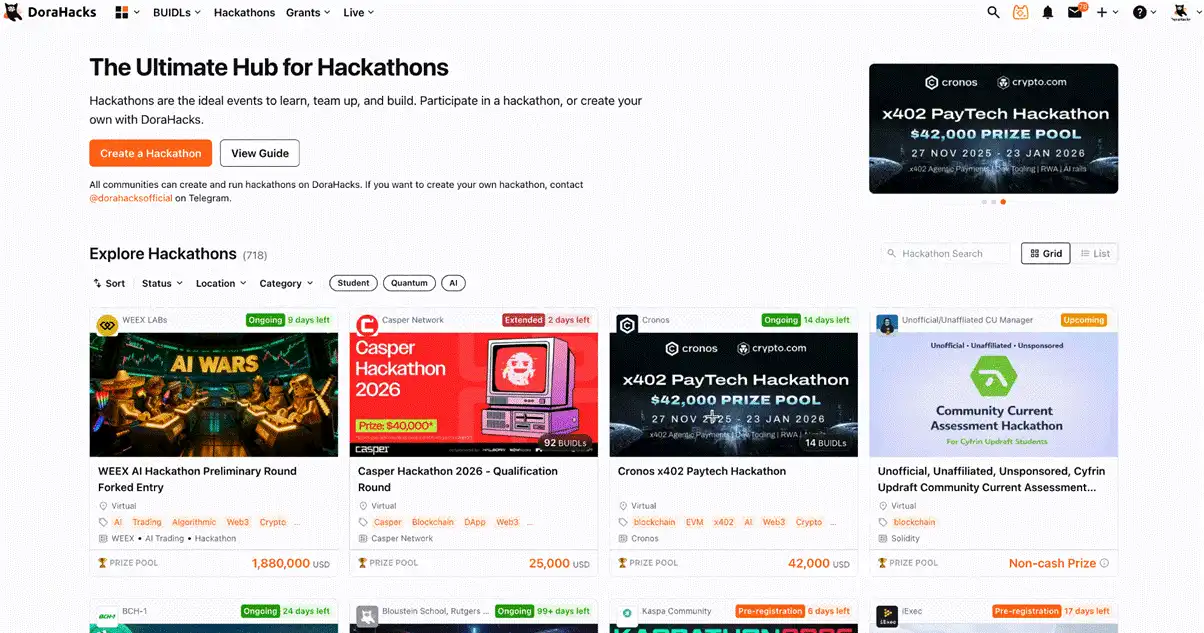
Not all hackathons are created equal. As a beginner, it's recommended to start with events hosted by large companies, such as Google or AWS's AI-themed hackathons, or events from major crypto tech companies like Circle or Binance. These hackathons have clear rules, responsive organizers, and judges who provide valuable feedback (and yes, the rewards are usually quite generous).

A reliable platform can help filter out the noise. DoraHacks is one of the world's primary hackathon platforms. Thanks to the trust of hackers and the industry, DoraHacks consistently collaborates with leading enterprises and communities to host hackathons in various tech fields like AI and blockchain. The platform's reputation means both organizers and participants have a basic quality guarantee. Furthermore, the platform archives hundreds of thousands of past projects; you can research before competing and learn from previous winners (more on that later).

Be cautious of smaller platforms or hackathons with vague information—your time is precious, so spend it on competitions that respect that.
2. Treat the Rules as Your Lifeline (This is Crucial for Your Submission)

This might sound obvious, but you'd be surprised how many excellent projects get disqualified for not following the rules. Before writing your first line of code or description, thoroughly read the rules. Understand exactly what details to submit and in what format.

Pay attention to eligibility requirements; check submission materials like demo videos, GitHub repositories, or any documentation; note any restrictions; and understand the judging criteria.
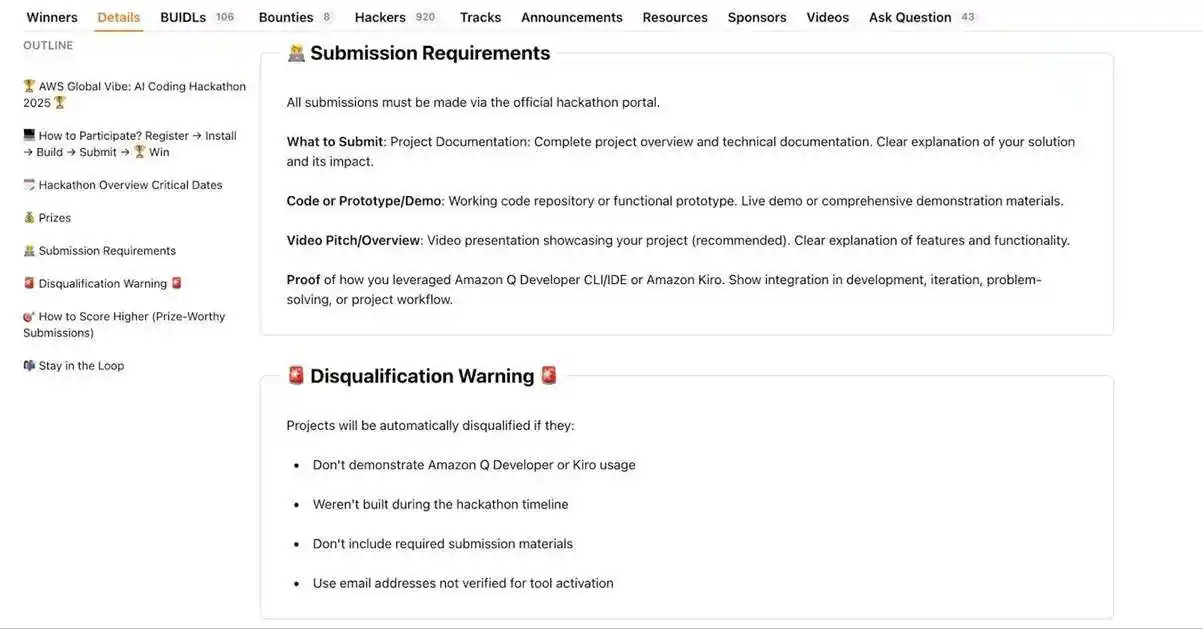
Rules for the 2025 AWS AI Vibe Coding Hackathon

The rules aren't red tape; they're a contract between you and the organizers. Following them not only shows professionalism but also ensures your efforts are judged fairly.

3. Don't Be a "Bounty Hunter"

Tempted to submit the same project to every hackathon hoping to get lucky? Stop. Organizers and judges can easily spot recycled, off-topic projects, and these submissions usually don't fare well.

Most hackathons have themes for a reason. Even if there's an "open track," judges will still evaluate how well your project aligns with the hackathon's goals. Submitting an unrelated dating app at a blockchain hackathon won't be a good fit, no matter how polished it is.

Instead of spreading yourself thin across ten unrelated competitions, focus on a few that genuinely match your interests and skills. You'll produce better work and make a stronger impression on judges and sponsors who actually care about these issues.

4. Communicate Early and Often

Many beginners treat hackathons like an exam—heads down, no talking, figure it all out alone. This is a big mistake. Good hackathons have organizers, mentors, and community channels specifically to help you succeed. Use them!

If the rules are unclear, ask for clarification before going down the wrong path. If you hit a technical snag, reach out to a mentor or post in the community Discord. If you're unsure if your idea fits the theme, check with the organizers early; don't wait until judging to find out. For example, on DoraHacks, you can message the organizers directly.

Don't struggle alone when help is readily available.
5. Learn from Other Hackers

One of the most underrated benefits of hackathons is the opportunity to learn from other participants. You're surrounded by people solving similar problems with different approaches, skill levels, and perspectives.

Studying past projects is one of the fastest ways to improve. On DoraHacks, you can browse a vast archive of past projects (like this one), filter by category, and see exactly what winning teams submitted. Watch their demo videos, read their project pages, and observe how they present their ideas. Notice what makes top projects stand out: a clear problem statement, a polished demo, strong alignment with the theme. Equally important: observe what weaker projects lack so you can avoid the same pitfalls.

During the competition, interact with other participants too. Share your progress, ask what others are working on, and don't be afraid to give or receive feedback. The hacker community is generally very supportive; today's competitor could be your collaborator or co-founder tomorrow.
6. Submit a Great Demo

A great project with a poor presentation often loses to a decent project with an amazing demo. Judges have limited time and dozens of submissions to review. Make it easy for them.

Your written description is crucial: use clear language, logical flow, and don't assume judges have background information you haven't provided. Screenshots, diagrams, and links to a working demo all make your submission stronger.

Keep your demo video concise and clear: explain the problem you're solving, show how your solution works, highlight what's unique—aim for 1 to 3 minutes total, unless the rules specify otherwise.
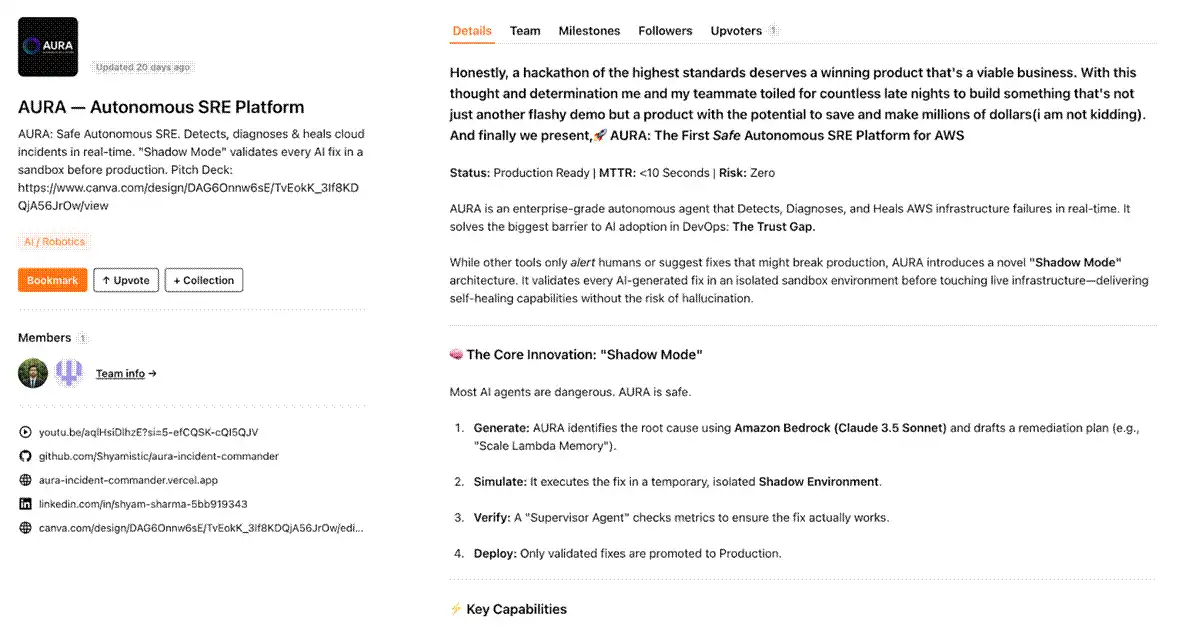
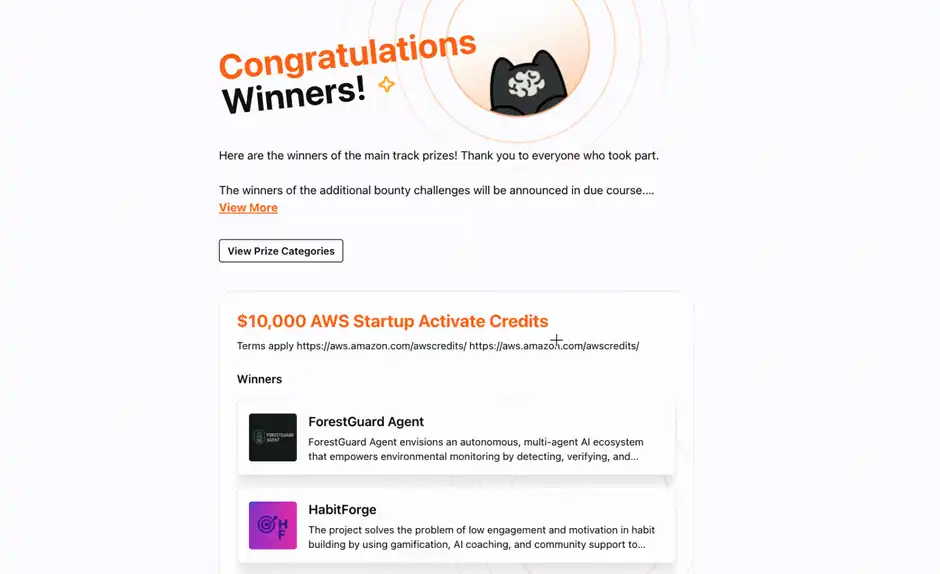
An example of a winning project on DoraHacks

Treat your submission like a pitch. You're not just showing what you built; you're convincing the judges why it matters.

7. Manage Your Time Wisely

Hackathons have deadlines, and they arrive faster than you think. Poor time management is the most common reason potentially great projects end up with incomplete submissions.

Always reserve time for submitting your materials. Recording the demo video, writing documentation, packaging everything up—these take longer than you think. Don't wait until the last minute.

If you're on a team, define roles clearly. Working in parallel is efficient only if everyone knows their responsibilities.

8. Accept the Outcome and Keep Building

Hackathons are competitions, and competitions have winners and losers. You might give it your all and walk away empty-handed. It stings, but it's completely normal.

The difference between a successful hacker and a frustrated one is how they respond. If you don't win, ask yourself what you learned. If the idea is solid and you keep iterating seriously, opportunities will find you. Many successful projects didn't win their first hackathon either but found their moment through continuous improvement.

The hackathon ends, but your work doesn't have to. If the project has potential, keep developing it. Hackathon projects are excellent portfolio pieces, and continued progress shows potential employers or investors that you're serious.

Countless amazing projects are born at hackathons and then disappear forever. The excitement fades, life gets busy, and that brilliant idea never gets another commit. Don't let that happen to you.

Celebrate the wins, learn from the losses, and then keep competing. In the long run, persistence matters more than luck.

Conclusion: Play the Long Game

Your first hackathon is just the beginning. You'll make mistakes, learn lessons, and probably wish you'd done some things sooner. That's okay; everyone starts from zero.

The people who get the most out of hackathons treat each one as a step in a longer journey. They accumulate skills, expand their network, and build a track record of consistent participation and delivery. Over time, victories come not from luck but from becoming stronger.

So, find a hackathon on DoraHacks that excites you, read the rules, chat with the organizers, learn from others, and keep creating. Leave the rest to time.

Happy hacking!

About DoraHacks

DoraHacks is a leading global hackathon community and open-source developer incentive platform. DoraHacks provides a toolkit for all parties to empower them to organize hackathons and fund early-stage ecosystem startups.

DoraHacks is committed to driving a global hacker movement in Web3, AI, quantum computing, and space technology. To date, over 30,000 startup teams have received more than $300 million in total funding through the DoraHacks community. Numerous open-source communities, enterprises, and technology ecosystems are actively utilizing DoraHacks and its BUIDL AI capabilities to organize hackathons and provide financial support for open-source initiatives.

Website | Twitter | Discord | Telegram | Binance Live | Youtube

Пов'язані питання

QWhat is the most important thing to do before writing any code for a hackathon?

ARead the rules thoroughly to understand submission requirements, format, eligibility, and judging criteria.

QWhy should new hackers avoid being 'prize miners'?

ASubmitting the same project to multiple unrelated hackathons is easily spotted by judges and usually results in poor outcomes due to lack of relevance to the theme.

QWhat is a key benefit of studying past projects on platforms like DoraHacks?

AIt is one of the fastest ways to learn what makes winning projects successful, such as clear problem statements, polished demos, and strong theme alignment.

QWhat is a crucial element for a successful project submission that many beginners overlook?

AA good demo, including a clear and concise 1-3 minute video that explains the problem, shows the solution working, and highlights its unique value.

QWhat should a hacker do if their project doesn't win a hackathon?

ALearn from the experience, ask what was gained, and continue building and iterating on the project, as persistence is more important than luck in the long run.

Пов'язані матеріали

Must-Watch Events Next Week|CLARITY Act Could Face Senate Vote; SpaceX, Circle to Report Earnings (8.3-8.9)

**Summary: Key Events and Developments to Watch (August 3-9)** The upcoming week is marked by significant financial disclosures, key legislative deadlines, and notable product updates. **Major Financial Events:** Several companies are scheduled to release their Q2 2026 earnings. American Bitcoin (ABTC) will report on August 3, followed by SpaceX and Hut 8 Mining Corp. on August 4, and Circle on August 5. Notably, a significant portion of SpaceX shares (up to 12% of total shares) will be unlocked on August 6 following their earnings release. **Key Legislative Deadline:** The U.S. Senate faces an August 7 deadline to secure 60 votes for the CLARITY Act, a bipartisan bill aiming to establish a federal regulatory framework for cryptocurrencies. The Senate may hold a full vote on the bill during the week. **Economic Data:** The U.S. July Non-Farm Payrolls report will be released on August 7, providing crucial labor market data. **Technology & Product Updates:** * **Shutdowns:** DeFi portfolio tracker Zapper and wallet app Ctrl Wallet will cease operations on August 3. * **Upgrades:** LayerZero will deprecate its v1 relayers on August 3. XRP Ledger's new version 3.3.0, featuring five new functions, is expected next week. * **AI:** Elon Musk announced that the advanced Grok 4.6 AI model is set for release around August 7. * **Bitcoin:** The BIP-110 forced signaling for a potential Bitcoin network change is scheduled to begin around August 8. **Other Notable Events:** Chinese robotics firm Unitree Tech has set its preliminary price inquiry for its IPO for August 5. South Korean exchange Upbit will delist AQT and AERGO tokens on August 3.

marsbit4 хв тому

Must-Watch Events Next Week|CLARITY Act Could Face Senate Vote; SpaceX, Circle to Report Earnings (8.3-8.9)

marsbit4 хв тому

Stocks Are Plummeting More Sharply Than Cryptocurrencies. Where Has the Money Gone?

Stock Markets Plunge Deeper Than Cryptocurrencies: Where Did the Money Go? In late July, Seoul's Kospi index triggered circuit breakers for two consecutive days, plummeting over 40% from its June high. The collapse was led by heavyweight stocks like SK Hynix, whose record profits still disappointed investors, and devastating leveraged ETFs, with one major product losing over 83% of its value. This signaled a global, forced deleveraging targeting the most crowded trades. Interestingly, while stocks exhibited extreme volatility akin to crypto markets, Bitcoin rose nearly 15% in July after a prior steep drop. Analysis shows the money fleeing equities did not flow into Bitcoin. Instead, Bitcoin had already absorbed its sell-off in May-June, when U.S. spot Bitcoin ETFs saw historic outflows. The true safe-haven beneficiary was gold, whose price rose over 20% year-on-year, highlighting a decoupling between Bitcoin and gold as "digital gold." The sell-off was a targeted unwinding of leveraged positions in tech and semiconductors, accelerated by broker-dealer risk management and shifts in the AI narrative, including new competition from Chinese memory chipmakers. The retreat path was clear: from high-valuation tech stocks to cash and U.S. Treasuries, then to gold. For Bitcoin to attract sustained institutional inflows, conditions like eased global liquidity pressure, a "soft-landing" Fed rate cut, and U.S. regulatory clarity via legislation like the stalled CLARITY Act are needed. Currently, Bitcoin is not a safe haven but an already-cleared asset. Its low correlation with tech stocks, however, makes it a potential diversification play for institutional portfolios once the storm passes. The money isn't here yet, but the positioning is underway.

marsbit4 хв тому

Stocks Are Plummeting More Sharply Than Cryptocurrencies. Where Has the Money Gone?

marsbit4 хв тому

In Conversation with Ray Dalio: We Are Currently in an AI Bubble, with 1% of My Portfolio in Bitcoin

Ray Dalio, founder of Bridgewater Associates, warns in an interview that the current AI boom shows classic bubble characteristics, which could lead to significant economic downturns as seen in past cycles like 1929 or 2000. He explains that speculative enthusiasm, fueled by debt and overvaluation, often precedes a crash when rising rates or taxation force asset sales, causing widespread losses and recession. Dalio also outlines his "Big Cycle" theory, describing an approximate 80-year pattern where widening wealth gaps, massive government deficits, and shifting geopolitical power (like China's rise) create internal conflict and global instability. He emphasizes that we are in a late-cycle, transitional phase where traditional powers like the US and UK face decline. For personal wealth protection, Dalio advises diversification beyond cash into assets like stocks, bonds, real estate, and particularly gold, which he prefers over Bitcoin. While he holds about 1% of his portfolio in Bitcoin as a non-printable hard asset, he views gold as more secure from technological or governmental threats. Regarding AI's impact, Dalio believes it will disproportionately benefit capital owners, worsening inequality by replacing both physical and cognitive labor. He suggests that human intuition and emotional intelligence, combined with AI, will be key for future workers. On taxation, Dalio argues that wealth taxes are impractical and risk triggering asset sell-offs, reducing productive investment. He points to the UK as a cautionary example of debt, low productivity, and political strife. Geopolitically, Dalio foresees a more regionalized world, with the US showing weakness in prolonged conflicts like with Iran, akin to past imperial declines. The ideal outcome, he suggests, is coexisting powerful blocs (e.g., Americas, China-Asia Pacific) without major war.

marsbit3 год тому

In Conversation with Ray Dalio: We Are Currently in an AI Bubble, with 1% of My Portfolio in Bitcoin

marsbit3 год тому

Daily 7.2 Trillion KRW: Foreign Capital's Record Net Buying on Friday! Wall Street Says Headwinds for Korean Stock Fund Flows Have Subsided

South Korean stock market sees a dramatic shift in fund flows. On July 31, foreign investors made a record net purchase of approximately KRW 7.2 trillion in KOSPI stocks, marking a fundamental reversal from the persistent large-scale net outflows seen in previous months. This contributed to a significant narrowing of foreign net selling in July to KRW 9.8 trillion, down sharply from KRW 48.4 trillion in June and KRW 44.5 trillion in May. Simultaneously, domestic institutional pressure eased. South Korean pension funds and asset managers turned to a net buying position in July, purchasing KRW 1.0 trillion worth of KOSPI shares, contrasting with net sales in May and June. Market volatility is expected to be dampened by new financial regulations. Effective July 31, the Financial Services Commission tightened access for retail investors to single-stock leveraged ETFs by raising the minimum cash deposit requirement. Trading volumes for these products subsequently dropped to about 50% of their monthly average. Citigroup Research maintains its year-end KOSPI target of 10,000 points. The firm cites several supportive factors: the substantial easing of headwinds from capital outflows, a robust fundamental outlook for the semiconductor sector, historically low market valuations, strong economic fundamentals, and the potential for policy support from financial authorities if needed.

marsbit3 год тому

Daily 7.2 Trillion KRW: Foreign Capital's Record Net Buying on Friday! Wall Street Says Headwinds for Korean Stock Fund Flows Have Subsided

marsbit3 год тому

Торгівля

Спот
活动图片





