Bear Market Signal Triggers 70%! BofA Advises Taking Profits, Current U.S. Stocks Resemble '1 Month Before the 2000 Bubble Burst'

marsbitОпубліковано о 2026-06-09Востаннє оновлено о 2026-06-09

Анотація

US Bank of America issues a stark warning, triggering 70% of its bear market signals and suggesting investors take profits, drawing parallels to the market peak one month before the 2000 dot-com bubble burst. The warning follows a sharp sell-off in tech stocks, with the Philadelphia Semiconductor Index posting its worst day since March 2020. BofA's quantitative chief notes excessive speculation, with high-P/E stocks outperforming and stretched valuations. The tech sector's internal dispersion, with a ~120 percentage point median return gap between top and bottom performers, mirrors levels seen in February 2000. However, Morgan Stanley and Citi remain bullish, citing strong earnings revisions and macroeconomic data, advising clients to buy the dip. While BofA acknowledges current tech fundamentals are stronger than in 2000, it highlights deteriorating trends like plateauing cash flow conversion and rising capital intensity among cloud giants.

Source: Wall Street News

A clear divergence has emerged on Wall Street following the sharp decline in U.S. tech stocks. Bank of America issued a warning, stating there are "too many danger signals" in the market and advising investors to take profits; while institutions such as Morgan Stanley and Citigroup remain bullish, recommending buying on dips.

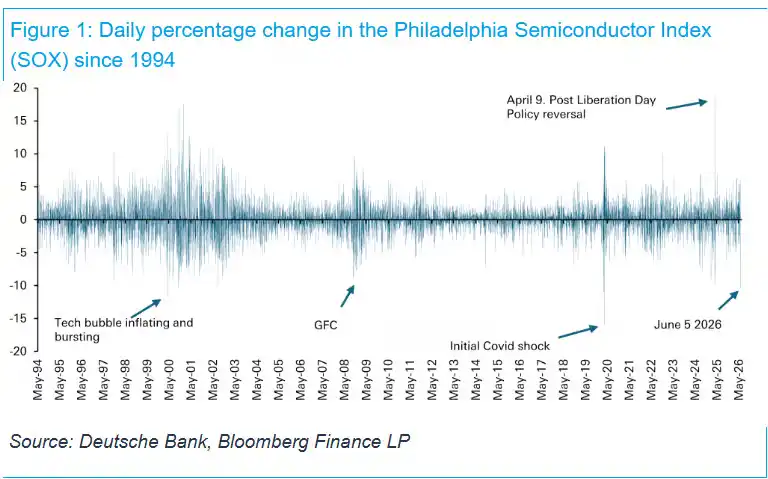
The Philadelphia Semiconductor Index plummeted over 10% last Friday, marking its largest single-day drop since March 2020 and the fourth-largest single-day decline since data records began in 1994. Strong U.S. employment data pushed bond yields higher, increasing market bets on the Fed's next move being a rate hike, further dampening risk appetite. (Related Reading: Seeking Alpha Hot Article: Why U.S. Stocks Might Crash in June?)
Savita Subramanian, Head of U.S. Equity & Quantitative Strategy at Bank of America, promptly released a report, stating "Too many danger signals, take profits," maintaining the year-end target for the S&P 500 at 7,100 points, implying approximately 6% downside from last Friday's close.

Despite this, Morgan Stanley strategist Mike Wilson maintains his forecast for the S&P 500 to reach 8,000 points by year-end, while a team led by Citigroup strategist Scott Chronert raised their year-end target price from 7,700 to 8,100 points. Both institutions cited strong corporate earnings growth and supportive macroeconomic data as their primary arguments.

These two diametrically opposed judgments leave investors facing a directional choice after the tech sell-off: whether to buy the dip or lock in profits before market volatility intensifies.

Bank of America: Bear Market Signals Triggered at 70%, Reaching Historical Peak Levels

The core basis for Bank of America's warning this time is the bank's quantitative signal system tracking bear market precursors. According to Subramanian's report, seven out of the ten monitored indicators have now been triggered — two new in May, five triggered in April, and four in March — reaching a trigger ratio of 70%, comparable to the average level before the seven S&P 500 market tops since 1990.
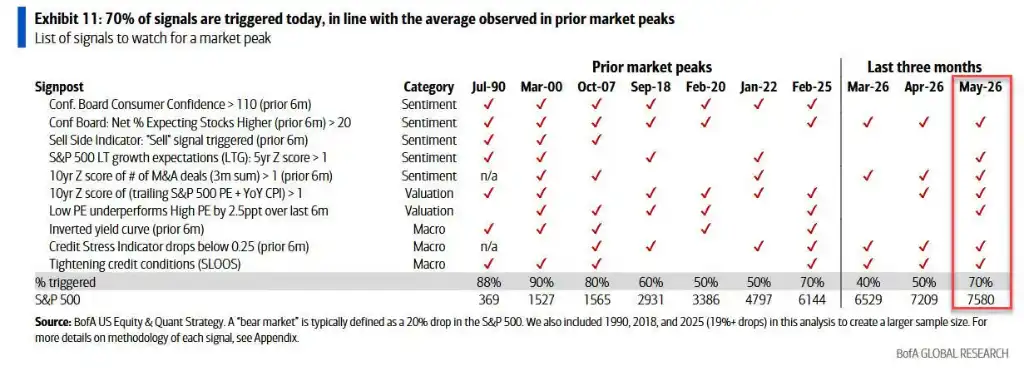
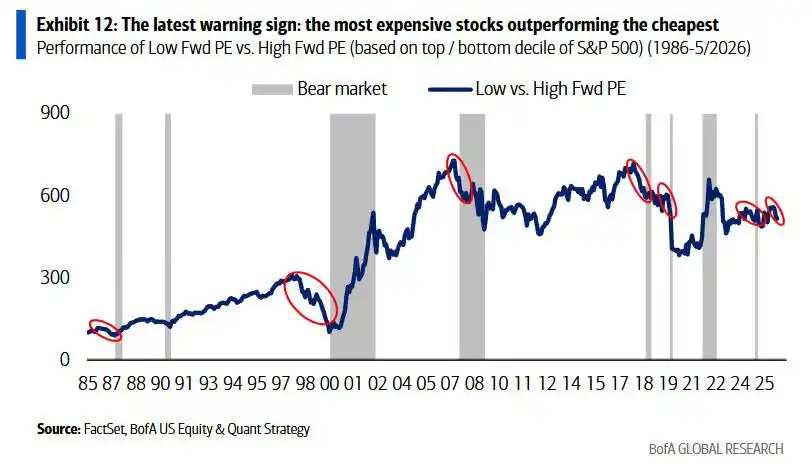
Two of the most recently triggered signals are particularly noteworthy: first, high-P/E stocks significantly outperforming low-P/E stocks, seen as a typical characteristic of excessive market speculation; second, overly high long-term growth expectations, with valuation levels entering a zone where stocks are highly sensitive to earnings disappointments.
Bank of America's sentiment model, the "Sell Side Indicator," has not officially triggered yet, but it showed significant deterioration in May, with market sentiment continuing to trend towards extreme optimism. Meanwhile, the yield curve has not yet inverted, but the spread between 2-year and 10-year Treasury yields has compressed to 39 basis points, its lowest level since the equivalent tariff period.

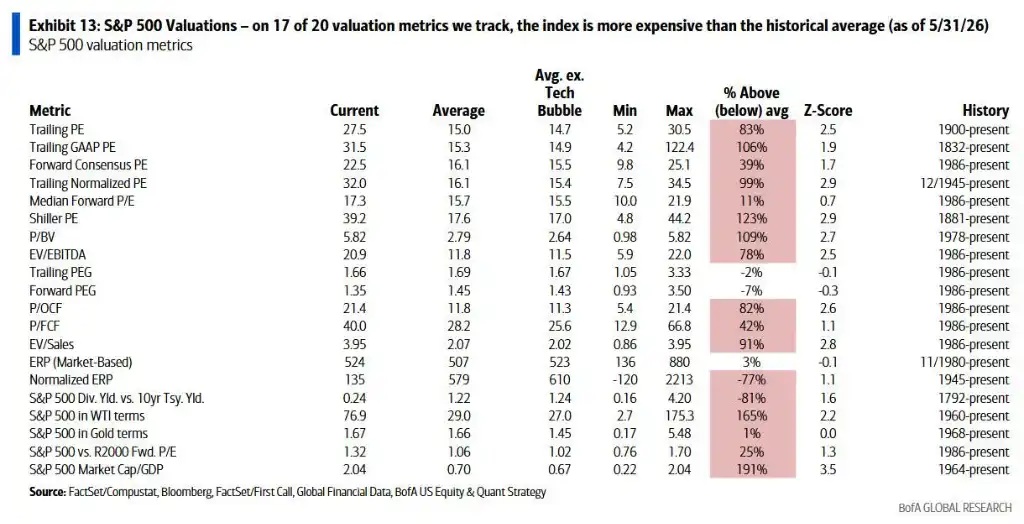
The report also points out that even from a pure valuation perspective, the S&P 500 is above its historical average in 17 out of the 20 metrics tracked by Bank of America, indicating overall index overvaluation risk.
Technology Sector Mirrors February 2000 Internet Bubble Peak

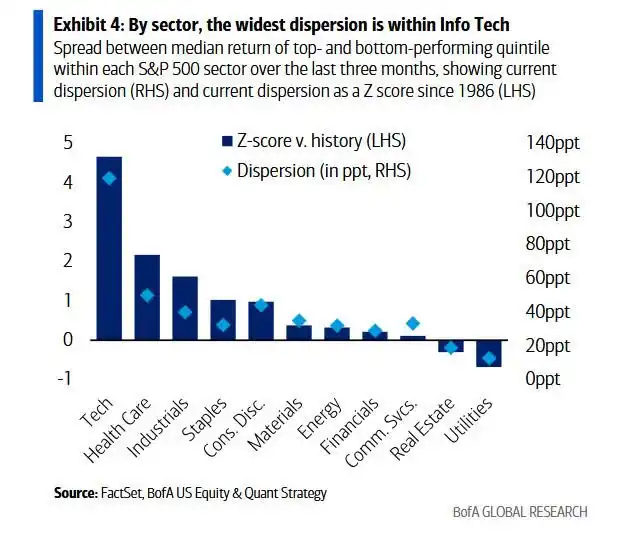
The most impactful assertion in Bank of America's warning is the direct comparison of the current technology sector's trajectory to that of February 2000—approximately one month before the peak of the dot-com bubble.

The most crucial metric cited in the report is the degree of internal sector dispersion: the median return gap between the best and worst quintile stocks within the technology sector has currently reached about 120 percentage points, the highest level since February 2000—at that time, this indicator reached about 130 percentage points before the market top on March 24, 2000.
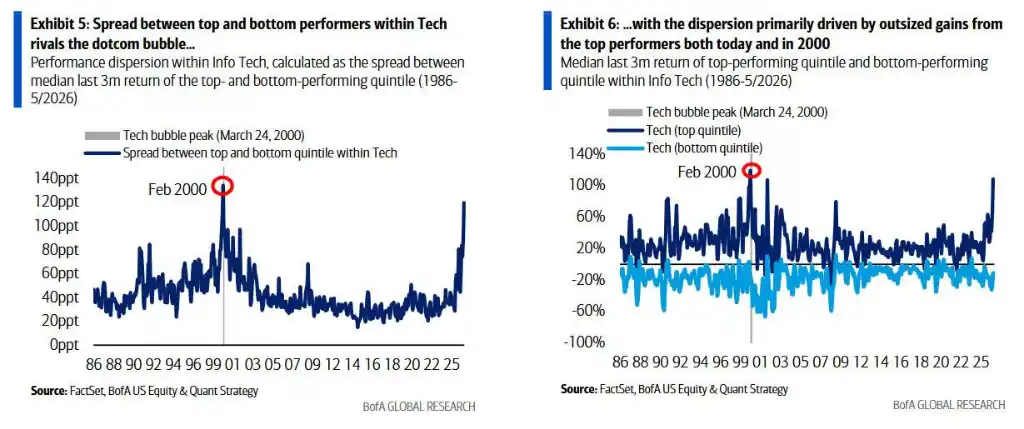
In terms of individual stock gains, within the best-performing quintile of the current tech sector, the median stock has risen about 110% over the past three months; during the internet bubble, similar stocks saw maximum gains of about 120% before the bubble burst.
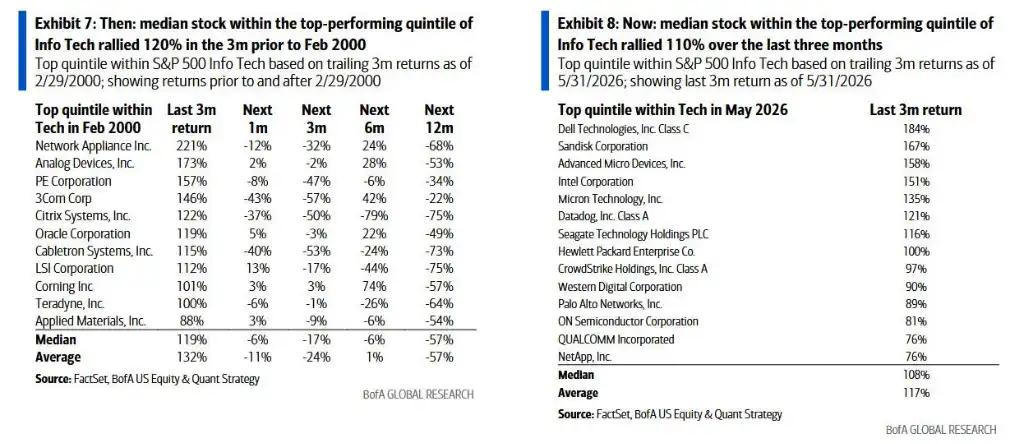
Bank of America concludes that the current situation shares three highly similar characteristics with February 2000:

The energy sector ranks first in Bank of America's tactical sector model, combining momentum, earnings revisions, and valuation advantages; Information Technology and Communication Services tie for second place, with strong momentum and earnings revisions but elevated valuations; Consumer Staples rank last, identical to February 2000—and this sector performed most resiliently after the tech bubble burst, cumulatively outperforming the index by 73 percentage points from March 2000 to October 2002 when the S&P 500 bottomed.

Morgan Stanley, Citigroup Maintain Bullish Stance: Earnings Revision Breadth Hits Cycle High

Regarding the same market volatility, Morgan Stanley's Mike Wilson reached a completely different conclusion. In a research report released on Monday, he noted that the rapid rally of the S&P 500 from its March lows was inherently unsustainable, and this correction is "inevitable and ultimately beneficial for the bull market to extend through year-end."

Wilson attributes the core basis for his bullishness to earnings revision breadth: the S&P 500's earnings revision breadth has now reached 26%, a new high for this cycle.

On the macro front, the ISM Manufacturing PMI rose to 54 last week, the highest since 2022; the three-month average of private sector payroll growth improved to 166,000, the strongest since 2023. He believes that after the normalization of crowded semiconductor and memory stock holdings, cyclical sectors such as Consumer Discretionary, Transportation, and Regional Banks are expected to take over leadership.

Citigroup's Scott Chronert raised the S&P 500 year-end target from 7,700 to 8,100 points, citing a "significant jump in earnings expectations," implying 9.7% upside from last Friday's close.

Bank of America Acknowledges Tech Fundamentals Stronger Than Dot-Com Era, But Deterioration Trends Emerging

Bank of America does not completely negate the current fundamentals of the tech industry. The report points out that on multiple metrics including leverage, valuation, and capital intensity, the current health of the tech industry is superior to that during the dot-com bubble era.

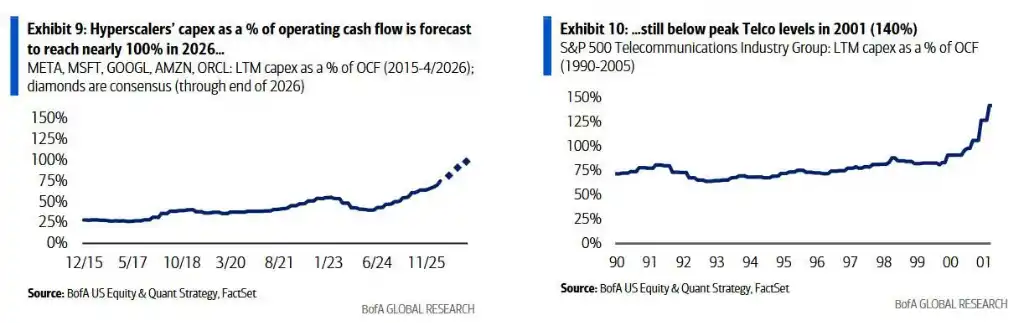
However, the report also documents several deteriorating trends emerging since the beginning of the year: cash flow conversion rates have plateaued, investment-grade bond and equity supply have increased, and the proportion of buybacks to market capitalization has slowed; the ratio of capital expenditure to operating cash flow for hyperscale cloud computing companies is expected to approach 100% by year-end, a significant increase from 40% in 2023. Although this figure remains below the 140% seen at the peak of the telecommunications industry in 2001, the pace of increase has drawn attention.
Subramanian wrote in the report that while the S&P 500 is up about 11% year-to-date, the market's overall gains have been primarily driven by earnings revisions, and the overall valuation multiple has actually compressed slightly from 22x forward P/E at the start of the year to 21x.

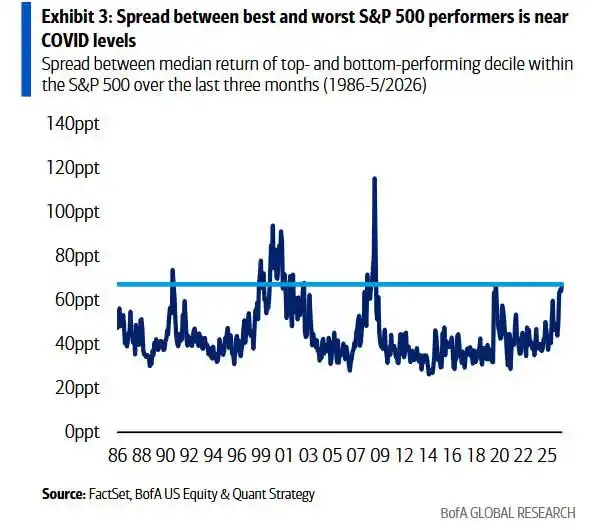
At the same time, sectors like Financials, Healthcare, and Consumer Discretionary have recorded negative returns year-to-date. The strong performance at the index level masks the fact that internal return dispersion has continued to climb to its highest level since the pandemic.
Пов'язані питання

QAccording to Bank of America's warning, what percentage of their bear market precursor signals have been triggered, and what is this level comparable to?

AAccording to Bank of America's report, 70% of their tracked bear market precursor signals have been triggered. This level is comparable to the average seen before the seven S&P 500 market tops since 1990.

QWhat specific historical period does Bank of America compare the current tech sector's market behavior to, and why?

ABank of America compares the current tech sector's market behavior to February 2000, just about a month before the peak of the internet bubble. The key reason is the extreme internal dispersion within the sector, where the median return gap between the best and worst quintiles of stocks has reached about 120 percentage points, the highest level since February 2000.

QWhat are the core arguments presented by Morgan Stanley and Citigroup for maintaining a bullish outlook on the S&P 500?

AMorgan Stanley's core argument is strong earnings revision breadth, which has reached a cycle high of 26%. Citigroup raised its year-end target to 8100 points based on a 'significant leap in earnings expectations'. Both also cite robust corporate profit growth and supportive macro data.

QWhat are the two latest bear market signals triggered in May according to Bank of America's report?

AThe two latest signals triggered in May are: 1) High P/E stocks significantly outperforming low P/E stocks, a typical sign of excessive speculation. 2) Excessively high long-term growth expectations, pushing valuations into a zone where stocks are sensitive to earnings disappointment.

QHow does Bank of America assess the current fundamental health of the technology sector compared to the internet bubble era, and what concerning trends have emerged?

ABank of America acknowledges that the tech sector's fundamentals are healthier than during the internet bubble in areas like leverage, valuation, and capital intensity. However, they note deteriorating trends since the start of the year, including plateauing cash flow conversion, increased supply of investment-grade bonds and equities, slowing share buybacks, and a rapid rise in capital expenditure as a percentage of operating cash flow for hyperscale cloud companies.

Пов'язані матеріали

The Clarity Act's Journey Through Congress: The Thorny Path of Bipartisan Compromise in the U.S.

The U.S. Congress is struggling to advance the crypto market structure bill known as the Clarity Act, with bipartisan compromise proving difficult. Key hurdles include unresolved disputes over "yield" products and, more critically, the inclusion of strong ethics provisions for elected officials—a non-negotiable demand for many Democrats. While a compromise on yield was reached in May, securing only limited Democratic support in committee, the separate Senate Agriculture Committee version later passed with no Democratic votes due to the ethics impasse. As Republicans push for a full Senate vote in July, demands for ethics rules have expanded, and other contentious issues like developer protections and concerns from law enforcement and large banks further complicate negotiations. Despite consensus on the need for legislation, the path forward is unclear. Recent discussions between senators and White House officials aim to find acceptable ethics language. Some lawmakers question whether a compromise text can garner enough bipartisan support, with one Democrat stating the current proposal lacks the strong ethics provisions required for their vote. Potential short-term goals for the crypto community include symbolic Senate action before the August recess, a longer-term aim for passage by 2026, or establishing a detailed framework that addresses ethics and other compromises. The process remains arduous, relying on the traditional, vote-by-vote effort to build bipartisan support.

marsbit11 хв тому

The Clarity Act's Journey Through Congress: The Thorny Path of Bipartisan Compromise in the U.S.

marsbit11 хв тому

Are Kalshi and Polymarket Founders at Odds? This Business Rivalry Is More Brutal Than You Think

"The Rivalry Between Kalshi and Polymarket Founders Turns Bitter and Litigious" The intense feud between Tarek Mansour, CEO of Kalshi, and Shayne Coplan, founder of Polymarket, has escalated far beyond typical business competition into personal animosity and regulatory battles. Both lead billion-dollar prediction market platforms, but their approaches differ sharply. Kalshi positions itself as the compliant operator, securing U.S. regulatory approval before launching. In contrast, Polymarket initially operated offshore, allowing U.S. users to access its platform via VPN, which drew regulatory scrutiny. The conflict reached a peak in November 2024 when FBI agents raided Coplan's New York apartment. While Coplan publicly blamed political motives, his team privately suspected Kalshi was involved. According to sources, Kalshi's lawyers had previously reported Polymarket's operations to federal prosecutors, highlighting its accessibility to U.S. users despite a ban. This incident fueled mutual accusations and underhanded tactics, including social media smear campaigns and attempts to sabotage each other's major business deals. Their rivalry also played out in Washington, influencing regulatory debates. Kalshi actively lobbied against Polymarket's practices, framing them as illegal and unethical. Polymarket, after facing a CFTC fine and investigation, later acquired a licensed U.S. firm to launch a domestic app, regaining a foothold. Despite the hostility, both companies have seen massive growth, with combined trading volumes soaring. However, increased regulatory scrutiny, particularly around insider trading on Polymarket's platform, continues to pose challenges. The founders' deep-seated mutual disdain ensures their battle for market dominance remains as much a personal vendetta as a commercial one.

marsbit20 хв тому

Are Kalshi and Polymarket Founders at Odds? This Business Rivalry Is More Brutal Than You Think

marsbit20 хв тому

Bank of America Quietly Positions: Could $6 Trillion in Bank Deposits Flow into Stablecoins?

Bank of America (BofA) is making strategic moves in digital assets, appointing senior leaders to advance a platform covering stablecoins, tokenized deposits, custody, and crypto settlement. This comes amid a broader discussion about the potential migration of trillions in bank deposits to stablecoins. A cited TBAC report estimated up to $6.6 trillion in transactional deposits could be at risk of moving to stablecoins long-term, a point BofA's CEO previously conditioned on stablecoins being allowed to pay interest. The regulatory landscape is evolving, with the GENIUS Act setting a final implementation deadline for January 2027. Major banks, however, are not waiting; JPMorgan, Citi, BofA, and others are already developing tokenized deposit networks and services. Industry observers note that while retail crypto trading is sluggish, institutional adoption of stablecoins for real-world use cases is driving growth. Despite the activity, some analysts remain cautious, noting banks have a long history of blockchain announcements and that true structural change is slow. The stablecoin market itself has seen a recent dip from its peak. Optimistic projections, however, foresee significant growth, with stablecoin settlement volume already reaching $33 trillion in 2025. The race is on for the post-January 2027 landscape, where regulatory clarity is expected to accelerate the fusion of traditional finance and crypto.

marsbit25 хв тому

Bank of America Quietly Positions: Could $6 Trillion in Bank Deposits Flow into Stablecoins?

marsbit25 хв тому

Торгівля

Спот
活动图片