Bear Market Financial Report Comparison: Pure Crypto Exchanges vs. Multi-Asset Platforms, Robinhood More Resilient Than Coinbase

marsbitОпубліковано о 2026-05-14Востаннє оновлено о 2026-05-14

Анотація

Bear Market Earnings Showcase the Resilience of Multi-Asset Platforms vs. Crypto-Only Exchanges Coinbase and Robinhood's recent earnings reports, both missing expectations and erasing $12 billion in market value, highlight a core vulnerability of exchange models in a crypto downturn: heavy reliance on transaction fees. Coinbase's Q1 revenue fell 31% to $1.41 billion, with a net loss of $394 million, driven by a 40% drop in transaction revenue as spot trading volumes plummeted. While its subscription and services segment (44% of revenue) offers some buffer, key components like stablecoin revenue remain tied to trading activity. In contrast, Robinhood reported a 15% revenue increase to $1.07 billion, with net income of $350 million. Although its crypto trading revenue fell 47%, this was offset by strong growth in other areas: prediction market revenue surged 320%, stock revenue grew 46%, and options revenue rose 8%. This diversification, with transaction revenue still at 58% of the total, made Robinhood more resilient. The analysis extends to platforms like Revolut, where payments and banking are central. In 2025, Revolut's revenue grew 45% to $6.1 billion, evenly spread across segments. Its wealth segment (including crypto, stocks, and CFDs) constituted just 15% of revenue, making it far less exposed to crypto market cycles than Coinbase or even Robinhood. The key takeaway is that platforms with diversified, non-correlated revenue streams—particularly through derivatives, ...

Author: Lex

Compiled by: Deep Tide TechFlow

Deep Tide Introduction: Coinbase and Robinhood both reported earnings below expectations last week, erasing $12 billion in market value. This exposes a fundamental issue with the exchange model: how to survive in a bear market when revenue is highly dependent on trading fees? Platforms like Revolut, which are payment-centric, are almost unaffected, with trading income accounting for only 15% of their revenue. This comparison reveals the underlying logic of competition among fintech platforms.

Cryptocurrency is in the depths of a bear market.

Bitcoin hovers around $80,000, down approximately 36% from its peak of $126,000 in October 2025. Spot trading volume on centralized exchanges has fallen to its lowest level since September 2019, down 44% year-over-year in the first quarter according to Coinbase data.
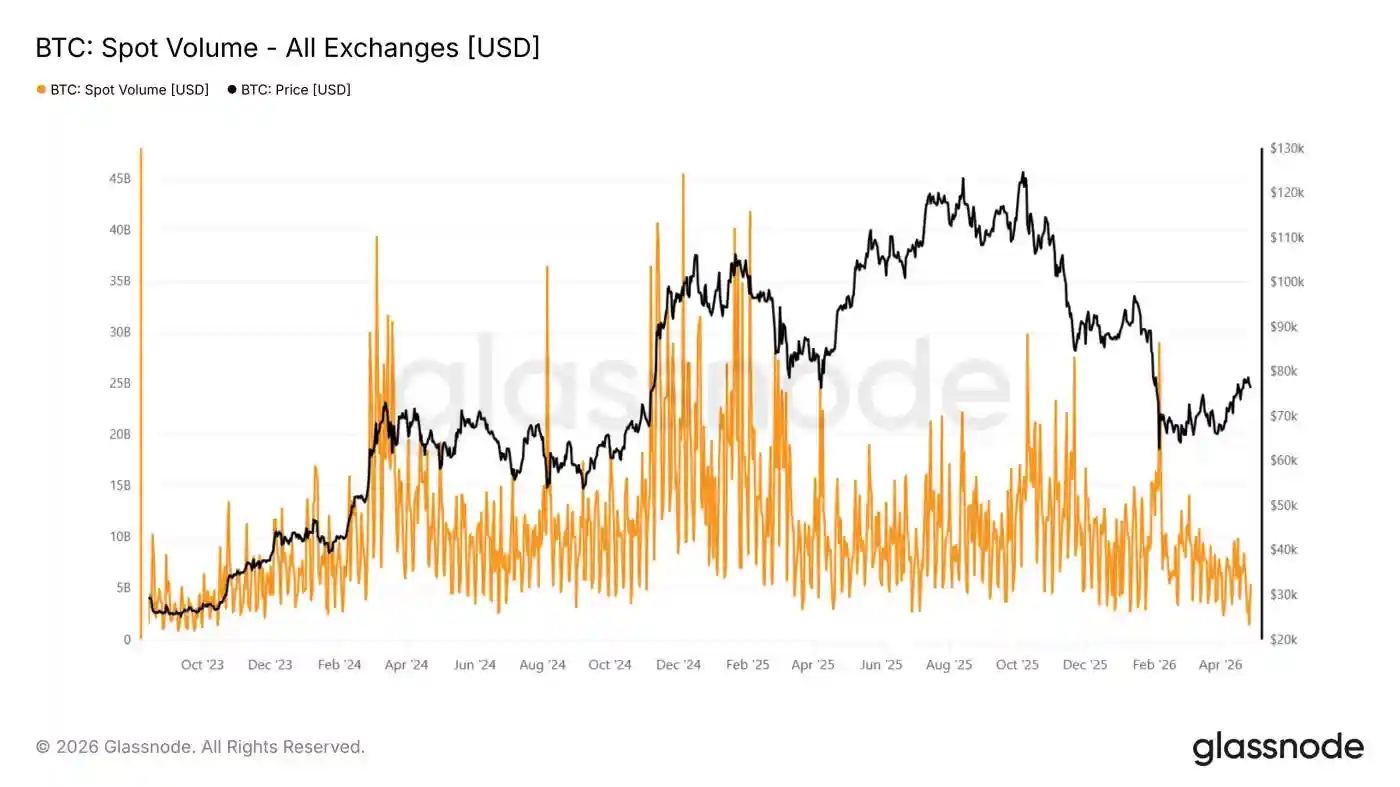
Some on-chain analysts believe the recent rebound from $60,000 may lack sustained momentum. This has been the longest bear market rally of the past two cycles, but it appears more technically than fundamentally driven. Open interest in derivatives (perpetual contracts) has risen, but spot activity is low, suggesting the rise is driven more by short liquidations and speculative position unwinding than persistent buying.

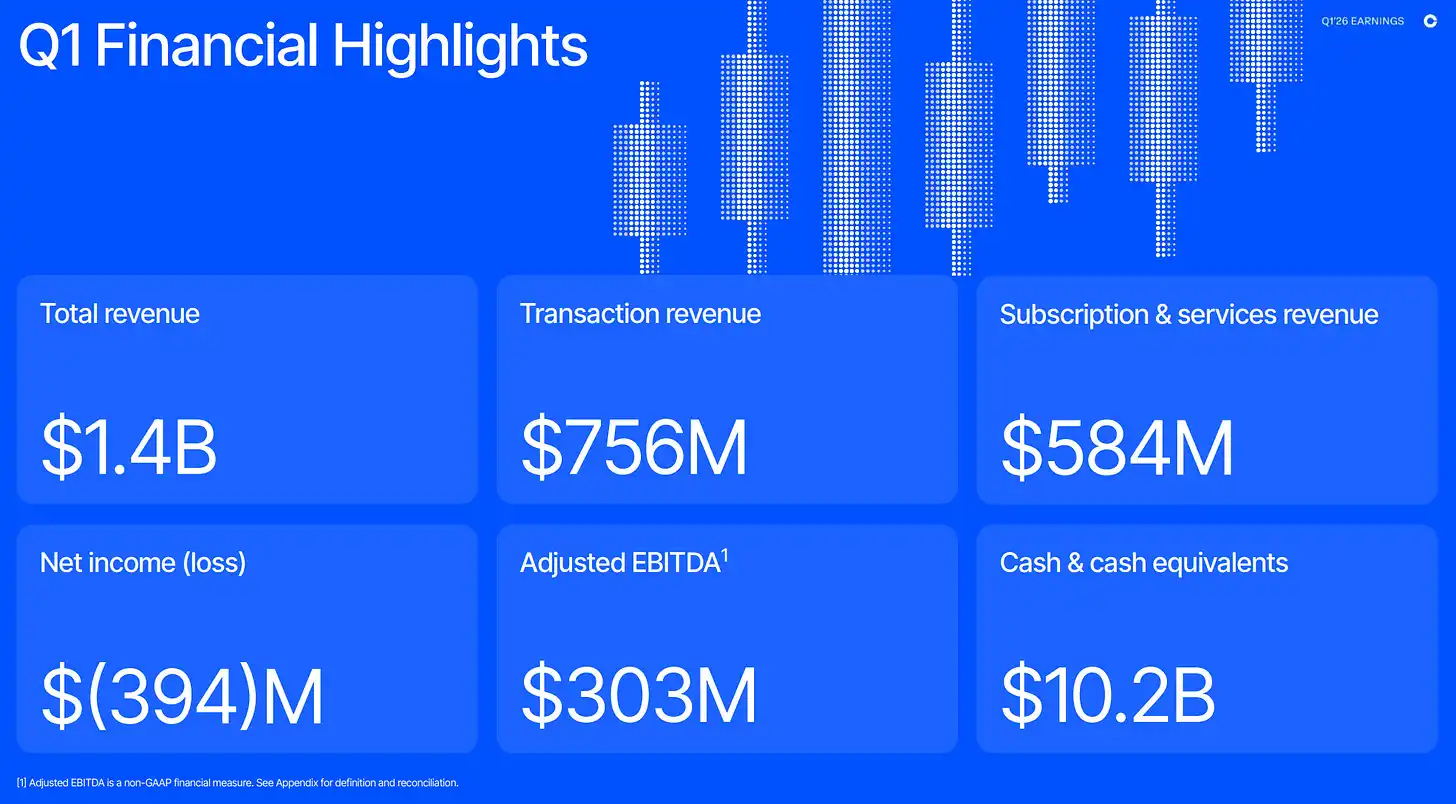
Decreased trading activity is eroding platform revenue. Coinbase's revenue fell 31% year-over-year to $1.41 billion, with a net loss of $394 million, compared to a profit of $66 million in the same period last year. Management also announced layoffs of 700 employees (about 14% of its workforce) the same week, citing both crypto cyclicality and a cost "reset for the AI era."
Trading business is at the center of the decline.

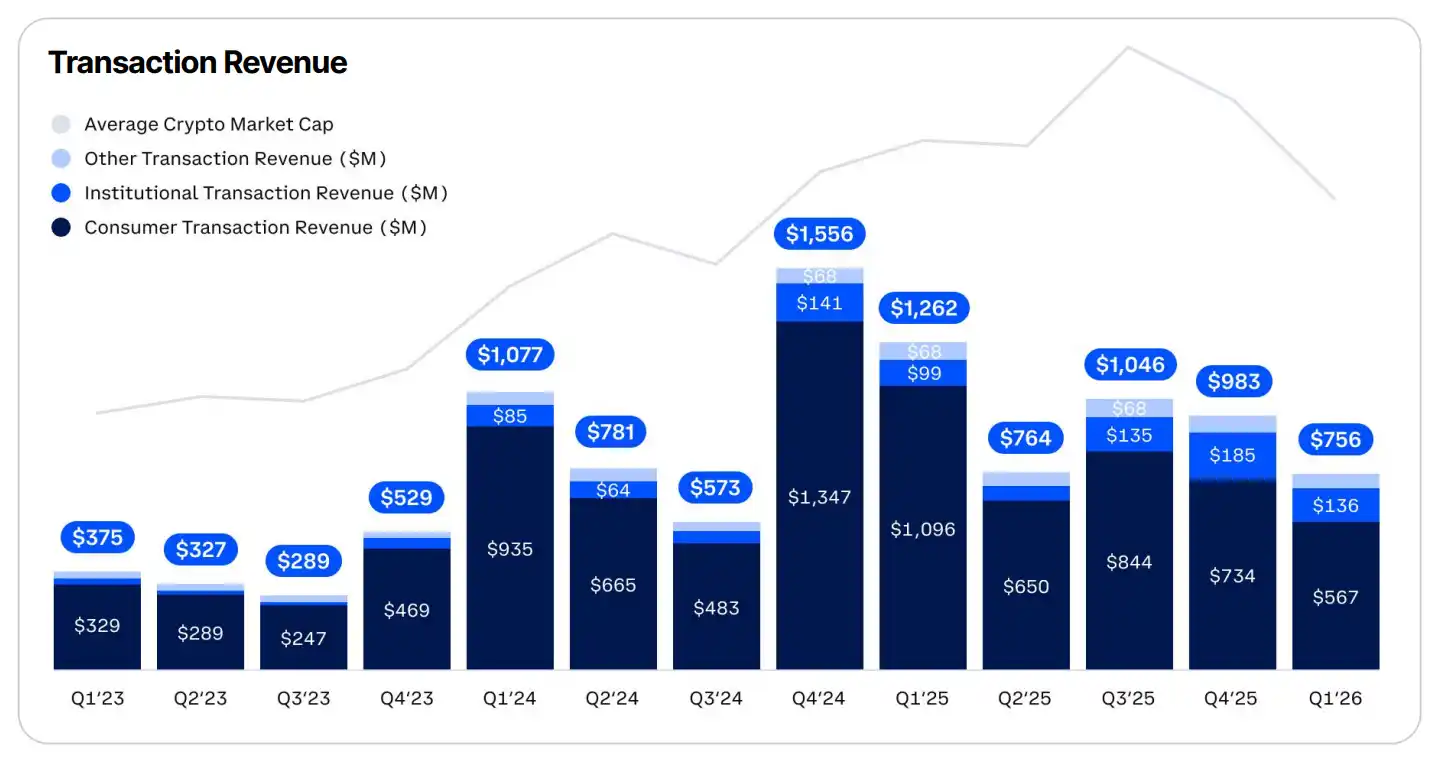
Transaction revenue accounted for 56% of total revenue in Q1, down 40% year-over-year. Consumer transaction revenue fell 48% to $567 million. Institutional transaction revenue actually grew during this period, but this was almost entirely due to the $4.3 billion acquisition of Deribit completed in August 2025; organic institutional trading volume actually fell 48%.
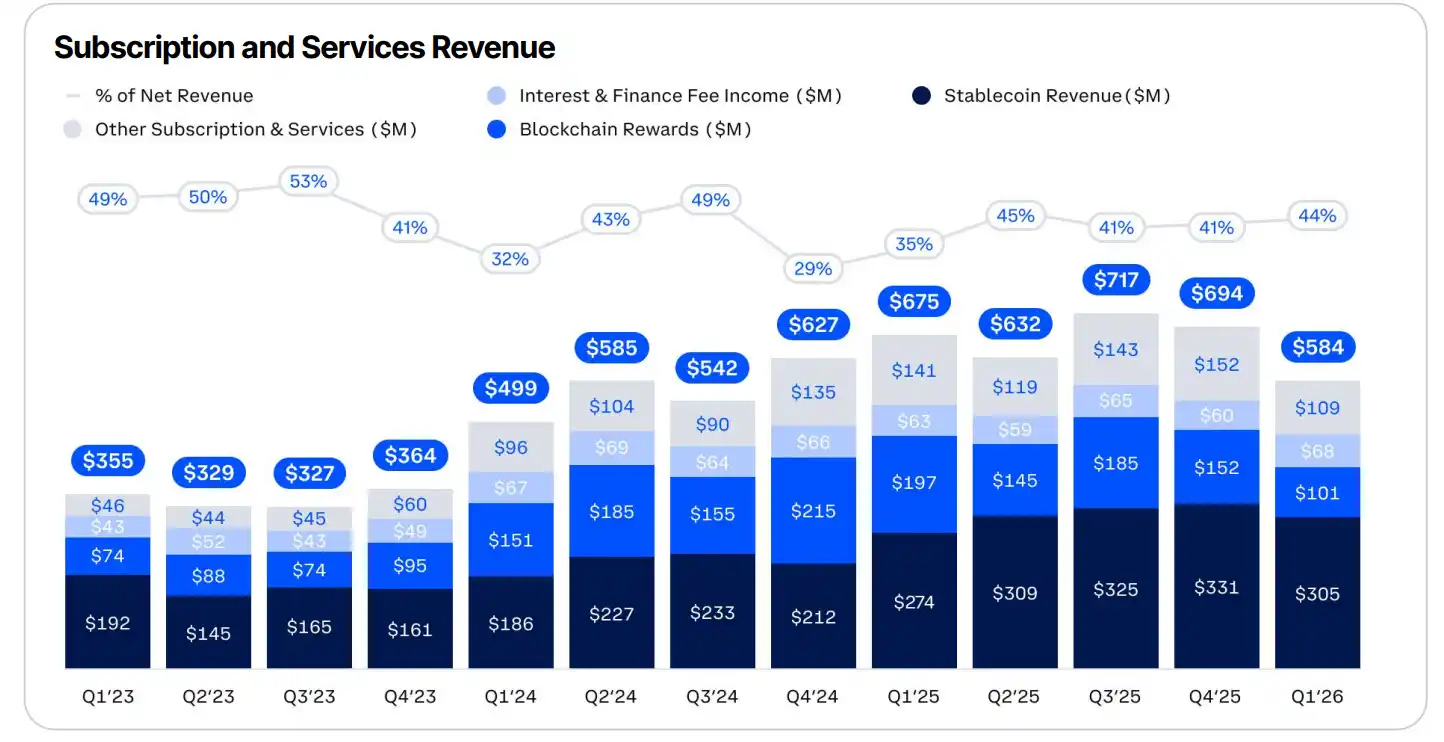
The remaining revenue comes from subscriptions and services, distributed across stablecoin revenue (interest earned from customer USDC balances via Coinbase's partnership with Circle), blockchain rewards, interest and financing fees, and other subscription products like Coinbase One.

This segment now accounts for 44% of total revenue, which management positions as a "durable buffer" against trading volatility. But this is somewhat misleading. Stablecoin revenue is the largest single item, accounting for 22% of net revenue, up 11% year-over-year, but it is also highly correlated with trading volume. Customers move into USDC to avoid volatility or rotate between assets, but reconfigure back into volatile assets once the market turns. This dynamic partly explains why the proportion of subscription and service revenue to total revenue has looked fairly steady over the past 3 years.
Meanwhile, Robinhood reported stronger numbers.

Revenue increased 15% year-over-year to $1.07 billion, with net profit of $350 million, but still missed analysts' revenue expectations. Like Coinbase, the miss was driven by crypto, with related transaction revenue falling 47% year-over-year to $134 million. Notably, this was the only major revenue line item to decline year-over-year.
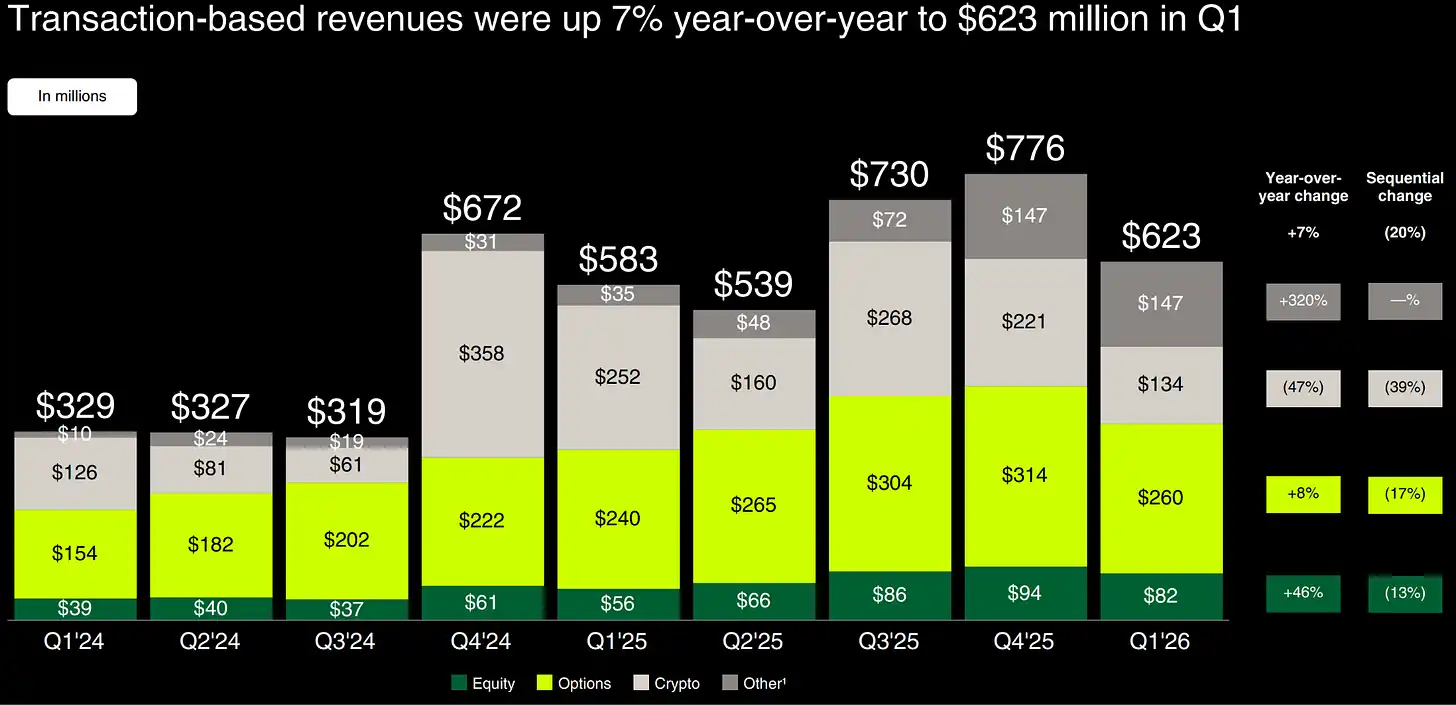
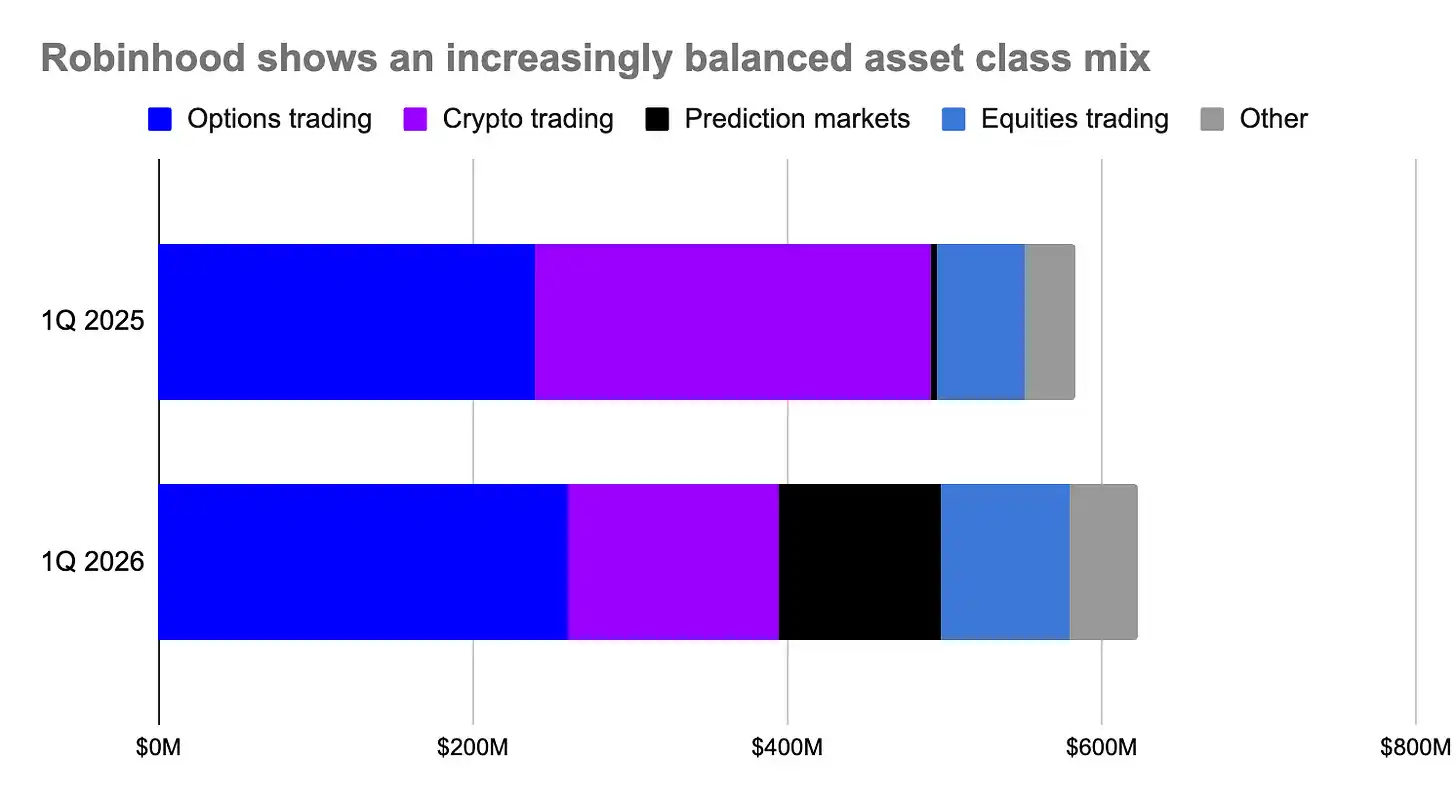
Trading still accounts for 58% of Robinhood's revenue, basically flat from a year ago. But due to the diversity of tradable asset classes, the company has performed better throughout the bear market. Total transaction revenue grew 7% year-over-year to $623 million, driven by a 320% surge in prediction market revenue via Robinhood's partnership with Kalshi, a 46% increase in stock revenue, and 8% growth in options.
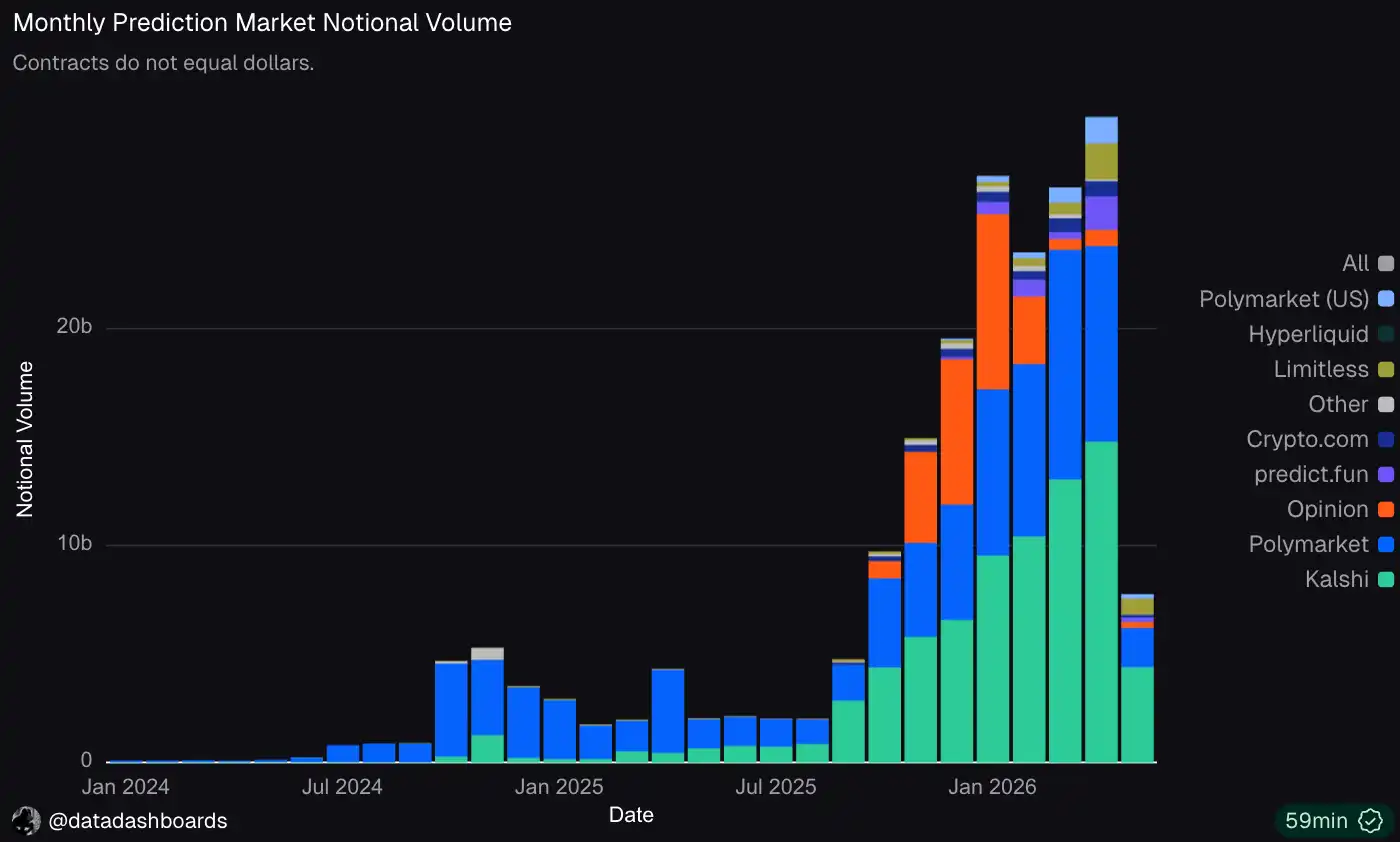
Derivatives like prediction markets and perpetual contracts have shown more resilience during downturns. Kalshi raised $1 billion last week at a $22 billion valuation, doubling its valuation in just 6 months and tripling its annualized trading volume to $178 billion.

Event-driven trading, like predictions, often focuses on sports, elections, and economic data, making it less sensitive to the broader market. But growth also stems from institutions starting to use it as a hedging tool during market volatility. There is an organic adoption tailwind masking the cyclicality.
Perpetual contracts show a similar pattern. As of the end of April, the total value of leveraged positions by traders on Hyperliquid (measured as "open interest") was $4.3 billion, having grown 9% over the past two months despite the general collapse in spot markets. While this metric is still down from the October peak, it is clearly performing better.

This is significant for trading platforms that have these features.

Prediction markets now account for 17% of Robinhood's total transaction revenue!

While it doesn't directly offer perpetual contracts, it does offer similar margin trading on stocks and crypto, and earns interest from it. In Q1 2026, margin interest revenue grew 75% year-over-year to $193 million, accounting for 18% of total revenue.

Coinbase is a latecomer to this shift. While it launched prediction markets and perpetual contracts for retail customers in January 2026, it hasn't yet had a material impact on its P&L. Consequently, the exchange has greater exposure to spot trading.

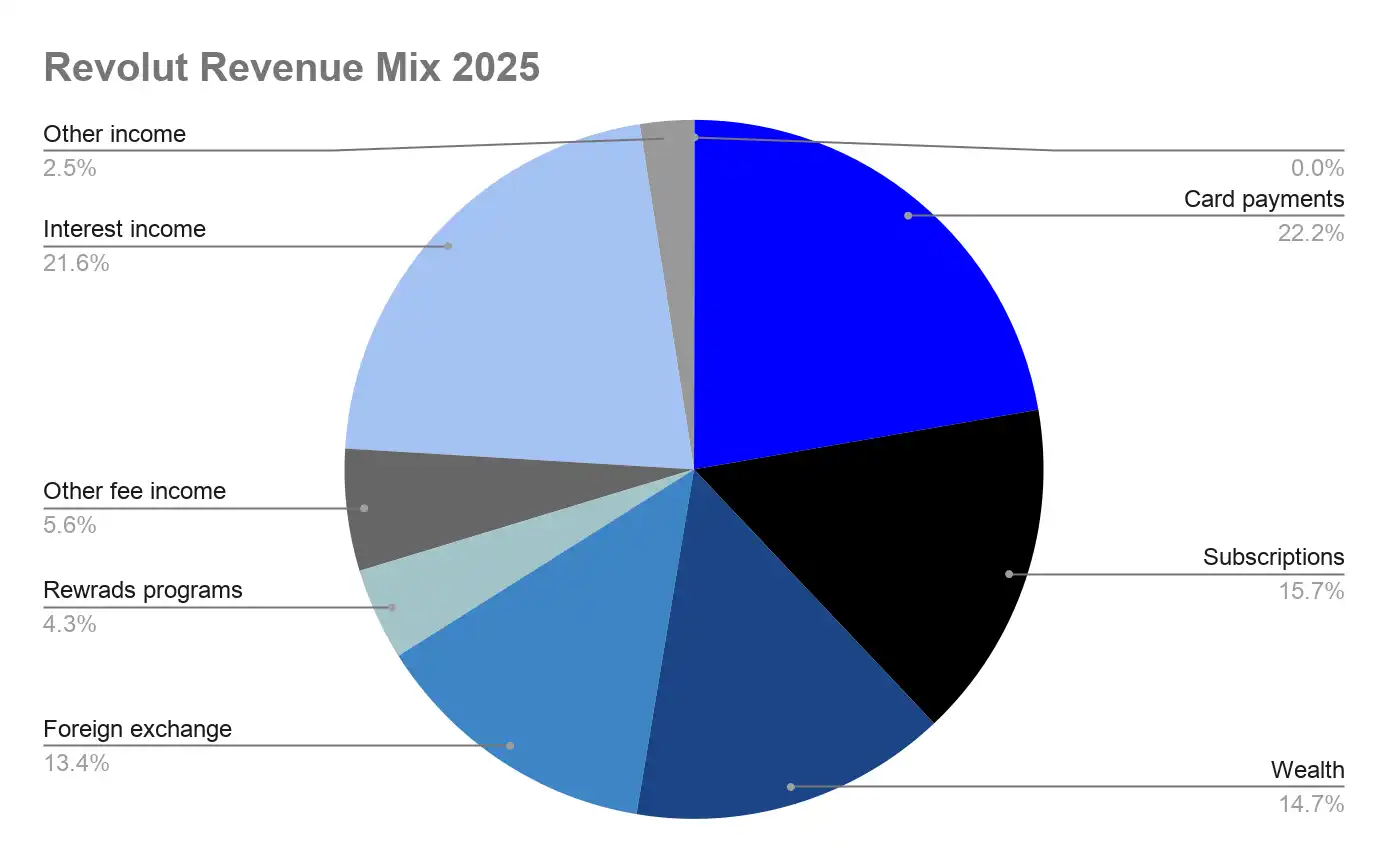
Fintech platforms centered on payments and banking, but with significant trading activity like Revolut, are much less affected. Revenue grew strongly by 45% to $6.1 billion in 2025, with a balanced distribution across major revenue streams, each accounting for 13-22% of total revenue.

Card interchange fees and interest income are the two largest items, each around $1.3 billion. Crypto trading, along with stocks and CFDs, falls under the Wealth segment, accounting for 15% of total revenue—a fraction of Robinhood's exposure and a sliver of Coinbase's.
Notably, Revolut's interest income is similar to Coinbase's stablecoin revenue, both monetizing idle customer balances. As of year-end, Revolut held 90% of its $68 billion customer balance in cash and treasury investments. But the behavior driving these balances is fundamentally different. Revolut's deposits grow with primary banking relationships and direct deposit growth (up 45% year-over-year), while Coinbase's USDC balances grow as willingness to trade declines. If the crypto market turns more bullish, Coinbase is more likely to see balances decline.

The challenge for trading-first platforms like Coinbase and Robinhood is whether they can meaningfully expand into adjacent financial products while being tightly linked to market cycles. Robinhood has shown that diversity in tradable asset classes, especially prediction markets and derivatives, can act as a hedge.

Coinbase is moving in a similar direction. The risk is that a prolonged bear market hinders their growth ability, while fintech competitors like Revolut, Nubank, and Cash App take a greater share of customer deposits.


Пов'язані питання

QAccording to the article, why did Coinbase's revenue decline in the last quarter, and what was the main driver?

ACoinbase's revenue declined 31% year-over-year to $1.41 billion, primarily driven by a 40% drop in transaction revenue. This was due to decreased trading activity in the crypto bear market, with consumer transaction revenue specifically falling 48%.

QHow did Robinhood's performance in the recent quarter differ from Coinbase's, especially regarding revenue sources?

ARobinhood's revenue grew 15% year-over-year to $1.07 billion, while Coinbase's fell. A key difference was the diversity of Robinhood's revenue streams. Although its crypto transaction revenue dropped 47%, this was offset by significant growth in prediction markets (up 320%), stock trading (up 46%), and options trading (up 8%).

QWhat is the fundamental business model challenge highlighted for trading-first platforms like Coinbase and Robinhood during a bear market?

AThe fundamental challenge is their heavy reliance on transaction fees, which are highly cyclical and tied directly to market trading volumes. During a prolonged bear market with low activity, their core revenue stream suffers significantly, raising questions about sustainability and growth.

QWhy is a platform like Revolut less affected by the crypto bear market compared to Coinbase or Robinhood, based on the article?

ARevolut is less affected because its business model is centered on payments and banking, not trading. Crypto trading is part of its 'Wealth' segment, which constitutes only about 15% of its total revenue. Its largest revenue streams are card interchange fees and interest income, which are more stable and less tied to crypto market cycles.

QWhat new product areas does the article suggest are more resilient during market downturns, and which company has benefited from this?

AThe article suggests that derivatives and event-driven trading products like prediction markets are more resilient during downturns. Robinhood has significantly benefited from this through its partnership with Kalshi (prediction markets), which now represents 17% of its total transaction revenue and saw a 320% year-over-year increase.

Пов'язані матеріали

The Value Distribution of Stablecoins

**Summary: The Value Distribution of Stablecoins** The article argues that stablecoins are evolving from mere trading tools into broader channels for dollar access. It divides the stablecoin ecosystem into four layers to analyze how value is distributed: 1. **Issuance Layer:** Mints stablecoins, holds reserve assets, and captures the spread between reserve yield and user costs (e.g., Tether, Circle). This layer currently earns the largest profit margin. 2. **Infrastructure Layer:** Connects stablecoins to the traditional financial system, handling fiat on/off-ramps, banking integration, compliance (KYC/AML), and asset management (e.g., Bridge, BVNK). This is the "unglamorous" but critical work, building the essential bridges between crypto and real-world finance. 3. **Acquiring/Distribution Layer:** Integrates stablecoins into merchant systems, manages payment flows, and provides enterprise financial software (e.g., Stripe, Coinbase). They act as the access point for businesses. 4. **Application Layer:** The end-users and businesses that ultimately use stablecoins for payments, settlements, or as a store of value. They benefit from convenience but have little pricing power. The core thesis is that while the issuance layer currently dominates profits, the often-overlooked **infrastructure layer holds significant long-term potential**. The real challenge and barrier to mass adoption is not the on-chain transfer of stablecoins (which is simple), but the complex "last mile" integration into existing business workflows, banking systems, and regulatory frameworks across different countries. Companies in this layer are currently in a "land grab" phase, investing heavily to build networks, secure bank partnerships, and establish compliance pathways. While their position is currently pressured by the profitable issuers above and distribution platforms below, the article suggests that if stablecoins become a default financial rail for businesses, the infrastructure providers who have done the hard work of integration will ultimately gain strong pricing power and become entrenched, essential players.

marsbit4 год тому

The Value Distribution of Stablecoins

marsbit4 год тому

The Value Distribution of Stablecoins

The Value Distribution of Stablecoins The article argues that stablecoins are evolving from a mere trading tool into a broad "dollar channel." It analyzes the industry's value chain through four layers: 1. **Issuance Layer (e.g., Tether, Circle):** The top layer that mints stablecoins, holds reserve assets, and captures the thickest interest rate spread. 2. **Infrastructure Layer (e.g., Bridge, BVNK):** Connects stablecoins to the traditional financial system, handling critical but complex "dirty work" like fiat on/off-ramps, banking integration, compliance (KYC/AML), and cross-border settlement. 3. **Acquiring/Distribution Layer (e.g., Stripe, Coinbase):** Embeds stablecoins into merchant systems, manages payment flows, and integrates with enterprise software. 4. **Application Layer:** End-users and businesses that ultimately use stablecoins for payments, settlement, or storing value. The author posits that while the issuance layer currently captures the most profit, the most overlooked and potentially critical layer is infrastructure. The core challenge for stablecoin adoption isn't the on-chain transfer (which is simple), but bridging the gap between blockchain and the real-world financial system. This involves solving practical problems for businesses: fiat conversion, reconciliation, tax handling, and user onboarding. Infrastructure companies are currently in a difficult "land-grab" phase—building networks, securing banking relationships, and achieving compliance country-by-country. They face pressure from both the profitable issuance layer above and distribution platforms below. However, the author suggests this layer is building a crucial moat. Once stablecoins become a default business rail, the infrastructure players who have done the hard work of integration may gain significant, durable value and pricing power.

链捕手4 год тому

The Value Distribution of Stablecoins

链捕手4 год тому

How to Do Research Well: Deliberately Practice the Real Skills That Matter

No one truly teaches you how to do research. You're often given a desk, a pre-selected problem, and vague instructions to "create something new." Consequently, many people reverse-engineer the job based on visible outputs—papers, posts, announcements—learning only how to *appear* like a researcher rather than how to *become* one. True research capability is built from stacking small, trainable skills, nearly all of which can be developed through deliberate practice. **Pick Your Own Problem:** Most researchers absorb problems from advisors or trends, lacking the underlying reasoning. Choosing a problem you genuinely care about, as John Schulman advises, leads to original work. Develop "taste" like a muscle: predict experiment outcomes, guess paper results from methods, and track which findings remain important over time. **Upgrade Your Inputs:** Relying on shared reading lists (arXiv hot lists, filtered group chats) leads to unoriginal conclusions. Undervalued old literature often holds crucial insights (e.g., MoE, LSTM, backpropagation). Richard Sutton's "The Bitter Lesson" or Claude Shannon's 1952 talk on creative thinking are more predictive than lengthy modern surveys. Breadth matters as much as depth: draw from neuroscience, mechanism design, hardware knowledge, and honest statistics. Read papers directly, especially appendices and limitations sections. **Write Everything Down:** As Paul Graham noted, writing exposes flaws in seemingly mature ideas. Writing is the cheapest defense against self-deception. Following Feynman's principle, Darwin programmatically wrote down facts contradicting his theory to combat memory bias. Maintain a detailed log of hypotheses, setups, predictions, results, and updated understandings. Reviewing past logs fosters essential humility.

marsbit6 год тому

How to Do Research Well: Deliberately Practice the Real Skills That Matter

marsbit6 год тому

Торгівля

Спот
Ф'ючерси
活动图片




