Base Official Selection: 12 Promising Projects Chosen from 1,175 Applications

marsbitОпубліковано о 2026-04-10Востаннє оновлено о 2026-04-10

Анотація

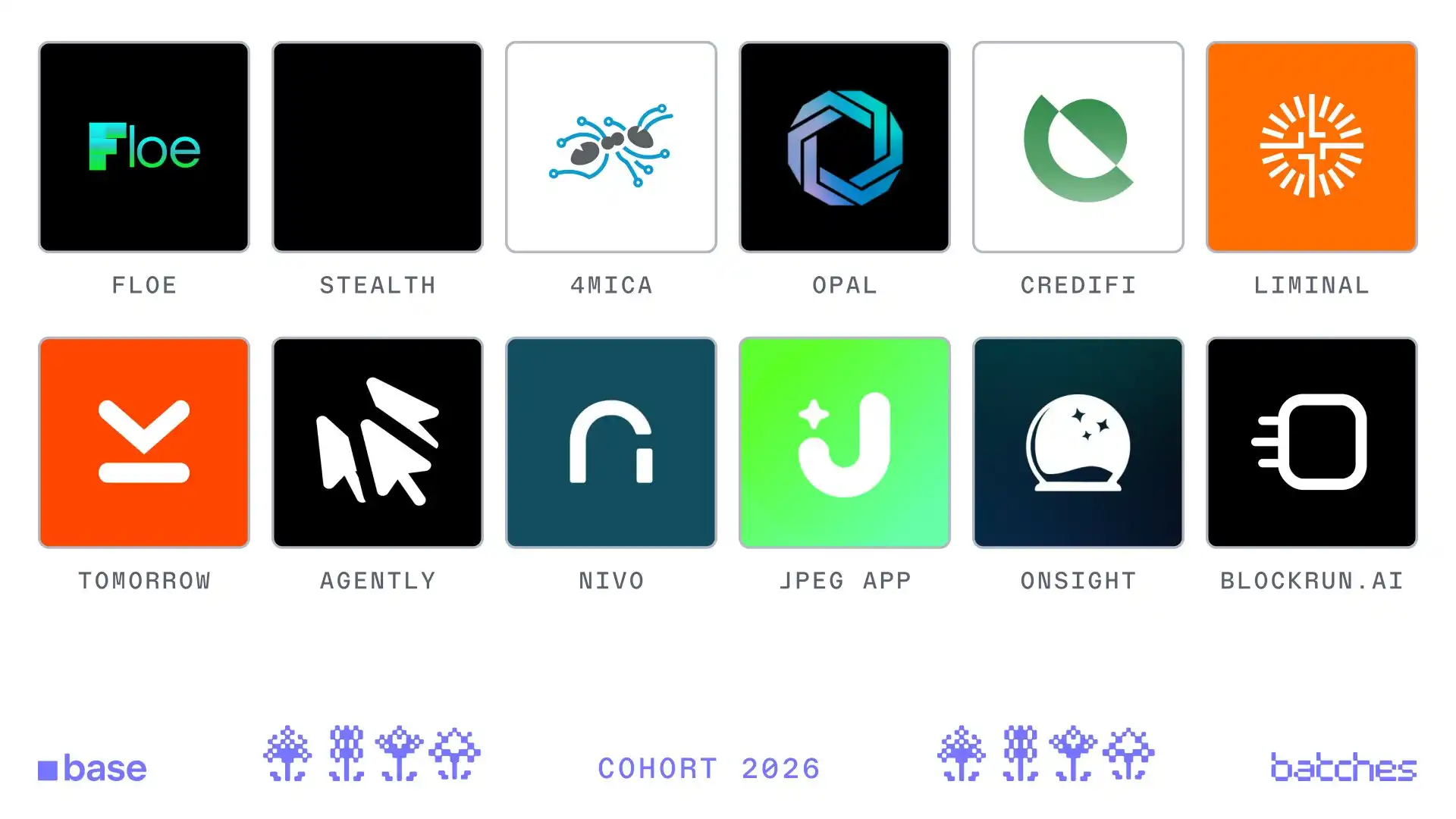
Base has officially selected 12 standout projects from 1,175 applications for its accelerator program, signaling a strategic focus on high-potential on-chain ecosystems over independent unified stacks outside the OP Superchain. The chosen projects span key sectors including DeFi, prediction markets, AI agents, and payments. Highlights include: BlockRunAI (AI agent infrastructure with x402 pay-per-use payments), a stealth prediction market with novel leverage primitives, 0x4Mica (micropayment clearing for AI agents), Opal DEX (privacy-focused perpetual DEX), TradeOnsight (gamified social prediction platform), Credifi (uncollateralized lending via zkTLS), Tomorrow Loans (creator economy lending), AgentlyHQ (AI agent coordination layer), Nivo Finance (FX hedging for SMEs), JPEGapp (image-based prediction market), Floe Labs (AI agent credit infrastructure), and Liminal (AI-native neobank). Base is positioning itself as a major hub for on-chain innovation this cycle.

Author: yyy

Base has just announced the 12 ecosystem projects selected for its official accelerator program, which I believe sends an important strategic signal:

@base prioritizes the development of on-chain potential ecosystems over building a unified stack independent of the OP Superchain.

These 12 projects were chosen from 1,175 applications to the @base official accelerator program, covering promising sectors such as DeFi, prediction markets, AI Agents, and payments. They are truly one-in-a-hundred selections, with higher credibility than previous batches.

Here is the information on these 12 projects:

1/ @BlockRunAI

Sub-sector: AI Agent Infrastructure / x402 Payments

Provides routing for LLM, tools, and data access for AI Agents, with pay-per-request via the x402 protocol.

2/ (Stealth Project)

Sub-sector: Prediction Markets

Develops a new leverage primitive for prediction markets to enhance trading capital efficiency.

3/ @0x4Mica

Sub-sector: AI Agent Micropayments / Clearing Infrastructure

Provides clearing infrastructure for high-frequency micro-transactions of AI Agents, supporting collateralization and batch settlements.

4/ @opal_dex

Sub-sector: DeFi / Privacy Perpetual DEX

A privacy-protected perpetual contract DEX supporting cryptocurrency and RWA trading, with sealed matching and "dealer" privacy.

5/ @TradeOnsight

Sub-sector: Prediction Markets / Social Gamification

A gamified social prediction market platform that combines social chat with betting experiences.

6/ @credifi

Sub-sector: DeFi / Uncollateralized Lending

An uncollateralized lending protocol based on zkTLS and on-chain credit scoring, lowering the barrier to DeFi lending.

7/ @tomorrowloans

Sub-sector: DeFi / Creator Economy Lending

A collateralized stablecoin lending platform for creators based on verifiable revenue (e.g., Google AdSense).

8/ @AgentlyHQ

Sub-sector: AI Agent Coordination / Transaction Routing

A coordination and transaction routing layer for AI Agents, enabling multiple agents to collaborate on complex tasks and on-chain payments.

9/ @nivo_finance

Sub-sector: DeFi / Foreign Exchange Hedging

An on-chain foreign exchange hedging and forward locking protocol for SMEs and cross-border businesses to manage exchange rate risks.

10/ @jpegapp

Sub-sector: Prediction Markets / Opinion Markets

An opinion market based on photo content where users bet on images, and the highest bet wins.

11/ @FloeLabs

Sub-sector: AI Agent Credit / DeFi

Provides credit lines and credit infrastructure for AI Agents and institutions, supporting payment scenarios like x402.

12/ @liminalcash

Sub-sector: Neobank / AI-Native Banking

An AI-native, self-custodial digital bank integrating self-custody wallets, payments, and smart financial management features.

Base is highly likely to become one of the main battlegrounds for on-chain ecosystem innovation in this crypto cycle. Wait for the wind to come.


Пов'язані питання

QWhat is the main strategic signal released by Base according to the article?

ABase prioritizes the layout of on-chain potential ecosystems over building a unified stack independently from the OP Superchain.

QHow many projects applied to Base's official accelerator program, and how many were selected?

AThere were 1175 applications, and 12 projects were selected.

QWhich project provides a new leverage primitive for prediction markets to improve capital efficiency?

AThe stealth project (unnamed) in the prediction market segment.

QWhat is the core function of the project @0x4Mica?

AIt provides clearing infrastructure for high-frequency micro-transactions of AI Agents, supporting collateralization and batch settlements.

QWhat type of financial service does @liminalcash aim to provide?

AIt aims to be an AI-native, self-custodial digital bank that integrates self-custody wallets, payments, and intelligent financial management features.

Пов'язані матеріали

STRC Breaks Below $95: Why Does It Continue to Depeg? Is There Default Risk?

"STRC Falls Below $95: Why the Persistent Depegging and Is There Default Risk?" The article discusses the recent decline in the price of STRC, a perpetual preferred stock issued by Strategy (MSTR) designed to trade around a $100 par value. As of publication, STRC traded at $94.65, raising market concerns. STRC is described as a high-yield cash flow product, offering an 11.50% annual dividend paid monthly. Its "preferred" status grants it priority over common stock for dividends and in liquidation. Key reasons cited for the price depegging include: 1. **Bitcoin's Price Drop:** MSTR's assets are heavily tied to Bitcoin (BTC), which fell over 21% from its recent high, pressuring all Strategy-related products. 2. **Competitive Pressure:** Rival Strive Asset Management's similar product, SATA, offers daily dividends and has maintained its $100 par value with a ~13% yield. In response, Strategy has proposed changing STRC's dividend frequency from monthly to bi-weekly, pending shareholder vote. 3. **Technical Selling:** A break below $100 may have triggered algorithmic selling and stop-losses, exacerbating the decline. Regarding default risk, the analysis suggests it is currently low. Strategy founder Michael Saylor confirmed the June 2026 dividend rate remains at 11.50% with no cuts or suspensions. The company's massive reserve of 843,706 BTC provides a significant backstop for its obligations. Industry opinions are mixed. Some analysts view the BTC holdings as reliable support for dividends, while critics like Peter Schiff warn of potential dividend cuts leading to price crashes and lawsuits. Others highlight inflation risk and the company's ability to reduce dividends without a formal default. In summary, STRC's drop is attributed to BTC volatility, competition, and technical factors. While immediate default risk appears contained, the product faces challenges from market conditions and competitive dynamics.

marsbit12 хв тому

STRC Breaks Below $95: Why Does It Continue to Depeg? Is There Default Risk?

marsbit12 хв тому

AI Trading Cools, South Korean Stocks Plunge 1.8%, Spot Gold Rises 1%, Bitcoin Dives

A sell-off in AI-related stocks, triggered by Broadcom's disappointing earnings forecast, sent shockwaves through global markets. South Korea's KOSPI led Asia's decline, plunging 1.8% as the risks from concentrated chip stock gains and surging leveraged investments came to the fore. The tech-heavy Nasdaq 100 futures fell 0.5% following Broadcom's 14% after-hours plunge, which signaled a slower-than-expected transition to AI clients. This pullback extended Wall Street's weakness, halting the S&P 500's nine-day rally amid hawkish Fed signals and renewed Middle East tensions. South Korean authorities convened an emergency meeting, pledging "immediate measures" against market volatility and warning of record-high stock margin debt. The adjustment rippled across assets: Bitcoin fell to around $64,000, its lowest since February, while safe-haven gold rose 1% on bargain hunting. Oil prices dipped on Middle East ceasefire news. Market analysts noted the sell-off was driven by profit-taking after massive gains, particularly in chip stocks like Samsung and SK Hynix, which now dominate the KOSPI. Wall Street banks are divided on Korea's outlook, with Goldman Sachs raising its target while Citigroup and others warn of overvaluation and a potential bubble. Bridgewater's Ray Dalio noted that great technological shifts often create bubbles. Meanwhile, Fed officials' hints at potential future rate hikes added to the cautious mood ahead of key U.S. jobs data.

华尔街日报38 хв тому

AI Trading Cools, South Korean Stocks Plunge 1.8%, Spot Gold Rises 1%, Bitcoin Dives

华尔街日报38 хв тому

Seeking Alpha's Hot Article: Why Might the U.S. Stock Market Crash in June?

In a recent Seeking Alpha article, financial professor and analyst Damir Tokic argues that the US stock market may be poised for a significant crash in June 2026. The core thesis centers on a "mega-bubble" in equities, particularly within the technology sector, which has driven the S&P 500 to near-record valuations, with a Shiller P/E ratio exceeding 40—a level comparable to the 2000 dot-com bubble. Tokic identifies two primary catalysts for a potential collapse. First, he points to unsustainable market exuberance fueled by what he terms the "Trump Stimulus"—massive AI capital expenditure by tech giants, which he believes is politically driven and cannot last. Second, and more urgently, he highlights the escalating Iran war as a critical threat. The ongoing closure of the Strait of Hormuz has created a severe global energy supply crunch. Strategic petroleum reserves are projected to hit critically low operational levels by June, potentially causing oil prices to spike above $200 per barrel and triggering a severe, supply-driven inflationary shock. This scenario, Tokic warns, would force the Federal Reserve's hand. Despite currently maintaining a dovish bias, the Fed would likely be compelled to officially pivot to a hawkish stance at its June FOMC meeting to combat soaring inflation and bond yields. He contends that such a shift—or even a failure to act, which would destroy Fed credibility—could be the trigger that punctures the market bubble. The resulting downturn, he concludes, could rival the bear markets of 2000 and 2008, advising investors to prepare for a major correction.

marsbit1 год тому

Seeking Alpha's Hot Article: Why Might the U.S. Stock Market Crash in June?

marsbit1 год тому

Торгівля

Спот
Ф'ючерси
活动图片