Barclays Backs Crypto Company Ubyx Amid Growing Stablecoin Clearing Race

bitcoinistОпубліковано о 2026-01-08Востаннє оновлено о 2026-01-08

Анотація

Barclays has made its first direct investment in the stablecoin sector by acquiring an equity stake in Ubyx, a startup that provides a clearing and settlement layer for stablecoins. This move reflects a broader trend of traditional banks exploring digital currency infrastructure within regulatory boundaries. Ubyx aims to reduce market fragmentation by enabling standardized redemption and settlement of stablecoins across different issuers and blockchains. The investment aligns with Barclays' ongoing initiatives in digital money, including participation in a consortium exploring a G7-backed stablecoin and tokenized deposit pilots. While stablecoins like Tether dominate crypto liquidity, regulators remain cautious about systemic risks. Barclays' backing signals growing institutional interest in compliant stablecoin infrastructure.

Barclays has made its first direct move into the stablecoin sector, taking an equity stake in Ubyx, as global banks quietly position themselves for a future where digital settlement becomes more common.

While the investment is modest in disclosed detail, it signals how traditional lenders are approaching stablecoins not as speculative assets, but as infrastructure that could reshape payments and treasury operations if regulation allows.

Ubyx, founded in 2025, operates a clearing and settlement layer for stablecoins, digital tokens typically pegged one-to-one with fiat currencies such as the U.S. dollar. Its goal is to reduce market fragmentation by allowing stablecoins from different issuers and blockchains to be settled and redeemed in a more standardized manner.
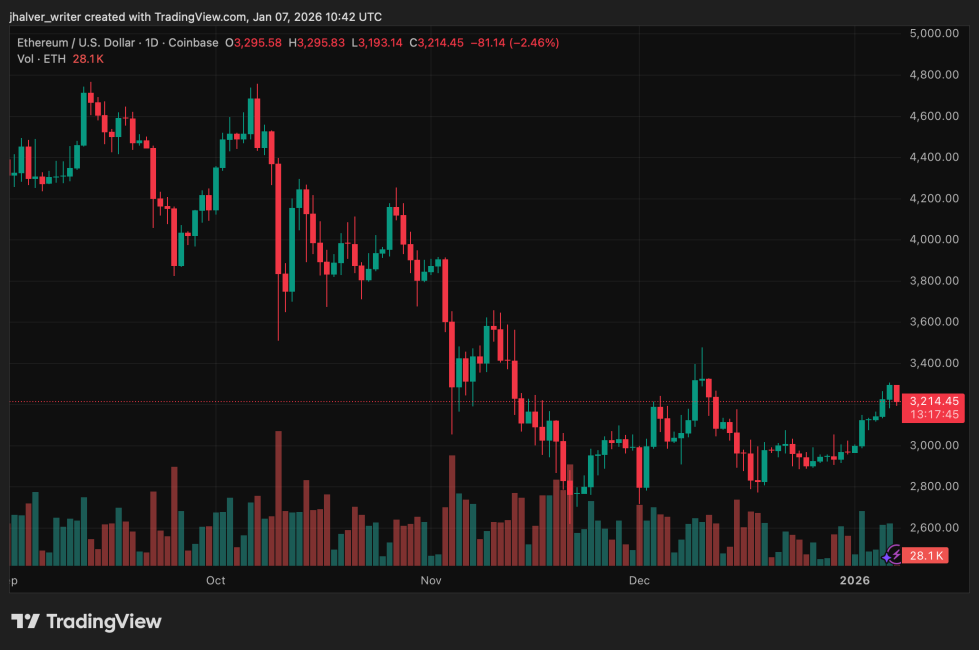
ETH's price moving sideways on the daily chart. Source: ETHUSD on Tradingview

The Case for Regulated Tokenized Cash

Barclays said the investment aligns with its broader work on “new forms of digital money,” emphasizing that any development would sit within existing regulatory boundaries.

The bank did not disclose the size of its stake or Ubyx’s valuation. However, the decision places Barclays among a growing list of large financial institutions seeking exposure to stablecoin rails without directly issuing tokens or operating outside compliance frameworks.

The bank’s interest is not new. In October, Barclays joined a group of global lenders, including Goldman Sachs and UBS, to explore the issuance of a jointly backed stablecoin by G7 currencies.

It has also participated in tokenized deposit pilots and other distributed ledger initiatives, reflecting a cautious but consistent approach to blockchain-based settlement.

Ubyx’s Role in a Crowded Infrastructure Layer

Ubyx positions itself as an intermediary between stablecoin issuers and regulated banks or fintech firms. Its platform supports what it calls universal redemption, allowing businesses to deposit stablecoins from multiple issuers directly into existing accounts at face value.

The startup raised $10 million in seed funding in mid-2025, with backing from Galaxy Ventures, Coinbase Ventures, Founders Fund, and Paxos. Barclays’ entry adds a major UK banking name to that list, blending traditional finance interest with crypto-native capital.

Regulation Support for the Competitive Market

Stablecoins already play a central role in the crypto market’s liquidity, led by Tether, which has approximately $187 billion in circulation.

However, most usage remains inside trading venues. Regulators, including the Bank of England, continue to weigh limits and safeguards to prevent risks such as deposit flight during periods of stress.

That tension defines the current stablecoin race. Banks want faster, programmable settlement. Regulators want control and clear accountability. Infrastructure providers like Ubyx are betting that standardized, compliant clearing can bridge the two worlds, and Barclays’ backing suggests that major lenders are watching closely.

Cover image from ChatGPT, ETHUSD chart from Tradingview

Пов'язані питання

QWhat is the significance of Barclays' investment in Ubyx?

ABarclays' investment in Ubyx marks its first direct move into the stablecoin sector and signals how traditional lenders are approaching stablecoins not as speculative assets, but as infrastructure that could reshape payments and treasury operations if regulation allows.

QWhat does Ubyx do in the stablecoin ecosystem?

AUbyx operates a clearing and settlement layer for stablecoins, aiming to reduce market fragmentation by allowing stablecoins from different issuers and blockchains to be settled and redeemed in a more standardized manner.

QWhich other major financial institutions has Barclays collaborated with regarding stablecoins?

AIn October, Barclays joined a group of global lenders, including Goldman Sachs and UBS, to explore the issuance of a jointly backed stablecoin by G7 currencies.

QWho were the initial backers of Ubyx in its seed funding round?

AUbyx raised $10 million in seed funding in mid-2025 with backing from Galaxy Ventures, Coinbase Ventures, Founders Fund, and Paxos.

QWhat is the main tension in the current stablecoin market according to the article?

AThe main tension is between banks, which want faster, programmable settlement, and regulators, who want control and clear accountability to prevent risks such as deposit flight during periods of stress.

Пов'язані матеріали

In Jinjiang, Fujian, a Storage Super Unicorn Lies Quiet

In Fujian's Jinjiang, a city known for sportswear, lies a quiet semiconductor giant: Fujian Jinhua Integrated Circuit Co. (JHICC). Once a promising domestic DRAM manufacturer alongside Yangtze Memory and ChangXin Memory Technologies (CXMT), its journey was derailed in 2018 when the U.S. placed it on an Entity List and filed criminal charges for alleged trade secret theft. This halted production for years. A turning point came in February 2024 when a U.S. federal court found JHICC not guilty. However, it had lost crucial time. While CXMT soared to become a top-valued A-share company in 2024, JHICC, with an estimated valuation of 80 billion RMB, was just restarting. Its current output is primarily customized DDR4 chips, not the advanced DDR5/HBM demanded for AI, but it still benefits from the broader memory chip upcycle. JHICC's story is tied to Chen Zhengkun, a veteran engineer who left Micron to lead the venture. Founded in 2016 with state-backed funding, JHICC partnered with Taiwan's UMC to develop DRAM technology. Rapid progress was cut short by the U.S. actions, which Micron initiated, partly due to its heavy reliance on the Chinese market. Post-sanctions, Chen's team worked to rebuild the production line with reduced reliance on U.S. technology. According to its records, JHICC achieved small-scale production and revenue growth under immense pressure. It now focuses on the stable "niche" DRAM market (e.g., TVs, routers) with a monthly capacity of ~40,000 wafers, aiming for 60,000 by 2026. It holds over 1,000 patents but remains on the Entity List. For Jinjiang, investing in JHICC was a bold industrial leap. The local government provided unwavering financial and logistical support during the crisis, helping the company survive. JHICC has become the anchor for a growing local semiconductor cluster. Though its scale lags behind domestic peers, JHICC's persistence symbolizes a hard-won foothold in a global market long dominated by Samsung, SK Hynix, and Micron. Having missed one boom, it seeks a place in the new AI-driven memory supercycle.

marsbit1 год тому

In Jinjiang, Fujian, a Storage Super Unicorn Lies Quiet

marsbit1 год тому

Торгівля

Спот
活动图片





