Banks Prepare To Spend $100 Million+ To Stop Crypto Bills, Expert Warns

bitcoinistОпубліковано о 2026-03-11Востаннє оновлено о 2026-03-11

Анотація

The fight over US crypto legislation is intensifying into a direct clash between the digital asset industry and the established banking sector. According to Dennis Porter, CEO of the Satoshi Action Fund, the banking industry is preparing a massive lobbying push, potentially exceeding $100 million, to counteract efforts to advance crypto market structure and stablecoin legislation. Porter warns that this creates a significant counterbalance to crypto lobbying groups and could lead lawmakers to withdraw support. He states that crypto industry faces political challenges, including low public trust and ethical concerns linked to Trump family involvement. Furthermore, market structure legislation is politically difficult as it covers a wide range of complex issues. The banking industry holds an advantage due to its entrenched local influence, including physical branches and jobs in lawmakers' districts. Porter cautions that if the dispute escalates into an open lobbying war, it could jeopardize the already tight Senate vote. He also notes that the legislative window is narrowing as midterm elections approach, with electoral incentives increasingly shaping the calendar.

The fight over US crypto legislation is turning into a direct clash between digital-asset firms and one of Washington’s oldest power centers. In an interview with Pete Rizzo, Satoshi Action Fund founder and CEO Dennis Porter said the banking industry is preparing a nine-figure lobbying push that could complicate efforts to advance both market structure legislation and stablecoin rules.

Crypto’s D.C. Outlook Just Got Darker

Porter said the core dispute is no longer just about whether Congress wants to regulate crypto, but on whose terms. President Donald Trump has publicly backed keeping the GENIUS Act intact, Porter noted, which he described as a positive sign for crypto firms. But he argued that support from the White House does not resolve the deeper standoff with banks, especially around stablecoins and the issue of rewards programs that banks view as a threat to deposits.

“The bank lobby has come out and said that they do plan to spend to counteract the crypto industry,” Porter said. “They said they’re raising nine figures, which is right up there with the Fairshake number. So that does create that counterbalance where they can essentially assert themselves into the ecosystem and start to peel some of these lawmakers off.”

That matters because, in Porter’s telling, crypto is entering the fight without a clean political backdrop. He said Democrats have grown more cautious around digital-asset legislation as Trump family involvement in the sector has raised ethics concerns among both lawmakers and voters.

At the same time, he described market structure as a far more expansive and politically difficult package than stablecoin legislation, since it touches not only securities-versus-commodities questions but also DeFi, illicit finance, ethics provisions and the makeup of the CFTC.

Porter argued that this leaves the legislation exposed to a wider set of objections and delays. He said there is still a path forward if key Democrats become comfortable with revisions, but added that the bill currently lacks a decisive forcing mechanism and has been pushed aside while lawmakers focus on a housing package.

The bank-crypto standoff, he suggested, could become especially dangerous if it turns into an open lobbying war. “If we end up in a situation where they’re directly lobbying against each other, you could see a lot of not just Democrats peel off this bill, but even possibly Republicans peel off this bill as well,” Porter said. “The vote is already tight in the Senate, very tight.”

His reasoning was straightforward: banks bring not just money, but entrenched local influence. Unlike much of crypto, Porter said, banks can point to branches, jobs and long-standing relationships in lawmakers’ districts. That advantage becomes even more important at a time when, by his own account, the industry is struggling politically.

“And also, crypto really is not popular right now,” Porter said. “Public trust in the crypto space is at an all-time low. Something that we’re deeply concerned about at Satoshi Action. Something that definitely needs some work.”

Porter framed that weakness as both a political problem and a policy argument. In his view, one purpose of market structure legislation is precisely to clean out the “crap” and scams that have damaged the sector’s reputation. But until lawmakers see a clearer consumer and political upside, he suggested, crypto firms may have trouble overcoming resistance from incumbents that view stablecoins as an existential threat to their business model.

He was notably cautious on timing. While some analysts have argued the window effectively closes by summer, Porter said the odds decline as the midterms approach but do not disappear entirely. His broader point was that the legislative calendar is being shaped as much by electoral incentives as by the text of the bills themselves.

At press time, the total crypto market cap stood at $2.34 trillion.
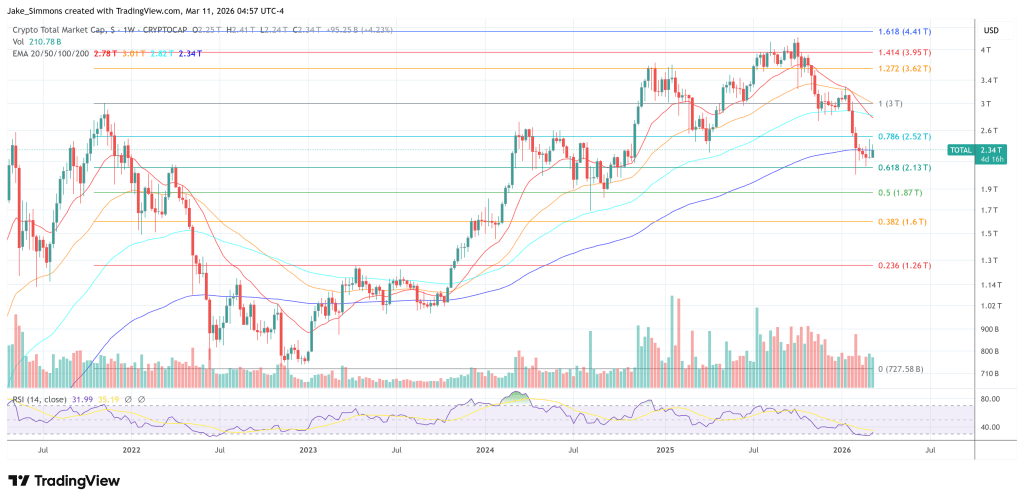
Total crypto market cap, 1-week chart | Source: TOTAL on TradingView.com

Пов'язані питання

QAccording to Dennis Porter, how much money is the banking industry preparing to spend to counteract crypto legislation efforts?

AThe banking industry is preparing to spend a nine-figure sum, which is over $100 million, to lobby against crypto bills.

QWhat are the two main types of US crypto legislation mentioned that are being complicated by this banking push?

AThe two main types of US crypto legislation mentioned are market structure legislation and stablecoin rules.

QWhat reason does Porter give for why banks have a significant advantage in a lobbying war against crypto?

APorter states that banks have an advantage because they bring not just money, but entrenched local influence, including physical branches, jobs, and long-standing relationships in lawmakers' districts.

QWhat does Dennis Porter cite as a major political weakness for the crypto industry in this fight?

AHe cites that 'crypto is not popular right now' and that 'public trust in the crypto space is at an all-time low.'

QBeyond the bank opposition, what other reason is given for why the market structure bill is politically difficult to pass?

AThe market structure bill is described as politically difficult because it is a far more expansive package that touches on securities-vs-commodities questions, DeFi, illicit finance, ethics provisions, and the makeup of the CFTC, leaving it exposed to a wider set of objections.

Пов'язані матеріали

Gensyn AI: Don't Let AI Repeat the Mistakes of the Internet

In recent months, the rapid growth of the AI industry has attracted significant talent from the crypto sector. A persistent question among researchers intersecting both fields is whether blockchain can become a foundational part of AI infrastructure. While many previous AI and Crypto projects focused on application layers (like AI Agents, on-chain reasoning, data markets, and compute rentals), few achieved viable commercial models. Gensyn differentiates itself by targeting the most critical and expensive layer of AI: model training. Gensyn aims to organize globally distributed GPU resources into an open AI training network. Developers can submit training tasks, nodes provide computational power, and the network verifies results while distributing incentives. The core issue addressed is not decentralization for its own sake, but the increasing centralization of compute power among tech giants. In the era of large models, access to GPUs (like the H100) has become a decisive bottleneck, dictating the pace of AI development. Major AI companies are heavily dependent on large cloud providers for compute resources. Gensyn's approach is significant for several reasons: 1) It operates at the core infrastructure layer (model training), the most resource-intensive and technically demanding part of the AI value chain. 2) It proposes a more open, collaborative model for compute, potentially increasing resource utilization by dynamically pooling idle GPUs, similar to early cloud computing logic. 3) Its technical moat lies in solving complex challenges like verifying training results, ensuring node honesty, and maintaining reliability in a distributed environment—making it more of a deep-tech infrastructure company. 4) It targets a validated, high-growth market with genuine demand, rather than pursuing blockchain integration without purpose. Ultimately, the boundaries between Crypto and AI are blurring. AI requires global resource coordination, incentive mechanisms, and collaborative systems—areas where crypto-native solutions excel. Gensyn represents a step toward making advanced training capabilities more accessible and collaborative, moving beyond a niche controlled by a few giants. If successful, it could evolve into a fundamental piece of AI infrastructure, where the most enduring value in the AI era is often created.

marsbit9 год тому

Gensyn AI: Don't Let AI Repeat the Mistakes of the Internet

marsbit9 год тому

Why is China's AI Developing So Fast? The Answer Lies Inside the Labs

A US researcher's visit to China's top AI labs reveals distinct cultural and organizational factors driving China's rapid AI development. While talent, data, and compute are similar to the West, Chinese labs excel through a pragmatic, execution-focused culture: less emphasis on individual stardom and conceptual debate, and more on teamwork, engineering optimization, and mastering the full tech stack. A key advantage is the integration of young students and researchers who approach model-building with fresh perspectives and low ego, prioritizing collective progress over personal credit. This contrasts with the US culture of self-promotion and "star scientist" narratives. Chinese labs also exhibit a strong "build, don't buy" mentality, preferring to develop core capabilities—like data pipelines and environments—in-house rather than relying on external services. The ecosystem feels more collaborative than tribal, with mutual respect among labs. While government support exists, its scale is unclear, and technical decisions appear driven by labs, not state mandates. Chinese companies across sectors, from platforms to consumer tech, are building their own foundational models to control their tech destiny, reflecting a broader cultural drive for technological sovereignty. Demand for AI is emerging, with spending patterns potentially mirroring cloud infrastructure more than traditional SaaS. Despite challenges like a less mature data industry and GPU shortages, Chinese labs are propelled by vast talent, rapid iteration, and deep integration with the open-source community. The competition is evolving beyond a pure model race into a contest of organizational execution, developer ecosystems, and industrial pragmatism.

marsbit11 год тому

Why is China's AI Developing So Fast? The Answer Lies Inside the Labs

marsbit11 год тому

3 Years, 5 Times: The Rebirth of a Century-Old Glass Factory

Corning, a 175-year-old glass company, is experiencing a dramatic revival as a key player in AI infrastructure, driven by surging demand for high-performance optical fiber in data centers. AI data centers require vastly more fiber than traditional ones—5 to 10 times as much per rack—to handle high-speed data transmission between GPUs. This structural demand shift, coupled with supply constraints from the lengthy expansion cycle for fiber preforms, has created a significant supply-demand gap. Nvidia has invested in Corning, along with Lumentum and Coherent, in a $4.5 billion total commitment to secure the optical supply chain for AI. Corning's competitive edge lies in its expertise in producing ultra-low-loss, high-density, and bend-resistant specialty fiber, which is critical for 800G+ and future 1.6T data rates. Its deep involvement in co-packaged optics (CPO) with partners like Nvidia further solidifies its position. While not the largest fiber manufacturer globally, Corning's revenue from enterprise/data center clients now exceeds 40% of its optical communications sales, and it has secured multi-year supply agreements with major hyperscalers including Meta and Nvidia. Financially, Corning's optical communications revenue has surged, doubling from $1.3 billion in 2023 to over $3 billion in 2025. Its stock price has risen nearly 6-fold since late 2023. Key future catalysts include the rollout of Nvidia's CPO products and the scale of undisclosed customer agreements. However, risks include high current valuations and potential disruption from next-generation technologies like hollow-core fiber. The company's long-term bet on light over electricity, maintained even through the telecom bubble crash, is now being validated by the AI boom.

marsbit11 год тому

3 Years, 5 Times: The Rebirth of a Century-Old Glass Factory

marsbit11 год тому

Торгівля

Спот
Ф'ючерси
活动图片





