Banks’ Concerns Over Stablecoin Interest Payments Are ‘Totally Absurd’, Circle CEO Says

bitcoinistОпубліковано о 2026-01-23Востаннє оновлено о 2026-01-23

Анотація

Circle CEO Jeremy Allaire dismissed banking industry concerns over interest payments on stablecoins as "totally absurd," arguing that fears of massive deposit flight are unfounded. Speaking at the World Economic Forum, he compared stablecoin rewards to other common financial products like credit cards, emphasizing their role in customer engagement rather than systemic risk. Allaire countered bank claims that stablecoins could drain up to $6 trillion in deposits, noting that similar concerns emerged with money market funds yet lending continued unaffected. He highlighted the shift toward private credit and capital markets, asserting that stablecoins should function as safe, regulated cash instruments while lending evolves independently through new models.

The CEO of stablecoin issuer Circle has weighed in on the importance of stablecoin rewards and why he believes the banking industry’s concerns about interest payments on these assets are “absurd.”

Circle CEO Rejects Banks’ Stablecoin Fears

Speaking at the World Economic Forum (WEF) in Davos, Circle’s CEO, Jeremy Allaire, discussed banks’ growing concerns that paying interest on stablecoins poses a threat to the industry, calling the deposit flight narrative “totally absurd.”

The banking sector has expressed concerns about stablecoin rewards, arguing that interest payments will distort market dynamics and affect credit creation. In the US, banks have heavily criticized the GENIUS Act, claiming that it has loopholes that could pose risks to the financial system.

The executive rejected the sector’s general arguments, citing historical and practical reasons. He asserted that this exact argument has been historically used when new financial products, such as government money market funds, have emerged.

Notably, Bank of America CEO Brian Moynihan recently compared the digital assets to money market mutual funds, which require reserves to be held in short-term instruments, such as US Treasuries, reducing lending capacity in the system.

The executive told investors that the banking sector, small- and medium-sized businesses in particular, could face significant challenges if the US Congress does not prohibit interest-bearing stablecoins, as up to $6 trillion in deposits, or 30% to 35% of all US commercial bank deposits, could flow out of the banking system and into the stablecoin sector.

However, Allaire pointed out that, despite institutions claiming that financial products would “draw all the deposit base,” their growth has not “stopped the ability for lending to happen.”

The importance Of Rewards

Circle’s CEO also argued that stablecoins should not be singled out when rewards for other financial products exist and contribute to the system. “Those rewards (...) exist in every balance that you have with a credit card that you use. They exist around so many other financial products and services that we have,” he detailed.

“These rewards are actually very important,” Allaire continued. “They help with stickiness, they help with customer traction. They are not themselves like these huge monetary policy dampers.”

Most importantly, he pointed out that lending is moving away from the risk-taking of banks, with “a huge amount of lending is moving towards private credit.”

He cited a Wednesday WEF panel, in which a capital markets participant highlighted how the vast majority of GDP growth in the United States was “formed by capital market formation around junk bonds.”

“So private credit issuing junk bonds, capitalizing the build out of the American technology advancements, not bank credit,” the executive added.

Previously, Coinbase Institute shared a similar argument, affirming that “credit is evolving, not shrinking. Lending is shifting to private credit, fintech, and DeFi channels that don’t depend on deposits. Liquidity moves—it doesn’t vanish.”

Allaire concluded that “we want stablecoin money to be cash instrument money, prudentially supervised, very, very safe money. And then I think what we want to do is we want to build models for lending that build on top of stablecoins.”
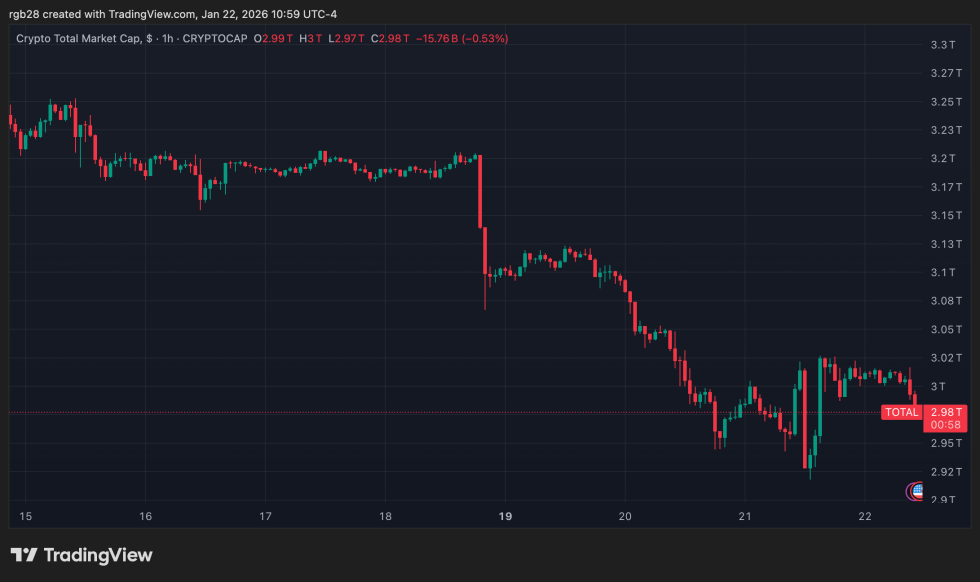
The total crypto market capitalization is at $2.98 trillion in the one-week chart. Source: TOTAL on TradingView


Пов'язані питання

QWhat is Circle CEO Jeremy Allaire's view on banks' concerns about interest payments on stablecoins?

AJeremy Allaire calls the banking industry's concerns about interest payments on stablecoins 'totally absurd' and rejects the narrative that they pose a threat to the industry or will cause significant deposit flight.

QAccording to the banking sector, what risk does the GENIUS Act pose?

ABanks have criticized the GENIUS Act, claiming it has loopholes that could distort market dynamics, affect credit creation, and pose risks to the overall financial system.

QWhat historical financial product does Allaire compare stablecoins to when refuting the banks' arguments?

AAllaire compares stablecoins to government money market funds, which also faced similar criticisms when they emerged, yet their growth did not stop the ability for lending to happen.

QHow much in bank deposits could potentially flow into the stablecoin sector according to the concerns raised by bank executives?

ABank executives warned that up to $6 trillion in deposits, or 30% to 35% of all US commercial bank deposits, could flow out of the banking system and into the stablecoin sector if interest-bearing stablecoins are not prohibited.

QWhere does Jeremy Allaire argue that lending is increasingly moving towards?

AAllaire argues that a huge amount of lending is moving away from traditional banks and towards private credit, fintech, and DeFi channels, citing the growth of the junk bond market as an example of capital formation that doesn't rely on bank credit.

Пов'язані матеріали

Popular Interaction Collection | Interstate Launches Points Event; Flip Early Waitlist Application (June 12)

**Interstate Launches Points Event, Flip Opens Early Waitlist Applications** *Originally published by Odaily Planet Daily, author Asher.* **Interstate**, an infrastructure platform integrating on-chain transactions for assets like Meme tokens, prediction markets, and xStocks, has launched a points event. Each trade on the platform now rewards users with points. The project has completed a $1.5 million seed round from investors including MH Ventures, Alchemy Ventures, and Marshland Capital. Users can visit the official website to connect their wallets and start earning points through trading tasks (note: the site may experience high traffic). **Flip**, an AI-powered financial assistant, has opened applications for its early waitlist. The platform allows users to manage finances via chat, helping with spending tracking, bill management, investment portfolio monitoring (including stocks and crypto), and more. Flip recently raised $1.4 million in a pre-seed round led by The House Fund and participated in a16z's Speedrun accelerator. Interested users can join the waitlist via the official website. **ArcNova**, an AI-native infrastructure platform for short-form video and entertainment, continues to offer tasks for earning points. Users can sign in daily, complete social and app tasks, and refer friends to accumulate points. The project announced a $15 million funding round in May, backed by Adaverse Ventures, Animoca Brands, and others. The task portal is accessible through the ArcNova website. These updates highlight ongoing opportunities for user engagement and potential rewards across emerging crypto and AI projects.

Odaily星球日报29 хв тому

Popular Interaction Collection | Interstate Launches Points Event; Flip Early Waitlist Application (June 12)

Odaily星球日报29 хв тому

MoneyGram: Why Did We Launch Our Own Stablecoin?

MoneyGram, a global leader in cross-border remittances for over 80 years, has launched its own stablecoin, MGUSD. The initiative aims to evolve from single-transaction services to becoming a more integral part of users' financial lives. By allowing customers to hold a stable US dollar balance within the MoneyGram app, MGUSD enables not only remittances but also everyday spending, currency exchange, cash access, and future financial services. Targeting the billions globally who face challenges like currency volatility or lack of bank accounts, MGUSD leverages Stellar blockchain technology with a self-custody wallet architecture. This gives users control over their assets while providing a secure, compliant experience through a trusted brand. The approach focuses on solving existing customer pain points within MoneyGram's established network, rather than competing for broad crypto market liquidity. A key advantage is MoneyGram's hybrid model, combining digital services with the world's largest physical network for crypto-to-cash conversions. The stablecoin also modernizes the company's internal infrastructure, streamlining treasury management and partner settlements, with annual forex volume via stablecoins already reaching $2 billion. The project was delivered in about a year, driven by a reorganization into agile, cross-functional teams that operate with startup-like speed while leveraging decades of institutional expertise. Partners include Stablecoin (issuance), Crossmint (wallet APIs), Fireblocks (enterprise treasury), m0 (smart contracts), and the Stellar network. MoneyGram emphasizes that enhancing direct consumer offerings strengthens its partner ecosystem. The future direction is clear: to provide users worldwide with stable value storage, better financial tools, and greater control over their funds through a trusted, existing network.

Foresight News1 год тому

MoneyGram: Why Did We Launch Our Own Stablecoin?

Foresight News1 год тому

Торгівля

Спот
Ф'ючерси
活动图片




