Banks Advance Plans to Create Stablecoins as Bank for International Settlements Questions Their Role

cryptonews.ruОпубліковано о 2026-08-29Востаннє оновлено о 2026-08-29

Анотація

While the Bank for International Settlements (BIS) argues that stablecoins lack key properties to function as money at scale, major global banks are actively developing their own stablecoin plans on public blockchains. BIS head Pablo Hernández de Cos advocates for tokenized bank deposits as a superior foundation for modern digital payments, citing issues with stablecoins regarding uniformity, interoperability, and financial integrity. These problems include exchange rate fluctuations between different stablecoins, settlement complexities across fragmented blockchains, and anonymity concerns. Despite these warnings, a consortium of over a dozen major banks, including Bank of America and Citi, is preparing to launch a bank-issued stablecoin. This shift is driven by competitive pressure and regulatory changes like the GENIUS Act, with banks fearing potential deposit outflows to crypto-native issuers. Data shows stablecoin transaction volumes are massive, but a small fraction represents real-economy payments. While central banks prefer tokenized deposits for core payments, commercial banks increasingly see a strategic need for stablecoins to retain relevance, even as some, like JPMorgan, currently deny having imminent launch plans.

Despite the Bank for International Settlements (BIS) chief's view that stablecoins cannot be considered money on a large scale, the world's largest banks are moving financial settlements and regular transactions onto public blockchains.

Speaking at the Economic Symposium in Jackson Hole on August 28, BIS General Manager Pablo Hernández de Cos stated that a system based on tokenized deposits "looks more promising" than stablecoins. BIS representatives emphasized that tokenized deposits should form the foundation of modern digital payment systems as banks transition their operations to blockchain.

For banks, the dilemma is straightforward: should they adopt blockchain now, or wait for regulators to approve a more technologically advanced version of this innovative solution?

Where Stablecoins Fall Apart, According to de Cos

De Cos's argument centers on three properties he says money must possess: uniformity, interoperability, and financial integrity.

Regarding uniformity, he gave a simple example. If one person holds Tether's $USDT tokens and wants to transfer money to a recipient who only accepts Circle's $USDC tokens, that person would first have to sell $USDT and buy $USDC. However, since the coins' prices can fluctuate on the market, the final transfer amount might not equal one US dollar. The system does not guarantee that two stablecoins will exchange one-for-one.

The interoperability issue creates another problem. Most fiat-backed stablecoins operate on fragmented, permissionless public blockchains and scaling layers. Even a request to transfer the same stablecoin issued on different blockchains from one chain to another requires performing complex—and sometimes costly—procedures.

In contrast, the settlement process for tokenized deposits involves using central bank accounts, as de Cos noted, preserving the nominal redeemability and finality of such deposits.

The Integrity Issue BIS Keeps Returning To

The third issue is financial integrity. According to de Cos, information shows that most stablecoins are currently held in self-custodied wallets and that an increasing number of transfers between blockchain wallets are conducted without any platform performing "Know Your Customer" (KYC) checks. This is vastly different from traditional finance, where bank deposits, the least anonymous form of money, predominate.

In its Annual Economic Report on June 23, the Bank for International Settlements (BIS) presented a similar viewpoint. In the section on stablecoins, it went so far as to state that existing stablecoin designs "do not meet the fundamental properties of money and threaten financial integrity."

Furthermore, the research expressed concern about the concept of "stablecoin dollarization" in developing countries, where the demand for foreign stablecoins could impact capital flows and reduce their monetary sovereignty.

What Payment Data Actually Shows

The discussion on scale is backed by significant figures.

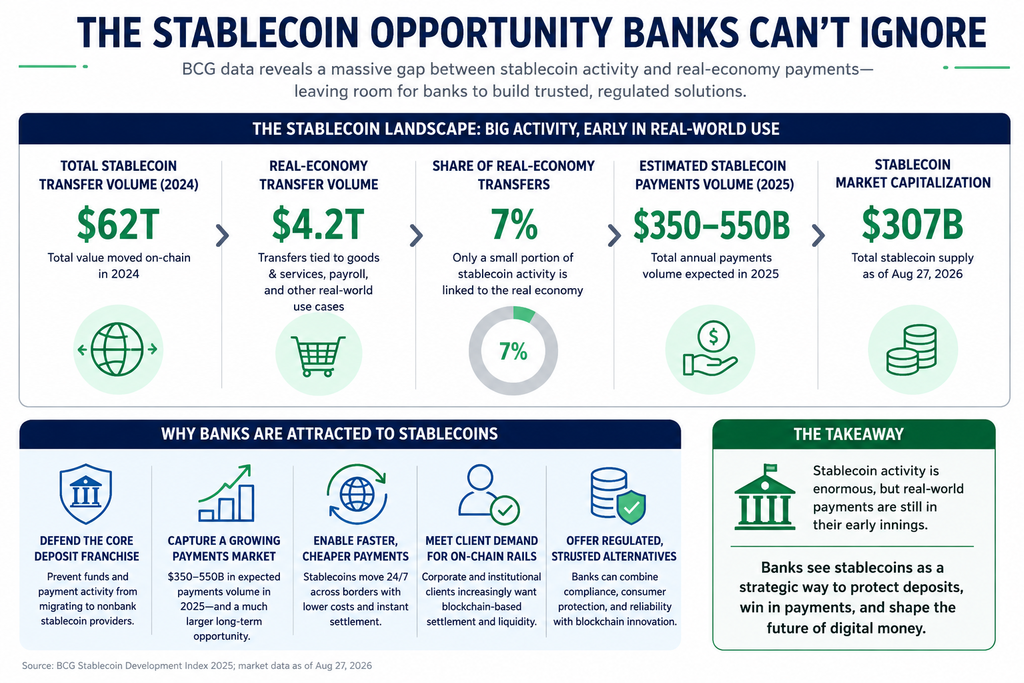
According to an analytical report published in January 2026 by Boston Consulting Group (BCG) and blockchain data analytics firm Allium, over $62 trillion worth of stablecoin transactions occurred on public blockchains in a year. However, of this amount, only about $4.2 trillion (approximately 7% of the total) represented payments made in the real economy.

BCG estimated the observed volume of bilateral payments for goods and services in 2025 to be between $350 and $550 billion, which they termed a minimal figure. Additionally, the article noted that the stablecoin market capitalization grew to $307 billion by December 2025.

Why Are Banks Shifting Policy at All?

These warnings have not stopped banks from moving towards blockchain adoption.

On August 28, Forkast reported that a consortium of over 12 global banks, including Bank of America, Wells Fargo, Santander, Citi, Goldman Sachs, and UBS, is preparing to issue its own stablecoin on public blockchains, rather than leaving the market to Tether and Circle.

The GENIUS Act, which took effect on July 18, 2025, was a legislative measure allowing banks to access the federal level through subsidiaries approved by the Office of the Comptroller of the Currency (OCC), although it prohibited issuers from paying any interest to holders.

Bank of America CEO Brian Moynihan warned that up to $6 trillion in deposits could be withdrawn from banks if stablecoin issuers were allowed to offer yields.

"If it is legalized, we will engage in this business."

Smaller lending institutions are also adopting new technologies. Cryptopolitan reported that 39 state bankers' associations have formed the BankChain Alliance, set to launch in 2027. This initiative aims to provide local banks with shared access to tokenized deposits and stablecoins without relying on crypto platforms.

Are Banks Moving from Research to Creating a Joint Stablecoin?

Today's article in the Seoul Economic Daily states that a major banking group is considering initially issuing a dollar-pegged token, with subsequent expansion to G7 currencies. It also highlights the strategic reason: banks fear stablecoins could divert deposits away from traditional banks.

Feature Stablecoins Tokenized Deposits
What is it? Digital tokens designed to maintain a stable value relative to a reference asset, typically the US dollar. Digital representation of ordinary commercial bank deposits on a programmable ledger.
Issuer Typically a private stablecoin issuer. Commercial bank.
Holder's Claim Claim on the stablecoin issuer's/reserve structure. Direct claim on the issuing bank.
Backing Typically reserves like cash, central bank reserves, Treasury bonds, or other permitted assets. Ultimately, the bank's deposit obligations are part of the banking system.
Redeemability Intended for redemption at $1, but secondary market prices may deviate from par. Exchanges at par as a bank deposit/claim.
Settlement Transfers between token holders on blockchain networks. Payment results in debiting one bank account and crediting another, with interbank settlement ultimately using central bank money.
Blockchain Often public/permissionless networks. Typically permissioned/controlled bank platforms, though hybrid models are possible.
Interoperability Can be fragmented across issuers and blockchains. Higher fungibility achieved when using tokenized central bank reserves.
AML/KYC May involve anonymous wallets and self-custody. Account ownership and activities within regulated bank infrastructure.
Bank Deposits Could potentially divert funds away from banks. Secures deposits within the banking system.
Main Advantage Global reach, programmability, and 24/7 transfer capability. Programmability while preserving the existing bank/central bank monetary structure.
BIS's Preferred Role Specialized uses, not the basis for everyday payments. Handling large daily payments and wholesale settlements.
Current Examples $USDT, $USDC, and other fiat-backed tokens. JPMorgan's deposit token model and other bank tokenization projects.
The differences between stablecoins and tokenized deposits are structural, not merely numerical. | BIS

Central banks want to see tokenized deposits and central bank money at the heart of the blockchain economy, while commercial banks are increasingly concluding that they also need stablecoins. Notably, JPMorgan's position remains that the company has no current plans to issue a stablecoin.

end-content

Трендові криптовалюти

Пов'язані питання

QAccording to the head of the BIS, what are the three properties that money should have, and how do stablecoins fail to meet them?

AAccording to the head of the BIS, Pablo Hernández de Cos, the three properties money should have are unity (uniqueness), compatibility (interoperability), and financial integrity. He argues stablecoins fail because: 1) Different stablecoins like USDT and USDC are not guaranteed to exchange at a 1:1 rate (unity). 2) They operate on fragmented, permissionless blockchains, making cross-chain transfers complex (compatibility). 3) Many are held in self-custody wallets with limited KYC checks, raising concerns about financial integrity versus traceable bank deposits.

QWhat is the Bank for International Settlements' (BIS) preferred model for the foundation of modern digital payment systems, and why?

AThe BIS prefers a system based on tokenized bank deposits as the foundation for modern digital payment systems. They argue this model is more promising than one based on stablecoins because tokenized deposits utilize central bank accounts for settlement, preserving nominal redemption and finality. This approach maintains the existing monetary structure, ensures financial integrity through bank-level AML/KYC, and prevents potential disintermediation of commercial bank deposits.

QDespite the BIS's warnings, why are major global banks reportedly planning to issue their own stablecoin on public blockchains?

AMajor global banks are reportedly planning to issue their own stablecoin on public blockchains to prevent deposits from being drained away by private stablecoin issuers like Tether and Circle. They fear that if these private issuers are allowed to offer yield, trillions in deposits could leave the traditional banking system. The passing of the GENIUS law, which allows banks to access the public blockchain space via OCC-approved subsidiaries (though without paying interest), is a key factor enabling this strategic move.

QWhat does the data from Boston Consulting Group (BCG) and Allium reveal about the volume of stablecoin transactions versus payments in the real economy?

AData from BCG and Allium reveals a significant gap between total stablecoin transaction volume and real-economy payments. They estimated that over $62 trillion worth of stablecoin transactions occurred on public blockchains in a year. However, only about $4.2 trillion (approximately 7% of the total) constituted payments made within the real economy. The observed volume of bilateral payments for goods and services in 2025 was estimated to be between $350 billion and $550 billion, which they termed a minimal figure.

QAccording to the article's comparison table, what is a key structural difference between the holder's claim in a stablecoin versus a tokenized deposit?

AA key structural difference is the nature of the holder's claim. For a stablecoin, the holder has a claim on the stablecoin issuer's reserve structure. For a tokenized deposit, the holder has a direct claim on the issuing commercial bank itself, just like a traditional bank deposit. This makes tokenized deposits an integral part of the existing banking system, whereas stablecoins represent a claim on an external, often private, entity.

Пов'язані матеріали

Ripple (XRP) Company Announces Plans for Major Future Update

Ripple (XRP) has announced a four-phase plan to prepare the XRP Ledger (XRPL) for future security threats posed by quantum computers. The company's senior director of engineering stated the goal is to build necessary infrastructure before quantum computers become a direct threat, aiming to minimize impact on existing systems, user assets, and network operations. The plan begins with identifying potential quantum vulnerabilities within XRPL, followed by testing quantum-resistant cryptographic methods. The next phase involves parallel testing of existing security mechanisms and new quantum-resistant solutions to ensure reliability and prevent disruption for users and applications. The final phase would involve transitioning the XRPL to more comprehensive, quantum-resistant security standards if the technology matures. Ripple is also developing contingency plans for a faster-than-expected advancement of quantum computing, which could accelerate the transition timeline. A current XRPL feature allowing users to change the keys controlling their accounts without altering the accounts themselves is seen as a potential advantage in any future migration. However, Ripple cannot unilaterally change transaction validation rules or network-wide cryptographic standards; such updates require coordination and approval from independent validators via XRPL's governance process. While quantum computers are not yet capable of breaking the cryptography used by major blockchains like Bitcoin or XRPL, developers across the industry are already evaluating transition scenarios to quantum-resistant algorithms due to the long-term risks they pose to public-key cryptography.

cryptonews.ru16 хв тому

Ripple (XRP) Company Announces Plans for Major Future Update

cryptonews.ru16 хв тому

Торгівля

Спот

Популярні статті

Що таке $BANK

Bank AI: Революційний крок у майбутнє банківської справи Вступ В епоху, що характеризується швидкими технологічними змінами, Bank AI знаходиться на перетині штучного інтелекту (ШІ) та банківських послуг. Цей інноваційний проєкт прагне переосмислити фінансовий ландшафт, підвищуючи ефективність роботи, заходи безпеки та досвід клієнтів завдяки потужності ШІ. Розпочинаючи дослідження Bank AI, ми заглибимося в суть проєкту, його операційні динаміки, історичний контекст і значущі етапи. Що таке Bank AI? У своїй основі Bank AI представляє собою трансформаційну ініціативу, спрямовану на інтеграцію штучного інтелекту в різні банківські операції. Цей проєкт використовує можливості ШІ для автоматизації процесів, покращення протоколів управління ризиками та підвищення взаємодії з клієнтами через персоналізовані послуги. Основні цілі Bank AI включають: Автоматизація банківських функцій: Використовуючи технології ШІ, Bank AI прагне автоматизувати рутинні завдання, зменшуючи навантаження на людські ресурси та підвищуючи ефективність. Покращене управління ризиками: Проєкт використовує алгоритми ШІ для прогнозування та виявлення ризиків, тим самим зміцнюючи заходи безпеки проти шахрайства та інших загроз. Персоналізація банківських послуг: Bank AI зосереджується на пропозиції індивідуальних фінансових продуктів і послуг, аналізуючи дані і поведінку клієнтів. Покращення досвіду клієнтів: Впровадження рішень на основі ШІ, таких як чат-боти та віртуальні асистенти, має на меті забезпечити користувачам більш природну взаємодію, революціонізуючи спосіб, яким клієнти спілкуються з банками. З цими цілями Bank AI займає важливу роль в робленні банківської справи більш ефективною, безпечною та орієнтованою на користувача. Хто є творцем Bank AI? Деталі стосовно творця Bank AI залишаються невідомими. Таким чином, жодна конкретна особа або організація не були ідентифіковані в доступній інформації. Анонімність навколо створення проєкту піднімає питання, але це не зменшує його амбітного бачення та цілей. Хто є інвесторами Bank AI? Аналогічно творцеві проєкту, конкретна інформація стосовно інвесторів або організацій, що підтримують Bank AI, не була розкрито. Без цієї інформації важко окреслити фінансову підтримку та інституційну підтримку, які могли б сприяти розвитку проєкту. Тим не менше, важливість наявності міцної інвестиційної бази є вирішальною для забезпечення розвитку в такій інноваційній сфері. Як працює Bank AI? Bank AI функціонує на кількох інноваційних фронтах, фокусуючись на унікальних факторах, які відрізняють його від традиційних банківських структур. Нижче наведено ключові операційні характеристики: Автоматизація: Застосовуючи алгоритми машинного навчання, Bank AI автоматизує різні ручні процеси в банках. Це призводить до зниження операційних витрат і дозволяє працівникам перенаправити свої зусилля на більш стратегічні завдання. Покращене управління ризиками: Інтеграція ШІ в практики управління ризиками забезпечує банки інструментами для точного прогнозування потенційних загроз, таких як шахрайство, забезпечуючи при цьому безпеку інформації і активів клієнтів. Індивідуальні фінансові рекомендації: Завдяки безперервному навчанню з інтерaktionen з клієнтами, системи ШІ розвивають тонке розуміння потреб користувачів, що дозволяє їм пропонувати персоналізовані поради щодо фінансових рішень. Покращені взаємодії з клієнтами: Використовуючи чат-ботів і віртуальних асистентів на базі ШІ, Bank AI дозволяє створити більш залучений досвід для клієнтів, дозволяючи користувачам швидше отримувати відповіді на свої запитання, зменшуючи час очікування та підвищуючи рівень задоволеності. Разом ці операційні характеристики позиціонують Bank AI як піонера в банківському секторі, встановлюючи нові стандарти для надання послуг і операційної досконалості. Хронологія Bank AI Для розуміння траєкторії Bank AI необхідно ознайомитися з його історичним контекстом. Нижче наведено хронологію, що підкреслює важливі етапи та розробки: Ранні 2010-ті: Концептуалізація інтеграції ШІ в банківські послуги почала привертати увагу, коли банківські установи визнали потенційні переваги. 2018: Відбулося помітне збільшення впровадження технологій ШІ, коли банки почали використовувати інструменти ШІ, такі як чат-боти для базового обслуговування клієнтів та системи управління ризиками для покращення безпеки. 2023: Софістикація ШІ продовжувала розвиватися, з введенням генеративного ШІ для більш складних завдань, таких як обробка документів і аналіз інвестицій в реальному часі. Цей рік став важливим стрибком у можливостях, які забезпечує технологія ШІ для банків. 2024-актуальний статус: Станом на цей рік, Bank AI знаходиться на зростаючій траєкторії, з постійними дослідженнями та розробками, які готові подальше покращити можливості в банківських операціях. Продовження дослідження застосувань ШІ натякає на захоплюючі події, які ще попереду. Ключові моменти про Bank AI Інтеграція ШІ в банківську справу: Bank AI зосереджується на прийнятті штучного інтелекту для оптимізації банківських процесів та покращення досвіду користувачів. Автоматизація та фокус на управлінні ризиками: Проєкт сильного підкреслює ці сфери, прагнучи зshift тягар рутинних завдань, водночас підвищуючи безпеку через прогнозну аналітику. Персоналізовані банківські рішення: Завдяки використанню даних клієнтів, Bank AI забезпечує персоналізовані банківські послуги, що відповідають потребам окремих користувачів. Прихильність до розвитку: Bank AI залишається відданим постійним дослідженням і розробкам, що забезпечують його адаптацію та постійну актуальність у міру того, як технології продовжують розвиватися. Висновок Підсумовуючи, Bank AI є важливим кроком вперед у банківській індустрії, використовуючи штучний інтелект для переформатування операційних парадигм, підвищення безпеки та сприяння задоволеності клієнтів. Незважаючи на прогалини в інформації щодо творця та інвесторів, чіткі цілі і функціональні механізми Bank AI забезпечують міцну основу для його подальшої еволюції. Оскільки технологія ШІ продовжує розвиватися та інтегруватися в банківський сектор, Bank AI має всі шанси суттєво вплинути на майбутнє фінансових послуг, покращуючи спосіб, яким ми розуміємо та взаємодіємо з банківською справою.

367 переглядів усьогоОпубліковано 2024.04.06Оновлено 2024.12.03

Що таке $BANK

Як купити BANK

Ласкаво просимо до HTX.com! Ми зробили покупку Lorenzo Protocol (BANK) простою та зручною. Дотримуйтесь нашої покрокової інструкції, щоб розпочати свою криптовалютну подорож.Крок 1: Створіть обліковий запис на HTXВикористовуйте свою електронну пошту або номер телефону, щоб зареєструвати обліковий запис на HTX безплатно. Пройдіть безпроблемну реєстрацію й отримайте доступ до всіх функцій.ЗареєструватисьКрок 2: Перейдіть до розділу Купити крипту і виберіть спосіб оплатиКредитна/дебетова картка: використовуйте вашу картку Visa або Mastercard, щоб миттєво купити Lorenzo Protocol (BANK).Баланс: використовуйте кошти з балансу вашого рахунку HTX для безперешкодної торгівлі.Треті особи: ми додали популярні способи оплати, такі як Google Pay та Apple Pay, щоб підвищити зручність.P2P: Торгуйте безпосередньо з іншими користувачами на HTX.Позабіржова торгівля (OTC): ми пропонуємо індивідуальні послуги та конкурентні обмінні курси для трейдерів.Крок 3: Зберігайте свої Lorenzo Protocol (BANK)Після придбання Lorenzo Protocol (BANK) збережіть його у своєму обліковому записі на HTX. Крім того, ви можете відправити його в інше місце за допомогою блокчейн-переказу або використовувати його для торгівлі іншими криптовалютами.Крок 4: Торгівля Lorenzo Protocol (BANK)Легко торгуйте Lorenzo Protocol (BANK) на спотовому ринку HTX. Просто увійдіть до свого облікового запису, виберіть торгову пару, укладайте угоди та спостерігайте за ними в режимі реального часу. Ми пропонуємо зручний досвід як для початківців, так і для досвідчених трейдерів.

1.0k переглядів усьогоОпубліковано 2025.05.09Оновлено 2026.06.02

Як купити BANK

Обговорення

Ласкаво просимо до спільноти HTX. Тут ви можете бути в курсі останніх подій розвитку платформи та отримати доступ до професійної ринкової інформації. Нижче представлені думки користувачів щодо ціни BANK (BANK).

活动图片