Banking Lobby Digs In Against Landmark Crypto Bill as $SUBBD Gains Ground

bitcoinistОпубліковано о 2026-02-11Востаннє оновлено о 2026-02-11

Анотація

A powerful banking coalition, including the ABA and BPI, is lobbying against the landmark FIT21 crypto bill, claiming it creates regulatory gaps and risks, despite its aim to provide clearer rules. This resistance highlights a power struggle, as traditional finance sees crypto and DeFi as threats to its dominance. The resulting regulatory uncertainty is pushing users toward decentralized alternatives. This centralization problem extends beyond finance to the $191B content creation industry, where high fees and platform control are common. SUBBD Token ($SUBBD) emerges as a Web3 solution, offering creators decentralized earnings through subscriptions, NFTs, and AI tools, while giving fans participation via token-gated content and staking. The project's presale has raised over $1.4 million, signaling strong interest in a decentralized model for creators. With a fixed 20% APY for staking, it incentivizes early adoption. Regulatory gridlock may ironically fuel SUBBD's growth, as users seek transparent, fair platforms outside traditional control.

As Washington grapples with regulating digital assets, a powerful banking coalition just drew a line in the sand against the landmark Financial Innovation and Technology for the 21st Century Act (FIT21). It’s a move that highlights the growing schism between traditional finance and crypto, a conflict that’s inadvertently pushing users toward projects operating completely outside the old guard’s control.

The banking groups involved did release a statement after the meeting, despite not moving forward, but it didn’t outline the next steps.

In a recent letter to Senate leadership, the American Bankers Association (ABA) and the Bank Policy Institute (BPI), among others, urged lawmakers to kill the bill, even after it passed the House with surprising bipartisan support. Why the pushback? They claim FIT21 would create regulatory gaps, undermine existing securities laws, and expose consumers to undue risk. The bill itself is designed to do the opposite: establish a clearer framework for digital assets by finally delineating the jurisdictions of the SEC and CFTC.

Let’s be clear: this resistance isn’t just about policy. It’s about power. The banking sector sees the burgeoning crypto ecosystem, especially stablecoins and DeFi, as a direct threat to its long-held dominance over finance.

By lobbying against regulatory clarity, they perpetuate the very uncertainty that stifles mainstream adoption. And the second-order effect? It pushes innovation and user interest right into the arms of decentralized platforms that promise to bypass the gatekeepers altogether. While titans debate, builders build.

SUBBD Emerges as an Answer to Centralized Control

This battle in Washington underscores a problem that goes way beyond finance: the pitfalls of centralization. Sound familiar? The same dynamics, exorbitant fees, censorship, and arbitrary rule changes, plaguing traditional banking, are just as rampant in the $191B content creation industry. Platforms like YouTube, Twitch, and OnlyFans can slash creator earnings with fees as high as 70%, all while holding the power of sudden de-platforming over their heads.

This is the exact friction point that SUBBD Token ($SUBBD) was built to solve. It’s a Web3-native alternative that merges a decentralized ethos with powerful AI tools, aiming to become the ultimate hub for the modern creator.

The platform tackles the industry’s biggest pain points head-on, offering creators multiple ways to earn, from subscriptions and tipping to NFT sales, all within a transparent ecosystem on Ethereum.

What most coverage misses is the parallel here. The banking lobby fears disintermediation, and frankly, the creator economy is more than ready for it. SUBBD’s entire architecture is designed to hand power back to the user. It integrates an AI Personal Assistant for automating fan interactions, AI voice cloning, and even the ability to launch fully AI-driven influencers.
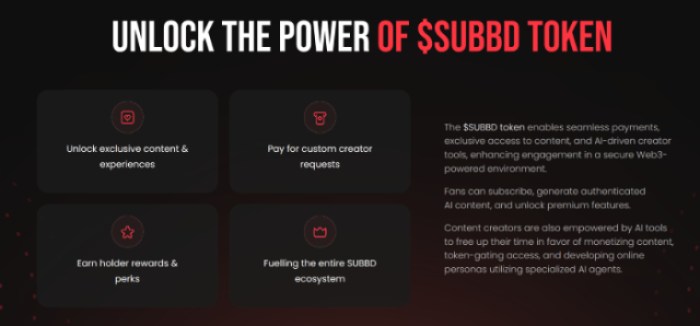
For fans, the platform isn’t just about consumption; it’s about participation through token-gated content and staking rewards. It creates a symbiotic economy where both sides win, without a middleman taking an outrageous cut.

CHECK OUT THE $SUBBD TOKEN ON ITS PRESALE PAGE

Presale Momentum Signals a Shift in Creator and Fan Sentiment

The market’s appetite for a decentralized fix is becoming undeniable. The ongoing SUBBD Token presale has already pulled in over $1.4 mwith tokens priced at just $0.057495. That kind of early-stage funding isn’t just noise; it’s a clear signal that people believe the creator economy is ripe for a shakeup.

Investors aren’t just buying a token; they’re buying into a whole new model for content ownership. The project’s staking mechanism, which offers a fixed 20% APY for the first year, gives an immediate incentive to get involved.

Stakers get access to exclusive content, livestreams, and other perks, transforming them from passive consumers into active participants. The risk? Well, like any new platform, it all comes down to achieving critical mass, attracting enough great creators and dedicated fans to make the ecosystem thrive.

Ironically, the regulatory gridlock in the U.S. might just be SUBBD’s biggest catalyst. As legacy institutions fight tooth and nail to preserve the status quo, they’re inadvertently making the best possible case for platforms that are transparent and fair by design.

The traction in SUBBD’s presale says it all: creators and users aren’t waiting for permission from Washington or Wall Street anymore. They’re just building a better system themselves. Join the SUBBD Token presale here.

BUY YOUR $SUBBD HERE

This article is for informational purposes only and should not be considered financial advice. All investments in cryptocurrency carry inherent risks, and you should conduct your own research.


Пов'язані питання

QWhat is the main argument made by the banking lobby (ABA and BPI) against the FIT21 Act?

AThe banking lobby argues that the FIT21 Act would create regulatory gaps, undermine existing securities laws, and expose consumers to undue risk.

QAccording to the article, what is the core problem that SUBBD Token ($SUBBD) aims to solve in the content creation industry?

ASUBBD Token aims to solve the problems of exorbitant fees (as high as 70%), censorship, and the risk of sudden de-platforming that creators face on centralized platforms like YouTube and OnlyFans.

QWhat are some of the key AI tools integrated into the SUBBD platform for creators?

AThe SUBBD platform integrates an AI Personal Assistant for automating fan interactions, AI voice cloning, and the ability to launch fully AI-driven influencers.

QHow does the SUBBD platform's staking mechanism work to incentivize users?

AThe staking mechanism offers a fixed 20% APY for the first year, and stakers gain access to exclusive content, livestreams, and other perks, turning them into active participants.

QWhat does the article suggest is the 'second-order effect' of the lobbying efforts against crypto regulation?

AThe second-order effect is that it pushes innovation and user interest toward decentralized platforms that operate outside of traditional financial control, as these platforms promise to bypass the gatekeepers altogether.

Пов'язані матеріали

Podcast Notes | Conversation with GSR Asset Management Head: To Determine if This Crypto Rally is Real, Just Watch the Lending Rates on Aave

Podcast Summary: Dialogue with GSR's Head of Asset Management: To Determine if This Crypto Rally is Real, Just Check Lending Rates on Aave Andy Baehr, Managing Director of Asset Management at GSR, discusses the current crypto market, characterizing it as stuck in a state of "ambivalence" with short-lived, unsustainable rallies. He outlines a simple framework: the market moves between "ambivalence" and "conviction" (sustained upward momentum). Currently, every rally resembles a single-stage rocket booster that quickly fizzles out. Baehr identifies three key signals to watch: 1) DeFi lending rates, 2) the potential passage of the CLARITY Act, and 3) the market forming a consensus on the "Fed hawkish peak." He emphasizes that the most immediate indicator for the sustainability of the recent CPI-triggered rally is the USDC borrowing rate on Aave, currently around 3.75%—close to U.S. Treasury yields. The absence of a credit spread indicates low leverage demand and a lack of market energy. He explains that a healthy, sustained rally requires layered buying pressure. Last year's rally progressed from an ETH short squeeze to crypto-native trader influx and finally to ETF inflows. Currently, this structure is missing. Other potential structural buyers like Digital Asset Treasury (DAT) companies are absent, and ETF flows have proven transient. Baehr notes that while small-cap crypto tokens outperformed large caps in Q2—a potential sign of capitation in major assets—capital is also flowing to more exciting opportunities like AI stocks and tech IPOs, leaving crypto sidelined. Regarding DeFi, he highlights that platforms like Aave provide a clear, real-time signal of leverage demand through their supply/demand-driven interest rates. A significant, sustained rate increase would signal genuine market conviction. He also observes the quiet emergence of fixed-income-like products and vaults in DeFi. On regulation, the probability of the CLARITY Act passing before the August 7th deadline has dropped linearly from 75% to below 40% on Polymarket. Baehr suggests its passage would be treated as a bullish surprise, a potent driver for price movement. However, political hurdles, including ethical clause debates and disclosures about the First Family's crypto profits, remain significant obstacles. Ultimately, the market awaits clarity on the Fed's terminal rate under Chair Warsh. Until the "Fed Solstice"—the point where the market collectively understands the peak of hawkish policy—sustained conviction will be difficult to achieve.

marsbit15 хв тому

Podcast Notes | Conversation with GSR Asset Management Head: To Determine if This Crypto Rally is Real, Just Watch the Lending Rates on Aave

marsbit15 хв тому

7 Months After the Collapse of Huiwang, Southeast Asia's Escrow Platforms Undergo a Major Reshuffle

Following the collapse of Huione Pay—dubbed the "Alipay of Southeast Asia"—seven months ago, the region's underground financial guarantee platform sector is undergoing a significant reshuffle. This power vacuum has been swiftly filled by emerging platforms such as XinBi, Tiger/Navigator, JinBei (renamed JinBo), Dali/Tiancheng, and FullyLight. These platforms, operating largely via Telegram and offering services like escrow for illicit transactions, have absorbed the vast user base and markets left behind by Huione. While positioning themselves as "trust intermediaries," their primary clientele consists of networks involved in online scams, money laundering, illegal gambling, and even human trafficking. For instance, the Tiger/Navigator platform explicitly provides "escrow" services for kidnapping-for-ransom operations ("强押车交易"). Data underscores the immense scale: Huione alone processed over $103 billion in cryptocurrency payments and facilitated over $31 billion through its escrow market before its downfall, linking it to Cambodia's notorious Prince Group. Since its collapse, competitors have seen explosive growth. For example, the XinBi platform has accumulated over $1.6 billion in total USDT revenue, while platforms like NewPay, OkPay (under Dali), and FullyLight Wallet collectively processed over $4.8 billion in USDT in a single year. This ecosystem thrives in regions like Cambodia and Myanmar, where regulatory gaps allow these platforms to act as critical financial infrastructure for sprawling cybercrime industries, from scam compounds to online casinos. The article concludes that the moniker "Southeast Asian Alipay" is a misnomer, obscuring the platforms' fundamental role in enabling serious criminal enterprises rather than representing legitimate financial innovation.

Odaily星球日报1 год тому

7 Months After the Collapse of Huiwang, Southeast Asia's Escrow Platforms Undergo a Major Reshuffle

Odaily星球日报1 год тому

Торгівля

Спот
活动图片




