Banking Lobby Digs In Against Landmark Crypto Bill as $SUBBD Gains Ground

bitcoinistОпубліковано о 2026-02-11Востаннє оновлено о 2026-02-11

Анотація

A powerful banking coalition, including the ABA and BPI, is lobbying against the landmark FIT21 crypto bill, claiming it creates regulatory gaps and risks, despite its aim to provide clearer rules. This resistance highlights a power struggle, as traditional finance sees crypto and DeFi as threats to its dominance. The resulting regulatory uncertainty is pushing users toward decentralized alternatives. This centralization problem extends beyond finance to the $191B content creation industry, where high fees and platform control are common. SUBBD Token ($SUBBD) emerges as a Web3 solution, offering creators decentralized earnings through subscriptions, NFTs, and AI tools, while giving fans participation via token-gated content and staking. The project's presale has raised over $1.4 million, signaling strong interest in a decentralized model for creators. With a fixed 20% APY for staking, it incentivizes early adoption. Regulatory gridlock may ironically fuel SUBBD's growth, as users seek transparent, fair platforms outside traditional control.

As Washington grapples with regulating digital assets, a powerful banking coalition just drew a line in the sand against the landmark Financial Innovation and Technology for the 21st Century Act (FIT21). It’s a move that highlights the growing schism between traditional finance and crypto, a conflict that’s inadvertently pushing users toward projects operating completely outside the old guard’s control.

The banking groups involved did release a statement after the meeting, despite not moving forward, but it didn’t outline the next steps.

In a recent letter to Senate leadership, the American Bankers Association (ABA) and the Bank Policy Institute (BPI), among others, urged lawmakers to kill the bill, even after it passed the House with surprising bipartisan support. Why the pushback? They claim FIT21 would create regulatory gaps, undermine existing securities laws, and expose consumers to undue risk. The bill itself is designed to do the opposite: establish a clearer framework for digital assets by finally delineating the jurisdictions of the SEC and CFTC.

Let’s be clear: this resistance isn’t just about policy. It’s about power. The banking sector sees the burgeoning crypto ecosystem, especially stablecoins and DeFi, as a direct threat to its long-held dominance over finance.

By lobbying against regulatory clarity, they perpetuate the very uncertainty that stifles mainstream adoption. And the second-order effect? It pushes innovation and user interest right into the arms of decentralized platforms that promise to bypass the gatekeepers altogether. While titans debate, builders build.

SUBBD Emerges as an Answer to Centralized Control

This battle in Washington underscores a problem that goes way beyond finance: the pitfalls of centralization. Sound familiar? The same dynamics, exorbitant fees, censorship, and arbitrary rule changes, plaguing traditional banking, are just as rampant in the $191B content creation industry. Platforms like YouTube, Twitch, and OnlyFans can slash creator earnings with fees as high as 70%, all while holding the power of sudden de-platforming over their heads.

This is the exact friction point that SUBBD Token ($SUBBD) was built to solve. It’s a Web3-native alternative that merges a decentralized ethos with powerful AI tools, aiming to become the ultimate hub for the modern creator.

The platform tackles the industry’s biggest pain points head-on, offering creators multiple ways to earn, from subscriptions and tipping to NFT sales, all within a transparent ecosystem on Ethereum.

What most coverage misses is the parallel here. The banking lobby fears disintermediation, and frankly, the creator economy is more than ready for it. SUBBD’s entire architecture is designed to hand power back to the user. It integrates an AI Personal Assistant for automating fan interactions, AI voice cloning, and even the ability to launch fully AI-driven influencers.
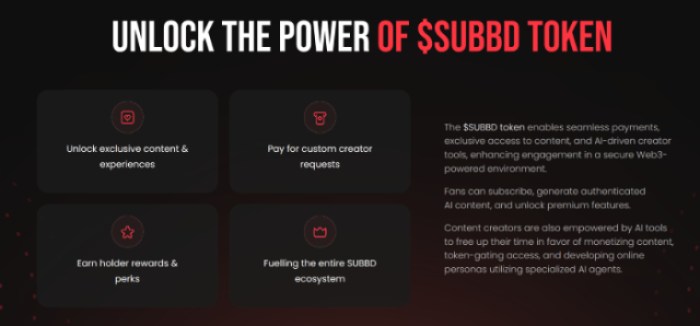
For fans, the platform isn’t just about consumption; it’s about participation through token-gated content and staking rewards. It creates a symbiotic economy where both sides win, without a middleman taking an outrageous cut.

CHECK OUT THE $SUBBD TOKEN ON ITS PRESALE PAGE

Presale Momentum Signals a Shift in Creator and Fan Sentiment

The market’s appetite for a decentralized fix is becoming undeniable. The ongoing SUBBD Token presale has already pulled in over $1.4 mwith tokens priced at just $0.057495. That kind of early-stage funding isn’t just noise; it’s a clear signal that people believe the creator economy is ripe for a shakeup.

Investors aren’t just buying a token; they’re buying into a whole new model for content ownership. The project’s staking mechanism, which offers a fixed 20% APY for the first year, gives an immediate incentive to get involved.

Stakers get access to exclusive content, livestreams, and other perks, transforming them from passive consumers into active participants. The risk? Well, like any new platform, it all comes down to achieving critical mass, attracting enough great creators and dedicated fans to make the ecosystem thrive.

Ironically, the regulatory gridlock in the U.S. might just be SUBBD’s biggest catalyst. As legacy institutions fight tooth and nail to preserve the status quo, they’re inadvertently making the best possible case for platforms that are transparent and fair by design.

The traction in SUBBD’s presale says it all: creators and users aren’t waiting for permission from Washington or Wall Street anymore. They’re just building a better system themselves. Join the SUBBD Token presale here.

BUY YOUR $SUBBD HERE

This article is for informational purposes only and should not be considered financial advice. All investments in cryptocurrency carry inherent risks, and you should conduct your own research.


Пов'язані питання

QWhat is the main argument made by the banking lobby (ABA and BPI) against the FIT21 Act?

AThe banking lobby argues that the FIT21 Act would create regulatory gaps, undermine existing securities laws, and expose consumers to undue risk.

QAccording to the article, what is the core problem that SUBBD Token ($SUBBD) aims to solve in the content creation industry?

ASUBBD Token aims to solve the problems of exorbitant fees (as high as 70%), censorship, and the risk of sudden de-platforming that creators face on centralized platforms like YouTube and OnlyFans.

QWhat are some of the key AI tools integrated into the SUBBD platform for creators?

AThe SUBBD platform integrates an AI Personal Assistant for automating fan interactions, AI voice cloning, and the ability to launch fully AI-driven influencers.

QHow does the SUBBD platform's staking mechanism work to incentivize users?

AThe staking mechanism offers a fixed 20% APY for the first year, and stakers gain access to exclusive content, livestreams, and other perks, turning them into active participants.

QWhat does the article suggest is the 'second-order effect' of the lobbying efforts against crypto regulation?

AThe second-order effect is that it pushes innovation and user interest toward decentralized platforms that operate outside of traditional financial control, as these platforms promise to bypass the gatekeepers altogether.

Пов'язані матеріали

The AI Agent Era Accelerates Its Arrival: Questflow Defines a New Paradigm of Financial Intelligence with On-Chain AI Brokerage

The AI Agent era is accelerating, with the CB Insights AI 100 list highlighting global investment confidence. The focus has shifted from whether AI works to its speed of deployment and ability to manage complex workflows, with autonomous AI Agents driving this transformation. At the forefront is Questflow, a Singapore-based startup redefining financial intelligence through its on-chain AI brokerage. Unlike tools that merely provide data dashboards, Questflow deploys AI Agents that proactively scan markets, form judgments, and execute trades via a conversational interface—operating 24/7 without requiring manual confirmation for each decision. This embodies the new AI paradigm of agents capable of executing multi-step workflows autonomously. Questflow's mission is to democratize institutional-grade trading intelligence. Historically reserved for the ultra-wealthy, this capability is now accessible starting from just $1 through Questflow's "AI Clone + Copy Trade" model. The platform charges only a 1% execution fee, aligning its incentives directly with users and eliminating traditional management or performance fees. The timing is opportune, aligning with key trends identified by CB Insights: the scalable deployment of AI Agents, accelerated AI adoption in financial services, and the maturation of on-chain infrastructure. With robust liquidity on platforms like Hyperliquid and Polymarket, alongside advancements in AI reasoning and non-custodial wallet security, Questflow is positioned to merge the roles of broker, fund, and exchange into a single, accessible platform for millions.

链捕手1 хв тому

The AI Agent Era Accelerates Its Arrival: Questflow Defines a New Paradigm of Financial Intelligence with On-Chain AI Brokerage

链捕手1 хв тому

Why Pricing Social Interactions is Doomed to Fail?

Titled "Why Putting a Price on Social Interaction Is Doomed to Fail," this article critiques attempts to monetize social networks directly through SocialFi models, arguing their inevitable failure stems from a fundamental misunderstanding of media dynamics. Using Marshall McLuhan's theory of "hot" and "cold" media, the author posits that social networks are inherently "cold" media. Their value isn't contained in individual posts but is co-created through user participation, interpretation, and fragmented, ongoing interaction (e.g., replies, shares). This ambiguity and need for user involvement are core to their function. The article asserts that SocialFi projects like Friend.tech failed because introducing real-time, tradable financial pricing (a definitive "hot" signal) into this "cold" environment doesn't add a layer—it replaces the medium's essence. The unambiguous price signal overshadows and nullifies the nuanced, participatory social signal. Users become traders, not participants, and when speculative profits vanish, the underlying social ecosystem—never genuinely cultivated—collapses entirely. This principle extends beyond crypto. The author argues platforms like Twitter have gradually "heated up" through metrics (likes, retweets counts, algorithmically defined value), shifting users from participants to performers and eroding organic engagement. The solution isn't to abandon capital but to manage its entry point. Successful models like Substack, Patreon, or Bandcamp allow capital to "condense" at specific, isolated nodes (e.g., subscriptions, one-time payments) without permeating and "heating" every social interaction. They preserve the core "cold," participatory medium while enabling monetization at designated boundaries. The NFT boom and bust serves as a stark parallel: the ancient "cold" medium of collecting (valued for story, community, gradual accumulation) was rapidly destroyed by platforms that introduced real-time floor prices, rarity scores, and trading dashboards, transforming collectors into speculators and vaporizing cultural value when prices fell. The core lesson: "Liquidity equals heat." Injecting high liquidity and definitive pricing into a "cold" participatory medium doesn't optimize it; it fundamentally alters and destroys its value-creating mechanism. The future lies not in pricing every social gesture but in finding precise, non-invasive points for capital to condense without overheating the entire ecosystem.

marsbit9 хв тому

Why Pricing Social Interactions is Doomed to Fail?

marsbit9 хв тому

Jensen Huang's CMU Speech: In the AI Era, Don't Just Watch, Build

Jensen Huang, CEO of NVIDIA and a first-generation immigrant, delivered the commencement address to Carnegie Mellon University's class of 2026. He shared his personal journey from a humble background to founding NVIDIA, emphasizing resilience, learning from failure, and the responsibility that comes with leadership. Huang framed the present moment as the dawn of the AI revolution, a shift he believes is more profound than previous computing waves. He described AI as fundamentally resetting computing—moving from human-written software to machines that understand, reason, and use tools. This will create a new industry for generating intelligence and transform every sector. While acknowledging AI's potential to automate tasks and displace some jobs, Huang distinguished between the *tasks* of a job and its core *purpose*. He argued AI will augment human capability, not replace humans. The real risk, he stated, is not AI itself, but people being left behind by those who effectively use AI. He presented AI as a generational opportunity for massive infrastructure investment—in chip factories, data centers, energy grids, and advanced manufacturing—that could re-industrialize nations like the U.S. and bridge the digital divide by making computing and intelligent tools accessible to all. Huang called for a balanced approach: advancing AI safely and responsibly, establishing prudent policies, ensuring broad access, and encouraging universal participation. He urged the graduates not to fear the future but to engage with optimism and ambition, reminding them of CMU's motto, "My heart is in the work." His core message was clear: this is their moment to actively build and shape the AI-powered future, not merely observe it.

marsbit1 год тому

Jensen Huang's CMU Speech: In the AI Era, Don't Just Watch, Build

marsbit1 год тому

Торгівля

Спот
Ф'ючерси
活动图片




