Balaji Says ‘Zcash Or Communism’ As He Warns AI Supercharges Surveillance

bitcoinistОпубліковано о 2026-02-20Востаннє оновлено о 2026-02-20

Анотація

Balaji Srinivasan argues that the rise of AI-powered surveillance creates an urgent need for financial privacy, framing the choice as “Zcash or communism.” He warns that AI enables any state or individual to compile extensive personal dossiers from online data, surpassing historical surveillance capabilities. Encryption, particularly through Zcash, is presented as a critical defense, making individuals “sovereign” and invisible to targeting. Srinivasan also positions Zcash as a scalable, privacy-focused blockchain with Solana-like throughput, using zero-knowledge proofs for private transactions. He suggests Zcash can coexist with transparent chains like Bitcoin, serving different needs while addressing the growing threat of AI-driven wealth seizure and control.

Balaji Srinivasan is once again making the most provocative version of a privacy argument and he’s pinning it to a specific chain: Zcash. In a Feb. 18 video shared on X, Srinivasan framed the stakes in stark terms: “The choice is clear. It’s Zcash or communism,” tying the rise of AI-enabled surveillance to what he described as a renewed appetite for wealth seizure.

In a follow-up post, he argued that AI has shifted surveillance from a state-scale project to something closer to an on-demand service. “Any scrap of information online can now be integrated, digested, and synthesized...by any state or stalker capable of running an AI model...to form a dossier more complete than anything the Soviets could ever dream of,” he wrote.

Srinivasan’s prescription was blunt: “There will be no single silver bullet. But anything you haven’t encrypted can and will be used against you.”

Srinivasan anchored his “communism requires surveillance” claim in an historical example meant to make a modern point about data exhaust. “In 1918, in the midst of the Bolshevik Revolution, Lenin gave an order to murder 100 nearby ‘kulaks,’” he said, emphasizing that such an order “required a list”: names, locations, and a population that couldn’t easily move.

His argument is that the internet reverses that asymmetry if encryption becomes the default. “Today, neo-communism is rising once again. But the Internet could change the game,” he said. “No full list, if we encrypt it. No fixed location, either. They can’t hit what they can’t see.”

Those themes carried into a longer discussion on the Never Say Podcast, where Srinivasan connected privacy to basic operational freedom. “If you’re under surveillance, you’re not sovereign,” he said. “If every move is being tracked...you don’t have the advantage of surprise. You can never launch something. You can never have private deliberations.”

Arjun Khemani, a 19-year-old Zcash researcher on the episode, echoed the AI angle from the user side: “Especially with AI, being able to recognize where you are exactly...you can’t have freedom without privacy,” he said, arguing that broadcasting every transaction and context signal is “not... the world that I want to live in.”

Zcash As A Scaling Bet, Not Just A Privacy Stance

Srinivasan’s pitch wasn’t limited to privacy-by-principle. He positioned Zcash as a technical response to where he thinks the market has landed on scalability: on-chain throughput wins, and routing complexity loses.

Asked why “Zcash must scale” is a “moral imperative,” Srinivasan contrasted Bitcoin’s scaling reality: exchanges, custodians, and database entries with the decentralization promise many users think they’re buying. “Lightning...they’ve been saying, ‘Lightning is going to be there any day now’ for 10 years,” he said, arguing that real-world deployments tend toward “a hub and spoke topology” resembling traditional finance rails. “Within a bank, it’s fast...between banks, they do settlement,” he added, describing a dynamic he sees mirrored in major Lightning implementations.

From there, he argued crypto has effectively segmented into layers: Bitcoin for immutability and brand, Ethereum for programmability, and Solana for straightforward on-chain execution at scale. The opening he sees for Zcash is combining “Solana-like scalability” with private transactions, leaning on zero-knowledge proofs as “compression technology” as much as secrecy. “It’s what a lot of people wanted Bitcoin to be,” he said.

Srinivasan also stressed that privacy doesn’t necessarily replace transparency, it complements it. He argued that Bitcoin’s public ledger can be a feature for proof-of-reserves narratives, while Zcash’s private-by-default design targets a different threat model. His bottom line is coexistence, not conquest: “It’s possible that Bitcoin... and Zcash coexist because Bitcoin is transparent and Zcash is private,” he said, while suggesting “this could be Zcash’s moment.”

At press time, ZEC traded at $259.18.
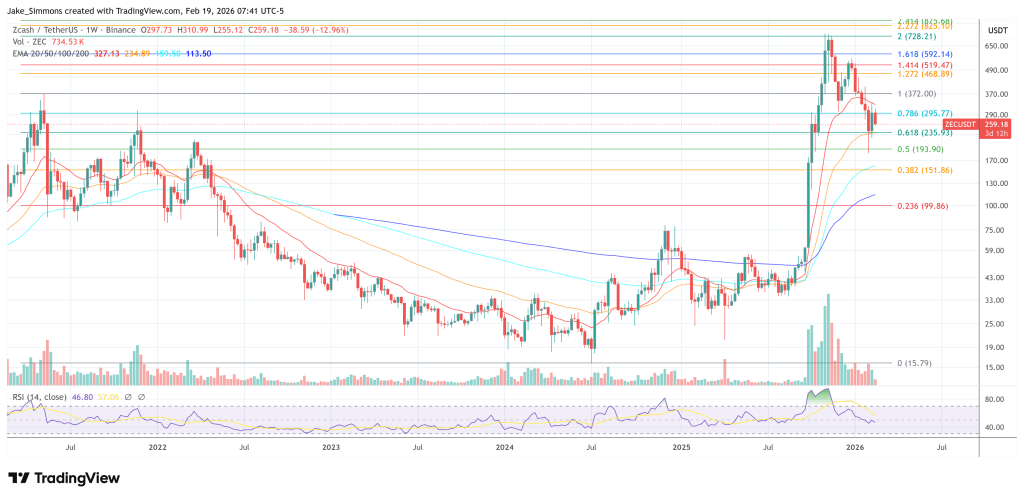
ZEC price remains below the 0.786 Fib, 1-week chart | Source: ZECUSDT on TradingView.com

Пов'язані питання

QWhat is the main argument Balaji Srinivasan makes about the relationship between privacy, Zcash, and communism?

ABalaji Srinivasan argues that the rise of AI-enabled surveillance creates a stark choice: 'Zcash or communism.' He claims that communism requires extensive surveillance for wealth seizure and control, and that encryption, specifically through privacy-focused cryptocurrencies like Zcash, is the technological solution to prevent this by making individuals sovereign and their information private.

QHow does Srinivasan claim AI has changed the nature of surveillance?

ASrinivasan states that AI has shifted surveillance from a large-scale state project to an on-demand service. He argues that any state or individual with an AI model can now integrate, digest, and synthesize any scrap of online information to create a more comprehensive dossier than was ever possible before, surpassing even the capabilities of historical surveillance states like the Soviet Union.

QBesides privacy, what other technical advantage does Srinivasan attribute to Zcash?

ABeyond its core privacy feature, Srinivasan positions Zcash as a scaling bet. He argues it combines 'Solana-like scalability' with private transactions by using zero-knowledge proofs as a form of 'compression technology.' This addresses what he sees as the market's preference for on-chain throughput over complex routing solutions like the Lightning Network.

QWhat historical example does Srinivasan use to support his claim that 'communism requires surveillance'?

ASrinivasan uses the historical example of Lenin during the 1918 Bolshevik Revolution ordering the murder of 100 'kulaks.' He emphasizes that such an order 'required a list'—names, locations, and a population that couldn't easily move—to illustrate how surveillance is foundational to state control and seizure of assets.

QHow does Srinivasan view the potential coexistence of Bitcoin and Zcash?

ASrinivasan believes Bitcoin and Zcash can coexist because they serve different purposes. He states that Bitcoin's transparent ledger is a feature for narratives like proof-of-reserves, while Zcash's private-by-default design addresses a different threat model. His view is one of complementary coexistence, not conquest, suggesting 'this could be Zcash's moment.'

Пов'язані матеріали

Annual Salary of Millions Competing for Electricians, Meta Rushes to Open Its Own Technical School

The AI boom is facing an unexpected bottleneck: a severe shortage of skilled construction workers and electricians. As tech giants like Meta, OpenAI, and Alphabet race to build massive data centers—such as OpenAI's $16 billion "Stargate" project—they are hitting a critical labor wall. The U.S. needs an estimated 130,000 more electricians, 240,000 construction workers, and 150,000 supervisors by 2030 for AI infrastructure alone, but tens of thousands of electrician jobs go unfilled each year. While AI companies offer high premiums, with electricians earning up to $280,000 annually, worker scarcity still causes massive losses—delays on a single project can cost $14.2 million per month. The complexity of building AI data centers, which require immense power (equivalent to powering hundreds of thousands of homes), sophisticated electrical systems, and advanced liquid cooling solutions, demands highly skilled technicians who are in short supply. To combat this, companies are investing heavily in training. Meta has committed $115 million to a free training school offering tuition, housing, and stipends, targeting 5,000 new workers. OpenAI is partnering with unions to secure skilled labor. These efforts are paying off, with a significant rise in Gen Z interest in trade schools over college. However, the power demands are staggering. AI data centers are driving a rapid surge in electricity consumption, projected to account for up to 12% of U.S. power use by 2028 and raising costs for consumers. Furthermore, the construction boom is project-based, leading to a potential future glut of trained workers once building peaks, which could depress wages industry-wide. The race for AI supremacy now depends as much on skilled hands as on advanced chips.

marsbit32 хв тому

Annual Salary of Millions Competing for Electricians, Meta Rushes to Open Its Own Technical School

marsbit32 хв тому

OpenAI No Longer Sells Its Most Expensive Model for Profit

OpenAI is shifting its business strategy away from promoting its most expensive, flagship models for every task. Recent price cuts—80% for GPT-5.6 Luna and 20% for Terra—signal a deeper change: the company now actively advises users that many tasks don't require the most powerful model. Instead, OpenAI recommends a tiered approach: use the high-end GPT-5.6 Sol for complex planning and analysis, then delegate execution to cheaper models like Luna. This mirrors moves by Anthropic, which recently launched Claude Opus 5 at half the price of its top model, Fable 5. Both companies are de-emphasizing flagship models as primary revenue drivers, using them instead for brand prestige and technological showcases. The industry is entering a "mass-market" phase, similar to automotive, where high-volume, cost-effective models handle daily operations and drive scale. OpenAI's price reductions are partly enabled by AI models themselves optimizing underlying code and infrastructure, creating a self-reinforcing cycle of efficiency gains and cost reduction. Competition is shifting from "who is smartest" to "who offers the best value." The goal is no longer selling individual models but fostering widespread API adoption and ecosystem lock-in. By making AI calls cheap and ubiquitous, companies like OpenAI aim to become the indispensable, utility-like infrastructure powering automated workflows—the "water and electricity" of software, quietly embedded everywhere.

marsbit32 хв тому

OpenAI No Longer Sells Its Most Expensive Model for Profit

marsbit32 хв тому

Will the Fed Definitely Raise Interest Rates in September? How Will Crypto and U.S. Stocks Withstand the Pressure?

The market's expectation for a September Fed rate hike surged dramatically in early August, jumping from under 50% to over 80% within a week. This shift followed a contentious July FOMC meeting, where a 9-3 vote to hold rates revealed growing dissent from hawkish members advocating for an immediate hike to combat persistent inflation. The primary catalyst for this repricing is rising oil prices, driven by renewed geopolitical tensions around the Strait of Hormuz, which threaten global supply. Energy costs directly influence inflation metrics, making the upcoming July CPI report (due August 12th) a critical data point. If it shows inflation reaccelerating, the probability of a September hike will solidify. For Bitcoin and crypto assets, this is typically bearish news. Bitcoin continues to behave as a high-beta, liquidity-sensitive risk asset. A rate hike raises the opportunity cost of holding non-yielding assets and could drive capital toward money markets, pressuring crypto prices in the short term. However, historical patterns suggest that if a hike is perceived as the end of a tightening cycle rather than the start, any negative price impact may be brief. U.S. stocks, particularly crypto-linked equities like Coinbase and growth-oriented tech stocks, are also vulnerable. Higher rates increase discount rates in valuation models, putting pressure on high-multiple companies. This coincides with a pivotal tech earnings season where investor focus has shifted from massive AI capital expenditure to tangible revenue and cash flow generation. Companies with negative cash flow and weak growth narratives could face heightened volatility if borrowing costs rise in September. In summary, a September Fed hike has evolved into a mainstream market scenario. Key factors to watch are oil prices, the July CPI report, and Fed communications, which will determine the final decision and its impact on volatile crypto and equity markets.

marsbit42 хв тому

Will the Fed Definitely Raise Interest Rates in September? How Will Crypto and U.S. Stocks Withstand the Pressure?

marsbit42 хв тому

Торгівля

Спот
活动图片





