Balaji Says ‘Zcash Or Communism’ As He Warns AI Supercharges Surveillance

bitcoinistОпубліковано о 2026-02-20Востаннє оновлено о 2026-02-20

Анотація

Balaji Srinivasan argues that the rise of AI-powered surveillance creates an urgent need for financial privacy, framing the choice as “Zcash or communism.” He warns that AI enables any state or individual to compile extensive personal dossiers from online data, surpassing historical surveillance capabilities. Encryption, particularly through Zcash, is presented as a critical defense, making individuals “sovereign” and invisible to targeting. Srinivasan also positions Zcash as a scalable, privacy-focused blockchain with Solana-like throughput, using zero-knowledge proofs for private transactions. He suggests Zcash can coexist with transparent chains like Bitcoin, serving different needs while addressing the growing threat of AI-driven wealth seizure and control.

Balaji Srinivasan is once again making the most provocative version of a privacy argument and he’s pinning it to a specific chain: Zcash. In a Feb. 18 video shared on X, Srinivasan framed the stakes in stark terms: “The choice is clear. It’s Zcash or communism,” tying the rise of AI-enabled surveillance to what he described as a renewed appetite for wealth seizure.

In a follow-up post, he argued that AI has shifted surveillance from a state-scale project to something closer to an on-demand service. “Any scrap of information online can now be integrated, digested, and synthesized...by any state or stalker capable of running an AI model...to form a dossier more complete than anything the Soviets could ever dream of,” he wrote.

Srinivasan’s prescription was blunt: “There will be no single silver bullet. But anything you haven’t encrypted can and will be used against you.”

Srinivasan anchored his “communism requires surveillance” claim in an historical example meant to make a modern point about data exhaust. “In 1918, in the midst of the Bolshevik Revolution, Lenin gave an order to murder 100 nearby ‘kulaks,’” he said, emphasizing that such an order “required a list”: names, locations, and a population that couldn’t easily move.

His argument is that the internet reverses that asymmetry if encryption becomes the default. “Today, neo-communism is rising once again. But the Internet could change the game,” he said. “No full list, if we encrypt it. No fixed location, either. They can’t hit what they can’t see.”

Those themes carried into a longer discussion on the Never Say Podcast, where Srinivasan connected privacy to basic operational freedom. “If you’re under surveillance, you’re not sovereign,” he said. “If every move is being tracked...you don’t have the advantage of surprise. You can never launch something. You can never have private deliberations.”

Arjun Khemani, a 19-year-old Zcash researcher on the episode, echoed the AI angle from the user side: “Especially with AI, being able to recognize where you are exactly...you can’t have freedom without privacy,” he said, arguing that broadcasting every transaction and context signal is “not... the world that I want to live in.”

Zcash As A Scaling Bet, Not Just A Privacy Stance

Srinivasan’s pitch wasn’t limited to privacy-by-principle. He positioned Zcash as a technical response to where he thinks the market has landed on scalability: on-chain throughput wins, and routing complexity loses.

Asked why “Zcash must scale” is a “moral imperative,” Srinivasan contrasted Bitcoin’s scaling reality: exchanges, custodians, and database entries with the decentralization promise many users think they’re buying. “Lightning...they’ve been saying, ‘Lightning is going to be there any day now’ for 10 years,” he said, arguing that real-world deployments tend toward “a hub and spoke topology” resembling traditional finance rails. “Within a bank, it’s fast...between banks, they do settlement,” he added, describing a dynamic he sees mirrored in major Lightning implementations.

From there, he argued crypto has effectively segmented into layers: Bitcoin for immutability and brand, Ethereum for programmability, and Solana for straightforward on-chain execution at scale. The opening he sees for Zcash is combining “Solana-like scalability” with private transactions, leaning on zero-knowledge proofs as “compression technology” as much as secrecy. “It’s what a lot of people wanted Bitcoin to be,” he said.

Srinivasan also stressed that privacy doesn’t necessarily replace transparency, it complements it. He argued that Bitcoin’s public ledger can be a feature for proof-of-reserves narratives, while Zcash’s private-by-default design targets a different threat model. His bottom line is coexistence, not conquest: “It’s possible that Bitcoin... and Zcash coexist because Bitcoin is transparent and Zcash is private,” he said, while suggesting “this could be Zcash’s moment.”

At press time, ZEC traded at $259.18.
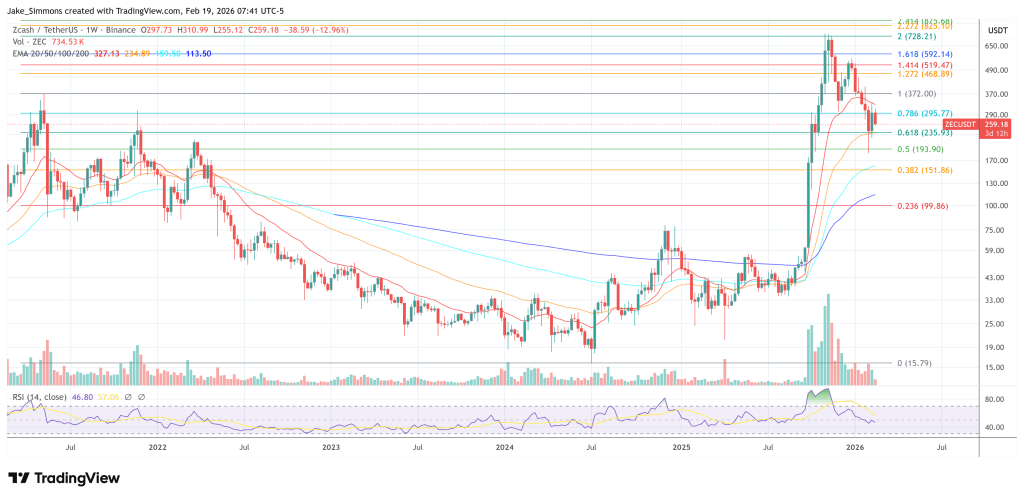
ZEC price remains below the 0.786 Fib, 1-week chart | Source: ZECUSDT on TradingView.com

Пов'язані питання

QWhat is the main argument Balaji Srinivasan makes about the relationship between privacy, Zcash, and communism?

ABalaji Srinivasan argues that the rise of AI-enabled surveillance creates a stark choice: 'Zcash or communism.' He claims that communism requires extensive surveillance for wealth seizure and control, and that encryption, specifically through privacy-focused cryptocurrencies like Zcash, is the technological solution to prevent this by making individuals sovereign and their information private.

QHow does Srinivasan claim AI has changed the nature of surveillance?

ASrinivasan states that AI has shifted surveillance from a large-scale state project to an on-demand service. He argues that any state or individual with an AI model can now integrate, digest, and synthesize any scrap of online information to create a more comprehensive dossier than was ever possible before, surpassing even the capabilities of historical surveillance states like the Soviet Union.

QBesides privacy, what other technical advantage does Srinivasan attribute to Zcash?

ABeyond its core privacy feature, Srinivasan positions Zcash as a scaling bet. He argues it combines 'Solana-like scalability' with private transactions by using zero-knowledge proofs as a form of 'compression technology.' This addresses what he sees as the market's preference for on-chain throughput over complex routing solutions like the Lightning Network.

QWhat historical example does Srinivasan use to support his claim that 'communism requires surveillance'?

ASrinivasan uses the historical example of Lenin during the 1918 Bolshevik Revolution ordering the murder of 100 'kulaks.' He emphasizes that such an order 'required a list'—names, locations, and a population that couldn't easily move—to illustrate how surveillance is foundational to state control and seizure of assets.

QHow does Srinivasan view the potential coexistence of Bitcoin and Zcash?

ASrinivasan believes Bitcoin and Zcash can coexist because they serve different purposes. He states that Bitcoin's transparent ledger is a feature for narratives like proof-of-reserves, while Zcash's private-by-default design addresses a different threat model. His view is one of complementary coexistence, not conquest, suggesting 'this could be Zcash's moment.'

Пов'язані матеріали

Cerebras IPO: A $48.8 Billion Valuation—Is the 'Nvidia Challenger' a Bubble or a New King?

Cerebras Systems, positioning itself as an NVIDIA challenger, is going public with a $48.8 billion valuation despite several underlying paradoxes revealed in its S-1 filing. While 2025 revenue grew 76% to $510M and GAAP net income was $237.8M, this profitability relies heavily on a one-time, non-cash accounting gain. Adjusting for this, the company's non-GAAP net loss actually widened to $75.7M. Furthermore, customer concentration remains extreme: 86% of 2025 revenue came from two Abu Dhabi-based entities, MBZUAI (62%) and G42 (24%). Its landmark deal with OpenAI, valued at over $20 billion, creates a complex, nested relationship where OpenAI is simultaneously a major customer, lender, warrant holder, and strategic partner with exclusivity clauses. Cerebras's technical edge in latency-sensitive AI inference is real, with its wafer-scale chip outperforming competitors in benchmarks. However, this advantage is confined to a specific niche, not the broader AI training market dominated by NVIDIA's CUDA ecosystem. With a 95x price-to-sales ratio, the valuation demands flawless execution of the OpenAI contract and massive future revenue growth. Key long-term risks include intense competition from giants like NVIDIA and AMD, a dual-class share structure granting insiders near-total voting control, and ongoing geopolitical uncertainties regarding export controls. The IPO is a pivotal capital markets event for AI infrastructure. As an investment, it represents a high-risk, high-reward bet on the "inference-first" narrative and Cerebras's ability to dominate its specialized segment, underpinned by a valuation that highlights the current fervor in the sector.

marsbit26 хв тому

Cerebras IPO: A $48.8 Billion Valuation—Is the 'Nvidia Challenger' a Bubble or a New King?

marsbit26 хв тому

What Happens to Ethereum Developer Tools After the Grants Run Out?

On February 27th, the Ethereum Foundation (EF) announced Project Odin, a structured sustainability support program designed for a select group of strategic, previously grant-funded teams. Unlike a standard grant, Odin offers a long-term advisory mechanism focused on helping these teams establish credible, sustainable paths within a two-year framework, thereby reducing long-term dependence on single funding sources. The program addresses a critical post-grant challenge: how essential public goods, especially major developer tools, can achieve financial sustainability beyond initial funding. While grants from EF and programs like Gitcoin or RetroPGF remain vital for startups and research, they often fall short for mature, widely-used infrastructure. Tools like compilers, languages, and network stacks are deeply embedded but struggle with monetization, trapped between being too foundational to lose and too public to generate natural revenue. Project Odin provides teams with a dedicated Strategic Advisor to guide them through a three-phase process: 1) analyzing current funding and realistic options, 2) validating potential paths with stakeholders, and 3) executing plans, which may include crafting support contracts, service agreements, or other recurring revenue models. The first pilot participant is Vyper, a critical smart contract language for the EVM, highlighting the need for sustainable models for core infrastructure. The initiative reframes the public goods conversation from "who should be funded" to "how do already-proven teams avoid perpetual funding crises?" It encourages ecosystem participants—protocols and projects that depend on these tools—to view sustainable support not just as charity, but as essential risk management for their own operational supply chains.

marsbit55 хв тому

What Happens to Ethereum Developer Tools After the Grants Run Out?

marsbit55 хв тому

MARA Reports Q1 Revenue Below Expectations, Net Loss of $1.3 Billion, Stock Plunges After Hours

Bitcoin mining firm MARA Holdings reported disappointing Q1 2024 results, causing its stock to erase all daily gains and fall 3.44% in after-hours trading. Revenue dropped 18% year-over-year to $174.6 million, missing Wall Street estimates of $192.7 million. The company posted a net loss of $1.3 billion, a significant increase from a $533.4 million loss a year ago, primarily driven by unrealized losses on its holdings of 38,689 Bitcoin, which depreciated in value during the quarter. MARA also sold over 15,100 BTC in late March to repurchase debt at a discount. The broader mining environment remains challenging due to a 35% decline in Bitcoin's price from its all-time high and a nearly 30% increase in mining difficulty over the past year. MARA's market cap ranking among U.S. miners has slipped to seventh. Critically, the company announced a strategic pivot away from Bitcoin mining expansion. It stated it has no plans to purchase new mining equipment and is fully transitioning toward AI data centers. Its strategy involves retrofitting existing mining sites for AI and high-performance computing (HPC) and leveraging its recent $1.5 billion acquisition of Long Ridge Energy & Power, a gas-fired power plant and data center. This infrastructure could eventually support 600 MW of AI compute capacity, allowing MARA to redeploy up to 90% of its non-custodial mining power for AI and IT workloads.

marsbit56 хв тому

MARA Reports Q1 Revenue Below Expectations, Net Loss of $1.3 Billion, Stock Plunges After Hours

marsbit56 хв тому

Торгівля

Спот
Ф'ючерси
活动图片