Auto Research Era: 47 Tasks Without Standard Answers Become the Must-Test Leaderboard for Agent Capabilities

marsbitОпубліковано о 2026-05-13Востаннє оновлено о 2026-05-13

Анотація

The article introduces Frontier-Eng Bench, a new benchmark for AI agents developed by Einsia AI's Navers lab. Unlike traditional tests with clear answers, this benchmark presents 47 complex, real-world engineering tasks—such as optimizing underwater robot stability, battery fast-charging protocols, or quantum circuit noise control—where there is no single correct solution, only continuous optimization towards a limit. It shifts AI evaluation from static knowledge retrieval to a dynamic "engineering closed-loop": the AI must propose solutions, run simulations, interpret errors, adjust parameters, and re-run experiments to iteratively improve performance. This process tests an agent's ability to learn and evolve through long-term feedback, much like a human engineer tackling trade-offs between power, safety, and performance. Key findings from the benchmark reveal two patterns: 1) Improvements follow a power-law decay, becoming harder and smaller as optimization progresses, and 2) While exploring multiple solution paths (breadth) helps, sustained depth in a single path is crucial for breakthrough innovations. The research suggests this marks a step toward "Auto Research," where AI systems can autonomously conduct continuous, tireless optimization in scientific and engineering domains. Humans would set high-level goals, while AI agents handle the iterative experimentation and refinement. This could fundamentally change research and development workflows.

If we throw AI into an engineering site with no standard answers, can it still survive?

For a long time, AI Agents have appeared omnipotent, but in reality, most are just 'flipping through memories' within known knowledge bases.

Yet the real engineering world is harsh: the stability of underwater robots, the lithium plating boundary of power batteries, the noise control of quantum circuits... These problems have no 'perfect score', only 'optimizations that inch closer to the limit'.

Recently, the Agent Benchmark released by Navers lab under Einsia AIFrontier-Eng Bench—officially tore off the label of AI being an 'exam-crammer'.
The research team didn't have AI grind through outdated coding problems. Instead, they gave it a complete 'engineering closed loop': propose a solution, connect to the simulator, digest errors, adjust parameters, and re-run.

Faced with 47 hardcore tasks spanning multiple disciplines, AI must behave like a senior engineer, seeking the optimal solution within the 'impossible triangle' of power consumption, safety, and performance.

This is not just a test suite; it's more like a rehearsal for Agent 'evolution'.

When AI begins to learn self-correction from feedback, the Auto Research era, where 'humans set goals and AI iterates non-stop 24/7', might be closer than we imagine.

AI Starts Tackling 'Hard Work'

Past large language models were more like super straight-A students.

You pose a question, it 'flips through memory' from massive training data, then pieces together an answer that seems plausible.

In this mode, the large model is essentially playing 'word chain', not solving real-world problems.

But the emergence of Frontier-Eng Bench has AI doing the work of 'engineering optimization'.

The process has shifted to letting AI first propose a solution, then connect to a simulator to run experiments, subsequently obtain feedback and errors, modify parameters and code, and continue re-running until performance improves further.

In this closed-loop system, AI's identity undergoes a qualitative change.

Want to make the underwater robot more stable? AI must start automatically tuning the controller.

Want to increase the speed of the robotic arm a bit more? AI has to run simulations itself.

To some extent, AIs have shed their purely semantic understanding role and begun to act like professional engineers, continuously optimizing based on real-world environmental feedback.
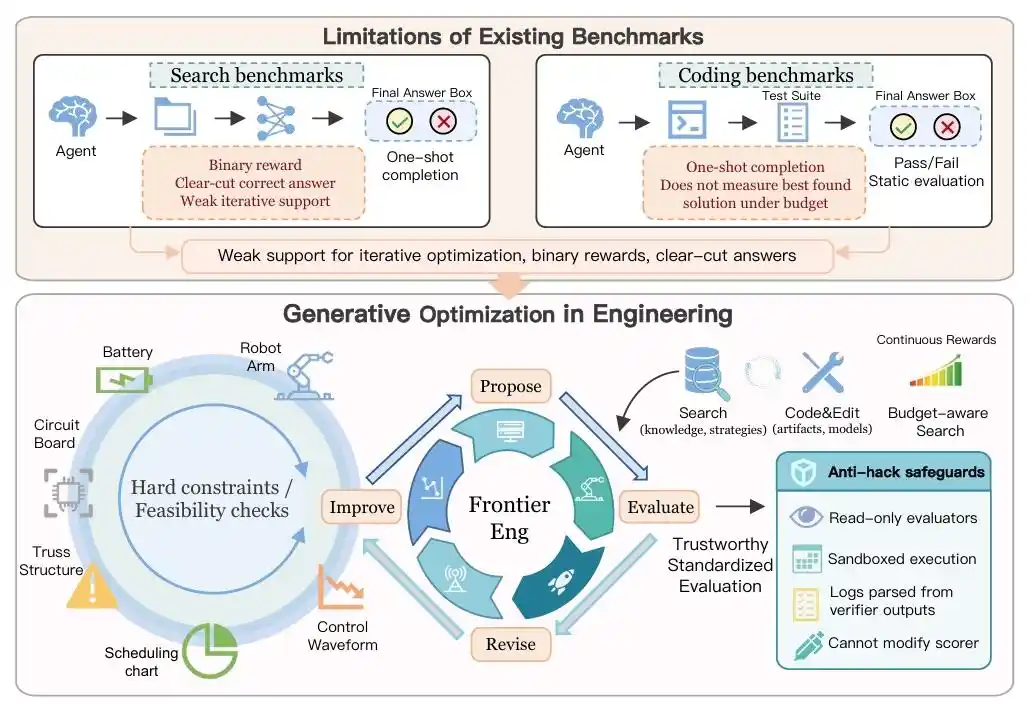
The most interesting aspect of Frontier-Eng Bench is: it doesn't test whether AI 'answered correctly', but rather whether AI can continuously become stronger.

Because real engineering optimization is never about multiple-choice questions; there is no single standard answer.

Take fast-charging batteries as an example: the goal sounds simple—charge as fast as possible, but reality isn't so easy.

Under strict constraints like temperature mustn't spike, voltage can't overspeed, battery life can't drop too fast, and lithium plating must be avoided, AI must precisely hit the balance point of performance.

This means AI cannot pass through by any clever 'test-cramming' tricks; it must demonstrate endurance for continuous evolution through long-term feedback.

Can AI perform long-term optimization in real environments?

Looking at the results, GPT5.4 showed the most stable overall performance, but AIs still have a long way to go before 'solving' the Benchmark.
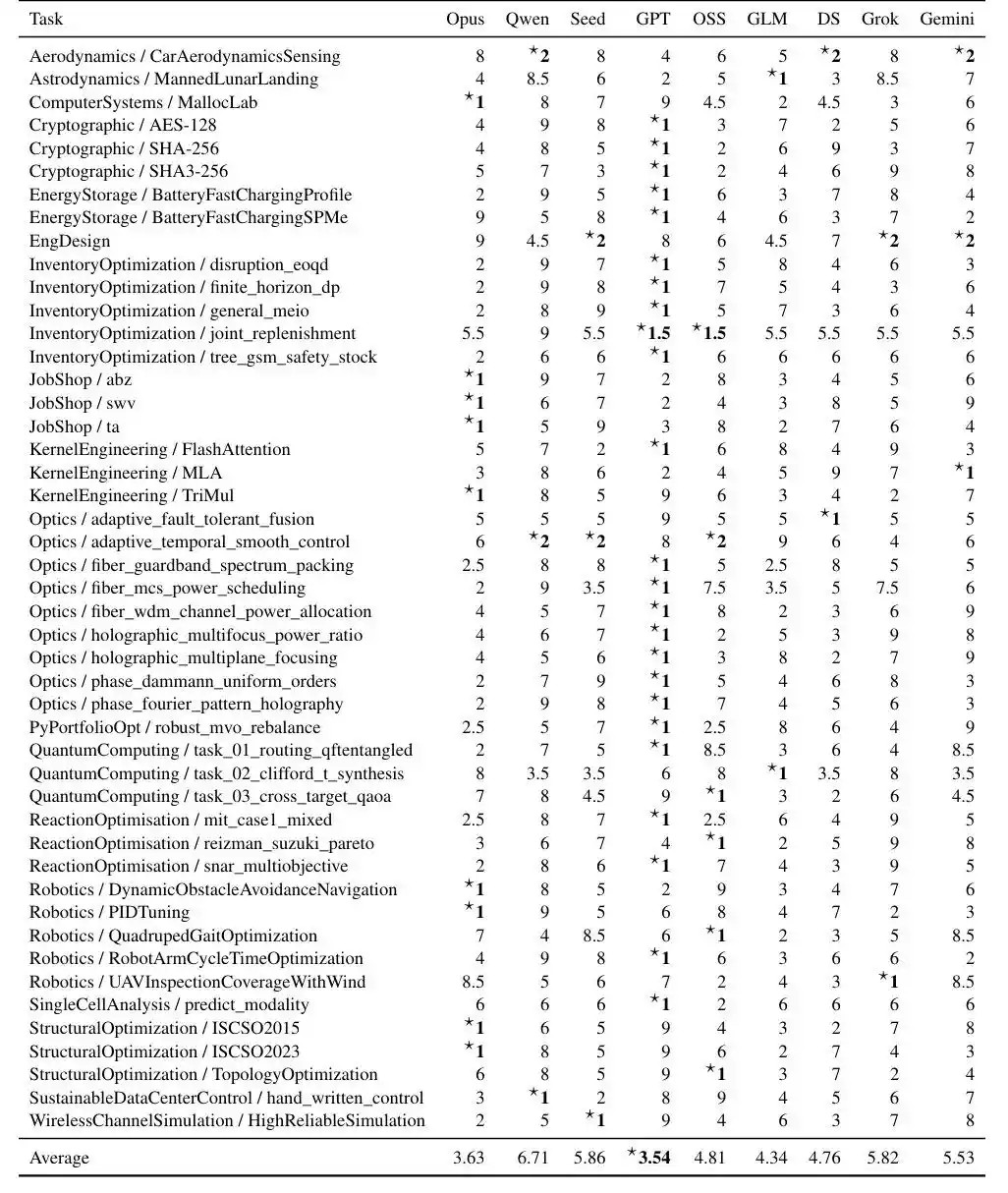
Auto Research Enters the 'Iterative Optimization' Era

The research team raised a very interesting point in their paper:

Truly advanced intelligence essentially relies on long-term feedback loops.

Just as AlphaGo could defeat Lee Sedol, it lay in the vast number of simulations and immediate feedback behind each decision, not the rote memorization of established game records.

True scientific research is the same: top labs don't rely on a single burst of inspiration, but continuously propose hypotheses, run experiments, examine results, modify plans, and try again.

Engineering optimization follows the same principle: anyone can create the first version; what's truly difficult is that final 1% performance leap.

The significance of Frontier-Eng Bench lies here: For the first time, it systematically begins testing AI's 'iterative optimization capability', and has summarized two nearly brutal laws of AI evolution.
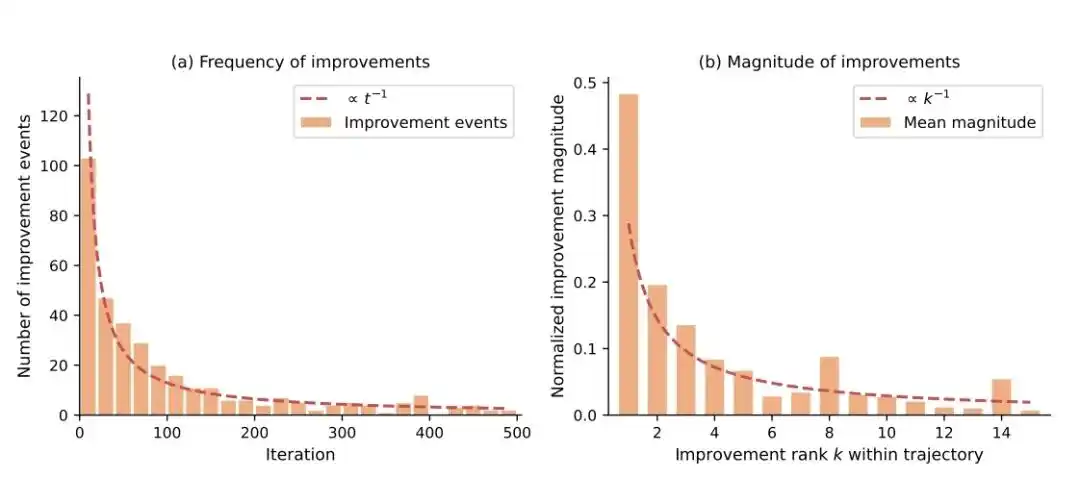
The first law is: The further you go, the harder the improvement.

This paper found that the frequency and magnitude of Agent improvements follow a power-law decay:

  • Improvement frequency ∝ 1 / iteration count
  • Improvement magnitude ∝ 1 / improvement count

Simply put: the fastest gains come in the first few rounds, and it gets progressively harder and smaller later on.

This closely resembles the real R&D process: the first version of AI can quickly eliminate many 'low-hanging fruits', but the closer it gets to the bottleneck, the more effort is required to squeeze out even a bit more performance.

Would it be more cost-effective to explore multiple paths in parallel for trial and error? The answer lies in the second law.
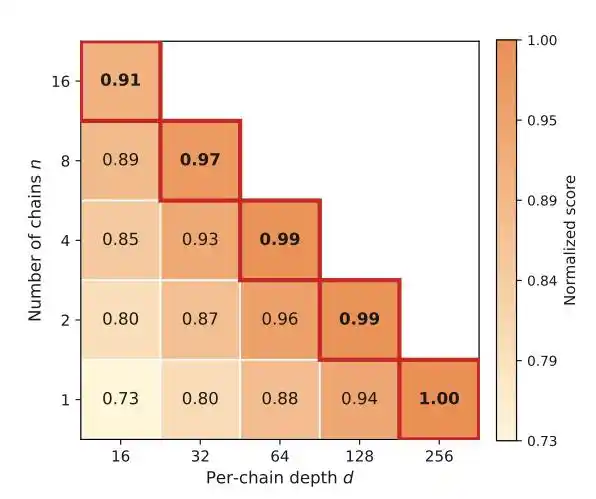
The second law: Breadth is useful, but depth is even more indispensable.

Running multiple parallel paths can avoid getting stuck, but with a fixed budget, each additional chain opened shallows the depth of exploration.

Many engineering breakthroughs require continuous accumulation and constant correction before structural leaps emerge; they can't be achieved simply by 'trying a few more times'.

This actually points towards the development direction of next-generation Agents: not models that 'output an answer once', but systems that can continuously iterate and self-evolve within long-term feedback loops.

AI Engineers Might Really Be Coming

The true far-reaching significance of this research lies in its preliminary outline of an AI system beginning to approach the real engineering cycle.
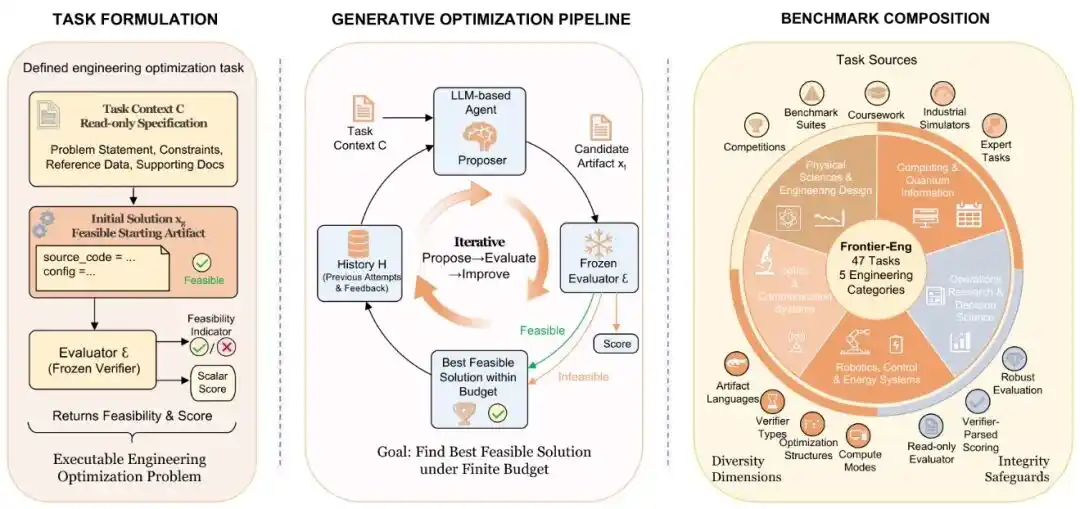
Imagine when AI connects to industrial software, simulation environments, CAD systems, chip design tools, scientific computing platforms...

A dramatic transformation in the modality of productivity is on the verge of emerging.

In future labs, a division of labor like this might appear:

Human researchers are responsible for proposing directions and goals.

For example, 'reduce this component's energy consumption by 30%', 'compress this model's forward pass GPU usage even lower', 'increase the stability of robot control a bit more', 'push the fidelity of this quantum circuit closer to the limit', etc.

And AI is responsible for 'grinding the path'. They focus on these goals, continuously optimizing.

For example, automatically running simulations and experiments, automatically reading feedback from verifiers and simulators, then continuing to modify and optimize, iterating non-stop 24/7.

This evolutionary logic frees AI from the identity of an 'assistive tool', allowing it to begin solving complex system problems like a real engineering team—and tirelessly at that.

And the issues revealed by the Frontier-Eng Benchmark are actually very direct:

When AI begins to learn 'long-term optimization', how far is it from true engineering intelligence?

Paper Title: Frontier-Eng: Benchmarking Self-Evolving Agents on Real-World Engineering Tasks with Generative Optimization

Project Homepage: https://lab.einsia.ai/frontier-eng/

Arxiv: https://arxiv.org/abs/2604.12290

GitHub repo: https://github.com/EinsiaLab/Frontier-Engineering

This article is from the WeChat public account "Quantum Bit", author: Yun Zhong

Пов'язані питання

QWhat is the main purpose of the Frontier-Eng Benchmark released by Einsteina AI's Navers lab?

AThe main purpose of the Frontier-Eng Benchmark is to move beyond testing AI's ability to recall known information. It systematically tests AI agents' capability for 'iterative optimization' on 47 real-world, open-ended engineering tasks without standard answers, evaluating if they can continuously improve performance through a feedback loop involving simulation, error analysis, and parameter adjustment.

QHow does the AI's role change in the Frontier-Eng Benchmark testing process compared to traditional language models?

AIn the Frontier-Eng Benchmark, the AI transitions from acting as a 'super student' that retrieves and assembles answers from training data to performing 'engineering optimization.' Its role becomes akin to a professional engineer: it proposes solutions, runs simulations, analyzes feedback and errors, modifies parameters/code, and reruns experiments in a continuous loop to seek optimal performance under complex constraints.

QWhat are the two key 'AI evolution laws' discovered through the Frontier-Eng Benchmark regarding iterative optimization?

AThe two key laws are: 1) Improvements become progressively harder and smaller (showing a power-law decay: Improvement frequency ∝ 1/iteration count, Improvement magnitude ∝ 1/improvement count). 2) While exploring multiple parallel paths (breadth) is useful, sustained depth in a single optimization path is more critical for achieving structural breakthroughs, as fixed budgets force a trade-off between breadth and depth.

QWhat future work paradigm does the article suggest might emerge from the development of self-evolving AI agents?

AThe article suggests a future 'Auto Research' paradigm where human researchers define the goals and direction (e.g., 'reduce component energy consumption by 30%'), and AI agents take on the role of 'grinding the path.' They would work autonomously and tirelessly—running simulations, interpreting feedback from verifiers and simulators, and iteratively optimizing—24/7 to approach performance limits.

QAccording to the article, what fundamental shift in AI capability does the Frontier-Eng Benchmark represent?

AThe Frontier-Eng Benchmark represents a fundamental shift from evaluating AI's ability to find predetermined 'correct answers' to testing its capacity for 'self-evolution' through long-term feedback loops. It moves the focus to whether AI can demonstrate sustained learning and improvement in complex, real-world scenarios with no single correct answer, pushing AI closer to genuine engineering intelligence.

Пов'язані матеріали

STRC Breaks Below $95: Why Does It Continue to Depeg? Is There Default Risk?

"STRC Falls Below $95: Why the Persistent Depegging and Is There Default Risk?" The article discusses the recent decline in the price of STRC, a perpetual preferred stock issued by Strategy (MSTR) designed to trade around a $100 par value. As of publication, STRC traded at $94.65, raising market concerns. STRC is described as a high-yield cash flow product, offering an 11.50% annual dividend paid monthly. Its "preferred" status grants it priority over common stock for dividends and in liquidation. Key reasons cited for the price depegging include: 1. **Bitcoin's Price Drop:** MSTR's assets are heavily tied to Bitcoin (BTC), which fell over 21% from its recent high, pressuring all Strategy-related products. 2. **Competitive Pressure:** Rival Strive Asset Management's similar product, SATA, offers daily dividends and has maintained its $100 par value with a ~13% yield. In response, Strategy has proposed changing STRC's dividend frequency from monthly to bi-weekly, pending shareholder vote. 3. **Technical Selling:** A break below $100 may have triggered algorithmic selling and stop-losses, exacerbating the decline. Regarding default risk, the analysis suggests it is currently low. Strategy founder Michael Saylor confirmed the June 2026 dividend rate remains at 11.50% with no cuts or suspensions. The company's massive reserve of 843,706 BTC provides a significant backstop for its obligations. Industry opinions are mixed. Some analysts view the BTC holdings as reliable support for dividends, while critics like Peter Schiff warn of potential dividend cuts leading to price crashes and lawsuits. Others highlight inflation risk and the company's ability to reduce dividends without a formal default. In summary, STRC's drop is attributed to BTC volatility, competition, and technical factors. While immediate default risk appears contained, the product faces challenges from market conditions and competitive dynamics.

marsbit1 год тому

STRC Breaks Below $95: Why Does It Continue to Depeg? Is There Default Risk?

marsbit1 год тому

AI Trading Cools, South Korean Stocks Plunge 1.8%, Spot Gold Rises 1%, Bitcoin Dives

A sell-off in AI-related stocks, triggered by Broadcom's disappointing earnings forecast, sent shockwaves through global markets. South Korea's KOSPI led Asia's decline, plunging 1.8% as the risks from concentrated chip stock gains and surging leveraged investments came to the fore. The tech-heavy Nasdaq 100 futures fell 0.5% following Broadcom's 14% after-hours plunge, which signaled a slower-than-expected transition to AI clients. This pullback extended Wall Street's weakness, halting the S&P 500's nine-day rally amid hawkish Fed signals and renewed Middle East tensions. South Korean authorities convened an emergency meeting, pledging "immediate measures" against market volatility and warning of record-high stock margin debt. The adjustment rippled across assets: Bitcoin fell to around $64,000, its lowest since February, while safe-haven gold rose 1% on bargain hunting. Oil prices dipped on Middle East ceasefire news. Market analysts noted the sell-off was driven by profit-taking after massive gains, particularly in chip stocks like Samsung and SK Hynix, which now dominate the KOSPI. Wall Street banks are divided on Korea's outlook, with Goldman Sachs raising its target while Citigroup and others warn of overvaluation and a potential bubble. Bridgewater's Ray Dalio noted that great technological shifts often create bubbles. Meanwhile, Fed officials' hints at potential future rate hikes added to the cautious mood ahead of key U.S. jobs data.

华尔街日报1 год тому

AI Trading Cools, South Korean Stocks Plunge 1.8%, Spot Gold Rises 1%, Bitcoin Dives

华尔街日报1 год тому

Торгівля

Спот
Ф'ючерси

Популярні статті

Як купити ERA

Ласкаво просимо до HTX.com! Ми зробили покупку Caldera (ERA) простою та зручною. Дотримуйтесь нашої покрокової інструкції, щоб розпочати свою криптовалютну подорож.Крок 1: Створіть обліковий запис на HTXВикористовуйте свою електронну пошту або номер телефону, щоб зареєструвати обліковий запис на HTX безплатно. Пройдіть безпроблемну реєстрацію й отримайте доступ до всіх функцій.ЗареєструватисьКрок 2: Перейдіть до розділу Купити крипту і виберіть спосіб оплатиКредитна/дебетова картка: використовуйте вашу картку Visa або Mastercard, щоб миттєво купити Caldera (ERA).Баланс: використовуйте кошти з балансу вашого рахунку HTX для безперешкодної торгівлі.Треті особи: ми додали популярні способи оплати, такі як Google Pay та Apple Pay, щоб підвищити зручність.P2P: Торгуйте безпосередньо з іншими користувачами на HTX.Позабіржова торгівля (OTC): ми пропонуємо індивідуальні послуги та конкурентні обмінні курси для трейдерів.Крок 3: Зберігайте свої Caldera (ERA)Після придбання Caldera (ERA) збережіть його у своєму обліковому записі на HTX. Крім того, ви можете відправити його в інше місце за допомогою блокчейн-переказу або використовувати його для торгівлі іншими криптовалютами.Крок 4: Торгівля Caldera (ERA)Легко торгуйте Caldera (ERA) на спотовому ринку HTX. Просто увійдіть до свого облікового запису, виберіть торгову пару, укладайте угоди та спостерігайте за ними в режимі реального часу. Ми пропонуємо зручний досвід як для початківців, так і для досвідчених трейдерів.

464 переглядів усьогоОпубліковано 2025.07.17Оновлено 2026.06.02

Як купити ERA

Обговорення

Ласкаво просимо до спільноти HTX. Тут ви можете бути в курсі останніх подій розвитку платформи та отримати доступ до професійної ринкової інформації. Нижче представлені думки користувачів щодо ціни ERA (ERA).

活动图片