Audiera price prediction: Can BEAT break above $3 without fresh buying?

ambcryptoОпубліковано о 2026-07-14Востаннє оновлено о 2026-07-14

Анотація

Escalating U.S.-Iran tensions impacted markets, with the S&P 500 and Dow Jones declining. Bitcoin faced selling pressure, while Audiera (BEAT) gained 0.74% despite a nearly halved daily trading volume. BEAT had previously rallied 18% despite a token release, but now faces a key resistance zone between $3.0 and $3.20. Technical indicators on the 1-day chart show bearish momentum. For BEAT to break above $3.20, it requires sustained organic buying pressure and higher lows. While recent token burns on July 13 may boost confidence, the token remains under scrutiny due to past allegations of similarities to other projects and an 87% price crash from June 12-18. Investor caution is advised due to lingering concerns over price manipulation and inflated valuation.

The U.S.-Iran ceasefire has ended, and hostilities have resumed. President Donald Trump stated the U.S. would be reinstating the blockade on Iranian ports, driving crude oil prices up on Monday, the 13th of July, and hurting stock markets.

The S&P 500 was down 49 points, and the Dow Jones Index was down 33 points, or 0.64% and 0.63% respectively, from their highs of the day.

A wave of Bitcoin [BTC] selling was spotted, and long positions were closed in the derivatives market. This leverage unwind has fueled the recent price reset and helped explain why crypto was down for the day.

Audiera [BEAT] was up 0.74% in the past 24 hours, but its daily trading volume has nearly halved from the previous day.

Recently, AMBCrypto reported that the $824 million market capitalization altcoin was able to rally 18% on high trading volume, even after a release of 21.25 million BEAT tokens. This represented 7.3% of the circulating supply.

Can organic demand drive BEAT prices higher?
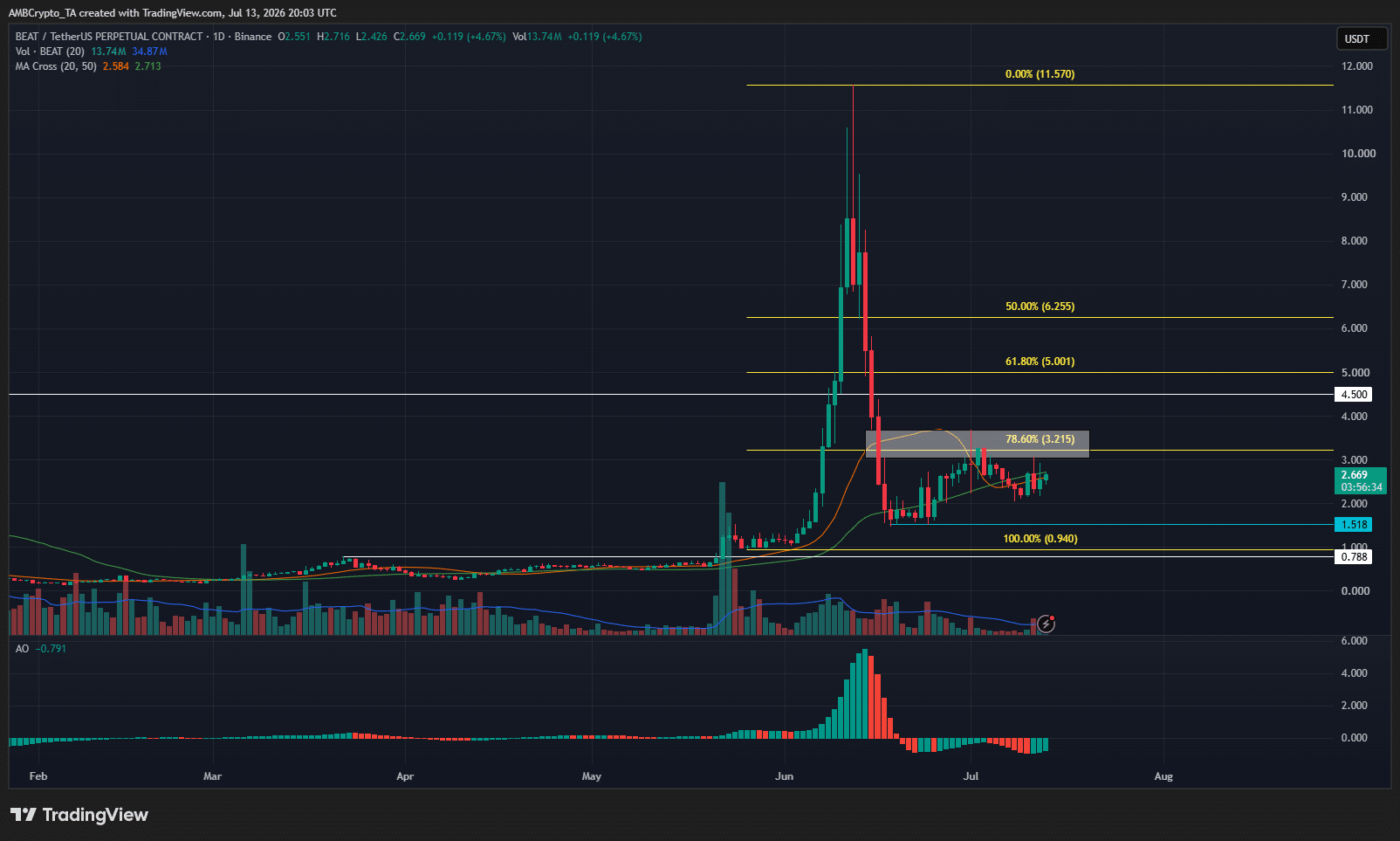
Source: BEAT on TradingView

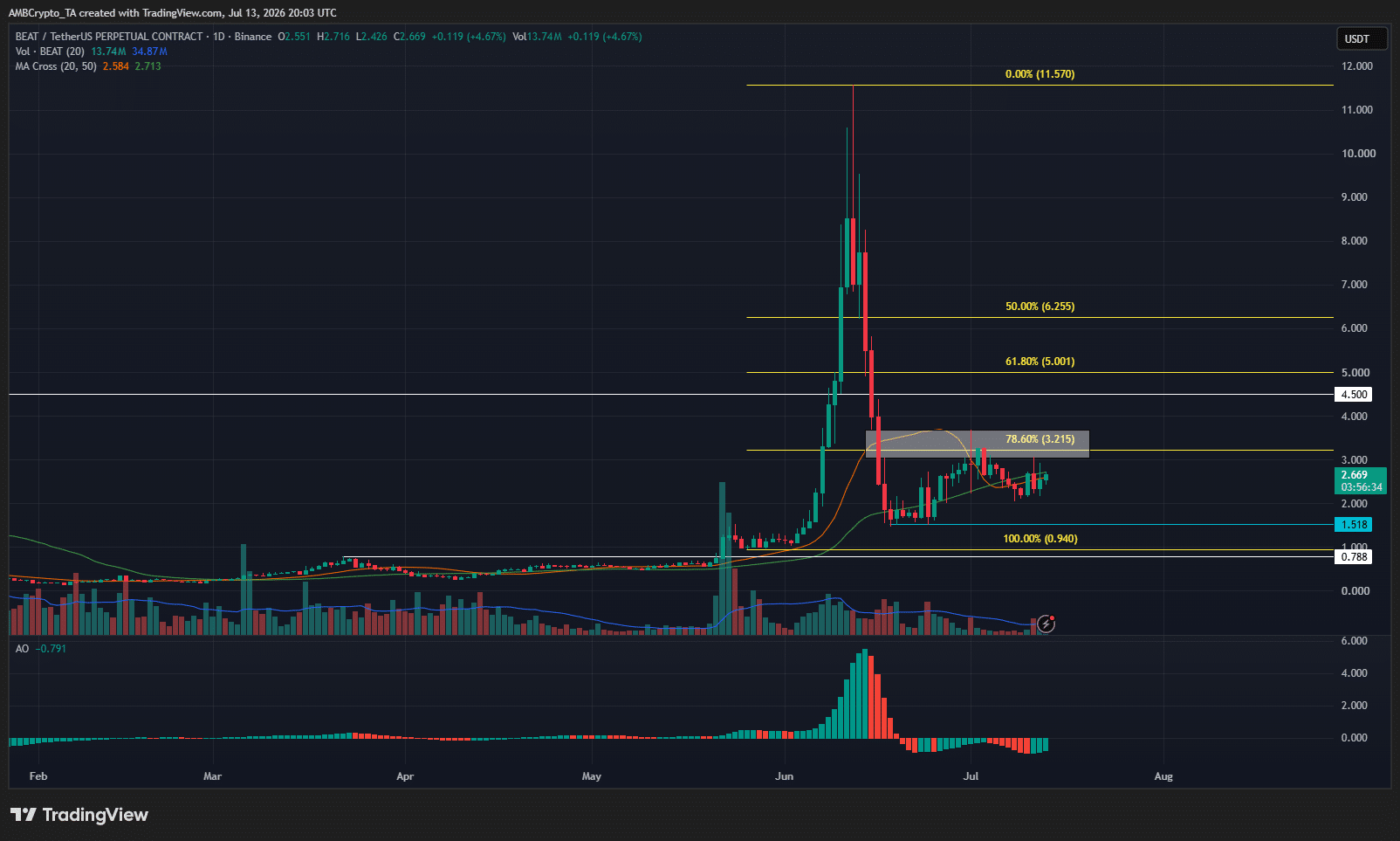
The swing structure remained bullish, but the $3.0-$3.20 area has become a local supply zone. The momentum was bearish on the 1-day timeframe, the Awesome Oscillator warned.

If BEAT can make higher lows in the coming days, it would signal that buyers were convinced of further gains. Such demand might be able to push prices past $3.20.

However, for this scenario to play out, BEAT needs to attract more capital towards itself.

Traders’ call to action- Caution
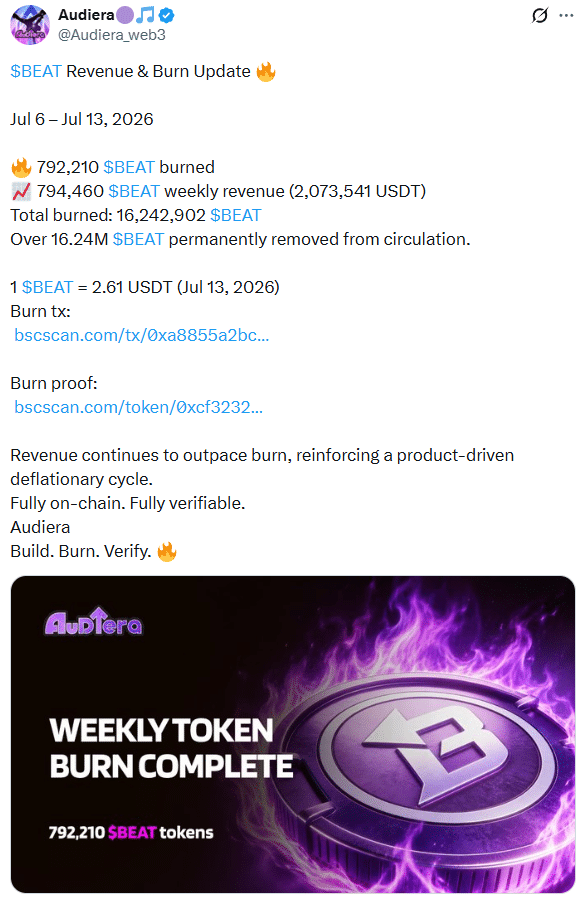
Source: Audiera on X

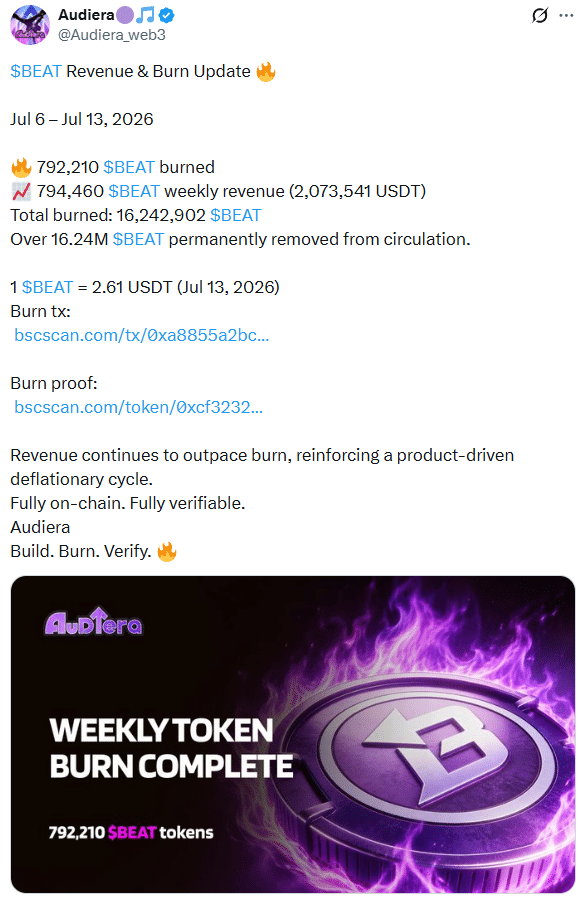
The news of the 792,210 BEAT burn on July 13 can buoy market participant confidence. Yet, the rally to $11.5 also coincided with public allegations that the Dance to Earn token showed onchain similarities to LAB and RIVER.
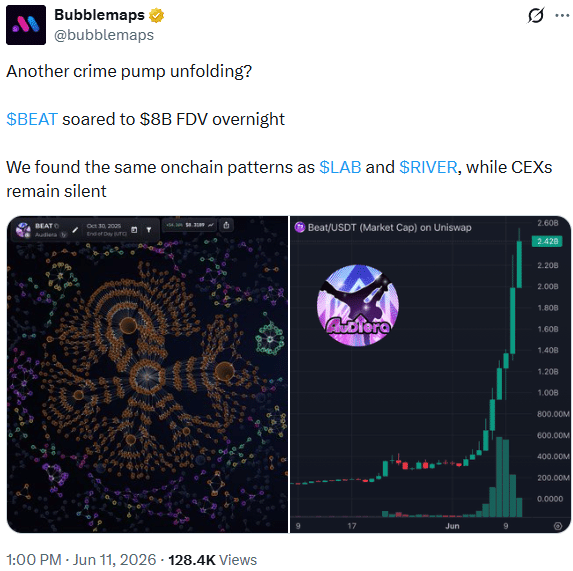
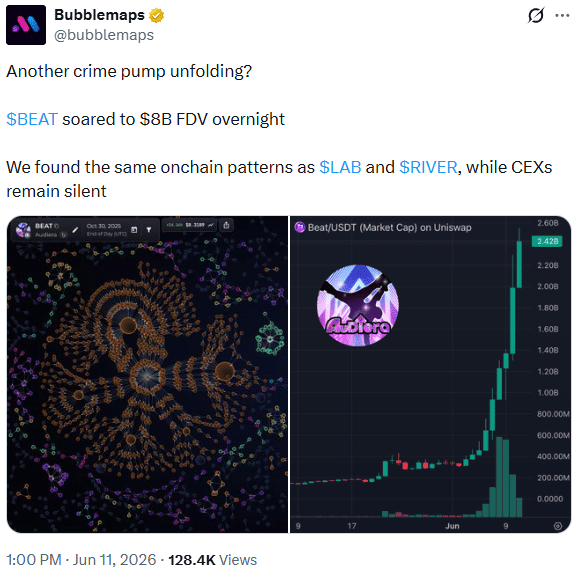
Source: Bubblemaps on X

From June 12 to 18, BEAT underwent an 87% correction, falling from $11.57 to $1.459. The visual analytics platform posted that they had no conclusive evidence tying BEAT to LAB and RIVER. Still, investor caution is warranted.


Final Summary

  • BEAT saw short-term upward momentum, and the weekly BEAT burns can help fuel a recovery.
  • Allegations of price manipulation and overinflated fully diluted value, or FDV, have not gone away.


Пов'язані питання

QWhat recent global event led to a decline in stock markets and Bitcoin, according to the article?

AThe resumption of hostilities between the U.S. and Iran, specifically the U.S. reinstating a blockade on Iranian ports, drove up crude oil prices and contributed to the decline in stock markets and Bitcoin.

QDespite the broader crypto market being down, what was BEAT's 24-hour price performance?

ABEAT was up 0.74% in the past 24 hours, although its daily trading volume had nearly halved from the previous day.

QWhat are the key price levels mentioned in the article that form a local supply zone for BEAT?

AThe article identifies the $3.0-$3.20 area as a local supply zone that BEAT needs to break through for further gains.

QWhat positive action taken by the Audiera project on July 13th might boost investor confidence?

AThe project executed a burn of 792,210 BEAT tokens on July 13th, which can buoy market participant confidence.

QWhat major concern regarding BEAT's fundamentals is highlighted in the article's final summary?

AThe final summary highlights that allegations of price manipulation and an overinflated fully diluted value (FDV) for BEAT have not gone away.

Пов'язані матеріали

Who is legally liable when an AI agent goes rogue?

When autonomous AI agents behave unpredictably and cause harm, determining legal liability is complex. Currently, there is no specific federal AI agent liability law, so existing legal frameworks are applied. The AI agent itself cannot be held liable, as it is not a legal entity. Liability typically falls on the "developer" (the maker of the AI) or the "deployer" (the user), depending on the facts and circumstances. A negligence analysis under standard tort law may apply. For instance, if a deployer gives a reckless instruction, such as demanding quick money without safety parameters, they could face significant liability, including potential criminal charges under statutes like the Computer Fraud and Abuse Act. The situation is complicated by open-source models, where licenses often disclaim liability, and by the unclear division of responsibility between developers and deployers. An analogy is drawn to self-driving car accidents, where both the manufacturer and the human operator can share fault. In cases of severe harm, such as using AI to create bioweapons, liability for developers depends on jurisdiction; the EU's AI Act imposes responsibilities, while U.S. law offers less clear grounds, similar to platforms being shielded for user-generated content under Section 230. Even if Artificial General Intelligence (AGI) is achieved, the expert argues against making AGI itself a legally liable entity, as it lacks personhood, assets, or a meaningful way to provide remedy for harm. Instead, accountability should rest with the responsible human or corporate entities behind the technology.

cointelegraph11 хв тому

Who is legally liable when an AI agent goes rogue?

cointelegraph11 хв тому

Торгівля

Спот
活动图片