Aster Chain mainnet debuts: Can it slow the DEX’s falling market share?

ambcryptoОпубліковано о 2026-03-18Востаннє оновлено о 2026-03-18

Анотація

Aster Chain, a perpetual DEX backed by YZi Labs, has launched its mainnet. The new Layer 1 blockchain incorporates zero-knowledge proofs and stealth addresses to prevent "position hunting" and improve privacy for high-frequency traders, while maintaining a CEX-like user experience. Despite a strong initial debut in late 2025, Aster's trading volume and market share have significantly declined. Weekly volume dropped from a peak of $74 billion to under $10 billion, and its market share fell from 40% to 20%. Competitor Hyperliquid, which initially lost dominance to Aster, has since regained much of its market share. The native token, ASTER, fell 86% from its high but recovered 80% during a broader market bounce. The mainnet announcement caused a brief 10% price surge, but gains were not sustained. The token remains range-bound between $0.70 and $0.80, with a potential move to $0.95 if key resistance is broken. Future demand may depend on the success of planned staking features.

YZi Labs-backed perpetual DEX platform Aster has finally unveiled its Aster Chain mainnet. The new chain will adopt zero-knowledge proofs and stealth addresses in a bid to curb ‘position hunting,’ common on transparent public chains and platforms like Hyperliquid.

Initially, the DEX debuted on BNB Chain via a bridge and later extended to Ethereum [ETH], Solana [SOL], and Arbitrum [ARB] as a multi-chain dApp. While it will still support trading across these chains, it will transition into a sovereign Layer 1 ecosystem.

The move is aimed at achieving the privacy and other optimal features for high-frequency traders while maintaining a CEX-like user experience.

Aster’s market share falls

Although the DEX became an instant hit after its launch last September, the traction has waned significantly in 2026.

During its peak activity in October 2025, it handled nearly $74 billion in weekly trading volume. But its trading activity shrank to less than $10 billion as of mid-March 2026, following the broader crypto rout in the past few months.

Its overall market share in perps trading volume declined by half, from 40% to 20%, over the same period.
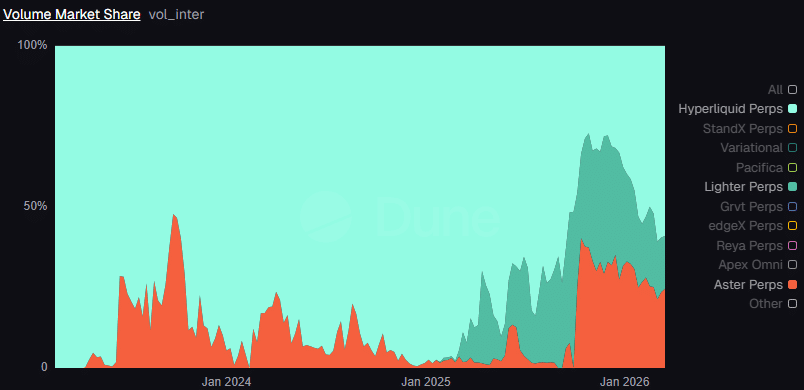
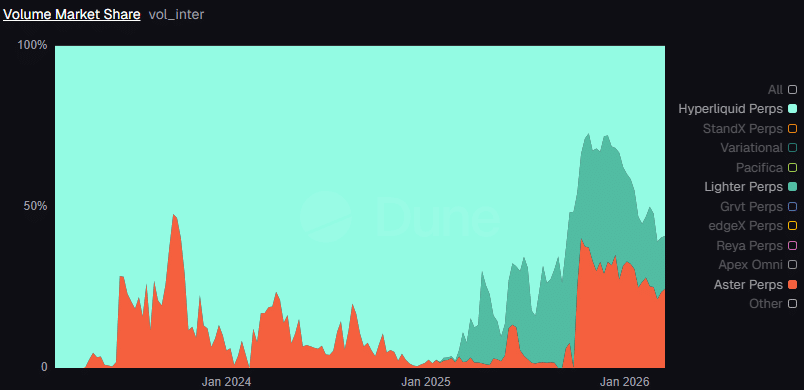
Source: Dune

Interestingly, Aster’s wild FOMO after launch clawed down Hyperliquid’s [HYPE] market share. Hyperliquid had over 60% dominance before Aster went live. Afterward, its dominance fell to 27% but began reclaiming it only after unveiling trading support for oil, gold, silver, and other commodities via HIP-3.

As of writing, Hyperliquid has regained most of its trading volume, while Aster’s steep decline has not abated.

ASTER price reaction

Likewise, its native token ASTER slumped 86% after a free fall from $3 to a low of $0.4. However, the broader market relief bounce from early February has boosted the altcoin’s recovery by 80%.

But the mainnet debut didn’t help bulls that much. After the update, ASTER swiftly rallied by nearly 10%, hitting $0.790, but had erased most of the gains at the time of writing.

When zoomed out, the altcoin was still stuck at its February tight price range of $0.70 and $0.80. The sideways structure may extend if there is no meaningful catalyst for a broader market extended recovery.

However, should the $0.80 price level be flipped to support, then retesting $0.950 could be feasible. It’s unclear whether the planned staking feature will induce demand for ASTER.
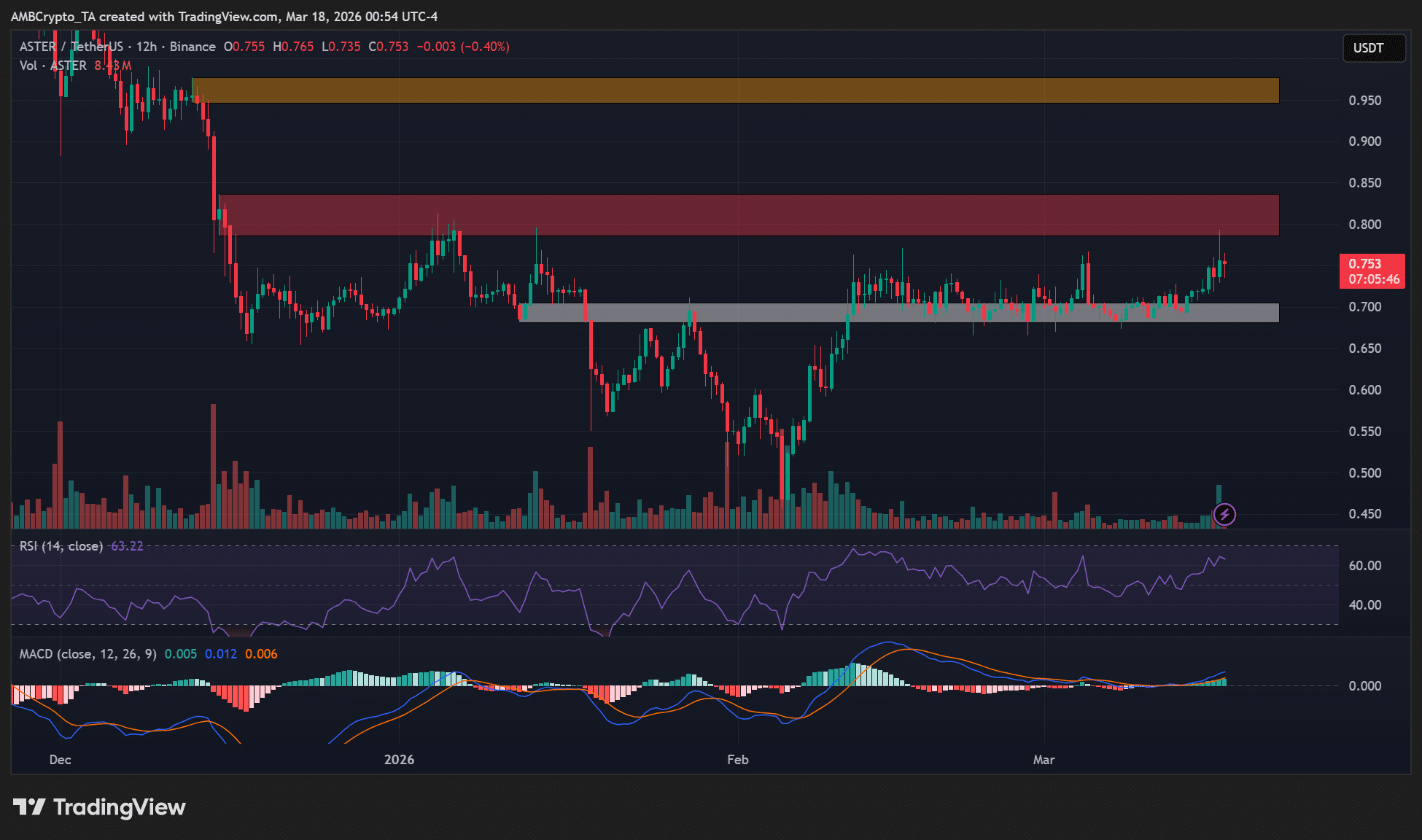
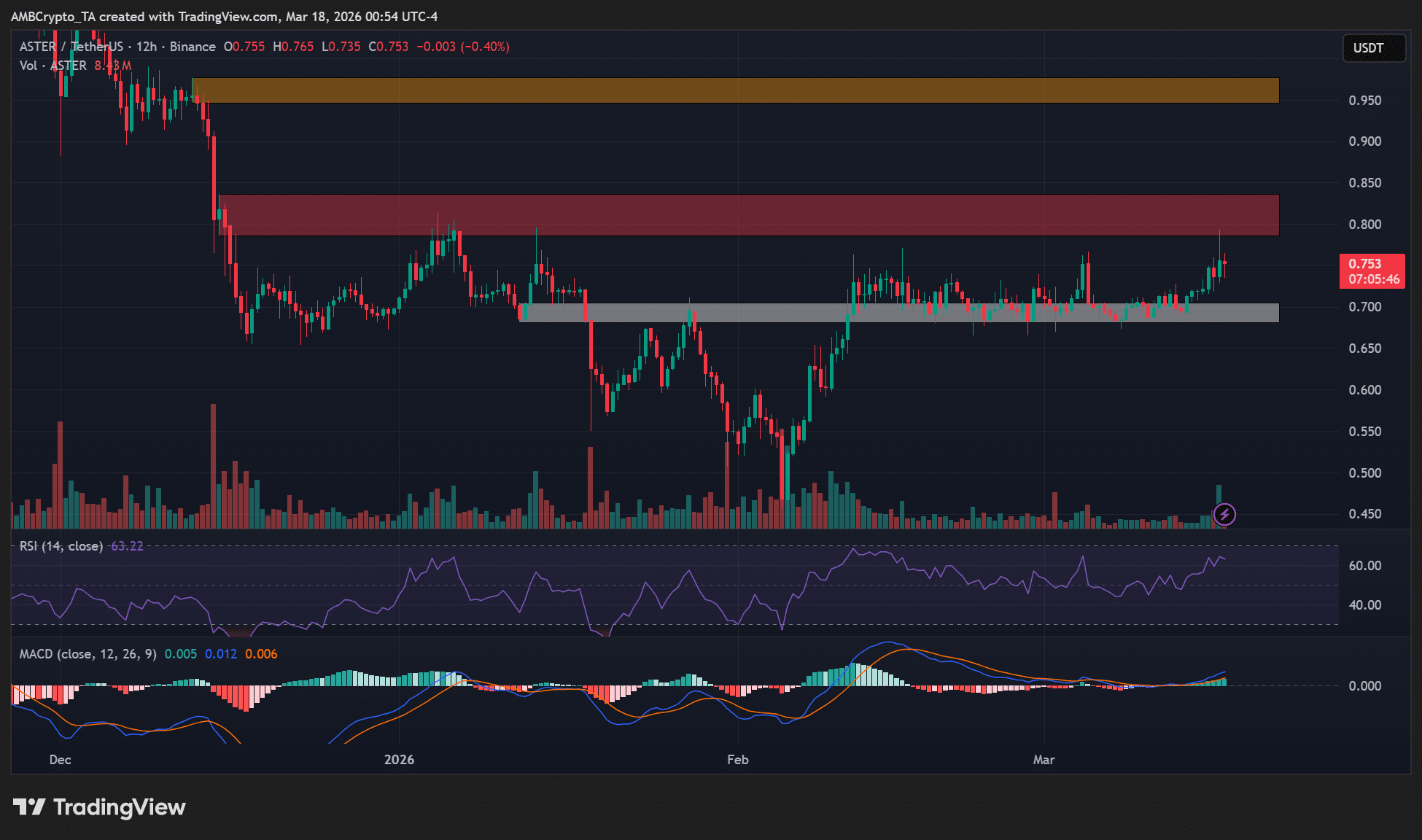
Source: ASTER/USDT, TradingView

Final Summary

  • Aster has unveiled its Aster Chain mainnet to double down on privacy and trading efficiency.
  • Still, the DEX’s traction remains in a downtrend while the ASTER price has been stuck in a tight range.


Трендові криптовалюти

Пов'язані питання

QWhat is the main purpose of the newly launched Aster Chain mainnet?

AThe Aster Chain mainnet aims to provide enhanced privacy and optimal features for high-frequency traders by adopting zero-knowledge proofs and stealth addresses to curb position hunting, while maintaining a CEX-like user experience.

QHow did Aster's market share in perpetual trading volume change from its peak to mid-March 2026?

AAster's market share in perpetual trading volume declined by half, from 40% at its peak to 20% by mid-March 2026.

QWhat was the impact of Aster's launch on Hyperliquid's market dominance?

AAster's launch reduced Hyperliquid's market dominance from over 60% to 27%, though Hyperliquid later regained most of its trading volume after introducing support for commodities like oil, gold, and silver via HIP-3.

QHow did the ASTER token price react to the mainnet debut?

AThe ASTER token initially rallied nearly 10% to $0.790 after the mainnet debut but erased most of those gains shortly after, remaining stuck in the $0.70 to $0.80 range.

QWhat chains did Aster initially support before transitioning to a sovereign Layer 1 ecosystem?

AAster initially debuted on BNB Chain via a bridge and later extended to Ethereum, Solana, and Arbitrum as a multi-chain dApp before transitioning to a sovereign Layer 1 ecosystem.

Пов'язані матеріали

Podcast Notes | Conversation with GSR Asset Management Head: To Determine if This Crypto Rally is Real, Just Watch the Lending Rates on Aave

Podcast Summary: Dialogue with GSR's Head of Asset Management: To Determine if This Crypto Rally is Real, Just Check Lending Rates on Aave Andy Baehr, Managing Director of Asset Management at GSR, discusses the current crypto market, characterizing it as stuck in a state of "ambivalence" with short-lived, unsustainable rallies. He outlines a simple framework: the market moves between "ambivalence" and "conviction" (sustained upward momentum). Currently, every rally resembles a single-stage rocket booster that quickly fizzles out. Baehr identifies three key signals to watch: 1) DeFi lending rates, 2) the potential passage of the CLARITY Act, and 3) the market forming a consensus on the "Fed hawkish peak." He emphasizes that the most immediate indicator for the sustainability of the recent CPI-triggered rally is the USDC borrowing rate on Aave, currently around 3.75%—close to U.S. Treasury yields. The absence of a credit spread indicates low leverage demand and a lack of market energy. He explains that a healthy, sustained rally requires layered buying pressure. Last year's rally progressed from an ETH short squeeze to crypto-native trader influx and finally to ETF inflows. Currently, this structure is missing. Other potential structural buyers like Digital Asset Treasury (DAT) companies are absent, and ETF flows have proven transient. Baehr notes that while small-cap crypto tokens outperformed large caps in Q2—a potential sign of capitation in major assets—capital is also flowing to more exciting opportunities like AI stocks and tech IPOs, leaving crypto sidelined. Regarding DeFi, he highlights that platforms like Aave provide a clear, real-time signal of leverage demand through their supply/demand-driven interest rates. A significant, sustained rate increase would signal genuine market conviction. He also observes the quiet emergence of fixed-income-like products and vaults in DeFi. On regulation, the probability of the CLARITY Act passing before the August 7th deadline has dropped linearly from 75% to below 40% on Polymarket. Baehr suggests its passage would be treated as a bullish surprise, a potent driver for price movement. However, political hurdles, including ethical clause debates and disclosures about the First Family's crypto profits, remain significant obstacles. Ultimately, the market awaits clarity on the Fed's terminal rate under Chair Warsh. Until the "Fed Solstice"—the point where the market collectively understands the peak of hawkish policy—sustained conviction will be difficult to achieve.

marsbit33 хв тому

Podcast Notes | Conversation with GSR Asset Management Head: To Determine if This Crypto Rally is Real, Just Watch the Lending Rates on Aave

marsbit33 хв тому

7 Months After the Collapse of Huiwang, Southeast Asia's Escrow Platforms Undergo a Major Reshuffle

Following the collapse of Huione Pay—dubbed the "Alipay of Southeast Asia"—seven months ago, the region's underground financial guarantee platform sector is undergoing a significant reshuffle. This power vacuum has been swiftly filled by emerging platforms such as XinBi, Tiger/Navigator, JinBei (renamed JinBo), Dali/Tiancheng, and FullyLight. These platforms, operating largely via Telegram and offering services like escrow for illicit transactions, have absorbed the vast user base and markets left behind by Huione. While positioning themselves as "trust intermediaries," their primary clientele consists of networks involved in online scams, money laundering, illegal gambling, and even human trafficking. For instance, the Tiger/Navigator platform explicitly provides "escrow" services for kidnapping-for-ransom operations ("强押车交易"). Data underscores the immense scale: Huione alone processed over $103 billion in cryptocurrency payments and facilitated over $31 billion through its escrow market before its downfall, linking it to Cambodia's notorious Prince Group. Since its collapse, competitors have seen explosive growth. For example, the XinBi platform has accumulated over $1.6 billion in total USDT revenue, while platforms like NewPay, OkPay (under Dali), and FullyLight Wallet collectively processed over $4.8 billion in USDT in a single year. This ecosystem thrives in regions like Cambodia and Myanmar, where regulatory gaps allow these platforms to act as critical financial infrastructure for sprawling cybercrime industries, from scam compounds to online casinos. The article concludes that the moniker "Southeast Asian Alipay" is a misnomer, obscuring the platforms' fundamental role in enabling serious criminal enterprises rather than representing legitimate financial innovation.

Odaily星球日报1 год тому

7 Months After the Collapse of Huiwang, Southeast Asia's Escrow Platforms Undergo a Major Reshuffle

Odaily星球日报1 год тому

Торгівля

Спот

Популярні статті

Як купити ASTER

Ласкаво просимо до HTX.com! Ми зробили покупку Aster (ASTER) простою та зручною. Дотримуйтесь нашої покрокової інструкції, щоб розпочати свою криптовалютну подорож.Крок 1: Створіть обліковий запис на HTXВикористовуйте свою електронну пошту або номер телефону, щоб зареєструвати обліковий запис на HTX безплатно. Пройдіть безпроблемну реєстрацію й отримайте доступ до всіх функцій.ЗареєструватисьКрок 2: Перейдіть до розділу Купити крипту і виберіть спосіб оплатиКредитна/дебетова картка: використовуйте вашу картку Visa або Mastercard, щоб миттєво купити Aster (ASTER).Баланс: використовуйте кошти з балансу вашого рахунку HTX для безперешкодної торгівлі.Треті особи: ми додали популярні способи оплати, такі як Google Pay та Apple Pay, щоб підвищити зручність.P2P: Торгуйте безпосередньо з іншими користувачами на HTX.Позабіржова торгівля (OTC): ми пропонуємо індивідуальні послуги та конкурентні обмінні курси для трейдерів.Крок 3: Зберігайте свої Aster (ASTER)Після придбання Aster (ASTER) збережіть його у своєму обліковому записі на HTX. Крім того, ви можете відправити його в інше місце за допомогою блокчейн-переказу або використовувати його для торгівлі іншими криптовалютами.Крок 4: Торгівля Aster (ASTER)Легко торгуйте Aster (ASTER) на спотовому ринку HTX. Просто увійдіть до свого облікового запису, виберіть торгову пару, укладайте угоди та спостерігайте за ними в режимі реального часу. Ми пропонуємо зручний досвід як для початківців, так і для досвідчених трейдерів.

607 переглядів усьогоОпубліковано 2025.09.25Оновлено 2026.06.02

Як купити ASTER

Обговорення

Ласкаво просимо до спільноти HTX. Тут ви можете бути в курсі останніх подій розвитку платформи та отримати доступ до професійної ринкової інформації. Нижче представлені думки користувачів щодо ціни ASTER (ASTER).

活动图片












