'ASIC Giant' Marvell Sets Record Quarterly Revenue, Raises Guidance Again, CEO Says Data Center Business Is 'On Fire'

marsbitОпубліковано о 2026-05-28Востаннє оновлено о 2026-05-28

Анотація

Marvell Technology, a leading player in custom AI chips and data center connectivity, reported record revenue for its fiscal Q1 2027, driven by explosive demand in its data center business. Revenue reached $2.418 billion, slightly surpassing expectations, though GAAP net income fell year-over-year due to acquisition-related costs. Crucially, data center revenue hit $1.83 billion, making up 76% of the total and growing 27% YoY. The company significantly raised its full-year and next-year guidance, citing "exceptionally strong AI-related orders." Revenue is now projected at ~$11.5 billion for FY2027 and ~$16.5 billion for FY2028. CEO Matt Murphy emphasized that growth in the data center segment is accelerating. The AI Interconnect business, now expected to grow over 70% annually, saw its forecast lifted again due to rising network demands in complex AI models. Additionally, Marvell's custom chip (XPU) business is on a steep growth path, with FY2028 revenue anticipated to double and a target of over $10 billion by FY2029. The company also expanded its strategic collaboration with NVIDIA, focusing on silicon photonics, system integration, and AI-RAN solutions. To secure supply for surging demand, Marvell plans about $1 billion in supplier prepayments this fiscal year, highlighting its long-term capacity planning. Despite the strong results, the stock dipped slightly in after-hours trading.

Marvell delivered a seemingly brilliant report card with record revenue and a significant guidance raise.

After the U.S. market closed on May 27th, AI custom chip, optical communication, and data center interconnect leader Marvell released its Q1 FY2027 financial results and held an earnings call. The data center business continued its explosive growth, leading the company to once again significantly raise its full-year guidance. CEO Matt Murphy directly stated on the call, "Our data center business is on fire", and "orders are exceptionally strong."

Marvell's Q1 FY2027 revenue was $2.418 billion, up 28% year-over-year and 9% quarter-over-quarter, slightly exceeding analyst expectations of $2.41 billion. Non-GAAP earnings per share were $0.80, in line with analyst estimates. However, GAAP net profit was $34.5 million, a significant decline from $177.9 million in the same period last year, primarily due to one-time costs and non-cash amortization related to the acquisitions of Celestial AI and XConn.

The data center business contributed $1.83 billion in revenue, accounting for 76% of total revenue, up 27% year-over-year and 11% quarter-over-quarter.

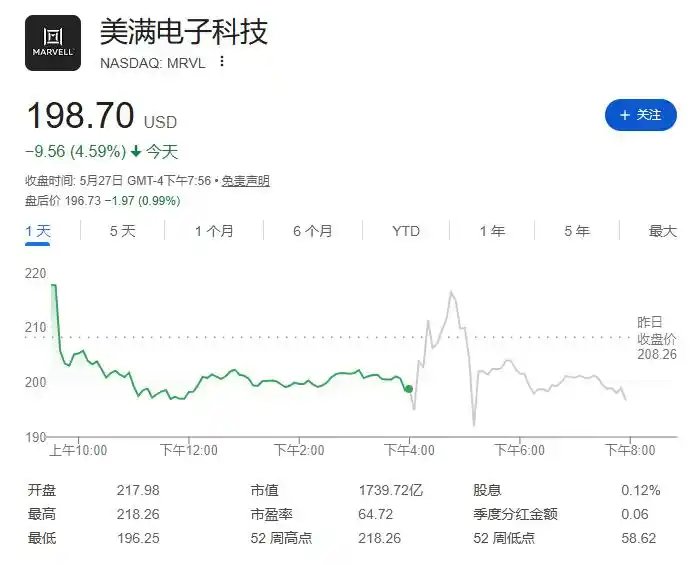
Following the earnings report and call, the company's stock price fell slightly by about 1%. Year-to-date, the stock had already more than doubled ahead of the earnings report. Against high expectations, merely "meeting expectations" may no longer be enough to impress the market.
01

"AI-Related Orders Are Exceptionally Strong," Marvell Raises Guidance Again

This marks Marvell raising its guidance for multiple consecutive quarters.

For the Q2 FY2027 guidance, the company expects revenue of approximately $2.7 billion (plus or minus 5%), representing year-over-year growth of about 35%, higher than the analyst consensus estimate of $2.6 billion. The non-GAAP EPS guidance range is $0.88 to $0.98, compared to the analyst consensus of $0.90.

For the full-year guidance, Marvell raised its FY2027 revenue expectation to approximately $11.5 billion, representing growth of about 40% year-over-year. Three months ago, the company's guidance was "approaching $11 billion."

More attention-grabbing is the outlook for FY2028. Marvell raised its FY2028 revenue target to approximately $16.5 billion, about $1.5 billion higher than the guidance provided last quarter, representing year-over-year growth of about 45%.

CEO Matt Murphy stated in the earnings release: "We are seeing exceptionally strong AI-related orders, and as a result, we are significantly raising our revenue expectations for Marvell's FY2027 and FY2028, showing substantial improvement compared to the guidance provided last quarter."

02

Data Center: Accounts for 76% of Revenue, Growth Still Accelerating

Q1 data center revenue was $1.83 billion, up 27% year-over-year and 11% quarter-over-quarter, accounting for 76% of total revenue.

Marvell's growth forecasts for this business are:

FY2026: +46% (already achieved)

FY2027: approximately +50%

FY2028: approximately +55%

Murphy stated:

The data center business is on fire, and we expect growth rates to accelerate this year and next, starting from an already high base.

03

Interconnect Business: Growth Rate from 30%→50%→70%, CEO Says "There's Room for Upside"

The AI Data Center Interconnect business is the largest segment within Marvell's data center portfolio, covering optical interconnect, DCI modules, coherent optics, and other product lines.

The expected annual growth rate for this business has been raised consecutively over the past few quarters: around 30% around September last year, later raised to 50%, and now raised again to over 70%.

When pressed by analysts, Murphy said directly:

I think there is a lot of potential for upside here. Our traditional DSP business will see a significant jump next year, the 1.6T product line has higher value content, DCI is accelerating, along with new businesses like retimers, AEC, and scale-up optics... This is the beginning of a major growth cycle for us.

Why has the interconnect business suddenly become so important? Murphy provided a clear logic:

Early generative AI primarily addressed compute and memory bottlenecks, with network interconnect being a secondary concern. However, with the deployment of more complex architectures like inference models and Mixture of Experts (MoE) models, the volume of data transmission within AI clusters has increased dramatically, significantly elevating the importance of network interconnect.

Some key numbers:

TIA and Driver Chips: Expected to surpass an annualized revenue run rate of $1 billion in the coming quarters.

DCI Module Business: Already shipping to all five major U.S. hyperscale cloud providers. Expected to surpass an annualized revenue run rate of $1 billion in FY2028, approximately double that of FY2026 (~$500 million).

Scale-up optics (NPO/CPO Optical Interconnect): Previously expected to be around $150 million; now raised, expected to exceed $300 million in FY2028.

04

Custom Chips (XPU): Doubling Next Year, Targeting Over $10 Billion by FY2029

Marvell's custom chip (Custom/XPU) business is another important growth line and a major focus for the market.

Current Progress:

FY2027 Custom Chip Revenue: Growth exceeding 20% year-over-year.

FY2028 Custom Chip Revenue: Expected to double year-over-year, higher than last quarter's expectation.

FY2029 Target: Exceed $10 billion (previous target was approximately $8 billion).

Analyst Vivek Arya (Bank of America Securities) pressed during the call: Does this mean FY2028 custom chip revenue will be over $4 billion, then jump to $10 billion in FY2029, implying a single-year incremental revenue of $5-6 billion?

Murphy's response was: Yes, you heard that correctly.

Three drivers for FY2028 custom chip growth:

Continued growth from existing flagship XPU projects.

More than ten XPU satellite projects (NIC, CXL, etc.) entering higher-volume production stages, with demand consistently exceeding expectations.

A new leading XPU project entering production — Murphy stated, "The project is progressing smoothly, and the full-year production plan is in place."

Murphy also revealed that while newly won design projects typically require about a two-year development cycle before contributing revenue, the significance of these projects lies in providing security for longer-term growth, which he referred to as "insurance policies."

05

Expanding Collaboration with NVIDIA, Three Key Directions Materializing

This quarter, Marvell announced an expanded strategic collaboration with NVIDIA. Murphy detailed three core directions on the call:

1. Optical Interconnect Collaboration: Marvell has long provided DSP, TIA, and drivers to NVIDIA. The two companies are now further collaborating on developing silicon photonics technology, considered a key enabling technology for scale-up networks.

2. NVLink Fusion Integration: Allows Marvell to build custom chips and network semiconductors that seamlessly interface with NVIDIA's infrastructure. Murphy stated this provides hyperscale cloud providers with greater flexibility to freely mix and match between custom chips and NVIDIA chips. "Marvell uniquely provides the bridge between these two architectures," creating new market opportunities for both companies.

3. AI-RAN: Marvell will enhance its Octeon base station processors to enable them to work directly in tandem with NVIDIA GPUs, running both 5G/6G wireless workloads and AI applications on the same hardware platform.

06

Supply Chain: Locking in Capacity Early, ~$1 Billion in Prepayments Planned This Year

Facing continuously climbing demand, supply chain management has become a critical variable.

CFO Willem Meintjes revealed on the call that the company plans to make approximately $1 billion in supplier prepayments during FY2027, with the first payments starting in Q2. These prepayments will be credited against future material purchases.

COO Chris Koopmans explained Marvell's supply chain strategy in response to analyst questions:

Everything related to AI has been supply-constrained from day one. Our approach is to build extremely close relationships with a small number of core suppliers, provide them with five-year demand forecasts, deliver on our promises every time, and back up our forecasts with action and prepayments.

Financially, Q1 operating cash flow reached a record $639 million. The company repurchased $200 million worth of stock in the quarter and paid $54 million in dividends. As of the end of Q1, total debt stood at $4.96 billion, with net debt/EBITDA at 0.32x.

This article is from the WeChat public account "Wall Street Insights Max," author: Long Yue

Пов'язані питання

QWhat was the key factor behind Marvell's significant increase in its revenue guidance for fiscal years 2027 and 2028?

AThe key factor was exceptionally strong AI-related orders, which led the company to significantly raise its revenue outlook compared to the guidance provided the previous quarter.

QWhat percentage of Marvell's total Q1 revenue came from its Data Center segment, and what was its growth rate?

AMarvell's Data Center segment contributed 76% of its total Q1 revenue, with a year-over-year growth of 27% and a sequential growth of 11%.

QHow did Marvell describe the growth trajectory for its AI Data Center Interconnect (Interconnect) business?

AMarvell described the growth trajectory as accelerating significantly, with the annual growth rate expectation being raised from around 30% to 50%, and now to over 70%. The CEO indicated there is substantial upside potential remaining.

QWhat is Marvell's stated revenue target for its Custom Chip (XPU) business by fiscal year 2029, and what major driver was mentioned for growth in fiscal year 2028?

AMarvell's stated revenue target for its Custom Chip (XPU) business by fiscal year 2029 is over $10 billion. A major driver for growth in fiscal year 2028 is the expected doubling of its custom chip revenue, aided by a new major XPU project entering production.

QWhat are the three core areas of Marvell's expanded strategic collaboration with NVIDIA, as detailed in the earnings call?

AThe three core areas are: 1) Collaboration on optical interconnect and silicon photonics technology. 2) NVLink Fusion Integration, allowing Marvell to build custom chips and networking semiconductors that interface seamlessly with NVIDIA infrastructure. 3) AI-RAN, enhancing Marvell's Octeon base station processors to work directly with NVIDIA GPUs for simultaneous 5G/6G and AI workloads.

Пов'язані матеріали

Solo Company Craze: Some Earn Millions Annually, Others See Incomes Shrink by 90%

The Rise of the "One-Person Company" (OPC): AI Fuels a Solo Entrepreneurship Wave The concept of the "One-Person Company" (OPC)—where an individual leverages AI tools to start and run a business—is gaining significant traction, hailed by some as ushering in a "golden age" for solo entrepreneurship. While success stories abound, the reality is a mixed picture of high earnings and significant struggles. The article profiles several OPC founders across different industries: * A game developer created 6 bullet-chat (danmaku) games in a year using an AI-powered workflow, earning approximately 1 million RMB. AI handled around 70% of art and 99% of coding tasks, slashing development cycles from months to about 15 days per game. * A materials researcher in Japan, using AI for tasks from translation to legal advice, earns roughly triple the salary of a local white-collar worker. * A biotech entrepreneur uses AI Agents to automate 80% of repetitive work like data analysis, doubling their previous income while gaining time freedom. * Conversely, a former tech executive turned cross-border e-commerce founder in Latin America reports a 90% drop in income compared to their previous corporate job, cautioning against blindly following the trend. Key insights from these cases include: AI dramatically lowers barriers to entry and operational costs, but does not guarantee success. It excels at automating repetitive tasks but cannot replace core human skills like creativity, project management, judgment, and client acquisition. Industry experience and existing client/resources remain critical advantages. The model suits self-starters with specific expertise but poses challenges in areas like sales, compliance, and scaling. Ultimately, while AI empowers solo ventures, entrepreneurship's inherent risks and demands persist.

marsbit6 хв тому

Solo Company Craze: Some Earn Millions Annually, Others See Incomes Shrink by 90%

marsbit6 хв тому

Goldman Sachs Research Report Analysis: Chip Shortage to Persist Until 2028, Maintain Buy Recommendations

Goldman Sachs Research Report Summary: Memory Shortage Until 2028, Maintain Buy Recommendations Goldman Sachs' latest Asia-Pacific equities report, "The 720," forecasts a sustained memory chip upcycle extending into 2028, driven by strong AI server demand visibility, limited supply growth, and binding long-term agreements. The firm believes the market significantly underestimates the cycle's duration, as evidenced by low P/E ratios for memory stocks. Key sector calls include raising 12-month price targets for Samsung Electronics and SK Hynix, and upgrading Kioxia from Hold to Buy, citing higher and more sustainable peak profits over the next 2-3 years. The report also highlights the broader AI hardware supply chain benefiting from hyperscaler capex acceleration. Recommendations include: * MediaTek (Buy) for its data center/ASIC pivot. * Eoptolink (Buy) on 1.6T optical module ramp-up. * Biren (Buy) for its AI chip migration. * Huaqin (Buy, newly covered) for its shift from consumer electronics ODM to AI data centers. * Lenovo (Buy) on the AI PC refresh cycle. Other notable mentions include China property developers (under an optimistic scenario), BYD for its affordable city NOA strategy, and select Japanese semiconductor equipment makers. A macro theme notes the divergence between AI-boom beneficiaries (e.g., Korea, Taiwan) and energy-importing economies facing inflationary pressure. The report concludes with standard disclaimers, noting that price targets are forward-looking estimates and that sell-side research has an inherent bullish bias. The core investment thesis hinges on the longevity of the memory upcycle and the AI-driven capex wave.

marsbit39 хв тому

Goldman Sachs Research Report Analysis: Chip Shortage to Persist Until 2028, Maintain Buy Recommendations

marsbit39 хв тому

A Detailed Look at Cathie Wood's Masterful Moves on Circle

Title: A Detailed Look at Cathie Wood's Masterful Moves on Circle ARK Invest's Cathie Wood executed a textbook investment strategy on Circle (CRCL), showcasing how a long-term investor can capitalize on short-term volatility. Key to her success was securing 4.49 million shares at the $31 IPO price before the public offering, leveraging pre-IPO access unavailable to most investors. The stock debuted at $69, fueled by extreme demand against a limited float of only 15% of total shares. Wood then began systematically selling as the price soared, driven by policy optimism like the GENIUS Act, which pushed shares to nearly $299. She sold approximately 1.7 million shares across four transactions at an average price around $210, partly triggered by ARK's internal rule to rebalance when a single stock's weight exceeds 10%. Following a steep decline due to lock-up expirations, increased supply, and interest rate concerns, Circle fell over 80% from its peak. Wood started buying back shares around $82-$86 after a strong Q3 earnings report ironically caused a price drop in November 2025. She continued buying on the way down, eventually rebuilding her position to roughly 4.5 million shares by Q1 2026. The core lessons from Wood's play are: 1) A firm, independent conviction in Circle's long-term narrative as a digital dollar infrastructure player. 2) Executing in phases—selling into strength and buying into weakness—without attempting to time exact tops or bottoms. 3) Strict adherence to position-sizing and rebalancing rules, which forced profit-taking at highs and created capacity to buy at lows. For most investors, chasing the volatile post-IPO "pop" is risky; Wood's success was built on pre-IPO access, deep research, and disciplined execution.

marsbit42 хв тому

A Detailed Look at Cathie Wood's Masterful Moves on Circle

marsbit42 хв тому

Morning Post | Michael Saylor Releases Bitcoin Tracker Info; Aave Publishes Kelp rsETH Bridge Attack Post-Incident Investigation; Gravity Bridge Announces Service Suspension Following Attack

ChainCatcher Daily Summary - June 1, 2026 In regulatory news, the U.S. OCC granted preliminary conditional approval for Laser Digital to establish a federally regulated trust bank. In Vietnam, a draft law amendment proposes allowing SMEs to use digital and virtual assets as loan collateral. Hong Kong's SFC chairman reported that trading volume on the city's 12 licensed virtual asset platforms grew nearly 300% YoY in Q1 2026. Notable incidents include the Cosmos ecosystem cross-chain bridge Gravity Bridge pausing services after an attack. Aave published a post-mortem on the April 18th Kelp rsETH bridge attack, attributing it to a third-party bridge infrastructure vulnerability via an RPC poisoning attack, not the Aave protocol itself. In market developments, MicroStrategy's Michael Saylor hinted at a potential upcoming Bitcoin purchase announcement. Fed Governor Waller commented that widespread stablecoin adoption could amplify the impact of U.S. monetary policy. Meanwhile, sentiment analysis from Santiment indicates a record-high Bitcoin long/short ratio of 2.23, potentially signaling a short-term price correction, while Ethereum shows signs of FUD among commentators. In legal matters, the SEC sued the founder of Privvy Investments for an alleged $12.3 million crypto AI trading bot scam. In China, a Qingdao man was sentenced to 10 years and 9 months for stealing 107 BTC by obtaining a victim's wallet seed phrase. Top trending meme tokens on ETH, Solana, and Base networks for the past 24 hours are also listed.

链捕手1 год тому

Morning Post | Michael Saylor Releases Bitcoin Tracker Info; Aave Publishes Kelp rsETH Bridge Attack Post-Incident Investigation; Gravity Bridge Announces Service Suspension Following Attack

链捕手1 год тому

Торгівля

Спот
Ф'ючерси
活动图片





