'ASIC Giant' Marvell Sets Record Quarterly Revenue, Raises Guidance Again, CEO Says Data Center Business Is 'On Fire'

marsbitОпубліковано о 2026-05-28Востаннє оновлено о 2026-05-28

Анотація

Marvell Technology, a leading player in custom AI chips and data center connectivity, reported record revenue for its fiscal Q1 2027, driven by explosive demand in its data center business. Revenue reached $2.418 billion, slightly surpassing expectations, though GAAP net income fell year-over-year due to acquisition-related costs. Crucially, data center revenue hit $1.83 billion, making up 76% of the total and growing 27% YoY. The company significantly raised its full-year and next-year guidance, citing "exceptionally strong AI-related orders." Revenue is now projected at ~$11.5 billion for FY2027 and ~$16.5 billion for FY2028. CEO Matt Murphy emphasized that growth in the data center segment is accelerating. The AI Interconnect business, now expected to grow over 70% annually, saw its forecast lifted again due to rising network demands in complex AI models. Additionally, Marvell's custom chip (XPU) business is on a steep growth path, with FY2028 revenue anticipated to double and a target of over $10 billion by FY2029. The company also expanded its strategic collaboration with NVIDIA, focusing on silicon photonics, system integration, and AI-RAN solutions. To secure supply for surging demand, Marvell plans about $1 billion in supplier prepayments this fiscal year, highlighting its long-term capacity planning. Despite the strong results, the stock dipped slightly in after-hours trading.

Marvell delivered a seemingly brilliant report card with record revenue and a significant guidance raise.

After the U.S. market closed on May 27th, AI custom chip, optical communication, and data center interconnect leader Marvell released its Q1 FY2027 financial results and held an earnings call. The data center business continued its explosive growth, leading the company to once again significantly raise its full-year guidance. CEO Matt Murphy directly stated on the call, "Our data center business is on fire", and "orders are exceptionally strong."

Marvell's Q1 FY2027 revenue was $2.418 billion, up 28% year-over-year and 9% quarter-over-quarter, slightly exceeding analyst expectations of $2.41 billion. Non-GAAP earnings per share were $0.80, in line with analyst estimates. However, GAAP net profit was $34.5 million, a significant decline from $177.9 million in the same period last year, primarily due to one-time costs and non-cash amortization related to the acquisitions of Celestial AI and XConn.

The data center business contributed $1.83 billion in revenue, accounting for 76% of total revenue, up 27% year-over-year and 11% quarter-over-quarter.

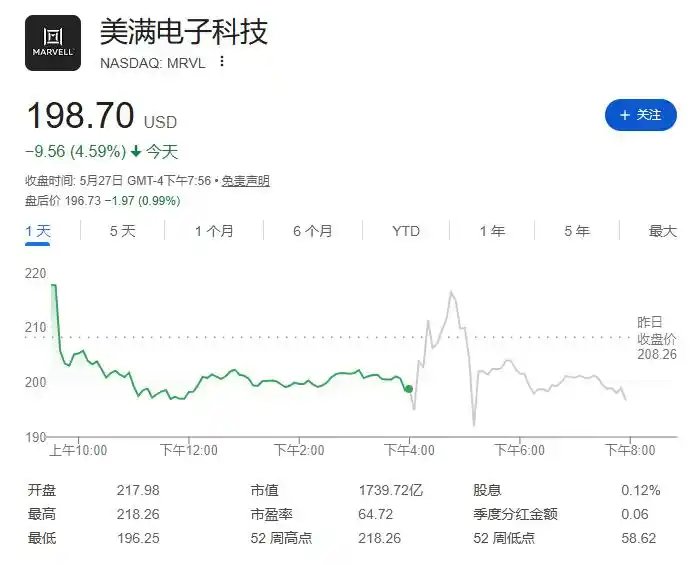
Following the earnings report and call, the company's stock price fell slightly by about 1%. Year-to-date, the stock had already more than doubled ahead of the earnings report. Against high expectations, merely "meeting expectations" may no longer be enough to impress the market.
01

"AI-Related Orders Are Exceptionally Strong," Marvell Raises Guidance Again

This marks Marvell raising its guidance for multiple consecutive quarters.

For the Q2 FY2027 guidance, the company expects revenue of approximately $2.7 billion (plus or minus 5%), representing year-over-year growth of about 35%, higher than the analyst consensus estimate of $2.6 billion. The non-GAAP EPS guidance range is $0.88 to $0.98, compared to the analyst consensus of $0.90.

For the full-year guidance, Marvell raised its FY2027 revenue expectation to approximately $11.5 billion, representing growth of about 40% year-over-year. Three months ago, the company's guidance was "approaching $11 billion."

More attention-grabbing is the outlook for FY2028. Marvell raised its FY2028 revenue target to approximately $16.5 billion, about $1.5 billion higher than the guidance provided last quarter, representing year-over-year growth of about 45%.

CEO Matt Murphy stated in the earnings release: "We are seeing exceptionally strong AI-related orders, and as a result, we are significantly raising our revenue expectations for Marvell's FY2027 and FY2028, showing substantial improvement compared to the guidance provided last quarter."

02

Data Center: Accounts for 76% of Revenue, Growth Still Accelerating

Q1 data center revenue was $1.83 billion, up 27% year-over-year and 11% quarter-over-quarter, accounting for 76% of total revenue.

Marvell's growth forecasts for this business are:

FY2026: +46% (already achieved)

FY2027: approximately +50%

FY2028: approximately +55%

Murphy stated:

The data center business is on fire, and we expect growth rates to accelerate this year and next, starting from an already high base.

03

Interconnect Business: Growth Rate from 30%→50%→70%, CEO Says "There's Room for Upside"

The AI Data Center Interconnect business is the largest segment within Marvell's data center portfolio, covering optical interconnect, DCI modules, coherent optics, and other product lines.

The expected annual growth rate for this business has been raised consecutively over the past few quarters: around 30% around September last year, later raised to 50%, and now raised again to over 70%.

When pressed by analysts, Murphy said directly:

I think there is a lot of potential for upside here. Our traditional DSP business will see a significant jump next year, the 1.6T product line has higher value content, DCI is accelerating, along with new businesses like retimers, AEC, and scale-up optics... This is the beginning of a major growth cycle for us.

Why has the interconnect business suddenly become so important? Murphy provided a clear logic:

Early generative AI primarily addressed compute and memory bottlenecks, with network interconnect being a secondary concern. However, with the deployment of more complex architectures like inference models and Mixture of Experts (MoE) models, the volume of data transmission within AI clusters has increased dramatically, significantly elevating the importance of network interconnect.

Some key numbers:

TIA and Driver Chips: Expected to surpass an annualized revenue run rate of $1 billion in the coming quarters.

DCI Module Business: Already shipping to all five major U.S. hyperscale cloud providers. Expected to surpass an annualized revenue run rate of $1 billion in FY2028, approximately double that of FY2026 (~$500 million).

Scale-up optics (NPO/CPO Optical Interconnect): Previously expected to be around $150 million; now raised, expected to exceed $300 million in FY2028.

04

Custom Chips (XPU): Doubling Next Year, Targeting Over $10 Billion by FY2029

Marvell's custom chip (Custom/XPU) business is another important growth line and a major focus for the market.

Current Progress:

FY2027 Custom Chip Revenue: Growth exceeding 20% year-over-year.

FY2028 Custom Chip Revenue: Expected to double year-over-year, higher than last quarter's expectation.

FY2029 Target: Exceed $10 billion (previous target was approximately $8 billion).

Analyst Vivek Arya (Bank of America Securities) pressed during the call: Does this mean FY2028 custom chip revenue will be over $4 billion, then jump to $10 billion in FY2029, implying a single-year incremental revenue of $5-6 billion?

Murphy's response was: Yes, you heard that correctly.

Three drivers for FY2028 custom chip growth:

Continued growth from existing flagship XPU projects.

More than ten XPU satellite projects (NIC, CXL, etc.) entering higher-volume production stages, with demand consistently exceeding expectations.

A new leading XPU project entering production — Murphy stated, "The project is progressing smoothly, and the full-year production plan is in place."

Murphy also revealed that while newly won design projects typically require about a two-year development cycle before contributing revenue, the significance of these projects lies in providing security for longer-term growth, which he referred to as "insurance policies."

05

Expanding Collaboration with NVIDIA, Three Key Directions Materializing

This quarter, Marvell announced an expanded strategic collaboration with NVIDIA. Murphy detailed three core directions on the call:

1. Optical Interconnect Collaboration: Marvell has long provided DSP, TIA, and drivers to NVIDIA. The two companies are now further collaborating on developing silicon photonics technology, considered a key enabling technology for scale-up networks.

2. NVLink Fusion Integration: Allows Marvell to build custom chips and network semiconductors that seamlessly interface with NVIDIA's infrastructure. Murphy stated this provides hyperscale cloud providers with greater flexibility to freely mix and match between custom chips and NVIDIA chips. "Marvell uniquely provides the bridge between these two architectures," creating new market opportunities for both companies.

3. AI-RAN: Marvell will enhance its Octeon base station processors to enable them to work directly in tandem with NVIDIA GPUs, running both 5G/6G wireless workloads and AI applications on the same hardware platform.

06

Supply Chain: Locking in Capacity Early, ~$1 Billion in Prepayments Planned This Year

Facing continuously climbing demand, supply chain management has become a critical variable.

CFO Willem Meintjes revealed on the call that the company plans to make approximately $1 billion in supplier prepayments during FY2027, with the first payments starting in Q2. These prepayments will be credited against future material purchases.

COO Chris Koopmans explained Marvell's supply chain strategy in response to analyst questions:

Everything related to AI has been supply-constrained from day one. Our approach is to build extremely close relationships with a small number of core suppliers, provide them with five-year demand forecasts, deliver on our promises every time, and back up our forecasts with action and prepayments.

Financially, Q1 operating cash flow reached a record $639 million. The company repurchased $200 million worth of stock in the quarter and paid $54 million in dividends. As of the end of Q1, total debt stood at $4.96 billion, with net debt/EBITDA at 0.32x.

This article is from the WeChat public account "Wall Street Insights Max," author: Long Yue

Пов'язані питання

QWhat was the key factor behind Marvell's significant increase in its revenue guidance for fiscal years 2027 and 2028?

AThe key factor was exceptionally strong AI-related orders, which led the company to significantly raise its revenue outlook compared to the guidance provided the previous quarter.

QWhat percentage of Marvell's total Q1 revenue came from its Data Center segment, and what was its growth rate?

AMarvell's Data Center segment contributed 76% of its total Q1 revenue, with a year-over-year growth of 27% and a sequential growth of 11%.

QHow did Marvell describe the growth trajectory for its AI Data Center Interconnect (Interconnect) business?

AMarvell described the growth trajectory as accelerating significantly, with the annual growth rate expectation being raised from around 30% to 50%, and now to over 70%. The CEO indicated there is substantial upside potential remaining.

QWhat is Marvell's stated revenue target for its Custom Chip (XPU) business by fiscal year 2029, and what major driver was mentioned for growth in fiscal year 2028?

AMarvell's stated revenue target for its Custom Chip (XPU) business by fiscal year 2029 is over $10 billion. A major driver for growth in fiscal year 2028 is the expected doubling of its custom chip revenue, aided by a new major XPU project entering production.

QWhat are the three core areas of Marvell's expanded strategic collaboration with NVIDIA, as detailed in the earnings call?

AThe three core areas are: 1) Collaboration on optical interconnect and silicon photonics technology. 2) NVLink Fusion Integration, allowing Marvell to build custom chips and networking semiconductors that interface seamlessly with NVIDIA infrastructure. 3) AI-RAN, enhancing Marvell's Octeon base station processors to work directly with NVIDIA GPUs for simultaneous 5G/6G and AI workloads.

Пов'язані матеріали

A Nation Blocks Chips, a Giant Buys a Nuclear Power Plant: Why It's Time to Seriously Consider DeAI

**Title: Great Powers Blockade Chips, Giants Buy Nuclear Plants: Why It's Time to Seriously Consider DeAI** In May 2026, the US closed loopholes for Chinese firms to acquire advanced NVIDIA chips via overseas subsidiaries. That same month, Kenya halted a $1B geothermal data center project involving Microsoft, fearing its immense energy consumption. Meanwhile, Huawei announced mass production of its Ascend AI chip. These disparate events underscore a new reality: the competition for computing power ("compute") has escalated beyond the tech industry, becoming a geopolitical and infrastructural battleground. A new era of oligopoly is forming, with control over the AI stack—from GPU chips (NVIDIA) and cloud platforms (AWS, Azure, Google Cloud) to foundational models (OpenAI, Anthropic)—concentrating in a few Western "AI Octopus" corporations. This centralization creates systemic risks: pricing power and platform lock-in for users, infrastructure fragility, and a widening "compute divide" that threatens to marginalize nations without independent AI capacity. An "AI Iron Curtain" is deepening through export controls. In response, some nations like Saudi Arabia and the UAE are investing heavily to buy compute power, aiming to transition from oil to AI economies. The EU seeks to triple its compute capacity by 2030 to reduce dependency. However, the spending gap is vast, with four US tech giants alone planning ~$750B in AI capex for 2026. The race is increasingly constrained by energy, with AI tasks consuming up to 1000x more power than web searches, pushing firms to even acquire nuclear plants. This landscape is fueling interest in Decentralized AI (DeAI). It proposes a third way: using open protocols to coordinate a global network of idle GPUs, independent developers, and data centers, creating an AI infrastructure without a single controlling entity. Leveraging blockchain and cryptographic verification, DeAI aims to break market concentration, disperse energy demands, reduce geopolitical dependencies, and enhance transparency. While still nascent in performance and stability, DeAI's core promise is not immediate superiority but providing a crucial alternative architecture to resist monopoly, censorship, and centralized power. As specialized AI hardware costs fall and open-source models flourish, the window to build this foundation is open. The very existence of such competition serves as a vital check against the inevitable abuse of concentrated power.

marsbit52 хв тому

A Nation Blocks Chips, a Giant Buys a Nuclear Power Plant: Why It's Time to Seriously Consider DeAI

marsbit52 хв тому

Outpoll Review: A Prediction Market Platform Built for Active Traders

Outpoll Review: A Prediction Market Platform Built for Active Traders In recent years, prediction markets have grown from a niche sector to a mainstream arena, attracting billions in trading volume and institutional capital. However, the user experience and tools for traders have not kept pace. Outpoll, a new global prediction market platform, aims to fill this gap by providing enhanced trading infrastructure for active and professional traders. Built on standard prediction market principles, Outpoll allows users to trade on the outcome of specific events. It uses fully collateralized contracts with USDC settlement, charges a competitive 0.1% fee per trade, and provides clear settlement rules upfront to minimize disputes. A key focus for Outpoll is its professional-grade trading tools. The platform supports limit and market orders, as well as take-profit and stop-loss orders for open positions—features uncommon in prediction markets. For automated trading, Outpoll offers comprehensive REST and WebSocket APIs, enabling portfolio management, price arbitrage, and integration with existing tools. The platform also features a creator-led market model, where approved experts and community leaders can create and manage markets for niche topics under platform supervision. Its integrated interface combines news feeds directly with trading functions, allowing users to monitor events and manage positions seamlessly. Outpoll launched with a native Android app (available on Google Play) and plans an iOS version later this year. In summary, Outpoll distinguishes itself with trader-focused tools, practical APIs, transparent and collateralized markets, integrated news, and an expanding creator program. For active traders, its advanced order types and API access alone make it a platform worth watching. Outpoll is now globally accessible via outpoll.com and Google Play.

marsbit1 год тому

Outpoll Review: A Prediction Market Platform Built for Active Traders

marsbit1 год тому

Bitwise: Crypto Becomes a Contrarian Investment, Three Logics to Understand the Current Market

**Summary** Matt Hougan, Bitwise's CIO, analyzes the current crypto market through three key lenses, arguing it has shifted from a momentum-driven to a contrarian investment. **1) Crypto Becomes a Contrarian Play:** The market is weak, with major assets like Bitcoin and Ethereum down significantly. Capital has moved to hot sectors like AI, leaving crypto as an "unloved" asset class. This transforms crypto investing from trend-following to a test of patience and fundamental analysis. Investors now favor projects with solid fundamentals (e.g., Hyperliquid) over speculative ones. **2) Regulatory Overhang:** The uncertain fate of the U.S. CLARITY Act, a major crypto regulatory framework, is a key headwind. With its passage in 2024 seen as far from guaranteed (estimates range from 30-55%), institutional capital remains on the sidelines, choosing less risky alternatives like AI stocks. The market needs clarity—whether the bill passes or fails—more than any specific outcome to move decisively. **3) Capital Rotates to New Fundamentals:** This cycle differs from past bear markets where money fled to Bitcoin. Now, capital seeks smaller assets with strong use cases. While major cryptos fell in May 2024, tokens like Hyperliquid (+72%), Zcash (+50%), and XLM (+44%) rallied on their specific fundamentals. This rotation confirms the new contrarian, fundamentals-driven logic and signals the bear market may be in its later stages. **Conclusion:** Short-term pressure persists due to regulatory uncertainty and competition from AI narratives. Investing in crypto now requires a contrarian mindset—acting against the crowd and focusing on fundamental value. Patience and targeting high-quality projects based on their merits are essential for capturing long-term gains.

marsbit1 год тому

Bitwise: Crypto Becomes a Contrarian Investment, Three Logics to Understand the Current Market

marsbit1 год тому

Торгівля

Спот
Ф'ючерси
活动图片