Asia's Web3 Policy Landscape Reshaped: Justin Sun's GWDC Korea Speech Highlights Collaboration and Balance as the Most Scarce Competitiveness in the Next Phase

比推Опубліковано о 2026-03-23Востаннє оновлено о 2026-03-23

Анотація

On March 23, the Hong Kong–Korea Web3 Policy Promotion Alliance Preparatory Committee was officially established, alongside the launch of the "2026 GWDC Global Developers Conference · Seoul (Korea Station)." The online launch event, hosted by Web3Labs, HYPAI Labs, and GWDC, featured key figures including Hong Kong Legislative Council Member Wu Jiezhuang, South Korean National Assembly Member Byung-deok Min, TRON founder Justin Sun, and Bithumb CEO Lee Jae-won. In his keynote speech titled "Asia’s New Web3 Era: Improving Regulatory Systems, Empowering Infrastructure, and Deepening International Collaboration," Justin Sun discussed global regulatory trends, TRON’s infrastructure strategy and AI developments, and the importance of cross-border policy cooperation in the Asia-Pacific region. He emphasized that global regulatory landscape is becoming clearer and more standardized, citing legislative progress in the U.S., E.U. MiCA enforcement, Hong Kong’s stablecoin framework, and pro-innovation environments in Singapore and the UAE. Sun highlighted that regulatory clarity has driven significant market growth, with the stablecoin market expanding from $206 billion to over $320 billion. However, he cautioned that excessive regulation could hinder innovation and stressed the need for balanced policies that foster both safety and growth. He also shared updates on TRON’s development, noting it has over 370 million registered accounts and processes $20–30 billion in daily transaction...

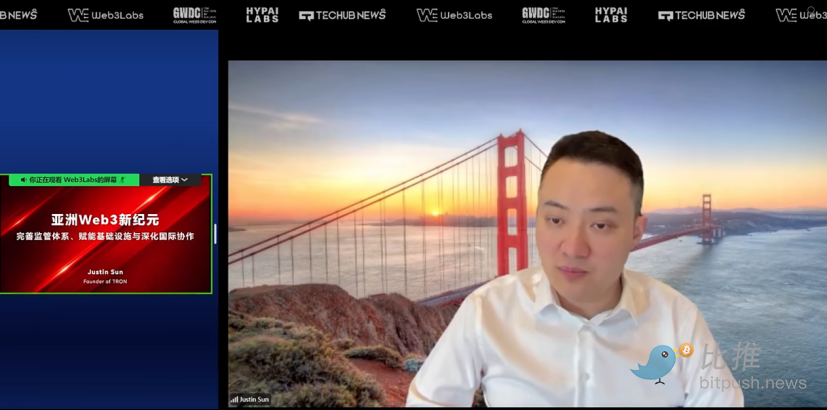
On March 23, the Hong Kong-Korea Web3 Policy Promotion Alliance Preparatory Committee was officially established, simultaneously launching the "2026 GWDC Global Developers Conference · Seoul Station (Korea Station)". This online event was jointly hosted by Web3Labs, HYPAI Labs, and GWDC, bringing together political and business leaders including Hong Kong Legislative Council member Wu Jiezhuang, South Korean National Assembly member Byung-deok Min, TRON founder Justin Sun, and Bithumb CEO Lee Jae-won. The event supported trilingual subtitles in Chinese, English, and Korean, and was broadcast globally via platforms like YouTube.

Justin Sun delivered a keynote speech titled "Asia's New Era of Web3: Perfecting the Regulatory System, Empowering Infrastructure, and Deepening International Collaboration". In his speech, he systematically elaborated on global regulatory trends, TRON's infrastructure strategy and AI frontier layout, as well as core propositions for promoting cross-border policy collaboration in the Asia-Pacific, demonstrating his forward-looking vision and global influence as a leading figure in Asia's Web3 industry, which has attracted high attention from the industry.
Global Regulatory Clarity Accelerates, Web3 Innovation Welcomes a Historic Window of Opportunity

In his speech, Sun pointed out that over the past year, global Web3 regulation has rapidly shifted from an "exploratory design" phase to an "implementation and landing" phase, showing an unprecedented trend towards clarity and convergence. The United States has successively passed a stablecoin bill and established a strategic Bitcoin reserve, with the new leadership of the SEC and CFTC generally holding an open attitude towards the crypto industry; the EU's MiCA regulation has entered a full enforcement phase, focusing on regulating stablecoins and custody businesses; Hong Kong, China has launched a stablecoin regulatory framework and entered the first batch of licensing issuance; Singapore and the UAE continue to be important hubs for crypto startup projects.

The improvement in the regulatory environment is releasing significant market dividends. Sun cited data showing that the stablecoin market size has surged from $206 billion to over $320 billion in the past year, and directions such as tokenized assets and the integration of AI and blockchain technology have also experienced explosive growth. He emphasized that regulatory certainty significantly reduces compliance costs, attracting large-scale entry from traditional financial institutions, and the integration between traditional industries and the Web3 industry is accelerating comprehensively.

However, Sun also cautioned that the impact of regulation on technological innovation is dual. Overly cautious and conservative regulatory policies can also stifle innovation, so regulation must seek "balance," and it is necessary to establish a benign interaction and communication channel between legislators and the industry. "If we only emphasize safety and ignore the momentum of innovation, I'm afraid the currently leading Asian Web3 industry will also lose its global competitiveness," he said.

It is worth noting that just earlier this month, the U.S. Securities and Exchange Commission (SEC) has asked the court to dismiss all charges it made in 2023 against Justin Sun personally, the TRON Foundation, and the BitTorrent Foundation. This development, following the SEC's previous dismissals of lawsuits against well-known crypto institutions such as Binance, Coinbase, and Uniswap, has again become an important milestone in the global crypto industry's compliance process. Sun stated that he will continue to focus on accelerating innovation globally, deepening cooperation with regulatory agencies in various countries, and contributing to the healthy development of the cryptocurrency industry.

TRON: Global Practice of Mature Blockchain Infrastructure and New AI Layout

In his speech, Sun systematically introduced the latest progress of TRON in blockchain infrastructure construction and the field of artificial intelligence.

Since its establishment in 2017, TRON has always been committed to promoting the maturity of the regional ecosystem and the actual application landing. Currently, the TRON network has over 370 million registered accounts, with a daily on-chain transfer volume between $20 billion and $30 billion, making it one of the public chains with the largest stablecoin circulation volume globally. The transaction share of USDT on TRON has long been among the top globally, providing low-cost, high-efficiency underlying support for cross-border payments, DeFi, and daily financial activities for users in the Asia-Pacific and globally.

In terms of infrastructure capabilities, TRON is known for its high throughput, ultra-low transaction fees, and 7×24 global settlement capability, and has become the preferred public chain platform for developers and enterprises in the Asia-Pacific region. In recent years, TRON has continued to increase its investment in the integration of AI and blockchain, launching innovative products such as AINFT; at the same time, through TRON DAO, it continues to support developer conferences, ecological funds, and stablecoin integration projects, helping Web3 projects in South Korea, Hong Kong China, Singapore, and other places to land quickly, and practically promoting ordinary users and small and medium-sized enterprises to enjoy the inclusive benefits of Web3.

Regarding the AI strategic layout, Sun announced that TRON has officially joined the Agentic AI Council hosted by the Linux Foundation, the world's largest open-source technology consortium, as a Gold Member, sitting on the council of this core international organization alongside global technology and financial giants such as OpenAI, Anthropic, Circle, and JPMorgan Chase. Sun commented on this: "The next wave of digital payments will be driven by machines. We are ready for it."

Cross-Border Collaboration is Key to Achieving "Balanced and Safe Regulation"

In the third part of his speech, Sun emphasized the strategic significance of cross-border policy collaboration for building a healthy Web3 ecosystem and expressed high recognition and full support for the establishment of the Hong Kong-Korea Web3 Policy Promotion Alliance.

He pointed out that Web3 is inherently borderless, and the regulatory framework of a single country can easily lead to "regulatory arbitrage" or ecosystem fragmentation risks. Only through cross-regional collaboration mechanisms like this alliance can legislators share best regulatory practices, coordinate stablecoin and custody standards, while fully listening to the voices from the industry front lines, ensuring that regulatory policies can effectively prevent risks, protect user rights, and not stifle innovation vitality.

He believes that Hong Kong, China's pragmatic regulatory framework and South Korea's open attitude towards Web3 are exemplary models of Asia-Pacific regional cooperation, and the synergy between the two will provide an important reference sample for global Web3 regulation.

Sun also specifically introduced TRON's practical achievements in the field of security and compliance. Since 2024, TRON and its partners have jointly established the T3 Task Force to combat financial crime. In nearly two years, it has successfully frozen over $300 million in funds involved in financial crimes across five continents globally, accumulating rich experience in enhancing collaboration with international security agencies and jointly addressing blockchain financial security threats, setting a successful example for industry security and compliance collaboration.

Sun concluded: "The future of Web3 belongs to those pioneers who dare to collaborate and courageously seek balance. The establishment of the alliance today is the starting point of this vision. I and TRON will, as always, contribute our strength, working hand in hand with everyone to promote the Web3 ecosystem in Asia-Pacific and globally towards a new era that is safer, more transparent, and more prosperous."


Twitter:https://twitter.com/BitpushNewsCN

Bitpush TG Communication Group:https://t.me/BitPushCommunity

Bitpush TG Subscription: https://t.me/bitpush

Original link:https://www.bitpush.news/articles/7622311

Трендові криптовалюти

Пов'язані питання

QWhat was the main theme of Justin Sun's speech at the GWDC Korea event?

AThe main theme was 'Asia's Web3 New Era: Improving the Regulatory System, Empowering Infrastructure, and Deepening International Collaboration', focusing on global regulatory trends, TRON's infrastructure strategy, AI integration, and promoting cross-border policy cooperation in the Asia-Pacific region.

QWhat significant development did Justin Sun announce regarding TRON's involvement in AI?

AJustin Sun announced that TRON has joined the Agentic AI Council, hosted by the Linux Foundation, as a Gold Member, collaborating with major tech and financial giants like OpenAI, Anthropic, Circle, and JPMorgan to advance AI and blockchain integration.

QHow has the global regulatory environment for Web3 changed recently, according to Justin Sun?

AGlobal Web3 regulation has shifted from 'exploration and design' to 'implementation and enforcement', with increased clarity and convergence. Examples include the U.S. passing stablecoin laws, EU enforcing MiCA regulations, Hong Kong issuing stablecoin licenses, and Singapore and the UAE becoming crypto hubs.

QWhat is the purpose of the Hong Kong-Korea Web3 Policy Promotion Alliance mentioned in the article?

AThe alliance aims to foster cross-regional collaboration, share best regulatory practices, coordinate standards for stablecoins and custody, and ensure policies balance risk prevention and innovation, leveraging Hong Kong's pragmatic framework and Korea's open attitude toward Web3.

QWhat achievement did Justin Sun highlight regarding TRON's efforts in financial security?

ATRON, through the T3 task force, has successfully frozen over $300 million in funds involved in financial crimes across five continents, enhancing international collaboration to address blockchain security threats and setting a benchmark for industry compliance.

Пов'язані матеріали

When the World Cup Collides with Agents: From Web2 to Web3, How Are Wallets Evolving into Agentic Wallets?

World Cup as a Catalyst for Agentic Wallets: From Web2 to Web3 This article explores how the World Cup provides a real-world scenario for observing the evolution of digital wallets from simple asset managers towards "Agentic Wallets"—intelligent, AI-powered interfaces. Using the example of prediction markets like Polymarket, it illustrates how AI Agents can lower the barrier to Web3 interaction. Instead of navigating complex DApps, users can express intent in natural language (e.g., "I think Portugal will win") within platforms like Discord or web pages. The Agent then interprets this intent, finds the relevant market, and seamlessly guides the user through the on-chain transaction via their wallet. The core shift is from wallets as mere "function menus" for signing transactions to "intent interpreters" that understand user goals. The article highlights parallel developments in traditional finance, such as Mastercard's "Agent Pay" and WeChat Pay's AI tests, which focus on granting AI controlled, authorized, and auditable payment capabilities. This underscores a broader trend of AI entering the financial layer. However, the article emphasizes that the primary challenge for Agentic Wallets in Web3 is not automation but establishing clear security boundaries. Unlike traditional systems with chargebacks, on-chain transactions are often irreversible. Therefore, future wallets must ensure users retain ultimate control and comprehension. They need to transparently communicate an Agent's permissions, spending limits, authorized durations, and provide easy ways to pause or revoke access. The World Cup experiments represent early steps toward wallets that are not just applications but ubiquitous, intelligent interfaces that simplify Web3 while keeping users securely in control.

marsbit1 год тому

When the World Cup Collides with Agents: From Web2 to Web3, How Are Wallets Evolving into Agentic Wallets?

marsbit1 год тому

Options Don't Work in DeFi? Vitalik Might Not Agree

For years, the prevailing view has been that options struggle to gain traction in DeFi due to complexity, fragmented liquidity, and lack of natural demand compared to products like perpetual futures. However, a recent algorithmic stablecoin design proposed by Vitalik Buterin presents a different perspective, using options not as a standalone trading product, but as foundational infrastructure for other financial instruments. In this design, one unit of ETH is split into two components: a "stable" side (P) that retains value up to a specified strike price, and an "upside" side (N) that captures all appreciation above that strike. Combined, they always equal one ETH, eliminating debt, margin, and liquidation risks inherent in typical collateralized debt position (CDP) stablecoins. The stable component essentially mimics the payoff of a covered call option. To function as a stablecoin, this structure requires continuously rolling deep in-the-money calls, which introduces challenges like rollover slippage, predictable transaction flow vulnerable to front-running, and persistent liquidity needs. A core hurdle is finding consistent buyers for the leveraged ETH upside exposure (N). While it offers leverage without funding rates or liquidation, it must compete with simpler alternatives like direct call options or perpetuals. The system's scalability depends on a sustained demand for this specific form of leverage. The author draws parallels to their experience with Rysk, where earlier versions of DeFi options protocols struggled. The breakthrough came with Rysk V12, which aligns incentives: asset holders generate yield by selling covered calls against their holdings, while market makers efficiently acquire the desired option exposure. This demonstrates that options can find product-market fit when embedded as a risk distribution and pricing engine within structured products, stablecoins, or yield-generating assets, rather than marketed as a complex direct trading instrument. Vitalik's proposal reinforces this architectural approach—using fully collateralized, non-custodial, and physically settled options as a fundamental building block. The real opportunity for options in DeFi may lie not in becoming the next perpetual swap, but in powering the next generation of on-chain financial products.

marsbit1 год тому

Options Don't Work in DeFi? Vitalik Might Not Agree

marsbit1 год тому

Conversation with Investor Zheng Di: MicroStrategy's Coin Sale Experiment, AI Economy, and Opportunities in US Stocks

Frontier tech investor Zheng "Didier" Di discusses the recent Bitcoin price drop, the financial strategy shift at MicroStrategy, the AI-driven surge in U.S. stocks, and the evolving role of crypto exchanges. Didier posits that the recent BTC decline stems less from macro factors or ETF outflows, and more from market repricing due to MicroStrategy's new financial structure. Following a wave of preferred stock and debt issuance (STRC, STRZ, etc.), MicroStrategy must now manage cash flow to pay dividends, potentially leading to a market expectation of sustained, small-scale BTC sales to maintain its "per-share bitcoin neutral" principle. Didier views this as a financial "experiment" testing market capacity for such recurring sell pressure, which, while creating near-term structural headwinds, likely avoids a true "death spiral" absent major new external shocks. Shifting to AI, Didier argues that tokens are becoming the new form of labor, with AI models and compute (tokenized inputs) increasingly replacing human roles in execution and middle-management. This drives enterprise efficiency and higher margins, fueling the sustained rally in U.S. semiconductor, data center, and infrastructure stocks. He foresees an emerging "machine economy" where automated agents transact and collaborate on-chain. Regarding crypto exchanges offering U.S. equities, Didier sees this as a natural evolution. With few crypto-native assets generating lasting value, exchanges are pivoting towards real-world assets (RWAs) like stocks and bonds. This doesn't necessarily cannibalize crypto but reflects a maturing industry focusing on blockchain's core utilities: decentralized choice and efficient settlement. He notes that trading logic for crypto natives doesn't need to drastically change, as meme-driven and fundamentalist strategies find analogs in U.S. markets. The "1011 event" (likely referring to a major market crash) severely damaged crypto market liquidity, marking a probable end to the altcoin speculative cycle, with capital flowing towards the deeper liquidity of U.S. markets. For the macro outlook, Didier is cautious about near-term market pressure from potential mega-IPOs (e.g., SpaceX) and the U.S. midterm elections, which could bring more regulatory scrutiny. Long-term, he remains bullish on AI's productivity gains and its convergence with blockchain/Web3, predicting a shift from speculative frenzy to a more institutionalized, industrial phase for the crypto sector.

marsbit2 год тому

Conversation with Investor Zheng Di: MicroStrategy's Coin Sale Experiment, AI Economy, and Opportunities in US Stocks

marsbit2 год тому

Playnance’s $GCOIN Lists on KoinBX Amid Rapid Growth in India

Playnance's native token, $GCOIN, has been listed on the cryptocurrency exchange KoinBX as of June 18. This move aims to enhance accessibility for its rapidly growing community, particularly in India, where the blockchain-powered Web3 iGaming ecosystem has gained significant traction. Over 130 partners in Playnance's "Be the Boss" program have built communities engaging thousands of active players in the region. The "Be the Boss" model allows participants to create and manage their own gaming communities, earning rewards tied to community activity. CEO Pini Peter noted India's high engagement, with community leaders successfully building player networks. One partner, Dr. Nicolas, reported earning over $57,000 through the program in recent months, highlighting both the financial rewards and the opportunity to grow an engaged community. $GCOIN serves as the ecosystem's core utility token, incentivizing participation and aligning the interests of players and community leaders ("Bosses"). The listing on KoinBX is part of Playnance's strategy to expand globally, increasing the token's utility and accessibility by combining community ownership, gamified engagement, and blockchain-based incentives. Founded in 2020, Playnance is a Web3 iGaming infrastructure company focused on creating live, non-custodial, on-chain products to onboard mainstream users. It currently processes approximately one million transactions daily, aiming to simplify the user experience while maintaining full on-chain transparency.

TheNewsCrypto2 год тому

Playnance’s $GCOIN Lists on KoinBX Amid Rapid Growth in India

TheNewsCrypto2 год тому

Торгівля

Спот
Ф'ючерси

Популярні статті

Як купити SUN

Ласкаво просимо до HTX.com! Ми зробили покупку SUN (SUN) простою та зручною. Дотримуйтесь нашої покрокової інструкції, щоб розпочати свою криптовалютну подорож.Крок 1: Створіть обліковий запис на HTXВикористовуйте свою електронну пошту або номер телефону, щоб зареєструвати обліковий запис на HTX безплатно. Пройдіть безпроблемну реєстрацію й отримайте доступ до всіх функцій.ЗареєструватисьКрок 2: Перейдіть до розділу Купити крипту і виберіть спосіб оплатиКредитна/дебетова картка: використовуйте вашу картку Visa або Mastercard, щоб миттєво купити SUN (SUN).Баланс: використовуйте кошти з балансу вашого рахунку HTX для безперешкодної торгівлі.Треті особи: ми додали популярні способи оплати, такі як Google Pay та Apple Pay, щоб підвищити зручність.P2P: Торгуйте безпосередньо з іншими користувачами на HTX.Позабіржова торгівля (OTC): ми пропонуємо індивідуальні послуги та конкурентні обмінні курси для трейдерів.Крок 3: Зберігайте свої SUN (SUN)Після придбання SUN (SUN) збережіть його у своєму обліковому записі на HTX. Крім того, ви можете відправити його в інше місце за допомогою блокчейн-переказу або використовувати його для торгівлі іншими криптовалютами.Крок 4: Торгівля SUN (SUN)Легко торгуйте SUN (SUN) на спотовому ринку HTX. Просто увійдіть до свого облікового запису, виберіть торгову пару, укладайте угоди та спостерігайте за ними в режимі реального часу. Ми пропонуємо зручний досвід як для початківців, так і для досвідчених трейдерів.

550 переглядів усьогоОпубліковано 2024.12.12Оновлено 2025.03.21

Як купити SUN

Обговорення

Ласкаво просимо до спільноти HTX. Тут ви можете бути в курсі останніх подій розвитку платформи та отримати доступ до професійної ринкової інформації. Нижче представлені думки користувачів щодо ціни SUN (SUN).

活动图片