Original Author: Arthur Hayes
Original Compilation: Luffy, Foresight News
Is this all just my hallucination, or is investing in artificial intelligence nowadays really as simple as subscribing to Citrini Research's service and blindly buying all the stocks it recommends?
Am I dreaming, or has oil price long lost its influence on the economy and politics? That's why Trump and the Islamic Revolutionary Guard Corps of Iran can engage in a war of words on social media, while a large number of ships remain stranded in the Strait of Hormuz.
The yield on the two-year U.S. Treasury note is 0.5 percentage points higher than the effective federal funds rate. With the market sending such a clear signal, will the Federal Reserve really stand still and refuse to raise interest rates at its upcoming policy meeting?
Will all the dividends created by artificial intelligence for the United States really only flow into the hands of a few tech workers?
This chaotic world in front of me forces me to do a reality check to confirm whether I am awake or deeply trapped in a dream. Once the test results prove it's all an illusion, I will immediately adjust my investment portfolio. This article is my process of verification. After finishing writing these words and organizing my thoughts, my position allocation will undergo major changes, or remain as is.
Let me first state my core judgment: the current market state is more like a dream. In the entire investment system, the price of oil and other hydrocarbon energy is the core variable with reverse transmission effects. The essence of human perception of the world is the conversion of energy into biological intelligence, and the logic of artificial intelligence is the same. This rule will never be broken. The market may deviate from this common sense in the short term, but reality will ultimately retaliate.
This article will start with oil prices and ultimately land on the U.S. presidential election. The current situation is likely to trigger a burst in the artificial intelligence stock market bubble and drag down the entire crypto market along with it. Only after the dust settles will Bitcoin have a chance to bottom out and rebound. I previously asserted that Bitcoin would never touch the $60,000 mark again, and I was clearly mistaken, which is normal in market predictions. I always adhere to one principle: views can be sharp, but there's no need to be stubborn.
Next, we will analyze in detail.
To Negotiate or Not: The Core Dilemma of the Moment
Politicians always act around their own interests. The reason why Trump launched a military attack on Iran for no apparent reason is probably known only to himself. Faced with the various statements he and his aides make at every moment, it is impossible for the outside world to discern the truth. Now that things have come to this, obsessing over the cause is meaningless. The real problem is whether Trump and the Islamic Revolutionary Guard Corps of Iran will choose a ceasefire and in what way to end the confrontation.
This conflict is now entirely dominated by Trump, and for him and the Republican camp, starting a war in an election year undoubtedly puts them in a passive position.
In the United States, the prices of daily necessities like gasoline and food often directly determine election outcomes. Currently, the blockage of traffic through the Strait of Hormuz is driving up energy and food inflation, the root cause of which is the Trump administration's rash action against Iran without public discussion. Some may point the finger at Israel, but this claim doesn't hold water. Anyone familiar with American history understands that domestic forces never follow external arrangements.
As long as the war does not affect their own lives and no relatives or friends are killed, the American public is not averse to going to war abroad. Trump has also repeatedly emphasized that only thirteen U.S. military personnel have been killed in this special military operation. This is also why the U.S. is keen on using high-precision long-range weapons and waging "video game-like wars." Even though launching this Middle Eastern war lacks a clear winning strategy and goes against the expectations of many supporters, his base still chooses to stand with the Republican Party. Some Republican lawmakers who wavered in their stance were pressured by Trump within the party and lost their seats, which also confirms this point.
Trump's core problem is not that his base voters are unwilling to vote in the November election, but that soaring prices will cause a large number of swing voters to lean toward the Democrats. The cost-of-living issue has become the biggest problem on Trump's election path.
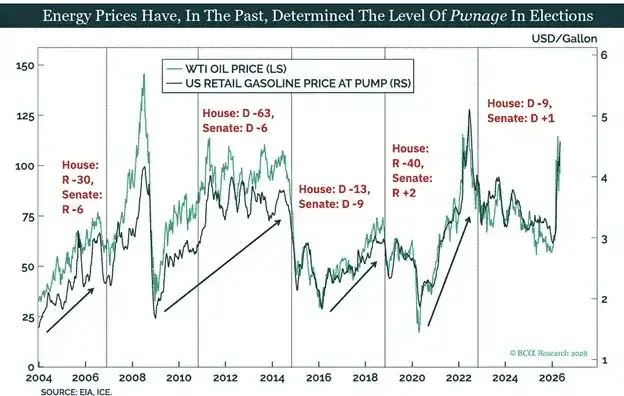
To win over swing voters, Trump must at least stabilize current oil prices. Now that the supply chain has just begun to gradually digest the pressure brought by rising energy and various raw material prices, it is already unrealistic to completely curb inflation. All Trump can do now is manage market expectations for inflation, not change inflation itself.
Whether Trump is willing to reconcile with Iran depends entirely on the trend of oil prices. If oil prices keep rising, his statements will tend to be conciliatory; but once the market predicts that both sides are about to negotiate and oil prices fall accordingly, he will change his stance again. After all, from a geopolitical perspective, the agreement reached from such negotiations will likely be more passive than the one signed by the Obama administration with Iran. In the eyes of many voters, this is tantamount to "defeat," and the Republican Party will pay the price in the election.
Negotiations always require concessions from both sides, and the Islamic Revolutionary Guard Corps of Iran has similar considerations. If oil prices are too high, its main economic and trade partners will pressure Iran to make concessions to the United States; but once Iran signals a willingness to negotiate and oil prices fall, pressure from economic and trade partners will also ease.
At current oil price levels, neither the U.S. nor Iran has the motivation to back down proactively. Although current oil prices are significantly higher than before the war, they have not yet reached a level that would trigger a full-blown crisis. The overall bulk commodity market is stable, there is no widespread famine globally, and most countries can still supplement key industrial materials from other channels.
But this delicate balance is destined not to last. A significant reduction in global core energy supply, while prices remain calm, violates market laws. Once global idle production capacity is exhausted, spot prices are bound to rise sharply, which is also the consensus of many commodity analysts. The current crisis has not fully erupted mainly because global energy inventories were sufficient before the war.
If the U.S.-Iran stalemate continues until the end of the second quarter, spot prices for hydrocarbons and various basic commodities in the third quarter of this year will inevitably experience a surge.
To borrow Churchill's famous saying: Politicians will try every possible method before doing the right thing. Only when the situation is completely out of control will Trump and Iran truly sit down at the negotiation table. In my view, the current state of blocked shipping in the Strait of Hormuz will likely continue until early in the third quarter.
Let's assume that oil prices will gradually rise amid fluctuations. Against this backdrop, how will rising oil prices and Trump's campaign rhetoric influence each other?
The November Election Showdown: Republicans vs. Democrats
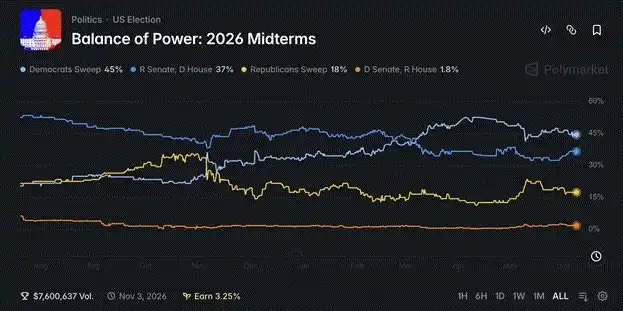
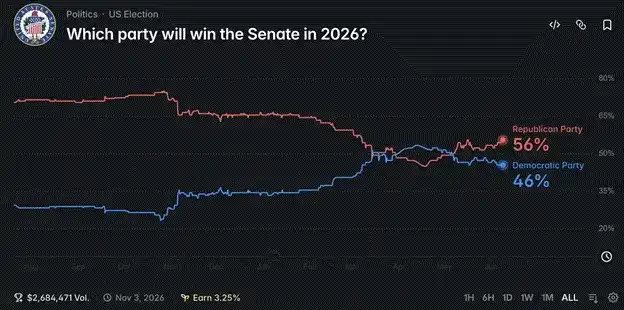
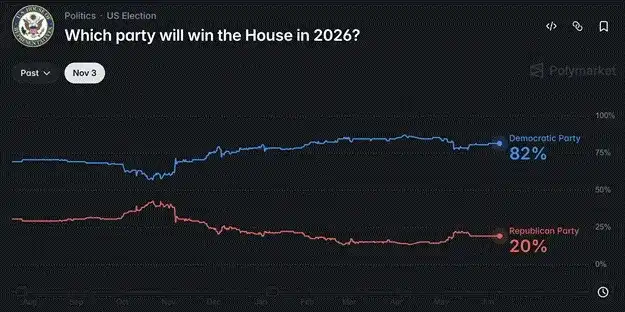
According to the odds from prediction market Polymarket, the Republican Party can currently only retain control of the Senate by a narrow margin, while it is expected to suffer a significant loss in House seats.
It is widely believed that the Republican Party will lose the House, but I hold a different view. Trump still has a chance to turn the tables, and the breakthrough lies in adjusting the direction of public discourse, making statements regarding regulation and taxation targeting data center construction and the artificial intelligence industry.
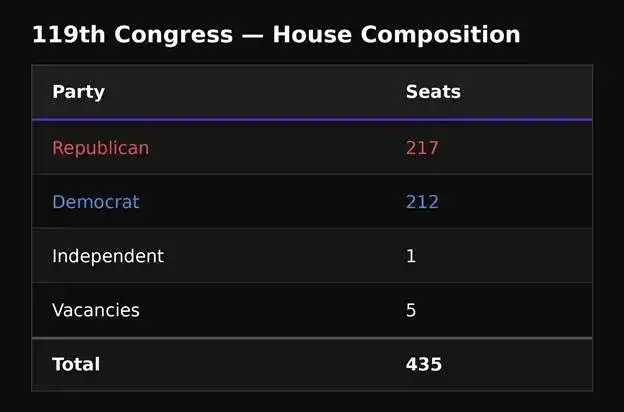
The current distribution of votes among parties is as follows (218 votes are needed to pass a bill):
Based on Polymarket's current odds, here is the projected party composition after the election:
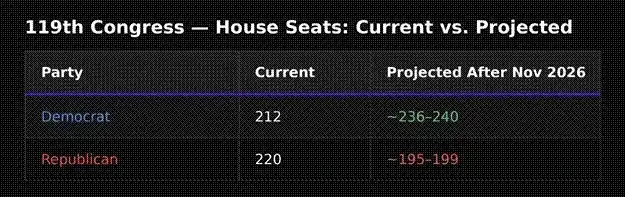
The Republican Party's seat situation in both the Senate and House is not optimistic after the election. However, the Republican Party can change the situation through redistricting; when the existing rules are destined for defeat, changing the rules becomes inevitable. Assuming Polymarket's predictions are correct, the Republican Party needs to gain 19 more seats. Redistricting can reduce this number.
Here is the potential impact of redistricting:
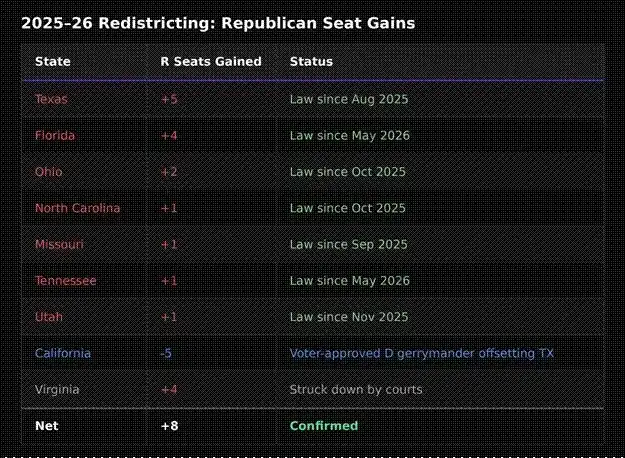
Now the Republican Party only needs to secure 11 more seats. Next, let's look at which races are closely contested and, based on current polls, which districts might lean slightly Republican within the margin of error.
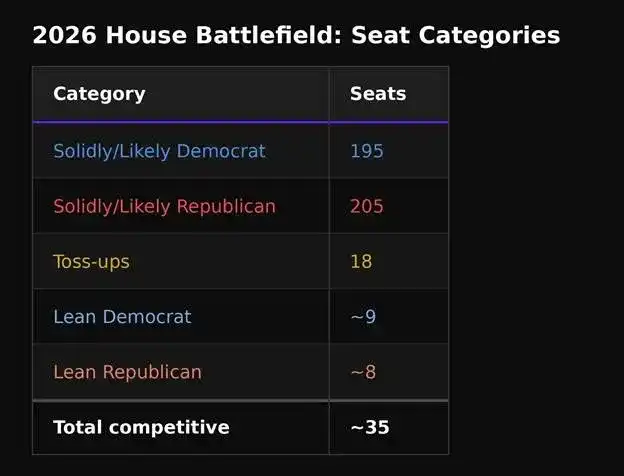
There are 35 seats with significant uncertainty. As mentioned earlier, high inflation and rising living costs are negative issues that Trump cannot easily reverse. The other major topic that can engage voters from both parties is the expansion of data centers and the impact of artificial intelligence on the job market.
Except for the top wealthy, almost everyone is worried about data center construction driving up various costs and afraid that artificial intelligence will take away jobs. Many places have already introduced policies to suspend new data center projects, and calls for imposing taxes on AI companies and subsidizing ordinary people are growing. After all, the vast majority are not AI company executives or high-paid practitioners.
For voters in competitive districts, such topics are highly influential. Trump can completely win the remaining key seats by making statements about the AI industry. At this stage, he only needs to release related rhetoric, without needing to implement specific bills. He only needs to promise ordinary people that if the Republican Party wins, he will start cracking down on the AI industry after the election.
As a seasoned politician, Trump has always been good at making campaign promises but rarely delivering afterward. His handling of the Epstein-related files is typical—during the campaign, he loudly proclaimed a thorough investigation of relevant personnel, but after taking office, he only disclosed a small amount of information. Now he can follow the same method, announcing during the campaign that he will introduce bills to slow down data center expansion, impose windfall taxes on AI companies, and use the tax revenue for a new round of relief payments; after the election and the Republican Party secures power, gradually walk back those statements.
Some may find it difficult to understand Trump mimicking the tactics of left-wing Democratic politicians. But don't forget, he rolled out the largest universal relief plan since Roosevelt's New Deal, even though low-income people used the relief funds for daily consumption, he did not restrict it. To preserve his political position, it's not difficult for Trump to temporarily distance himself from giants in the AI field like Elon Musk and create an image of supporting ordinary people.
If Trump does release tough rhetoric targeting the AI industry, the market will not see it as mere campaign tactics but will believe that the U.S. will substantively restrict capital expansion in the AI field and increase industry taxes. Panic will immediately spread, and the AI stock market bubble will burst as a result.
Previously, when Elon Musk and Trump publicly clashed on social media, with Musk's departments publicly questioning Trump, Trump then stated he would cancel government cooperation orders related to Musk's companies, Tesla's stock price plummeted 18% in a single day, showing the market's sensitivity to such disturbances. Politics can foster industries and instantly bring blows.
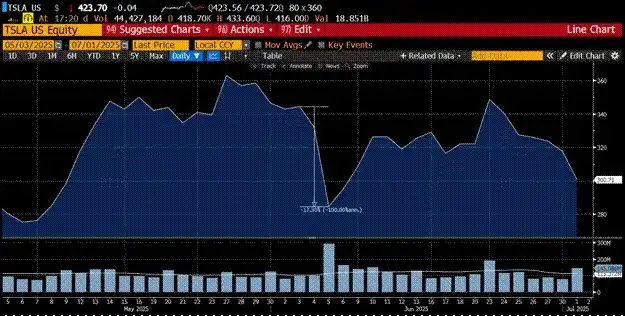
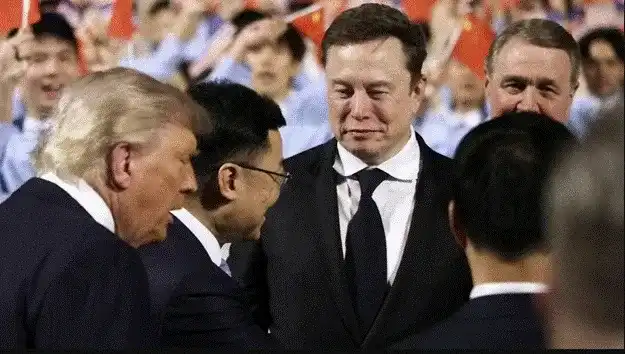
That dispute was later proven to be just a public relations stunt; the two quickly reconciled, and Musk was even invited to attend the recent summit between Trump and Chinese leaders in Beijing. But at the time, the market believed it was real, triggering massive selling.
This was just the shock caused by personal conflict between the two. Once Trump, representing the Republican Party, clearly states plans to impose heavy taxes on AI models and agent-related businesses, the impact will far exceed that. When similar rhetoric emerged from South Korean politicians, the local composite stock index nearly hit a limit-down the next day until officials urgently denied the rumors, and the market returned to an upward track.
The current optimistic expectations for the AI sector are based on the belief that industry revenue will continue to grow exponentially and that new technologies and wealth concentration will not trigger public resistance. This thinking is already detached from reality, more like being immersed in a dream. And Trump's statements will become the reality test that bursts the illusion. As for whether he will actually act, the core still depends on oil prices.
If the Iran situation continues to push up oil prices and inflation becomes more severe, Trump will have fewer campaign rhetoric options and will ultimately have to target data centers and the AI industry.
The reason Trump desperately wants to avoid Democratic control of the House is very clear. If Democrats win the House, they can exercise subpoena power, constantly summoning Trump himself, his family, and key aides to testify, posing various sharp questions. If Democrats regain the White House in 2028, the Justice Department, armed with many clues, will launch investigations into Trump's business entities.
To summarize the logical chain: The U.S. and Iran cannot reach a reconciliation, so oil prices will inevitably rise; rising prices cause voter dissatisfaction, forcing Trump to win votes by promising to regulate and tax the AI industry.
From now until the November election, even if AI-related stocks are cut in half, it's an acceptable price for Trump to pay to avoid endless investigations from Democrats. After the election, he can always reverse previous statements against data centers and AI, the industry will return to normal, and the S&P 500 might even hit the 10,000-point mark.
But for investors, market movements are interconnected. A crash in the AI sector will completely change market expectations for its future earnings. After experiencing the shock of regulation and heavy taxes, investors can no longer blindly favor this sector as before.
California Dream: Where Does Liquidity Flow?
Before analyzing the impact of the planned IPOs of SpaceX, Anthropic, and OpenAI on global financial markets, let me explain a question: Since the end of the third quarter last year, dollar liquidity has continued to ease, but Bitcoin has not seen a synchronous surge. What's the reason behind this?
On November 30, 2022, ChatGPT was officially launched to the public, marking the beginning of the AI super bubble. Almost simultaneously, the scandal of FTX founder SBF misappropriating user funds was fully exposed. Bitcoin, after hitting a low of around $15,000 that year, rose all the way to $125,000 in October 2025, a cumulative increase of over six times. But during the same period, Nvidia's stock price rose elevenfold, and many small and medium-cap tech stocks reliant on computing power, converting electricity into intelligence, also skyrocketed. The performance of the AI sector far outstripped that of the crypto market, and the gap has been widening since the end of 2024.
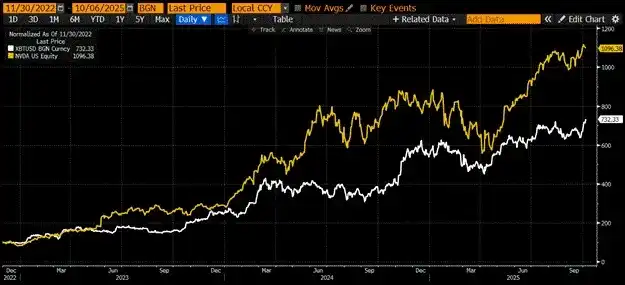
Even at its historical peak, Bitcoin (white) was outperformed by Nvidia (gold) in returns.
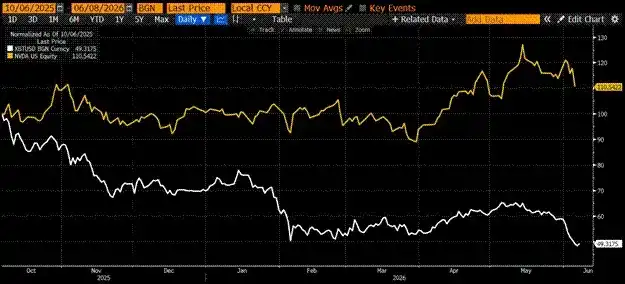
Bitcoin (white) performed worse after hitting its all-time high and has fallen 50% since. Nvidia (gold), as the world's highest-valued company, is still up 10% since late 2025.
According to my previous logic of judging the crypto market based on fiat liquidity, Bitcoin should have seen higher gains in the current environment, but the reality is the opposite. Where exactly is the problem?
I used to be accustomed to counting the overall scale of fiat currency issuance but ignored the specific flow of funds. I originally thought that liquidity would eventually flow into Bitcoin, pushing up its price. This time, my judgment was off.
My conclusion is: Almost all new dollar liquidity has been absorbed by the AI sector. Artificial intelligence is a capital-intensive industry. To build massive data centers capable of running AI, vast amounts of energy must be consumed. Hydrocarbon energy, nuclear power, and renewable energy are converted into electricity, transmitted to data centers, and used for model training and inference through specialized chips.
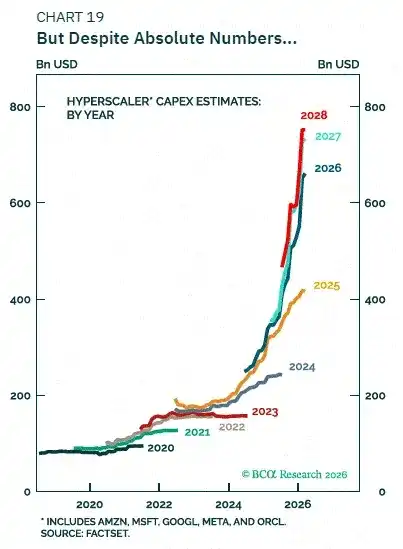
Starting in 2024, global data center capital expenditure began to surge, with further acceleration in 2025, and industry financing needs also skyrocketed. According to disclosed data statistics, from November 2022 to the present, the total amount of various debt financing in the AI-related field reached $1.5 trillion, while the increase in the U.S. broad money supply M2 during the same period was exactly $1.5 trillion. The answer is obvious: All new dollars have flowed into the AI sector, leaving no incremental funds for Bitcoin.
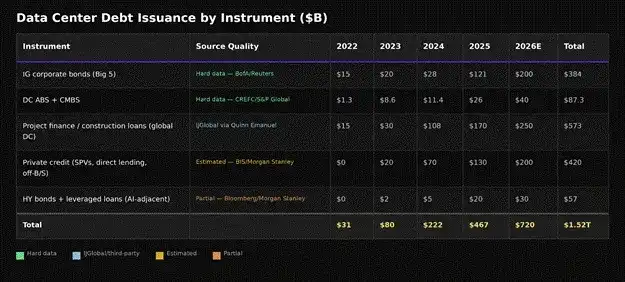
Bitcoin was able to start a strong rebound from the FTX bankruptcy low in 2022 only because large-scale debt expansion in the AI industry mainly concentrated after 2025. Of the $1.5 trillion in debt, $1.3 trillion was generated from 2025 to the present. Coincidentally, Bitcoin's price peak occurred in October 2025, when capital expenditure in the AI field also reached an unprecedented scale.
This linkage is crucial. Once the AI stock market crashes, there will be no excess funds to deploy into Bitcoin. Banks will tighten lending, and many institutions will discover that loans previously issued based on false revenue data carry huge risks. When leading tech company stocks plunge more than 50%, bank credit officers will begin to worry about companies' inability to repay debts, credit scales will contract, and overall market liquidity will tighten further. Coupled with negative attitudes from U.S. politicians toward the AI industry, the industry is unlikely to receive financial rescue in the short term.
Even if the government later steps in to rescue financial institutions, judging from the current situation, related measures will only be implemented after the November election.
The connection between Bitcoin and AI stock prices means we must make a judgment: Does the AI stock market have a bubble, when will it burst, and what is the trigger?
AI Bubble: Unable to Escape a Triple Blow
Three factors will burst the current AI bubble: rising energy costs, the market's inability to absorb the massive IPO financing of SpaceX, Anthropic, and OpenAI, and Trump's anti-AI industry policy statements.
The core logic of AI is to maximize the efficiency of "energy-to-intelligence" conversion. Humans rely on food intake to convert energy into wisdom; AI relies on electricity. Currently, most of the additional electricity for new data centers relies on hydrocarbon energy like natural gas. Rising energy prices mean the cost of AI operation and computing power output increases simultaneously, directly squeezing the profit margins of companies like Google, Anthropic, and OpenAI.
As costs rise, companies will choose to raise service prices, and the growth rate of users utilizing computing power and models will slow down. Geopolitical games between the U.S. and Iran continue to push up oil prices, ultimately eroding the profitability of AI companies. When the market begins to question the rationality of continuous data center expansion, an industry inflection point will arrive, companies' expected P/E ratios will shrink significantly, and a bear market will officially arrive.
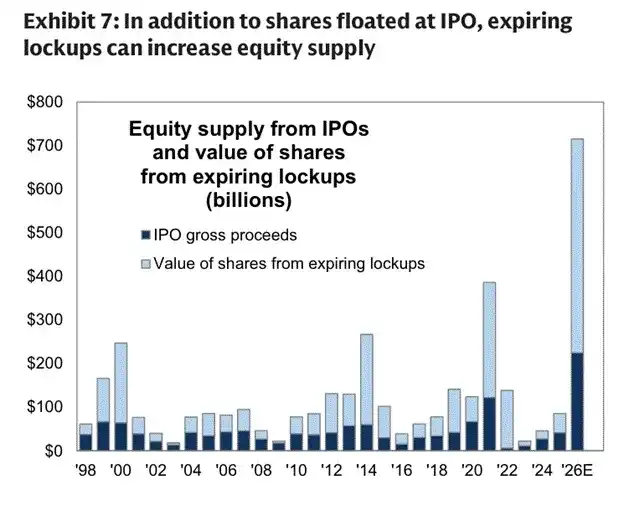
In addition, the gradual unlocking of restricted shares from SpaceX, Anthropic, OpenAI, and other tech companies, coupled with large-scale IPOs, the total financing scale even exceeds the sum of all IPO financing during the dot-com bubble era, an unprecedented size. Whether the market can absorb such massive stock selling pressure is a big question mark.
The continuous rise of the AI sector in recent years was premised on investors' belief that industry profits would continue to accelerate growth. Once the market's confidence in the industry's prospects wavers, investors will lower their valuation of future earnings. The performance of these giants' IPOs will become a barometer of market sentiment. If the IPOs fall short of expectations, investors will conclude the industry has peaked and start collective selling.
Let's analyze using SpaceX, which has relatively complete disclosed information. Capital markets always follow the rule of "first mover advantage." Elon Musk is a master of marketing. Choosing to go public first allows the company and early shareholders to cash out to the maximum extent. Crypto market participants easily understand this model: extremely low circulating supply but a fully diluted valuation that remains high, similar to the logic of some altcoin operations.
According to SpaceX's IPO filing with the SEC, the IPO valuation is nearly a hundred times its revenue. More notably, the company initially releases only 4% to 5% of its shares. In the current hot environment for the AI sector, the stock price will likely surge on the first day, but extremely high market expectations also mean it will be difficult to continuously satisfy investors' imaginations later.
After listing, SpaceX's market capitalization will reach $1.8 trillion, ranking as the world's seventh-largest company by market cap. If the stock price rises another 50%, its market cap could surpass Amazon to become the world's fifth largest, but its profitability cannot match this tier of market capitalization. Nvidia maintains a high valuation based on considerable gross margins and revenue scale. SpaceX focuses on space data center business, with industry analysis indicating that the construction and operation costs of such facilities are four times those of ground-based data centers, and costs are expected to equalize only within a decade. If the initial valuation were more rational, subsequent stock price trends would be more stable. Crypto market participants understand the logic: if secondary market investors cannot profit, the unlocked shares held by insiders will have no one to buy, and the stock price will only go down.
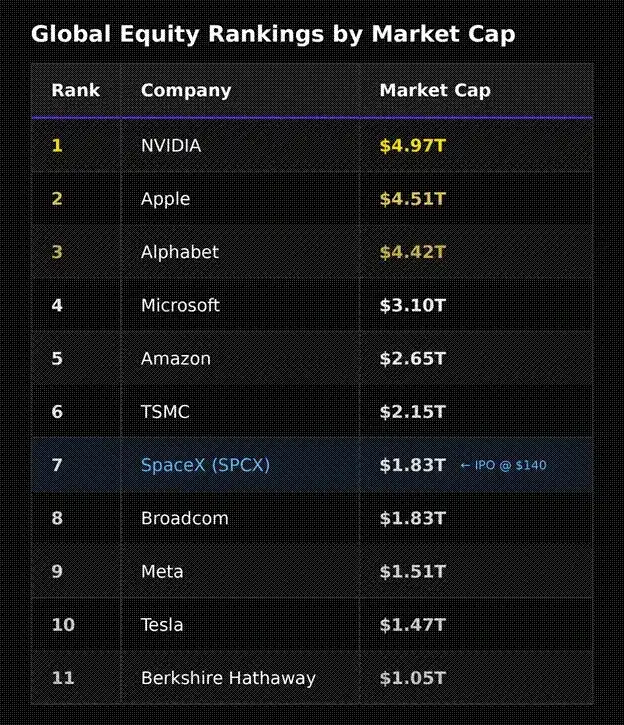
Looking at the share unlock schedule, from now to early September, SpaceX's circulating supply will expand fivefold, with massive shares flooding the market, putting huge upward pressure on the stock price. Making matters worse, Anthropic and OpenAI also plan to launch IPOs in September, both companies also targeting trillion-dollar valuations.
From June to September this year, SpaceX may still have a brief window for price increase, but when three ultra-high valuation companies concentrate their IPOs and a large number of new shares flood the market, market disappointment is bound to spread. Investors expect stock prices to soar, and slight fluctuations upward cannot meet expectations.
In summary, with the triple headwinds of rising energy prices, concentrated giant IPOs, and Trump's industry regulatory statements, the performance of these companies' IPOs will hardly meet market expectations. Once investors no longer believe that AI-related companies can maintain exponential profit growth, the valuation of the entire sector will be re-rated downward, and stock prices will collectively weaken.
Currently, there is a large amount of stock pledge lending in the AI field, and banks have also provided huge credit for industry capital expansion. After the sector crashes, the banking system will bear huge bad debts.
In an environment where the global AI bubble bursts and various risk assets generally fall, Bitcoin will struggle to have an independent uptrend in the short term. After the market fully clears out, Bitcoin will bottom out first. By then, to save the overall economy, a new round of large-scale monetary easing will arrive, and Bitcoin will start a new round of rise. But for now, the primary task is to protect crypto capital.
Before sharing Maelstrom fund's stock and crypto asset allocation strategy, let's analyze the Federal Reserve's monetary policy direction.
The Fed Chairman's Dilemma
The new Federal Reserve Chairman, Kevin Warsh, is in a very delicate situation, and external evaluations of his style are mixed, all depending on how he handles the Fed's current contradictions.
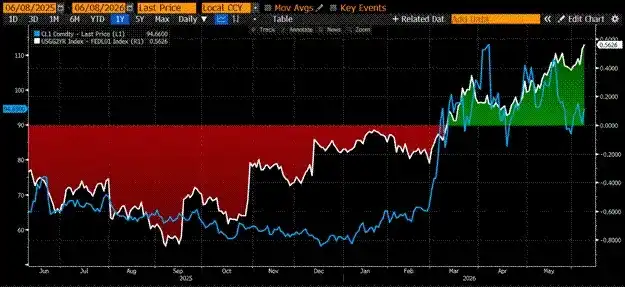
The spread between the two-year U.S. Treasury yield and the effective federal funds rate intuitively reflects market attitude; the chart also marks the WTI crude oil near-month futures price.
Trump nominated Kevin Warsh as Fed Chairman, hoping he would promote rate cuts. Warsh previously signaled that inflation from geopolitical conflicts is a short-term phenomenon, and the productivity improvement brought by AI is the long-term trend, allowing the Fed to lower rates.
But the market has given a completely opposite signal. The two-year Treasury yield is 0.5 percentage points higher than the effective federal funds rate, meaning the market believes that due to persistently high inflation, the Fed should choose to raise interest rates at the June 16-17 policy meeting, not cut them.
For now, the Fed keeping rates unchanged is the most likely outcome. But the market will focus on interpreting the post-meeting press conference and adjustments to the reserve management plan. Even standing still will be distinguished by the market as hawkish or dovish.
A hawkish hold will have an impact equivalent to a rate hike. On one hand, the U.S.-Iran conflict has no solution, oil prices keep rising; on the other hand, three AI giants concentrate IPOs, market supply is under pressure; with multiple headwinds, all risk assets will experience varying degrees of correction.
The worst-case scenario is Trump instructing Warsh to immediately raise rates following market calls, trying to suppress prices to win voter support. But unless the Fed raises rates significantly while selling bonds on the open market to shrink its balance sheet, it still cannot keep up with the pace of inflation. This scene is identical to the situation in the 1970s: the Fed aggressively raised rates but never enough to curb inflation.
In the current environment, the possibility of the Fed cutting rates is minimal. Whether it ultimately chooses to raise rates or keep them unchanged, the market will interpret it as a signal of tightening liquidity, further dampening confidence in the AI sector's bulls.
Combining all the above, the trend of rising oil prices will eventually evolve into a negative for all types of risk assets. Next, let's talk about the specific portfolio layout of the Maelstrom fund.
Portfolio Allocation
The operation of everything in the world relies on energy. Since we judge that energy prices will rise later, allocating to energy assets is an inevitable choice.
Currently, the U.S. and Iran are still at a stalemate, shipping through the Strait of Hormuz is blocked, and the daily loss of crude oil and natural gas supply continues to increase. Current market sentiment is still calm, but if this confrontation continues, rising energy prices will become inevitable.
Various industry data point to the same conclusion: affected by geopolitical conflicts, global energy inventories have fallen to multi-year lows and continue to decline. Once inventories fall below critical levels, the entire energy supply system will have problems, and prices will experience runaway increases.
Even under the best outcome—an immediate ceasefire and normal shipping resumes in the Strait of Hormuz—countries will increase purchases for restocking and strategic reserves, and oil prices will still be pushed higher.
Judging from both scenarios, in the next three to six months, regardless of whether oil prices briefly fall after a short-term peace agreement, the medium- to long-term upward trend for crude oil and natural gas prices is already established. Based on this, we have heavily allocated to U.S.-listed energy production companies.
The energy sector has upside potential under various scenarios and currently has more attractive valuations compared to tech industries highly dependent on energy. Conversely, assets relying on cheap energy to maintain high valuations do not have optimistic prospects.
In an environment where oil prices climb to $150 per barrel, the AI industry will struggle to continue its previous strong performance. Therefore, we have cleared all AI-related stocks.
Incremental funds once poured continuously into the AI stock market. Once that sector declines rapidly, even if crypto assets have relative resilience, they will have difficulty attracting capital inflows. Based on this, we have reduced all non-core crypto holdings. Last week, we sold HYPE, NEAR, WLD, and cleared ZEC due to the Orchard Pool vulnerability issue. Preserving capital is more important than chasing returns at the moment.
Current holdings are only Bitcoin and Ethereum. There is no immediate need for large liquidation of Ethereum, so we continue to hold. I firmly believe that the bursting of the AI bubble will trigger a new round of financial turmoil, at which time the world will start another monetary easing cycle, and Bitcoin will fall first and then rise.
Faced with market volatility, we will hold core positions long-term while using derivatives for short-term short-selling operations to capture phased market movements. After all, the joy of trading is something I don't want to give up.
If it turns out that the actual market movement is completely different from my judgment and it's all just a false alarm, that's fine too. Taking profits before starting a Mediterranean trip is a prudent choice in itself. In early September, I will review market movements and previous judgments, and then decide whether to buy back positions based on market conditions.
Unlike investment institutions that need to deliver fixed returns annually, the Maelstrom fund focuses more on long-term compound growth, thus having enough leeway to calmly respond to the ever-changing market of reality and illusion.


















