Artemis: Why We Are Bullish on Circle?

marsbitОпубліковано о 2026-08-21Востаннє оновлено о 2026-08-21

Анотація

Artemis argues that the market underestimates Circle (CRCL) due to three key drivers: 1) The stablecoin market is expected to grow at a 40% CAGR, reaching over $1 trillion by 2030 and has decoupled from crypto price cycles. 2) Winner-takes-most dynamics, driven by liquidity and network effects, protect incumbents like Circle (USDC) and Tether, making it difficult for new entrants like the Open Standard Alliance's OUSD to gain significant share. 3) The market misprices Circle as a mere "stablecoin issuer" reliant on interest income, rather than a "full-stack money platform" with growing payment network and blockchain revenue streams. The recent 17% drop in CRCL's price following the OUSD announcement represents a market overreaction, in Artemis's view. Historical precedent and the inherent challenges of large consortia suggest OUSD poses a limited threat to Circle's dominant position. Looking ahead, if USDC captures 20% of a $1T stablecoin market with a 2% interest rate, it could generate $4B in interest revenue. Combined with projected growth from the Circle Payments Network and the Arc blockchain, total revenue could reach ~$5B by 2030. As Circle diversifies its revenue away from pure interest dependence, its valuation multiple should expand from the current ~6.7x P/S to a more justified 10x, supporting a potential $50B market capitalization.

Author: Artemis

Compiled by: Deep Tide TechFlow

Deep Tide Guide: Last week, ARK Invest's Lorenzo Valente discussed in a podcast why the market is undervaluing Circle. This week, Artemis's Thesis pushes this logic to its conclusion: the market thinks Circle has a weak moat, that stablecoins are a commodity, and that the Open Standard alliance composed of over 140 companies will seize most of the market share. However, Artemis believes Circle's first-mover advantage and network effects are severely underestimated. Three core statements: stablecoins will grow at a 40% CAGR to exceed 1 trillion dollars by 2030; winner-takes-all liquidity makes it difficult for alliances to steal market share; the market mistakenly prices Circle as an 'issuer' rather than a 'full-stack money platform'. When the 'shock' from Open Standard pushed CRCL to historic lows, it might be the moment of greatest market mispricing.

Core Drivers

There are three core drivers supporting this view:

  • Stablecoins will expand at a 40% compound annual growth rate (CAGR), surpassing 1 trillion dollars by 2030.
  • In a market dominated by liquidity and network effects, the winner takes all. Alliances like OUSD will struggle to capture significant share.
  • The market anchors Circle's valuation as a 'stablecoin issuer,' not a 'full-stack money platform.'

Why Now? The 'Shock' from Open Standard

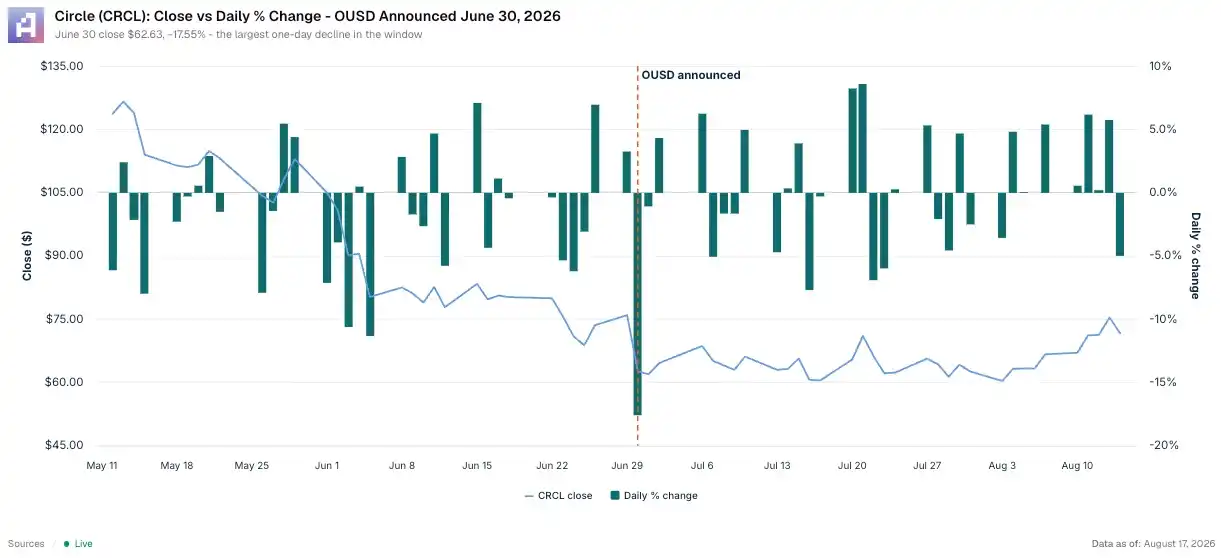
Circle's second-worst trading day in history occurred precisely on the day Open Standard announced its formation. The launch of this alliance stablecoin project, backed by over 140 companies including giants like Stripe, Visa, Mastercard, and Google, sent Circle's stock price tumbling 17%. The market's reaction was telling: Stripe is restructuring the 'band' to overthrow the duopoly of Circle and Tether and distribute stablecoin revenue among members proportionally. This news pushed CRCL's stock price near its all-time low.
Stablecoin Growth: Decoupled from the Crypto Cycle

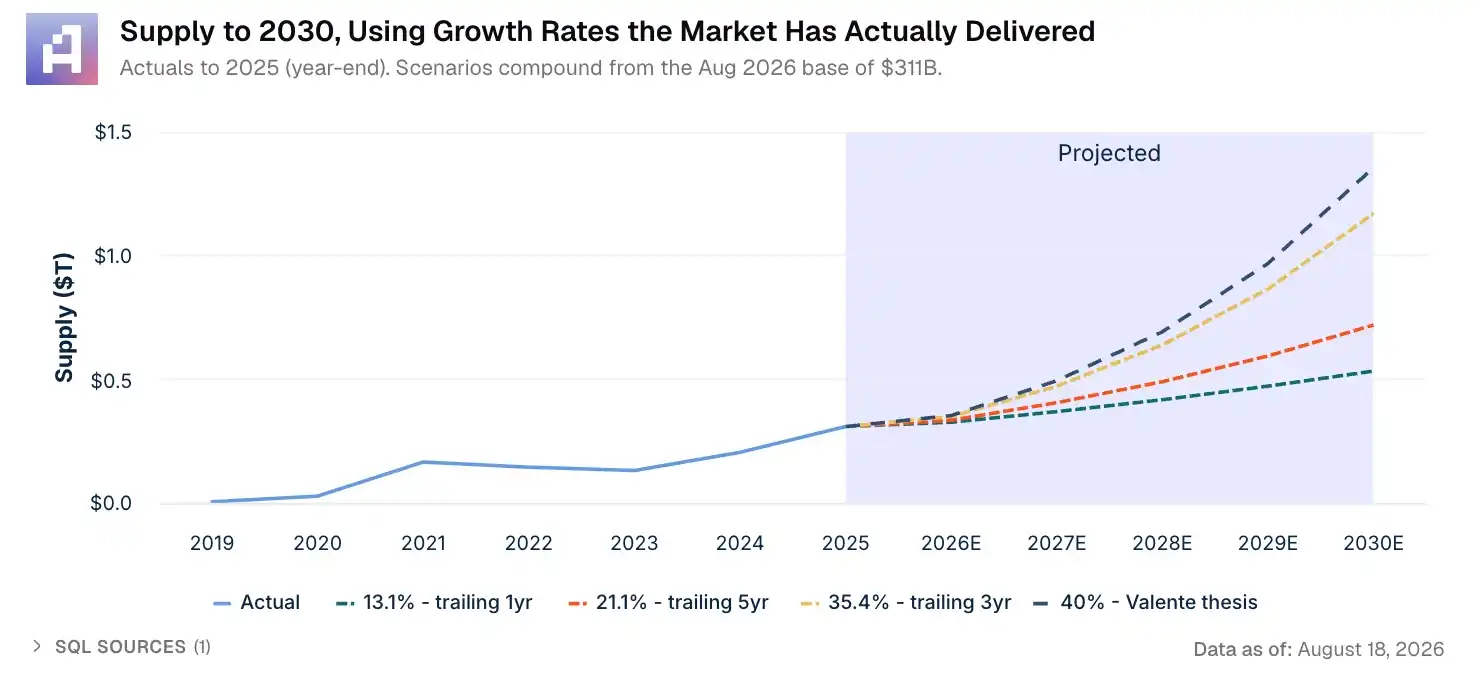
We believe many investors doubt stablecoins can reach 1 trillion dollars by 2030, pointing to stagnation in stablecoin growth. But for the first time ever, stablecoin supply has decoupled from crypto prices. While crypto assets are down 50%–70% from their highs, stablecoin supply remains steady, indicating it has become an independent asset class. If stablecoin supply continues its growth rate of the past 3 years, global supply will surpass 1 trillion dollars by 2030 (projected).
Winner Takes All: Deep Moats Built on Liquidity and Network Effects

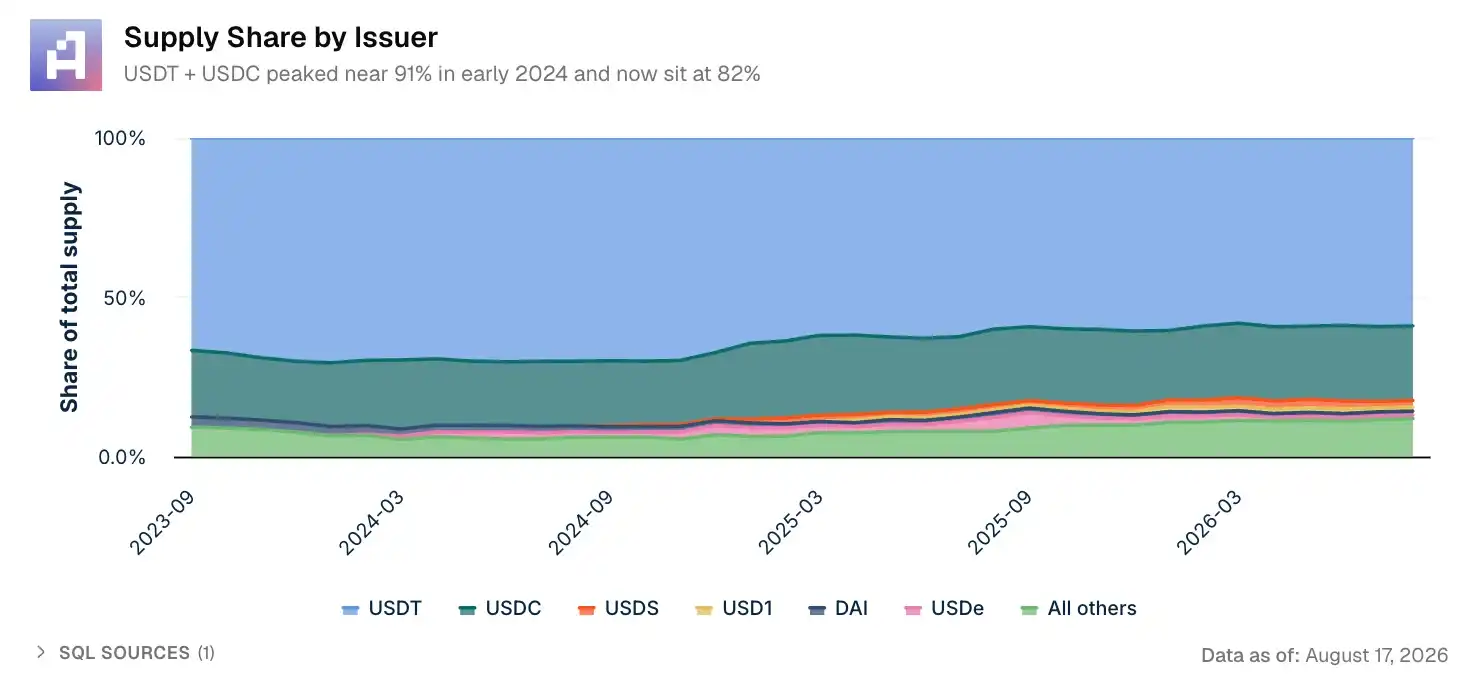
Over the past few years, dozens of issuers have tried to dismantle the Circle and Tether duopoly. Despite hundreds of stablecoins being issued today, these two giants still control over 80% of the supply share. The first-mover advantage is extremely difficult to overcome—building cross-chain, cross-application, cross-exchange liquidity from scratch is a monumental task, and Circle has already left challengers far behind.
Can the OUSD Alliance Succeed?

Specifically regarding OUSD, the market clearly sees it as a major threat to Circle's business. However, history shows that alliances rarely succeed. A successful alliance requires:

  • Aligned Member Incentives — OUSD has this to some extent through interest income sharing;
  • Clear Governance — Open Standard appears weak here, with several 'announced partners' disclosing they were not consulted and their stance is unclear;
  • Existential Pressure — I believe most institutions do not yet view stablecoins as a matter of survival, although Stripe might.

Based on current information, Open Standard meets only about one-third of the necessary conditions.

Market Misjudgment: Circle is Not an Issuer, but a Full-Stack Money Platform

The market views Circle merely as the issuer of USDC, because almost all its revenue comes from interest income dictated by the Federal Reserve, leading to a discounted valuation.

In reality, Circle is building a full-stack suite of monetary products for the future of the internet; at its core, it is a technology company.

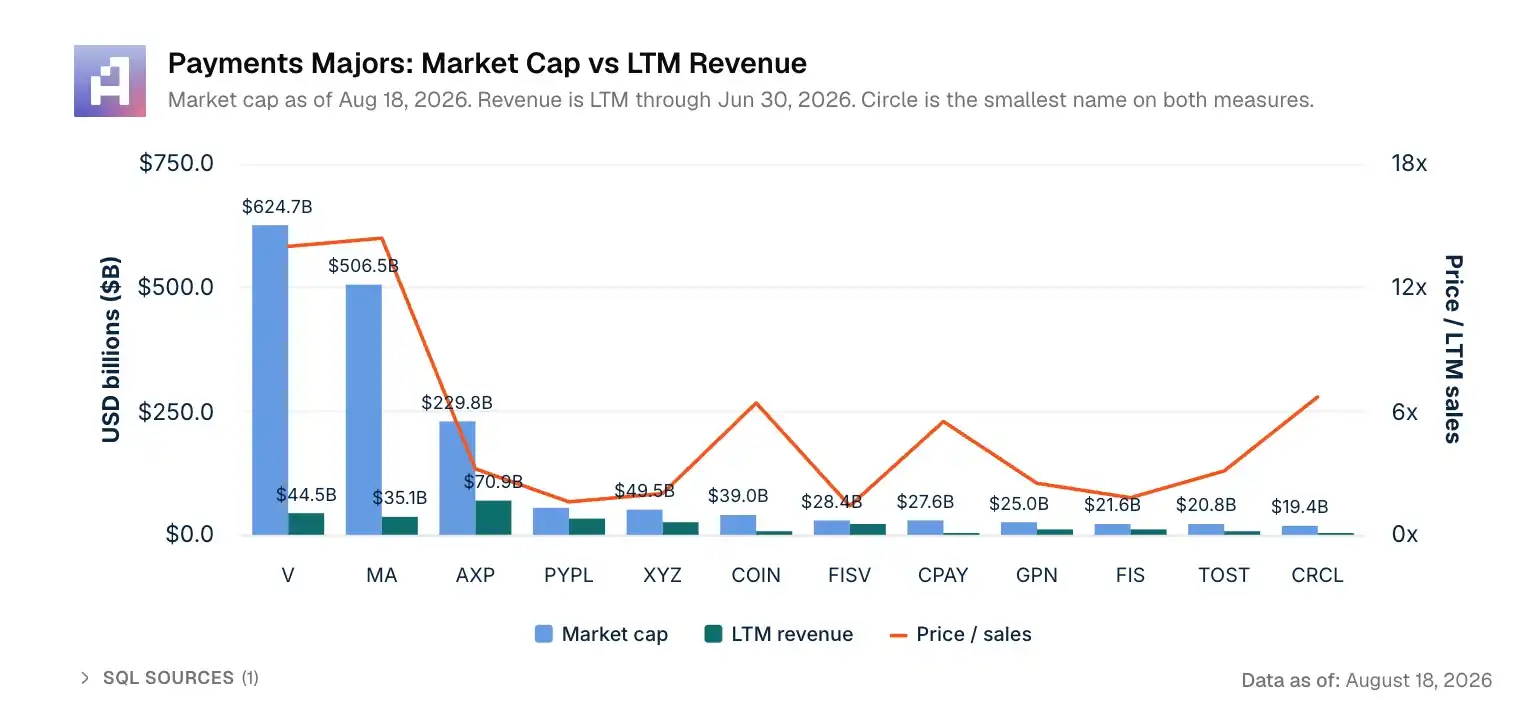
A comparison of Circle's valuation with its payment peers clearly shows the valuation gap between card networks and other players. If Circle truly builds the next-generation full-stack payment system, its market cap and valuation should align more closely with card networks—charging fees based on transaction volume (bps), not profiting from float spreads.
Imagining a $50 Billion Circle

Currently, Circle's revenue run rate is approximately $2.8 billion, with a market cap of about $18 billion, giving it a price-to-sales (P/S) ratio of only 6.7x. This is far below payment networks (14x) and high-growth fintech companies like HOOD (17x).
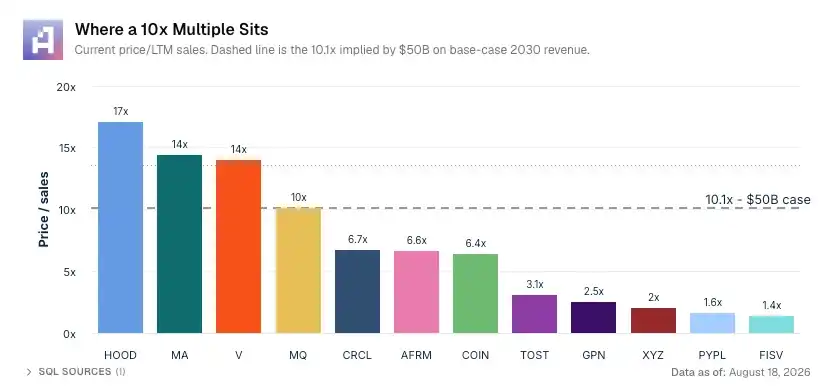
Its multiple is almost identical to Coinbase's—which the market primarily views as a crypto exchange.

The market prices Circle as a business correlated with the crypto cycle and sensitive to interest rates. But Circle will outperform both of these labels and those fragile revenue sources, earning a higher multiple—10x is conservative and reasonable.

If our judgment is correct, and liquidity and network effects are indeed solid moats, then under a scenario where stablecoin supply reaches 1 trillion dollars by 2030, USDC holds a 20% share, and interest rates are at 2%, CRCL could generate approximately $4 billion in interest income.

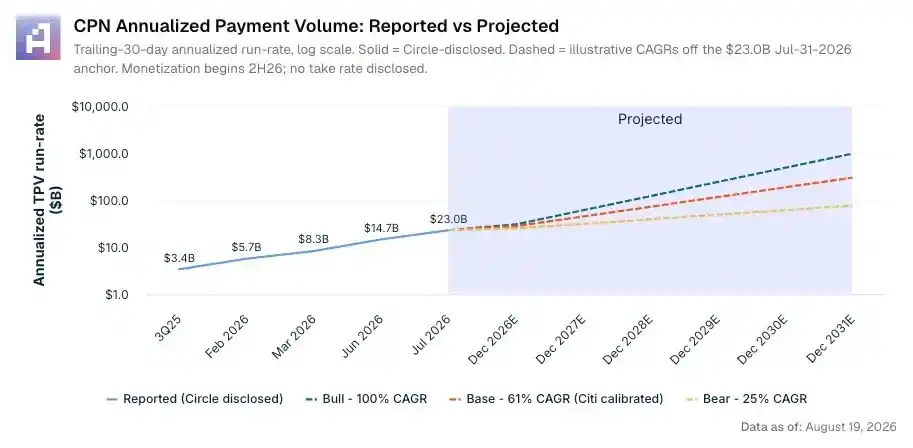
Regarding revenue diversification, Circle is already seeing results from key growth products like the Circle Payments Network. Despite ongoing pressure on crypto prices and flat stablecoin supply, transaction volume on the Circle Payments Network is exploding—latest disclosure as of end-July 2026 shows an annualized scale of $23 billion, a 6.8x year-over-year increase (albeit from a small base) and a 70% quarter-over-quarter growth. If growth maintains a 60%–65% CAGR, transaction volume could approach $200 billion by 2030; at a 20 basis point take rate, this would contribute an additional $400 million in revenue.
Looking at the Arc blockchain: if it can achieve the scale of another stablecoin-focused chain like Tron, Arc could generate around $500 million in fee revenue.

The above calculations push CRCL's revenue to roughly $5 billion, with 20% coming from rapidly growing payment/settlement-related business lines. Investors can fully understand and assign a higher multiple to such a mix. Combining revenue growth and multiple expansion, we get $5 billion × 10 = $50 billion. A $50 billion CRCL is not far-fetched.


Пов'язані питання

QAccording to the article, what is the primary reason the market undervalues Circle, and how does the author counter this perception?

AThe market undervalues Circle because it views it as a mere stablecoin issuer whose revenue is tied to interest rates, giving it a discounted valuation. The author counters this by arguing that Circle is actually building a full-stack monetary platform for the internet's future, positioning it as a technology company with a more sustainable and diversified revenue model akin to a payment network.

QWhat key event led to a significant drop in Circle's stock price, and what does this market reaction signify according to the analysis?

ACircle's stock price dropped 17% following the announcement of the Open Standard Alliance (OUSD), backed by over 140 companies. This market reaction signifies that investors perceived OUSD as a serious threat capable of disrupting the Circle/Tether duopoly by redistributing stablecoin revenue among its members, pushing CRCL to near its historical lows.

QThe article presents two main structural advantages for incumbent stablecoins like Circle's USDC. What are they?

AThe two main structural advantages are network effects and liquidity. The article argues that these create a winner-takes-most dynamic, making it extremely difficult for new entrants to compete because building cross-chain, cross-application, and cross-exchange liquidity from scratch is a formidable barrier.

QBased on the author's 2030 projections, what are the three main sources of Circle's potential $5 billion revenue?

AThe three main sources are: 1) Approximately $4 billion in interest income from USDC (assuming a 1 trillion stablecoin market, 20% USDC share, and 2% interest rate). 2) Around $4 billion in revenue from the Circle Payments Network (projecting ~$2 trillion in transaction volume with a 20 bps take rate). 3) Approximately $5 billion in fee revenue from the Arc blockchain (if it scales to the size of the Tron network).

QWhat does the author point out about the recent relationship between stablecoin supply and cryptocurrency prices to support the growth thesis?

AThe author points out that stablecoin supply has decoupled from cryptocurrency prices for the first time. While crypto asset prices fell 50-70% from their highs, stablecoin supply remained steady. This indicates stablecoins have become an independent asset class, and if the supply continues its growth rate of the past three years, it is projected to surpass $1 trillion by 2030.

Пов'язані матеріали

Mysterious "Ox Alpha" Large Model Goes Viral with Limited-Time Free Access

A mysterious anonymous AI model named "Ox Alpha," nicknamed "Cow is Coming" by Chinese netizens, has appeared on OpenRouter, sparking widespread speculation. The model offers a 1 million token context, supports text, image, and video inputs, can call tools, and is currently free. Its standout feature is strong coding ability. Initial tests on the DeepSWE benchmark, which evaluates real-world software engineering tasks, showed an 80% pass rate on a subset of tasks, reportedly nearing top-tier code models. However, follow-up tests yielded a 63% score, with variations attributed to different task sets and configurations. The model's true developer is a major topic of debate. The prevailing theory points to Zhipu AI's unreleased GLM-5.3 Flash or its multimodal variant. Evidence cited includes identical visual token consumption patterns with GLM-5V-Turbo for videos, a consistent offset in text token counts compared to GLM-5.3, and similar behavioral traits like refusing audio processing. Zhipu has a precedent of anonymous testing. Simultaneously, another anonymous model, "korrine," appeared on Code Arena, with guesses ranging from Moonshot's Kimi K3.1 to models from Qwen or MiMo, adding to the industry's guessing game. This trend of anonymous "undercover" testing allows for unbiased performance evaluation in platforms like Arena and provides real-world, high-pressure testing through tools like OpenRouter before official release. It also serves as an effective marketing tactic, prolonging discussion through suspense. If Ox Alpha is indeed a "Flash" model, its performance raises expectations for the full-scale version's potential.

marsbit4 год тому

Mysterious "Ox Alpha" Large Model Goes Viral with Limited-Time Free Access

marsbit4 год тому

Breaking News: DeepSeek Announces All-Day Off-Peak Pricing on Weekends, Making Weekend Work More Cost-Effective?

DeepSeek has announced a significant change to its API pricing model, effective August 23. The new policy removes peak/off-peak distinctions on weekends (Saturdays and Sundays), charging the lower off-peak rate for the entire two-day period. This adjustment has sparked mixed reactions within the developer and professional communities. For developers and businesses heavily reliant on DeepSeek's V4-Flash and V4-Pro APIs, this is welcome news. It allows them to schedule bulk processing tasks on weekends without the higher peak-hour costs, potentially halving their API bills for such workloads. Some users have celebrated the move for making weekend work more cost-effective. However, the announcement has also raised concerns among employees. There is apprehension that companies, particularly in cost-sensitive sectors like AI-powered short drama production, might reorganize work schedules to align with these new cost incentives. Instances are already emerging where teams schedule high-token tasks during cheaper nighttime hours or adjust staff shifts. This has led to worries about a potential shift towards weekend workdays and weekday time-off, prioritizing cost savings over traditional work-life balance. Debate has ensued regarding the practicality of such schedule changes, with questions about increased communication overhead and overall efficiency. Speculation about DeepSeek's motives for the change includes theories that peak pricing correlates with internal model training schedules, though others counter that training is largely automated. The new pricing structure is now in effect, prompting users to reconsider their task scheduling strategies.

marsbit5 год тому

Breaking News: DeepSeek Announces All-Day Off-Peak Pricing on Weekends, Making Weekend Work More Cost-Effective?

marsbit5 год тому

Just Now, The World's First Human vs. Robot Tennis Match Begins, Robot's Desperate Save Leaves Zheng Jie Astonished

Just now, the world's first human vs. robot tennis match began, featuring stunning robotic saves that left tennis star Zheng Jie in awe. This historic event, part of the second World Humanoid Robot Games and broadcast live globally by China Media Group, marked a pivotal moment in Chinese technological innovation and embodied artificial intelligence. The match featured both mixed human-robot doubles and a groundbreaking singles match between Zheng Jie and the "Galaxy Xingzai" humanoid robot developed by Galaxy General. The robot demonstrated impressive skills including serving, forehands, backhands, and strategic court movement, with serves exceeding 100 km/h. It exhibited remarkable adaptability, recovering from a fall to continue play and handling slices and spins. The doubles match highlighted its ability to coordinate dynamically with a human partner. The event's significance extends far beyond a novelty match. Tennis represents an ultimate pressure test for embodied AI, demanding real-time integration of perception, decision-making, full-body motion control, and live博弈 within fractions of a second—a stark contrast to the discrete, contemplative environment of board games like Go mastered by AlphaGo. It directly confronts Moravec's paradox, showcasing AI's move from digital cognition to physical execution. This capability is powered by Galaxy General's proprietary "Galaxy Star Brain" (AstraBrain) model. Its key innovation is a unified architecture that integrates high-level task understanding/tactical decision-making ("brain") and dynamic whole-body motion control ("cerebellum") into a single model, eliminating latency and information loss between separate modules. The model was trained using a two-step process via the "Galaxy Star Workshop" platform. First, it learned foundational movement priors from "imperfect" human motion data (both amateur and professional). Second, it underwent massive-scale evolution in a virtual tennis simulator where multiple AI agents played millions of games against each other. Through this adversarial training, skills like极限救球and recovery from falls emerged autonomously without explicit programming, before being transferred to the physical robot. This "AstraTennis" moment symbolizes a major leap: a decade after AlphaGo conquered the digital world, embodied AI from China has now demonstrated it can operate under the extreme, unpredictable physical pressures of real-world competition.

marsbit5 год тому

Just Now, The World's First Human vs. Robot Tennis Match Begins, Robot's Desperate Save Leaves Zheng Jie Astonished

marsbit5 год тому

Торгівля

Спот
活动图片