Argentina Bans Polymarket Over Illegal Gambling Concerns Following Colombia

TheNewsCryptoОпубліковано о 2026-03-17Востаннє оновлено о 2026-03-17

Анотація

Argentina has blocked the prediction market platform Polymarket following a court ruling in Buenos Aires that declared its operations illegal under the country's gambling regulations. Authorities have directed internet service providers and app stores to restrict access to the platform. Officials raised concerns over the use of cryptocurrencies for betting and the lack of user identity checks, which could allow minors to participate. The decision follows similar action taken by Colombia, where Polymarket was also classified as an illegal gambling operation for failing to meet licensing requirements. The case reflects growing global regulatory scrutiny of crypto-based prediction markets, which are increasingly being treated as gambling platforms due to their structure and potential risks to market integrity.

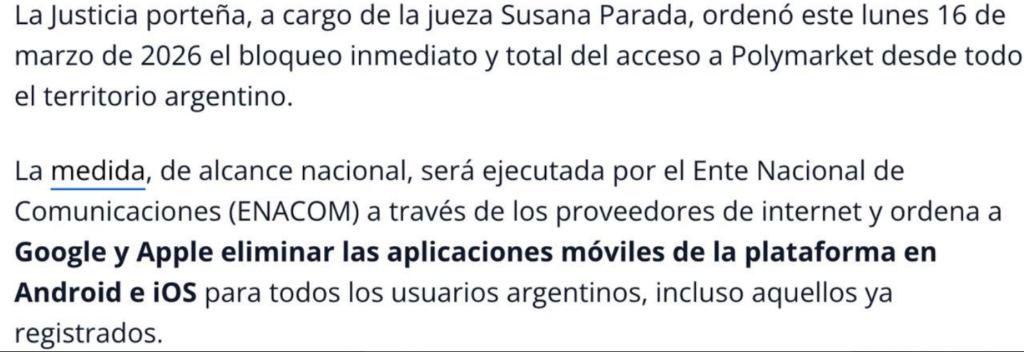
Argentina’s authorities have blocked Polymarket across the country after a ruling by a Buenos Aires court. It declared that it operated illegally and outside the country’s legal framework and regulations regarding gambling. The country’s authorities have asked ENACOM to impose a blockade against Polymarket by internet service providers. The limited access to mobile applications across the country. They have also asked app stores to remove Polymarket applications to prevent users from accessing them.

It was also determined that the platform enabled users to place bets using cryptocurrencies. And the traditional forms of payment in an easy manner. There were also concerns raised by officials regarding the lack of verification measures for the identity of users. This may lead minors to indulge in illegal betting activities. Complaints from local gambling organizations prompted legal action against the platform’s operations.
Regulatory Concerns and Regional Crackdown Expand

Investigations were conducted regarding suspicious trading activities related to inflation prediction markets. This have recently received significant regulatory interest from financial oversight organizations. Reports have been received about unusual betting patterns that have sparked concerns about a potential case. The officials have studied the trading and have observed that some behaviors may have suggested a potential information advantage for some groups in the entire system. This may have compromised the overall integrity and transparency in the current decentralized prediction markets operating globally.

It is worth noting that the authorities concluded that the platform operated like an online betting system. The authorities noted that prediction markets generally take a similar form to gambling structures, in which users of the platforms make predictions about real-world events in order to obtain financial rewards. The classification of prediction markets as gambling structures increases the need for stricter regulation and enforcement of the existing gambling laws.

Argentina’s decision comes in the wake of a similar decision made by the Colombian authorities, banning Polymarket from operating within their jurisdiction since it did not comply with the licensing requirements. The Colombian authorities classified the prediction platform as an illegal gambling platform and asked all the internet service providers within the country to block the platform immediately. The case is a testament to the increasing global scrutiny of crypto-based platforms that take a similar form to gambling and trading mechanisms.

Highlighted Crypto News:

Polymarket Users Threaten Journalist Over Iran Missile Report Dispute

TagsArgentinaBlockchainCRYPTO GAMBLINGCryptocurrencyexchangegamblingPolymarket

Пов'язані питання

QWhy did Argentina block Polymarket?

AArgentina blocked Polymarket because a Buenos Aires court ruled that it operated illegally outside the country's legal gambling framework and regulations.

QWhat actions did Argentine authorities take against Polymarket?

AAuthorities asked ENACOM to impose an ISP blockade, restricted access to its applications, and requested app stores to remove Polymarket's apps.

QWhat were the specific concerns officials had about Polymarket platform?

AOfficials raised concerns about the use of cryptocurrencies for betting, lack of user identity verification, and the risk of minors engaging in illegal betting activities.

QHow did Argentina classify Polymarket's operations?

AArgentina classified Polymarket as an online betting system, noting that prediction markets function similarly to gambling structures where users predict real-world events for financial rewards.

QWhich other country recently took similar action against Polymarket?

AColombia recently banned Polymarket for operating without complying with licensing requirements, classifying it as an illegal gambling platform.

Пов'язані матеріали

Bitcoin Withdrawals Continue: 8 Years of Storage in a Coldcard Cold Wallet Ended in Zero

Coldcard Hardware Wallet Hacked: Losses Mount Due to Vulnerable Seed Generation A critical vulnerability in Coldcard hardware wallets has led to a continued wave of fund thefts. According to Galaxy Research, the total stolen has reached 1,367.05 BTC (approx. $88.6 million) from 4,585 addresses, a significant increase from the initial 594.5 BTC reported on July 30, 2026. Most of the stolen funds remain on the attackers' addresses. The issue is not with the current firmware, which Coinkite has updated, but with seed phrases generated on vulnerable devices between March 2021 and the release of fixed firmware versions. Due to a programmer error, devices switched from using a hardware random number generator to the software-based Yasmarang generator, which was initialized with publicly accessible data like the chip's serial number. This made the seed phrases predictable through offline brute-force attacks, meaning wallets remain at risk until funds are moved to a new wallet generated with the patched firmware. Affected devices include Mk2/Mk3 with firmware 4.0.1–4.1.9 (and up to 5.0.3), Mk4/Mk5 up to version 5.6.0, and Q models up to 1.5.0Q. The only exceptions are seeds created with a high-entropy method like at least 50 independent dice rolls or a strong unique BIP-39 passphrase. All other owners must generate a new seed on the fixed firmware and transfer their assets. A case highlighting the human impact involves a 39-year-old long-term investor who lost 2 BTC (approx. $130,000) in minutes. He had accumulated the Bitcoin over eight years through physical labor, viewing it as a financial lifeline and a retirement plan in a country suffering from hyperinflation. His story underscores that even conservative "buy and hold in cold storage" strategies can be compromised by such underlying technical flaws. From a technical perspective, this incident echoes historical failures where weak random number generators undermined cryptographic security, challenging the assumption that offline storage is automatically foolproof.

cryptonews.ru2 год тому

Bitcoin Withdrawals Continue: 8 Years of Storage in a Coldcard Cold Wallet Ended in Zero

cryptonews.ru2 год тому

Торгівля

Спот
活动图片





