Arcus Chooses "Stepfather" Robinhood Chain, "Biological Father" dYdX Awkwardly Attempts to Salvage the Situation

Odaily星球日报Опубліковано о 2026-07-03Востаннє оновлено о 2026-07-03

Анотація

Robinhood officially launched its own Layer 2 network, Robinhood Chain. In response, many major DeFi protocols like Uniswap and Chainlink announced integration. A key point of discussion was Arcus, a new decentralized exchange (DEX) developed by the dYdX team, which chose to launch on Robinhood Chain instead of the native dYdX Chain. Arcus offers 24/7, zero-fee trading of 95 tokenized stocks and perpetual contracts. This move sparked community concerns about dYdX Chain potentially being sidelined, causing DYDX token's price to drop over 12%. Critics questioned if dYdX Labs' focus is shifting to Arcus and how DYDX token holders would benefit from Arcus's future growth, especially as its founder mentioned a future Arcus token would allocate a portion to the dYdX community. dYdX founder Antonio Juliano clarified that dYdX Chain will continue operating, but acknowledged its deep decentralization involved trade-offs in performance and user experience. He stated Arcus is a separate product led by a new CEO, responding to market demands for faster, simpler platforms. The dYdX Foundation also confirmed DYDX's role remains unchanged for dYdX Chain governance and staking, with no plans for token migration. However, the core uncertainty remains: if Arcus succeeds, how will that value flow back to dYdX Chain and its DYDX token holders?

Original | Odaily Planet Daily (@OdailyChina)

Author | Asher (@Asher_0210)
Yesterday morning, Robinhood announced the official launch of its own Layer 2 network, Robinhood Chain, to the public mainnet. This chain is built on the Arbitrum tech stack and is positioned as institutional-grade, permissionless, AI-native, and specifically designed for real-world assets (RWA).

In other words, Robinhood doesn't just want to add another chain to the crypto industry; it aims to consolidate stocks, RWAs, lending, trading, and on-chain financial products into its own infrastructure.

As a major platform enters the fray, key players in the ecosystem quickly take sides.

Leading protocols including Uniswap, 1inch, Lighter, Morpho, Chainlink, BitGo, Ethena, and EtherFi have successively announced integrations with Robinhood Chain, covering core crypto sectors such as trading, liquidity, lending, oracles, custody, and cross-chain interoperability.
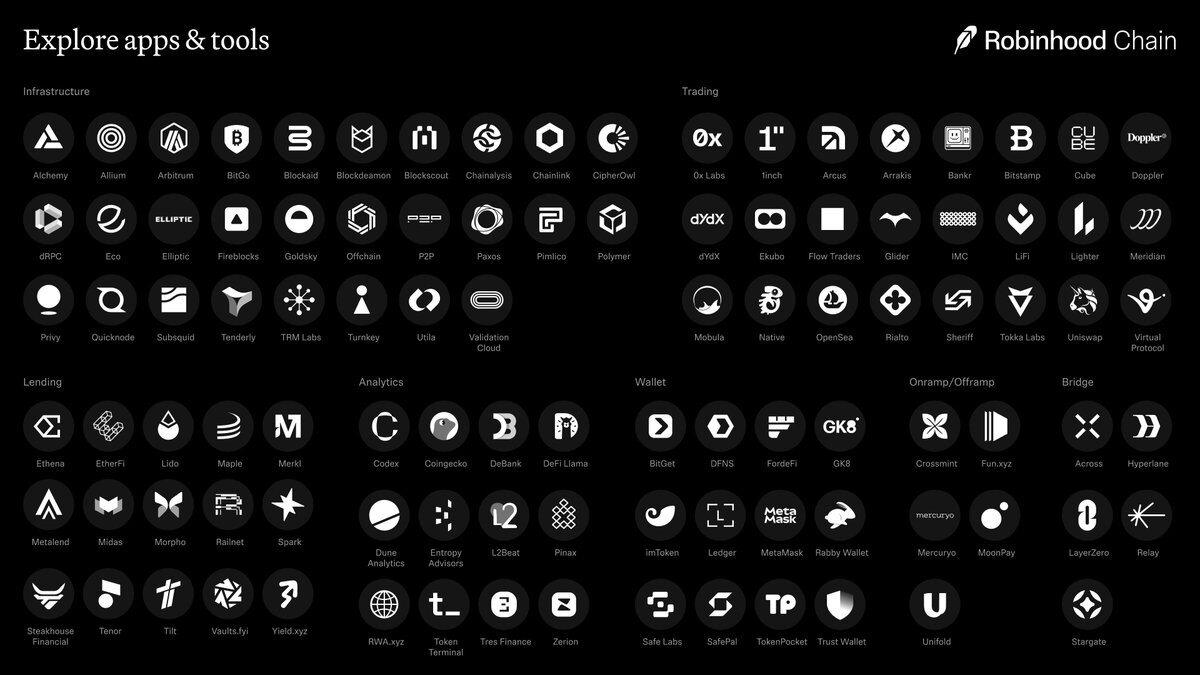
Overview of Robinhood Chain Ecosystem Projects

Amid this wave of major ecosystem integrations, Arcus, a new DEX launched by the dYdX team, has surprisingly become the focal point of community discussion.

Community users have raised concerns: Is dYdX Labs shifting its focus to Arcus? Will the original dYdX Chain be marginalized? Can the DYDX token continue to capture protocol value in the future? And how will Arcus be associated with the dYdX ecosystem?

Influenced by these controversies, DYDX has fallen over 12% in the past 24 hours, with its current market capitalization temporarily reported at $108 million.
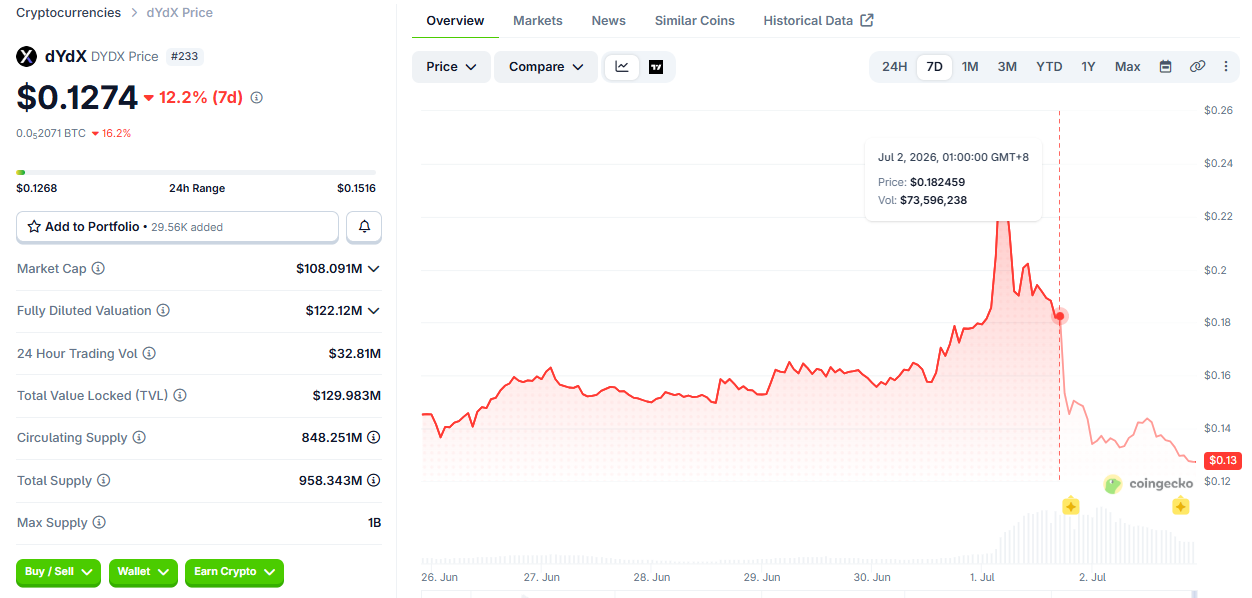
DYDX Token 7-Day Price Chart

What is Arcus? 7×24 Hour Zero-Fee Trading of Tokenized Stocks

Arcus: A Decentralized Exchange Developed by the dYdX Team, Now Open for Early Waitlist

Arcus is a decentralized exchange developed by the dYdX team, now live on Robinhood Chain, offering 7×24 hour zero-fee trading of 95 tokenized stocks and perpetual contracts. Arcus supports trading of tokenized stocks, commodities, indices, and crypto assets. All tokenized stocks are issued and redeemable on Robinhood Chain, can be self-custodied, and integrated into the DeFi ecosystem.
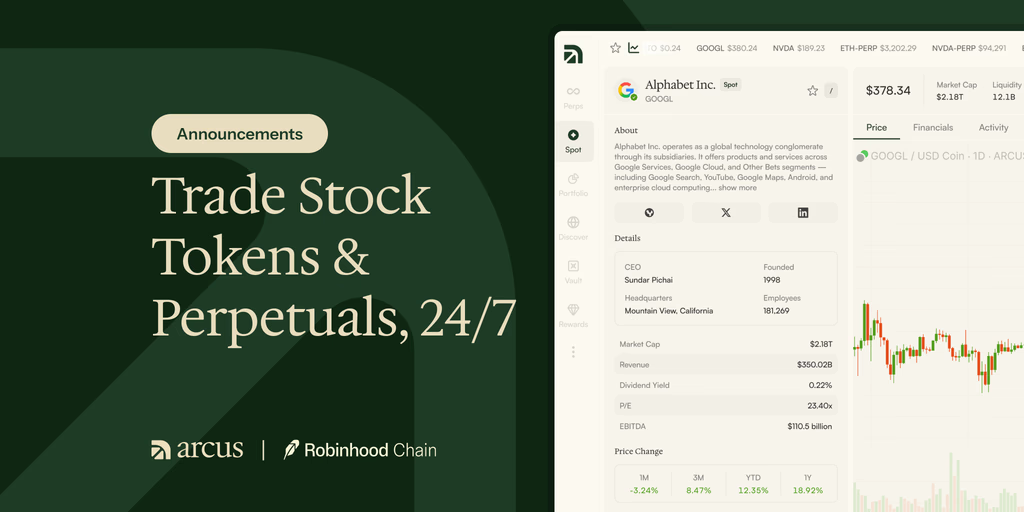
Arcus x Robinhood: 24/7 Trading of Stocks and Perpetuals

Currently, Arcus has opened its early waitlist (link: https://waitlist.arcus.xyz/). Users can complete interactions by connecting their personal X account and wallet.
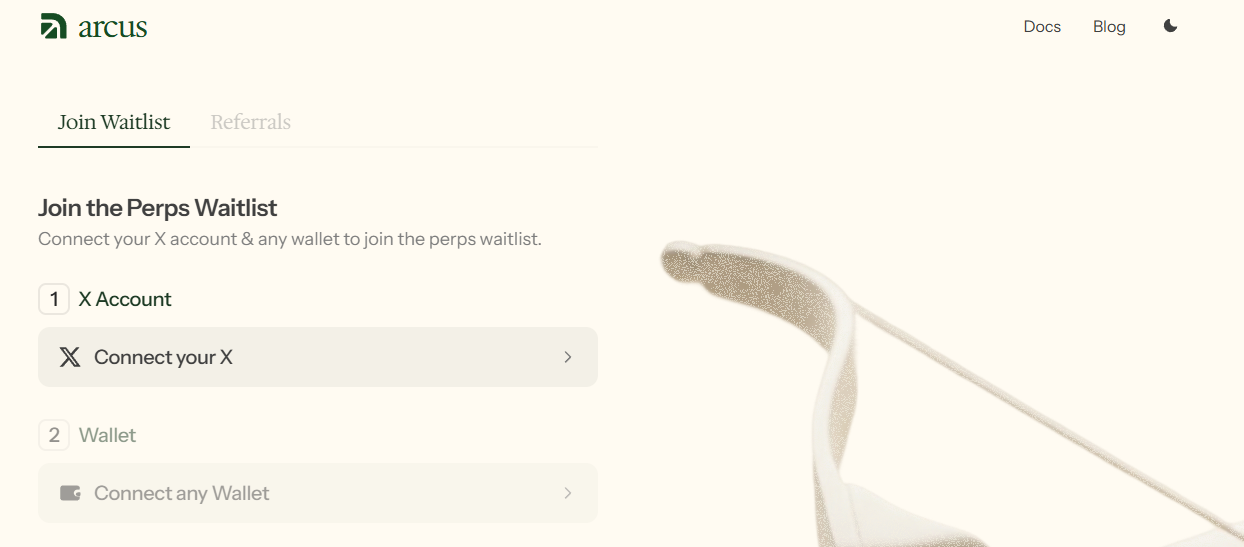
Arcus Early Waitlist is Open

Furthermore, Arcus plans to support using tokenized stocks and crypto assets as collateral for perpetual contracts and to offer pre-IPO trading for hot private companies like OpenAI in the future.

Future Arcus Tokens Will Be Allocated to the dYdX Community

At first glance, Arcus, a DEX developed by the dYdX team, is capitalizing on a major crypto theme this year—tokenized stocks. However, the issue lies in the fact that Arcus is not deployed on the dYdX Chain; instead, it has chosen to run on Robinhood Chain and is being developed as an independent product with its own separate infrastructure. This suggests that dYdX Labs is crafting a new growth narrative, one that does not place the dYdX Chain and the DYDX token at its core.

What's more subtle is that dYdX founder Antonio Juliano stated in the latest dYdX documentation that "a portion of future Arcus tokens will be allocated to the dYdX community." While this statement aims to reassure the old community, it also directly amplifies expectations for an Arcus token launch, making many users pay more attention to new potential airdrop opportunities.
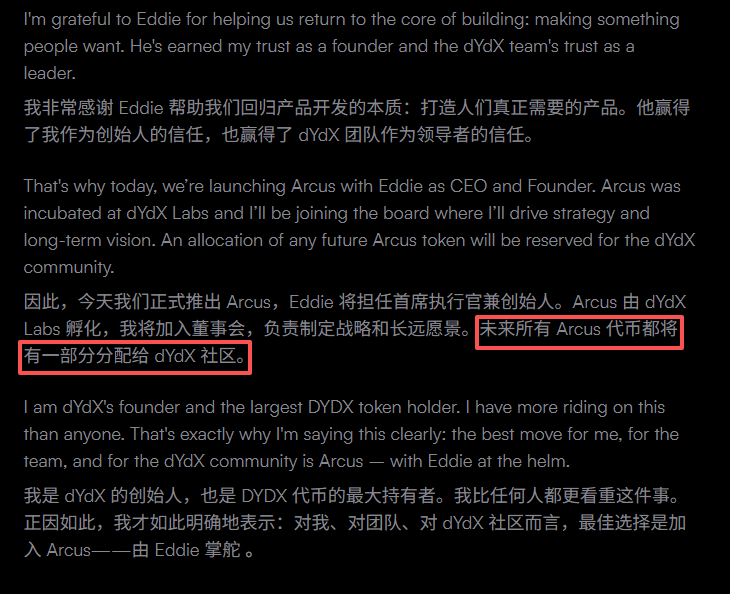
Arcus Tokens Will Be Allocated to the dYdX Community

Considering that dYdX once conducted one of the largest airdrops in the industry, if Arcus subsequently initiates trading incentives, point campaigns, or early user programs, it could potentially attract some traders and liquidity to migrate to the new platform ahead of time. For the dYdX Chain, this means that its already pressured trading volume and activity may face further diversion.

dYdX Founder Responds: Arcus is a New Product, dYdX Chain Will Not Be Shut Down

Facing community skepticism, dYdX founder Antonio Juliano posted an explanation, stating that the dYdX Chain has previously delved deeply into decentralization, featuring an open-source architecture, community governance, over 200 markets, and more than 50 validators running order books.

However, he also acknowledged that this path involved trade-offs in performance and user experience. As competition in on-chain derivatives intensifies, the market is rewarding faster, simpler, and more liquid trading platforms. Arcus was born in this context.

Additionally, Antonio stated that Arcus will be led by Eddie Zhang as CEO and Founder, while he himself will join the board, responsible for strategy and long-term vision. In other words, Arcus is not a new feature on the dYdX Chain but a new trading platform being developed separately by dYdX Labs.

For the old community, Antonio stated that dYdX v4 will continue to be supported, and user funds and positions will remain accessible on the dYdX Chain; if Arcus issues tokens in the future, a portion will be reserved for the dYdX community, with priority given to users who have previously participated in dYdX trading, staking, validation, and community building.

Subsequently, the dYdX Foundation further emphasized that Arcus is an independent product built on independent infrastructure and that the dYdX Chain will not be affected. DYDX remains the governance and staking token for the dYdX Chain, with its mechanisms, supply, and operational characteristics unchanged, and there are currently no arrangements for token swaps or migrations.

However, market concerns are not merely about "whether the dYdX Chain can still be used."

The real question lies in: If Arcus generates significant trading volume and revenue in the future, can the dYdX Chain share in this growth? If Arcus issues a new token, how much value will DYDX holders receive? How will dYdX Labs allocate its future resources between Arcus and the dYdX Chain?

Until clear answers are provided to these questions about value capture, Arcus represents a new story for dYdX Labs, but for DYDX holders, it's more like a puzzle yet to be solved.

Трендові криптовалюти

Пов'язані питання

QWhat is Arcus and what does it offer on the Robinhood Chain?

AArcus is a decentralized exchange (DEX) developed by the dYdX team. It is deployed on the Robinhood Chain and offers 24/7 zero-fee trading of 95 tokenized stocks and perpetual contracts. It supports tokenized trading of stocks, commodities, indices, and crypto assets, with the tokenized stocks issued and redeemable on Robinhood Chain, allowing for self-custody and integration into DeFi.

QWhy did the dYdX community express concerns regarding Arcus, and how did it affect the DYDX token?

AThe dYdX community expressed concerns that dYdX Labs might be shifting its focus to the new Arcus platform, potentially sidelining the original dYdX Chain. Questions arose about whether the DYDX token would continue to capture the protocol's value and how Arcus would relate to the dYdX ecosystem. These concerns contributed to a more than 12% drop in the DYDX token's price over 24 hours.

QHow did dYdX founder Antonio Juliano address community concerns about Arcus and dYdX Chain?

AAntonio Juliano explained that Arcus is a new, independent product built on separate infrastructure (Robinhood Chain), led by a new CEO. He stated that dYdX Chain (v4) would continue to be supported, with user funds and positions remaining accessible. He also mentioned that if Arcus were to issue a token in the future, a portion would be allocated to the dYdX community, prioritizing past participants.

QWhat is the stated purpose and positioning of the newly launched Robinhood Chain?

ARobinhood Chain, based on the Arbitrum tech stack, is a Layer 2 network designed to be institution-grade, permissionless, and AI-native, specifically built for Real World Assets (RWA). Its goal is not just to add another blockchain for crypto but to unify stocks, RWAs, lending, trading, and on-chain financial products within its own infrastructure.

QWhat future plans does Arcus have beyond its initial offering on Robinhood Chain?

AArcus plans to support using tokenized stocks and crypto assets as collateral for perpetual contracts. It also intends to offer pre-IPO trading for popular private companies like OpenAI.

Пов'язані матеріали

MSTR Discloses Sale of 3,588 Bitcoins, Stock Price Drops Over 5% at One Point During Trading

MicroStrategy, the world's largest corporate holder of Bitcoin, has significantly shifted its business model. Between June 29 and July 5, the company sold 3,588 bitcoins for approximately $216 million to fund quarterly dividends for its preferred stock. This marks its largest-ever Bitcoin sale and signals a strategic pivot: Bitcoin is transitioning from a "buy-and-hold" reserve asset to a liquidity management tool for the company. This move follows a recent authorization allowing Bitcoin sales when equity fundraising is less attractive. The announcement contributed to a more than 5% intraday drop in MicroStrategy's stock price, while Bitcoin fell to around $61,800—below the company's average holding cost of roughly $75,700. The sale represents a major departure from MicroStrategy's long-standing "never sell" commitment, which saw its first minor breach in May with a $2.5 million sale. The latest, hundred-times-larger transaction underscores growing financial pressures. Analysts note the company faces about $1.5 billion in annual preferred dividend obligations, far exceeding cash flow from its software business. As of July 5, MicroStrategy holds 843,775 bitcoins. Its current operational logic involves buying Bitcoin during favorable financing conditions and selling portions to cover dividends when needed, creating a flexible capital management cycle amidst a challenging market environment.

华尔街日报2 год тому

MSTR Discloses Sale of 3,588 Bitcoins, Stock Price Drops Over 5% at One Point During Trading

华尔街日报2 год тому

Q-Day Countdown: Will Quantum Computing End Cryptocurrencies?

Quantum Computing's Threat to Cryptocurrency: A Countdown to Q-Day Quantum computing, specifically Shor's algorithm, poses a fundamental threat to the public-key cryptography (e.g., ECDSA, RSA) that secures blockchain networks like Bitcoin and Ethereum. This critical juncture, known as Q-Day, is estimated to occur potentially within the next 5-15 years. The core vulnerability stems from the public and immutable nature of blockchains. Assets in addresses where the public key is already exposed on-chain (e.g., spent outputs) are at direct risk, as a sufficiently powerful quantum computer could derive the private key. This threatens the very trust model of cryptocurrencies. The response lies in Post-Quantum Cryptography (PQC)—algorithms like lattice-based ML-DSA and hash-based SLH-DSA, which are resistant to quantum attacks. NIST has standardized key PQC algorithms (FIPS 203, 204, 205), providing a migration path. However, the primary challenge is not technical but socio-economic and involves complex governance: * **Bitcoin's** path is constrained by its conservative ethos. Migrating requires a soft-fork to new address types, facing hurdles like significantly larger signature sizes and, most critically, the divisive governance question of how to handle at-risk legacy UTXOs without violating core principles. * **Ethereum** is pursuing a "cryptographic agility" strategy, with a multi-layered roadmap. It leverages account abstraction for user accounts and is developing compressed hash-based signatures (e.g., leanXMSS) for its consensus layer, aiming for a full-stack upgrade over time. In conclusion, quantum computing does not spell an instant end for cryptocurrency but initiates a critical countdown. The industry has a limited "engineering comfort window" to orchestrate a coordinated, ecosystem-wide migration to PQC. The ultimate bottlenecks are the immense coordination efforts and governance decisions required for this foundational transition.

marsbit3 год тому

Q-Day Countdown: Will Quantum Computing End Cryptocurrencies?

marsbit3 год тому

Trump, the President Who Knows Best How to 'Trade Stocks'

Former US President Donald Trump reported a record-breaking $2.2 billion in personal income for 2025, the highest annual income ever disclosed by a sitting president. This figure, from a 927-page government ethics filing, represented a 3.5-fold increase from his $600 million income in 2024 and boosted his net worth to $6.5 billion. The primary drivers were cryptocurrency (64% of income, approximately $1.4 billion) and real estate (26%, approximately $575 million). His crypto earnings stemmed largely from the launch of his personal meme coin, $TRUMP, generating over $600 million in licensing fees, and substantial profits from the WLFI token and its parent company. Despite a sluggish property market, his Mar-a-Lago resort and associated golf clubs saw revenue surges of 50% and 27%, respectively, attributed to their use as venues for presidential events. Trump's financial disclosure also revealed an unprecedented level of stock market activity, with over 22,000 trades executed in 2025, averaging 87 trades per market day. Media analyses noted several instances where significant trading coincided with major policy announcements, such as proposed tariffs, raising questions about potential conflicts of interest. While the White House stated these trades were handled by a family-managed trust fund and not Trump directly, critics highlighted this as a departure from the blind trusts traditionally used by presidents post-Watergate. The report has intensified debate over the commercialization of the presidency. Supporters view it as a success story of a businessman-president, while critics argue it demonstrates an unprecedented conversion of public influence into private wealth, with policy decisions potentially linked to personal financial gains. The controversy centers on whether Trump's earnings represent innovative entrepreneurship or a fundamental conflict of interest, sparking renewed calls for stricter ethics reforms in US governance.

marsbit4 год тому

Trump, the President Who Knows Best How to 'Trade Stocks'

marsbit4 год тому

Countdown to Q-Day: Will Quantum Computing End Cryptocurrencies?

The article explores the existential threat quantum computing poses to cryptocurrencies and the urgent need for "post-quantum" migration. It outlines that quantum computers, through Shor's algorithm, could break the elliptic-curve cryptography (ECC) underlying blockchain security, potentially allowing private keys to be derived from public keys. The core challenge is not a lack of post-quantum cryptography (PQC) standards—like NIST's ML-KEM and ML-DSA—but the immense complexity of upgrading entire ecosystems before "Q-Day" (when quantum computers become capable of such attacks, estimated around 2035-2045). Key points include: * **Bitcoin's** risk is concentrated in legacy UTXOs with exposed public keys (e.g., early P2PK outputs). Migration faces massive hurdles: PQC signatures are much larger, increasing transaction size and cost, and the governance dilemma of handling un-migrated assets threatens its "code is law" ethos. * **Ethereum's** strategy focuses on "cryptographic agility," using Account Abstraction for user accounts and developing compressed hash-based signatures (like leanXMSS with SNARK aggregation) for consensus. Its migration is a complex, full-stack overhaul of execution, consensus, and data layers. * The "security debt" is enormous. The comfortable engineering window for a coordinated, ecosystem-wide upgrade is only 5-8 years. High-value infrastructure (exchanges, bridges) may face pressure before mainnet protocols. In conclusion, quantum computing is not an instant "doomsday" event but a forcing function for systemic change. Bitcoin's ultimate test is social consensus and property rights governance, while Ethereum's is technical complexity. Failure to migrate in time could lead to a fundamental re-pricing of crypto assets.

链捕手4 год тому

Countdown to Q-Day: Will Quantum Computing End Cryptocurrencies?

链捕手4 год тому

Торгівля

Спот

Популярні статті

Як купити DYDX

Ласкаво просимо до HTX.com! Ми зробили покупку dYdX (DYDX) простою та зручною. Дотримуйтесь нашої покрокової інструкції, щоб розпочати свою криптовалютну подорож.Крок 1: Створіть обліковий запис на HTXВикористовуйте свою електронну пошту або номер телефону, щоб зареєструвати обліковий запис на HTX безплатно. Пройдіть безпроблемну реєстрацію й отримайте доступ до всіх функцій.ЗареєструватисьКрок 2: Перейдіть до розділу Купити крипту і виберіть спосіб оплатиКредитна/дебетова картка: використовуйте вашу картку Visa або Mastercard, щоб миттєво купити dYdX (DYDX).Баланс: використовуйте кошти з балансу вашого рахунку HTX для безперешкодної торгівлі.Треті особи: ми додали популярні способи оплати, такі як Google Pay та Apple Pay, щоб підвищити зручність.P2P: Торгуйте безпосередньо з іншими користувачами на HTX.Позабіржова торгівля (OTC): ми пропонуємо індивідуальні послуги та конкурентні обмінні курси для трейдерів.Крок 3: Зберігайте свої dYdX (DYDX)Після придбання dYdX (DYDX) збережіть його у своєму обліковому записі на HTX. Крім того, ви можете відправити його в інше місце за допомогою блокчейн-переказу або використовувати його для торгівлі іншими криптовалютами.Крок 4: Торгівля dYdX (DYDX)Легко торгуйте dYdX (DYDX) на спотовому ринку HTX. Просто увійдіть до свого облікового запису, виберіть торгову пару, укладайте угоди та спостерігайте за ними в режимі реального часу. Ми пропонуємо зручний досвід як для початківців, так і для досвідчених трейдерів.

165 переглядів усьогоОпубліковано 2024.12.13Оновлено 2026.06.02

Як купити DYDX

Обговорення

Ласкаво просимо до спільноти HTX. Тут ви можете бути в курсі останніх подій розвитку платформи та отримати доступ до професійної ринкової інформації. Нижче представлені думки користувачів щодо ціни DYDX (DYDX).

活动图片