Arbitrum gains 10% as volume spikes – Can ARB break supply zone?

ambcryptoОпубліковано о 2026-04-08Востаннє оновлено о 2026-04-08

Анотація

ARB gained 10% in 24 hours, supported by a 40% surge in trading volume exceeding $100 million, indicating strong demand. The token is testing a key supply zone near $0.1031. While the Stochastic RSI suggests potential exhaustion, on-chain data shows whale accumulation reducing supply, and derivatives reflect bullish sentiment with a Long/Short Ratio of 1.6. A break above the resistance could target $1.1, but failure may lead to consolidation. The rally's sustainability depends on continued volume and buying pressure.

Arbitrum gained momentum as price and activity increased over the past 24 hours.

The token, ARB, rose 10%, supported by a sharp rise in market participation. Trading Volume climbed 40%, crossing $100 million.

That expansion suggested growing demand rather than fading interest. However, the Stochastic RSI signaled caution near current levels.

Is volume driving ARB’s rally?

Trading activity surged alongside price, strengthening the current move. The rise in Trading Volume indicated fresh participation rather than short-lived speculation.

That move aligned with sustained buying pressure, which kept momentum intact despite early signs of exhaustion.
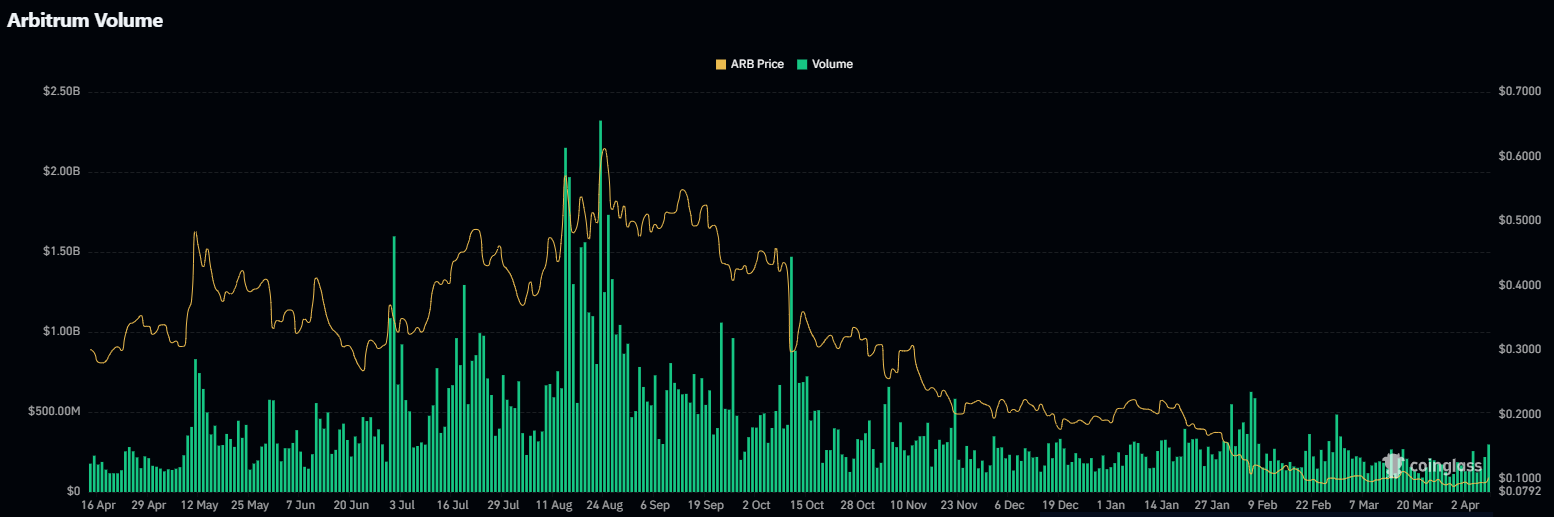
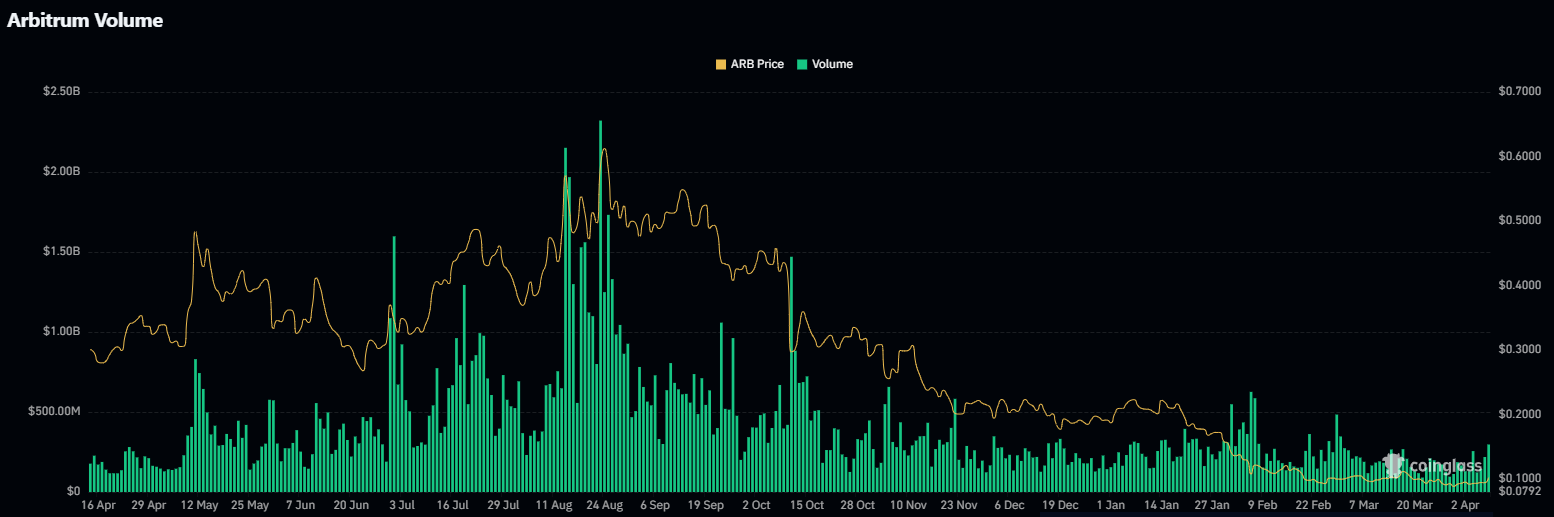
Source: CoinGlass

Can ARB clear its supply zone?

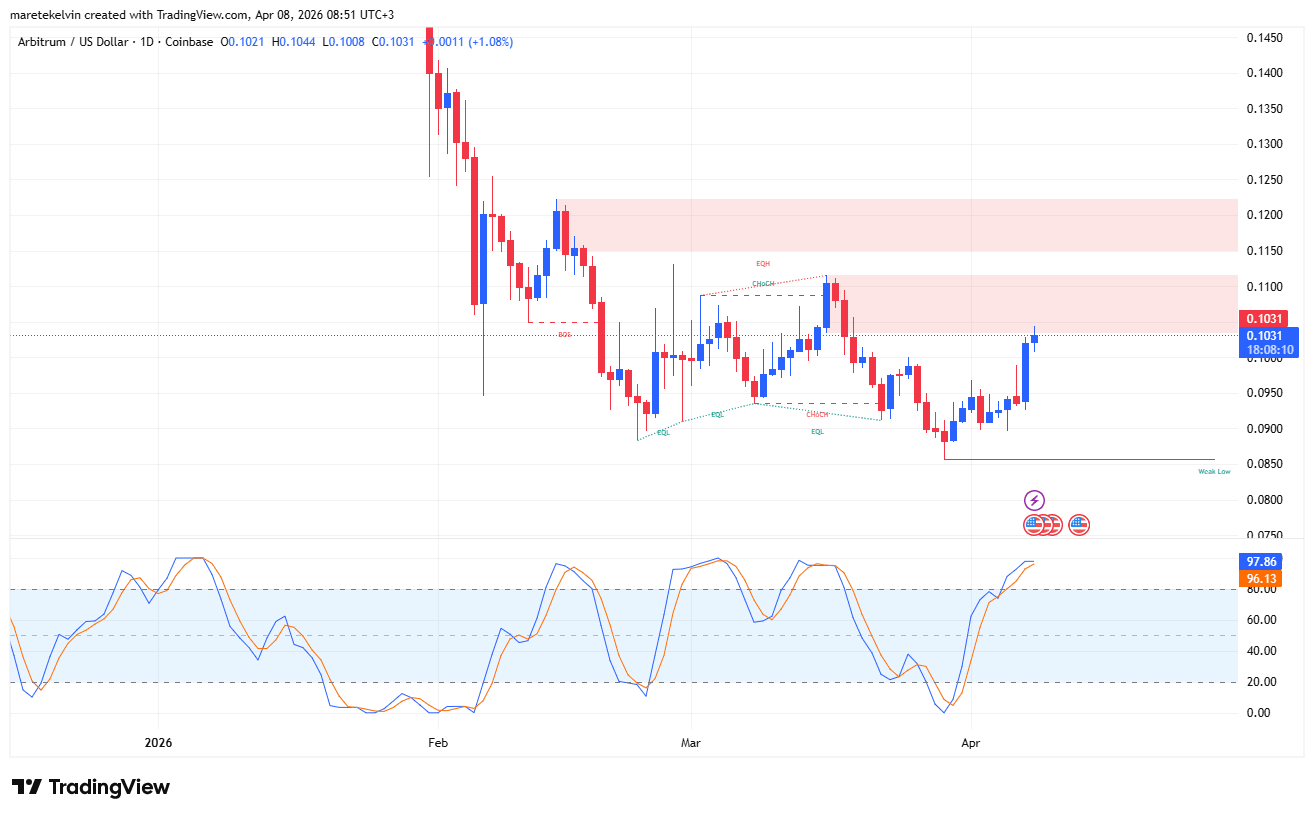
Arbitrum [ARB] tested a key supply zone near $0.1031 on the daily chart. The move followed a strong rally after clearing liquidity clusters during the previous downtrend phase.

Even so, the structure still favored buyers at press time.

However, the Stochastic RSI suggested the rally approached an exhaustion phase. The RSI remained in an oversold region, indicating a potential cooldown.

This left price consolidating near resistance while the market absorbed recent gains.
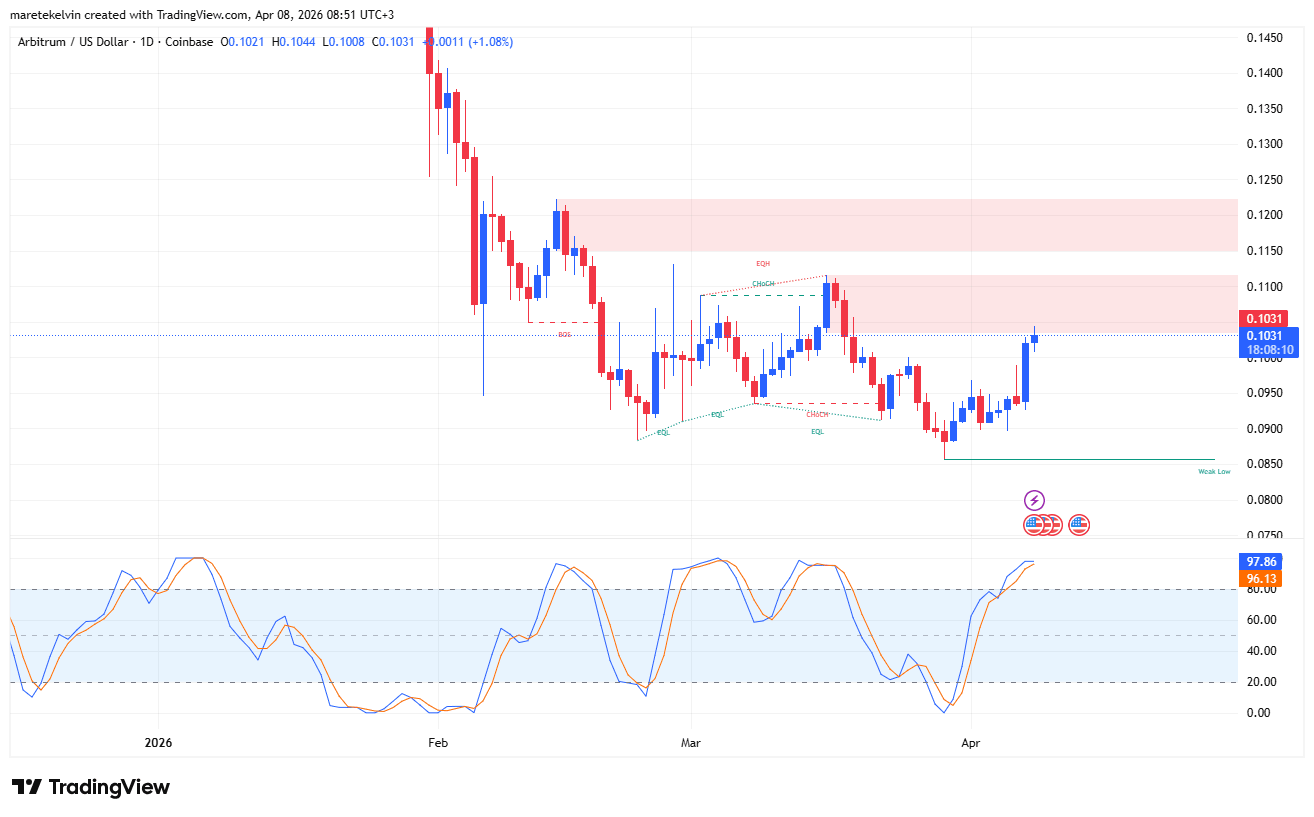
Source: TradingView

Whale accumulation supports the trend

On-chain data showed continued accumulation by large holders at current levels. This behavior reduced circulating supply and supported the ongoing trend.
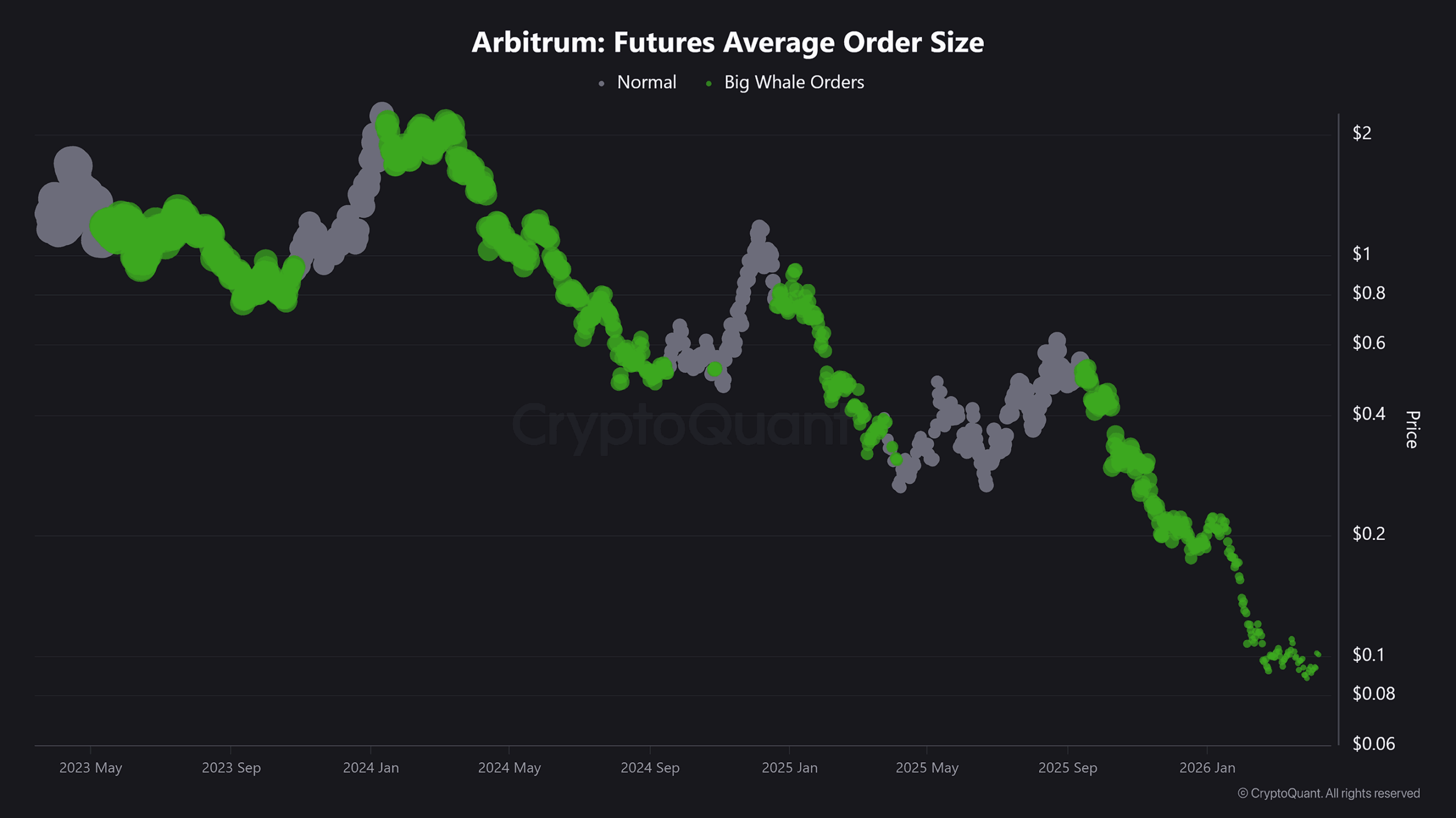
Source: CryptoQuant

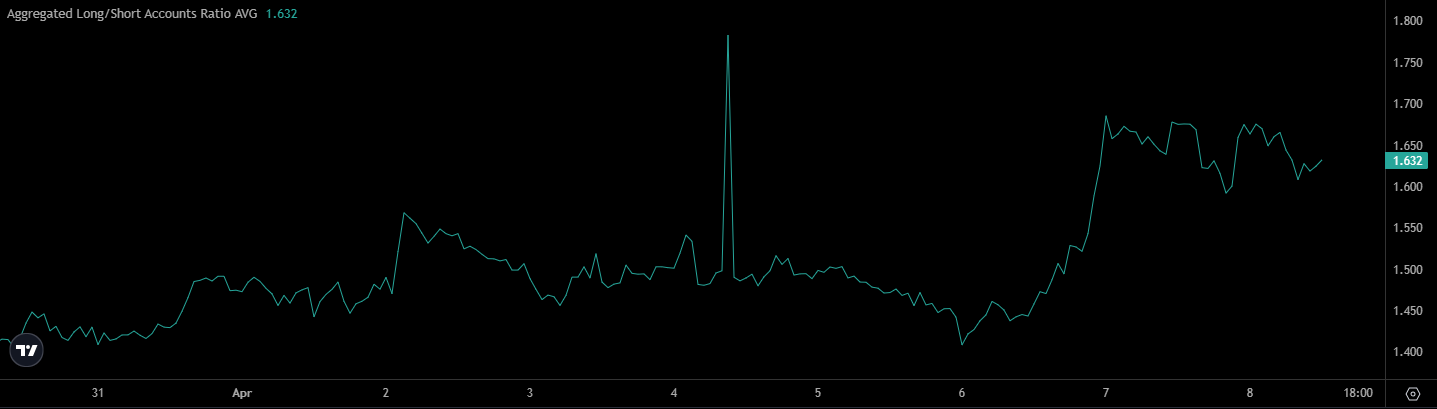
On top of that, derivatives data confirmed bullish positioning. The Long/Short Ratio stood at 1.6, at press time, showing longs outweighed shorts.

That alignment suggested traders leaned toward continuation rather than reversal.
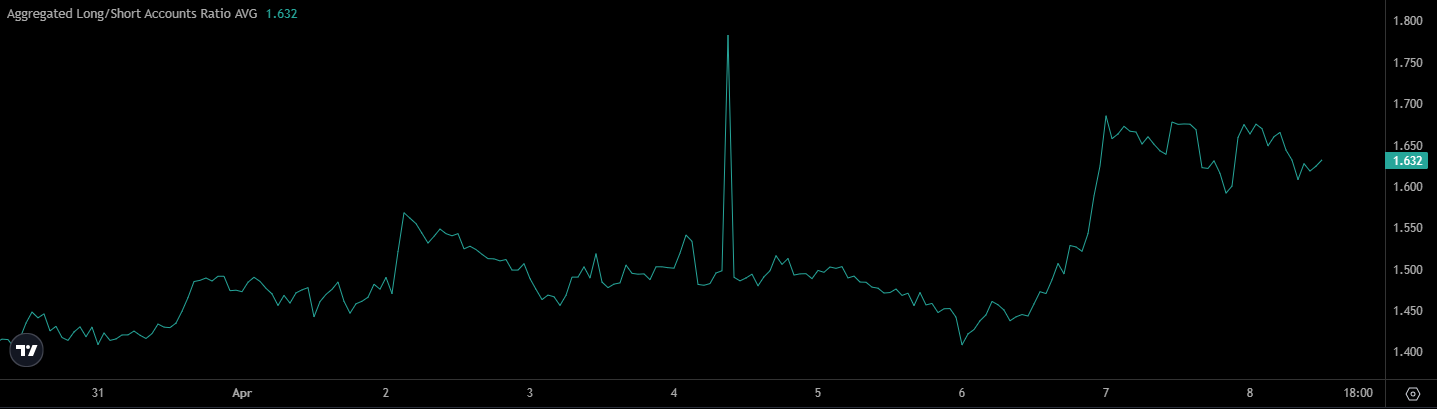
Source: Coinalyze

What is ahead for ARB?

The structure remained constructive as long as buying pressure held. Sustained momentum depended on strong Trading Volume and continued accumulation.

A successful break above the supply zone could open the path toward $1.1. Failure to sustain demand may lead to consolidation before the next move.


Final Summary

  • ARB’s price rise is backed by strong volume growth, showing real market participation rather than a weak bounce.
  • The token is now testing a key supply zone, which will decide whether the rally continues or stalls.


Пов'язані питання

QWhat was the percentage increase in ARB's price and the approximate trading volume mentioned in the article?

AARB's price rose by 10%, and the trading volume climbed 40%, crossing $100 million.

QAccording to the technical analysis, what does the Stochastic RSI signal for ARB near its current price level?

AThe Stochastic RSI signaled caution and suggested that the rally was approaching an exhaustion phase.

QWhat key supply zone is ARB testing on the daily chart, and what could a successful break above it lead to?

AARB is testing a key supply zone near $0.1031. A successful break above it could open the path toward $1.1.

QHow did on-chain data and whale activity contribute to supporting the ongoing trend for ARB?

AOn-chain data showed continued accumulation by large holders (whales) at current levels, which reduced circulating supply and supported the ongoing trend.

QWhat does the Long/Short Ratio of 1.6 indicate about trader positioning in the ARB market?

AA Long/Short Ratio of 1.6 indicates that long positions outweigh short positions, showing that traders are leaning toward a continuation of the trend rather than a reversal.

Пов'язані матеріали

How to Do Research Well: Deliberately Practice the Real Skills That Matter

No one truly teaches you how to do research. You're often given a desk, a pre-selected problem, and vague instructions to "create something new." Consequently, many people reverse-engineer the job based on visible outputs—papers, posts, announcements—learning only how to *appear* like a researcher rather than how to *become* one. True research capability is built from stacking small, trainable skills, nearly all of which can be developed through deliberate practice. **Pick Your Own Problem:** Most researchers absorb problems from advisors or trends, lacking the underlying reasoning. Choosing a problem you genuinely care about, as John Schulman advises, leads to original work. Develop "taste" like a muscle: predict experiment outcomes, guess paper results from methods, and track which findings remain important over time. **Upgrade Your Inputs:** Relying on shared reading lists (arXiv hot lists, filtered group chats) leads to unoriginal conclusions. Undervalued old literature often holds crucial insights (e.g., MoE, LSTM, backpropagation). Richard Sutton's "The Bitter Lesson" or Claude Shannon's 1952 talk on creative thinking are more predictive than lengthy modern surveys. Breadth matters as much as depth: draw from neuroscience, mechanism design, hardware knowledge, and honest statistics. Read papers directly, especially appendices and limitations sections. **Write Everything Down:** As Paul Graham noted, writing exposes flaws in seemingly mature ideas. Writing is the cheapest defense against self-deception. Following Feynman's principle, Darwin programmatically wrote down facts contradicting his theory to combat memory bias. Maintain a detailed log of hypotheses, setups, predictions, results, and updated understandings. Reviewing past logs fosters essential humility.

marsbit1 год тому

How to Do Research Well: Deliberately Practice the Real Skills That Matter

marsbit1 год тому

Following US Ban on Fable 5, Zhipu AI's Stock Soars 47%

On June 15th, shares of Zhipu AI surged dramatically on the Hong Kong stock market, peaking at a 47.6% gain before closing 32.82% higher. This sharp increase was directly triggered by two recent industry events. On June 12th, Anthropic announced it was suspending global access to its latest flagship models, Claude Fable 5 and Claude Mythos 5, to comply with a U.S. government export control order. The next day, Zhipu AI announced it would open access to its latest open-source flagship model, GLM-5.2, under the permissive MIT license. The Anthropic incident highlighted a critical issue beyond raw model capability: the risk of sudden, unpredictable loss of access to advanced AI models, especially for developers and enterprises deeply integrated with them. This has shifted industry and market focus toward factors like stability, sustainable access, and controllability. Zhipu's move, promoting "frontier intelligence for all," positions its openly available model as a reliable and accessible alternative. The GLM-5.2 model emphasizes "Long Horizon Task" capabilities with a 1M context window, targeting complex, multi-step coding and engineering workflows where maintaining context is crucial. Analysts note this event exposes the risk of dependency on closed-source models subject to single jurisdictional controls, potentially accelerating a shift toward domestic base models and localized deployments. The market's reaction signals a new valuation dimension in AI: providers who can offer stable, long-term, and sustainably accessible AI capabilities are gaining strategic importance.

marsbit1 год тому

Following US Ban on Fable 5, Zhipu AI's Stock Soars 47%

marsbit1 год тому

Fully Entering the AI Era: Alipay Bets on Conversation, WeChat Holds Fast to Social

In May 2026, Alipay announced over 300 million AI payment transactions. Shortly after, WeChat opened its mini-programs for AI integration, sparking controversy by requiring developer source code access. This highlights their diverging approaches to AI integration. Alipay is testing "Project Treasure," an optional AI-native interface replacing traditional app grids with a conversational window. Users can command complex tasks (e.g., "book a ride and order coffee") handled end-to-end by AI. This shift follows an abandoned standalone AI app, focusing instead on enhancing its existing user base. For unmodified mini-programs, Alipay's AI uses "screen-reading" to simulate user interactions, bypassing the need for developer overhaul. It also introduced "Token Pay" for micro-transactions and "AI Wallets" for autonomous agent spending. WeChat, prioritizing its core social function, is taking an embedded approach. Its AI agent will operate within existing contexts like group chats and official accounts, assisting without a separate interface. To enable this, WeChat offers developers two paths: granting source code access for direct AI control ("Automatic Mode") or manually encapsulating services into standardized "Skills." Both place significant burden on developers. Key differences emerge in handling legacy services: WeChat demands developer cooperation (code or labor), while Alipay's screen-reading offers immediate, if potentially less stable, compatibility. Alipay's 3 billion AI transactions demonstrate user acceptance of AI-driven commercial actions. The divergent strategies may reshape mini-program ecosystems—Alipay passively "AI-fying" services, WeChat potentially favoring resource-rich developers—and set competing technical standards. Ultimately, the competition centers on where users entrust the command to "help me get things done."

marsbit1 год тому

Fully Entering the AI Era: Alipay Bets on Conversation, WeChat Holds Fast to Social

marsbit1 год тому

Торгівля

Спот
Ф'ючерси
活动图片