Anthropic's Seventy-Two-Hour Identity Crisis

marsbitОпубліковано о 2026-02-27Востаннє оновлено о 2026-02-27

Анотація

Over a critical 72-hour period, AI company Anthropic faced a severe identity crisis as it navigated intense pressure from the U.S. Pentagon, public accusations from Elon Musk, and a major shift in its own safety policies. The Pentagon issued an ultimatum: lift restrictions on military use of its AI model Claude—including for autonomous weapons and domestic surveillance—by Friday at 5:01 PM, or lose a $200 million contract and face potential blacklisting. Simultaneously, Anthropic released its Responsible Scaling Policy (RSP) 3.0, removing its core commitment to pause training if safety couldn't be assured. Elon Musk publicly accused Anthropic of large-scale training data theft, referencing a $1.5 billion settlement over copyrighted material. The company also accused three Chinese AI firms of “industrial-scale distillation attacks” via its public API, framing it as a national security threat—a move widely seen as hypocritical. Amid a $380 billion valuation and rapid growth, Anthropic’s founding narrative—building powerful AI more responsibly than competitors—began to unravel. Its balancing act between safety branding and commercial and government pressures reached a breaking point. The company’s identity, once defined by its ethical differentiation, now appears to be converging with the rest of the industry.

Written by: Ada, Shenchao TechFlow

February 24th, Tuesday. Washington, The Pentagon.

Anthropic CEO Dario Amodei sat across from Defense Secretary Pete Hegseth. According to multiple media outlets including NPR and CNN citing informed sources, the atmosphere of the meeting was "polite," but the content was anything but.

Hegseth gave him an ultimatum: By 5:01 PM on Friday, lift the restrictions on the military use of Claude, allowing the Pentagon to use it for "all lawful purposes," including autonomous weapons targeting and domestic mass surveillance.

Otherwise, cancel the $200 million contract. Initiate the Defense Production Act for compulsory requisition. Designate Anthropic as a "supply chain risk," which is equivalent to blacklisting it alongside hostile entities like Russia and China.

On the same day, Anthropic released the third version of its "Responsible Scaling Policy" (RSP 3.0), quietly deleting the company's most core commitment since its founding: if safety measures cannot be guaranteed to be in place, do not train more powerful models.

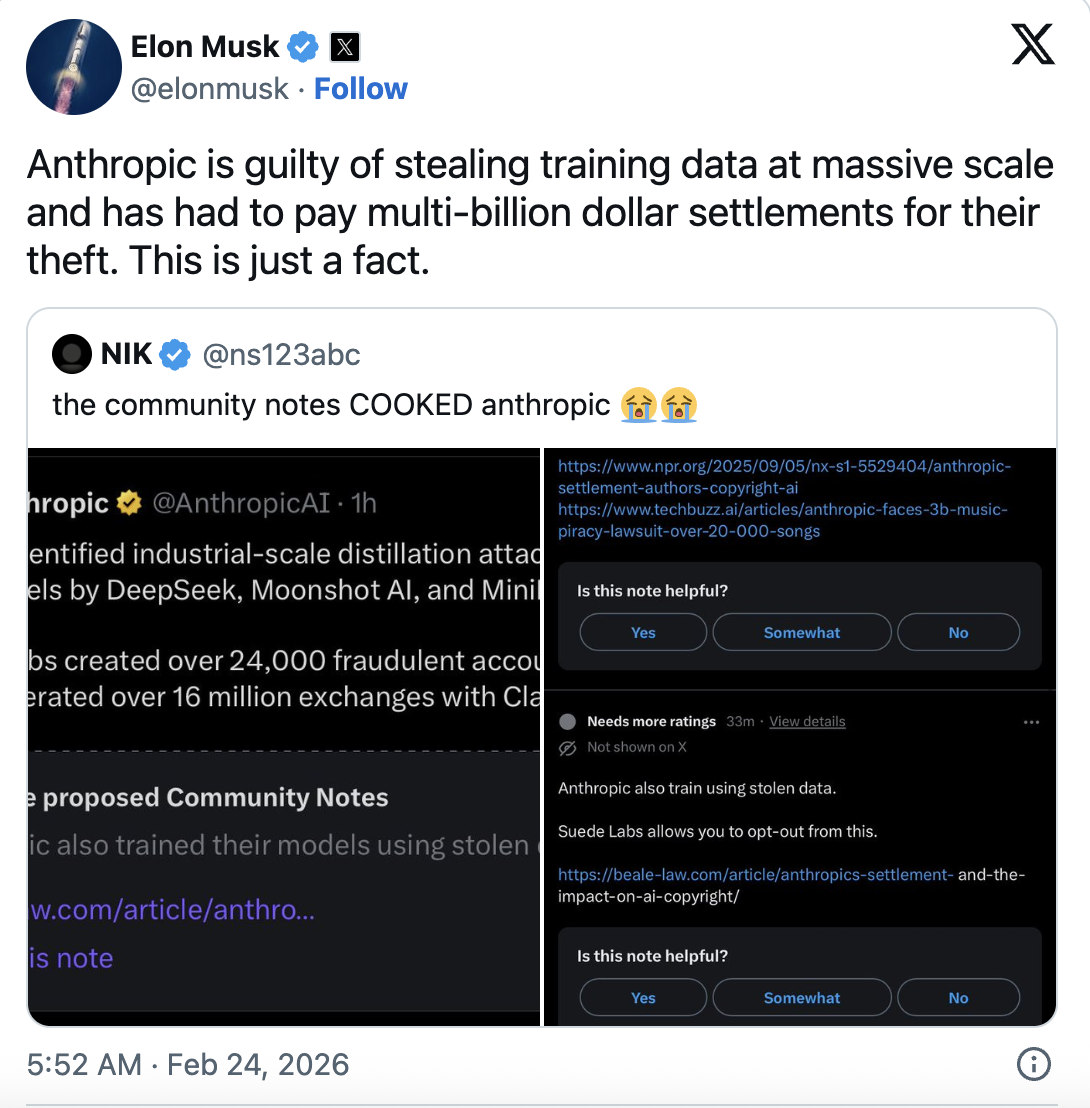
Also on the same day, Elon Musk posted on X: "Anthropic massively stole training data. This is a fact." Simultaneously, a Community Note on X added a report that Anthropic paid a $1.5 billion settlement for using pirated books to train Claude.

Within seventy-two hours, this AI company that claims to have a "soul" simultaneously played three roles: safety martyr, intellectual property thief, and Pentagon turncoat.

Which one is real?

Perhaps all of them.

The Pentagon's "Comply or Get Out"

The first layer of the story is simple.

Anthropic was the first AI company to gain classified-level access from the U.S. Department of Defense. The contract, with a ceiling of $200 million, was secured last summer. OpenAI, Google, and xAI subsequently secured contracts of similar scale.

According to Al Jazeera, Claude was used in a U.S. military operation this past January. The report stated the operation involved the kidnapping of Venezuelan President Maduro.

But Anthropic drew two red lines: no support for fully autonomous weapons targeting, and no support for mass surveillance of U.S. citizens. Anthropic believes AI's reliability is insufficient for weapon control, and there are currently no laws or regulations governing the use of AI in mass surveillance.

The Pentagon wasn't buying it.

White House AI advisor David Sacks publicly accused Anthropic on X last October of "using fear as a weapon, engaging in regulatory capture."

Competitors have already knelt. OpenAI, Google, and xAI have all agreed to let the military use their AI for "all lawful scenarios." Musk's Grok was just approved for entry into classified systems this week.

Anthropic is the last one standing.

As of publication, Anthropic stated in its latest announcement that it does not intend to concede. But the Friday 5:01 PM deadline is looming.

An anonymous former liaison between the Justice Department and the Defense Department expressed confusion to CNN: "How can you simultaneously declare a company a 'supply chain risk' and force that company to work for your military?"

Good question, but it's not within the Pentagon's consideration. They care that if Anthropic doesn't comply, they will resort to compulsory measures, or, Anthropic becomes a Washington outcast.

"Distillation Attack": A Slap-in-the-Face Accusation

On February 23rd, Anthropic published a fiercely worded blog post accusing three Chinese AI companies of carrying out an "industrial-scale distillation attack" on Claude.

The defendants are DeepSeek, Moonshot AI, and MiniMax.

Anthropic accused them of using 24,000 fake accounts to initiate over 16 million interactions with Claude, specifically extracting its core capabilities in agent reasoning, tool use, and programming.

Anthropic framed this as a national security threat, claiming that distilled models are "unlikely to retain safety guardrails" and could be used by authoritarian governments for cyber attacks, disinformation, and mass surveillance.

The narrative was perfect, the timing was perfect.

It came just after the Trump administration had recently relaxed chip export controls to China, just when Anthropic needed ammunition for its lobbying stance on chip export controls.

But Musk fired a shot: "Anthropic massively stole training data and paid billions in settlements for it. This is a fact."
Tory Green, co-founder of AI infrastructure company IO.Net, stated: "You train your models on data from the entire web, and when others learn from you using your public API, it's called a 'distillation attack'?"

Anthropic calls distillation an "attack," but it's commonplace in the AI industry. OpenAI uses it to compress GPT-4, Google uses it to optimize Gemini, even Anthropic itself does it. The only difference is, this time they were the ones being distilled.

As Singapore's Nanyang Technological University AI professor Erik Cambria told CNBC: "The boundary between legitimate use and malicious exploitation is often blurry."

Even more ironic, Anthropic just paid a $1.5 billion settlement for using pirated books to train Claude. It trains its models on data from the entire web, then accuses others of learning from it using its public API. This isn't double standards, it's triple standards.

Anthropic wanted to play the victim, but got exposed as the defendant.

Dismantling the Safety Commitment: RSP 3.0

On the same day as the Pentagon standoff and the Silicon Valley spat, Anthropic released the third version of its Responsible Scaling Policy.

Anthropic Chief Scientist Jared Kaplan told media in an interview: "We felt that stopping AI model training doesn't help anyone. In the context of rapid AI development, unilaterally making commitments... while competitors are full steam ahead, it doesn't make sense."

In other words, others aren't playing by the rules, so we're dropping the act too.

The core of RSP 1.0 and 2.0 was a hard commitment to pause training if model capabilities exceeded the coverage of safety measures. This commitment gave Anthropic a unique reputation in the AI safety community.

But 3.0 deleted it.

It was replaced with a more "flexible" framework, separating safety measures Anthropic can implement itself from safety recommendations requiring industry-wide collaboration into two tracks. A risk report is issued every 3-6 months. External experts review it.

Sounds responsible?

Independent reviewer Chris Painter from the non-profit METR, after seeing an early draft of the policy, stated: "This indicates Anthropic believes it needs to enter 'triage mode' because methods for assessing and mitigating risk can't keep up with the pace of capability growth. This is more evidence that society is unprepared for AI's potential catastrophic risks."

According to TIME, Anthropic spent nearly a year internally debating this rewrite, with CEO Amodei and the board unanimously approving it. The official line is that the original policy was designed to drive industry consensus, but the industry simply didn't follow. The Trump administration has taken a laissez-faire approach to AI development, even attempting to repeal state-level regulations. Federal AI law is a distant prospect. While a global governance framework seemed possible in 2023, three years later, that door has clearly closed.

An anonymous researcher long focused on AI governance put it more bluntly: "The RSP was Anthropic's most valuable brand asset. Deleting the training pause commitment is like an organic food company quietly tearing the 'organic' label off its packaging and then telling you their testing is now more transparent."

Identity Fracture Under a $380 Billion Valuation

In early February, Anthropic completed a $30 billion financing round at a $380 billion valuation, with Amazon as the anchor investor. Since its founding, it has achieved $14 billion in annualized revenue. Over the past three years, this figure has grown more than 10x each year.

Simultaneously, the Pentagon threatens to blacklist it. Musk publicly accuses it of data theft. Its own core safety commitment is deleted. Anthropic's AI safety lead, Mrinank Sharma, resigned and wrote on X: "The world is in danger."

Contradiction?

Perhaps contradiction is in Anthropic's DNA.

The company was founded by former OpenAI executives because they were concerned OpenAI was moving too fast on safety. Then they built a company themselves, building more powerful models at an even faster pace, while telling the world how dangerous these models are.

The business model can be summarized in one sentence: we are more afraid of AI than anyone else, so you should pay us to build it.

This narrative worked perfectly in 2023-2024. AI safety was a hot word in Washington, and Anthropic was the most popular lobbyist.

In 2026, the wind has changed.

"Woke AI" has become an attack label, state-level AI regulation bills are being blocked by the White House, and the California SB 53 supported by Anthropic was signed into law, but the federal level is a wasteland.

Anthropic's safety card is sliding from a "differentiating advantage" to a "political liability."

Anthropic is performing a complex balancing act. It needs to be "safe" enough to maintain its brand, yet "flexible" enough to avoid being abandoned by the market and the government. The problem is, the tolerance space on both ends is shrinking.

How Much is the Safety Narrative Still Worth?

Look at all three events together, and the picture becomes clear.

Accusing Chinese companies of distilling Claude is to strengthen the lobbying narrative for chip export controls. Deleting the safety pause commitment is to avoid falling behind in the arms race. Refusing the Pentagon's autonomous weapons demand is to preserve the last layer of moral clothing.

Each step has its logic, but the steps contradict each other.

You can't simultaneously claim that Chinese companies "distilling" your model threatens national security, while deleting the commitment that prevents your own model from going out of control. If the model is truly that dangerous, you should be more cautious, not more aggressive.

Unless you are Anthropic.

In the AI industry, identity is not defined by your statements, but by your balance sheet. Anthropic's "safety" narrative is essentially a brand premium.

In the early days of the AI arms race, this premium was valuable. Investors were willing to pay a higher valuation for "responsible AI," the government was willing to give the green light to "trustworthy AI," and customers were willing to pay for "safer AI."

But in 2026, this premium is evaporating.

Anthropic now faces not a multiple-choice question of "whether to compromise," but a sequencing problem of "who to compromise with first." Compromise with the Pentagon, brand damaged. Compromise with competitors, safety承诺废弃 (safety commitment废弃 - commitment abandoned). Compromise with investors, both have to give.

At 5:01 PM on Friday, Anthropic will deliver its answer.

But whatever the answer is, one thing is already certain: the Anthropic that once stood on "we're not like OpenAI" is becoming like everyone else.

The endpoint of an identity crisis is often the disappearance of identity.

Пов'язані питання

QWhat was the ultimatum given to Anthropic by the Pentagon, and what were the consequences of non-compliance?

AThe Pentagon gave Anthropic an ultimatum to remove restrictions on Claude's military use, allowing it to be used for 'all legitimate purposes,' including autonomous weapons targeting and domestic mass surveillance, by Friday at 5:01 PM. Failure to comply would result in the cancellation of a $200 million contract, the initiation of the Defense Production Act to force conscription, and the company being labeled a 'supply chain risk,' effectively blacklisting it alongside hostile entities like Russia and China.

QWhat significant change did Anthropic make to its Responsible Scaling Policy (RSP) 3.0, and why was it controversial?

AAnthropic removed the core commitment from its Responsible Scaling Policy (RSP) 3.0 that promised to halt training more powerful models if safety measures could not be guaranteed. This was controversial because it abandoned a foundational principle that had defined the company's identity and was seen as a move to prioritize competition over safety, especially as industry rivals advanced without similar restraints.

QWhat accusation did Elon Musk make against Anthropic, and how did it relate to the company's own claims about 'distillation attacks'?

AElon Musk accused Anthropic of 'massive theft of training data,' referencing reports that the company paid $1.5 billion in settlements for using pirated books to train Claude. This accusation undermined Anthropic's own claims of being a victim of 'industrial-scale distillation attacks' by Chinese AI firms, highlighting hypocrisy as Anthropic used scraped data for training while condemning others for learning from its public API.

QHow did Anthropic's business model and narrative shift between 2023 and 2026, according to the article?

AAnthropic's business model initially relied on a narrative of being more cautious and responsible than competitors like OpenAI, arguing that AI was dangerous and required safety measures. By 2026, this narrative became a political liability as regulatory momentum stalled and competition intensified. The company began compromising its safety promises to remain competitive, shifting from a 'differentiated advantage' to a potential 'political negative asset.'

QWhat broader implication does the article suggest about Anthropic's identity crisis and the AI industry?

AThe article suggests that Anthropic's identity crisis reflects a broader industry trend where ethical commitments are compromised under commercial and governmental pressures. Anthropic's attempts to balance safety branding with market demands led to contradictory actions, ultimately eroding its unique identity. The conclusion is that in the AI arms race, corporate identity defined by safety narratives is increasingly replaced by pragmatic alignment with power and profit, leading to a loss of distinctiveness.

Пов'язані матеріали

Has the 'Digital Gold' Narrative for BTC Failed?

**Title: Has the "Digital Gold" Narrative for Bitcoin Failed?** The article argues that Bitcoin's "digital gold" narrative remains valid despite a recent sharp price decline (from a peak near $126k in Oct 2025 to briefly under $61k in Feb 2026). It presents a long-term investment framework based on three core points: **1. Viewing Bitcoin as an Asset:** Bitcoin is presented as a superior potential store of value compared to gold. Key arguments are its absolute scarcity (21 million cap), superior portability, and transparent auditability via its public ledger. While acknowledging its current use in early, volatile stages (~3-4% global adoption), the author draws parallels to the early, disruptive phases of the internet and e-commerce. **2. Understanding the Recent Downturn:** The current ~50% correction is framed as a predictable, consensus-driven cycle following its post-halving peak (the 2024 halving preceded the Oct 2025 high). A crucial factor is a historic "changing of hands": the influx of new institutional buyers via ETFs allowed early, low-cost holders (miners, OG believers) to take profits. The author notes that while severe, Bitcoin's historical drawdowns (e.g., 93% in 2011, 77% in 2021-22) have been progressively smaller, suggesting maturing holder structure and decreasing volatility over time. **3. The Long-Term Perspective:** The long-term thesis hinges on Bitcoin capturing a portion of gold's market value. With Bitcoin's market cap at ~$1.4 trillion (at $70k) versus gold's ~$20 trillion, significant upside potential exists if the "digital gold" narrative is partially realized. However, the author strongly cautions that short-term risks remain, the bottom is unpredictable, and high volatility is inherent. The real risk is not Bitcoin failing but poor personal position management (over-leverage, wrong capital) and a lack of deep understanding, which can force investors out during severe downturns. The conclusion uses Amazon's 95% crash post-2000 dot-com bubble and subsequent 42x recovery as an analogy. The ultimate question is not if Bitcoin's price will rise, but if an investor's strategy and conviction can withstand the volatility to see the long-term play out. The recent divergence (gold up, Bitcoin down) is posed not as a narrative failure, but as potential evidence of this ongoing, painful transition from a speculative asset to a mainstream allocation.

marsbit5 год тому

Has the 'Digital Gold' Narrative for BTC Failed?

marsbit5 год тому

Has BTC's 'Digital Gold' Narrative Failed?

The article discusses Bitcoin's "digital gold" narrative, its recent price drop, and long-term outlook through the perspective of "Jason". It argues the narrative is not a failure but that Bitcoin represents a superior, new asset class due to its fixed supply (21 million), portability, and auditability. The piece compares its current ~3-4% global adoption rate to early internet/e-commerce, suggesting significant growth potential. Regarding the 2025-2026 price decline (from ~$126k to briefly under $61k), the author views it as a predictable, consensus-driven sell-off within Bitcoin's ~4-year cycle post-halving, exacerbated by a major "handover" from early, low-cost holders to new institutional buyers via ETFs. A key observation is that historical peak-to-trough drawdowns have lessened over time (e.g., 93% in 2011 to ~50% in 2026), indicating maturing volatility as holder structure changes. For the long term, the author uses a simple framework: Bitcoin's total market cap (~$1.4T at $70k) is only about 7% of gold's (~$20T). Even capturing 30-50% of gold's value would imply substantial upside. However, the article strongly cautions against viewing this as investment advice, emphasizing extreme volatility and the critical importance of risk management, position sizing, and deep fundamental understanding to survive severe drawdowns. It concludes by drawing a parallel to Amazon's 95% crash in 2000 and subsequent 42x recovery, stressing that the key is surviving market cycles to realize long-term potential.

链捕手5 год тому

Has BTC's 'Digital Gold' Narrative Failed?

链捕手5 год тому

From Code to Cognition: A Ten-Thousand-Word Guide to the Evolution of the Robot Brain

"From Code to Cognition: The Evolution of Robot Brains" The journey of robotic intelligence has shifted dramatically from manually coded systems to AI-driven brains. For decades, robots relied on layered software stacks—perception, state estimation, planning, control—each handcrafted. While predictable, they lacked adaptability. The 2010s saw deep learning revolutionize perception (e.g., object detection) and control (via reinforcement learning), but learned skills remained narrow. The arrival of Large Language Models (LLMs) marked a turning point. LLMs acted as high-level planners, interpreting natural language instructions and generating sequences of actions for traditional robotic systems to execute. However, true integration came with Visual-Language-Action (VLA) models, which fused vision, language, and motion prediction into a single network. Pioneered by models like RT-2 and open-source projects like OpenVLA, VLAs enable robots to reason and act directly from visual input and commands. The most advanced humanoid robots now employ a "dual-brain" architecture: a slow-thinking, large VLA (System 2) for reasoning and planning, and a fast-reacting, small network (System 1) for high-frequency motion control, sometimes with an even lower-level System 0 for balance. This split balances cognition with the physics of real-time movement. Computation is split between onboard hardware (e.g., NVIDIA Jetson) for safety-critical control loops and cloud/edge servers for non-critical tasks like learning and interfaces. A crucial driver is the open-source ecosystem—models like GR00T and OpenVLA allow startups to build upon pre-trained brains and fine-tune them with their own data, accelerating development. Despite progress, current systems struggle with recovery from errors, sample inefficiency, and long-horizon tasks. This has spurred the rise of **World Models**—neural networks that predict the consequences of actions. By simulating possible futures before acting (like NVIDIA Cosmos or Meta V-JEPA), robots can plan, recover, and generalize better. This represents the next frontier: shifting intelligence from learned reactions to an internal model of physics and cause-and-effect. The field is rapidly evolving. While not yet at its "ChatGPT moment," the convergence of cheaper hardware, scalable simulation, and world models points toward robots that are increasingly capable, adaptive, and useful. The question is shifting from "what can robots do?" to "what *should* they do?"

marsbit5 год тому

From Code to Cognition: A Ten-Thousand-Word Guide to the Evolution of the Robot Brain

marsbit5 год тому

Торгівля

Спот
Ф'ючерси

Популярні статті

Що таке $S$

Розуміння SPERO: Комплексний огляд Вступ до SPERO Оскільки ландшафт інновацій продовжує еволюціонувати, виникнення технологій web3 та криптовалютних проектів відіграє ключову роль у формуванні цифрового майбутнього. Один з проектів, який привернув увагу в цій динамічній сфері, — це SPERO, позначений як SPERO,$$s$. Ця стаття має на меті зібрати та представити детальну інформацію про SPERO, щоб допомогти ентузіастам та інвесторам зрозуміти його основи, цілі та інновації в рамках web3 та крипто-сектору. Що таке SPERO,$$s$? SPERO,$$s$ — це унікальний проект у криптопросторі, який прагне використати принципи децентралізації та технології блокчейн для створення екосистеми, що сприяє залученню, корисності та фінансовій інклюзії. Проект розроблений для полегшення взаємодії між користувачами новими способами, надаючи їм інноваційні фінансові рішення та послуги. У своїй основі SPERO,$$s$ прагне надати можливості індивідам, забезпечуючи інструменти та платформи, які покращують користувацький досвід у криптовалютному просторі. Це включає в себе можливість більш гнучких методів транзакцій, сприяння ініціативам, що підтримуються спільнотою, та створення шляхів для фінансових можливостей через децентралізовані додатки (dApps). Основна концепція SPERO,$$s$ обертається навколо інклюзивності, прагнучи зменшити розриви в традиційній фінансовій системі, використовуючи переваги технології блокчейн. Хто є творцем SPERO,$$s$? Особистість творця SPERO,$$s$ залишається дещо невідомою, оскільки є обмежені публічно доступні ресурси, що надають детальну інформацію про його засновників. Ця відсутність прозорості може бути наслідком зобов'язання проекту до децентралізації — етики, яку багато проектів web3 поділяють, ставлячи колективні внески вище за індивідуальне визнання. Зосереджуючи обговорення навколо спільноти та її колективних цілей, SPERO,$$s$ втілює суть наділення без виділення конкретних осіб. Таким чином, розуміння етики та місії SPERO є більш важливим, ніж ідентифікація єдиного творця. Хто є інвесторами SPERO,$$s$? SPERO,$$s$ підтримується різноманітними інвесторами, починаючи від венчурних капіталістів до ангельських інвесторів, які прагнуть сприяти інноваціям у крипто-секторі. Зосередження цих інвесторів зазвичай узгоджується з місією SPERO — пріоритет надається проектам, які обіцяють технологічний прогрес у суспільстві, фінансову інклюзію та децентралізоване управління. Ці інвесторські фонди зазвичай зацікавлені в проектах, які не лише пропонують інноваційні продукти, але й позитивно впливають на спільноту блокчейн та її екосистеми. Підтримка з боку цих інвесторів підкріплює SPERO,$$s$ як значного конкурента в швидко змінюваній сфері крипто-проектів. Як працює SPERO,$$s$? SPERO,$$s$ використовує багатогранну структуру, яка відрізняє його від традиційних криптовалютних проектів. Ось деякі ключові особливості, які підкреслюють його унікальність та інноваційність: Децентралізоване управління: SPERO,$$s$ інтегрує моделі децентралізованого управління, надаючи користувачам можливість активно брати участь у процесах прийняття рішень щодо майбутнього проекту. Цей підхід сприяє відчуттю власності та відповідальності серед членів спільноти. Корисність токена: SPERO,$$s$ використовує свій власний криптовалютний токен, розроблений для виконання різних функцій в екосистемі. Ці токени дозволяють здійснювати транзакції, отримувати винагороди та полегшувати послуги, що пропонуються на платформі, підвищуючи загальну залученість та корисність. Шарова архітектура: Технічна архітектура SPERO,$$s$ підтримує модульність та масштабованість, що дозволяє безперешкодно інтегрувати додаткові функції та додатки в міру розвитку проекту. Ця адаптивність є надзвичайно важливою для збереження актуальності в постійно змінюваному крипто-ландшафті. Залучення спільноти: Проект підкреслює ініціативи, що підтримуються спільнотою, використовуючи механізми, які стимулюють співпрацю та зворотний зв'язок. Підтримуючи сильну спільноту, SPERO,$$s$ може краще задовольняти потреби користувачів та адаптуватися до ринкових тенденцій. Фокус на інклюзію: Пропонуючи низькі комісії за транзакції та зручні інтерфейси, SPERO,$$s$ прагне залучити різноманітну базу користувачів, включаючи осіб, які раніше не брали участі в крипто-просторі. Це зобов'язання до інклюзії узгоджується з його загальною місією наділення через доступність. Хронологія SPERO,$$s$ Розуміння історії проекту надає важливі уявлення про його розвиток та етапи. Нижче наведено пропоновану хронологію, що відображає значні події в еволюції SPERO,$$s$: Етап концептуалізації та ідеації: Початкові ідеї, що стали основою SPERO,$$s$, були сформовані, тісно пов'язані з принципами децентралізації та фокусом на спільноті в індустрії блокчейн. Запуск білого паперу проекту: Після концептуального етапу був випущений комплексний білий папір, що детально описує бачення, цілі та технологічну інфраструктуру SPERO,$$s$, щоб залучити інтерес та зворотний зв'язок від спільноти. Створення спільноти та ранні залучення: Активні зусилля були спрямовані на створення спільноти ранніх прихильників та потенційних інвесторів, що полегшило обговорення цілей проекту та отримання підтримки. Подія генерації токенів: SPERO,$$s$ провів подію генерації токенів (TGE) для розподілу своїх рідних токенів серед ранніх прихильників та встановлення початкової ліквідності в екосистемі. Запуск початкового dApp: Перший децентралізований додаток (dApp), пов'язаний з SPERO,$$s$, став доступним, дозволяючи користувачам взаємодіяти з основними функціями платформи. Постійний розвиток та партнерства: Безперервні оновлення та вдосконалення пропозицій проекту, включаючи стратегічні партнерства з іншими учасниками блокчейн-простору, сформували SPERO,$$s$ у конкурентоспроможного та еволюціонуючого гравця на крипто-ринку. Висновок SPERO,$$s$ є свідченням потенціалу web3 та криптовалют для революціонізації фінансових систем та наділення індивідів. Завдяки зобов'язанню до децентралізованого управління, залучення спільноти та інноваційно спроектованих функцій, він прокладає шлях до більш інклюзивного фінансового ландшафту. Як і з будь-якими інвестиціями в швидко змінюваному крипто-просторі, потенційним інвесторам та користувачам рекомендується ретельно досліджувати та обдумано взаємодіяти з поточними подіями в SPERO,$$s$. Проект демонструє інноваційний дух крипто-індустрії, запрошуючи до подальшого дослідження його численних можливостей. Хоча подорож SPERO,$$s$ ще триває, його основні принципи можуть справді вплинути на майбутнє того, як ми взаємодіємо з технологією, фінансами та один з одним у взаємопов'язаних цифрових екосистемах.

73 переглядів усьогоОпубліковано 2024.12.17Оновлено 2024.12.17

Що таке $S$

Що таке AGENT S

Агент S: Майбутнє автономної взаємодії в Web3 Вступ У постійно змінюваному ландшафті Web3 та криптовалюти інновації постійно переосмислюють, як люди взаємодіють з цифровими платформами. Один з таких новаторських проектів, Агент S, обіцяє революціонізувати взаємодію людини з комп'ютером через свою відкриту агентну структуру. Прокладаючи шлях для автономних взаємодій, Агент S прагне спростити складні завдання, пропонуючи трансформаційні застосування в штучному інтелекті (ШІ). Це детальне дослідження заглиблюється в складності проекту, його унікальні особливості та наслідки для сфери криптовалюти. Що таке Агент S? Агент S є революційною відкритою агентною структурою, спеціально розробленою для вирішення трьох основних викликів в автоматизації комп'ютерних завдань: Набуття специфічних знань у галузі: Структура інтелектуально навчається з різних зовнішніх джерел знань та внутрішнього досвіду. Цей подвійний підхід дозволяє їй створити багатий репозиторій специфічних знань у галузі, покращуючи її продуктивність у виконанні завдань. Планування на довгих горизонтах завдань: Агент S використовує планування з підкріпленням досвіду, стратегічний підхід, який полегшує ефективний розподіл та виконання складних завдань. Ця функція значно підвищує її здатність ефективно та результативно управляти кількома підзавданнями. Обробка динамічних, неоднорідних інтерфейсів: Проект представляє Інтерфейс Агент-Комп'ютер (ACI), інноваційне рішення, яке покращує взаємодію між агентами та користувачами. Використовуючи багатомодальні великі мовні моделі (MLLMs), Агент S може безперешкодно орієнтуватися та маніпулювати різноманітними графічними інтерфейсами користувача. Завдяки цим новаторським функціям Агент S надає надійну структуру, яка вирішує складнощі, пов'язані з автоматизацією людської взаємодії з машинами, прокладаючи шлях для численних застосувань у ШІ та за його межами. Хто є творцем Агент S? Хоча концепція Агент S є фундаментально новаторською, конкретна інформація про його творця залишається невідомою. Творець наразі невідомий, що підкреслює або початкову стадію проекту, або стратегічний вибір зберегти засновників у таємниці. Незважаючи на анонімність, акцент залишається на можливостях та потенціалі структури. Хто є інвесторами Агент S? Оскільки Агент S є відносно новим у криптографічній екосистемі, детальна інформація про його інвесторів та фінансових спонсорів не задокументована. Відсутність публічно доступних відомостей про інвестиційні фонди або організації, що підтримують проект, викликає питання щодо його фінансової структури та дорожньої карти розвитку. Розуміння підтримки є критично важливим для оцінки стійкості проекту та потенційного впливу на ринок. Як працює Агент S? В основі Агент S лежить передова технологія, яка дозволяє йому ефективно функціонувати в різних умовах. Його операційна модель побудована навколо кількох ключових функцій: Взаємодія з комп'ютером, подібна до людської: Структура пропонує розширене планування ШІ, прагнучи зробити взаємодії з комп'ютерами більш інтуїтивними. Імітуючи людську поведінку при виконанні завдань, вона обіцяє підвищити досвід користувачів. Наративна пам'ять: Використовується для використання високорівневого досвіду, Агент S використовує наративну пам'ять для відстеження історій завдань, тим самим покращуючи свої процеси прийняття рішень. Епізодична пам'ять: Ця функція надає користувачам покрокові інструкції, дозволяючи структурі пропонувати контекстуальну підтримку в міру виконання завдань. Підтримка OpenACI: Завдяки можливості працювати локально, Агент S дозволяє користувачам зберігати контроль над своїми взаємодіями та робочими процесами, узгоджуючи з децентралізованою етикою Web3. Легка інтеграція з зовнішніми API: Його універсальність і сумісність з різними платформами ШІ забезпечують те, що Агент S може безперешкодно вписатися в існуючі технологічні екосистеми, роблячи його привабливим вибором для розробників та організацій. Ці функціональні можливості колективно сприяють унікальному положенню Агент S у крипто-просторі, оскільки він автоматизує складні, багатоступеневі завдання з мінімальним втручанням людини. У міру розвитку проекту його потенційні застосування в Web3 можуть переосмислити, як відбуваються цифрові взаємодії. Хронологія Агент S Розробка та етапи Агент S можуть бути узагальнені в хронології, яка підкреслює його значні події: 27 вересня 2024 року: Концепція Агент S була представлена в комплексній науковій статті під назвою “Відкрита агентна структура, яка використовує комп'ютери як людина”, що демонструє основи проекту. 10 жовтня 2024 року: Наукова стаття була опублікована на arXiv, пропонуючи детальне дослідження структури та її оцінки продуктивності на основі бенчмарку OSWorld. 12 жовтня 2024 року: Було випущено відеопрезентацію, що надає візуальне уявлення про можливості та особливості Агент S, ще більше залучаючи потенційних користувачів та інвесторів. Ці маркери в хронології не лише ілюструють прогрес Агент S, але й вказують на його прихильність до прозорості та залучення громади. Ключові моменти про Агент S У міру розвитку структури Агент S кілька ключових характеристик виділяються, підкреслюючи її новаторський характер та потенціал: Інноваційна структура: Розроблена для забезпечення інтуїтивного використання комп'ютерів, подібного до людської взаємодії, Агент S пропонує новий підхід до автоматизації завдань. Автономна взаємодія: Здатність автономно взаємодіяти з комп'ютерами через GUI означає стрибок до більш інтелектуальних та ефективних обчислювальних рішень. Автоматизація складних завдань: Завдяки своїй надійній методології він може автоматизувати складні, багатоступеневі завдання, роблячи процеси швидшими та менш схильними до помилок. Безперервне вдосконалення: Механізми навчання дозволяють Агенту S покращуватися на основі минулого досвіду, постійно підвищуючи свою продуктивність та ефективність. Універсальність: Його адаптивність до різних операційних середовищ, таких як OSWorld та WindowsAgentArena, забезпечує його здатність служити широкому спектру застосувань. Оскільки Агент S займає своє місце в ландшафті Web3 та криптовалюти, його потенціал покращити можливості взаємодії та автоматизувати процеси означає значний прогрес у технологіях ШІ. Завдяки своїй інноваційній структурі Агент S є прикладом майбутнього цифрових взаємодій, обіцяючи більш безперешкодний та ефективний досвід для користувачів у різних галузях. Висновок Агент S представляє собою сміливий крок вперед у поєднанні ШІ та Web3, з можливістю переосмислити, як ми взаємодіємо з технологією. Хоча проект все ще на ранніх стадіях, можливості для його застосування є величезними та переконливими. Завдяки своїй комплексній структурі, що вирішує критичні виклики, Агент S прагне вивести автономні взаємодії на передній план цифрового досвіду. У міру того, як ми заглиблюємося в сфери криптовалюти та децентралізації, проекти, подібні до Агент S, безсумнівно, відіграватимуть ключову роль у формуванні майбутнього технологій та співпраці людини з комп'ютером.

689 переглядів усьогоОпубліковано 2025.01.14Оновлено 2025.01.14

Що таке AGENT S

Як купити S

Ласкаво просимо до HTX.com! Ми зробили покупку Sonic (S) простою та зручною. Дотримуйтесь нашої покрокової інструкції, щоб розпочати свою криптовалютну подорож.Крок 1: Створіть обліковий запис на HTXВикористовуйте свою електронну пошту або номер телефону, щоб зареєструвати обліковий запис на HTX безплатно. Пройдіть безпроблемну реєстрацію й отримайте доступ до всіх функцій.ЗареєструватисьКрок 2: Перейдіть до розділу Купити крипту і виберіть спосіб оплатиКредитна/дебетова картка: використовуйте вашу картку Visa або Mastercard, щоб миттєво купити Sonic (S).Баланс: використовуйте кошти з балансу вашого рахунку HTX для безперешкодної торгівлі.Треті особи: ми додали популярні способи оплати, такі як Google Pay та Apple Pay, щоб підвищити зручність.P2P: Торгуйте безпосередньо з іншими користувачами на HTX.Позабіржова торгівля (OTC): ми пропонуємо індивідуальні послуги та конкурентні обмінні курси для трейдерів.Крок 3: Зберігайте свої Sonic (S)Після придбання Sonic (S) збережіть його у своєму обліковому записі на HTX. Крім того, ви можете відправити його в інше місце за допомогою блокчейн-переказу або використовувати його для торгівлі іншими криптовалютами.Крок 4: Торгівля Sonic (S)Легко торгуйте Sonic (S) на спотовому ринку HTX. Просто увійдіть до свого облікового запису, виберіть торгову пару, укладайте угоди та спостерігайте за ними в режимі реального часу. Ми пропонуємо зручний досвід як для початківців, так і для досвідчених трейдерів.

1.5k переглядів усьогоОпубліковано 2025.01.15Оновлено 2026.06.02

Як купити S

Обговорення

Ласкаво просимо до спільноти HTX. Тут ви можете бути в курсі останніх подій розвитку платформи та отримати доступ до професійної ринкової інформації. Нижче представлені думки користувачів щодо ціни S (S).

活动图片