Anthropic's One Trillion vs. DeepSeek's 10 Billion

marsbitОпубліковано о 2026-04-20Востаннє оновлено о 2026-04-20

Анотація

In April 2026, Anthropic's implied valuation briefly surpassed $1 trillion in secondary markets, despite its last official valuation being $380 billion. Its annualized revenue surged to $30 billion, largely driven by enterprise adoption of Claude Code. However, OpenAI accused Anthropic of inflating revenue by $80 billion through gross accounting. Anthropic is not expected to be profitable until 2027. Meanwhile, DeepSeek, after three years of rejecting external funding, announced its first fundraising round targeting a valuation over $10 billion. Founder Liang Wenfeng had prioritized independence and research over capital, citing chip shortages as a bigger constraint than funding. The move aims to address talent retention challenges and potential shifts toward commercialization. Both companies represent different AI philosophies: Anthropic’s closed-source, enterprise-focused model contrasts with DeepSeek’s open-source, research-driven approach. Each faces core challenges—Anthropic must justify its valuation with eventual profits, while DeepSeek must balance growth with its founding vision amid new investors.

On April 17, 2026, the AI funding circle was once again buzzing with excitement.

A screenshot circulated wildly among investor circles: Anthropic's implied valuation had quietly crossed a line on secondary market and derivatives platforms like Caplight and Ventuals—$1 trillion.

Briefly, but truly, surpassing OpenAI.

There was no official announcement, no press release, no statement from CEO Dario Amodei. It was just the Pre-IPO market voting with its dollars.

Investors grew excited looking at the revenue curve. Anthropic's annualized revenue surged from $9 billion at the end of 2025 to $30 billion in just four months—a 233% increase—and began spreading the word: the AI leader has changed.

Let's be clear about one thing. Anthropic's latest official post-money valuation was $380 billion after the completion of its Series G in February 2026. Several venture capital firms have since offered $800 billion or higher, but Anthropic has not yet accepted.

That $1 trillion is the implied figure on secondary market platforms.

Almost on the same day, another piece of news emerged from Hangzhou.

DeepSeek is planning its first external funding round since its founding, targeting a valuation of over $10 billion and aiming to raise at least $300 million. The first time in three years.

One is being force-fed capital, chased all the way to the trillion-dollar threshold. The other has kept capital at bay for three years, then chose a moment it deemed right to crack the door open slightly.

Reading these two pieces of news together reveals the same thing: this spring, the two most important AI companies from two different countries have both reached the boundaries of their respective paths.

Anthropic's List of Allegiances

First, Anthropic.

On February 13, 2026, Anthropic completed its Series G funding round, raising $30 billion with a post-money valuation of $380 billion. The lead investors were Singapore's sovereign wealth fund GIC and hedge fund Coatue, with co-investors including Blackstone, Goldman Sachs, J.P. Morgan, Qatar Investment Authority, Temasek, NVIDIA committing up to $10 billion, and Microsoft up to $5 billion.

Read that list again: Singapore's sovereign fund, Qatar's sovereign fund, America's largest investment banks, NVIDIA, Microsoft.

This is a list of allegiances. Global capital is voting with real money: AI's discourse power should remain in the United States, in the hands of this company.

Two months later, the report card arrived.

According to data from corporate spending management platform Ramp, in March 2026, 73% of new funds from enterprises' first-time purchases of AI services flowed to Anthropic, while OpenAI's share dropped to 27%. Just 10 weeks prior, it was a 50:50 split.

The core weapon is Claude Code, with annualized revenue exceeding $2.5 billion, more than doubling since early 2026, and enterprise subscription users quadrupling.
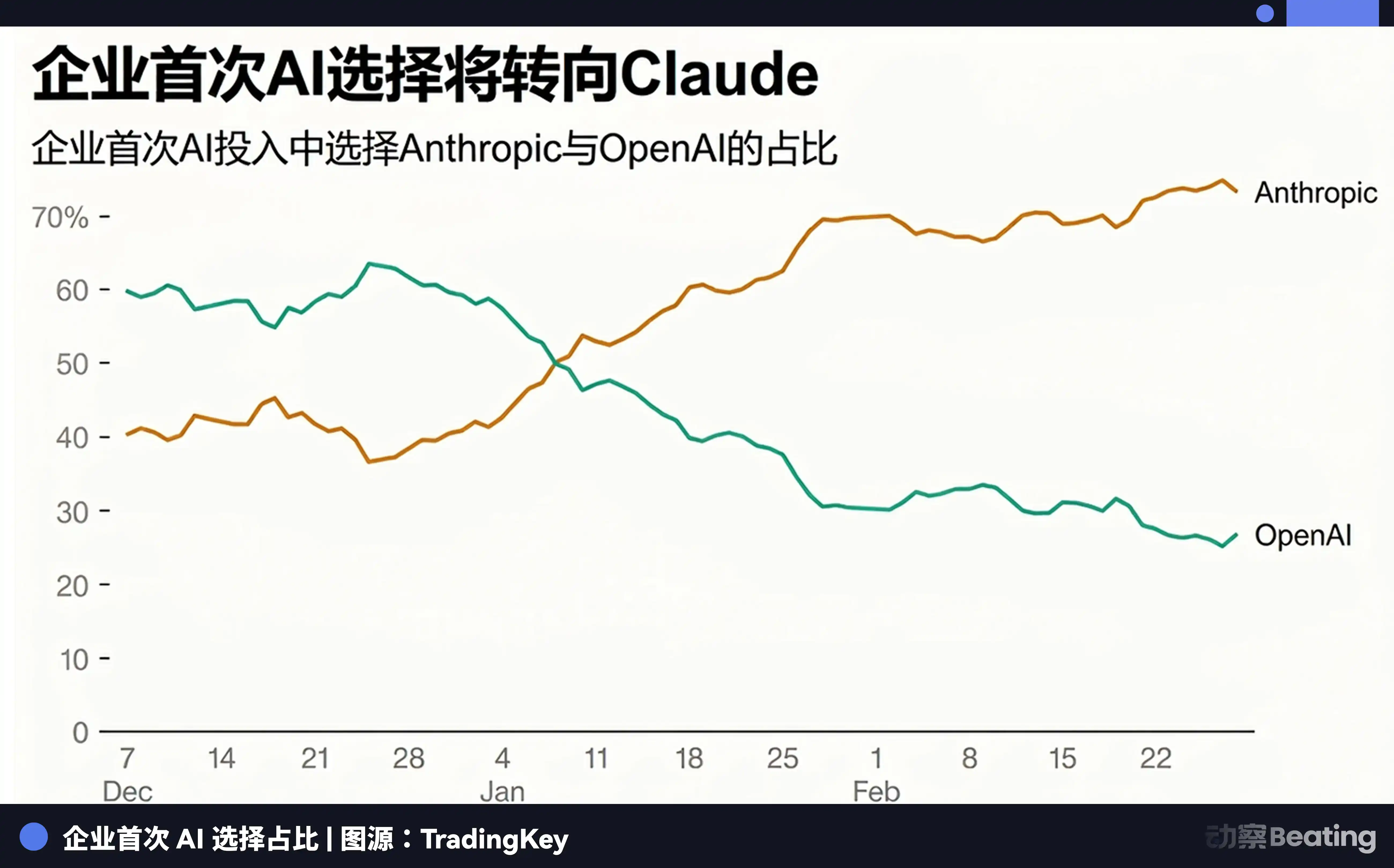
This reversal can be understood this way. OpenAI is building a consumer-facing Disney, charging admission fees based on foot traffic. Anthropic is constructing a toll road leading to enterprises' core systems—tolls are much more expensive than tickets, and once a vehicle is on the road, it's unlikely to switch lanes.

Shortly after Anthropic announced its overtaking, an internal memo written by OpenAI's Chief Revenue Officer Denise Dresser was leaked, accusing Anthropic of inflating revenue by approximately $8 billion using the "gross method."

When customers purchase services through platforms like AWS or Google Cloud, Anthropic records the entire amount paid by the customer as revenue, including the portion that must be shared with the cloud service providers. Excluding this part, Anthropic's true revenue is about $22 billion, not exceeding OpenAI's $25 billion.

The wording of this memo reads more like two former colleagues exposing each other's shortcomings.

Understanding this memo requires context. Anthropic's private market valuation is about $600 billion, a significant premium over its last funding round, while OpenAI's secondary market valuation is around $765 billion, a discount of about 10% from its last round. The former employer is under pressure in the capital markets; releasing this document is both an opponent attack and a move to stabilize its own position.

Then there's that discordant number amid the celebration. Anthropic is not expected to be profitable until 2027. $30 billion in annualized revenue, $380 billion valuation—every funding round breaks records, but profitability is still a distant future. The higher the valuation, the greater the investors' expectations, the faster the burn rate, and the more urgent the next funding round. Anthropic cannot break this cycle actively; it can only maintain it by running fast enough. This is its invisible wall.

And DeepSeek—It Left the Entire Investment Circle Waiting for Three Years

Now, Liang Wenfeng.

After R1 went viral, the entire Chinese investment scene was thrown into chaos. Zhu Xiaohu, who had just said he "didn't看好创业公司做大模型" (didn't看好 startup companies doing large models), publicly stated that the price wasn't too important anymore; the key was to be involved. Tencent executives went, Alibaba executives went, VCs took turns visiting.

Rumors emerged: Alibaba investing $1 billion, a Series C raising $700 million—one after another, one after another denied.

Liang Wenfeng left the entire investment circle waiting outside the door for three years.

His reason was one sentence: "No short-term financing plans. The problem we face has never been money, but the embargo on high-end chips."

幻方量化 (Huanfang Quant) invested 3 billion RMB in the first phase of DeepSeek's R&D, entirely supported by the profits from quantitative私募 (private equity). He really doesn't lack money; he lacks chips, and financing can't solve the chip problem.

As for why he doesn't accept investment, he has another concern: external investors coming in might interfere with company decisions.

Liang Wenfeng, reading his background, gives a sense of consistency. Born in 1985 in Zhanjiang, Guangdong, graduated from Zhejiang University's School of Information and Electronic Engineering, didn't look for a job after graduation and directly went into quantitative investment, founded 幻方量化 in 2015, self-invested nearly 200 million RMB in 2019 to build the computing cluster "Yinghuo一号" (Firefly One) equipped with 1,100 GPUs.
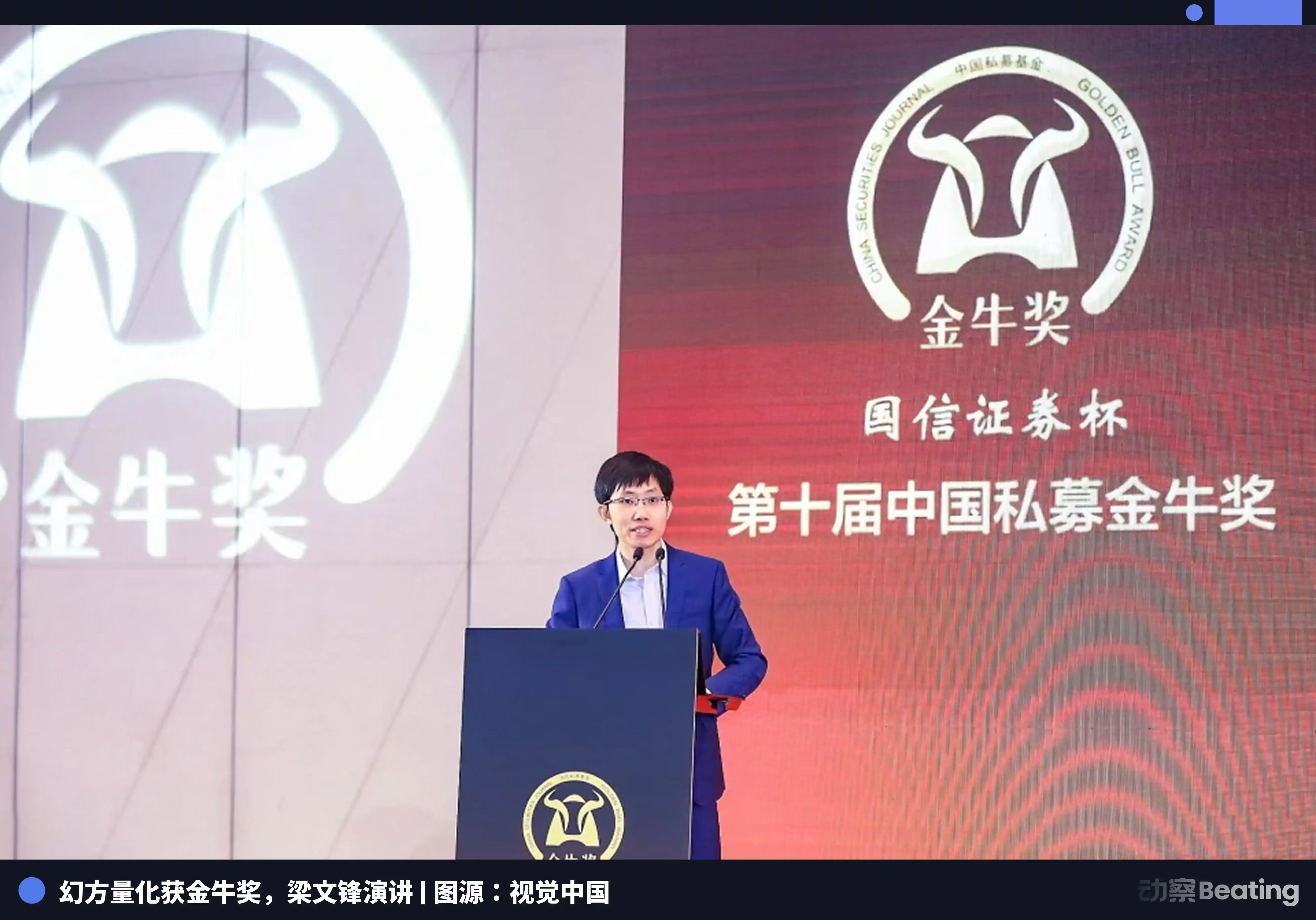
As soon as the A100 was launched, he抢在众多企业前面 (raced ahead of many companies), becoming one of the first in the Asia-Pacific region to get the chips. In 2021, he invested another 1 billion RMB to build "Yinghuo二号" (Firefly Two), equipped with about 10,000 A100s. In 2023, he shifted computing power to large models and founded DeepSeek.

Everything he does has an engineer's forward-thinking: prepare the tools first, then get to work. Refusing financing is one of his tools.

But now, this tool is beginning to fail.

DeepSeek's absolute salary is not low, but it cannot match the equity incentives and valuation premiums of market giants like ByteDance, Alibaba, and Tencent. Liang Wenfeng has already begun推进公司估值工作 (pushing forward company valuation work), clarifying option pricing to give the team more certainty.

Without external financing, there is no market valuation, and thus no option value. For a top engineer, working at DeepSeek means you might be changing the world, but you can't produce an equity certificate that calculates wealth.

In January 2026,智谱 (Zhipu) rang the bell on the Hong Kong Stock Exchange, MiniMax followed closely with an IPO. Peers' options are cashing in, and the talent pressure on DeepSeek is becoming increasingly real.

Another issue is being forced out: DeepSeek and幻方's executives are still discussing whether the company should shift from "primarily focused on research" to "building a business that generates substantial revenue and eventually profits." This discussion itself is a crack in the door.

This first funding round targets a valuation of over $10 billion, while the company's valuation in 2025 was about $3.4 billion. If the funding is completed, the valuation will achieve a several-fold leap. $300 million against a $10 billion valuation means a dilution of less than 3%. This number is extremely restrained, like someone feeling the temperature on the doorknob before opening the door, confirming no danger, then gently pushing it open.

Liang Wenfeng used three years of independence to earn himself the strongest negotiating chips. He is opening the door at the moment he is most confident.

Two Civilizations at the AI Table

Putting these two stories together, a hidden line emerges.

Anthropic's Series G investors: Singapore's GIC, Qatar Investment Authority, Blackstone, Goldman Sachs, NVIDIA, Microsoft.

Behind this list lies a complete logic: AI's discourse power should remain in the United States; "safe, trustworthy" AI is the next infrastructure. Every dollar coming in is betting on this judgment.

DeepSeek's first funding round, potential investors include Alibaba, state-owned funds, and other leading domestic institutions. This is the first time Chinese capital is publicly pricing a top AI research institution. Betting on another logic: technological autonomy, open-source ecosystem, domestic computing power.

Two lists, placed on the same table, represent two civilizations各自押注 (each placing their bets).

Closed-source and open-source are also choices between two power structures in this博弈 (game).

Anthropic is全程闭源 (fully closed-source), relying on enterprise trust premium. Monthly active users can generate $211 in revenue. What it sells, besides model capability, is a sense of assurance endorsed by experts—you don't need to understand it, just trust it.

Liang Wenfeng says open-source is "more of a cultural act than a commercial one; contributing to open-source will earn us respect." The former concentrates the definition of "what is good AI" in the hands of a few; the latter hands it over to global developers for discussion.

These are two political propositions about the future of AI.

But both companies actually face the same question: when you grow large enough, how do you prove you're worth that price?

Anthropic's answer is revenue growth and enterprise clients, but profitability won't come until 2027, and the former employer is constantly nitpicking on the side. DeepSeek's answer is still forming.

Epilogue

This race has no referee yet.

Anthropic's valuation冲向万亿 (rushes towards a trillion), profitability probably waiting until 2027. How long are the world's most shrewd sovereign wealth funds and top investment banks willing to wait? AI's history is short enough that no one has seen how a company of this scale soft-lands, nor how it crashes hard. Everyone is groping in the dark,只是摸索的姿势各不相同 (just the postures of groping vary).

DeepSeek's problem is the cost of choice. After financing, external shareholders come in. How long can the independence Liang Wenfeng has一直守护 (always guarded) last? Once the door is opened, no founder in the world can fully control what comes in after it's opened.

Dario Amodei positions himself as "an explorer寻找第三条路 (finding a third path) between the narrow roads加速通往天堂和坠入地狱 (accelerating towards heaven and falling into hell)." People around Liang Wenfeng say AGI is his ultimate goal; money and commercialization are not high priorities.

Two people, each believing they are doing something more important than financing.

The capital market doesn't believe in faith; it only believes in profit statements.

Three years from now, or five years, when we come back to翻这张账单 (flip through this bill): Did the company whose valuation once rushed towards a trillion prove it was worth that price? Did the company that used three years of independence to earn respect, then decided to take the first step,守住它的初衷 (guard its original intention)?

Both paths are not yet finished.
Трендові криптовалюти

Пов'язані питання

QWhat was the implied valuation of Anthropic on secondary markets in April 2026, and how did it compare to OpenAI?

AAnthropic's implied valuation on secondary markets briefly exceeded $1 trillion in April 2026, surpassing OpenAI's valuation at that time.

QWhat was the core product driving Anthropic's rapid growth in enterprise AI adoption in early 2026?

AClaude Code was the core product driving Anthropic's growth, with annualized revenue exceeding $2.5 billion and a quadrupling of enterprise subscription users since early 2026.

QWhy did DeepSeek refuse external funding for three years, and what changed in 2026?

ADeepSeek refused external funding for three years due to a lack of need for capital (relying on profits from its parent company, Jinhuan Quant) and concerns about investor interference. In 2026, it planned its first external round to address talent retention challenges and provide liquidity through equity valuation.

QHow did OpenAI respond to Anthropic's reported revenue surge, and what methodological critique did they raise?

AOpenAI's Chief Revenue Officer leaked an internal memo accusing Anthropic of using 'gross accounting' to inflate revenue by approximately $8 billion, claiming Anthropic counted platform fees paid to cloud providers as revenue, thereby overstating its actual performance.

QWhat broader ideological contrast does the article highlight between Anthropic's and DeepSeek's approaches to AI development?

AThe article contrasts Anthropic's closed-source, enterprise-trust model (focused on centralized control and safety) with DeepSeek's open-source, community-driven philosophy (emphasizing transparency and global collaboration), representing different visions for AI's future governance and accessibility.

Пов'язані матеріали

After Three Consecutive Quarters of Decline, Can the Crypto Market Find a Window for Stabilization in Q3?

The cryptocurrency market has just concluded its worst-performing quarter since 2022, with total capitalization dropping 12.6% to $2.1 trillion. All core metrics indicate capital is leaving the sector, not just rotating within it. Bitcoin fell 14.2% and Ethereum dropped 25.4% in Q2, breaking their previous correlation with US tech stocks. A key driver is the reversal in US spot Bitcoin ETF flows, which saw a net outflow of approximately $4.67 billion in Q2, including a record monthly outflow near $4.5 billion in June. While recent data suggests long-term holders are accumulating again, sustained ETF outflows mean continued selling pressure. Market focus is now singularly on the Federal Reserve. The upcoming July FOMC meeting is seen as the most critical event for Q3. A dovish signal could support Bitcoin reclaiming a $68,000-$84,000 range, while a hawkish stance might establish a new trading band around $50,000-$56,000. Additionally, regulatory uncertainty persists, with the progress of the crucial *CLARITY Act* stalling in the Senate, reducing its perceived 2026 passage probability to 40-45%. Despite the broad downturn, a few sectors showed growth. Prediction markets saw nominal volume surge 48.7% year-over-year to $113.8 billion, and tokenized collectibles transaction volume rose 143% quarterly to $1.4 billion. The Real-World Asset (RWA) tokenization sector also continued steady growth, now representing ~$28.1 billion in on-chain value. The market's foundation for an extreme crash appears limited, with Bitcoin price hovering near its 200-week moving average. However, the trading paradigm has shifted from narrative-driven speculation to decisions based on price action, policy developments, and interest rate expectations, making a broad sentiment-driven rally unlikely in the near term.

marsbit17 год тому

After Three Consecutive Quarters of Decline, Can the Crypto Market Find a Window for Stabilization in Q3?

marsbit17 год тому

BIT Trading Moment: BTC Still Suppressed by Weekly 200 EMA, Rejection May Restart Decline; Storage and Semiconductors that Surged Last Night Begin Falling in Evening Trading

**Crypto & Stock Market Wrap: Bitcoin Tests Resistance, Stocks Retreat After AI Surge** Bitcoin consolidates around $66,000, facing key resistance near $68,000—an area seen as a major psychological and technical hurdle where previous rallies have failed. Analysts note the cryptocurrency is caught between its 200-week moving average (~$63,333) and 200-week EMA (~$68,328). A clear break above $68k is needed to signal a stronger bullish trend, while a rejection could lead to a retest of $63k support. Market sentiment remains cautious, with low futures open interest pointing to a low-liquidity rebound rather than a full bull market. Bitcoin spot ETFs saw another $203 million inflow. US stock futures pointed lower after a strong Tuesday session led by a massive rebound in semiconductors and memory stocks. The rally was fueled by renewed optimism about AI-driven hardware demand, with Micron, SanDisk, and SK Hynix surging. However, those gains reversed in pre-market trading. Super Micro Computer (SMCI) soared over 20% after hours on strong guidance and a record backlog. Other standouts included Rocket Lab and nuclear energy plays Oklo and X-Energy. Rising oil prices (Brent above $91) and climbing Treasury yields (10-year near 4.64%), however, are reigniting inflation concerns and acting as a headwind for equities. In Asia, markets were mixed. South Korea's KOSPI pared early gains to close slightly higher as semiconductor stocks like SK Hynix gave back initial surges. Japan's Nikkei edged lower as the yen hit a fresh 38-year low against the dollar, raising fears of potential market intervention. Key events to watch include the Samsung Galaxy launch, AMD's AI event, and a slew of major tech earnings from Alphabet, Tesla, and IBM after the close on Wednesday, followed by the ECB meeting and Intel's earnings on Thursday.

marsbit17 год тому

BIT Trading Moment: BTC Still Suppressed by Weekly 200 EMA, Rejection May Restart Decline; Storage and Semiconductors that Surged Last Night Begin Falling in Evening Trading

marsbit17 год тому

Former CFTC Chairman, Circle President Tarbert: Preaching Long-Termism While Cashing Out $30 Million Himself

Former CFTC Chairman and Circle President Heath Tarbert has consistently advocated for a long-term vision in public, urging patience from investors as Circle’s stock price has fallen significantly from its peak. However, it has been revealed that since Circle’s IPO, Tarbert has continuously sold his CRCL shares through pre-arranged trading plans, cashing out approximately $30 million, without making any public market purchases. This contrast between his public messaging and personal actions has drawn criticism. Tarbert joined Circle in July 2023 as Chief Legal Officer, leveraging his regulatory experience to help guide the company through its IPO and expansion. Despite promoting stablecoins as long-term infrastructure, he established a 10b5-1 trading plan just before Circle went public, leading to substantial stock sales over the following year. In March 2026, he initiated another plan to sell more shares. His career trajectory highlights a pattern of moving between high-level regulatory roles and influential positions in the financial sector. After resigning as CFTC Chairman in early 2021, he joined Citadel Securities as Chief Legal Officer just 27 days later, during a period of intense regulatory scrutiny for the firm. He later joined Circle, aiding its efforts to navigate regulatory challenges for its public listing. While Tarbert's expertise in policy and compliance is valuable to companies like Circle, his actions—advocating long-term confidence while personally divesting—raise questions about the alignment between his public statements and his private financial decisions, leaving investors who followed his advice to bear the market risks.

marsbit18 год тому

Former CFTC Chairman, Circle President Tarbert: Preaching Long-Termism While Cashing Out $30 Million Himself

marsbit18 год тому

Gate Research Institute: The 'Wall Street-ization' Wave of Crypto Financial Products – Competition or Integration?

The article titled "Gate Research Institute: Are Crypto Financial Products Sparking a 'Wall Street' Wave—Competition or Convergence?" explores the evolving relationship between the crypto ecosystem and traditional finance (TradFi). The piece begins by reflecting on Bitcoin's original 2009 vision of decentralization, disintermediation, and moving away from banks. It then contrasts this with the 2024 landscape, where key crypto assets like Bitcoin are increasingly held through Wall Street products like ETFs issued by giants like BlackRock. The article questions whether this signifies that TradFi is systematically taking over the rights to issue, price, custody, and distribute crypto financial assets. The core argument is that this is not a zero-sum takeover but rather a bidirectional convergence where each side addresses the other's weaknesses. Crypto offers 24/7 global markets, programmable settlement, and open access but lacks compliant channels, institutional-grade custody, deep fiat liquidity, and mainstream distribution. TradFi possesses these but is constrained by legacy systems, limited operating hours, and slow settlement. Two primary convergence paths are highlighted: * **Path A (CEX to TradFi):** Exemplified by Gate, which has progressed from offering tokenized stocks and CFDs to providing direct, real stock trading (US, Hong Kong, South Korea) within its platform, using USDT. * **Path B (TradFi to Crypto):** Exemplified by Robinhood, which has integrated crypto trading, acquired exchanges like Bitstamp, and is moving traditional assets like stocks onto the blockchain via tokenization and its own Layer 2. Both paths are ultimately competing to become the next-generation, unified financial account—a "super account" where users can seamlessly trade cryptocurrencies, stocks, ETFs, RWA (Real World Assets), and tokenized treasury products in one interface. The growth of RWA and tokenized treasuries (e.g., BlackRock's BUIDL) is presented as the asset-layer fusion, providing stable, yield-bearing assets on-chain and acting as a bridge between the two worlds. In conclusion, the "Wall Street-ization" of crypto is framed as a mutual transformation. Decentralized ideals persist in the protocol layer, while at the application layer, a more efficient, global, and accessible unified capital market is emerging from this convergence. The future competition lies not between crypto exchanges and stockbrokers, but between platforms vying to offer the most comprehensive asset coverage, liquidity, and user experience within a single account.

marsbit18 год тому

Gate Research Institute: The 'Wall Street-ization' Wave of Crypto Financial Products – Competition or Integration?

marsbit18 год тому

Торгівля

Спот

Популярні статті

Як купити ONE

Ласкаво просимо до HTX.com! Ми зробили покупку Harmony (ONE) простою та зручною. Дотримуйтесь нашої покрокової інструкції, щоб розпочати свою криптовалютну подорож.Крок 1: Створіть обліковий запис на HTXВикористовуйте свою електронну пошту або номер телефону, щоб зареєструвати обліковий запис на HTX безплатно. Пройдіть безпроблемну реєстрацію й отримайте доступ до всіх функцій.ЗареєструватисьКрок 2: Перейдіть до розділу Купити крипту і виберіть спосіб оплатиКредитна/дебетова картка: використовуйте вашу картку Visa або Mastercard, щоб миттєво купити Harmony (ONE).Баланс: використовуйте кошти з балансу вашого рахунку HTX для безперешкодної торгівлі.Треті особи: ми додали популярні способи оплати, такі як Google Pay та Apple Pay, щоб підвищити зручність.P2P: Торгуйте безпосередньо з іншими користувачами на HTX.Позабіржова торгівля (OTC): ми пропонуємо індивідуальні послуги та конкурентні обмінні курси для трейдерів.Крок 3: Зберігайте свої Harmony (ONE)Після придбання Harmony (ONE) збережіть його у своєму обліковому записі на HTX. Крім того, ви можете відправити його в інше місце за допомогою блокчейн-переказу або використовувати його для торгівлі іншими криптовалютами.Крок 4: Торгівля Harmony (ONE)Легко торгуйте Harmony (ONE) на спотовому ринку HTX. Просто увійдіть до свого облікового запису, виберіть торгову пару, укладайте угоди та спостерігайте за ними в режимі реального часу. Ми пропонуємо зручний досвід як для початківців, так і для досвідчених трейдерів.

430 переглядів усьогоОпубліковано 2024.12.12Оновлено 2026.06.02

Як купити ONE

Обговорення

Ласкаво просимо до спільноти HTX. Тут ви можете бути в курсі останніх подій розвитку платформи та отримати доступ до професійної ринкової інформації. Нижче представлені думки користувачів щодо ціни ONE (ONE).

活动图片