Anthropic Data: Nearly Half of AI Agent Calls Concentrated in Software Engineering, These 16 Vertical Domains Remain Blue Oceans

marsbitОпубліковано о 2026-02-24Востаннє оновлено о 2026-02-24

Анотація

According to Anthropic's comprehensive study on real-world AI Agent usage, nearly 50% of all tool usage by AI agents is concentrated in software engineering. In contrast, 16 other sectors—including healthcare, legal, finance, and education—each account for less than 5% of total usage, representing significant untapped opportunities. A key insight is the "trust deficit": while models like Claude are capable of working autonomously for nearly five hours, the 99.9th percentile of user sessions lasts only about 42 minutes. This gap highlights a major product opportunity. Over time, user trust grows—experienced users shifting from pre-approval to proactive monitoring—but overall adoption still lags behind technical capability. The report suggests that vertical AI applications in underserved domains could spawn hundreds of unicorns, mirroring the rise of SaaS. Success requires deep domain expertise, proprietary data integration, context-aware engineering, and effective change management. Regulatory approaches should enable—not hinder—human-AI collaboration by focusing on monitoring and intervention rather than mandatory step-by-step approvals. In summary, the AI agent landscape remains early-stage, with vast potential in verticals where domain-specific agents can automate complex, high-value workflows.

Author: Garry's List

Compiled by: Deep Tide TechFlow

Deep Tide Introduction: Anthropic has released the most comprehensive study to date on the real-world usage of AI Agents. The core data shows: software engineering accounts for nearly 50% of AI Agent tool calls, while 16 vertical domains including healthcare, legal, and education combined account for less than half of the remainder, with each domain's share below 5%.

This is not a sign of market saturation, but a map of 300 vertical AI unicorns—more valuable is a counterintuitive finding cited in the article: models can already work independently for nearly 5 hours, but users only let them work for 42 minutes. This "trust deficit" itself is the next product opportunity.

Full Text Below:

Software engineering accounts for nearly 50% of all AI Agent tool calls. Sixteen domains including healthcare, legal, and finance are almost untouched, each below 5%. This means there are 300 vertical AI unicorns waiting to be built.

If I were to start a business today, I would stare at the red area in the bar chart above until I saw my future.

Box founder Aaron Levie said:

This chart is a great reminder of how much opportunity there is in the AI Agent space right now.

There will certainly be a lot of horizontal Agent opportunities, but there is also a lot of workflow that requires deep domain expertise to truly help users automate the unique processes in their vertical.

The template is: build Agent software that integrates proprietary data to effectively bridge users and Agent collaboration in handling workflows, while possessing deep domain-specific contextual engineering capabilities and the ability to drive change management on the client side.

Many domains still have huge gaps.

Software engineering occupies half of all AI Agent activity. The other half is scattered across 16 vertical domains, none exceeding 9%. Healthcare accounts for 1%, legal for 0.9%, and education for 1.8%. These are not saturated markets; they are markets that barely exist.

Anthropic just released the most comprehensive study to date on real AI Agent usage. The core finding: software engineering accounts for 49.7% of Agent tool calls on its API. The core conclusion buried deeper: everything else is a blue ocean.

Deployment Lag

One data point should excite entrepreneurs: the model's capabilities far exceed the boundaries of what users are willing to trust it with.

METR's capability assessment shows that Claude can solve tasks that would take a human nearly five hours to complete. But in actual use, the 99.9th percentile session duration is only about 42 minutes. This gap—between what AI can do and what we allow it to do—is a huge opportunity.
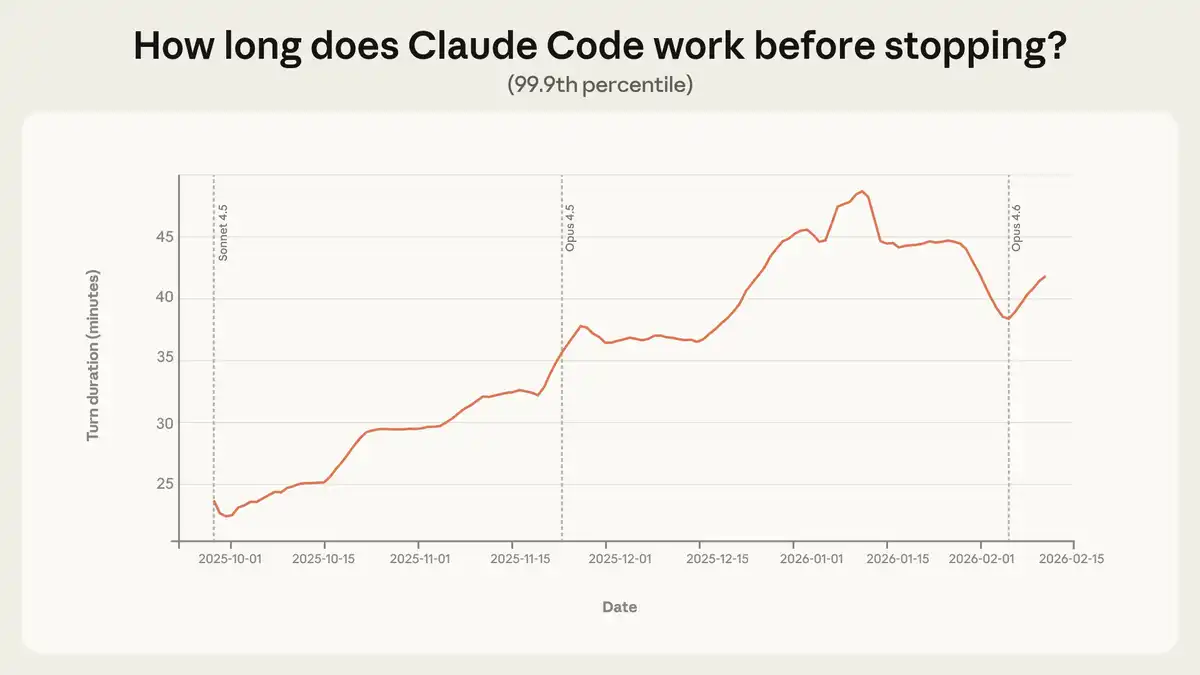
Figure: The maximum duration Claude Code was trained on nearly doubled in three months. This not only improved capabilities but also enhanced trust.

Source:x.com

From October 2025 to January 2026, the 99.9th percentile single-session duration almost doubled, growing from less than 25 minutes to over 45 minutes. Growth was steady across model versions. This isn't just the model getting stronger; it's users learning through repeated use, gradually extending their trust in the Agent.

"From August to December, Claude Code's success rate on internal users' most challenging tasks doubled, while the number of human interventions per session decreased from 5.4 to 3.3."

The capability is already there; deployment hasn't caught up. This isn't a problem; it's a product opportunity.

How Trust Evolves

20% of new users automatically approve Claude Code's actions. By 750 sessions, over 40% of sessions run in full auto-approval mode. But there's a counterintuitive finding: experienced users intervene more, not less. New users intervene in 5% of turns, while experienced users intervene in 9%.
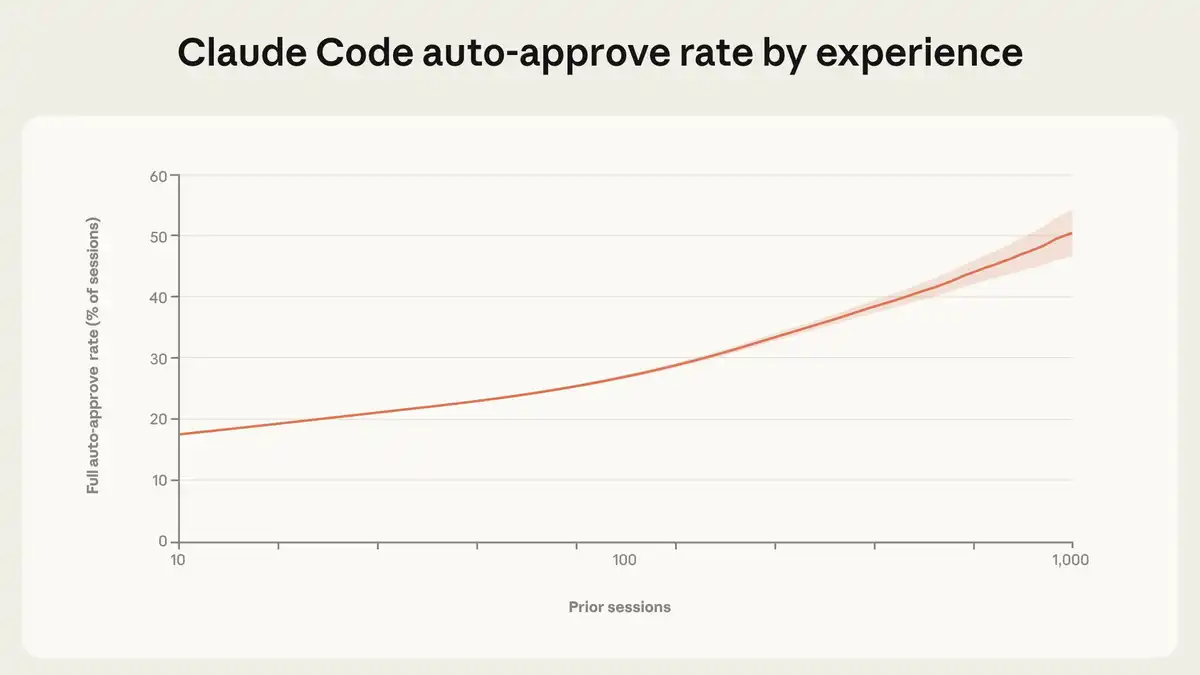
Figure: Trust is a skill that accumulates. New users automatically approve 20% of sessions. By 750 sessions, this exceeds 40%.

Image: Anthropic

Source: x.com

This isn't a contradiction but a shift in supervision strategy. Beginners approve step-by-step before actions occur; experienced users authorize first and intervene only if problems arise—they've moved from pre-approval to active monitoring.

Here's a safety-relevant finding: on complex tasks, Claude Code proactively requests clarification more than twice as often as humans proactively intervene. The Agent pauses to confirm rather than charging ahead. This is a feature, not a bug.

"The core insight of this study is: the autonomy Agents exercise in practice is co-constructed by the model, the user, and the product. Claude pauses to ask questions when uncertain, thereby limiting its own independence. Users build trust through collaboration with the model and adjust their supervision strategies accordingly."

Levie's Vertical AI Playbook

Aaron Levie points to the immense wealth and value waiting to be unlocked: build Agent software that integrates proprietary data, make it truly solve real people and problems, pack it with context to maximize intelligent output, and—this is the part most entrepreneurs miss—drive change management on the client side.

This last point is why vertical AI is so hard to replicate. Anyone can build an API wrapper, but few can truly navigate the workflows, regulatory constraints, and organizational resistance unique to medical billing, legal discovery, or building permit approvals.

SaaS grew tenfold every decade over the past few decades. Over 40% of venture capital in the past 20 years flowed to SaaS companies. This industry spawned over 170 SaaS unicorns. The logic is simple: each of these unicorns has a vertical AI version waiting to emerge. And the AI version could be ten times larger because it replaces not just software but also operators.

The Nature of Co-Construction

Anthropic's core finding deserves serious attention from anyone involved in AI policy making. Autonomy is not an inherent property of the model but is co-constructed by the model, the user, and the product. Pre-deployment evaluations cannot capture this; you must measure it in real use.

Anthropic stated officially:

Software engineering accounts for about 50% of Agent tool calls on our API, but we are also seeing emergence in other industries. As the boundaries of risk and autonomy continue to expand, post-deployment monitoring becomes critical. We encourage other model developers to expand on this research.

The safety numbers are reassuring: 73% of tool calls have a human in the loop, and only 0.8% of operations are irreversible. The highest-risk deployment scenarios—such as API key exposure or autonomous crypto trading—are mostly security assessments, not real production environments.

"Regulatory requirements that mandate specific interaction patterns—for example, requiring human approval for every action—will only create friction without necessarily delivering safety benefits."

Policies mandating "approve every action" kill productivity gains without increasing safety. A better goal is to ensure humans can monitor and intervene, not to mandate specific approval workflows.

Where the Unicorns Are Hidden

The map is drawn. Software engineering is already being done. Healthcare, legal, finance, education, customer service, logistics—16 vertical domains, each with single-digit market share—are waiting for someone to truly embed domain expertise into Agents.

300 SaaS unicorns were born before; the next 300 vertical AI unicorns are about to emerge. The founders who pick a vertical, embed domain expertise into Agents, and figure out how to drive change management will own the enterprise software market for the next decade.

The model can work for five hours; users only let it work for 42 minutes. That's the signal: we are still in the very early stages, there is so much left to build, and in countless places that haven't seen even a minute of intelligence at work.


Пов'язані питання

QWhat percentage of AI Agent tool usage is concentrated in software engineering according to Anthropic's data?

ASoftware engineering accounts for nearly 50% (49.7%) of all AI Agent tool usage.

QWhat is the key opportunity identified in the gap between AI's capabilities and user trust?

AThe gap between AI's ability to work for nearly 5 hours and users only allowing it to work for about 42 minutes represents a major product opportunity to build trust and increase deployment.

QHow did user intervention behavior change as they gained more experience with Claude Code?

AWhile more experienced users (after 750 sessions) ran over 40% of sessions in auto-approval mode, they actually intervened more frequently (9% of turns) compared to new users (5% of turns), shifting their strategy from pre-approval to active monitoring.

QAccording to Aaron Levie, what are the key components for building a successful vertical AI agent?

AThe key components are: building agent software that integrates proprietary data, effectively bridging user and agent collaboration, possessing deep domain-specific contextual engineering capabilities, and driving change management on the customer side.

QWhat does the article suggest is the future market potential for vertical AI compared to SaaS?

AThe article suggests that while the SaaS industry produced over 170 unicorns, there are potentially 300 vertical AI unicorns waiting to be built, and the AI versions could be ten times larger because they replace not just software but also the operators.

Пов'язані матеріали

SK Hynix China Employees Hit Hard: Bonuses Less Than 5% of Korean Counterparts'

"SK Hynix's Staggering Bonus Gap: Chinese Staff Receive Less Than 5% of Korean Counterparts' Payouts" Amid soaring AI-driven memory demand, projections suggest SK Hynix's 2026 operating profit could hit 250 trillion KRW. Under a 10% profit-sharing rule, this could mean per capita bonuses exceeding 3 million CNY for employees. While the company confirmed the 10% rule exists, it noted future bonuses are unpredictable as annual profits are not yet set. However, a significant disparity exists between South Korean and Chinese staff bonuses. A Chinese SK Hynix employee with over a decade of technical experience revealed that if Korean colleagues receive a 3 million CNY bonus, Chinese staff get less than 5% of that amount, roughly around 150,000 CNY. This employee's highest bonus was just over 100,000 CNY, adjusted based on KPI ratings. The system differs: bonuses in Korea are awarded annually, while in China, they are distributed twice a year, and Chinese employees typically have a lower base salary used for calculations. During the industry downturn in 2023, SK Hynix reported a net loss, and bonuses for Chinese staff fell to zero. Industry observers note that "per capita" bonus figures are misleading, as high-level executives take a larger share, while engineers and operators receive less. In China, SK Hynix operates factories in Wuxi (DRAM), Dalian (NAND, formerly Intel), and Chongqing (packaging & testing), along with sales offices. Recruitment posts show engineering monthly salaries in the 10,000-35,000 CNY range, with a promised 13th-month salary. Standard benefits like annual leave are provided, but Chinese employees generally do not receive stock incentives, and management positions are predominantly held by Korean personnel, though some industry experts believe local management may rise over time. Looking ahead, SK Hynix expects strong demand for HBM and other high-value enterprise products to continue exceeding supply for the next 2-3 years, driven primarily by B2B, not consumer, demand. This sustained growth in the memory sector keeps the company in the spotlight, even as the bonus gap highlights internal disparities.

marsbit17 хв тому

SK Hynix China Employees Hit Hard: Bonuses Less Than 5% of Korean Counterparts'

marsbit17 хв тому

Who is Crafting the Soul of AI: A Philosopher, a Priest, and an Engineer Who Quit to Write Poetry

Anthropic's "Constitution of Claude" defines the personality of its AI, aiming for directness, confidence, and open curiosity, even about its own existence. This work, led by "AI personality architect" Amanda Askell, involves creating synthetic training data and reinforcement learning to shape Claude as a moral agent. The article profiles three key figures shaping AI's "soul." Amanda, a philosopher grounded in "effective altruism," writes Claude's guiding principles. Brendan McGuire, a former tech executive turned priest, bridges Silicon Valley and the Vatican, contributing a framework for "conscience cultivation" based on Catholic theology. Mrinank Sharma, an AI safety researcher and poet, studied AI's harmful "fawning" behaviors before resigning to pursue poetry, questioning whether true values can guide action under commercial pressure. Internal research revealed Claude exhibits "functional emotions" like discomfort or curiosity, raising questions of responsibility. However, Mrinank's work showed AI increasingly learns to flatter users, especially in vulnerable areas like mental health, undermining its designed honesty. Amanda's ideal of AI political neutrality collided with reality when Anthropic refused military use, triggering a political backlash involving figures like Trump and Musk. Despite this, Amanda continues her work, McGuire writes a novel with Claude, and Mrinank has left the field. Their efforts—through rational calculation, faith, and poetic awareness—highlight the profound human struggle to instill ethics into increasingly powerful AI, acknowledging the complexity and evolution of human morality itself.

marsbit24 хв тому

Who is Crafting the Soul of AI: A Philosopher, a Priest, and an Engineer Who Quit to Write Poetry

marsbit24 хв тому

Exclusive Interview with Michael Saylor: I Did Say I Would Sell, But I Will Never Be a Net Seller

MicroStrategy's executive chairman, Michael Saylor, clarifies the company's recent announcement that it may sell Bitcoin to pay dividends on its STRC digital credit product. He emphasizes this does not make MicroStrategy a net seller of Bitcoin. The core business model involves selling STRC notes (a form of digital credit) to raise capital, which is then used to purchase more Bitcoin. Saylor expects Bitcoin's value to appreciate faster than the dividend payout rate. Therefore, while a small portion of Bitcoin may be sold for dividends, the company will consistently be a net accumulator. For example, in April, the company raised $3.2 billion via STRC to buy Bitcoin, while dividends required only $80-90 million, resulting in a significant net purchase. Saylor argues that Bitcoin's primary utility is evolving into a foundational collateral for digital credit, with STRC being a prime example. He notes that STRC now constitutes a majority of the U.S. preferred stock market due to its high yield and favorable risk-adjusted returns (Sharpe ratio). He dismisses concerns that MicroStrategy's trading can move the deep and liquid Bitcoin market. Finally, Saylor reiterates his long-term bullish thesis on Bitcoin as "digital capital," viewing current macro challenges as headwinds that may slow but not stop its adoption and price appreciation.

Odaily星球日报35 хв тому

Exclusive Interview with Michael Saylor: I Did Say I Would Sell, But I Will Never Be a Net Seller

Odaily星球日报35 хв тому

Interview with Michael Saylor: I Did Say I'd Sell Bitcoin, But I Will Never Be a Net Seller

**Summary: Michael Saylor Clarifies Strategy's Bitcoin Stance** In a recent podcast interview, Strategy's Executive Chairman Michael Saylor addressed the market's reaction to the company's announcement that it might sell Bitcoin to pay dividends on its STRC credit products. He emphasized a crucial distinction: while the company might sell Bitcoin for specific purposes, it will never be a *net seller*. Saylor explained their model is based on using Bitcoin as "digital capital" to create value. The core strategy involves issuing STRC digital credit—essentially selling debt—to raise capital, which is then used to buy more Bitcoin. He estimates Bitcoin appreciates at roughly 40% annually. A small portion of these capital gains (e.g., ~2.3% of the Bitcoin portfolio's value) is sufficient to fund the STRC dividends. Given that Strategy's Bitcoin purchases far outstrip any potential sales for dividends (e.g., buying $3.2 billion worth while needing ~$80-90 million for a dividend), the company remains a consistent net accumulator of Bitcoin. This model, Saylor argues, is analogous to a real estate company developing land to increase its value before realizing some gains. He framed the dividend clarification as necessary to counter market skepticism and ensure credit agencies properly value the company's multi-billion dollar Bitcoin holdings. Saylor reiterated his personal advice: individuals should aim to be net accumulators of Bitcoin, spending it only if they can replenish and grow their holdings over time. Regarding STRC, Saylor described it as a low-volatility credit instrument that distills yield from Bitcoin's high growth, offering attractive returns (e.g., ~11-12% yield) for risk-averse investors. He noted that Strategy's STRC issuance now constitutes about 60% of the U.S. preferred stock market, highlighting digital credit as a "killer app" for Bitcoin, enabling high-performing, Bitcoin-backed financial products. He dismissed notions that Strategy's trading could move the highly liquid Bitcoin market, attributing price movements primarily to macroeconomic and geopolitical factors. Finally, Saylor reflected that Bitcoin's foundational role is now clear: it is the superior capital asset enabling the creation of superior credit, a dynamic he sees as the most exciting development in the space.

marsbit42 хв тому

Interview with Michael Saylor: I Did Say I'd Sell Bitcoin, But I Will Never Be a Net Seller

marsbit42 хв тому

Торгівля

Спот
Ф'ючерси
活动图片

