Annual Revenue of Hundreds of Millions, Aggressive Buybacks: Why is Pump.fun Still Being 'Shorted' by the Market?

marsbitОпубліковано о 2026-03-19Востаннє оновлено о 2026-03-19

Анотація

Despite circulating rumors, on-chain evidence and multiple independent data sources (DeFiLlama, Dune, and verifiable wallet transactions) confirm that Pump.fun's revenue and aggressive buyback program are legitimate. Over eight months, 99.5% of daily protocol revenue—totaling $328 million—was used to repurchase and burn 105.1 billion PUMP tokens, offsetting 29.52% of the circulating supply. Statistical analyses of the 747-day revenue data further validate its authenticity, showing expected patterns like weekend effects, autocorrelation, and structural breaks aligned with product updates. However, PUMP's valuation remains suppressed due to three key factors: its classification as a "sin stock" (98.6% of tokens launched on the platform are alleged scam "rug pulls"), trust issues (anonymous founders, discretionary buyback policy, and historical controversies), and insider selling pressure (notable wallets dumping tokens at market prices despite the buyback). While community token emissions will stop in July 2026—reducing monthly inflation from 10 billion to 9.2 billion tokens—current buybacks already absorb twice the new supply. The trust discount, rather than fundamentals, explains the undervaluation of a protocol generating $1.25 million in daily verifiable revenue.

Original Author: Four Pillars

Original Compilation: AididiaoJP, Foresight News

Key Points

Completed a $328 million buyback in eight months using 99.5% of daily protocol revenue. Two independent data aggregators, despite not being interconnected, reached the same conclusion. To manipulate the data, one would need to simultaneously deceive DeFiLlama, maintain a stable 68-69% ratio with Adam_tech's Dune data (which only indexes Solana), and have 105.17 billion PUMP tokens in verifiable wallets as support.

The "dilution curve" in August 2026 is actually a supply replacement rather than an addition. At current revenue levels, the buyback can absorb twice the new supply. Community emissions will cease when team and investor unlocks begin. Monthly emissions will drop from 10 billion tokens to 9.2 billion tokens.

The real reasons for the current suppressed valuation multiples are: industry classification (the nature of "original sin stocks"), trust foundation (anonymous team, discretionary buybacks), and capital flow (insiders allegedly using buybacks to sell).

1. Proof of the $328 Million Buyback

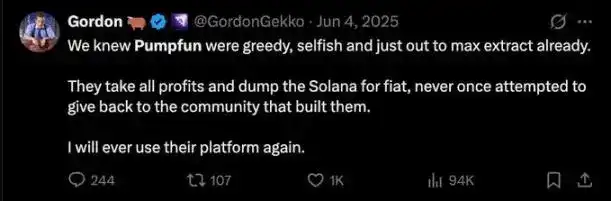
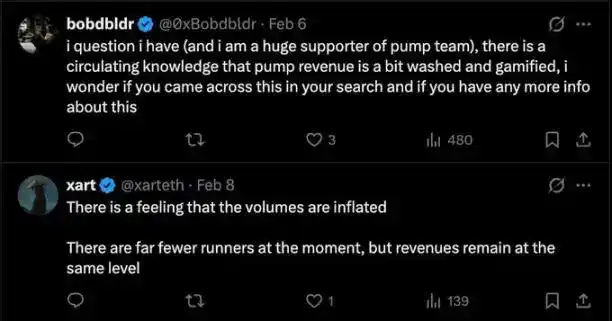
Rumors of Pump.fun's fabricated revenue have been circulating on Twitter. The following analysis shows these rumors are false.
As of March 15, 2026, data from fees.pump.fun shows a cumulative buyback amount of $328 million. This means 2,283,518 SOL was used to purchase 104.5 billion PUMP, accounting for 10.45% of the total supply and offsetting 29.52% of the circulating supply. Over eight months, the daily buyback amount remained between 99.5% and 100.5% of protocol revenue, averaging $1.25 million per day as of February 2026. Fabricating revenue would require massive capital support: for every dollar bought back, one dollar of SOL flows out from a verifiable wallet to purchase tokens stored in an auditable address. To fake $328 million in revenue, one would need to actually spend $328 million.

The relevant tokens are stored on-chain and can be verified (as of March 17, wallet G8CcfRff holds 103.96 billion PUMP, 8PSmqJy6 holds 1.21 billion PUMP, totaling 105.17 billion). The initial execution wallet 3vkpy5Y (marked as "Pump Buy Back" on Solscan) completed transfers to the holding wallets and was rotated in August 2025, now with a zero balance.

DeFiLlama recorded total protocol revenue from July 15, 2025, to February 21, 2026, as $300,041,880. During the same period, the cumulative buyback amount on fees.pump.fun was $300,178,162. The match is 100.05%, with only a $136,000 difference between two independent systems on a total of $300 million.

Adam_tech's Dune dashboard provides a third layer of verification. This platform only tracks Solana chain revenue, consistently representing 68-69% of DeFiLlama's multi-chain data, as it does not index Padre revenue launched on Base, Ethereum, and BNB Chain in October 2025. This ratio remains stable daily, indicating both are independently reading the same on-chain events.
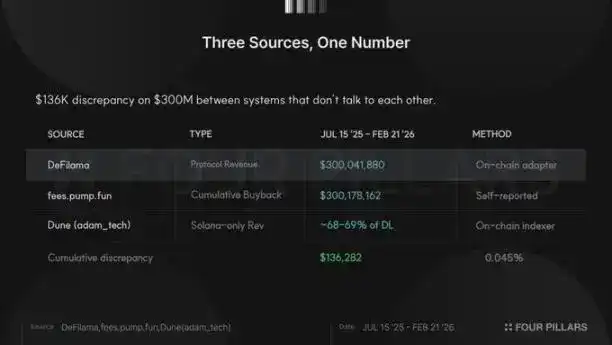
Before the launch of PumpSwap in March 2025, the error margin between the three data sources was within 1-5%. After PumpSwap launched, the data differentiated into three layers: total fees, protocol revenue, and Solana-only revenue. If someone were to fabricate revenue data, they would need to simultaneously deceive two independent on-chain indexers, maintain stable cross-correlation ratios through three product changes, keep a multi-chain revenue split ratio consistent with actual business expansion, and support it with token purchases in verifiable wallets.

2. Four Statistical Tests

In addition to on-chain evidence, 747 days of fee data can be subjected to four standard tests to verify the authenticity of the financial data. While a single test is not conclusive, when four tests point to the same conclusion, credibility increases significantly.

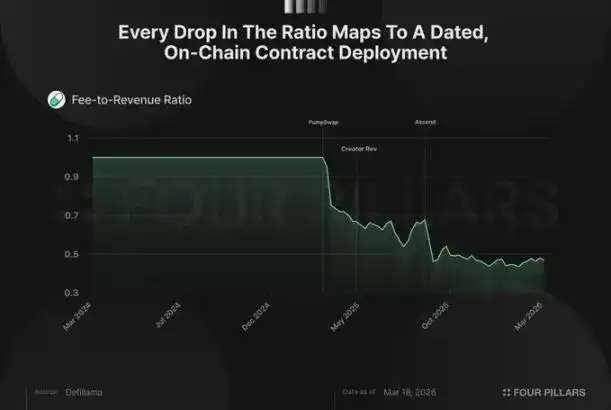
The first test is the fee-to-revenue ratio, the hardest indicator to fake. Pump.fun collects fees from each bonding curve transaction, but not all count as protocol revenue; some go to LPs, creators, and referral rewards. In the dataset, the total fee to net revenue ratio dropped from 1.0 to about 0.48, but not gradually. It dropped sharply in three stages, each corresponding to a documented on-chain product change:

  • March 20, 2025: PumpSwap launched with an LP fee split mechanism, ratio dropped from 1.00 to 0.70 in two days.
  • May 13, 2025: Creator revenue sharing mechanism launched, ratio dropped from 0.69 to 0.56.
  • September 2-3, 2025: The Ascend project introduced a dynamic fee mechanism, layered pricing allowing creators to get up to 0.95% fees on low-market-cap tokens, with the protocol keeping only 0.05%, ratio dropped from 0.68 to 0.46.

Faking this data would require simulating fee and revenue series undergoing three structural adjustments simultaneously, with the daily ratio fluctuating between 0.40 and 0.55 based on token tier composition. This complexity makes fabrication difficult. The reality is that product iterations naturally caused the changes, not artificial construction aligning with contract deployment times.
The second test examines continuity and digit distribution, aiming to determine if the data shows signs of manual entry. Humans struggle to generate truly random sequences, tend to avoid long streaks, prefer integers, and have unconscious biases toward specific digits. Pump.fun data lacks these characteristics:

The longest consecutive rise or fall is 6 days, with an average streak length of 1.92 days, consistent with expectations for a natural process with moderate momentum. Streak length decreases geometrically: 185 one-day streaks, 111 two-day streaks, 52 three-day streaks, down to 7 six-day streaks.

The last digit of daily fees is nearly uniformly distributed between 0-9, with each digit accounting for 8.7%-11.2%. 88.8% of days do not end with an integer; only 7 out of 743 non-zero days end with 00 or 000.
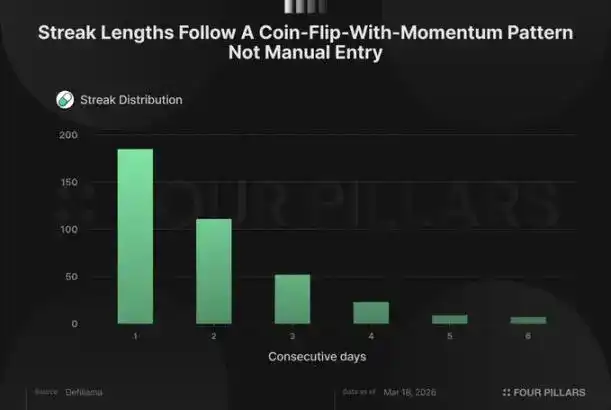
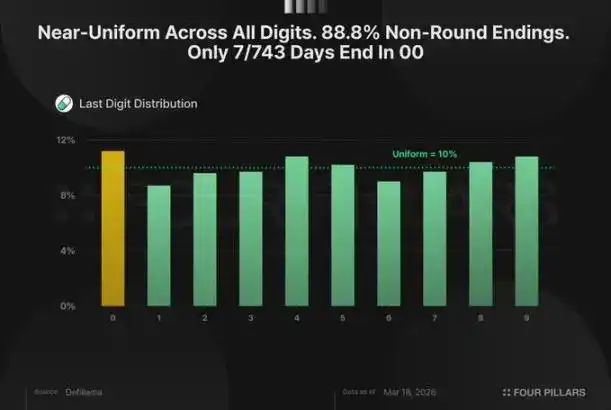
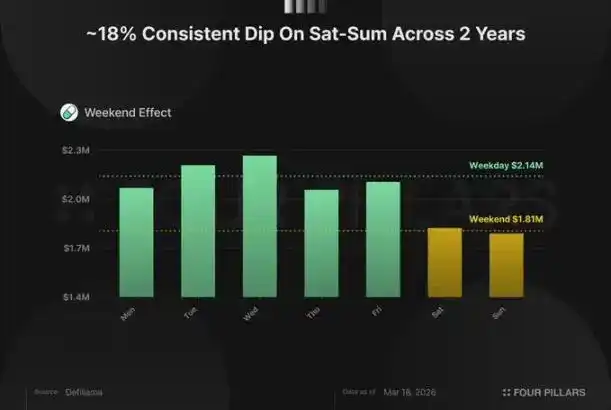
The third test examines the weekend effect. Pump.fun is a retail platform; users issue tokens more on weekdays than weekends. Average daily fees are $2.14 million on weekdays and $1.81 million on weekends, a consistent ~18% drop, appearing week after week in the two-year data. A Mann-Whitney test shows a p-value of 0.003, statistically significant. If data were fabricated, one would need to deliberately keep weekends consistently lower, increasing the complexity and risk of detection.
The final test examines autocorrelation, measuring the relationship between today's revenue and tomorrow's. Pump.fun's first-order lag autocorrelation is 0.78, meaning today's fees are 78% correlated with yesterday's; it remains 0.65 after one week (lag 7 days); and 0.57 after two weeks (lag 14 days). This slow, smooth decay reflects the momentum characteristic of organic platform activity: active periods cluster, and downturns persist. If daily revenue were generated randomly, correlation between adjacent days would be near zero, and the data would jump like noise rather than flow like a market. Faking high autocorrelation for a single lag is not difficult, but faking the entire decay structure (monotonically decreasing step by step for each lag), while maintaining the weekend effect, streak characteristics, and realistic digit distribution, is nearly impossible.
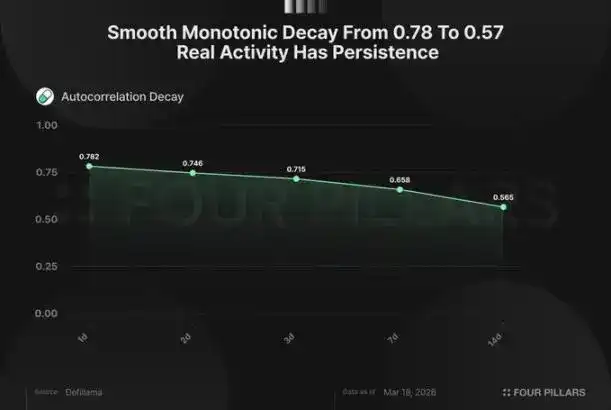
Four independent tests, four consistent conclusions, three data sources corroborating each other. The revenue data is authentic and reliable.

3. Analysis of Remaining Valuation Discount Factors

Rumors of fabricated revenue are one reason for PUMP's current suppressed valuation. The previous analysis has clarified this. But the token still trades at a discount; other suppressing factors and their validity need exploration.

First, analyze the August team unlock. Community emissions are 10 billion tokens monthly, will reach 240 billion tokens by July and then stop, coinciding with the start of team and investor unlocks, totaling 9.2 billion tokens monthly. Monthly emissions will drop from 10 billion to 9.2 billion tokens, an 8% decrease in inflation rate. At the current average daily revenue of $1.25 million, the monthly average buyback is $38 million. At a price of $0.0021 per token, this can absorb about twice the $19 million worth of new monthly supply. After August, emissions decrease while buybacks continue, further improving this ratio.

Revenue shows no sign of decline either. Over fourteen months, monthly average fees fluctuated between $2.3 million and $4.8 million daily: down 49% in July 2025, rebounded 94% in August, surged 72% in September, and jumped 45% in January 2026. Overall, it mean-reverts around a daily average of $2.5-3 million, with weekly trading volume stable at $640-700 million. The so-called "Q3 to Q1 decline" is a one-sided conclusion drawn by selectively picking September peak data.

The remaining suppressing factors are as follows:

The "original sin stock" discount is the most persistent. Solidus Labs found that 98.6% of tokens on the platform have "rug pull" characteristics. This finding had the intended effect: regardless of revenue, institutional allocators will not include a "meme coin casino" in their portfolios. This is a persistent structural factor, completely unrelated to revenue quality.
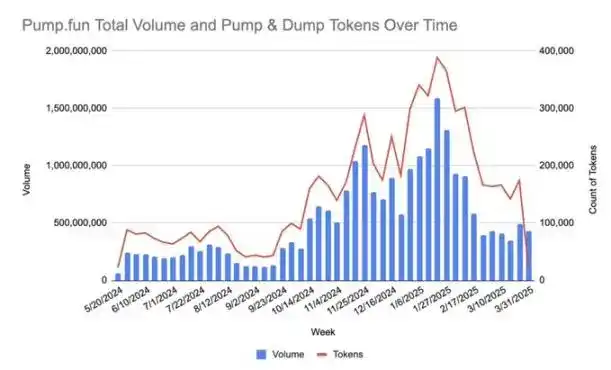
Source: Solidus Labs
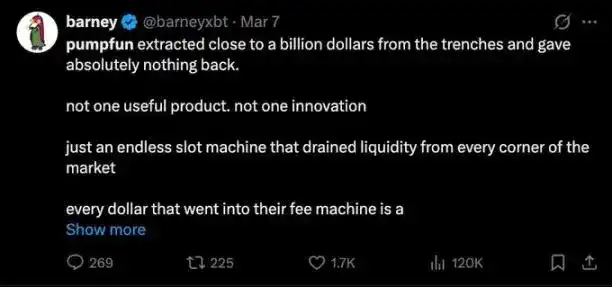
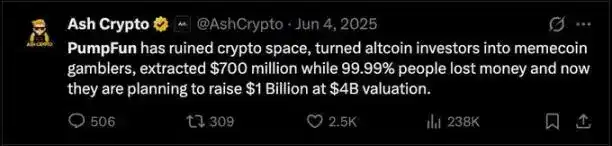
Alleged insider selling constitutes tangible recent pressure. Wallet 77DsB received 3.75 billion PUMP in July 2025 from an address marked "Token Custody Wallet" on Solscan, allegedly liquidated its position for 8.02 million USDC between February 16 and 22, 2026. Wallet GpCfm transferred 1.21 billion PUMP ($2.57 million) to Bitget during the same period. A third wallet deposited 1.757 billion PUMP ($3.54 million) into Bitget on March 6. Although no source confirms actual ownership, at least $14 million flowed to exchanges at a market price of $0.002 within thirty days while the protocol was buying back, compared to a private round price of $0.004. This situation raises questions, regardless of the wallet owners' identities.

The trust aspect is the hardest to price. The founders are anonymous (co-founder Dylan has a "rug pull" record from 2017); buybacks are explicitly "discretionary" ("pump.fun may modify or中止 the plan at any time"); Bubblemaps once alleged Hayden Davis was associated with a $50 million private placement, but later deleted the claim after co-founder Alon called it "defamation." On-chain associations exist, but attribution is disputed and unverified.

None of these factors relate to business fundamentals. The revenue is real, supported by data, and the unlock arrangement is favorable to holders. The "original sin stock" label, anonymous founders, and insider fund flows are all trust discounts applied to a protocol with $1.25 million in daily verifiable on-chain revenue, whose buybacks can absorb twice the new supply. The trust discount will eventually narrow; revenue of this scale will not be mispriced forever.


Пов'язані питання

QWhat evidence supports the claim that Pump.fun's $328 million in buybacks and revenue are real and not fabricated?

AMultiple independent data sources (DeFiLlama, fees.pump.fun, and Adam_tech's Dune dashboard) align, showing a 100.05% match on $300 million in total revenue and buybacks. The buybacks are verifiable on-chain, with 105.17 billion PUMP tokens held in public wallets. The data also passes statistical tests for authenticity, including fee-to-revenue ratio changes corresponding to product updates, natural number distribution, a consistent weekend effect, and realistic autocorrelation patterns, making a coordinated fraud across all these metrics highly improbable.

QHow does the upcoming 'dilution curve' in August 2026 affect PUMP token supply and inflation?

AThe community emissions of 10 billion tokens per month will cease upon the start of team and investor token unlocks in August 2026. The new combined monthly issuance from unlocks will be 9.2 billion tokens. This represents an 8% reduction in the monthly inflation rate, from 10 billion to 9.2 billion tokens. Furthermore, at current revenue levels, the protocol's buybacks are sufficient to absorb twice the amount of new supply being created.

QWhat are the key factors cited as the real reasons for PUMP's discounted valuation, despite its high revenue?

AThe three main factors suppressing PUMP valuation are: 1. The 'sin stock' discount, as the platform is associated with meme coins and rug pulls, deterring institutional investment. 2. Trust issues stemming from an anonymous founding team, a discretionary buyback policy that can be changed, and past controversies. 3. Insider selling pressure, with significant amounts of tokens from early wallets being sold on exchanges concurrently with the protocol's buyback program.

QWhat statistical tests were performed on the revenue data, and what did they conclude?

AFour statistical tests were performed: 1. Fee-to-Revenue Ratio Test: Showed structural breaks that perfectly matched three specific product updates, a pattern too complex to fake. 2. Continuity and Digit Distribution Test: Found natural sequences and a near-uniform distribution of ending digits, lacking human manipulation patterns. 3. Weekend Effect Test: Confirmed a statistically significant 18% drop in revenue on weekends, consistent with user behavior. 4. Autocorrelation Test: Revealed a high and smoothly decaying correlation between daily revenues, indicating organic market momentum. All tests concluded the data is authentic.

QHow does the protocol's current buyback capacity compare to the new token supply being emitted?

AAt the daily revenue rate of $1.25 million, the protocol generates approximately $38 million monthly for buybacks. At the current price of $0.0021 per PUMP, this allows it to buy back roughly 18 billion tokens per month. This buyback power is double the current monthly community emission of 9.2 billion tokens, meaning the buyback absorbs twice the new supply being created. This ratio is expected to improve further after August 2026 when emissions decrease.

Пов'язані матеріали

Borrowing Money from a Hundred Years Later, Building Incomprehensible AI

Tech giants like Alphabet, Amazon, Meta, and Microsoft are undergoing a radical financial transformation due to AI. Their traditional "light-asset, high-free-cash-flow" model is being dismantled by staggering capital expenditures on AI infrastructure—data centers, GPUs, and power. Combined 2026 guidance exceeds $700 billion, a 4.5x increase from 2022, causing free cash flow to plummet (e.g., Amazon's fell 95%). To fund this, they are borrowing unprecedented sums through long-dated, multi-currency bonds (e.g., Alphabet's 100-year bond). The world's most conservative capital—pensions, insurers—is now funding Silicon Valley's most speculative bet. This shift makes these companies resemble heavy-asset industrials (railroads, utilities) rather than software firms, threatening their premium valuations. Historically, such infrastructure booms (railroads, fiber optics) followed a pattern: genuine technology, overbuilding fueled by competitive frenzy, aggressive debt financing, and a crash triggered by financial conditions—not technology failure. The infrastructure remained, but many original builders and financiers did not survive. The core gamble is a "time arbitrage": using cheap debt today to build scale and lock in customers before AI capabilities commoditize. They are betting that AI revenue will materialize before debt comes due. Their positions vary: Amazon is under immediate cash pressure; Meta's path to monetization is unclear; Alphabet has a robust core business buffer; Microsoft has the shortest path from infrastructure to revenue. The contract is set: the most risk-averse global capital has lent its time to Silicon Valley, awaiting a future that is promised but uncertain.

marsbit9 хв тому

Borrowing Money from a Hundred Years Later, Building Incomprehensible AI

marsbit9 хв тому

The 'VVV' Concept Soars 9x in Half a Year, The New AI Narrative on Base Chain

"The article explores the 'VVV' concept as the new AI-focused narrative within the Base ecosystem, centered around the token $VVV of the privacy-focused, uncensored generative AI platform Venice, led by crypto veteran Erik Voorhees. Venice has seen significant growth in 2026, with its API users surging, partly attributed to exposure from OpenClaw. The platform now boasts over 2 million total users and 55,000 paid subscribers. Correspondingly, the $VVV token price has risen over 9x this year. Key to its performance are tokenomics designed for value accrual: reduced annual emissions, subscription revenue used for buyback-and-burn, and a unique staking mechanism. Staking $VVV yields $sVVV, which can be used to mint $DIEM tokens. Each staked $DIEM provides a daily $1 credit for using Venice's API services, creating tangible utility. The article also highlights other tokens associated with the 'VVV' narrative. $POD, the token of distributed AI network Dolphin (which co-developed Venice's default AI model), saw a massive price surge. $cyb3rwr3n, a project for a Venice credit auction market, gained attention due to perceived connections to Venice's team despite official denials. Finally, $SR of robotics platform STRIKEROBOT.AI rose after announcing a partnership with Venice for robot vision-language model development. Overall, the 'VVV' ecosystem combines AI platform growth, deflationary tokenomics, and innovative utility mechanisms, driving significant investor interest and price action in related tokens."

marsbit18 хв тому

The 'VVV' Concept Soars 9x in Half a Year, The New AI Narrative on Base Chain

marsbit18 хв тому

Anthropic and OpenAI Have Single-Handedly Severed the Logic of Pre-IPO Stock Tokenization

The pre-IPO stock token market is experiencing significant turmoil following strong statements from AI giants Anthropic and OpenAI. Both companies have updated their official policies, declaring that any transfer of their company shares—including sales, transfers, or assignments of share interests—without prior board approval is "invalid" and will not be recognized in their corporate records. This means buyers in such unauthorized transactions would not be recognized as shareholders and would have no shareholder rights. A major point of contention is the use of Special Purpose Vehicles (SPVs), which are legal entities commonly used by pre-IPO token platforms to pool investor funds and indirectly acquire shares from employees or early investors. The companies explicitly state they do not permit SPVs to acquire their shares, and any such transfer violates their restrictions. They warn that third parties selling shares through SPVs, direct sales, forward contracts, or stock tokens are likely engaged in fraud or are offering worthless investments due to these transfer limits. This stance directly threatens the core model of many pre-IPO token platforms, which rely on SPV structures. The announcement revealed additional risks within this model, such as complex "SPV-within-SPV" layering that obscures legal transparency, increases management fees, and creates a chain reaction risk of invalidation. Following the news, tokens like ANTHROPIC and OPENAI on platforms like PreStocks fell sharply (over 20%). The market reaction highlights a divergence: while asset-backed pre-IPO tokens plummeted, purely speculative pre-IPO futures contracts, which are bilateral bets on future IPO prices with no claim to actual shares, remained relatively stable as they are unaffected by the transfer restrictions. The industry is split on the implications. Some believe the fundamental logic of pre-IPO token trading is broken if leading companies reject SPV-held shares, potentially causing a domino effect. Others, like Rivet founder Nick Abouzeid, argue that buyers of such unofficial tokens always knowingly accepted the risk of non-recognition by the company. The statements serve as a stark risk warning and a corrective measure for a market where valuations for some AI-related pre-IPO tokens had soared to irrational levels, far exceeding recent funding round valuations.

marsbit1 год тому

Anthropic and OpenAI Have Single-Handedly Severed the Logic of Pre-IPO Stock Tokenization

marsbit1 год тому

Anthropic and OpenAI Personally Sever the Logic of Pre-IPO Crypto-Stocks

The pre-IPO token market has been rocked by strong statements from Anthropic and OpenAI. Both AI giants have updated official warnings, declaring that any sale or transfer of their company shares without explicit board approval is "invalid" and will not be recognized on their corporate records. This directly targets Special Purpose Vehicles (SPVs), the common legal structure used by pre-IPO token platforms. These platforms typically use an SPV to acquire shares from employees or early investors, then issue blockchain-based tokens representing a claim on the SPV's economic benefits. Anthropic and OpenAI's position means that if an SPV's share purchase lacked authorization, the underlying asset could be deemed worthless, nullifying the token's value. Anthropic explicitly warned that any third party selling its shares—via direct sales, forwards, or tokens—is likely fraudulent or offering a valueless investment. The crackdown highlights risks in the popular SPV model, including complex multi-layered "Russian doll" SPV structures that obscure legal ownership, add fees, and concentrate risk. If one layer is invalidated, the entire chain could collapse. Following the announcements, tokens like ANTHROPIC and OPENAI on platforms like PreStocks fell sharply (over 20%). In contrast, purely speculative pre-IPO prediction contracts remained stable, as they involve no actual share ownership. The move is seen as a corrective measure amid a market frenzy where some pre-IPO token valuations (e.g., Anthropic's token hitting a $1.4 trillion implied valuation) far exceeded recent official funding rounds. Opinions are split: some believe this undermines the core logic of pre-IPO token trading if top companies reject SPVs, while others argue buyers always assumed this legal risk when accessing unofficial channels. The statements serve as a stark warning and a potential catalyst for market de-leveraging and clearer boundaries.

Odaily星球日报1 год тому

Anthropic and OpenAI Personally Sever the Logic of Pre-IPO Crypto-Stocks

Odaily星球日报1 год тому

The Waged Worker Driven to Poverty by AI Subscriptions

"AI Membership: The Hidden Cost Pushing Workers Toward 'Poverty'" The widespread corporate push for AI adoption is creating a hidden financial burden for employees. Companies, from giants like Alibaba to small firms, are mandating AI use, often tying token consumption to KPIs, but frequently refuse to cover the costs. Workers are forced to pay for subscriptions out of pocket to stay competitive and avoid being replaced. Front-end developer Long Shen spends up to 2000 RMB monthly on tools like Cursor and ChatGPT Plus, seeing it as a necessary 3% salary investment to handle 90% of his coding tasks. While it boosted his performance and led to promotions, he now faces idle time at work, pretending to be busy. Designer Peng Peng navigates strict company firewalls by using personal devices and accounts for AI image generation tools like Midjourney, spending hundreds monthly without reimbursement, while her boss demands faster, more numerous revisions. The pressure creates workplace anxiety and suspicion. Programmer Li Huahua, after a friend's experience of raised KPIs following AI success, fears being branded a "traitor" for using it yet worries about falling behind if she doesn't. The dynamic allows management to demand results without understanding the tools or covering expenses, treating employees like AI "agents." While some, like entrepreneur Jin Tu, find high value in paid AI, building entire systems and winning competitions, for most, it's a trap. Free tools like Kimi and Doubao are introducing fees, closing off alternatives. The initial efficiency gains individual advantage, but as AI becomes ubiquitous, the personal edge disappears, workloads increase, and a cycle of dependency begins. Workers like Long Shen realize they cannot maintain AI-generated code without AI, making stopping harder than continuing to pay. The tool promising liberation is instead becoming a compulsory, costly chain in the modern workplace.

marsbit2 год тому

The Waged Worker Driven to Poverty by AI Subscriptions

marsbit2 год тому

Торгівля

Спот
Ф'ючерси
活动图片