Andrew Kang: Abandon Short-Termism, Embrace Exponential Growth

marsbitОпубліковано о 2026-02-12Востаннє оновлено о 2026-02-12

Анотація

Andrew Kang, founder of Mechanism Capital, argues that we are at a profoundly unique asymmetric moment in history, requiring a shift away from short-term thinking toward a long-term, exponential growth mindset. Having witnessed multiple market cycles, many investors become overly cautious during rapid price increases. However, Kang emphasizes that concerns about bubbles or attempts at market timing are misguided in the current environment. We are nearing a technological "singularity," driven by breakthroughs in AI, robotics, energy, and other innovative fields. In the coming decade, advancements such as billions of AI agents, humanoid robots, space data centers, multi-planetary colonization, and revolutionary medical therapies will compress more progress into twenty years than all of prior human history combined. Companies leveraging AI are already experiencing order-of-magnitude improvements in productivity. For instance, Anthropic now has Claude writing 100% of its product code. Traditional valuation models fail to capture the potential scale of growth, which could represent a 20-sigma event in terms of economic expansion. Wealth creation will accelerate dramatically. Those without exposure to these transformative trends risk being left behind as asset prices surge vertically. While short-term volatility is inevitable, Kang advises embracing long-term risk exposure rather than attempting to trade short-term fluctuations. The value of the embedded "call option" on the sin...

Original author: Andrew Kang, Founder of Mechanism Capital

Compiled by: Ken, Chaincatcher

For those who have experienced at least one full market cycle, you develop an instinct to be wary of price increases that far exceed historical growth rates. Witnessing the dot-com bubble, the 2008 global financial crisis, and the rise and fall of cryptocurrencies triggers pattern recognition alarms in your brain. You hesitate to enter the market because prices are too high, and you want to sell your holdings for fear of being at a peak.

But it is important to recognize that we are in one of the most profound and unique asymmetric moments in history. The only move now is to lengthen your time horizon and completely abandon short-termism.

Excessive worry about bubbles is foolish. Trying to time the market is also foolish. Short-term fluctuations and pullbacks will always occur, but given how close we are to the "singularity," these fluctuations are merely noise. Artificial intelligence, robotics, energy, and innovation are about to experience runaway explosive growth.

Within the next decade, we will have billions (or more) of AI agent workforces, humanoid robots, space data centers, multi-planetary colonization, and significantly improved medical therapies; we will fundamentally change the speed and output of technological breakthroughs in all fields. The technological progress and economic growth we compress into the next twenty years will exceed the sum total of all human civilization history.

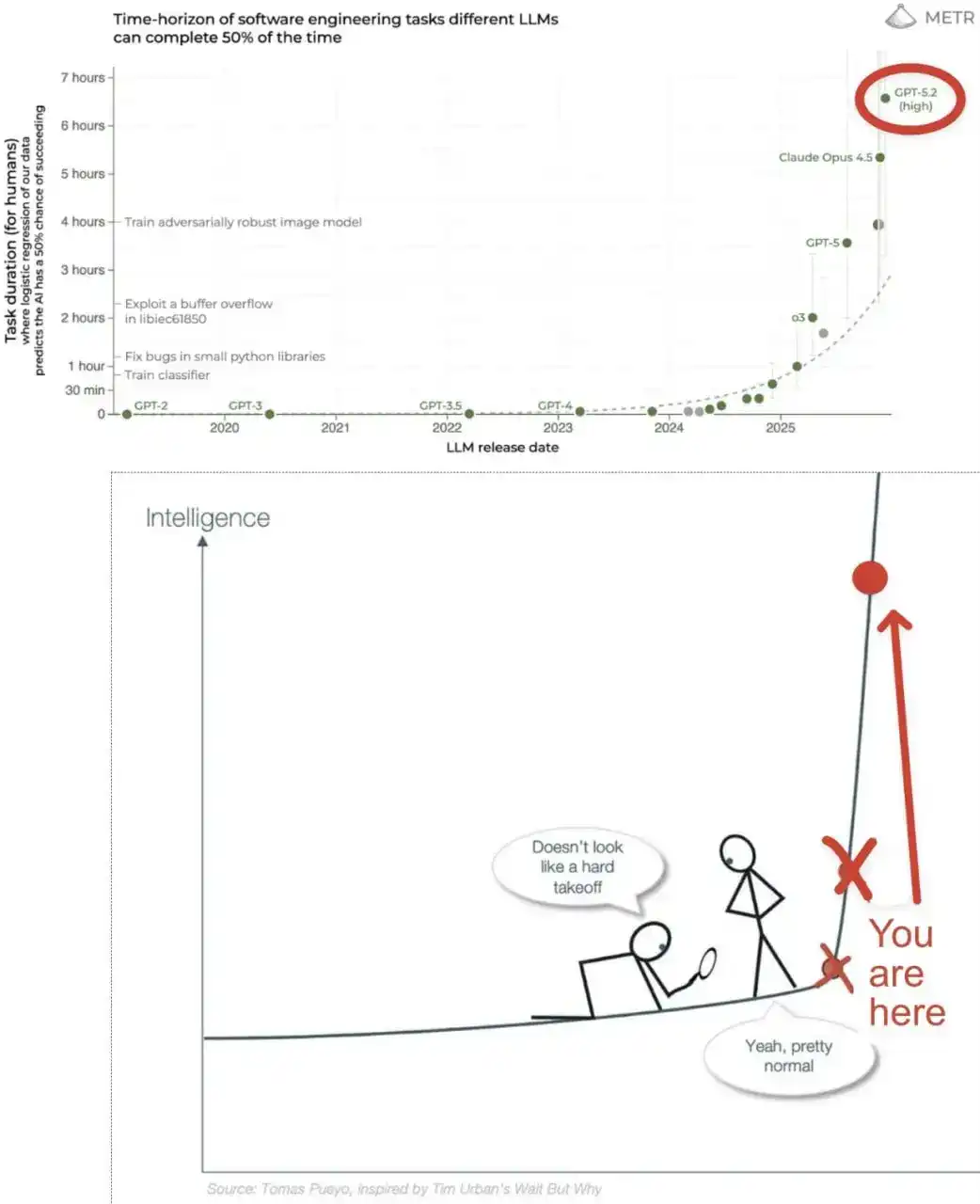
We are already in an extremely steep phase of the J-curve, but this is hard to perceive when we zoom in to the micro level of daily or weekly views. Anthropic now has 100% of its product code written by Claude. Product managers have a virtual team of software engineers so efficient it feels like they can bend time. Companies that effectively utilize AI are seeing product iteration speed improvements not in single digits, not double digits, but triple digits.

Moreover, the capabilities of these tools are still evolving at an accelerating pace. Whether we officially achieve Artificial Superintelligence (ASI) in 2027 or 2029 doesn't really matter. It will happen. By the time it's officially announced, the assets you want to own will have already multiplied in value countless times.

It is highly likely that the actual economic growth over the next 3-10 years will be on the order of 20 standard deviations (20-sigma) in any historical distribution model. This growth, once considered nearly impossible, will be driven by unprecedented second and third-order changes. Traditional valuation models are incapable of pricing these transformations. The potential upside is so vast that traditional present value calculations struggle to capture them.

The rate of wealth appreciation will be staggering, similar to how cryptocurrencies initially created numerous billionaires and millionaires in a short period, but this time the magnitude will be far more extreme. If you have no exposure, it will be difficult to pull the trigger and buy into such vertically rising asset prices; but unlike previous bubbles, the creation of real economic value will better keep pace with the vertical rise in asset prices. Over the past three years, those operating in the market with the cognition of an "exponential horizon" have reaped significant rewards. If you haven't adopted this mindset yet, it's not too late.

While it's important to always be mindful of downside risks, this is the largest upside risk in world history. Learn to bear risk over longer time horizons. Now is not the time for swing trading. For the vast majority of people, long-term investing typically outperforms short-term trading, but the gap in expected value between "trading" and "investing" will be wider than ever before. Ask yourself, what is the value of the call option embedded in the singularity?
Пов'язані питання

QAccording to Andrew Kang, why is it important to abandon short-termism in the current market environment?

ABecause we are at one of the most profound and unique asymmetric moments in history, with unprecedented exponential growth in AI, robotics, energy, and innovation. Short-term volatility is just noise compared to the long-term potential.

QWhat does Andrew Kang predict will happen in the next decade regarding technological progress?

AHe predicts we will have billions of AI agent workforces, humanoid robots, space data centers, multi-planetary colonization, and vastly improved medical therapies, compressing more technological progress and economic growth than the entire history of human civilization.

QHow does Andrew Kang describe the current stage of the J-curve in technological advancement?

AHe describes it as an extremely steep phase of the J-curve, where companies effectively using AI are seeing triple-digit percentage improvements in product iteration speed, though this is hard to notice on a daily or weekly scale.

QWhat does Kang suggest about the relationship between asset prices and the announcement of Artificial Superintelligence (ASI)?

AHe suggests that by the time ASI is officially announced, the prices of assets you would want to own will have already increased exponentially, making early exposure crucial.

QHow does Andrew Kang compare the future wealth creation to the early days of cryptocurrency?

AHe says the speed of wealth creation will be staggering, similar to how cryptocurrency quickly created billionaires and millionaires, but the scale will be far more extreme, with real economic value creation better keeping up with vertical asset price rises.

Пов'язані матеріали

Within Strategy's Framework, STRC's Dividend Yield Remains at 12% as Share Price Stays Below Par Value

Michael Saylor, Executive Chairman of Strategy (MSTR), confirmed that the dividend rate for its STRC perpetual preferred shares will remain at 12.00% through August 2026. The rate has increased from 9% at its July 2025 launch to the current high via a "ratchet" mechanism, which permanently raises the rate by 0.5% whenever the share price falls below $95. This mechanism is intended to push the price back toward its $100 par value and support Strategy's "at-the-market" (ATM) program for issuing new shares to fund Bitcoin purchases. However, the mechanism has not worked as intended. STRC shares closed at $89.46 on July 31, remaining about 10-11% below par value despite the record-high dividend. Competition from rival Strive's higher-yielding SATA securities has pressured demand. The persistent discount has forced Strategy to suspend new STRC issuances via its ATM program, limiting this funding channel for Bitcoin acquisitions. STRC's struggles reflect Bitcoin's own volatility, as the preferred shares historically move in tandem. Analysts have warned the ratchet structure carries long-term, one-way risk. A law firm is investigating Strategy's ability to maintain dividend payments if Bitcoin's price stays low. Retail investors own roughly 83% of outstanding STRC shares, a group seen as prone to panic selling during downturns. In response, Strategy has established financial reserves, including a liquidity cushion covering about 26 months of dividend/interest obligations, and a $2 billion share buyback program alongside a Bitcoin monetization framework, though the company emphasized it is not obligated to sell any Bitcoin.

cryptonews.ru13 хв тому

Within Strategy's Framework, STRC's Dividend Yield Remains at 12% as Share Price Stays Below Par Value

cryptonews.ru13 хв тому

Analyst: Bitcoin's Price Will Drop to $60k in August, Then Rebound to $70k

Financial analyst Andrey Poroshin has provided a new forecast for Bitcoin's price dynamics in August. Poroshin, an analyst at the Bitbanker exchange, expects the cryptocurrency market to experience a downturn this month, with prices retesting the $60,000 level due to a lack of supportive macroeconomic catalysts. He noted that the recent US Federal Reserve decision to hold interest rates did not significantly impact the market, while inflation remains above the 2% target. Poroshin stated that Bitcoin is ending July under pressure from moderate volatility and a lack of new macroeconomic stimuli, leading to continued market caution. According to his base scenario, Bitcoin will drop to a range of $60,000 to $62,000 before recovering to $70,000. He pointed out that even $70,000 remains below the cost of mining in the US, which has prompted some miners to shift towards AI data center operations. Poroshin cited the winding down of BitMEX's operations as a potential catalyst for a price rebound, suggesting the exit of weaker players often coincides with market reversals and reduced short-term selling pressure. He believes Bitcoin is currently less susceptible to geopolitical shocks, such as the Iran-US conflict, and does not expect significant market changes in August related to the pending CLARITY Act. Looking ahead, Poroshin forecasts that September will bring more active price fluctuations driven by potential Fed rate decisions and possible discussions or approval of the CLARITY Act.

cryptonews.ru13 хв тому

Analyst: Bitcoin's Price Will Drop to $60k in August, Then Rebound to $70k

cryptonews.ru13 хв тому

Торгівля

Спот
活动图片





