Anchorage Digital deepens RIA market push by acquiring unit of Securitize

cointelegraphОпубліковано о 2025-12-15Востаннє оновлено о 2025-12-15

Анотація

Anchorage Digital, a federally chartered digital asset bank, has acquired Securitize For Advisors (SFA), an investment adviser platform from Securitize. This acquisition allows Anchorage to consolidate custody, trading, and adviser tools into a single platform for registered investment advisers (RIAs), enhancing its services for institutional investors. Securitize will focus more on its core tokenization business, which includes BlackRock's $1.8 billion tokenized money market fund, BUIDL. Anchorage's CEO highlighted RIAs as a key driver of crypto adoption, especially following the approval of spot Bitcoin ETFs, which simplified access for institutional investors. The financial terms of the deal were not disclosed.

Anchorage Digital, a federally chartered digital asset bank, has acquired Securitize’s investment adviser platform as it seeks to expand its reach among institutional investors amid the growing adoption of digital assets.

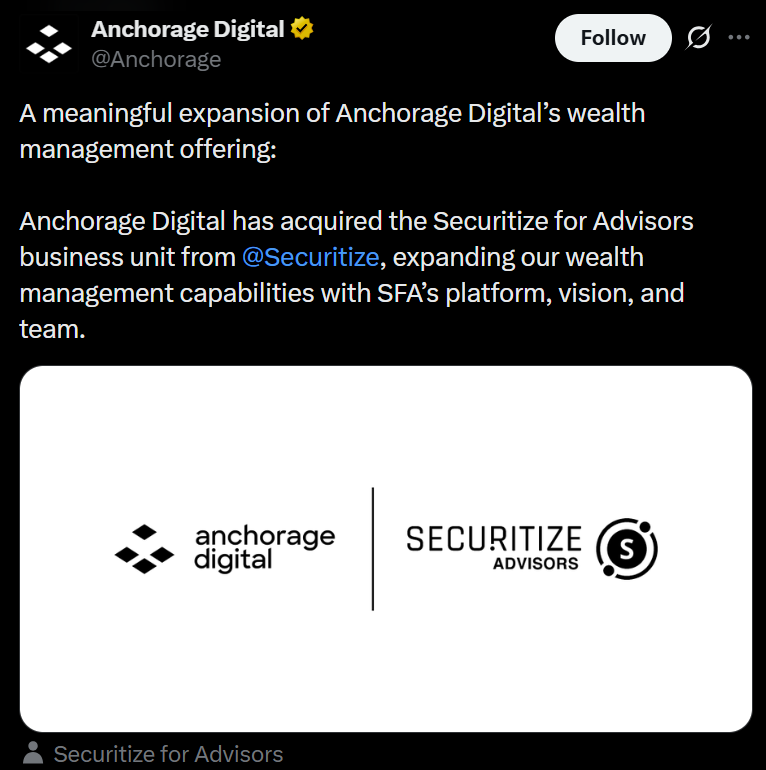
Anchorage announced on Monday that it has completed the acquisition of Securitize For Advisors (SFA), a lesser-known unit of Securitize, a company best known for its work in tokenizing real-world assets. Financial terms of the deal were not disclosed.

SFA is designed for registered investment advisers (RIAs); before the acquisition, it already relied on Anchorage for custody of client assets. By bringing the adviser platform in-house, Anchorage consolidates custody, trading and adviser-facing tools within a single platform, rather than operating across separate systems.
Source: Anchorage Digital

Anchorage is an institutional crypto platform that operates a federally chartered digital asset bank in the United States. In March, it was selected by Cantor Fitzgerald as a custody partner for Bitcoin (BTC).

For Securitize, the sale enables the company to focus more on its core tokenization business, according to Carlos Domingo, the company’s CEO.

Securitize has been accelerating its real-world asset strategy and has reportedly held talks about going public through a special purpose acquisition company sponsored by Cantor Fitzgerald. In May of last year, it raised $47 million in a funding round led by BlackRock.

Securitize is behind BlackRock’s tokenized money market fund, known as BUIDL.
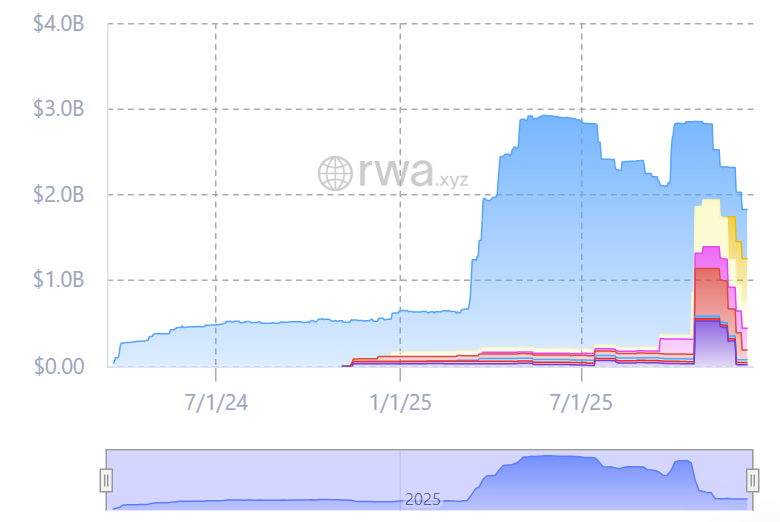
BlackRock’s BUIDL is the largest tokenized money market fund, with a value exceeding $1.8 billion. Source: RWA.xyz

Related: Anchorage Digital adds HYPE staking support through Figment partnership

RIAs emerge as a key channel for digital asset adoption

Nathan McCauley, co-founder and chief executive of Anchorage Digital, said registered investment advisers are “driving one of the most important waves of crypto adoption,” likely in reference to growing institutional adoption of digital assets via spot exchange-traded funds (ETFs) to clients.

RIA involvement has been building for several years. Momentum began to shift in 2020, when the Office of the Comptroller of the Currency allowed federally chartered banks to custody digital assets, giving advisers a compliant pathway to gain exposure.

Broader participation followed the approval of spot Bitcoin ETFs in early 2024, which lowered operational and regulatory hurdles for advisers and accelerated mainstream access.

The funds align with existing RIA infrastructure, including broker-dealers and custodians, making allocation easier for institutional investors.

Even after early adoption, RIAs still control access to sizable portions of the market that have yet to enter the digital assets space.

“The reason that we’re here today is because of the retail channels adopting crypto ETFs and crypto more broadly,” Federico Brokate, an executive at crypto issuer 21Shares, told Cointelegraph. “The next category is RIAs, and this is where we need to see the majority of ETF flow over the next five years.”

Related: SEC staff gives guidance on how securities laws could apply to crypto

Пов'язані матеріали

OpenAI Post-Training Engineer Weng Jiayi Proposes a New Paradigm Hypothesis for Agentic AI

OpenAI engineer Weng Jiayi's "Heuristic Learning" experiments propose a new paradigm for Agentic AI, suggesting that intelligent agents can improve not just by training neural networks, but also by autonomously writing and refining code based on environmental feedback. In the experiment, a coding agent (powered by Codex) was tasked with developing and maintaining a programmatic strategy for the Atari game Breakout. Starting from a basic prompt, the agent iteratively wrote code, ran the game, analyzed logs and video replays to identify failures, and then modified the code. Through this engineering loop of "code-run-debug-update," it evolved a pure Python heuristic strategy that achieved a perfect score of 864 in Breakout and performed competitively with deep reinforcement learning (RL) algorithms in MuJoCo control tasks like Ant and HalfCheetah. This approach, termed Heuristic Learning (HL), contrasts with Deep RL. In HL, experience is captured in readable, modifiable code, tests, logs, and configurations—a software system—rather than being encoded solely into opaque neural network weights. This offers potential advantages in explainability, auditability for safety-critical applications, easier integration of regression tests to combat catastrophic forgetting, and more efficient sample use in early learning stages, as demonstrated in broader tests on 57 Atari games. However, the blog acknowledges clear limitations. Programmatic strategies struggle with tasks requiring long-horizon planning or complex perception (e.g., Montezuma's Revenge), areas where neural networks excel. The future vision is a hybrid architecture: specialized neural networks for fast perception (System 1), HL systems for rules, safety, and local recovery (also System 1), and LLM agents providing high-level feedback and learning from the HL system's data (System 2). The core proposition is that in the era of capable coding agents, a significant portion of an AI's learned experience could be maintained as an auditable, evolving software system.

marsbit27 хв тому

OpenAI Post-Training Engineer Weng Jiayi Proposes a New Paradigm Hypothesis for Agentic AI

marsbit27 хв тому

Your Claude Will Dream Tonight, Don't Disturb It

This article explores the recent phenomenon of AI companies increasingly using anthropomorphic language—like "thinking," "memory," "hallucination," and now "dreaming"—to describe machine learning processes. Focusing on Anthropic's newly announced "Dreaming" feature for its Claude Agent platform, the piece explains that this function is essentially an automated, offline batch processing of an agent's operational logs. It analyzes past task sessions to identify patterns, optimize future actions, and consolidate learnings into a persistent memory system, akin to a form of reinforcement learning and self-correction. The article draws parallels to similar features in other AI agent systems like Hermes Agent and OpenClaw, which also implement mechanisms for reviewing historical data, extracting reusable "skills," and strengthening long-term memory. It notes a key difference from human dreaming: these AI "dreams" still consume computational resources and user tokens. Further context is provided by discussing the technical challenges of managing AI "memory" or context, highlighting the computational expense of large context windows and innovations like Subquadratic's new model claiming drastically longer contexts. The core critique argues that this strategic use of human-centric vocabulary does more than market products; it subtly reshapes user perception. By framing algorithms with terms associated with consciousness, companies blur the line between tool and autonomous entity. This linguistic shift can influence user expectations, tolerance for errors, and even perceptions of responsibility when systems fail, potentially diverting scrutiny from the companies and engineers behind the technology. The article concludes by speculating that terms like "daydreaming" for predictive task simulation might be next, continuing this trend of embedding the idea of an "inner life" into computational processes.

marsbit29 хв тому

Your Claude Will Dream Tonight, Don't Disturb It

marsbit29 хв тому

Торгівля

Спот
Ф'ючерси

Популярні статті

Як купити PUSH

Ласкаво просимо до HTX.com! Ми зробили покупку Push Protocol (PUSH) простою та зручною. Дотримуйтесь нашої покрокової інструкції, щоб розпочати свою криптовалютну подорож.Крок 1: Створіть обліковий запис на HTXВикористовуйте свою електронну пошту або номер телефону, щоб зареєструвати обліковий запис на HTX безплатно. Пройдіть безпроблемну реєстрацію й отримайте доступ до всіх функцій.ЗареєструватисьКрок 2: Перейдіть до розділу Купити крипту і виберіть спосіб оплатиКредитна/дебетова картка: використовуйте вашу картку Visa або Mastercard, щоб миттєво купити Push Protocol (PUSH).Баланс: використовуйте кошти з балансу вашого рахунку HTX для безперешкодної торгівлі.Треті особи: ми додали популярні способи оплати, такі як Google Pay та Apple Pay, щоб підвищити зручність.P2P: Торгуйте безпосередньо з іншими користувачами на HTX.Позабіржова торгівля (OTC): ми пропонуємо індивідуальні послуги та конкурентні обмінні курси для трейдерів.Крок 3: Зберігайте свої Push Protocol (PUSH)Після придбання Push Protocol (PUSH) збережіть його у своєму обліковому записі на HTX. Крім того, ви можете відправити його в інше місце за допомогою блокчейн-переказу або використовувати його для торгівлі іншими криптовалютами.Крок 4: Торгівля Push Protocol (PUSH)Легко торгуйте Push Protocol (PUSH) на спотовому ринку HTX. Просто увійдіть до свого облікового запису, виберіть торгову пару, укладайте угоди та спостерігайте за ними в режимі реального часу. Ми пропонуємо зручний досвід як для початківців, так і для досвідчених трейдерів.

518 переглядів усьогоОпубліковано 2024.12.13Оновлено 2025.03.21

Як купити PUSH

Обговорення

Ласкаво просимо до спільноти HTX. Тут ви можете бути в курсі останніх подій розвитку платформи та отримати доступ до професійної ринкової інформації. Нижче представлені думки користувачів щодо ціни PUSH (PUSH).

活动图片