Analyzing Noise's New Beta Version: How to 'Trade Hype' On-Chain?

marsbitОпубліковано о 2026-04-13Востаннє оновлено о 2026-04-13

Анотація

Noise, a "relevance prediction market," has launched its Beta version, allowing users to trade on the perceived importance of events and cultural trends. The platform generates a "Relevance Index" by algorithmically analyzing data from social platforms like X, Reddit, and YouTube, as well as prediction markets such as Polymarket. Users can speculate on whether the热度 of a topic will rise or fall, using up to 5x leverage. Transactions in Beta are conducted with credits purchased via fiat or crypto (USDC on Ethereum/Solana), though cash-out functionality is not yet available. Founded by a young team from USC and backed by Paradigm, Noise aims to move beyond traditional prediction markets by quantifying and trading cultural relevance rather than just event outcomes. Potential use cases include hedging marketing campaigns or investment strategies. The platform plans to launch on Base with real-money trading in the coming months.

On April 1, 2026, Beijing time, the "hype prediction market" Noise launched its Beta version, officially opening for trading. Users are required to pay $5 to trade on the Beta version DApp to prevent malicious activities.

Noise announced in January of this year that it had raised $7.1 million in a seed round led by Paradigm, with participation from Figment Capital, Anagram, GSR, and JPEG Trading. KaitoAI, a representative of the attention economy previously cut off from X's API, also participated in the investment.

The term "trading hype" has always referred to deliberately creating topics and sparking attention through various means to increase the exposure and discussion of an event. However, Noise quantifies hype into numbers, allowing users to trade the rise and fall of these numbers. In Noise's own words, prediction markets focus on "whether something will happen," while Noise focuses on "how important something is right now."

Hype Index Trading Platform

Noise's mechanism is actually quite simple to explain: Through Noise's algorithm, a hype index for a specific event or cultural symbol is generated. Users can predict whether the hype will rise or fall in the future and perform long or short operations.

Only two things need clarification: first, how to trade; second, how this index is calculated.

Perhaps because it is in the testing phase, trading on the Noise platform does not directly use fiat currency or cryptocurrency. Instead, users need to purchase "credits" on the platform and use these credits for trading.

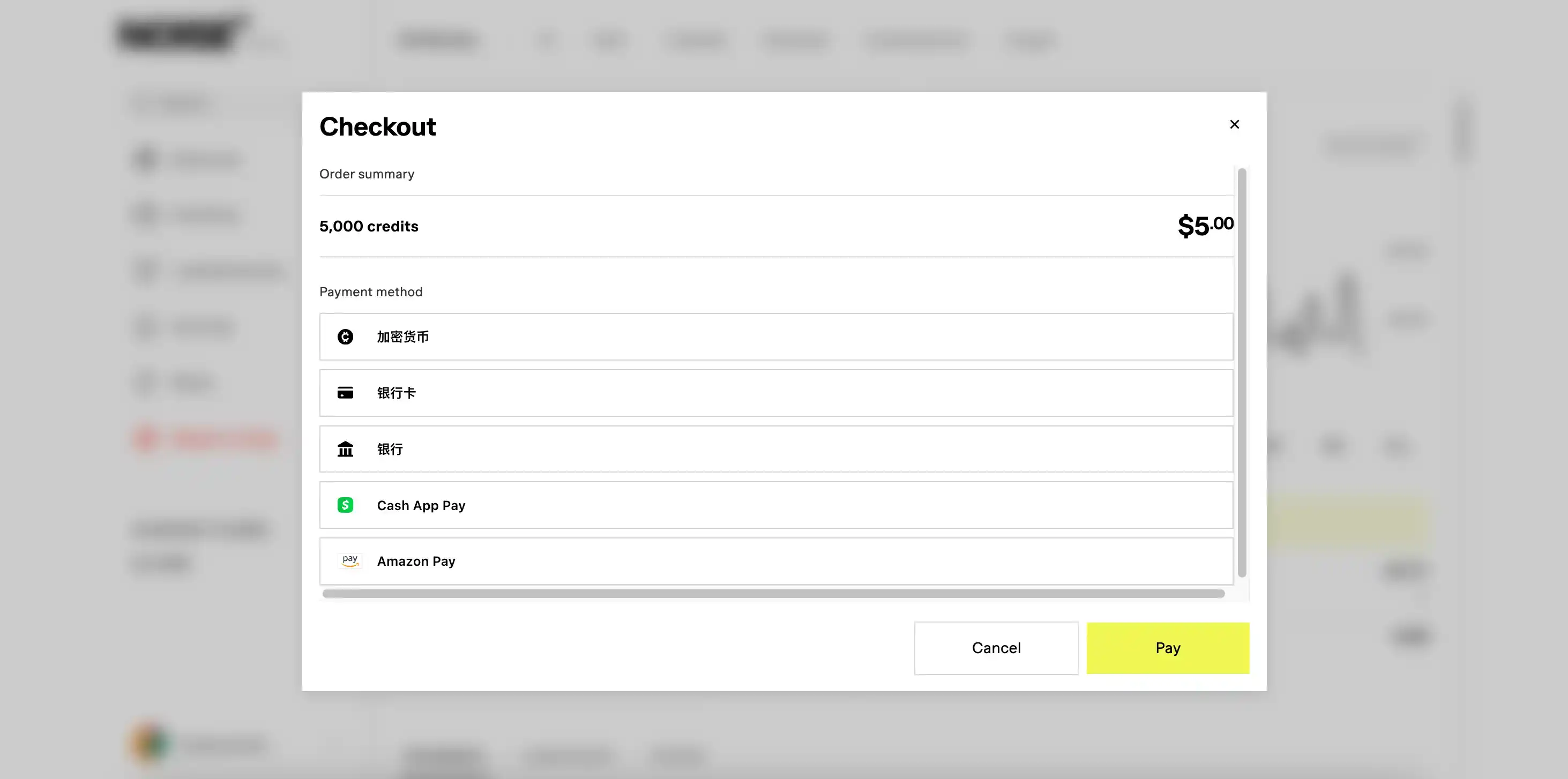
Fiat purchases are supported through banking channels, Cash App, and Amazon Pay. For cryptocurrency channels, transfers need to be made via MetaMask and Phantom, currently supporting USDC on Ethereum and Solana. The author did not find an entry to exchange credits back to fiat or stablecoins, possibly because the Beta version is only testing the trading engine and does not yet have a settlement function.

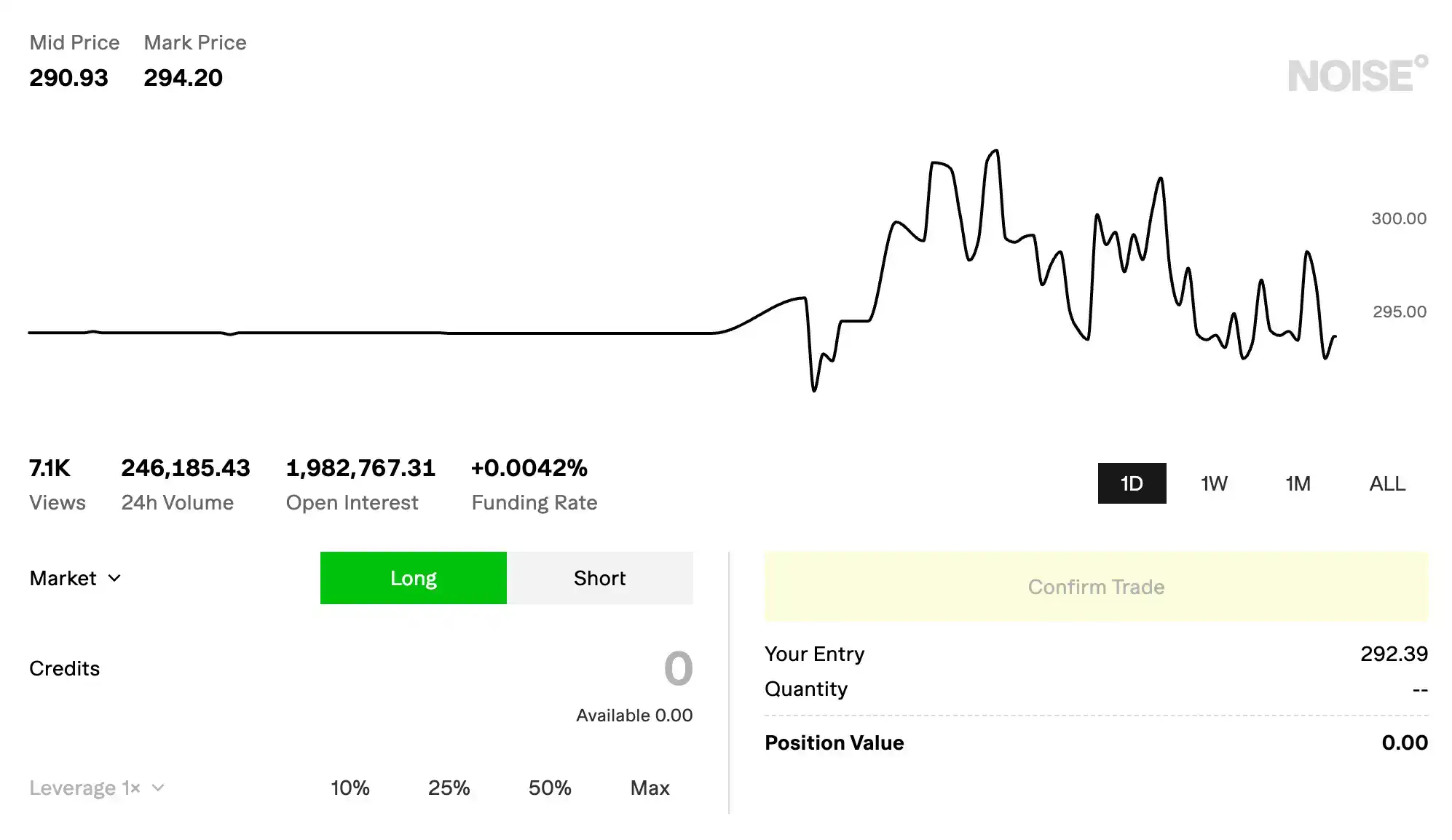
Taking "crude oil," a recent market focus with high attention, as an example, you can choose leverage from 1x to 5x for long or short trading. Currently, this market is one of the hottest in the Noise Beta version, but its 24-hour trading volume is only over 200,000, with an open interest value of about 2 million, which translates to less than $20 million in USD.

Although not displayed on the front end, Noise also uses an order book model. Unlike prediction markets, Noise's trading market is more like cryptocurrency perpetual contracts. The index provided by the oracle is the "mark price," and the market automatically adjusts the balance between the market price and the mark price through funding rates.
As for the hype index we are trading, Noise calls it the "Relevance Index." Data calculation is based on two sources: content and signals.

In terms of content, Noise tracks interactions, post counts, and unique author counts related to topics on platforms including X, Reddit, YouTube, Instagram, Substack, and RSS news feeds. Signals come from trading volume and market counts of related topics on Polymarket and Kalshi.

The smoothed values (to prevent short-term noise effects) of all sources and indicators are aggregated into a comprehensive value through weighting, which is the index users trade. However, Noise has not fully disclosed the specific algorithm, most likely to prevent someone from exploiting the algorithm's mechanism to artificially inflate the hype of an event or weaken the hype of a hot event with a large amount of irrelevant information.

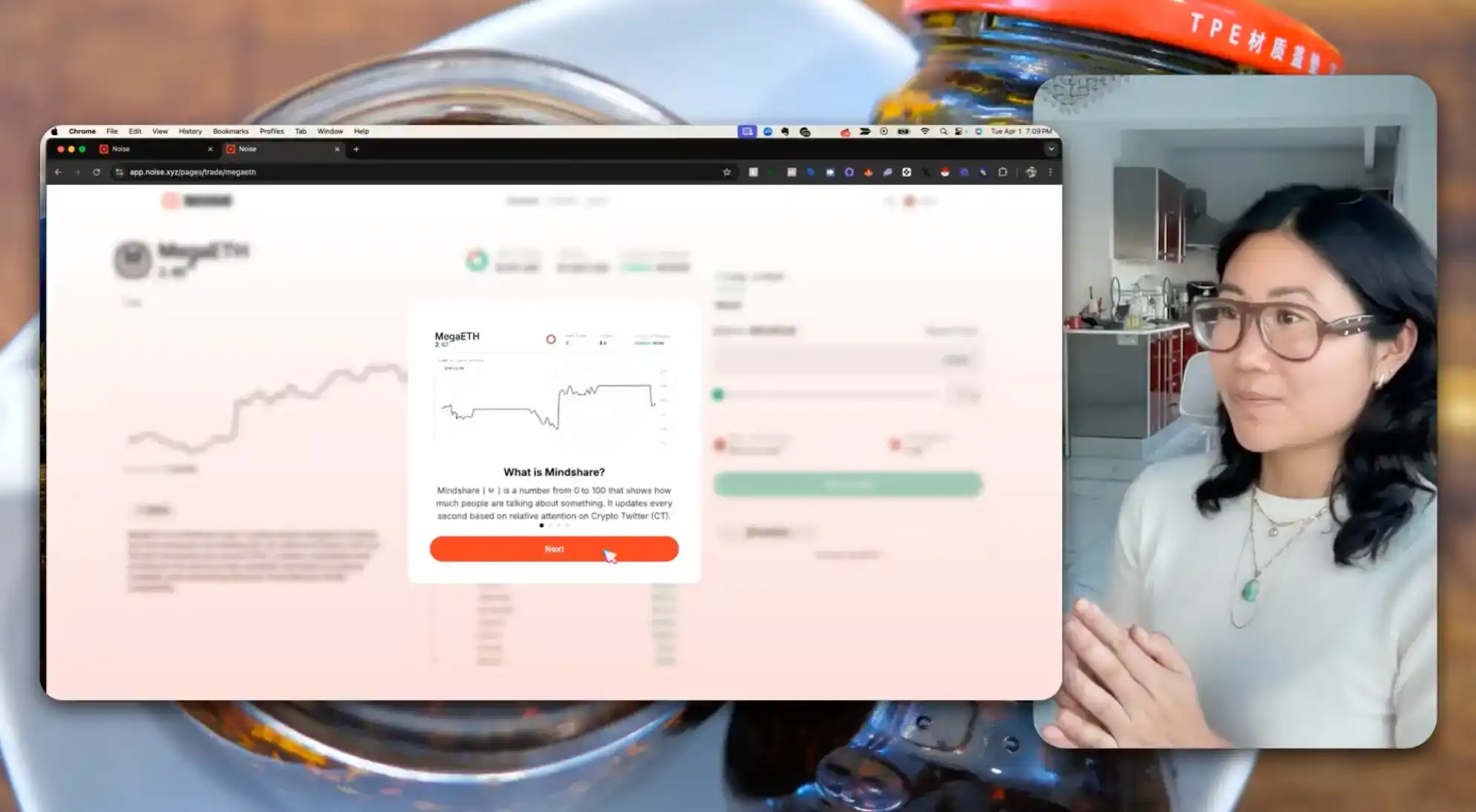
Interestingly, the author found a testnet experience video of Noise on YouTube from a year ago. In April 2025, Noise's index was still a "Mindshare" data between 0 and 100. Even in February of this year, Forbes' report on prediction markets still used this term.
The Founder Who Just Graduated from University

Noise's core founding team consists of three people, all from the University of Southern California: 22-year-old Luca Cordova Stuart, 26-year-old David Zhou, and 24-year-old Gabriel Perez Carafa.

Among them, Gabriel Perez Carafa had no work experience before Noise. Luca Cordova Stuart had an internship in BD at LayerZero Labs, and almost no public information can be found about David Zhou.

None of Noise's three co-founders have particularly impressive backgrounds, similar to Kalshi in its early days. The difference is, although Forbes categorizes Noise as a prediction market, these three young people do not agree. They wrote in the blog post announcing the Beta version launch, "You may have seen people compare Noise to prediction markets. We understand the reason for this comparison, but we do not agree with it. Speculation is just one of many factors. Our goal is to build a platform that helps people understand and spread deeper stories about modern culture, lifestyle, politics, and technological changes."

From multiple articles published in the past, Noise has always wanted to express: eliminate noise and gain true insight. Prediction markets provide the probability of an event happening, backed by real money. What Noise wants to discuss is "whether it is necessary to discuss whether this event will happen."

Besides Speculation, What Are the Application Scenarios?

Trading markets inevitably involve speculation, which is undeniable. The key is what practical use cases Noise has beyond speculation.

Previously, Kalshi's co-founder Lara shared at a conference that recently, there have been many multi-million dollar orders on Kalshi's inflation prediction market, and the source of these orders is large companies using them to hedge against potential wage increases due to a rebound in inflation. Noise provides a similar scenario here: companies can use a portion of their marketing budget to short the topics they plan to market, thereby hedging against the failure of marketing strategies.

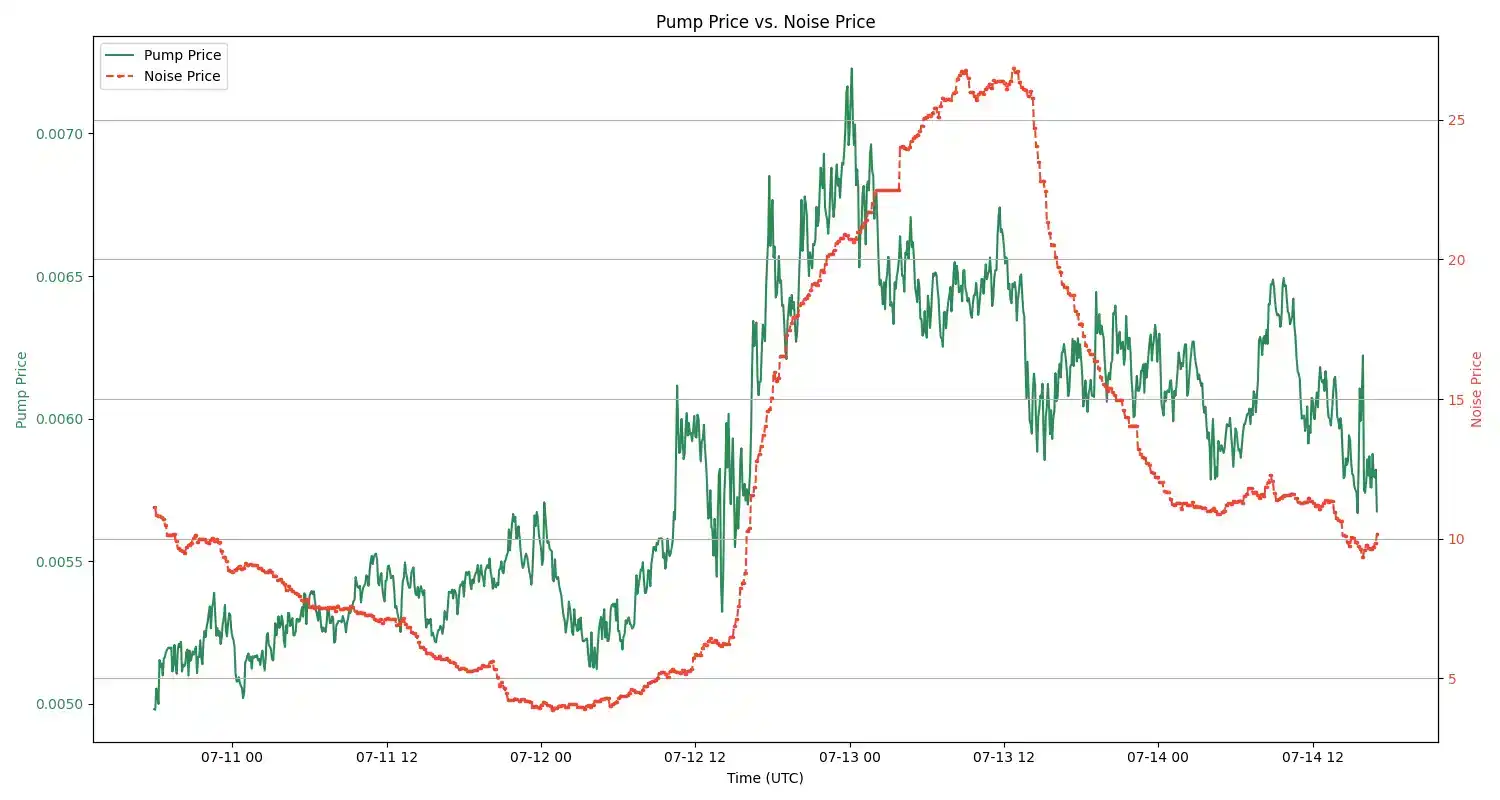
Additionally, "hype" has unique uses in trading such as cryptocurrencies and stocks. In Noise's market regarding the hype of the PUMP topic, the peak hype coincided with the rebound high point after PUMP's first wave of decline. For investors who believe in "buy when no one is interested, sell when everyone is talking," Noise's related markets might be a good reference and hedging channel.
Noise plans to launch its mainnet on Base in the coming months, at which time the platform will be open to everyone and support real money trading. From the author's perspective, Noise's idea is indeed relatively novel and has real application scenarios. However, like prediction markets over a decade ago, trading "hype" and "trends" might still be slightly ahead of its time. But at least in the recent market dominated by stablecoins and payment applications, Noise is a target for airdrop farming.


Пов'язані питання

QWhat is Noise and what does its Beta version allow users to do?

ANoise is a 'relevance prediction market' that launched its Beta version, allowing users to trade on the rise and fall of a 'Relevance Index' for various events or cultural symbols. Users can take long or short positions using leverage.

QHow does Noise generate the 'Relevance Index' that users trade on?

AThe 'Relevance Index' is calculated based on content (interactions, post counts, unique authors from platforms like X, Reddit, YouTube, etc.) and signals (trading volume and market count from prediction markets like Polymarket and Kalshi). These are weighted and smoothed to create a composite value.

QWhat is the purpose of using 'credits' for trading on the Noise Beta platform?

AIn the Beta version, users must purchase 'credits' with fiat currency or cryptocurrency to trade. This is primarily a measure to prevent malicious behavior and test the trading engine, as the platform does not yet support cashing out credits for real money.

QWho are the founders of Noise and what is their background?

ANoise was founded by three graduates from the University of Southern California: 22-year-old Luca Cordova Stuart, 26-year-old David Zhou, and 24-year-old Gabriel Perez Carafa. They have limited prior professional experience, with Stuart having a BD internship at LayerZero Labs.

QWhat are some potential real-world use cases for Noise beyond speculation?

ABeyond speculation, Noise can be used by companies to hedge marketing campaigns by shorting the topic they are promoting, thus hedging against campaign failure. It can also serve as a reference or hedging tool for investors in crypto or stocks by providing a measure of public interest or 'hype' around an asset.

Пов'язані матеріали

GitHub, Transfixed by AI

On the night of February 9th, GitHub suffered a major outage caused by a simple configuration change—reducing a cache refresh interval from 12 to 2 hours—that triggered a cascade of failures. This was not an isolated event, but part of a broader pattern. In early 2026, GitHub experienced at least 8 major incidents, failing to meet its promised 99.9% availability. These outages stemmed from structural issues: explosive growth in load, tight service coupling, and insufficient protection against abnormal traffic. This unprecedented load is driven by AI Agents. In 2025, GitHub handled ~1 billion commits. By 2026, weekly commits reached 275 million, projecting to ~14 billion for the year—a 14x increase. AI tools like Claude Code now contribute 4.5% of all public repository commits, with weekly submissions surging 25x in just three months. AI-generated pull requests jumped from 4 million to 17 million per month in half a year. Unlike human developers, AI Agents work continuously, generating commits at a scale that overwhelms infrastructure designed for human rhythms. The surge also shattered GitHub's business model. Copilot's flat-rate pricing, based on assisting human developers, became unsustainable as Agentic AI sessions consumed resources worth hundreds of dollars for a few dollars in fees. In response, GitHub imposed usage limits and, by June 1st, shifted to a pay-per-use "AI Credits" system. Facing this new reality, GitHub realized a 10x scaling plan was insufficient. It announced a need to *redesign* its architecture for 30x current scale—decoupling services, adding fault isolation, and improving change management to prevent cascading failures. Other platforms like Stripe and AWS are facing similar challenges with AI Agents. Fundamentally, GitHub is transitioning from a human collaboration platform to an "exhaust pipe" for automated AI workflows. Its detailed post-mortem reports aim to maintain trust during this turbulent rebuild. The February outage was not just a technical glitch, but a signal of the software industry's entry into a new, AI-driven era.

marsbit27 хв тому

GitHub, Transfixed by AI

marsbit27 хв тому

Both Suffer Massive Losses Exceeding $90 Billion, Which Is in Greater Peril: Strategy or Bitmine?

Facing massive paper losses exceeding $90 billion each amidst a sharp market downturn, "Digital Asset Treasury" (DAT) giants Strategy and Bitmine find themselves in a precarious position, but with different underlying risks. Strategy, heavily invested in Bitcoin (BTC), faces significant financial strain. Its strategy relies heavily on debt, including convertible notes and preferred stock (STRC) requiring substantial dividend payments. With its cash reserves dwindling and BTC offering no staking yield for cash flow, Strategy's high leverage makes it vulnerable. A continued price decline could force asset sales to meet obligations, potentially creating a negative feedback loop. Its market value has already fallen sharply. In contrast, Bitmine, an Ethereum (ETH) holder, appears on firmer financial ground. It primarily funds its purchases through equity offerings (like ATM programs), avoiding debt pressure. It also generates income by staking a large portion of its ETH holdings. While not immune to market drops and shareholder dilution concerns, Bitmine maintains more flexibility, recently announcing a new preferred share offering to raise further capital. The core divergence lies in their financing: Bitmine uses equity (investor money), while Strategy uses debt (borrowed money). Consequently, Bitmine currently faces less immediate liquidity pressure than Strategy, which must navigate the dual challenge of servicing debt/dividends and a declining core asset (BTC) price.

marsbit34 хв тому

Both Suffer Massive Losses Exceeding $90 Billion, Which Is in Greater Peril: Strategy or Bitmine?

marsbit34 хв тому

Торгівля

Спот
Ф'ючерси

Популярні статті

Як купити HYPE

Ласкаво просимо до HTX.com! Ми зробили покупку Hyperliquid (HYPE) простою та зручною. Дотримуйтесь нашої покрокової інструкції, щоб розпочати свою криптовалютну подорож.Крок 1: Створіть обліковий запис на HTXВикористовуйте свою електронну пошту або номер телефону, щоб зареєструвати обліковий запис на HTX безплатно. Пройдіть безпроблемну реєстрацію й отримайте доступ до всіх функцій.ЗареєструватисьКрок 2: Перейдіть до розділу Купити крипту і виберіть спосіб оплатиКредитна/дебетова картка: використовуйте вашу картку Visa або Mastercard, щоб миттєво купити Hyperliquid (HYPE).Баланс: використовуйте кошти з балансу вашого рахунку HTX для безперешкодної торгівлі.Треті особи: ми додали популярні способи оплати, такі як Google Pay та Apple Pay, щоб підвищити зручність.P2P: Торгуйте безпосередньо з іншими користувачами на HTX.Позабіржова торгівля (OTC): ми пропонуємо індивідуальні послуги та конкурентні обмінні курси для трейдерів.Крок 3: Зберігайте свої Hyperliquid (HYPE)Після придбання Hyperliquid (HYPE) збережіть його у своєму обліковому записі на HTX. Крім того, ви можете відправити його в інше місце за допомогою блокчейн-переказу або використовувати його для торгівлі іншими криптовалютами.Крок 4: Торгівля Hyperliquid (HYPE)Легко торгуйте Hyperliquid (HYPE) на спотовому ринку HTX. Просто увійдіть до свого облікового запису, виберіть торгову пару, укладайте угоди та спостерігайте за ними в режимі реального часу. Ми пропонуємо зручний досвід як для початківців, так і для досвідчених трейдерів.

270 переглядів усьогоОпубліковано 2024.12.11Оновлено 2026.06.02

Як купити HYPE

Обговорення

Ласкаво просимо до спільноти HTX. Тут ви можете бути в курсі останніх подій розвитку платформи та отримати доступ до професійної ринкової інформації. Нижче представлені думки користувачів щодо ціни HYPE (HYPE).

活动图片