Analyzing if AAVE could target $92 after breaking KEY support

ambcryptoОпубліковано о 2026-03-29Востаннє оновлено о 2026-03-29

Анотація

AAVE breached the $100 support level amid a broader market decline, falling to a three-week low of $96 and trading at $97 at press time, down 7.7% daily. The market cap dropped by over $200 million. The altcoin fell below its short-term moving averages, reflecting strong bearish pressure. Market participants turned bearish, with the Bulls vs. Bears indicator turning negative after over a month of positivity. Exchange data showed a net inflow of tokens, indicating selling dominance, and the Exchange Supply Ratio hit a monthly high of 0.137. The RSI dropped to 34, nearing oversold conditions, suggesting continued seller control. If bearish momentum persists, AAVE could decline toward $92. A rebound would require reclaiming $100 and key moving averages at $107 and $110; otherwise, the downtrend may continue.

Aave [AAVE] breached the $100 support level amid a broader market slip and fell to a three-week low of $96. In fact, at press time, AAVE traded at $97, down 7.7% on the daily charts, while the market cap fell by over $200 million.

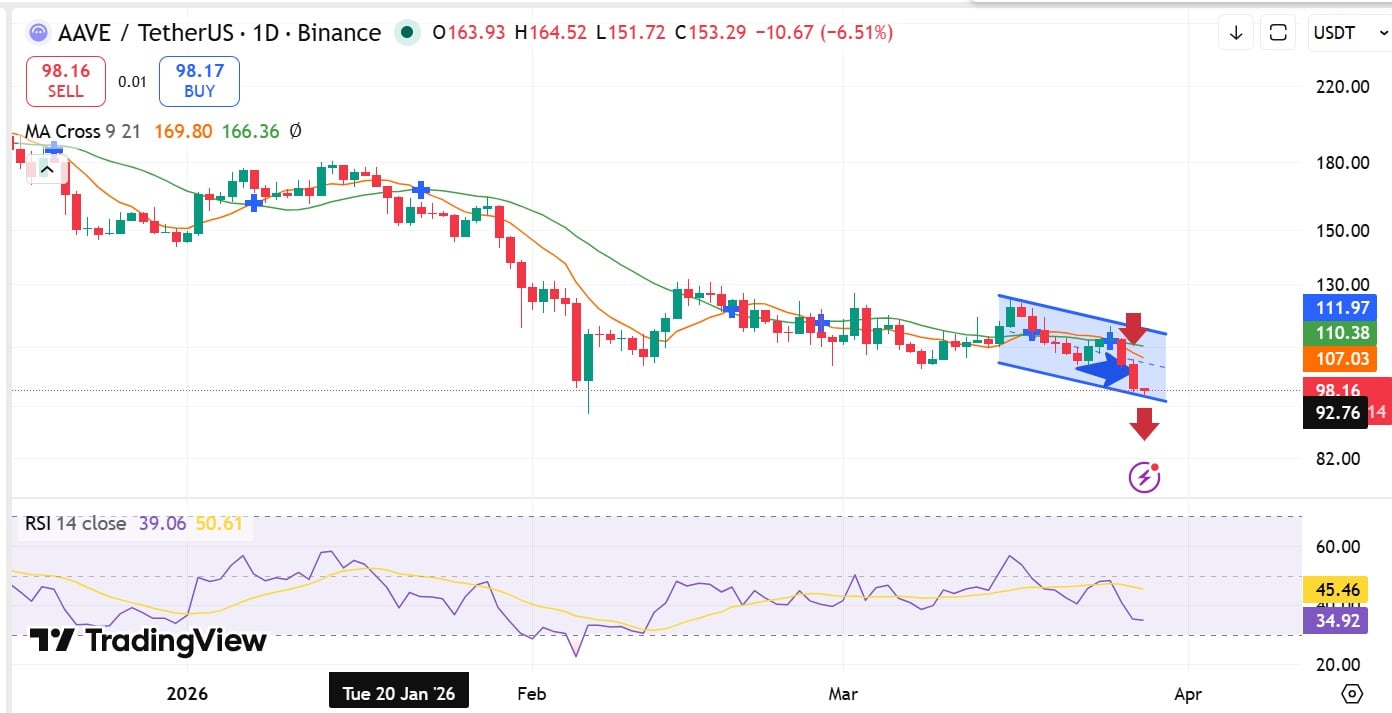
In doing so, the altcoin fell below its short-term Moving Averages (MA), the 9- and 21-day MAs, reflecting strong downside pressure.

AAVE drops below $100

As the crypto market retraced, AAVE market participants turned bearish and began exiting the market aggressively, thereby strengthening downside momentum.

In fact, the Bulls vs. Bears indicator turned negative after being positive for more than a month. When this metric turns negative, it suggests that sellers have dominated the market and displaced buyers.
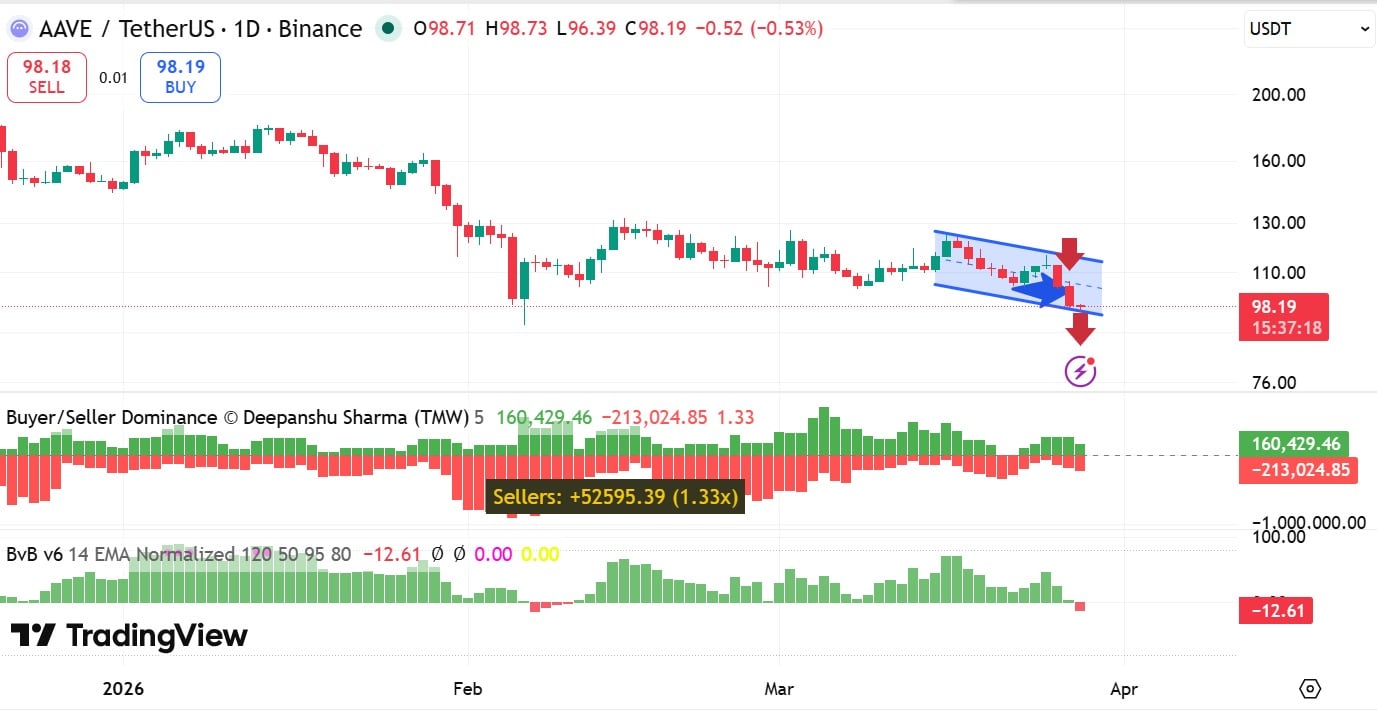
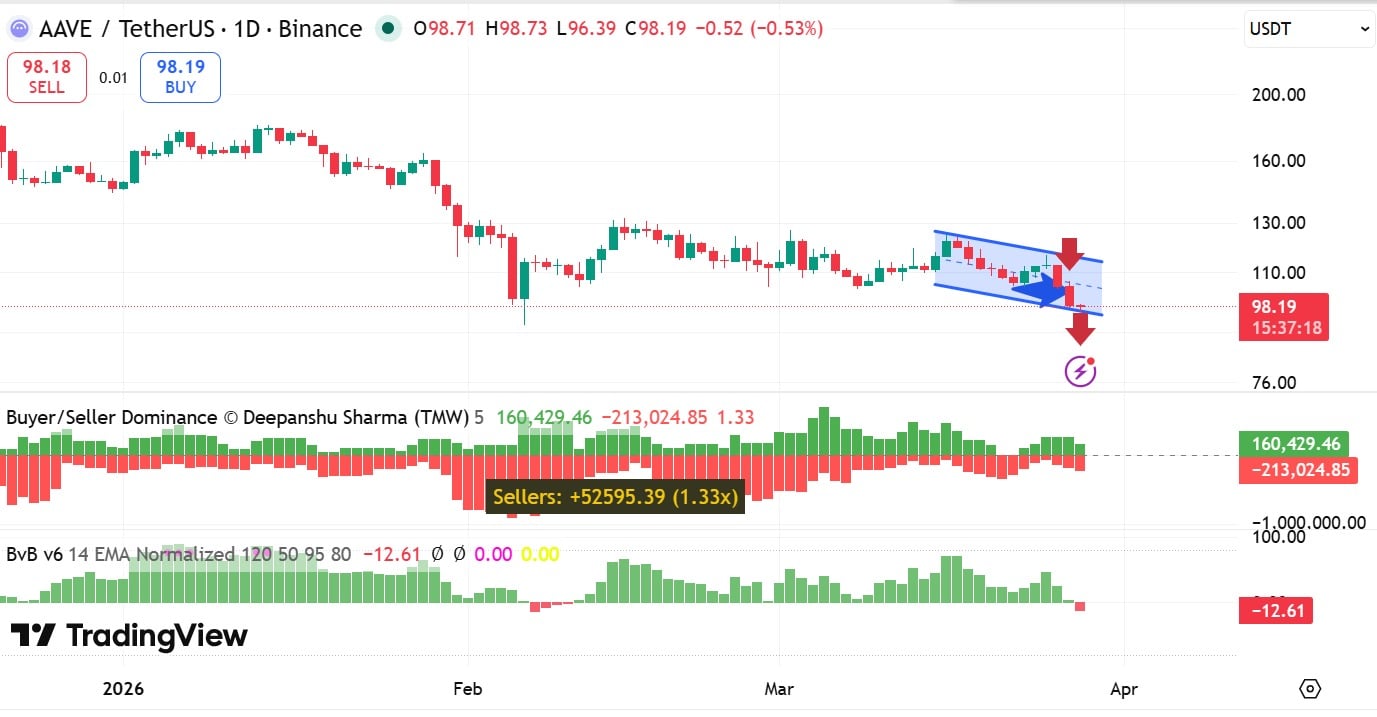
Source: TradingView

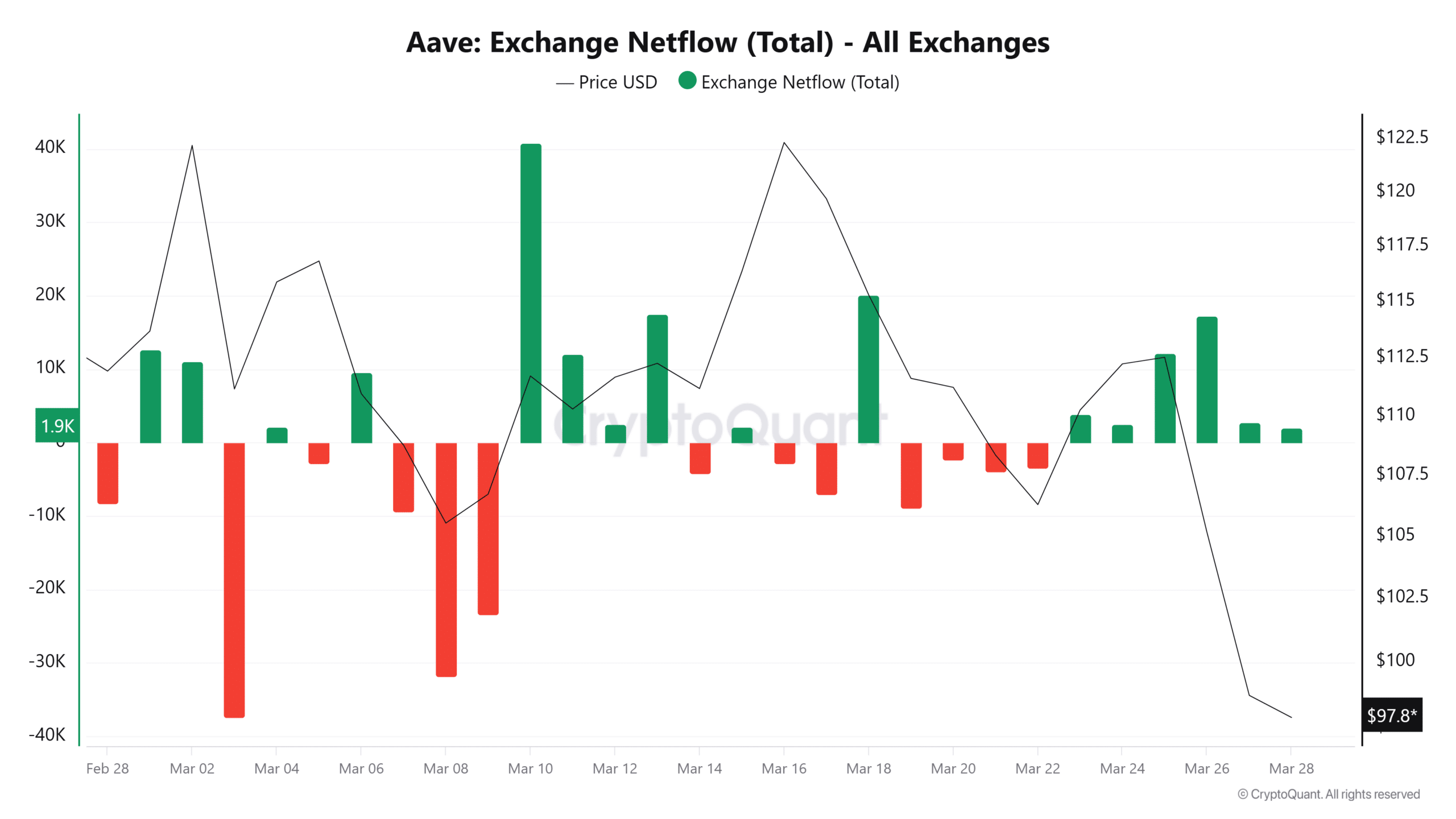
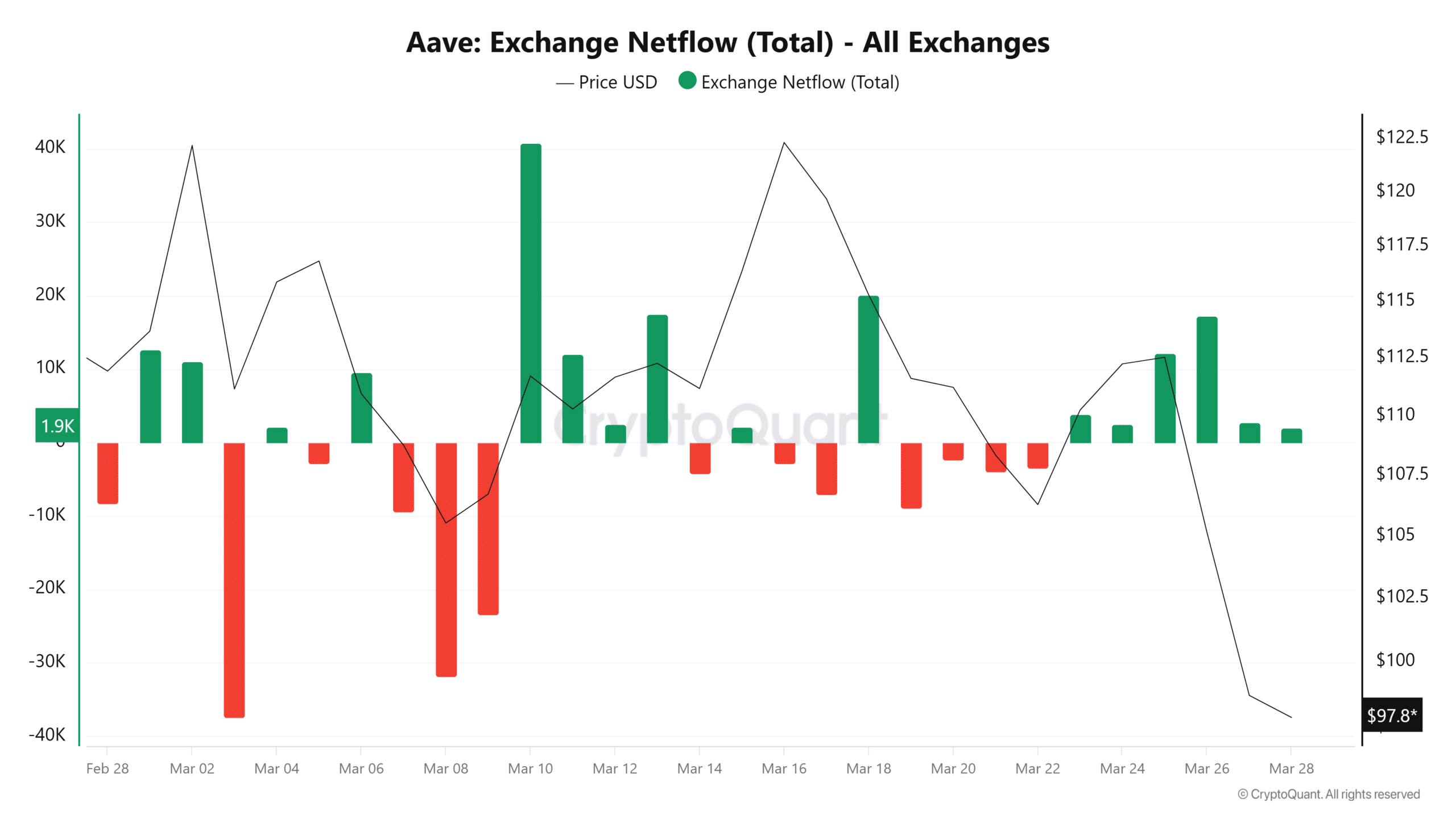
Furthermore, exchange activities echoed this seller dominance. According to CryptoQuant data, 79k AAVE tokens flowed into exchanges, compared to 74k flowing out.
Source: CryptoQuant

Thus, the altcoin’s Netflow extended its hold within the positive zone for the sixth day, suggesting that sellers have had a strong dominance over the market.

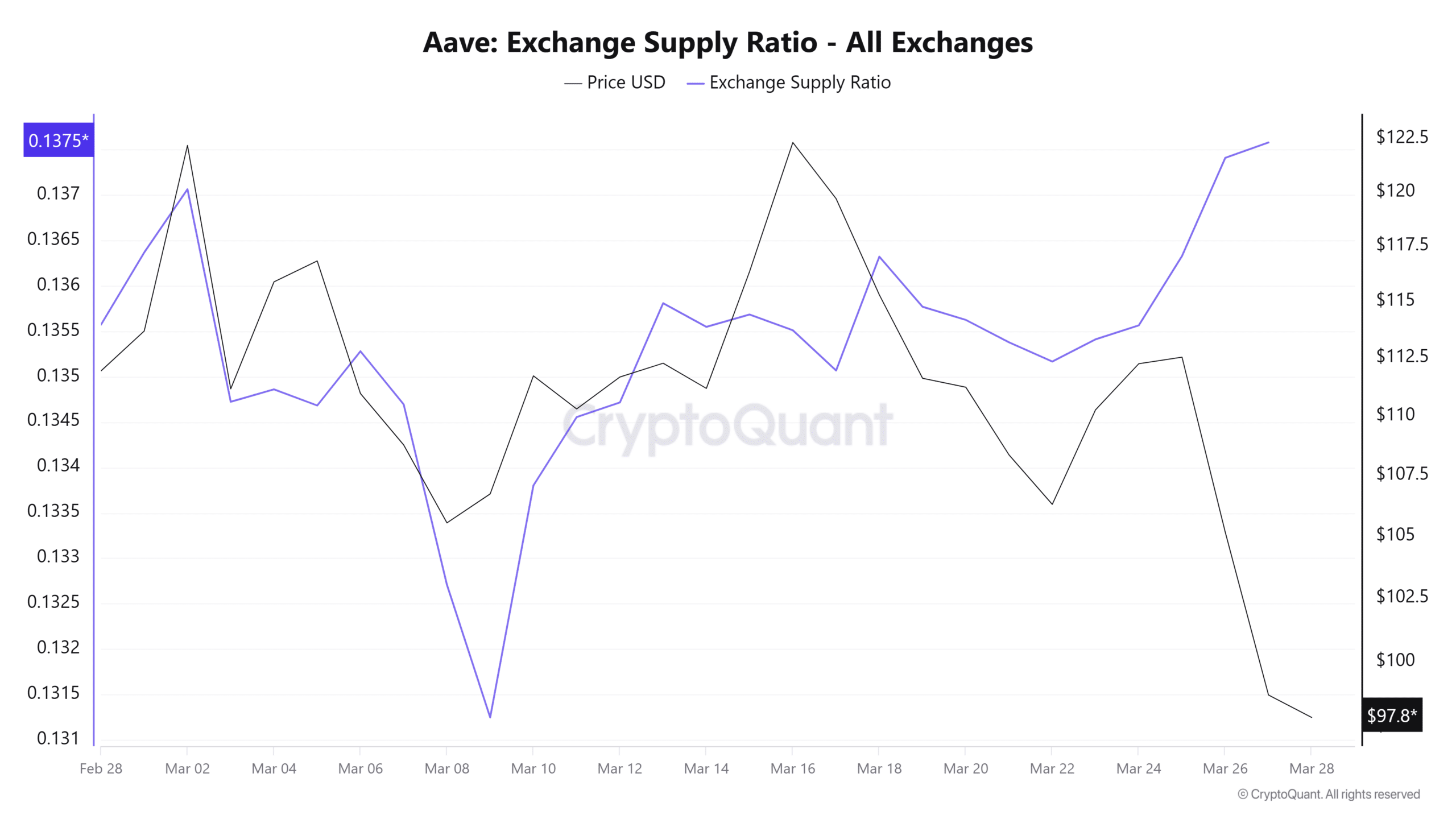
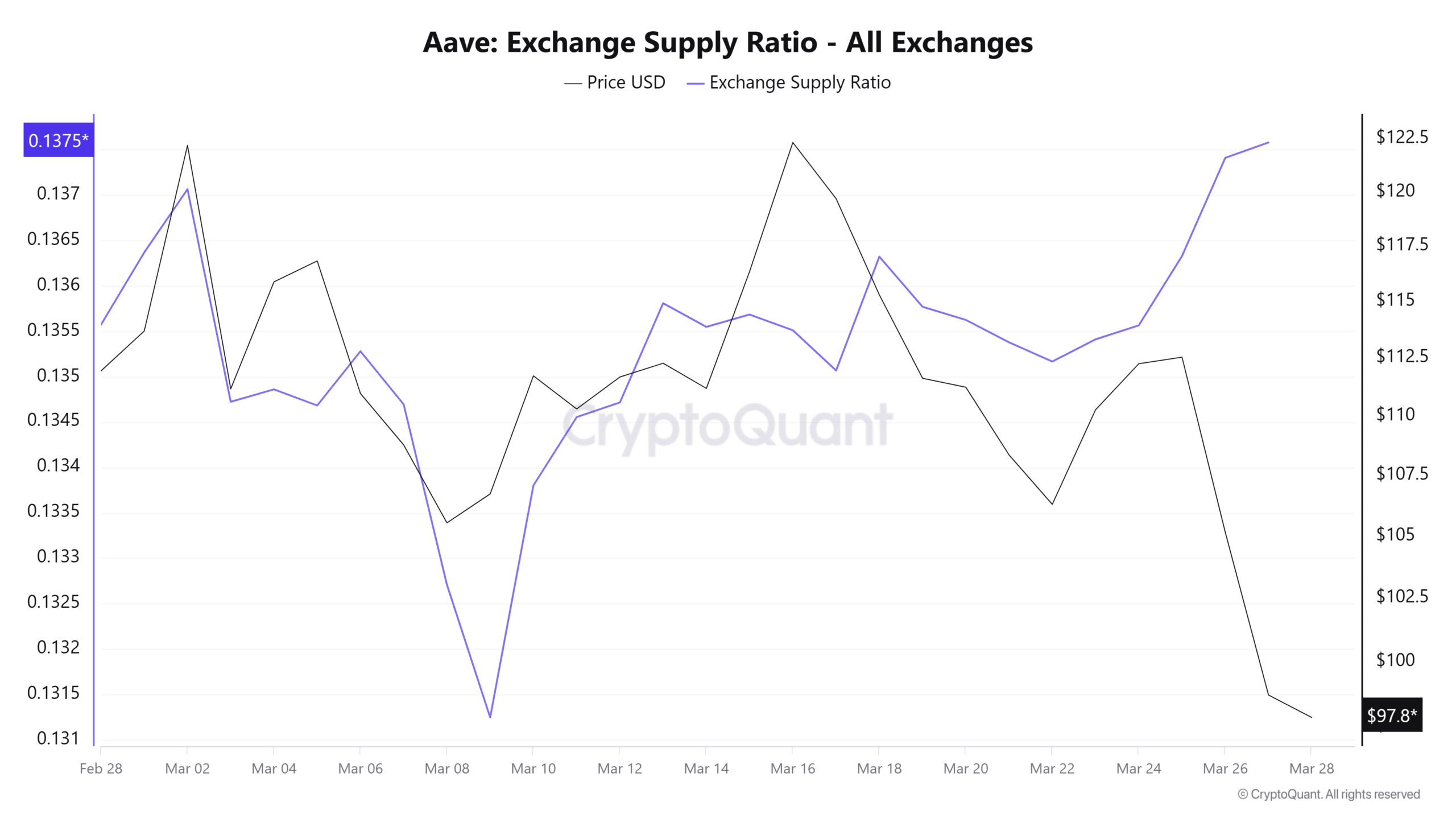
As a result, the altcoin’s Exchange Supply Ratio jumped to a monthly high of 0.137 as of writing, indicating increased selling activity. Often, such a jump in ESR reduces scarcity, thus increasing the supply available for immediate sale.
Source: CryptoQuant

Such a setup on exchanges has preceded strong downward momentum for the asset, leading to lower prices.

What momentum indicators suggest

AAVE has experienced strong downward momentum and breached a key support level, with sellers significantly outpacing buyers. Since then, the altcoin’s Relative Strength Index (RSI) dropped deeper into bearish territory, falling to 34 at press time.

With RSI nearing oversold territory, this suggests sellers’ control of the market, while buyers have largely stepped back. Traditionally, such market conditions have strengthened downward momentum, typically resulting in lower prices.
Source: TradingView

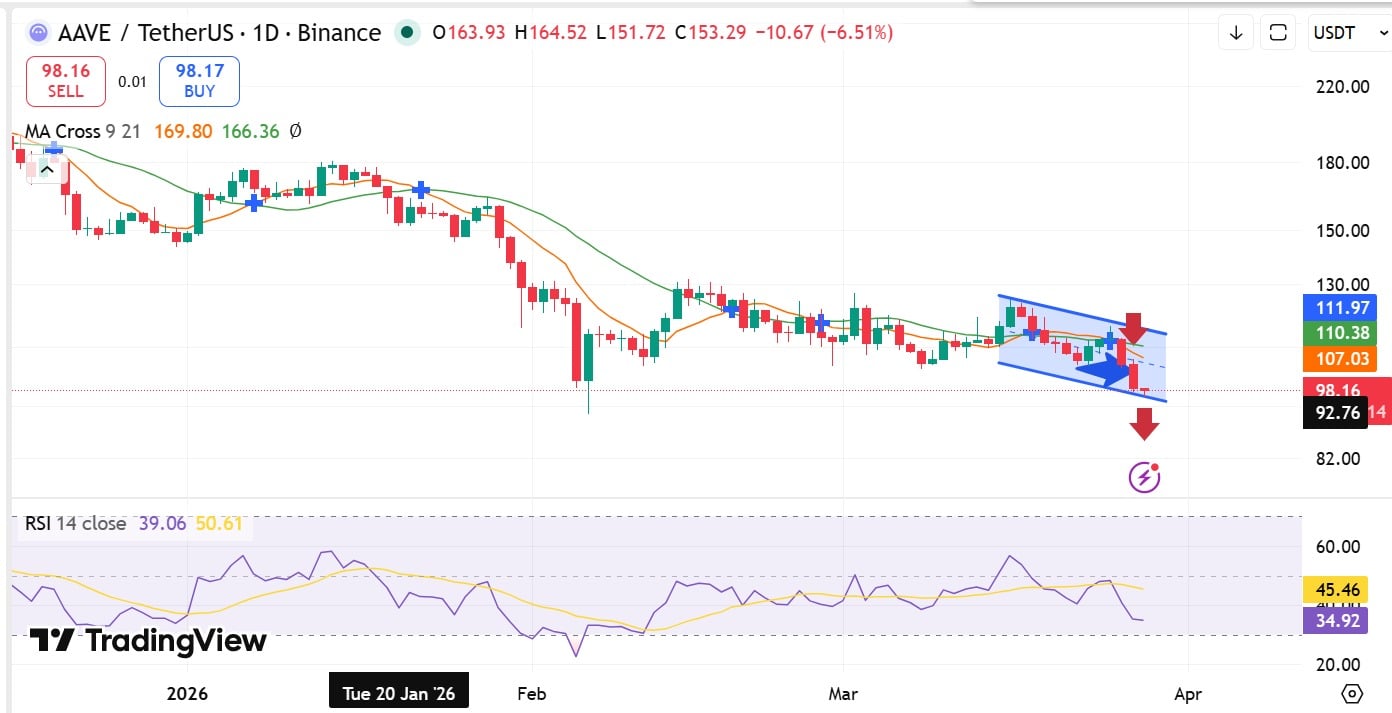
Therefore, if sellers continue to overrun the market with little resistance, AAVE is likely to slide towards $92 before attempting another leg up.

However, if the market cools down and bulls reclaim $100, the altcoin could set the ground for a rebound. But for a significant trend reversal, bulls need to flip $100 and reclaim the 9- and 21-day MAs at $107 and $110, respectively.

Failure to do so will see the altcoin enter an extended bearish streak, with a likelihood of staying below $100.


Final Summary

  • Aave dropped 7.7%, breaching $100 and dropping to a three-week low of $96.
  • AAVE faced intense selling pressure, with bears outpacing bulls, strengthening downside risk.

Пов'язані питання

QWhat key support level did AAVE breach, and what was its price at the time of writing?

AAAVE breached the $100 support level and was trading at $97 at the time of writing.

QWhat does the Bulls vs. Bears indicator turning negative suggest about the AAVE market?

AIt suggests that sellers have dominated the market and displaced buyers, indicating strong bearish sentiment.

QAccording to the data, how did the Netflow and Exchange Supply Ratio (ESR) metrics reflect selling pressure?

AThe Netflow was positive for the sixth day, and the Exchange Supply Ratio jumped to a monthly high of 0.137, both indicating increased selling activity and dominance by sellers.

QWhat does the RSI value of 34 at press time imply for AAVE's price momentum?

AAn RSI of 34 suggests that the market is nearing oversold territory, with sellers in control and strong downward momentum, which could lead to lower prices.

QWhat are the two potential price scenarios for AAVE mentioned in the article?

AIf sellers continue to dominate, AAVE could slide towards $92. If bulls reclaim $100, it could set the stage for a rebound, but a significant reversal requires flipping $100 and reclaiming the 9- and 21-day MAs at $107 and $110.

Пов'язані матеріали

From Theft to Re-entry: How Was $292 Million "Laundered"?

A sophisticated crypto laundering operation was executed following the $292 million hack of Kelp DAO on April 18. The attack, attributed to the North Korean Lazarus group, began with anonymous infrastructure preparation using Tornado Cash to fund wallets untraceably. The hacker exploited a vulnerability in Kelp’s cross-chain bridge, stealing 116,500 rsETH. To avoid crashing the market, the attacker used Aave and Compound as laundering tools—depositing the stolen rsETH as collateral to borrow $190 million in clean, liquid ETH. This move triggered a bank run on Aave, causing an $8 billion drop in TVL. After consolidating funds, the attacker fragmented them across hundreds of wallets to evade detection. A major breakpoint was THORChain, where over $460 million in volume—30 times its usual activity—was processed in 24 hours, converting ETH into Bitcoin. This shift to Bitcoin’s UTXO model exponentially increased tracing complexity by shattering funds into countless untraceable fragments. The final destination was Tron-based USDT, the primary channel for illicit crypto flows. From there, funds were cashed out via OTC brokers in China and Southeast Asia, using unlicensed underground banks and UnionPay networks outside Western sanctions scope. Ultimately, the laundered money supports North Korea’s weapons programs, which rely heavily on crypto hacking for foreign currency. The incident underscores structural challenges in DeFi: its openness, composability, and lack of central control make such laundering not just possible, but inherently difficult to prevent.

marsbit1 год тому

From Theft to Re-entry: How Was $292 Million "Laundered"?

marsbit1 год тому

Google and Amazon Simultaneously Invest Heavily in a Competitor: The Most Absurd Business Logic of the AI Era Is Becoming Reality

In a span of four days, Amazon announced an additional $25 billion investment, and Google pledged up to $40 billion—both direct competitors pouring over $65 billion into the same AI startup, Anthropic. Rather than a typical venture capital move, this signals the latest escalation in the cloud wars. The core of the deal is not equity but compute pre-orders: Anthropic must spend the majority of these funds on AWS and Google Cloud services and chips, effectively locking in massive future compute consumption. This reflects a shift in cloud market dynamics—enterprises now choose cloud providers based on which hosts the best AI models, not just price or stability. With OpenAI deeply tied to Microsoft, Anthropic’s Claude has become the only viable strategic asset for Google and Amazon to remain competitive. Anthropic’s annualized revenue has surged to $30 billion, and it is expanding into verticals like biotech, positioning itself as a cross-industry AI infrastructure layer. However, this funding comes with constraints: Anthropic’s independence is challenged as it balances two rival investors, its safety-first narrative faces pressure from regulatory scrutiny, and its path to IPO introduces new financial pressures. Globally, this accelerates a "tri-polar" closed-loop structure in AI infrastructure, with Microsoft-OpenAI, Google-Anthropic, and Amazon-Anthropic forming exclusive model-cloud alliances. In contrast, China’s landscape differs—investments like Alibaba and Tencent backing open-source model firm DeepSeek reflect a more decoupled approach, though closed-source models from major cloud providers still dominate. The $65 billion bet is ultimately about securing a seat at the table in an AI-defined future—where missing the model layer means losing the cloud war.

marsbit7 год тому

Google and Amazon Simultaneously Invest Heavily in a Competitor: The Most Absurd Business Logic of the AI Era Is Becoming Reality

marsbit7 год тому

Торгівля

Спот
Ф'ючерси
活动图片





