Analyst Shares Dogecoin Quantitative Roadmap To New All-Time Highs, Here’s What It Says

bitcoinistОпубліковано о 2026-03-19Востаннє оновлено о 2026-03-19

Анотація

Cryptocurrency analyst Cryptollica has shared a quantitative roadmap suggesting Dogecoin (DOGE) could reach new all-time highs. The analyst, DOGE is transitioning from a meme-driven asset to one gaining institutional interest. The roadmap identifies $0.08 as a critical "absolute bedrock" support level, where institutional buyers have historically absorbed selling pressure. Currently trading near this level, DOGE is quantitatively refusing to break lower. If the bear market extends, DOGE may bottom around $0.08 before a bullish reversal propels it above $0.50 by late 2026 or early 2027. The analyst highlights a "Terminal Apex" where downward momentum has exhausted, and pricing asymmetry is at a peak. Algorithms are accumulating supply while retail investors panic-sell. Two strategies are outlined: accumulating near current levels just above $0.08, or waiting for a confirmed breakout candle—though that may mean buying at a higher price. At the time of writing, DOGE is trading around $0.095, down over 5% in 24 hours.

Crypto analyst Cryptollica has shared a quantitative roadmap that could send Dogecoin to a new all-time high (ATH). This came as the analyst noted that DOGE is no longer a meme driven by internet culture and is now getting institutional attention.

The Dogecoin Quantitative Roadmap To A New ATH

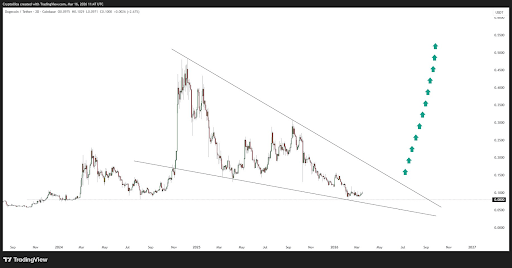
In an X post, Cryptollica shared a quantitative roadmap that could send Dogecoin to a new ATH. He noted that institutional quantitative models see DOGE as a perfectly engineered macroeconomic fractal while the retail crowd is paralyzed by micro-volatility. As part of this quantitative roadmap, the analyst pointed to the $0.08 level, which he described as an “absolute bedrock” and institutional floor for the meme coin.

Cryptollica noted a horizontal dotted axis at $0.08, while reiterating that this level was an impenetrable “Volumetric Bedrock” where smart money has historically placed massive absorption blocks. He added that Dogecoin’s price is currently resting directly on this mathematical floor, and is quantitatively refusing to break lower.
Source: Chart from Cryptollica on X

His accompanying chart showed that Dogecoin could bottom out at this level if the bear market extends into the latter part of this year. DOGE could then see a bullish reversal, sending it to new highs above $0.5.This rally above $0.5 is expected to happen between year-end and the start of 2027.

Key Indicators To Keep An Eye On

Cryptollica drew attention to the heavy descending black vector that is suppressing Dogecoin’s price against the $0.08 support. The analyst said that DOGE is now suffocating in a “Terminal Apex” and that the downward kinetic energy is dead. “There is literally zero room left for sideways movement,” he declared.

Furthermore, the analyst noted that a massive Descending Wedge resting perfectly on an absolute horizontal floor means that the pricing asymmetry is at its absolute peak. Cryptollica assured that the green vectors on his accompanying chart are not a guess but the systemic kinetic projection of the trapped energy. He claimed that algorithms are silently vacuuming the remaining supply while retail investors panic-sell.

With Dogecoin at the exact millimeter of the structural apex, Cryptollica outlined two algorithmic protocols that could determine investors’ next move. One is a front-run of the breakout, in which investors are gradually accumulating right now while the DOGE price is trading just above this $0.08 ‘bedrock’ support. The analyst said that the second move investors could make is to wait for the massive green breakout candle to confirm the trend and then end up buying higher because of a lack of conviction.

At the time of writing, the Dogecoin price is trading at around $0.09547, down over 5% in the last 24 hours, according to data from CoinMarketCap.

DOGE trading at $0.09 on the 1D chart | Source: DOGEUSDT on Tradingview.com

Пов'язані питання

QWhat is the key support level for Dogecoin according to analyst Cryptollica's quantitative roadmap?

AThe key support level is $0.08, which Cryptollica describes as an 'absolute bedrock' and institutional floor for Dogecoin.

QAccording to the analyst, what is the expected price target and timeframe for Dogecoin to reach a new all-time high?

AThe analyst expects Dogecoin to rally above $0.5, potentially reaching new all-time highs between year-end and the start of 2027.

QWhat two algorithmic protocols does Cryptollica outline for investors considering Dogecoin?

AThe two protocols are: 1) Front-running the breakout by gradually accumulating DOGE near the $0.08 support, or 2) Waiting for a massive green breakout candle to confirm the trend but potentially buying at higher prices.

QHow does Cryptollica characterize the current market behavior between institutions and retail investors regarding Dogecoin?

ACryptollica states that institutional quantitative models see DOGE as a perfectly engineered macroeconomic fractal, while retail investors are paralyzed by micro-volatility and are panic-selling, with algorithms vacuuming up the supply.

QWhat is the current trading price of Dogecoin mentioned at the end of the article?

AAt the time of writing, Dogecoin is trading at approximately $0.09547, down over 5% in the last 24 hours.

Пов'язані матеріали

OpenAI Post-Training Engineer Weng Jiayi Proposes a New Paradigm Hypothesis for Agentic AI

OpenAI engineer Weng Jiayi's "Heuristic Learning" experiments propose a new paradigm for Agentic AI, suggesting that intelligent agents can improve not just by training neural networks, but also by autonomously writing and refining code based on environmental feedback. In the experiment, a coding agent (powered by Codex) was tasked with developing and maintaining a programmatic strategy for the Atari game Breakout. Starting from a basic prompt, the agent iteratively wrote code, ran the game, analyzed logs and video replays to identify failures, and then modified the code. Through this engineering loop of "code-run-debug-update," it evolved a pure Python heuristic strategy that achieved a perfect score of 864 in Breakout and performed competitively with deep reinforcement learning (RL) algorithms in MuJoCo control tasks like Ant and HalfCheetah. This approach, termed Heuristic Learning (HL), contrasts with Deep RL. In HL, experience is captured in readable, modifiable code, tests, logs, and configurations—a software system—rather than being encoded solely into opaque neural network weights. This offers potential advantages in explainability, auditability for safety-critical applications, easier integration of regression tests to combat catastrophic forgetting, and more efficient sample use in early learning stages, as demonstrated in broader tests on 57 Atari games. However, the blog acknowledges clear limitations. Programmatic strategies struggle with tasks requiring long-horizon planning or complex perception (e.g., Montezuma's Revenge), areas where neural networks excel. The future vision is a hybrid architecture: specialized neural networks for fast perception (System 1), HL systems for rules, safety, and local recovery (also System 1), and LLM agents providing high-level feedback and learning from the HL system's data (System 2). The core proposition is that in the era of capable coding agents, a significant portion of an AI's learned experience could be maintained as an auditable, evolving software system.

marsbit26 хв тому

OpenAI Post-Training Engineer Weng Jiayi Proposes a New Paradigm Hypothesis for Agentic AI

marsbit26 хв тому

Your Claude Will Dream Tonight, Don't Disturb It

This article explores the recent phenomenon of AI companies increasingly using anthropomorphic language—like "thinking," "memory," "hallucination," and now "dreaming"—to describe machine learning processes. Focusing on Anthropic's newly announced "Dreaming" feature for its Claude Agent platform, the piece explains that this function is essentially an automated, offline batch processing of an agent's operational logs. It analyzes past task sessions to identify patterns, optimize future actions, and consolidate learnings into a persistent memory system, akin to a form of reinforcement learning and self-correction. The article draws parallels to similar features in other AI agent systems like Hermes Agent and OpenClaw, which also implement mechanisms for reviewing historical data, extracting reusable "skills," and strengthening long-term memory. It notes a key difference from human dreaming: these AI "dreams" still consume computational resources and user tokens. Further context is provided by discussing the technical challenges of managing AI "memory" or context, highlighting the computational expense of large context windows and innovations like Subquadratic's new model claiming drastically longer contexts. The core critique argues that this strategic use of human-centric vocabulary does more than market products; it subtly reshapes user perception. By framing algorithms with terms associated with consciousness, companies blur the line between tool and autonomous entity. This linguistic shift can influence user expectations, tolerance for errors, and even perceptions of responsibility when systems fail, potentially diverting scrutiny from the companies and engineers behind the technology. The article concludes by speculating that terms like "daydreaming" for predictive task simulation might be next, continuing this trend of embedding the idea of an "inner life" into computational processes.

marsbit28 хв тому

Your Claude Will Dream Tonight, Don't Disturb It

marsbit28 хв тому

Торгівля

Спот
Ф'ючерси
活动图片





