An Expensive Fantasy: The Evaporation of Wealth in Metaverse Real Estate

比推Опубліковано о 2026-03-20Востаннє оновлено о 2026-03-20

Анотація

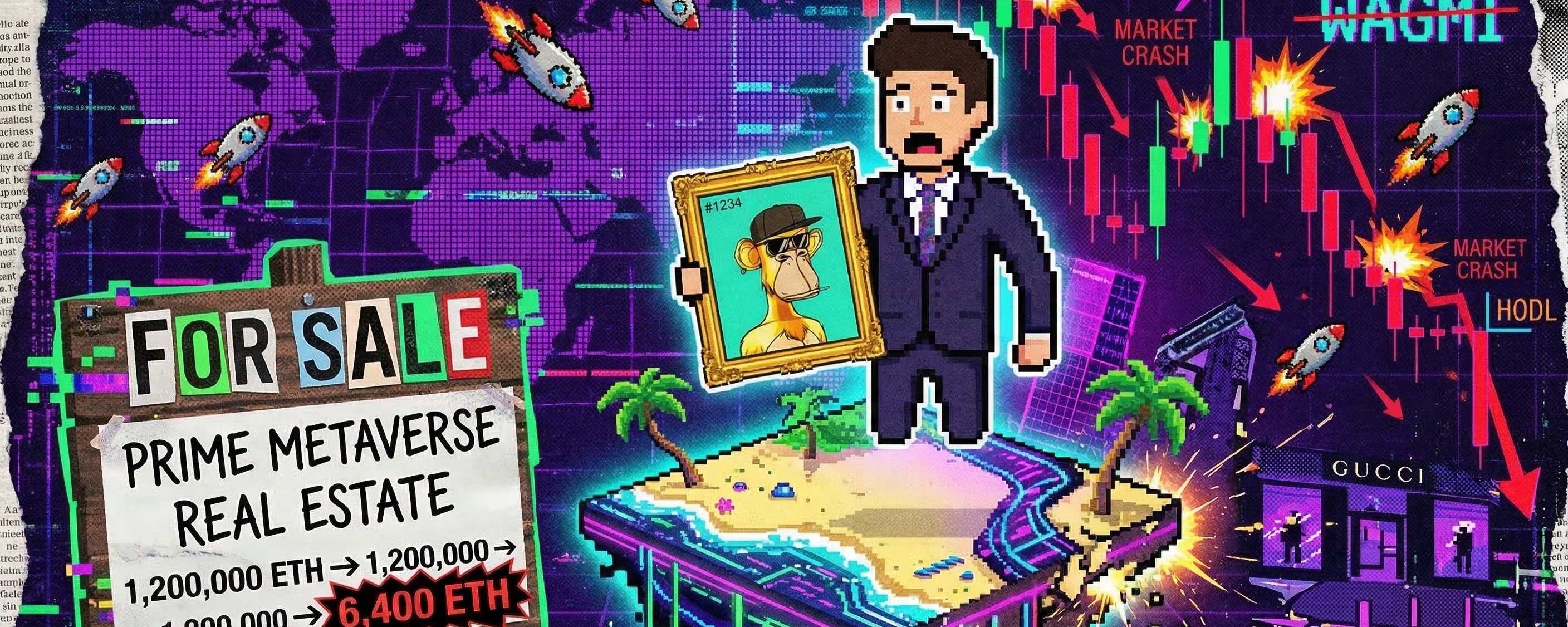
An investor recounts losing a $1.2 million fortune in the metaverse real estate crash, with their portfolio now valued at just $6,400. They purchased 11 virtual properties across platforms like Decentraland, The Sandbox, and Meta’s Horizon Worlds, driven by hype and promises of a digital frontier. Despite early enthusiasm, low user engagement, corporate pullouts (like Gucci), and platform shutdowns led to catastrophic value declines. The investor reflects on the culture of “diamond hands” (holding assets despite massive losses) and irrational optimism, while also noting losses from NFT investments like a Bored Ape. Meta’s $84 billion loss on its metaverse division underscores the speculative bubble’s collapse. The narrative concludes with a shift to AI-based virtual land investment, repeating the cycle of high-risk speculation.

Author: @gothburz

Compiled by: Big Pliers | PANews Lobster

Original Title: Metaverse Real Estate Victim's Account: My $1.2 Million Is Now Only $6,400


"Diamond hands" means: even if your investment drops by 94%, you never sell. We’ve packaged this financial paralysis as a personality trait.

My net worth peaked at $1.2 million.

But not a single cent of that money was real.

I’m not speaking philosophically. I mean, it existed on some servers—and those servers are now shut down.

I owned eleven properties in the metaverse. Three in Decentraland, four in The Sandbox, two in Voxels, one in Otherside. And a seaside villa in Horizon Worlds—I paid $214,000 for it because Mark Zuckerberg himself said it was the "next frontier."

Last week, that "frontier" closed.

It’s now a mobile app.

Last year, I sent the same message to 340 people: "You have no idea how early we were."

I stopped sending those messages later. Not because I admitted I was wrong, but because most of them had blocked me.

I entered the metaverse real estate market in November 2021. Everyone was buying back then. Someone spent $450,000 just to be Snoop Dogg’s neighbor in a game. In a video game. Where the avatars didn’t even have legs.

Yes, those avatars had no legs.

But I thought that was actually a good sign.

"Legs are coming eventually," I told everyone in the Discord group. "Legs are on the product roadmap." Three hundred people immediately replied with rocket emojis.

I gave myself a title—"Digital Real Estate Tycoon."

I put it in my Twitter bio.

I put it in my LinkedIn job title.

I even went on a podcast to talk about it. That podcast had eleven listeners. Three were bots. The rest were my own alt accounts.

My combined virtual properties were larger than my actual apartment.

But my actual apartment has furniture.

Location, location, location.

My most valuable asset was a plot right next to a virtual Gucci store.

In 2023, Gucci pulled out.

The store is still there. No one goes in. It’s like a shopping mall in Ohio—but with worse graphics and no food court.

I didn’t sell.

Diamond hands.

That’s what we always said—"diamond hands." It means: even if your investment drops by 94%, you never sell. We packaged this financial paralysis as a personality trait.

There was a guy in my Discord group who spent $2.4 million on a manor on a prime 618 plot in Decentraland. Prime location. High foot traffic.

I asked him what "foot traffic" meant on a platform with a daily active user count of 38.

He said I didn’t understand the technology.

He was right, I didn’t.

But I kept buying more.

We had a DAO—a decentralized autonomous organization. Meaning, everyone votes on decisions.

There were nine of us total. Three never showed up. Two voted on everything without reading the proposals. The other four were me and my alt accounts.

We voted to "acquire strategic plots."

Unanimously approved.

I cast four votes myself.

My portfolio peaked at $1.2 million. I told everyone. I made a spreadsheet. I predicted a 40x return by 2025. I made a business plan. One slide said:

"We are building a digital economy."

That slide had a rocket emoji.

That was my entire financial model.

In 2023, I spent $189,000 on a Bored Ape NFT.

Now it’s worth $14,000.

I don’t talk about that ape.

But I still use it as my profile picture. If someone asks, I say "I’m long-term bullish."

"Long-term bullish" means: if I sold, I’d cry in a Panera Bread.

My mom asked me what a Bored Ape was.

I said: "Digital art on the blockchain."

She asked why it was more expensive than her car.

I said: "You don’t understand Web3."

She said: "All I know is you live in a studio apartment."

She’s not in my Discord group.

Justin Bieber spent $1.3 million on one.

Now it’s probably worth around $90,000.

Hearing that made me feel better.

That’s the power of community.

WAGMI. We're All Gonna Make It.

We said it every day. In group chats. As the floor price kept dropping. As trading volume dried up. As 95% of NFT projects went to zero.

We’re all gonna make it.

None of us made it.

But we said it with absolute conviction, paired with laser-eye profile pictures. That has to count for something, right?

It doesn’t.

But we said it did. That’s called decentralized consensus.

Meta spent $84 billion on the metaverse.

Let me say that again.

$84 billion.

More than the GDP of Luxembourg. More than the combined GDPs of Iceland, Luxembourg, and Malta. They poured that money into a platform where avatars had no legs, the graphics looked like a 2006 Wii game, and the concurrent user count was lower than the lunch rush at a Chipotle in Des Moines.

They just removed Horizon Worlds from VR headsets.

It continues to exist as a mobile app.

My seaside villa is now a mobile app.

Location, location, location.

Zuckerberg renamed the entire company for this. Facebook became Meta. A $900 billion company changed its legal name because the CEO watched *Ready Player One* and said, "I want that."

Reality Labs division: lost $10 billion in 2021, $14 billion in 2022, $16 billion in 2023, $18 billion in 2024, $19 billion in 2025.

This isn’t strategy; it’s speedrunning.

This year, they laid off 1,500 employees from Reality Labs. Shut down three VR studios. Canceled Supernatural. Put the entire VR social vision in a coffin and announced: "We’re pivoting to AI and wearables."

This pivot took four years and burned $84 billion.

I pivoted too.

I’m now an AI real estate investor.

I bought a plot in an AI-generated virtual world that doesn’t exist yet. The founder said it’s at the "intersection of spatial computing and large language models."

I have no idea what that means.

I gave him $40,000.

He has a whitepaper, 47 pages. I read the title and the tokenomics section. That section was a pie chart. I love pie charts. They make everything look planned.

This project has a roadmap. Q1: Build community. Q2: Launch beta. Q3: Expand ecosystem. Q4: Blank.

Q4 is always blank.

That’s the slot reserved for the exit.

My accountant asked me to value my metaverse portfolio for tax purposes.

I said: $1.2 million.

He said: Current market value.

I said: $6,400.

He stared at me for eleven seconds.

I know because I counted.

He asked if I had any other investments.

I showed him my NFTs.

He stared longer.

I said these are "cultural artifacts with long-term provenance."

He asked if I had considered buying a 401(k).

I said 401(k)s are "legacy artifacts of traditional finance."

He told me to leave his office.

The metaverse is dead.

I don’t accept that.

I am a digital real estate tycoon. I own eleven properties across four platforms. I have a seaside villa that’s now a mobile app, a plot next to an empty Gucci store, and a cartoon monkey that cost more than my actual car.

Location, location, location.

This location is nothingness.

But I was early.

I’m always early.

It’s the same thing as being wrong—just said with more confidence.


Twitter:https://twitter.com/BitpushNewsCN

Bitpush TG Discussion Group:https://t.me/BitPushCommunity

Bitpush TG Subscription: https://t.me/bitpush

Original article link:https://www.bitpush.news/articles/7621504

Пов'язані питання

QWhat was the peak value of the author's metaverse real estate portfolio, and what is its current estimated value?

AThe peak value of the author's metaverse real estate portfolio was $1.2 million. Its current estimated value is $6,400.

QAccording to the author, what does the term 'diamond hands' mean in the context of their investment strategy?

AAccording to the author, 'diamond hands' means refusing to sell an investment even after it has fallen by 94%, a form of financial paralysis that was packaged as a personality trait.

QWhich major company invested heavily in the metaverse, how much did it lose, and what was the consequence for the author's property?

AMeta (formerly Facebook) invested heavily in the metaverse, losing over $100 billion across several years. A consequence for the author was that their $214,000 Horizon Worlds 'ocean-view villa' was moved from VR to a mobile app after the platform was shut down on VR headsets.

QWhat expensive NFT did the author purchase and what is the significant difference between its purchase price and its current value?

AThe author purchased a Bored Ape Yacht Club (BAYC) NFT for $189,000. It is now worth approximately $14,000, representing a significant loss.

QWhat ironic justification does the author use for their continued investment in digital assets despite the massive financial losses?

AThe author ironically justifies their continued investment by claiming they were 'early,' which they state is the same thing as being wrong, but said with more confidence.

Пов'язані матеріали

KOL's Perspective: Why Is SOL Set to Rise from This Point?

**Summary: Why SOL is Positioned for Growth at This Level** The article argues that SOL is poised for an upward move from its current price point, citing several key factors. Primarily, SOL has just broken out of a 4-month consolidation phase. This breakout signals a return of risk appetite to the broader crypto market, as SOL is seen as a key indicator of overall crypto health. The token's ownership has reportedly shifted from short-term traders and tourists to long-term accumulators, leading to low volume. Any meaningful increase in trading activity could thus trigger significant upward momentum. Fundamental strengths include strong institutional adoption, integration with DeFi and RWAs (Real-World Assets), and the potential benefits from the Clarity Act. Despite its high volatility—having dropped 70% from its all-time high but still up 12x from its bear market low—SOL is highlighted as one of the few tokens from the last cycle to reach new highs. It boasts a robust ecosystem of applications, users, and protocols. Future catalysts include the expected influx of AI developers following the Miami Accelerate conference, which focused on AI on Solana. Furthermore, Solana is positioned as the premier chain for memecoin activity, a trend expected to continue and drive network usage and fees. The article concludes that recent price action reflects a healthy transfer to long-term holders, setting the stage for growth.

marsbit32 хв тому

KOL's Perspective: Why Is SOL Set to Rise from This Point?

marsbit32 хв тому

Those Pre-Bitcoin PoW Protocols Have Recently Been Reimplemented

This article details a recent surge in replicating pre-Bitcoin Proof-of-Work (PoW) protocols, specifically focusing on Hal Finney's 2004 RPOW (Reusable Proofs of Work). Within five days in May 2026, multiple independent builders in the Bitcoin/cypherpunk community launched projects inspired by this early electronic cash proposal. The initiative began with Fred Krueger's `rpow2.com`, a centralized but auditable system that replaced RPOW's original IBM 4758 hardware with Ed25519 signatures. Initially a faithful replica, it later adopted Bitcoin-like features (21M supply cap, difficulty adjustment) and a controversial 5.24% founder allocation. This sparked rapid forks, including `rpow4.com` which incorporated full Bitcoin parameters, a prediction market (`rpowmarket.com`), and a DEX (`rpow2swap.com`). Concurrently, Mike In Space created a prototype of Wei Dai's 1998 b-money proposal (`b-money.replit.app`), pushing the historical exploration even further back. The article contrasts these centralized, server-dependent experiments with Bitcoin's core innovation of decentralized, trustless consensus. It also highlights a parallel development: the `HASH` project on Ethereum, which uses smart contract hooks to enable a purely fair-launch, browser-mineable PoW token with 0% allocations to team or VCs. The collective activity is framed as a meme-driven, educational exploration of cypherpunk history rather than a serious financial movement, with all projects heavily disclaiming any investment value.

marsbit36 хв тому

Those Pre-Bitcoin PoW Protocols Have Recently Been Reimplemented

marsbit36 хв тому

South Korean Exchanges 'Battle' Regulators, Challenging the Boundaries of Enforcement and Legislation

South Korea's cryptocurrency industry is engaged in a rare, direct confrontation with regulators. The Financial Intelligence Unit (FIU), the primary anti-money laundering (AML) watchdog, has recently imposed heavy penalties on major exchanges like Upbit and Bithumb for alleged violations involving unregistered overseas VASPs and AML procedures. However, exchanges are now actively challenging these actions in court and through industry associations. In a significant shift, the Seoul Administrative Court ruled in favor of Upbit's operator, Dunamu, overturning part of an FIU-ordered business suspension. The court found the FIU's penalty criteria and justification insufficiently clear. Similarly, the court suspended the enforcement of a six-month business suspension against Bithumb pending a final ruling, citing potential irreversible harm to the exchange. Beyond legal battles, the industry is contesting proposed legislative amendments. The Digital Asset eXchange Alliance (DAXA) strongly opposes a draft rule that would mandate Suspicious Transaction Reports (STRs) for all crypto transfers over 10 million KRW (~$6,800). DAXA argues this "poison pill" clause violates legal principles and would overwhelm the STR system, increasing reports from 63,000 to an estimated 5.45 million annually for major exchanges, thereby crippling effective AML monitoring. This conflict highlights a structural tension in South Korea's crypto governance: comprehensive digital asset laws are still developing, while regulators rely heavily on AML enforcement. The industry's move from passive compliance to active legal and legislative challenges signifies a new phase, pressing for clearer rules and more proportionate enforcement. While short-term disputes may intensify, this clash could ultimately lead to a more mature and sustainable regulatory framework for South Korea's vibrant crypto market.

marsbit1 год тому

South Korean Exchanges 'Battle' Regulators, Challenging the Boundaries of Enforcement and Legislation

marsbit1 год тому

After 50x Storage Surge, Justin Sun Always Looks to the Next Decade

Sun Yuchen, known for his controversial stunts like a $30 million lunch with Warren Buffett (canceled due to a kidney stone) and eating a $6.2 million duct-taped banana, is often overshadowed by a significant fact: his decade-long track record of spotting major investment trends. In 2016, he famously advised young people to invest in Bitcoin, Nvidia, Tesla, and Tencent instead of buying property. A hypothetical $20,000 investment in Nvidia and Tesla from that list would now be worth over 50 million RMB. His latest major call was on November 6, 2025, predicting a "50x storage opportunity" tied to the AI boom, which materialized with Sandisk's stock surging nearly 50-fold by 2026. Looking ahead, Sun now focuses on the next frontier: Physical AI. He identifies four key areas: 1. **Embodied AI/Robotics**: He sees this reaching its "iPhone moment," with companies like UBTech and Galaxy General leading in commercialization. 2. **Drones**: Viewed as the first commercially viable form of Physical AI, revolutionizing sectors from warfare (e.g., AeroVironment's Switchblade) to logistics. 3. **Spatial Computing**: Beyond VR, it's about AI understanding physical space, a foundational technology for robotics and autonomous systems, exemplified by Apple's Vision Pro. 4. **Space Exploration**: After a 2025 suborbital flight with Blue Origin, Sun advocates for space as the ultimate frontier, discussing blockchain's potential role in space asset management and data transactions. His investment philosophy involves betting on entire, inevitable trends rather than single companies. For robotics, he sees Tesla (the body/manufacturer) and Nvidia (the brain/AI platform) as complementary plays. In defense drones, he highlights companies making tanks obsolete (AeroVironment) and those augmenting fighter jets (Kratos). For space, he participated in Blue Origin's flight and anticipates SpaceX's potential IPO to redefine the sector's valuation. Sun Yuchen's vision frames the next two decades not as a revolution in information flow (like the internet), but in the fundamental operation of the physical world through AI-powered robots, autonomous systems, and spatial intelligence, ultimately extending human and AI activity into space. While many still focus on conventional assets, he continues to look toward the next technological horizon.

marsbit2 год тому

After 50x Storage Surge, Justin Sun Always Looks to the Next Decade

marsbit2 год тому

Торгівля

Спот
Ф'ючерси
活动图片