An App Made for 1000 RMB Now Valued at 10 Million

marsbitОпубліковано о 2026-01-12Востаннє оновлено о 2026-01-12

Анотація

Three post-95s developers spent 1,000 RMB and less than a month to create an app called “Died Yet?” — now valued at 10 million RMB. The app allows users to check in daily to confirm they are alive. If a user misses two consecutive check-ins, the system automatically sends an email to their emergency contact. Launched on January 8, it quickly topped Apple’s paid app chart at 8 RMB per download. Paying users grew 200-fold in days. A capital offer followed: the founders are considering selling 10% equity for 1 million RMB, implying a 10 million RMB valuation. The app taps into a real anxiety: China has over 120 million people living alone, a number expected to reach 200 million by 2030. The app’s viral name, “Died Yet?”, originated from an online meme and was key to its success. A copycat app, “Alive Yet?”, emerged within 24 hours, but the founders argue the concept—not the tech—is the core value. The piece contrasts this with crypto valuations, citing Fuel Network—a project once valued at $1 billion with minimal users, now down 99%—to highlight different valuation models: one driven by real users and payments, the other by narrative and tokenomics. The author concludes that “Died Yet?” offers more tangible value than most speculative assets.

Written by: Curry, Shenchao TechFlow

Three post-95s spent 1000 RMB and took less than a month to create an App.

Now it's valued at 10 million. A ten-thousand-fold increase.

This App is called "Is He Dead", and its function is ridiculously simple: open it every day and check in to prove you're still alive. If you don't check in for two consecutive days, the system automatically sends an email to your emergency contact.

That's it?

Yeah, that's it.

On January 8th, it topped the Apple paid charts, costing 8 RMB to download. Founder Mr. Guo said that the number of paying users has increased 200-fold in the past few days and is still rising.

Capital came knocking. Mr. Guo said he plans to sell 10% of the shares for 1 million RMB. Doing the math, that's a valuation of 10 million.
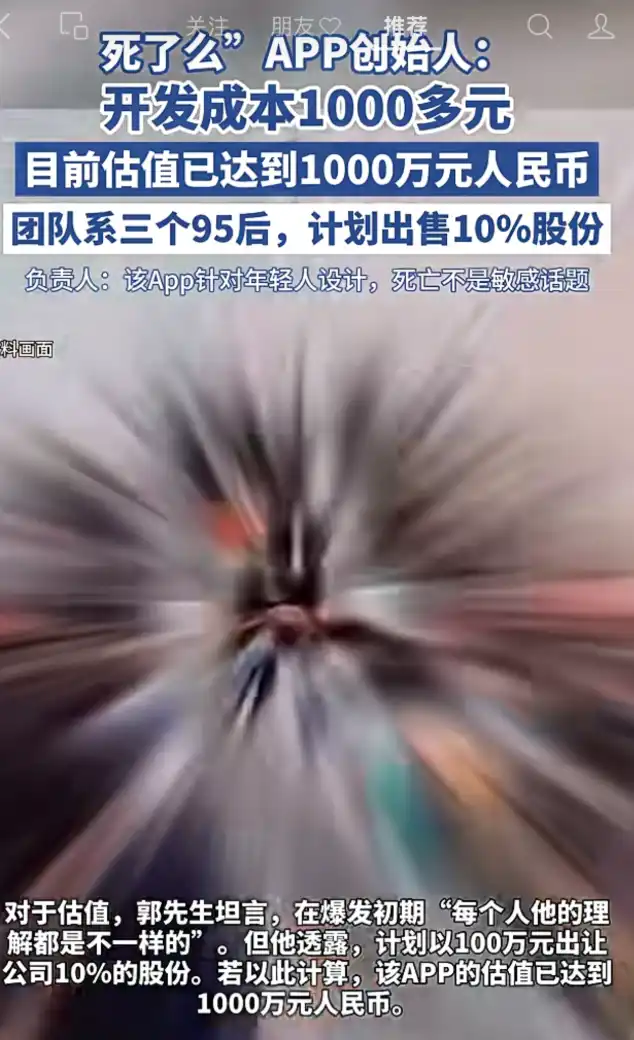
The name "Is He Dead" comes from a viral internet meme a few years ago.

Someone asked on a social platform: What App does everyone need and will definitely download?

A highly upvoted answer: Is He Dead.

Mr. Guo and his team saw this discussion and thought it had potential. They went to trademark the name and found that surprisingly, no one had registered it.

So they made it.

Why did something so simple become popular?

China's solo-living population exceeded 120 million in 2024. By 2030, it's projected to be 150 to 200 million. These people live in rental apartments in cities like Beijing, Shanghai, Guangzhou, and Shenzhen, sharing a common, very real anxiety:

If something happens to me at home one day, how long will it take for someone to find out? So, 8 RMB buys the confirmation that "someone knows I'm still alive."

Less than 24 hours after "Is He Dead" went viral, a copycat appeared.

An App called "Is He Alive" was listed on the Apple App Store, with exactly the same function, free to download.
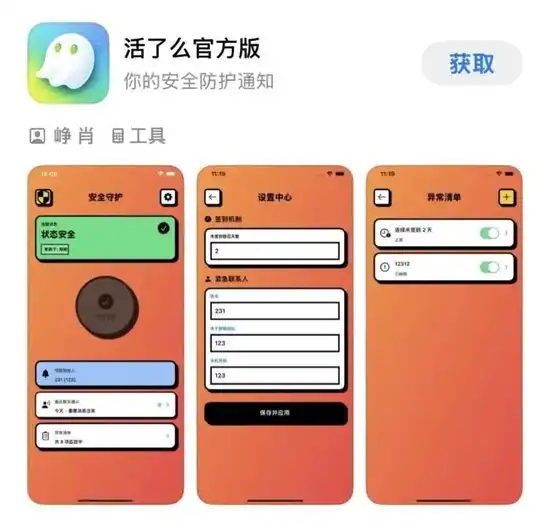
In response, Mr. Guo was very calm: The advantage of this product is not its technical barrier, but its discovery of user needs.

Translation: You can copy the function, but you can't copy my name.

Indeed. The three words "Is He Dead" are the most valuable part of this product. If it had been called "Solo Living Safety Guard," it would probably still be gathering dust in a corner of the App Store.

Looking back, an APP with no technical barrier, costing 1000 RMB, valued at 10 million, is that expensive?

Well, you might want to look at the valuation methods once used in the crypto industry?

In 2025, there was a crypto project called Fuel Network, working on a "modular blockchain execution layer." VCs gave it a valuation of 1 billion USD, roughly over 7 billion RMB.

700 times the valuation of "Is He Dead".

What does Fuel Network have?

A whitepaper, a roadmap, endorsements from a bunch of Tier1 institutions, videos of the founders speaking at major conferences.

But not many people actually using it.

What is Fuel Network's market cap now? Around 16 million USD. Down about 99% from its peak.
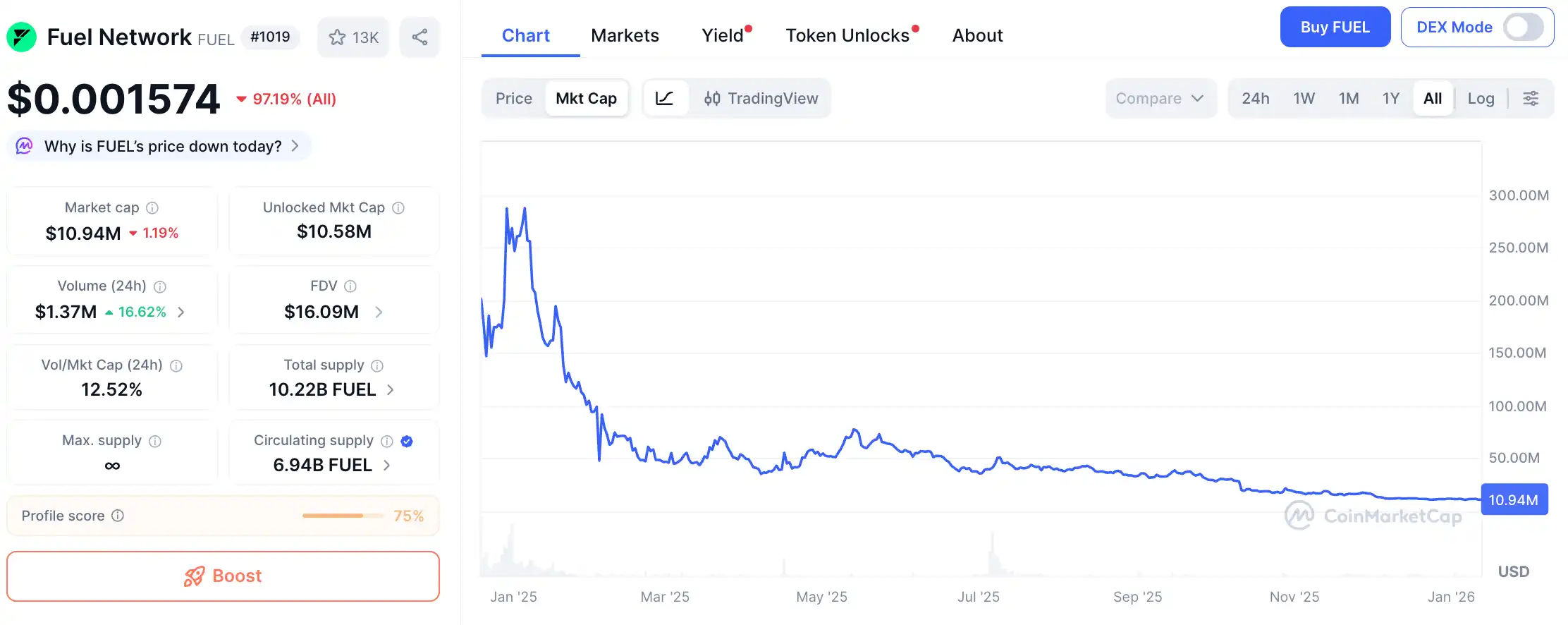
I'm not saying all crypto projects are scams.

I'm saying:

In the crypto world, a project can have no users, no revenue, no one actually using it, and still get a valuation of 1 billion USD.

In the world of "Is He Dead", you need people to actually pay 8 RMB to download it for it to count.

One gives a valuation first and then looks for users. The other has users first and then discusses valuation.

Which is more reasonable? I don't know.

What's more absurd is that the logic of "Is He Dead" is almost heresy in the crypto world.

You tell everyone: We have real users, real payments, solving a real need.

People will definitely ask: What's the narrative? The token economic model? What's the FDV?

You say: No token, just selling the App, 8 RMB each.

Everyone: Then why would I invest in you?

This isn't a joke. The crypto industry's valuation system operates like this.

Users aren't important, revenue isn't important; what's important is whether the story is sexy enough, whether the token can list on major exchanges, and whether the unlock schedule is long enough for early investors to have time to dump.

If "Is He Dead" issued a token, created a "Solo Living Chain", and painted a big picture of the "global loneliness economy", its valuation might really increase tenfold.

But then, it might not have real users anymore.

Perhaps the reason "Is He Dead" became popular is precisely because it serves people who have this anxiety but don't actually need it that badly.

The people who truly need it probably can't use it.

This is actually quite similar to the crypto industry:

Those who truly need "financial inclusion" are often the ones who can least use DeFi.

In the end, whether 10 million is expensive depends on what ruler you use.

Using the internet ruler: one month of development, a team of three, no funding, no burning cash, reaching number one on the paid charts, 10 million is not expensive.

Using the crypto ruler: no token, no narrative, no FDV, only 10 million? That's too cheap. How about issuing a token?

I think the most ironic point is the divide between Web2 and Web3:

In one world, "having users" is a prerequisite for valuation. In another world, "having users" is an accident of valuation.

After writing this, I actually downloaded "Is He Dead" and checked in.

8 RMB for peace of mind.

At least it's more reliable than most of the shitcoins I've bought.

Пов'язані питання

QWhat is the name of the app developed by three post-95s with an initial cost of 1000 RMB, and what is its core function?

AThe app is called '死了么' (translated as 'Is It Dead'). Its core function is to allow users to sign in daily to prove they are alive. If a user fails to sign in for two consecutive days, the system automatically sends an email to their emergency contact.

QHow much did the app '死了么' cost to download, and what was its performance on the Apple paid charts?

AThe app cost 8 RMB to download. It reached number one on the Apple paid charts on January 8th.

QWhat is the estimated valuation of the '死了么' app, and how was this valuation determined?

AThe app has an estimated valuation of 10 million RMB. This was determined as the founder, Mr. Guo, plans to sell 10% of the company's shares for 1 million RMB.

QAccording to the article, what is the valuation approach in the crypto industry contrasted with that of the '死了么' app?

AIn the crypto industry, projects can receive high valuations based on narratives, token economic models, and backing from institutions, even without real users or revenue. In contrast, the '死了么' app's valuation is based on actual user downloads and payments, emphasizing real user demand.

QWhat ironic point does the article make about the target audience of the '死了么' app and its similarity to the crypto industry?

AThe article points out that the app likely serves people who have the anxiety of being found in case of an emergency but don't truly need it, while those who genuinely need it might not use it. This is similar to the crypto industry, where those who truly need 'financial inclusion' are often the least able to use DeFi.

Пов'язані матеріали

Gensyn AI: Don't Let AI Repeat the Mistakes of the Internet

In recent months, the rapid growth of the AI industry has attracted significant talent from the crypto sector. A persistent question among researchers intersecting both fields is whether blockchain can become a foundational part of AI infrastructure. While many previous AI and Crypto projects focused on application layers (like AI Agents, on-chain reasoning, data markets, and compute rentals), few achieved viable commercial models. Gensyn differentiates itself by targeting the most critical and expensive layer of AI: model training. Gensyn aims to organize globally distributed GPU resources into an open AI training network. Developers can submit training tasks, nodes provide computational power, and the network verifies results while distributing incentives. The core issue addressed is not decentralization for its own sake, but the increasing centralization of compute power among tech giants. In the era of large models, access to GPUs (like the H100) has become a decisive bottleneck, dictating the pace of AI development. Major AI companies are heavily dependent on large cloud providers for compute resources. Gensyn's approach is significant for several reasons: 1) It operates at the core infrastructure layer (model training), the most resource-intensive and technically demanding part of the AI value chain. 2) It proposes a more open, collaborative model for compute, potentially increasing resource utilization by dynamically pooling idle GPUs, similar to early cloud computing logic. 3) Its technical moat lies in solving complex challenges like verifying training results, ensuring node honesty, and maintaining reliability in a distributed environment—making it more of a deep-tech infrastructure company. 4) It targets a validated, high-growth market with genuine demand, rather than pursuing blockchain integration without purpose. Ultimately, the boundaries between Crypto and AI are blurring. AI requires global resource coordination, incentive mechanisms, and collaborative systems—areas where crypto-native solutions excel. Gensyn represents a step toward making advanced training capabilities more accessible and collaborative, moving beyond a niche controlled by a few giants. If successful, it could evolve into a fundamental piece of AI infrastructure, where the most enduring value in the AI era is often created.

marsbit12 год тому

Gensyn AI: Don't Let AI Repeat the Mistakes of the Internet

marsbit12 год тому

Why is China's AI Developing So Fast? The Answer Lies Inside the Labs

A US researcher's visit to China's top AI labs reveals distinct cultural and organizational factors driving China's rapid AI development. While talent, data, and compute are similar to the West, Chinese labs excel through a pragmatic, execution-focused culture: less emphasis on individual stardom and conceptual debate, and more on teamwork, engineering optimization, and mastering the full tech stack. A key advantage is the integration of young students and researchers who approach model-building with fresh perspectives and low ego, prioritizing collective progress over personal credit. This contrasts with the US culture of self-promotion and "star scientist" narratives. Chinese labs also exhibit a strong "build, don't buy" mentality, preferring to develop core capabilities—like data pipelines and environments—in-house rather than relying on external services. The ecosystem feels more collaborative than tribal, with mutual respect among labs. While government support exists, its scale is unclear, and technical decisions appear driven by labs, not state mandates. Chinese companies across sectors, from platforms to consumer tech, are building their own foundational models to control their tech destiny, reflecting a broader cultural drive for technological sovereignty. Demand for AI is emerging, with spending patterns potentially mirroring cloud infrastructure more than traditional SaaS. Despite challenges like a less mature data industry and GPU shortages, Chinese labs are propelled by vast talent, rapid iteration, and deep integration with the open-source community. The competition is evolving beyond a pure model race into a contest of organizational execution, developer ecosystems, and industrial pragmatism.

marsbit13 год тому

Why is China's AI Developing So Fast? The Answer Lies Inside the Labs

marsbit13 год тому

3 Years, 5 Times: The Rebirth of a Century-Old Glass Factory

Corning, a 175-year-old glass company, is experiencing a dramatic revival as a key player in AI infrastructure, driven by surging demand for high-performance optical fiber in data centers. AI data centers require vastly more fiber than traditional ones—5 to 10 times as much per rack—to handle high-speed data transmission between GPUs. This structural demand shift, coupled with supply constraints from the lengthy expansion cycle for fiber preforms, has created a significant supply-demand gap. Nvidia has invested in Corning, along with Lumentum and Coherent, in a $4.5 billion total commitment to secure the optical supply chain for AI. Corning's competitive edge lies in its expertise in producing ultra-low-loss, high-density, and bend-resistant specialty fiber, which is critical for 800G+ and future 1.6T data rates. Its deep involvement in co-packaged optics (CPO) with partners like Nvidia further solidifies its position. While not the largest fiber manufacturer globally, Corning's revenue from enterprise/data center clients now exceeds 40% of its optical communications sales, and it has secured multi-year supply agreements with major hyperscalers including Meta and Nvidia. Financially, Corning's optical communications revenue has surged, doubling from $1.3 billion in 2023 to over $3 billion in 2025. Its stock price has risen nearly 6-fold since late 2023. Key future catalysts include the rollout of Nvidia's CPO products and the scale of undisclosed customer agreements. However, risks include high current valuations and potential disruption from next-generation technologies like hollow-core fiber. The company's long-term bet on light over electricity, maintained even through the telecom bubble crash, is now being validated by the AI boom.

marsbit14 год тому

3 Years, 5 Times: The Rebirth of a Century-Old Glass Factory

marsbit14 год тому

Торгівля

Спот
Ф'ючерси
活动图片