An 18-Year-Old Hacker Brags on Discord, Accidentally Reveals a $19 Million Theft Case

marsbitОпубліковано о 2026-05-13Востаннє оновлено о 2026-05-13

Анотація

An 18-year-old American hacker, Dritan Kapllani Jr., has been exposed by on-chain investigator ZachXBT for allegedly masterminding a series of social engineering attacks that stole approximately $19 million from crypto users. The investigation began after a Discord voice call on April 23, 2026, where Dritan shared his screen to boast, revealing an Exodus wallet holding around $3.68 million. Tracing this address, ZachXBT linked it to a major March 14, 2026 theft of 185 BTC (worth ~$13 million at the time), with about $5.3 million of that sum funneled into Dritan's wallet. Further analysis revealed the wallet also contained over $5.85 million from multiple social engineering thefts dating back to 2025. In a May 11, 2026 unsealed criminal complaint against another individual, Trenton Johnson, a key co-conspirator marked "CC-1" is identified, with the on-chain community pointing to Dritan. While not formally charged yet, he is now named in the judicial narrative. Another individual, Meme coin KOL yelotree, faces charges for allegedly assisting in money laundering. Dritan, known for a lavish lifestyle on social media, was previously seen as having a "protagonist aura" within hacking circles, evading consequences as associates were apprehended. However, now that he has turned 18, he is facing legal accountability for his past actions.

Author | Asher(@Asher_0210)

Last night, on-chain investigator ZachXBT exposed an 18-year-old hacker from the United States named Dritan Kapllani Jr. According to the disclosed information, this young man is suspected of involvement in multiple social engineering attacks targeting crypto users, with a total involved amount of approximately $19 million. Although he has not been formally charged yet, he has been included in U.S. judicial documents as a 'co-conspirator'.

This case quickly drew attention, not only due to the massive amount involved but also because of its highly dramatic starting point—a voice call meant for showing off wealth became the breakthrough for the entire investigation.

Just Bragged Once on Discord

On April 23, 2026, a dispute in a Discord voice channel kicked off this series of events.

It was a voice call known as 'Band 4 Band', where participants compared their 'strength' in the most direct way—by displaying their holdings. The atmosphere quickly shifted from banter to competition. Driven by this mood, in order to prove he was richer, Dritan directly started a screen share, showing his Exodus wallet interface with a balance of about $3.68 million.
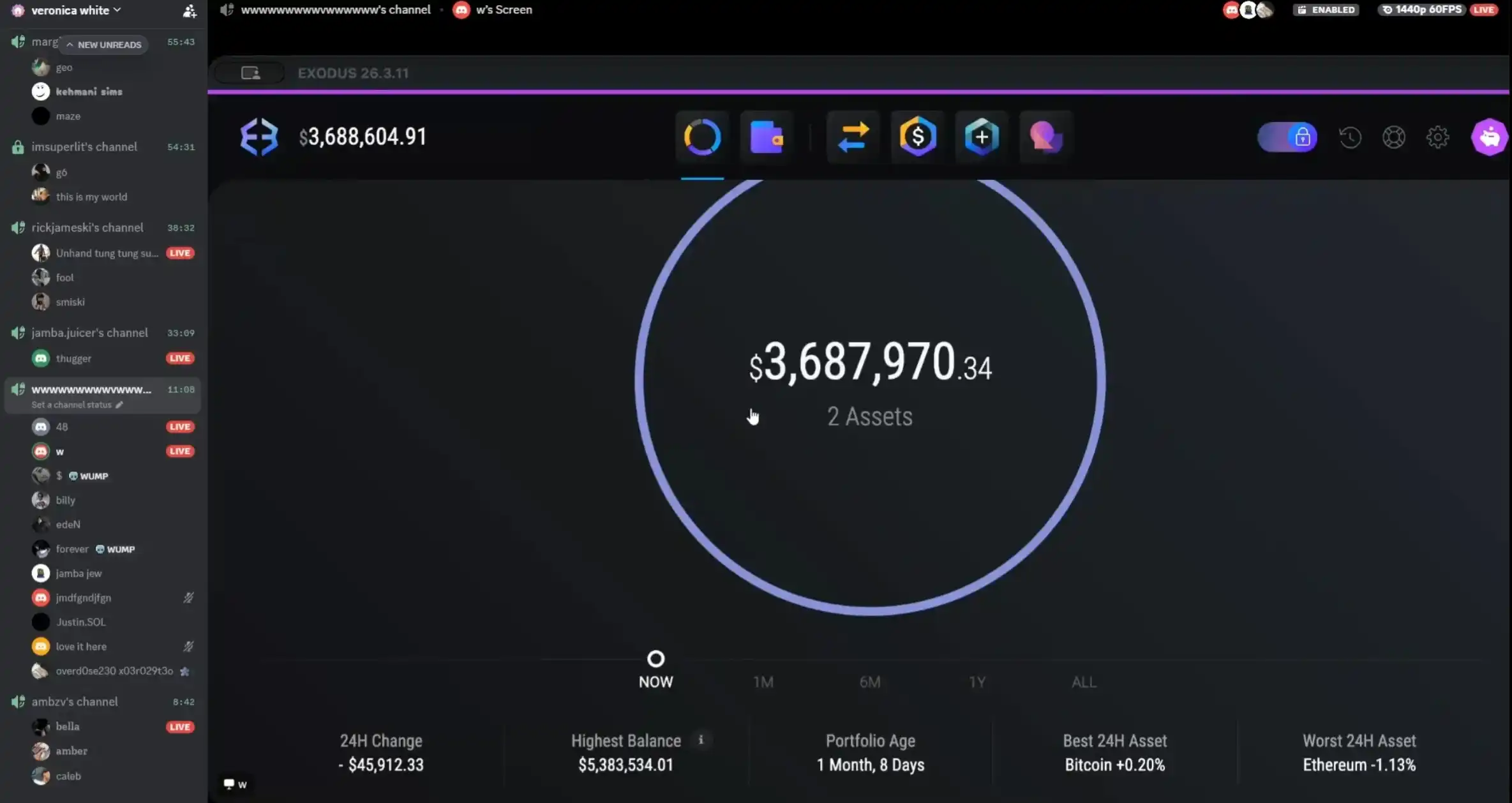
A few weeks later, this scene was revisited. On-chain investigator ZachXBT started from this address, piecing together originally scattered transactions one by one, gradually revealing a longer trail of funds.

A Trail of 185 Bitcoin Theft Funds Emerges

Going back to March 14, 2026, a social engineering theft involving 185 Bitcoins occurred, valued at about $13 million at the time. The funds were quickly moved out of the original address and rapidly entered an on-chain splitting system.

Just the next day, approximately $5.3 million of it was transferred into the wallet Dritan had shown during the Discord voice call (address: 0x4487db847db2fc99372a985743a26f46e0b2bba6). Over the following weeks, this sum of about $5.3 million was continuously split, transferred through multiple addresses, and flowed to different destinations. By the time of the April 23rd voice conversation, about $1.6 million had been further moved.
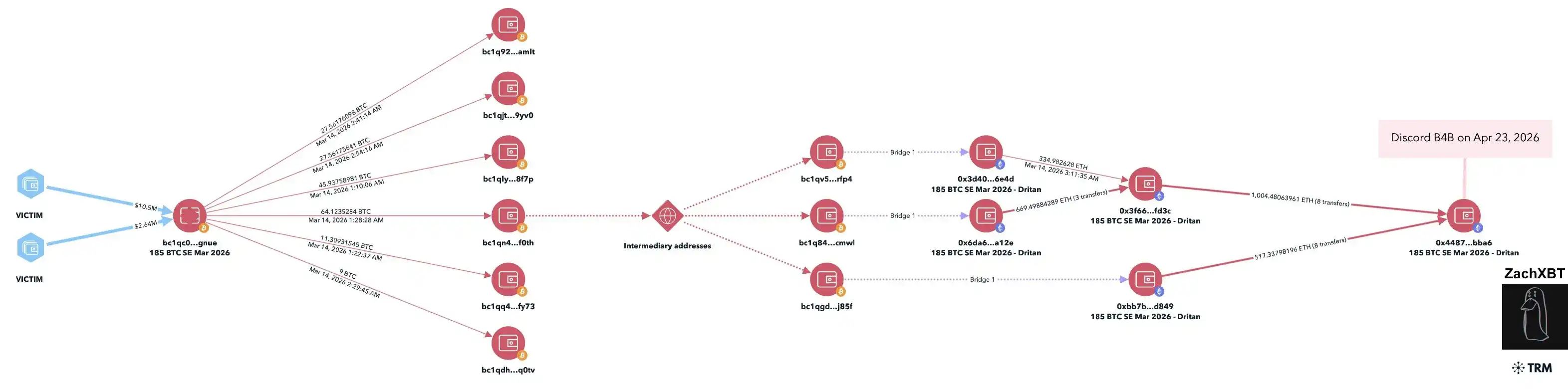
Not the First Time Involved in Crypto Theft

Tracing back from the wallet address Dritan showed, it soon became clear that the funds inside weren't just from that 185 Bitcoin theft.

According to on-chain analysis, the funds in this wallet can be traced back to multiple social engineering thefts in 2025, totaling over $5.85 million. Different victims, different times, but after the funds were transferred away, they would be quickly split, then moved through a series of addresses, following a very similar path. Matching up these funds transaction by transaction shows that many transfers ultimately landed in this wallet address Dritan displayed.

It's worth noting that Dritan once had a 'Band 4 Band' dispute with hacker John Daghita (Lick). Lick was later arrested for allegedly stealing approximately $46 million in U.S. government funds. In a later deleted Telegram post, he had publicly disclosed Dritan's old address (address: 0x97da0685dbba50b4cbabb0ca9e8336f4fbe41122), an act now appearing more like retaliation.

Judging from the on-chain behavior, this old address is highly consistent with the fund flow of the wallet Dritan displayed in terms of fund splitting methods, transfer paths, and subsequent destinations, and is therefore believed to be used by the same controlling party.

First Official 'Mention' in Judicial Documents

It wasn't until May 11, 2026, that this on-chain fund trail was formally confirmed for the first time in a judicial document. That day, the criminal indictment against Trenton Johnson was unsealed. He was charged for his involvement in the 185 Bitcoin theft case and faces up to 40 years in prison.

In the indictment, a key co-conspirator is labeled as 'Co-Conspirator 1 (CC-1)', and the on-chain analysis community has linked this identity to Dritan Kapllani Jr. Although Dritan has not been formally charged yet, he has moved from being an 'associated address' in on-chain inference to a 'co-conspirator' in the judicial narrative.

Furthermore, the same document mentions another involved person—Meme coin KOL yelotree, who is accused of assisting in money laundering through his Miami-based car rental business and faces up to 30 years in prison.

Turning 18, The End of a Decadent Life

Previously, Dritan had long lived a lavish lifestyle, frequently posting related content on Instagram and interacting with other hackers via Telegram. Within hacker circles, he was once considered to have a sort of 'protagonist aura'—multiple associated groups around him (such as ACG, 41 / RM Boyz, etc.) were successively dealt with by law enforcement, yet he himself remained untouched.

However, as he turned 18, this 'aura' came to an end, and his past actions began to be pursued legally.


Пов'язані питання

QWho exposed the 18-year-old hacker Dritan Kapllani Jr. and what was the alleged total amount involved?

AHe was exposed by on-chain detective ZachXBT. He is alleged to have participated in multiple social engineering attacks targeting crypto users, with a cumulative amount involved of approximately $19 million.

QWhat was the dramatic starting point for the investigation into Dritan Kapllani Jr.'s activities?

AThe investigation began after he screen-shared his Exodus wallet, showing a balance of about $3.68 million, during a 'Band 4 Band' argument in a Discord voice call where participants compared their wealth.

QAccording to the article, which specific wallet address did Dritan share in the Discord call, and what major theft was it linked to?

AThe wallet address he shared was 0x4487db847db2fc99372a985743a26f46e0b2bba6. It was linked to a 185 Bitcoin social engineering theft worth about $13 million that occurred on March 14, 2026, with approximately $5.3 million from that theft flowing into this address.

QWhat is Dritan Kapllani Jr.'s current legal status according to the unsealed indictment against Trenton Johnson?

AIn the unsealed criminal indictment against Trenton Johnson, Dritan Kapllani Jr. is referred to as 'Co-Conspirator 1 (CC-1).' While he has not been formally charged yet, he has been officially named as a co-conspirator in the judicial narrative.

QHow did the article describe the change in Dritan Kapllani Jr.'s situation after he turned 18?

AThe article states that after turning 18, his 'main character halo' (a perception of immunity) ended. His past actions are now subject to legal accountability, marking an end to his previously lavish and seemingly consequence-free lifestyle.

Пов'язані матеріали

TechFlow Intelligence Bureau: Chip Stocks Lose Trillions in a Single Day, Bitcoin Falls Below $60,000, US-Iran Conflict Escalates

**Daily Tech & Markets Roundup: AI Advances, Market Turmoil, and Geopolitical Tensions** **AI / LLMs**: Anthropic's internal report on AI self-improvement sparked serious discussions about Recursive Self-Improvement (RSI). Meanwhile, debate continues on AI coding tools after Claude was accused of introducing bugs into the rsync codebase. In positive news, DeepSeek V4 Flash impressed in local deployment tests, and GitHub Copilot now supports custom endpoints for local models. A surprising research turn suggests removing chain-of-thought prompting can sometimes improve LLM performance. **Crypto / Web3**: Bitcoin plunged below $60,000, with its RSI hitting levels last seen during the COVID-19 crash, driven by strong U.S. jobs data reviving interest rate hike fears. Discussions highlight Ethereum DeFi's continued lack of a smooth consumer payment layer. **Chips / Hardware**: Chip stocks suffered a massive sell-off, with the Philadelphia Semiconductor Index posting its worst single-day drop in six years, erasing over a trillion dollars in value. Marvell, Micron, AMD, and Intel were among the biggest losers. **Tech Companies**: A leaked Microsoft document revealing goals to make Copilot "addictive" drew criticism. LinkedIn founder Reid Hoffman left Microsoft's board to focus full-time on his AI agent startup, Manus. Google was revealed to be paying SpaceX $920 million monthly for AI training compute. **Markets & Macro**: A blowout U.S. jobs report (172k vs. 80k expected) crushed hopes for near-term rate cuts, sending Treasury yields soaring and triggering a broad market sell-off. CEOs from Kraft, McDonald's, and Whirlpool simultaneously warned U.S. consumers are exhausting their savings. **Geopolitics**: U.S.-Iran tensions escalated with missile/drone interceptions and U.S. strikes on Iranian radar sites, keeping the critical Strait of Hormuz largely closed since late February and posing ongoing oil supply risks. **The Bottom Line**: The strong jobs data acted as a single trigger for correlated sell-offs across equities, crypto, and chips. Underlying the volatility is a stark contradiction between robust employment data and warnings of consumer weakness, alongside geopolitical risks that could reignite inflation, leaving markets to price in a fraught macro outlook with no clear "soft landing" path.

marsbit59 хв тому

TechFlow Intelligence Bureau: Chip Stocks Lose Trillions in a Single Day, Bitcoin Falls Below $60,000, US-Iran Conflict Escalates

marsbit59 хв тому

It Took Me a Year to See the Bitter Truth About Agent Payments

After a year building infrastructure for the Agent economy, engaging with major players like Stripe, Visa, and Coinbase, the author shares a sobering analysis of the current state of Agent payments. The core finding is a stark lack of genuine, immediate demand across most envisioned use cases. The article breaks down four key market segments: 1. **Agent-to-Merchant (Consumer Shopping):** For most product categories (e.g., clothing, electronics), conversational AI shopping is a step backwards from visual e-commerce interfaces. While agents excel at understanding needs, they can't replace side-by-side product comparison. Real merchant interest is defensive "Agent Engine Optimization," not driven by current customer demand. Potential exists for high-frequency, low-decision purchases (like food delivery) or navigating complex store UIs, but these require massive B2C distribution channels dominated by giants like Amazon. 2. **Agent-to-API (Developer Services):** Developers already have subscriptions and billing relationships for APIs (compute, data). Prepaid balances solve micro-payment issues for low transaction volumes. A deeper structural problem is that major SaaS vendors' business models rely on enterprise contracts, resisting granular pay-per-call pricing. While protocols like MPP and x402 serve the long tail of niche services, this market is small and developers are historically low-willingness-to-pay. 3. **Agent-to-Agent:** This remains largely theoretical with minimal transaction volume. While it represents a long-term bet on a fundamentally new transaction infrastructure (sub-second, micro-penny to million-dollar, multi-party settlements), it does not constitute a present market. 4. **Agent-to-Finance:** This is the only category with existing, paying demand. Integrating AI into financial workflows (trading, portfolio management) is a natural evolution and enables new capabilities like autonomous rebalancing. However, competition favors established, regulated institutions. The "real problem" is not moving money between agents, but the broader challenge of **coordination**—orchestrating work between agents and humans, verifying outcomes, and settling results. Payment is just one component of settlement, which is itself part of coordination. Companies that solve the coordination layer will subsume payment, not the other way around. While well-funded incumbents build defensively for a long-term future, startups must find where the market is today—which, for the author's team, lies outside these four categories in an area of real, growing, and underserved activity.

marsbit1 год тому

It Took Me a Year to See the Bitter Truth About Agent Payments

marsbit1 год тому

It Took Me a Year to See the Hard Truth About Agent Payments

**Title: It Took Me a Year to See the Hard Truth About Agent Payments** Over the past year, I've worked on infrastructure for the Agent economy, engaging with major players like Stripe, Visa, Coinbase, and numerous startups. The findings reveal a stark reality: genuine, widespread demand for Agent-based payments does not yet exist. **Key Observations:** * **Agent-to-Merchant (Shopping):** The user experience for AI shopping often falls short, especially for visual product discovery. While AI excels at understanding needs, conversational interfaces can't yet replace browsing and comparing multiple products visually. Current merchant interest is largely defensive ("Agent Engine Optimization") for a future that hasn't arrived. High-frequency, low-friction purchases (like food delivery) are potential fits, but lack open APIs and face high AI inference costs. Simpler, more affordable, or cross-language interactions for complex UIs are a niche opportunity but require massive consumer distribution to scale. * **Agent-to-API (Developer Tools):** Developer payment needs for APIs (computing, data, models) are already met through subscriptions and prepaid credits. The core challenge is not payment friction but supplier economics: most large SaaS providers prefer enterprise contracts over micropayments for API calls. Protocols like MPP and x402 suit the long-tail of smaller services but cater to a developer market historically reluctant to pay for these tools. Major infrastructure needs at the top of the stack are already being addressed. * **Agent-to-Agent (Machine Commerce):** This is a long-term vision with almost no current transaction volume. While a future with high-speed, high-frequency, multi-party machine-to-machine transactions would require novel infrastructure, it remains theoretical. The market is not here yet. * **Agent-to-Finance:** This is the only category with clear, present demand. Financial professionals and DeFi users already pay for tools, and AI augmentation is a natural evolution. Autonomous AI agents can enable entirely new financial strategies. However, competition is fierce from established, regulated incumbents who can more easily layer AI onto their existing products. **The Core Insight:** Companies, especially giants with long time horizons, are building defensively for a potential future of mass machine commerce. For them, early investment is a low-cost hedge. For startups, the current market reality is different. The primary challenge isn't just moving money between agents (payments). The larger, unsolved problem is **orchestration** – coordinating work between agents and humans, verifying outcomes, and then settling. Payment is just a part of settlement, which is just a part of orchestration. Companies that solve the orchestration problem will subsume payments, not the other way around. After a year of building, we see the real, growing, and underserved market opportunity lies in this broader domain of orchestration.

链捕手2 год тому

It Took Me a Year to See the Hard Truth About Agent Payments

链捕手2 год тому

Claude Opus 4.8 Finds a $4.5 Billion Bug: The AI Era is Mass-Producing Hackers

A researcher discovered a critical "infinite mint" vulnerability in the Zcash cryptocurrency's Orchard protocol using Claude Opus 4.8, leading to a swift fix but also a 50% market drop, erasing billions in value. This incident highlights a new era where powerful, accessible AI models are dramatically lowering the barrier to finding software vulnerabilities. Previously, the security community feared specialized models like Claude Mythos Preview, capable of finding decades-old zero-day exploits. The Zcash case, however, involved a publicly available, general-purpose model. This shift makes advanced security auditing—and attack capabilities—accessible to far more people, not just experts. The mass democratization of vulnerability discovery brings a dual challenge: a flood of low-quality, AI-generated false reports that overwhelm maintainers, and the real, rapid uncovering of deep, dangerous bugs. Open-source projects, often understaffed and unfunded, are particularly vulnerable to this "attention DDoS." The article cites examples like curl shutting down its bug bounty program due to the unsustainable workload. Our perceived digital safety has often been luck, relying on the high cost and effort required to find deeply hidden flaws in complex systems, as seen with historical vulnerabilities like Heartbleed or Baron Samedit. AI changes this cost structure, effectively "mass-producing flashlights" to illuminate every corner of our codebase. While large companies operate extensive security chains involving external white-hat hackers and massive defensive operations, the global cybersecurity workforce faces a severe shortage, especially of experienced personnel capable of analyzing complex threats and coordinating fixes. The core dilemma emerges: AI makes *finding* bugs cheap and scalable, but *fixing* them remains a slow, expensive, and human-intensive process. The article concludes that AI won't destroy the internet but acts as a bright light, revealing that our digital existence is not inherently secure but is precariously maintained by ongoing human effort. The true cost in the AI era may not be discovery, but whether there will be enough people left willing and able to do the hard work of repair.

marsbit2 год тому

Claude Opus 4.8 Finds a $4.5 Billion Bug: The AI Era is Mass-Producing Hackers

marsbit2 год тому

Торгівля

Спот
Ф'ючерси

Популярні статті

Як купити NIGHT

Ласкаво просимо до HTX.com! Ми зробили покупку Midnight (NIGHT) простою та зручною. Дотримуйтесь нашої покрокової інструкції, щоб розпочати свою криптовалютну подорож.Крок 1: Створіть обліковий запис на HTXВикористовуйте свою електронну пошту або номер телефону, щоб зареєструвати обліковий запис на HTX безплатно. Пройдіть безпроблемну реєстрацію й отримайте доступ до всіх функцій.ЗареєструватисьКрок 2: Перейдіть до розділу Купити крипту і виберіть спосіб оплатиКредитна/дебетова картка: використовуйте вашу картку Visa або Mastercard, щоб миттєво купити Midnight (NIGHT).Баланс: використовуйте кошти з балансу вашого рахунку HTX для безперешкодної торгівлі.Треті особи: ми додали популярні способи оплати, такі як Google Pay та Apple Pay, щоб підвищити зручність.P2P: Торгуйте безпосередньо з іншими користувачами на HTX.Позабіржова торгівля (OTC): ми пропонуємо індивідуальні послуги та конкурентні обмінні курси для трейдерів.Крок 3: Зберігайте свої Midnight (NIGHT)Після придбання Midnight (NIGHT) збережіть його у своєму обліковому записі на HTX. Крім того, ви можете відправити його в інше місце за допомогою блокчейн-переказу або використовувати його для торгівлі іншими криптовалютами.Крок 4: Торгівля Midnight (NIGHT)Легко торгуйте Midnight (NIGHT) на спотовому ринку HTX. Просто увійдіть до свого облікового запису, виберіть торгову пару, укладайте угоди та спостерігайте за ними в режимі реального часу. Ми пропонуємо зручний досвід як для початківців, так і для досвідчених трейдерів.

1.2k переглядів усьогоОпубліковано 2025.12.08Оновлено 2026.06.02

Як купити NIGHT

Обговорення

Ласкаво просимо до спільноти HTX. Тут ви можете бути в курсі останніх подій розвитку платформи та отримати доступ до професійної ринкової інформації. Нижче представлені думки користувачів щодо ціни NIGHT (NIGHT).

活动图片












