Amid Stock Market Highs, Bond and Oil Markets Are Still 'Casting Dissenting Votes'

marsbitОпубліковано о 2026-04-16Востаннє оновлено о 2026-04-16

Анотація

The stock market has fully recovered its losses from the U.S.-Iran conflict, with the S&P 500 nearing all-time highs. However, bond and crude oil markets are signaling a different story. While equities are pricing in an optimistic scenario—low inflation, Fed rate cuts, contained costs, and conflict resolution—bond yields and oil prices suggest persistent inflation, limited Fed flexibility, and ongoing geopolitical risk. The 10-year Treasury yield has risen 30 basis points since the conflict began, reflecting inflation concerns rather than growth optimism. WTI crude is up 37%, indicating the market does not anticipate a near-term resolution to Middle East tensions. The 2-year yield, sensitive to Fed policy expectations, has increased 40 bps, challenging the narrative of imminent rate cuts. This divergence suggests the equity rally may be driven more by momentum than fundamentals. If upcoming inflation data exceeds expectations or geopolitical risks persist, stocks may need to correct downward to align with the realities reflected in bonds and oil. The author remains cautious, preferring to wait for clearer signals rather than chase a rally unsupported by key asset classes.

Original Title: The Bond Market Isn't Buying This Rally. Neither Am I.

Original Author: KURT S. ALTRICHTER, CRPS

Original Compilation: Peggy, BlockBeats

Editor's Note: As the stock market quickly recovers its wartime losses and approaches historical highs, a narrative that 'risks have been cleared' is once again taking dominance. However, this article reminds us that if we only look at the equity market, it is easy to misjudge the current real environment.

The signals from bonds and oil are inconsistent: rising interest rates and high oil prices point to sticky inflation, limited policy space for the Federal Reserve, and geopolitical conflicts that have not truly subsided. In contrast, the stock market is simultaneously pricing in low inflation, the restart of interest rate cuts, controllable costs, and conflict resolution—a highly idealized set of premises.

The author believes that this rally is driven more by momentum than fundamentals. Driven by trading behavior of 'fear of missing out,' prices can deviate from reality in the short term but must eventually return to the range determined by macroeconomic variables.

When divergences occur between different asset classes, the real risk often lies not in who is right or wrong, but in how this divergence is resolved. The current issue is not whether the market is optimistic, but whether this optimism has run ahead of the data.

Below is the original text:

"Rule Two: Excessive volatility in one direction often triggers excessive reversals in the opposite direction." — Bob Farrell

The S&P 500 has completely recovered all its losses during the U.S.-Iran conflict. As of yesterday, the index was 1% higher than on February 27 (the day before the first strike on Iran) and is only a step away from its historical high (less than 1%).

In just 10 trading days, the market has completed a full round trip.
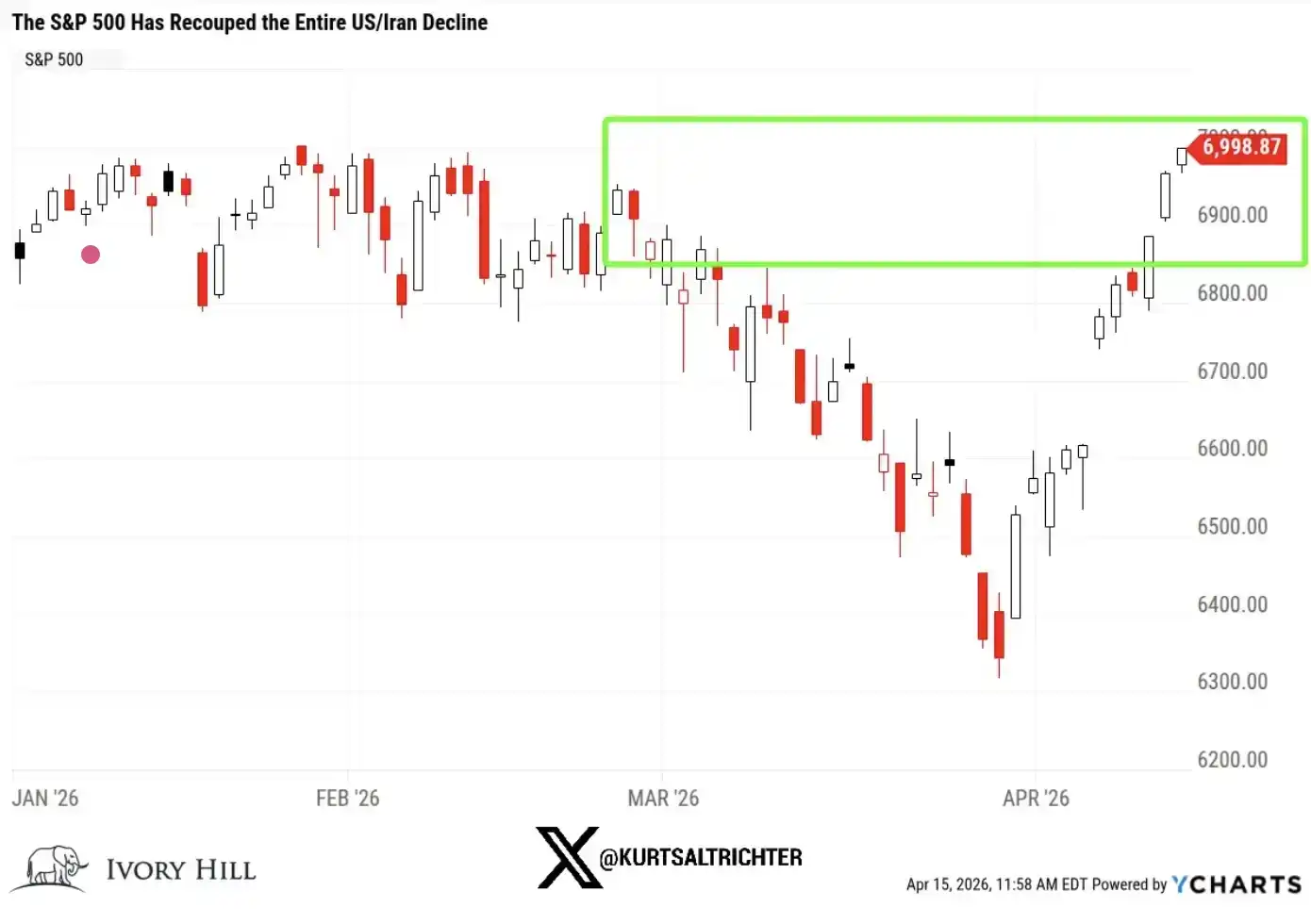
Let me be direct: if you only look at the stock market now, everything seems to be 'back to health.' War breaks out, the market falls, then quickly rebounds, everything returns to normal, and everyone moves on.

But if you broaden your perspective, this is not what is really happening.

The bond market has not confirmed this rally.

The oil market has not confirmed this rally either.

When the two most important global markets are telling a different story from the stock market, this is by no means a signal that can be ignored.

So, what is the stock market pricing in right now?

For the S&P 500 to stand above pre-war levels, the market essentially needs to believe in the following things simultaneously:

Current oil prices are not yet sufficient to substantially suppress consumption.

The Federal Reserve will ignore overheated inflation data and still choose to cut interest rates.

Higher raw material and transportation costs will not erode corporate profit margins.

The Middle East conflict will be sufficiently close to resolution within six months, no longer posing a risk.

Maybe things will indeed develop this way. I'm not saying it's impossible. But this is a rather aggressive set of premises, and the data released by the current bond and oil markets do not support these assumptions.

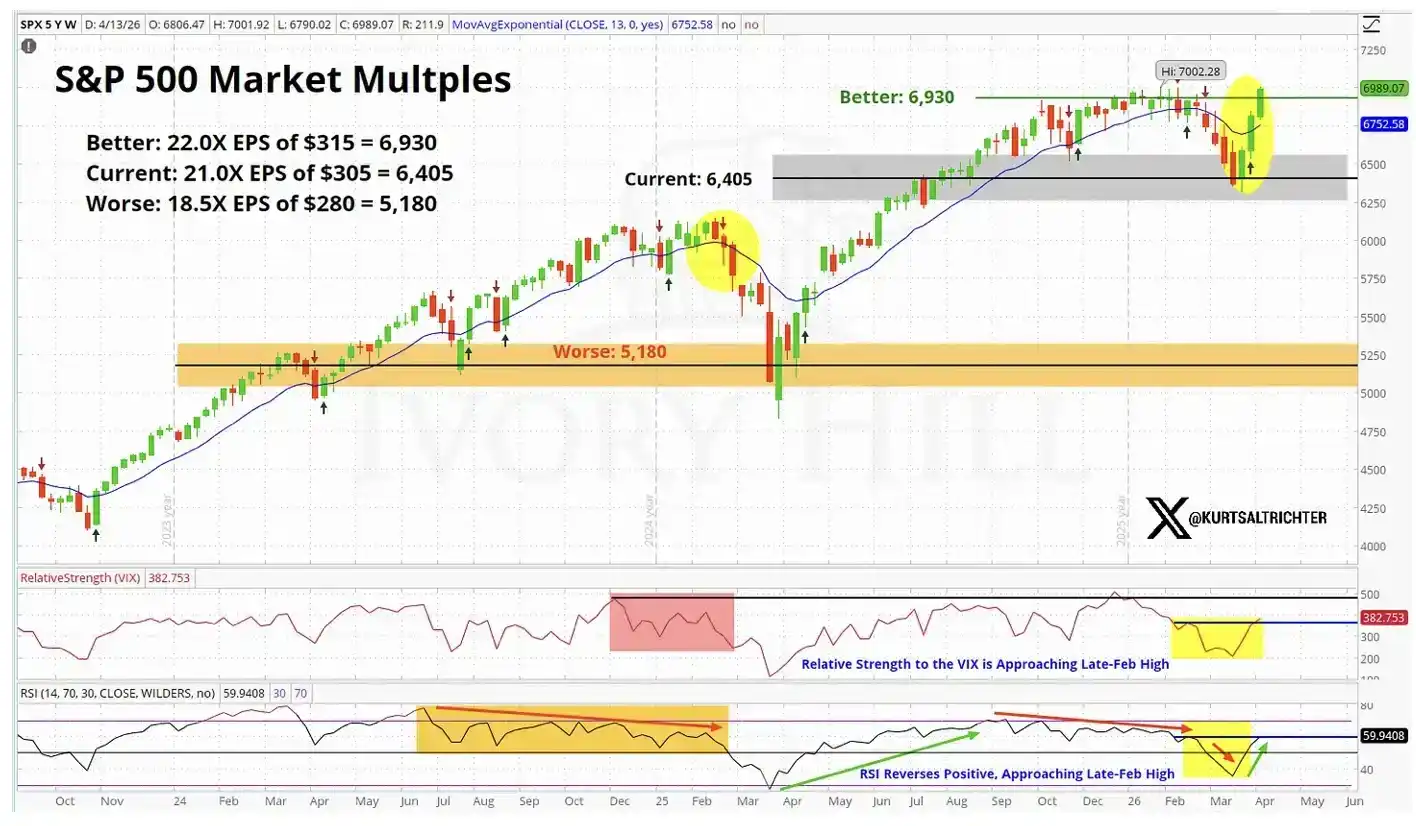
From a fundamental perspective, the stock market's pricing is already close to a 'perfect expectation.'
Let's look at more specific data

On February 27, the day before the war broke out, the closing levels of key indicators were as follows:

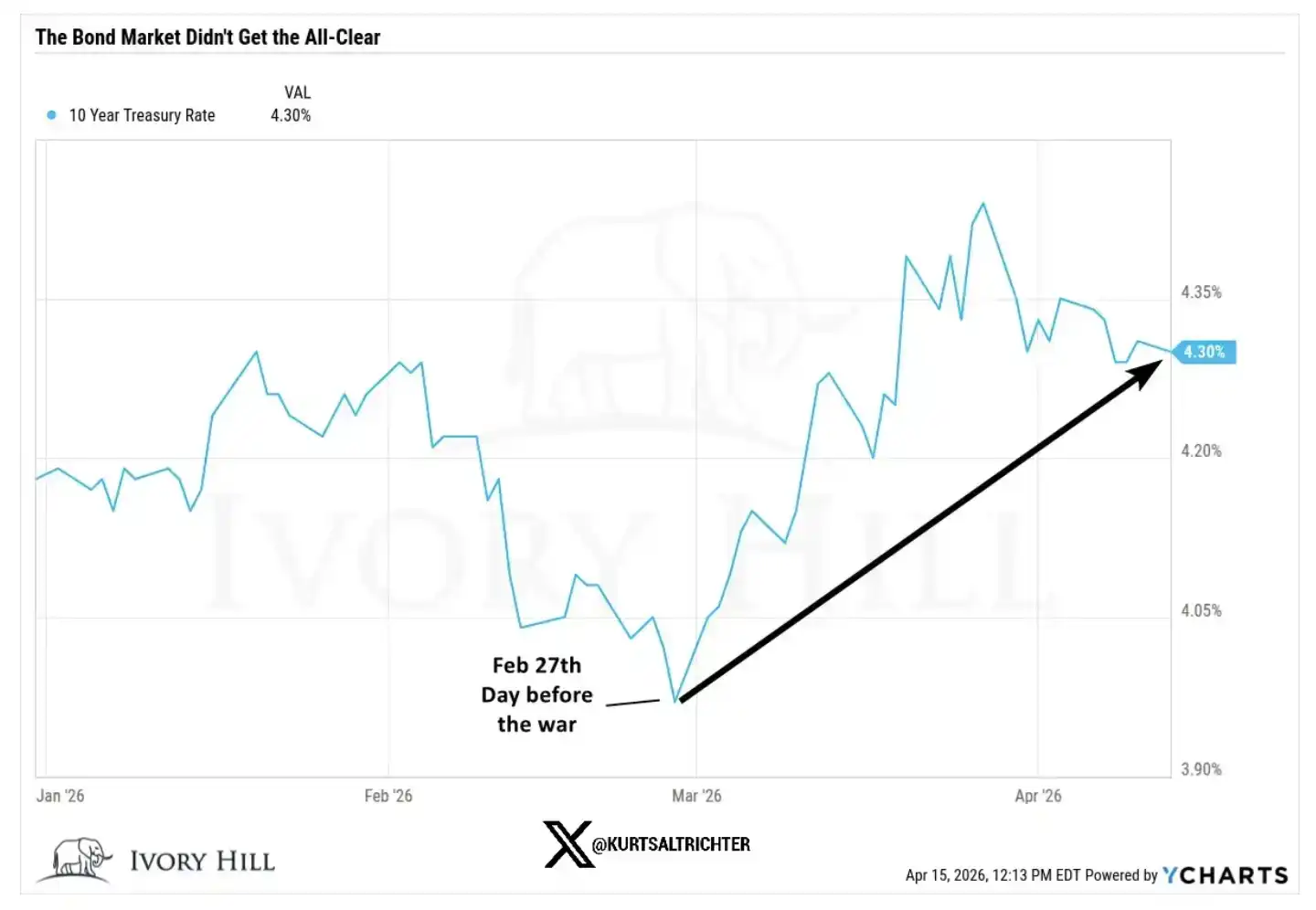
10-year U.S. Treasury yield: 3.95%, while yesterday it closed at 4.25%, up 30 basis points from pre-war levels.

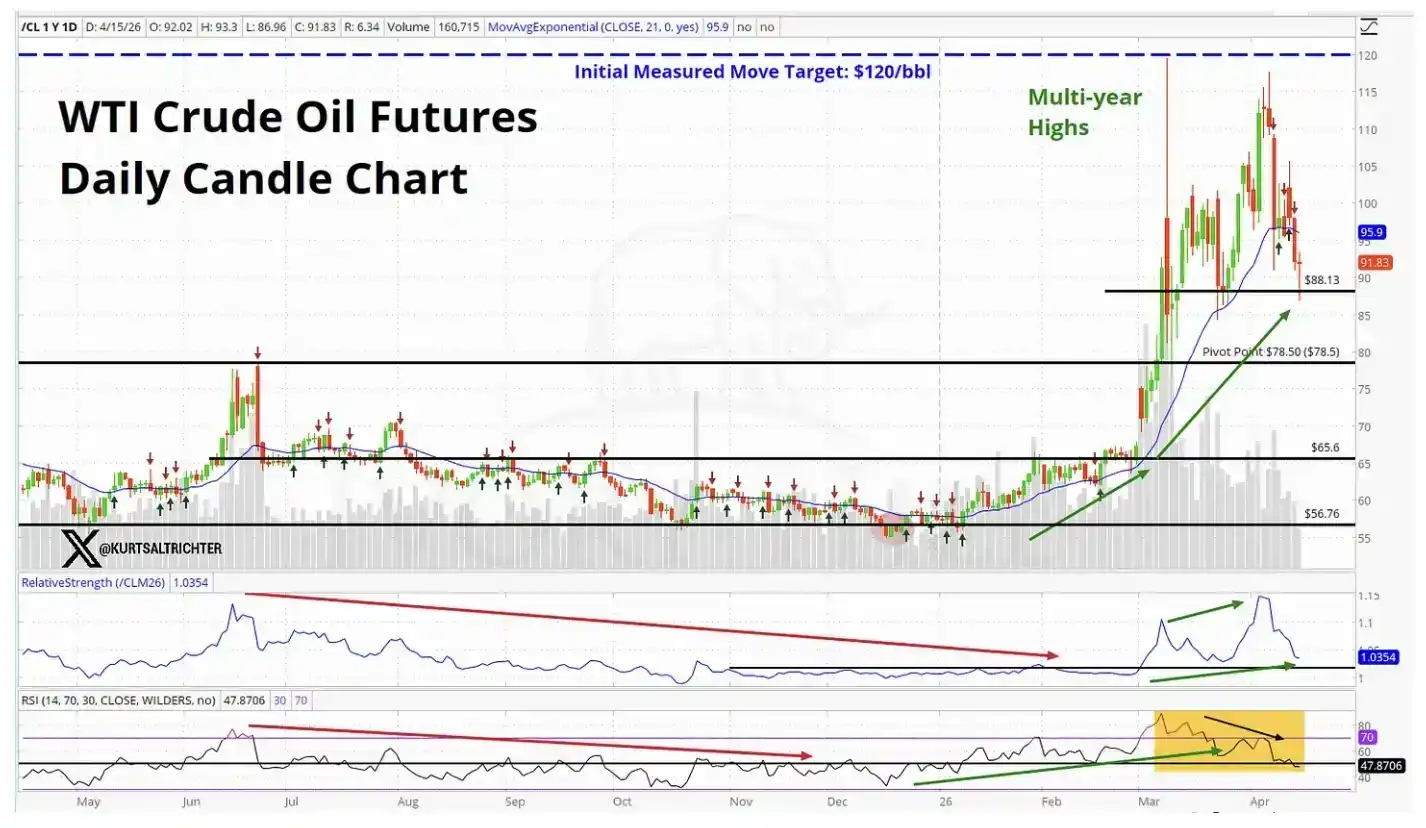
WTI crude oil: $67.02, currently about 37% higher than then.

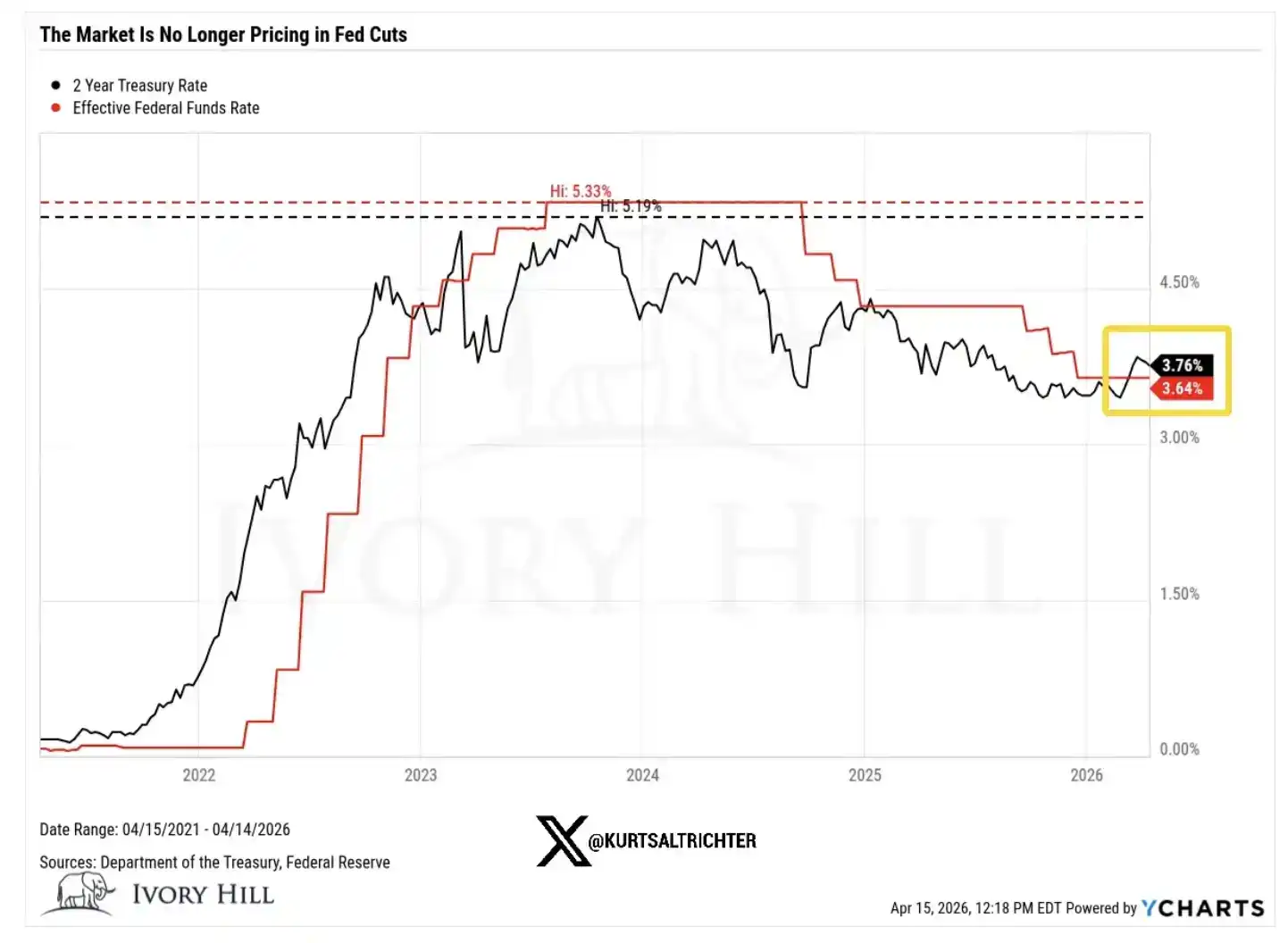
2-year U.S. Treasury yield: 3.38%, yesterday it closed at 3.75%, up nearly 40 basis points from pre-war levels.

Now, let's break down the implications behind these changes one by one.

The 30-basis-point rise in the 10-year yield after the war broke out is not because the bond market is more optimistic about economic growth. Current consumer sentiment is weakening, and confidence remains sluggish. This rise in interest rates is essentially the bond market 'quietly' pricing in inflation.

The signal it sends is clear: higher oil prices are transmitting to the overall price system, and the Federal Reserve's future policy space may not be as accommodative as the stock market assumes.
A 37% rise in oil prices over 6 weeks is not the performance one would expect if the market truly believed that a real, lasting agreement between the U.S. and Iran is imminent.

If traders were truly confident in a stable ceasefire agreement, oil prices should have long fallen back to the $70 range and continued to decline. But that is not the reality. Oil prices remain high, which means the oil market is not pricing in the same 'conflict resolution is imminent' expectation as the stock market.
And the 2-year U.S. Treasury yield is still 40 basis points higher than pre-war levels, which is itself a direct challenge to the narrative that 'the Federal Reserve is about to cut interest rates.'

The 2-year yield is the most sensitive indicator for observing interest rate expectations; it reflects the Federal Reserve's policy path more directly than any other asset. And now, the signal it sends is: the Federal Reserve's room for maneuver is smaller than the market imagines. This affects almost all the valuation logic supporting this stock market rally.
So, who is right?

The stock market might be right, I'm willing to admit that. If a substantive ceasefire agreement really emerges, bond yields could quickly fall back; once supply issues are credibly resolved, oil prices could also drop significantly. This is not the first time the stock market has led, with other markets 'catching up' or following later.

But there is another explanation that I think is currently underestimated.

A large part of this rally is not driven by fundamentals but by momentum. Traders' reluctance to short in an upward trend itself continuously pushes the market higher. Such buying can indeed sustain the trend longer than it should.

But it does not change the underlying logic.

And the underlying reality is: oil prices remain high, interest rates are still rising, and the Federal Reserve's room for interest rate cuts is more limited than what the bulls need.
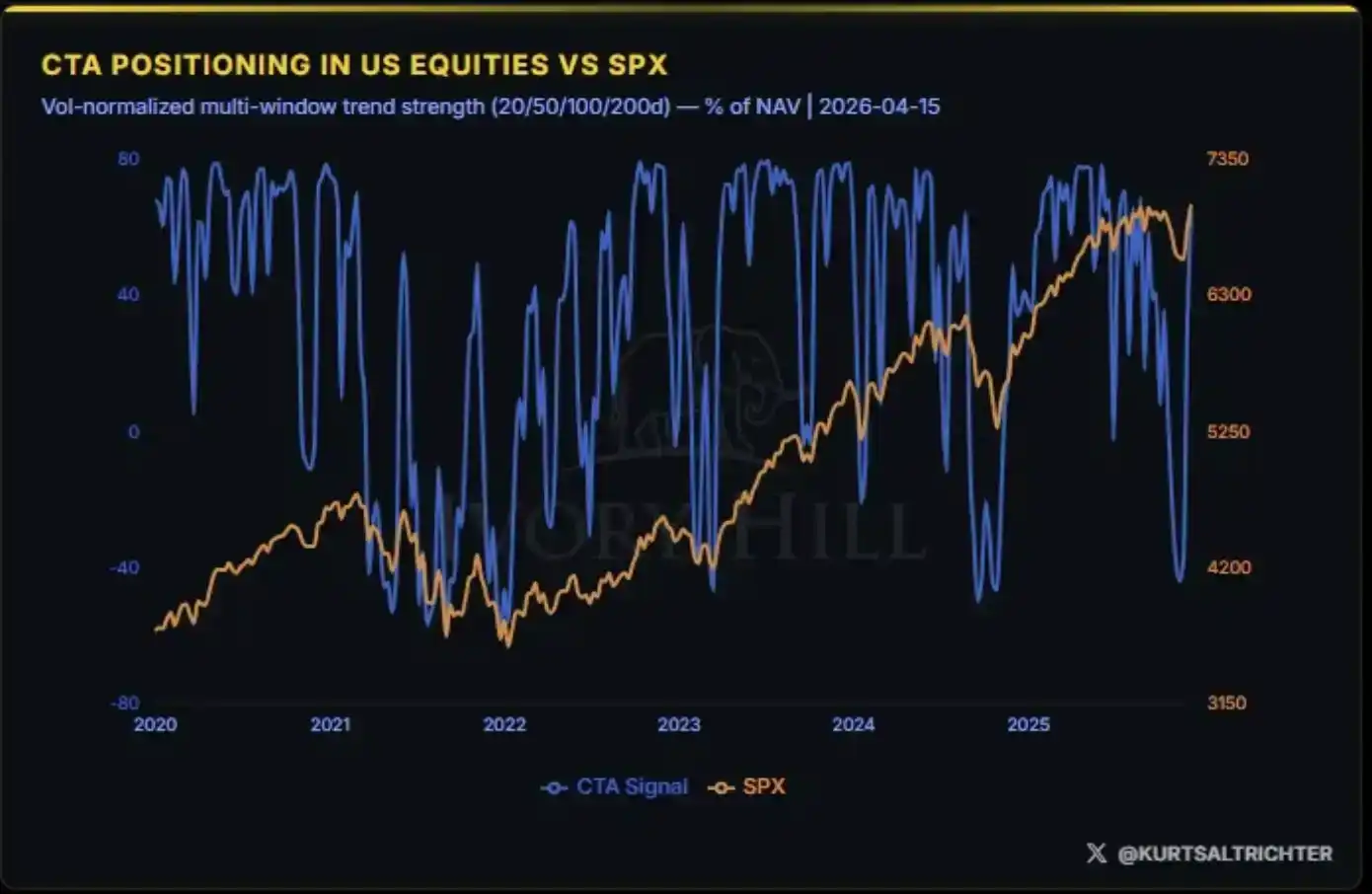
Rallies driven by fundamentals tend to be more sustainable; those driven by momentum are usually more fragile and shorter-lived. When you consider whether to add positions near historical highs, this difference is particularly critical. As the market valuation chart above shows, the current stock market is already pricing in a 'perfect scenario.'

My actual judgment

Over the past 10 days, the situation has indeed improved, I won't deny that. I'm not the type to be bearish for no reason.

But there is still a clear gap between the stock market's pricing and the reality reflected by bonds and oil, and this gap has not narrowed. I am closely watching this.

Currently, the stock market is at the most optimistic end of the range; bonds and oil are closer to the middle, reflecting a world where inflation still exists, the Federal Reserve's policy space is limited, and the conflict is not truly resolved.

This divergence will eventually be resolved, and there are only two paths:

Either a real ceasefire agreement is reached, oil prices fall back to around $70, the Federal Reserve gains clear room to cut rates, ultimately proving the stock market right;

Or none of this happens, and the stock market will fall back, moving closer to the levels currently reflected by bonds and oil.

And for now, bonds and oil show no signs of moving toward the stock market; it seems more like the stock market needs to move down to 'align' with them.

The next inflation data will be released on May 12. If my judgment is correct and CPI is above 3.5%, the narrative of rate cuts in 2026 will basically be over.

If you continue to add positions at this level, you are essentially betting that everything develops in the most ideal direction: the war ends smoothly, without interference from 'Trump's sudden remarks'; inflation remains controllable; the Federal Reserve cuts rates as planned; corporate profits hold steady. These four things must all happen simultaneously. If any one of them deviates significantly, the market's downward adjustment process is likely to be swift and severe.

In comparison, I prefer to remain patient rather than chase a rally that is 'quietly denied' by two key asset classes. If long-term signals point to buying, we will naturally gradually increase positions according to strategy.

And don't forget—the only certainty is that everything will eventually change.

Original link

Пов'язані питання

QWhat are the key signals from the bond and oil markets that contradict the stock market rally?

AThe 10-year Treasury yield has increased by 30 basis points since the pre-war period, indicating bond markets are pricing in persistent inflation rather than economic optimism. The 2-year Treasury yield is up 40 basis points, challenging the narrative of imminent Fed rate cuts. Oil prices have risen 37%, suggesting the market does not believe in a near-term resolution to Middle East conflicts, contrary to equity assumptions.

QAccording to the author, what underlying reality do bond and oil markets reflect compared to equities?

ABond and oil markets reflect a reality where inflation remains sticky, the Fed has limited policy flexibility, and geopolitical conflicts are unresolved. Equities, however, are pricing a 'perfect scenario' of low inflation, Fed rate cuts, controlled costs, and conflict resolution—a highly optimistic set of assumptions.

QWhat two paths could resolve the divergence between equity markets and bond/oil markets?

AEither a genuine ceasefire agreement is reached, causing oil prices to fall and the Fed to gain clear room for rate cuts (validating equities), or these conditions do not materialize, forcing equities to decline and align with the levels reflected in bond and oil markets.

QWhy does the author view the current stock rally as potentially fragile?

AThe rally is driven more by momentum and 'fear of missing out' (FOMO) trading behavior rather than fundamentals. Such momentum-driven gains are often short-lived and vulnerable to abrupt corrections if underlying macroeconomic variables—like inflation data or geopolitical events—disappoint.

QWhat critical data does the author highlight as a potential catalyst for market reassessment?

AThe next CPI data release on May 12th is highlighted. If CPI exceeds 3.5%, it would likely end the narrative of Fed rate cuts in 2026, forcing a reevaluation of equity valuations that rely on accommodative monetary policy.

Пов'язані матеріали

Cerebras IPO: A $48.8 Billion Valuation—Is the 'Nvidia Challenger' a Bubble or a New King?

Cerebras Systems, positioning itself as an NVIDIA challenger, is going public with a $48.8 billion valuation despite several underlying paradoxes revealed in its S-1 filing. While 2025 revenue grew 76% to $510M and GAAP net income was $237.8M, this profitability relies heavily on a one-time, non-cash accounting gain. Adjusting for this, the company's non-GAAP net loss actually widened to $75.7M. Furthermore, customer concentration remains extreme: 86% of 2025 revenue came from two Abu Dhabi-based entities, MBZUAI (62%) and G42 (24%). Its landmark deal with OpenAI, valued at over $20 billion, creates a complex, nested relationship where OpenAI is simultaneously a major customer, lender, warrant holder, and strategic partner with exclusivity clauses. Cerebras's technical edge in latency-sensitive AI inference is real, with its wafer-scale chip outperforming competitors in benchmarks. However, this advantage is confined to a specific niche, not the broader AI training market dominated by NVIDIA's CUDA ecosystem. With a 95x price-to-sales ratio, the valuation demands flawless execution of the OpenAI contract and massive future revenue growth. Key long-term risks include intense competition from giants like NVIDIA and AMD, a dual-class share structure granting insiders near-total voting control, and ongoing geopolitical uncertainties regarding export controls. The IPO is a pivotal capital markets event for AI infrastructure. As an investment, it represents a high-risk, high-reward bet on the "inference-first" narrative and Cerebras's ability to dominate its specialized segment, underpinned by a valuation that highlights the current fervor in the sector.

marsbit18 хв тому

Cerebras IPO: A $48.8 Billion Valuation—Is the 'Nvidia Challenger' a Bubble or a New King?

marsbit18 хв тому

What Happens to Ethereum Developer Tools After the Grants Run Out?

On February 27th, the Ethereum Foundation (EF) announced Project Odin, a structured sustainability support program designed for a select group of strategic, previously grant-funded teams. Unlike a standard grant, Odin offers a long-term advisory mechanism focused on helping these teams establish credible, sustainable paths within a two-year framework, thereby reducing long-term dependence on single funding sources. The program addresses a critical post-grant challenge: how essential public goods, especially major developer tools, can achieve financial sustainability beyond initial funding. While grants from EF and programs like Gitcoin or RetroPGF remain vital for startups and research, they often fall short for mature, widely-used infrastructure. Tools like compilers, languages, and network stacks are deeply embedded but struggle with monetization, trapped between being too foundational to lose and too public to generate natural revenue. Project Odin provides teams with a dedicated Strategic Advisor to guide them through a three-phase process: 1) analyzing current funding and realistic options, 2) validating potential paths with stakeholders, and 3) executing plans, which may include crafting support contracts, service agreements, or other recurring revenue models. The first pilot participant is Vyper, a critical smart contract language for the EVM, highlighting the need for sustainable models for core infrastructure. The initiative reframes the public goods conversation from "who should be funded" to "how do already-proven teams avoid perpetual funding crises?" It encourages ecosystem participants—protocols and projects that depend on these tools—to view sustainable support not just as charity, but as essential risk management for their own operational supply chains.

marsbit48 хв тому

What Happens to Ethereum Developer Tools After the Grants Run Out?

marsbit48 хв тому

MARA Reports Q1 Revenue Below Expectations, Net Loss of $1.3 Billion, Stock Plunges After Hours

Bitcoin mining firm MARA Holdings reported disappointing Q1 2024 results, causing its stock to erase all daily gains and fall 3.44% in after-hours trading. Revenue dropped 18% year-over-year to $174.6 million, missing Wall Street estimates of $192.7 million. The company posted a net loss of $1.3 billion, a significant increase from a $533.4 million loss a year ago, primarily driven by unrealized losses on its holdings of 38,689 Bitcoin, which depreciated in value during the quarter. MARA also sold over 15,100 BTC in late March to repurchase debt at a discount. The broader mining environment remains challenging due to a 35% decline in Bitcoin's price from its all-time high and a nearly 30% increase in mining difficulty over the past year. MARA's market cap ranking among U.S. miners has slipped to seventh. Critically, the company announced a strategic pivot away from Bitcoin mining expansion. It stated it has no plans to purchase new mining equipment and is fully transitioning toward AI data centers. Its strategy involves retrofitting existing mining sites for AI and high-performance computing (HPC) and leveraging its recent $1.5 billion acquisition of Long Ridge Energy & Power, a gas-fired power plant and data center. This infrastructure could eventually support 600 MW of AI compute capacity, allowing MARA to redeploy up to 90% of its non-custodial mining power for AI and IT workloads.

marsbit48 хв тому

MARA Reports Q1 Revenue Below Expectations, Net Loss of $1.3 Billion, Stock Plunges After Hours

marsbit48 хв тому

Торгівля

Спот
Ф'ючерси
活动图片





