AMD's Revenue Focus: How It Shifted Toward Data Centers Over 12 Quarters

marsbitОпубліковано о 2026-08-05Востаннє оновлено о 2026-08-05

Анотація

AMD's second-quarter earnings highlight a significant shift in its revenue composition over the past twelve quarters. While total company revenue grew substantially, the data center segment emerged as the dominant driver, now accounting for over half (58.2%) of AMD's total revenue. This segment reached $6.718 billion in Q2, a 107% year-over-year increase, and became AMD's largest revenue division in Q4 2025. Conversely, the gaming segment revenue declined to $779 million, down 31%, primarily due to lower semi-custom sales. The analysis shows the company's overall revenue base expanded, indicating growth was not a simple zero-sum resource transfer from gaming to data centers. A comparative view with NVIDIA and Intel reveals AMD's data center revenue growth trajectory is steep, though from a significantly smaller absolute base than NVIDIA's. The report confirms data center's rise as AMD's primary revenue focus, but public segment data alone cannot definitively attribute this shift to a direct internal reallocation of resources from the gaming business.

A second-quarter earnings report has pulled AMD's two revenue curves in opposite directions. According to AMD's quarterly report, Data Center segment revenue reached $6.718 billion, a 107% increase year-over-year.

Within the same report, Gaming segment revenue was $779 million, a 31% decrease year-over-year. Placing these two side by side easily gives rise to an intuition: is AMD shifting business originally belonging to Gaming over to Data Center?

Public financial reports can only answer where revenue comes from; they cannot directly reveal how R&D, wafer capacity, or customer resources flow within the company. However, by placing the segment data from these 12 quarters together, we can at least break down that intuition in finer detail.

First, Look at the Total Pie: Is Growth Just Internal Reallocation?
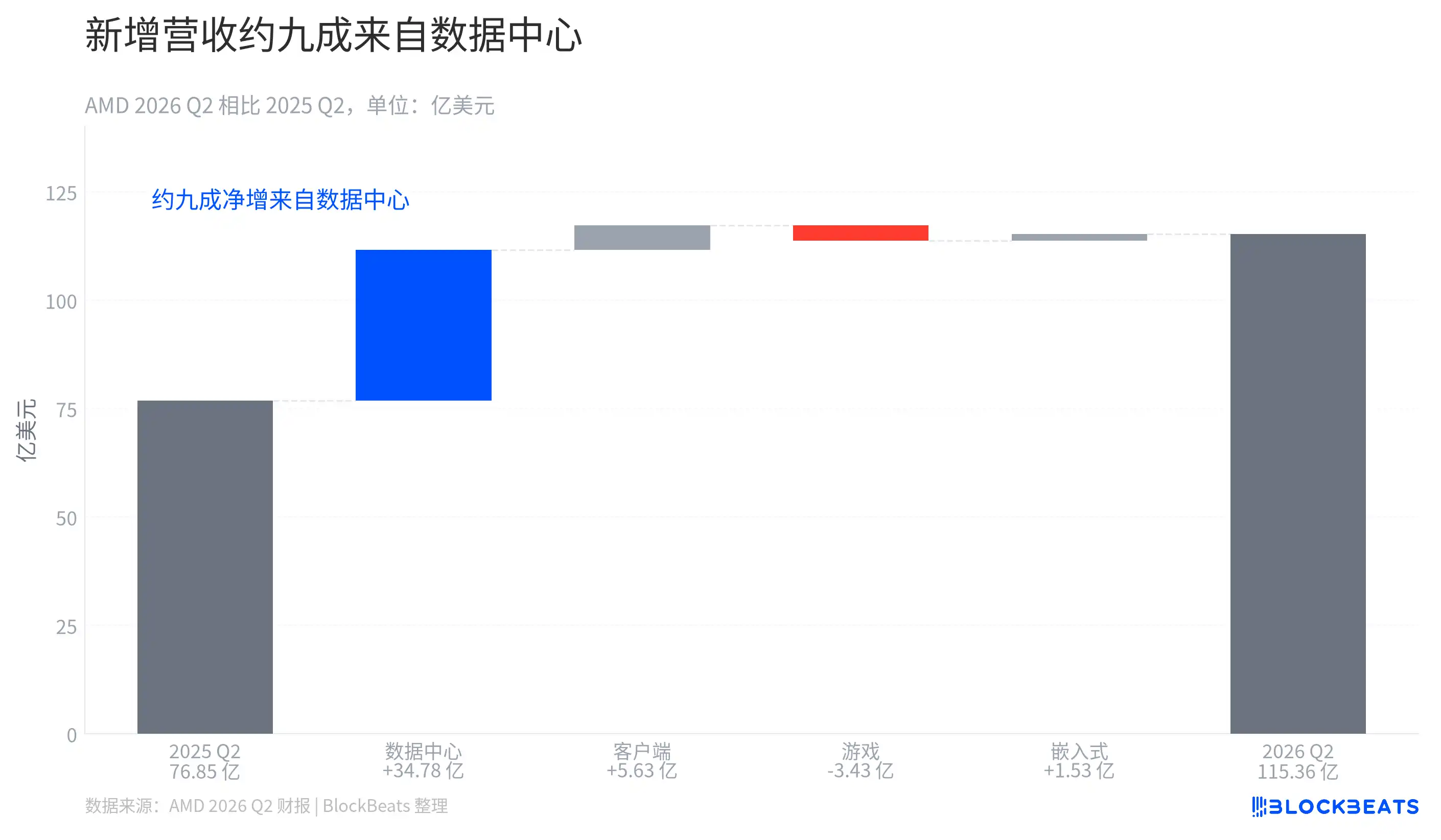
First, look at the year-over-year bridge. The answer is more restrained than "one falls as another rises." According to AMD's quarterly report, the company's total revenue increased from $7.685 billion to $11.536 billion. The end point is significantly higher than the starting point, indicating that growth first occurred in the total pie, not as an equal exchange between two existing businesses.

The tallest blue bar in the chart comes from Data Center. According to AMD's report, this segment increased by $3.478 billion year-over-year, accounting for about 90% of the company's net revenue increase for the quarter. This is an addition/subtraction of revenue; it cannot be inferred from this that R&D, production capacity, or customer resources have been shifted from one business to another.

Client and Embedded segments also increased in the quarter. Gaming segment revenue, however, decreased by $343 million year-over-year. According to AMD's report, this decline indeed exists, but it is insufficient to explain the scale of the new additions brought by Data Center. Therefore, this chart supports "an expansion of the total revenue base," and does not prove a one-to-one resource substitution between the two businesses.

There is also a nuance often omitted. AMD attributes the year-over-year decline in Gaming revenue primarily to lower semi-custom revenue, as the Gaming segment also includes console semi-custom business. Directly reading this line as sales of Radeon discrete graphics cards or consumer GPU demand would be narrowing the scope of the segment definition.

When Did Data Center Become the Revenue Focus?
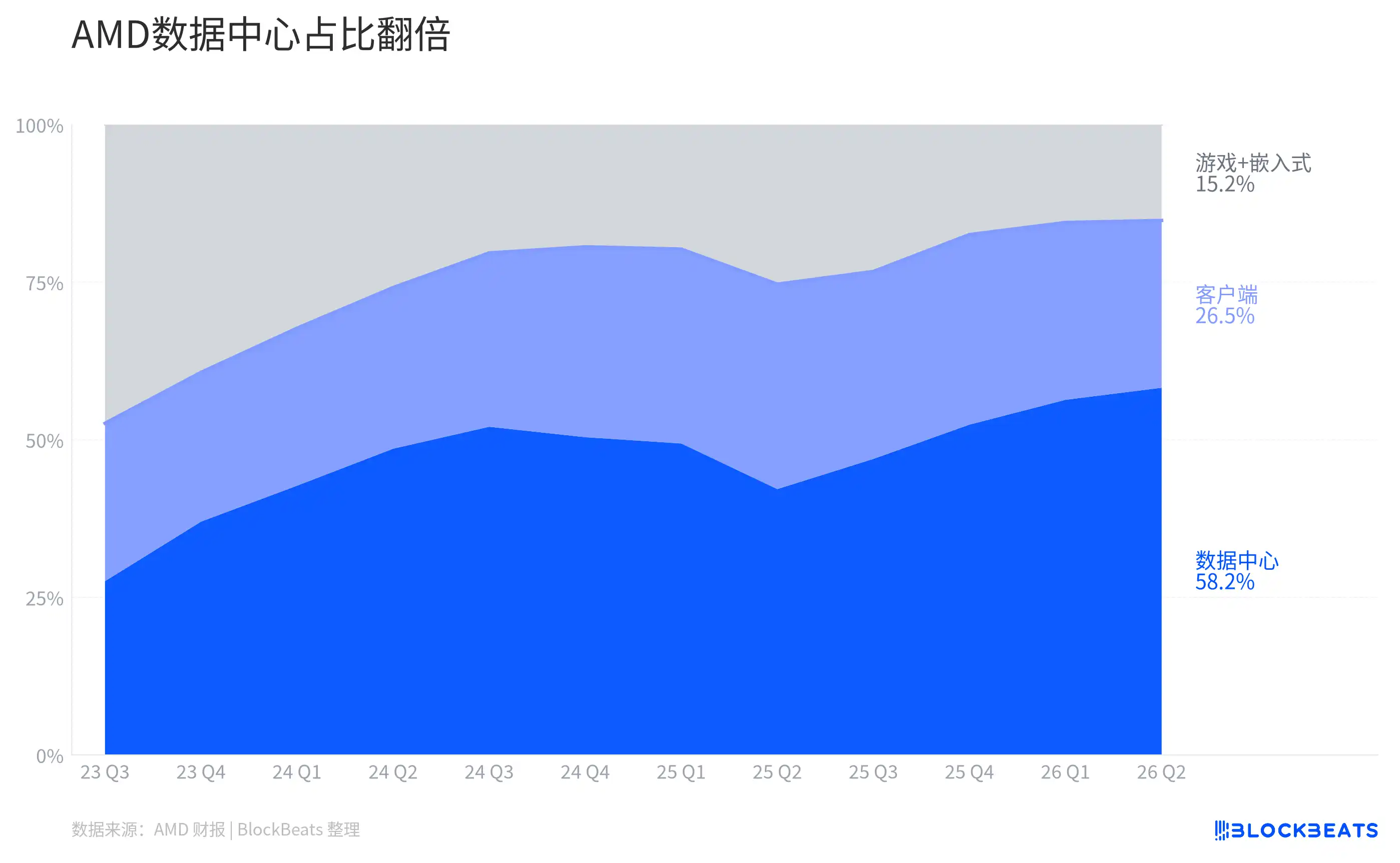
Highs and lows in a single quarter are always influenced by product delivery cycles. Structural changes across consecutive quarters better reflect the revenue mix. According to AMD's consecutive quarterly reports, Data Center's share of total revenue increased from 27.6% to 58.2%. In the imagination of every hundred dollars of revenue, Data Center has gone from accounting for less than thirty cents to becoming the source of over half.

This crossing of the midpoint occurred in Q4 2025. The dark blue area in the chart has not since retreated below the halfway mark, and Data Center has thus become AMD's largest revenue segment. Client, Gaming, and Embedded remain revenue sources. The latter two are merged into one layer in the chart to avoid misreading changes in the Gaming segment as the rise and fall of a specific graphics card product.

The rising share of Data Center also does not mean AMD has become a company that only sells AI chips. According to AMD's description of the segment, it covers multiple businesses including server processors and accelerators. The report does not further break down all incremental revenue by a single product. The chart shows the change in revenue mix. It can show which segment has a higher revenue share, but it cannot substitute for an internal ledger detailing product configuration or investment trade-offs.

This area chart also preserves a reading that is easy to overlook. The sum of the three layers each quarter is always 100%. The widening of the dark blue area is not only due to the absolute increase in Data Center revenue but also indicates its higher relative position within AMD's overall revenue. It can show *how* the segment revenue structure has changed, but it cannot, by itself, explain product configuration, capacity allocation, or internal investment trade-offs.

Placed Among Peers, Where Does AMD Stand?
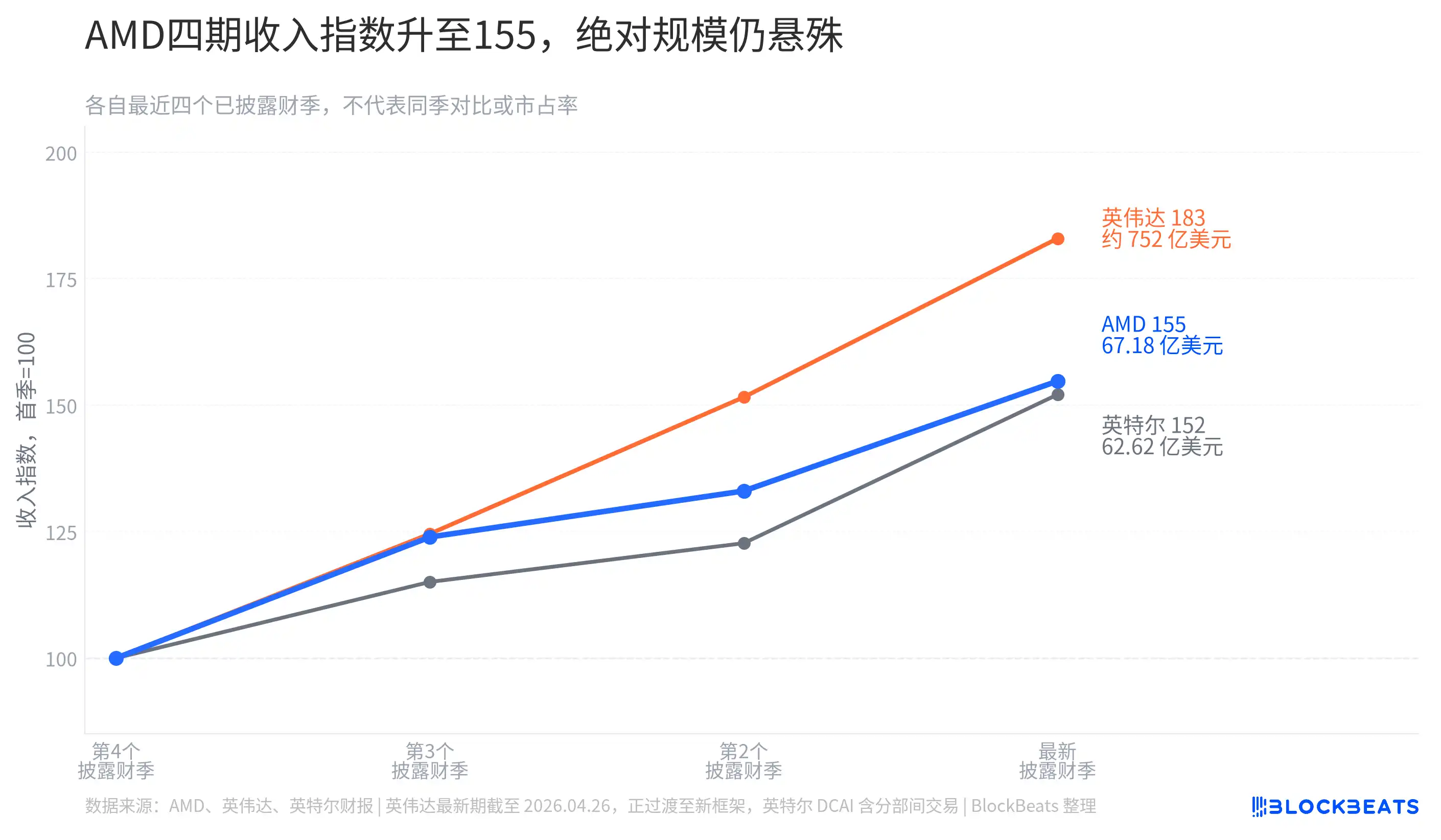
Putting AMD back among its peers, the easiest mistake is to treat the same indexed chart as the same race. According to the respective financial reports of AMD, NVIDIA, and Intel, Chart 2 normalizes the revenue of each company's four most recently disclosed fiscal quarters to 100. The blue line ends at 155, indicating that AMD's Data Center revenue grew rapidly during this disclosed sequence. NVIDIA's line is steeper, and Intel's line is also rising.

Beyond speed, there is also scale. According to the latest available reports from the three companies, AMD's Data Center revenue is $6.718 billion, while NVIDIA's is approximately $75.2 billion. Looking at both endpoint labels together prevents misreading an upward-sloping blue line as an already occurred swap in competitive positioning.

The latest segment revenue figures for AMD and Intel are close. According to Intel's report, Intel's DCAI (Data Center and AI) segment revenue is $6.262 billion. This proximity also requires a footnote: Intel's DCAI includes intersegment transactions, and its definition is not equivalent to AMD's Data Center business.

The timing is also not perfectly aligned. According to NVIDIA's FY2027 Q1 report, the latest fiscal quarter on the chart ended on April 26, 2026, earlier than AMD's and Intel's June quarters. NVIDIA stated at the time that it was transitioning to a new reporting framework, dividing its market platforms into Data Center & Edge Computing, and further subdividing Data Center into Hyperscale & ACIE sub-markets.

Chart 2 retains only the disclosed total Data Center revenue for the three companies and does not combine sub-categories from NVIDIA's old and new frameworks. The three lines can only be used to observe the trajectory of each company's disclosed revenue. They cannot be converted into market share, nor can they serve as a strict same-quarter ranking.

Therefore, this earnings report confirms that Data Center has become AMD's largest revenue segment. The contraction of the Gaming business occurred during the same period, but the public segment data is insufficient to explain it as a simple internal swap.


Трендові криптовалюти

Пов'язані питання

QAccording to the article, how has the Data Center segment's contribution to AMD's total revenue changed over the past 12 quarters?

AAccording to the article, Data Center's share of AMD's total revenue increased from 27.6% to 58.2% over the 12 quarters analyzed. It became AMD's largest revenue segment, crossing the 50% mark in Q4 2025.

QBased on the Q2 data, what was the primary driver for AMD's overall revenue growth?

AThe primary driver was the Data Center segment, which added approximately $3.478 billion year-over-year. This increase accounted for about 90% of AMD's total quarterly revenue growth, significantly expanding the company's overall revenue base.

QWhat caution does the article advise when interpreting the decline in AMD's Gaming business revenue?

AThe article cautions that the Gaming segment decline should not be directly read as a drop in consumer GPU (Radeon) sales. The segment includes semi-custom business for gaming consoles, and the reported decline is primarily attributed to lower semi-custom revenue, making the segment's composition broader than just discrete graphics cards.

QHow does AMD's Data Center revenue compare to NVIDIA's according to their latest reported figures?

AWhile AMD's Data Center revenue grew faster in the analyzed sequence, NVIDIA's absolute scale is much larger. AMD's latest Data Center revenue was $6.718 billion, while NVIDIA's was approximately $75.2 billion. Therefore, the growth trajectories should not be misinterpreted as a reversal of competitive positions.

QWhat key point does the article make about the relationship between Data Center growth and Gaming decline at AMD?

AThe article argues that the public financial data does not support the intuitive idea of a simple internal resource swap. While the Gaming segment declined and Data Center grew significantly in the same period, the decline in Gaming was smaller than the massive growth in Data Center. The overall revenue base expanded, indicating growth was not merely a zero-sum transfer between the two existing segments.

Пов'язані матеріали

Stunning, Musk Joins Forces with Huang Jen-hsun to Deploy the Stellar Brain! AI Computing Center Launched into Space

SpaceX, in its first public earnings report, has announced a partnership with NVIDIA to launch Starmind, an orbital AI computing network. This initiative aims to move AI's computational foundation into space to solve the critical challenges of energy consumption and heat dissipation faced by terrestrial data centers. The core concept involves deploying data centers equipped with NVIDIA's advanced GPUs (like the upcoming Rubin) into sun-synchronous orbit. Key advantages include near-continuous solar power for energy, the vacuum of space for highly efficient radiative cooling, and the absence of terrestrial constraints like land use and grid capacity. The first computational node, the Starmind AI1 satellite, is described as a massive vehicle with a 75-meter wingspan, generating 210 kW of solar power to run a 150 kW computing payload—equivalent to a full NVIDIA GB300 supercomputer rack. These "compute satellites" will connect to users via SpaceX's existing Starlink constellation using high-speed laser links, promising low-latency access from anywhere on Earth. SpaceX's ability to realize this vision is underpinned by its Starship rocket, designed for low-cost, high-frequency launches to transport thousands of satellites, and massive planned manufacturing facilities like the Gigasat factory and the Terafab chip plant. Elon Musk framed the project within the context of the Kardashev Scale, proposing Starmind as humanity's first substantive step toward becoming a Type II civilization capable of harnessing a star's energy. The ultimate goal is to deploy one terawatt of computational power in space, with even more ambitious plans involving lunar-based manufacturing and launch systems. The report positions Starmind not merely as a commercial AI service, but as a foundational infrastructure project to expand human intelligence and capability beyond Earth, leveraging SpaceX's integrated strengths in rockets, satellites, and global connectivity.

marsbit38 хв тому

Stunning, Musk Joins Forces with Huang Jen-hsun to Deploy the Stellar Brain! AI Computing Center Launched into Space

marsbit38 хв тому

Despite the sell-off, Goldman Sachs remains bullish on Samsung and SK Hynix. Here's why.

Goldman Sachs maintains "Buy" ratings on Samsung Electronics and SK Hynix despite recent stock declines. Its bullish view centers on three core arguments. Firstly, it expects HBM (High Bandwidth Memory) pricing to re-establish a premium over conventional DRAM by 2027, with a projected blended ASP of around $2.9/Gb. This is driven by tight supply-demand dynamics, increasing manufacturing complexity for newer HBM generations, and the need to restore its historical price premium. Secondly, the volatility of the memory cycle is expected to moderate due to widespread adoption of 3-5 year Long-Term Agreements (LTAs) with key customers. These contracts, covering a significant portion of planned capacity, feature mechanisms like price floors, prepayments, and penalties, reducing supplier risk and improving earnings visibility. Thirdly, inventory levels remain low at key suppliers and major customers, providing a buffer against a sharp downturn. Furthermore, robust demand from enterprise SSDs for AI servers is seen offsetting weakness in consumer segments like smartphones and PCs, preventing NAND markets from slipping into oversupply in the near term. While risks exist—such as potential weaker AI demand or aggressive capacity expansion—Goldman Sachs believes the combination of HBM repricing, LTAs, and low inventory underpins a more stable earnings outlook for the leading Korean memory makers.

marsbit53 хв тому

Despite the sell-off, Goldman Sachs remains bullish on Samsung and SK Hynix. Here's why.

marsbit53 хв тому

Korean Cryptocurrency Market Platform Kimpga Integrates with Global Web3 Data Platform RootData, Providing Popularity and Growth Scores for Token Projects

South Korean cryptocurrency market data platform Kimpga (kimpga.com) has announced a data partnership with the global Web3 project data platform RootData. As a result, Kimpga has integrated comprehensive token project information directly into its platform services. The integration introduces a new "RD Score" column within Kimpga's market listings. Clicking the score opens a detailed data window that displays the "RD Popularity Index," the "RD Growth Index," and key fundamental project data such as leading investors, core team members, and project category tags. For example, for Solana (SOL), users can view its indices and identify major backers like Polychain Capital, a16z, and Multicoin Capital directly from the interface, with links to full RootData project pages for deeper research. Jin Jae-yong, a representative of Kimpga, stated that the partnership allows users to quickly assess a project's fundamental strength, including its development team and investor lineup, without leaving the market data screen. This addresses a key challenge for investors who previously had to rely solely on price and premium data. RootData is a widely used global platform providing Web3 project details on funding history, team composition, and investor portfolios for due diligence and investment analysis. Kimpga, which boasts 10 million cumulative users, is a leading Korean crypto market platform providing real-time data and price premiums from over 18 domestic and international exchanges. This collaboration with RootData follows Kimpga's previous partnership with the token rating platform APYWA, further enriching its data offering to support user investment decisions.

marsbit53 хв тому

Korean Cryptocurrency Market Platform Kimpga Integrates with Global Web3 Data Platform RootData, Providing Popularity and Growth Scores for Token Projects

marsbit53 хв тому

He Was the Hero of Shanghai's Two Major Industries, Yet Passed Away Quietly in Regret

He was a pivotal figure in the development of two major Shanghai industries—semiconductors and commercial aircraft—yet passed away in quiet regret. Jiang Shangzhou, son of a veteran revolutionary and a Swiss-educated technocrat, became Deputy Director of the Shanghai Economic Commission in 1997. Tasked with identifying strategic industries, he championed integrated circuits (ICs) despite a climate of skepticism. Countering a national plan for just two 8-inch chip production lines, he boldly declared Shanghai would build ten within five years. He masterminded the Zhangjiang microelectronics zone, personally recruited top talent like Morris Chang, and helped establish SMIC. Through innovative financing that circumvented Western embargoes, SMIC grew rapidly, with Shanghai exceeding its target by building 18 lines. Simultaneously, while battling lung cancer, Jiang led the push for China's large commercial aircraft program as head of a state major projects panel. He argued it was a strategic imperative that would drive advancements across multiple industries. His relentless advocacy culminated in the 2006 state approval that paved the way for the C919. Jiang's career was marked by foresight often deemed too超前. Earlier postings in Sanya and Yangpu saw his ideas for tourism and economic reform initially rejected, only to be validated years later. In 2009, he became Chairman of the embattled SMIC. Despite his deteriorating health, he steered the company until his death in 2011, leaving a final insight for the chip industry: China need not master every process but must lead in key areas. He did not live to see the C919 fly or SMIC's full recovery, but his foundational work made Shanghai a national leader in both semiconductors and aerospace. Colleagues remembered him as a visionary whose impact shaped the three decades that followed.

marsbit1 год тому

He Was the Hero of Shanghai's Two Major Industries, Yet Passed Away Quietly in Regret

marsbit1 год тому

Illustrating the Cloudflare Wallet: The New Player in Stablecoin Payments Using x402

On August 4th, Cloudflare announced the launch of "Wallets," though the initial offering is limited to claiming a user handle. Full functionality for topping up, making payments, and using a Virtual Wallet via API keys is marked "Soon." The announcement clarifies that this handle is not yet a functional wallet. It represents a key piece in Cloudflare's broader payments strategy, alongside the Stripe Projects service (currently in open beta for agent-assisted purchases) and the Monetization Gateway for merchants (on a waitlist). The Wallet is positioned as the payer-side component for managing identity, balances, and authorization rules. While the underlying x402 protocol shows activity (75.41 million transactions, $24.24M volume in 30 days, averaging ~$0.32 per transaction), this data reflects the open network's usage, not specifically Cloudflare Wallet adoption. These metrics indicate suitability for frequent micro-payments like API calls. Cloudflare's documentation uses a $0.01 per-call example to illustrate the x402 flow: a server returns HTTP 402, the agent signs the payment, a facilitator verifies it, and the server delivers the result. Currently, developers must manage private keys and use test networks/USDC for agent payments. The Wallet roadmap aims to separate the user's Account Wallet from an agent's Virtual Wallet, adding controls for spending limits, whitelists, and per-transaction caps. This design resembles a corporate card with approval rules. However, these controls are not yet available for configuration. In summary, Cloudflare Wallet's current launch is a preliminary step. Critical details like supported stablecoins, blockchains, regions, KYC, custody, and fees remain undisclosed. The announcement primarily establishes a payer identity framework, with the full payment and agent autonomy system still under development.

marsbit1 год тому

Illustrating the Cloudflare Wallet: The New Player in Stablecoin Payments Using x402

marsbit1 год тому

Торгівля

Спот

Популярні статті

Що таке $S$

Розуміння SPERO: Комплексний огляд Вступ до SPERO Оскільки ландшафт інновацій продовжує еволюціонувати, виникнення технологій web3 та криптовалютних проектів відіграє ключову роль у формуванні цифрового майбутнього. Один з проектів, який привернув увагу в цій динамічній сфері, — це SPERO, позначений як SPERO,$$s$. Ця стаття має на меті зібрати та представити детальну інформацію про SPERO, щоб допомогти ентузіастам та інвесторам зрозуміти його основи, цілі та інновації в рамках web3 та крипто-сектору. Що таке SPERO,$$s$? SPERO,$$s$ — це унікальний проект у криптопросторі, який прагне використати принципи децентралізації та технології блокчейн для створення екосистеми, що сприяє залученню, корисності та фінансовій інклюзії. Проект розроблений для полегшення взаємодії між користувачами новими способами, надаючи їм інноваційні фінансові рішення та послуги. У своїй основі SPERO,$$s$ прагне надати можливості індивідам, забезпечуючи інструменти та платформи, які покращують користувацький досвід у криптовалютному просторі. Це включає в себе можливість більш гнучких методів транзакцій, сприяння ініціативам, що підтримуються спільнотою, та створення шляхів для фінансових можливостей через децентралізовані додатки (dApps). Основна концепція SPERO,$$s$ обертається навколо інклюзивності, прагнучи зменшити розриви в традиційній фінансовій системі, використовуючи переваги технології блокчейн. Хто є творцем SPERO,$$s$? Особистість творця SPERO,$$s$ залишається дещо невідомою, оскільки є обмежені публічно доступні ресурси, що надають детальну інформацію про його засновників. Ця відсутність прозорості може бути наслідком зобов'язання проекту до децентралізації — етики, яку багато проектів web3 поділяють, ставлячи колективні внески вище за індивідуальне визнання. Зосереджуючи обговорення навколо спільноти та її колективних цілей, SPERO,$$s$ втілює суть наділення без виділення конкретних осіб. Таким чином, розуміння етики та місії SPERO є більш важливим, ніж ідентифікація єдиного творця. Хто є інвесторами SPERO,$$s$? SPERO,$$s$ підтримується різноманітними інвесторами, починаючи від венчурних капіталістів до ангельських інвесторів, які прагнуть сприяти інноваціям у крипто-секторі. Зосередження цих інвесторів зазвичай узгоджується з місією SPERO — пріоритет надається проектам, які обіцяють технологічний прогрес у суспільстві, фінансову інклюзію та децентралізоване управління. Ці інвесторські фонди зазвичай зацікавлені в проектах, які не лише пропонують інноваційні продукти, але й позитивно впливають на спільноту блокчейн та її екосистеми. Підтримка з боку цих інвесторів підкріплює SPERO,$$s$ як значного конкурента в швидко змінюваній сфері крипто-проектів. Як працює SPERO,$$s$? SPERO,$$s$ використовує багатогранну структуру, яка відрізняє його від традиційних криптовалютних проектів. Ось деякі ключові особливості, які підкреслюють його унікальність та інноваційність: Децентралізоване управління: SPERO,$$s$ інтегрує моделі децентралізованого управління, надаючи користувачам можливість активно брати участь у процесах прийняття рішень щодо майбутнього проекту. Цей підхід сприяє відчуттю власності та відповідальності серед членів спільноти. Корисність токена: SPERO,$$s$ використовує свій власний криптовалютний токен, розроблений для виконання різних функцій в екосистемі. Ці токени дозволяють здійснювати транзакції, отримувати винагороди та полегшувати послуги, що пропонуються на платформі, підвищуючи загальну залученість та корисність. Шарова архітектура: Технічна архітектура SPERO,$$s$ підтримує модульність та масштабованість, що дозволяє безперешкодно інтегрувати додаткові функції та додатки в міру розвитку проекту. Ця адаптивність є надзвичайно важливою для збереження актуальності в постійно змінюваному крипто-ландшафті. Залучення спільноти: Проект підкреслює ініціативи, що підтримуються спільнотою, використовуючи механізми, які стимулюють співпрацю та зворотний зв'язок. Підтримуючи сильну спільноту, SPERO,$$s$ може краще задовольняти потреби користувачів та адаптуватися до ринкових тенденцій. Фокус на інклюзію: Пропонуючи низькі комісії за транзакції та зручні інтерфейси, SPERO,$$s$ прагне залучити різноманітну базу користувачів, включаючи осіб, які раніше не брали участі в крипто-просторі. Це зобов'язання до інклюзії узгоджується з його загальною місією наділення через доступність. Хронологія SPERO,$$s$ Розуміння історії проекту надає важливі уявлення про його розвиток та етапи. Нижче наведено пропоновану хронологію, що відображає значні події в еволюції SPERO,$$s$: Етап концептуалізації та ідеації: Початкові ідеї, що стали основою SPERO,$$s$, були сформовані, тісно пов'язані з принципами децентралізації та фокусом на спільноті в індустрії блокчейн. Запуск білого паперу проекту: Після концептуального етапу був випущений комплексний білий папір, що детально описує бачення, цілі та технологічну інфраструктуру SPERO,$$s$, щоб залучити інтерес та зворотний зв'язок від спільноти. Створення спільноти та ранні залучення: Активні зусилля були спрямовані на створення спільноти ранніх прихильників та потенційних інвесторів, що полегшило обговорення цілей проекту та отримання підтримки. Подія генерації токенів: SPERO,$$s$ провів подію генерації токенів (TGE) для розподілу своїх рідних токенів серед ранніх прихильників та встановлення початкової ліквідності в екосистемі. Запуск початкового dApp: Перший децентралізований додаток (dApp), пов'язаний з SPERO,$$s$, став доступним, дозволяючи користувачам взаємодіяти з основними функціями платформи. Постійний розвиток та партнерства: Безперервні оновлення та вдосконалення пропозицій проекту, включаючи стратегічні партнерства з іншими учасниками блокчейн-простору, сформували SPERO,$$s$ у конкурентоспроможного та еволюціонуючого гравця на крипто-ринку. Висновок SPERO,$$s$ є свідченням потенціалу web3 та криптовалют для революціонізації фінансових систем та наділення індивідів. Завдяки зобов'язанню до децентралізованого управління, залучення спільноти та інноваційно спроектованих функцій, він прокладає шлях до більш інклюзивного фінансового ландшафту. Як і з будь-якими інвестиціями в швидко змінюваному крипто-просторі, потенційним інвесторам та користувачам рекомендується ретельно досліджувати та обдумано взаємодіяти з поточними подіями в SPERO,$$s$. Проект демонструє інноваційний дух крипто-індустрії, запрошуючи до подальшого дослідження його численних можливостей. Хоча подорож SPERO,$$s$ ще триває, його основні принципи можуть справді вплинути на майбутнє того, як ми взаємодіємо з технологією, фінансами та один з одним у взаємопов'язаних цифрових екосистемах.

248 переглядів усьогоОпубліковано 2024.12.17Оновлено 2024.12.17

Що таке $S$

Що таке AGENT S

Агент S: Майбутнє автономної взаємодії в Web3 Вступ У постійно змінюваному ландшафті Web3 та криптовалюти інновації постійно переосмислюють, як люди взаємодіють з цифровими платформами. Один з таких новаторських проектів, Агент S, обіцяє революціонізувати взаємодію людини з комп'ютером через свою відкриту агентну структуру. Прокладаючи шлях для автономних взаємодій, Агент S прагне спростити складні завдання, пропонуючи трансформаційні застосування в штучному інтелекті (ШІ). Це детальне дослідження заглиблюється в складності проекту, його унікальні особливості та наслідки для сфери криптовалюти. Що таке Агент S? Агент S є революційною відкритою агентною структурою, спеціально розробленою для вирішення трьох основних викликів в автоматизації комп'ютерних завдань: Набуття специфічних знань у галузі: Структура інтелектуально навчається з різних зовнішніх джерел знань та внутрішнього досвіду. Цей подвійний підхід дозволяє їй створити багатий репозиторій специфічних знань у галузі, покращуючи її продуктивність у виконанні завдань. Планування на довгих горизонтах завдань: Агент S використовує планування з підкріпленням досвіду, стратегічний підхід, який полегшує ефективний розподіл та виконання складних завдань. Ця функція значно підвищує її здатність ефективно та результативно управляти кількома підзавданнями. Обробка динамічних, неоднорідних інтерфейсів: Проект представляє Інтерфейс Агент-Комп'ютер (ACI), інноваційне рішення, яке покращує взаємодію між агентами та користувачами. Використовуючи багатомодальні великі мовні моделі (MLLMs), Агент S може безперешкодно орієнтуватися та маніпулювати різноманітними графічними інтерфейсами користувача. Завдяки цим новаторським функціям Агент S надає надійну структуру, яка вирішує складнощі, пов'язані з автоматизацією людської взаємодії з машинами, прокладаючи шлях для численних застосувань у ШІ та за його межами. Хто є творцем Агент S? Хоча концепція Агент S є фундаментально новаторською, конкретна інформація про його творця залишається невідомою. Творець наразі невідомий, що підкреслює або початкову стадію проекту, або стратегічний вибір зберегти засновників у таємниці. Незважаючи на анонімність, акцент залишається на можливостях та потенціалі структури. Хто є інвесторами Агент S? Оскільки Агент S є відносно новим у криптографічній екосистемі, детальна інформація про його інвесторів та фінансових спонсорів не задокументована. Відсутність публічно доступних відомостей про інвестиційні фонди або організації, що підтримують проект, викликає питання щодо його фінансової структури та дорожньої карти розвитку. Розуміння підтримки є критично важливим для оцінки стійкості проекту та потенційного впливу на ринок. Як працює Агент S? В основі Агент S лежить передова технологія, яка дозволяє йому ефективно функціонувати в різних умовах. Його операційна модель побудована навколо кількох ключових функцій: Взаємодія з комп'ютером, подібна до людської: Структура пропонує розширене планування ШІ, прагнучи зробити взаємодії з комп'ютерами більш інтуїтивними. Імітуючи людську поведінку при виконанні завдань, вона обіцяє підвищити досвід користувачів. Наративна пам'ять: Використовується для використання високорівневого досвіду, Агент S використовує наративну пам'ять для відстеження історій завдань, тим самим покращуючи свої процеси прийняття рішень. Епізодична пам'ять: Ця функція надає користувачам покрокові інструкції, дозволяючи структурі пропонувати контекстуальну підтримку в міру виконання завдань. Підтримка OpenACI: Завдяки можливості працювати локально, Агент S дозволяє користувачам зберігати контроль над своїми взаємодіями та робочими процесами, узгоджуючи з децентралізованою етикою Web3. Легка інтеграція з зовнішніми API: Його універсальність і сумісність з різними платформами ШІ забезпечують те, що Агент S може безперешкодно вписатися в існуючі технологічні екосистеми, роблячи його привабливим вибором для розробників та організацій. Ці функціональні можливості колективно сприяють унікальному положенню Агент S у крипто-просторі, оскільки він автоматизує складні, багатоступеневі завдання з мінімальним втручанням людини. У міру розвитку проекту його потенційні застосування в Web3 можуть переосмислити, як відбуваються цифрові взаємодії. Хронологія Агент S Розробка та етапи Агент S можуть бути узагальнені в хронології, яка підкреслює його значні події: 27 вересня 2024 року: Концепція Агент S була представлена в комплексній науковій статті під назвою “Відкрита агентна структура, яка використовує комп'ютери як людина”, що демонструє основи проекту. 10 жовтня 2024 року: Наукова стаття була опублікована на arXiv, пропонуючи детальне дослідження структури та її оцінки продуктивності на основі бенчмарку OSWorld. 12 жовтня 2024 року: Було випущено відеопрезентацію, що надає візуальне уявлення про можливості та особливості Агент S, ще більше залучаючи потенційних користувачів та інвесторів. Ці маркери в хронології не лише ілюструють прогрес Агент S, але й вказують на його прихильність до прозорості та залучення громади. Ключові моменти про Агент S У міру розвитку структури Агент S кілька ключових характеристик виділяються, підкреслюючи її новаторський характер та потенціал: Інноваційна структура: Розроблена для забезпечення інтуїтивного використання комп'ютерів, подібного до людської взаємодії, Агент S пропонує новий підхід до автоматизації завдань. Автономна взаємодія: Здатність автономно взаємодіяти з комп'ютерами через GUI означає стрибок до більш інтелектуальних та ефективних обчислювальних рішень. Автоматизація складних завдань: Завдяки своїй надійній методології він може автоматизувати складні, багатоступеневі завдання, роблячи процеси швидшими та менш схильними до помилок. Безперервне вдосконалення: Механізми навчання дозволяють Агенту S покращуватися на основі минулого досвіду, постійно підвищуючи свою продуктивність та ефективність. Універсальність: Його адаптивність до різних операційних середовищ, таких як OSWorld та WindowsAgentArena, забезпечує його здатність служити широкому спектру застосувань. Оскільки Агент S займає своє місце в ландшафті Web3 та криптовалюти, його потенціал покращити можливості взаємодії та автоматизувати процеси означає значний прогрес у технологіях ШІ. Завдяки своїй інноваційній структурі Агент S є прикладом майбутнього цифрових взаємодій, обіцяючи більш безперешкодний та ефективний досвід для користувачів у різних галузях. Висновок Агент S представляє собою сміливий крок вперед у поєднанні ШІ та Web3, з можливістю переосмислити, як ми взаємодіємо з технологією. Хоча проект все ще на ранніх стадіях, можливості для його застосування є величезними та переконливими. Завдяки своїй комплексній структурі, що вирішує критичні виклики, Агент S прагне вивести автономні взаємодії на передній план цифрового досвіду. У міру того, як ми заглиблюємося в сфери криптовалюти та децентралізації, проекти, подібні до Агент S, безсумнівно, відіграватимуть ключову роль у формуванні майбутнього технологій та співпраці людини з комп'ютером.

868 переглядів усьогоОпубліковано 2025.01.14Оновлено 2025.01.14

Що таке AGENT S

Як купити S

Ласкаво просимо до HTX.com! Ми зробили покупку Sonic (S) простою та зручною. Дотримуйтесь нашої покрокової інструкції, щоб розпочати свою криптовалютну подорож.Крок 1: Створіть обліковий запис на HTXВикористовуйте свою електронну пошту або номер телефону, щоб зареєструвати обліковий запис на HTX безплатно. Пройдіть безпроблемну реєстрацію й отримайте доступ до всіх функцій.ЗареєструватисьКрок 2: Перейдіть до розділу Купити крипту і виберіть спосіб оплатиКредитна/дебетова картка: використовуйте вашу картку Visa або Mastercard, щоб миттєво купити Sonic (S).Баланс: використовуйте кошти з балансу вашого рахунку HTX для безперешкодної торгівлі.Треті особи: ми додали популярні способи оплати, такі як Google Pay та Apple Pay, щоб підвищити зручність.P2P: Торгуйте безпосередньо з іншими користувачами на HTX.Позабіржова торгівля (OTC): ми пропонуємо індивідуальні послуги та конкурентні обмінні курси для трейдерів.Крок 3: Зберігайте свої Sonic (S)Після придбання Sonic (S) збережіть його у своєму обліковому записі на HTX. Крім того, ви можете відправити його в інше місце за допомогою блокчейн-переказу або використовувати його для торгівлі іншими криптовалютами.Крок 4: Торгівля Sonic (S)Легко торгуйте Sonic (S) на спотовому ринку HTX. Просто увійдіть до свого облікового запису, виберіть торгову пару, укладайте угоди та спостерігайте за ними в режимі реального часу. Ми пропонуємо зручний досвід як для початківців, так і для досвідчених трейдерів.

1.9k переглядів усьогоОпубліковано 2025.01.15Оновлено 2026.06.02

Як купити S

Обговорення

Ласкаво просимо до спільноти HTX. Тут ви можете бути в курсі останніх подій розвитку платформи та отримати доступ до професійної ринкової інформації. Нижче представлені думки користувачів щодо ціни S (S).

活动图片