Amazon Invests Additional $25 Billion in Anthropic, AI Infrastructure 'Arms Race' Escalates

marsbitОпубліковано о 2026-04-21Востаннє оновлено о 2026-04-21

Анотація

Amazon announces an additional investment of up to $25 billion in Anthropic, with $5 billion delivered immediately and the remaining contingent on performance milestones. This follows a recent $50 billion investment in OpenAI, highlighting Amazon's strategy of backing leading AI labs. The deal includes a commitment from Anthropic to spend over $100 billion on AWS infrastructure over the next decade, securing up to 5 gigawatts of computing power to address growing demand and capacity constraints. Anthropic’s annualized revenue has surpassed $30 billion, but the company faces infrastructure strain due to rapid user growth. The investment will support scaling Claude’s capabilities using Amazon’s custom Trainium and Graviton chips. The move deepens integration between Anthropic and AWS, allowing Claude to be accessed natively within AWS services. Over 100,000 organizations already use Claude via Amazon Bedrock. This investment is part of a broader AI infrastructure race, with Amazon planning around $200 billion in capital expenditures this year, largely focused on expanding AI compute capacity.

Author: Claude, Deep Tide TechFlow

Deep Tide Guide: Amazon announced on Monday an additional investment of up to $25 billion in Anthropic (with $5 billion immediately available), securing a commitment from the latter for over $100 billion in AWS spending over the next decade.

This is Amazon's second hundred-billion-dollar check to a leading AI lab within two months—it had just invested $50 billion in OpenAI.

Anthropic's annualized revenue has exceeded $30 billion, but computing power bottlenecks are hampering the user experience; the core goal of this deal is to resolve the capacity crisis.
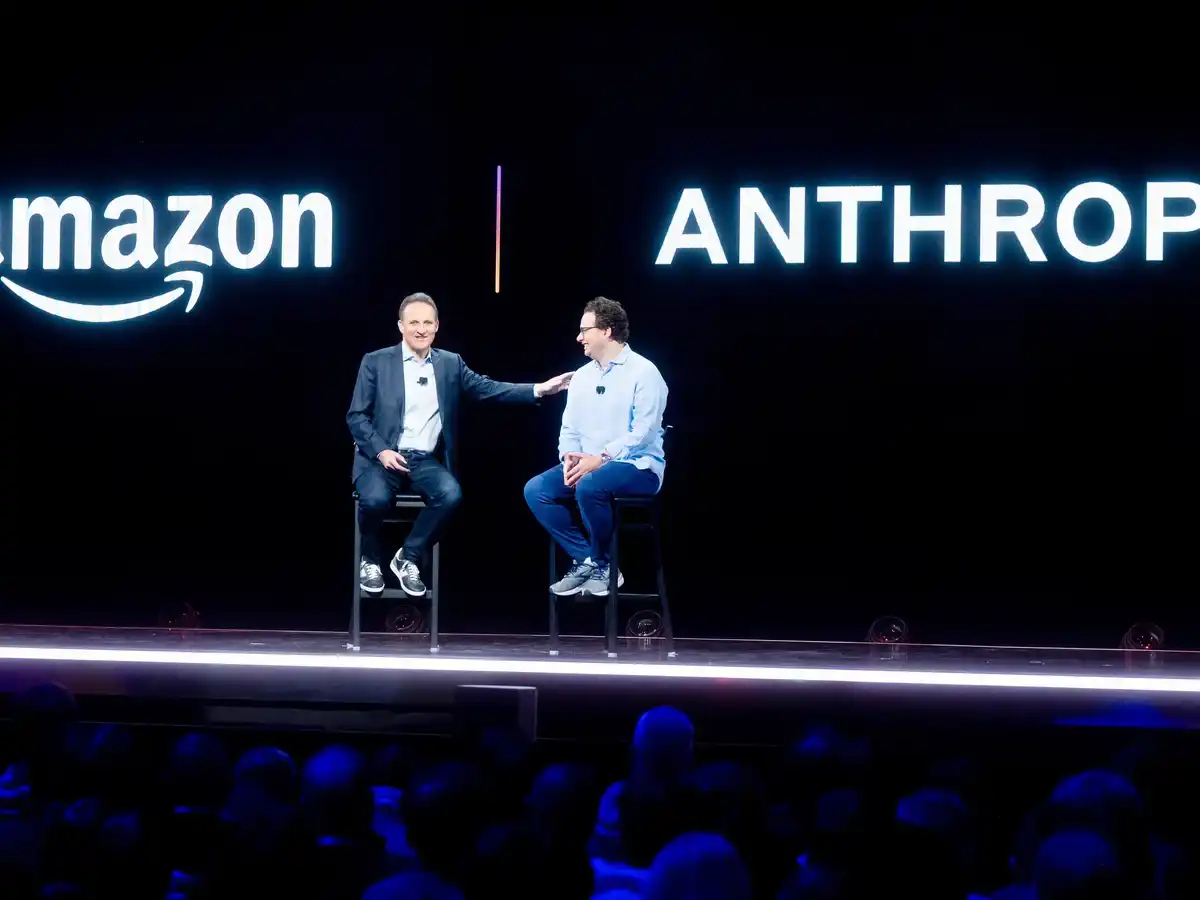
Amazon is placing bets on both of the AI field's top labs simultaneously, and the stakes are getting larger.

According to reports from CNBC, Bloomberg, and other media outlets on April 20, Amazon announced an additional investment of up to $25 billion in Anthropic, with $5 billion available immediately and the remaining $20 billion tied to specific business milestones. This investment is executed at Anthropic's $380 billion valuation from its Series G financing in February of this year. Combined with the previous cumulative investment of $8 billion, Amazon's total investment commitment to Anthropic now reaches a cap of $33 billion.

Two months ago, Amazon had just invested $50 billion in OpenAI, Anthropic's main competitor, and reached a cloud services agreement of a similar scale. Amazon CEO Andy Jassy stated in an announcement that Anthropic's commitment to running its large language models on AWS Trainium for up to ten years "reflects the progress we have made in the field of custom chips."

Following the news, Amazon's stock price rose approximately 2.5% in after-hours trading.

$100 Billion Cloud Commitment for 5 Gigawatts of Compute Power, Responding to OpenAI's 'Insufficient Compute' Allegations

The core of this deal is not just equity investment but a deeply binding infrastructure agreement.

Anthropic has committed to investing over $100 billion in AWS technology over the next decade, covering Amazon's custom AI chips Trainium (from Trainium2 to Trainium4 and future generations) and tens of millions of Graviton CPU cores. In exchange, Anthropic will receive up to 5 gigawatts of computing capacity for training and deploying Claude models. According to Anthropic's blog disclosure, the company currently uses over 1 million Trainium2 chips to train and serve Claude and plans to put nearly 1 gigawatt of Trainium2 and Trainium3 capacity into operation by the end of 2026.

This expansion in computing scale directly responds to recent public attacks from OpenAI. OpenAI's Chief Revenue Officer, Denise Dresser, claimed in an internal memo last week that Anthropic made a "strategic error by failing to secure sufficient computing power" and predicted that OpenAI would have 30 gigawatts of computing power by 2030, while Anthropic would have only 7 to 8 gigawatts by the end of 2027. In its announcement that day, Anthropic frankly admitted that demand for Claude from enterprises and developers is accelerating, and consumer usage has seen a "sharp increase," putting "inevitable pressure" on infrastructure and affecting reliability and performance during peak periods.

Anthropic CEO Dario Amodei stated in a declaration: "Users tell us that Claude is becoming increasingly important to their work, and we need to build infrastructure to keep up with the rapidly growing demand."
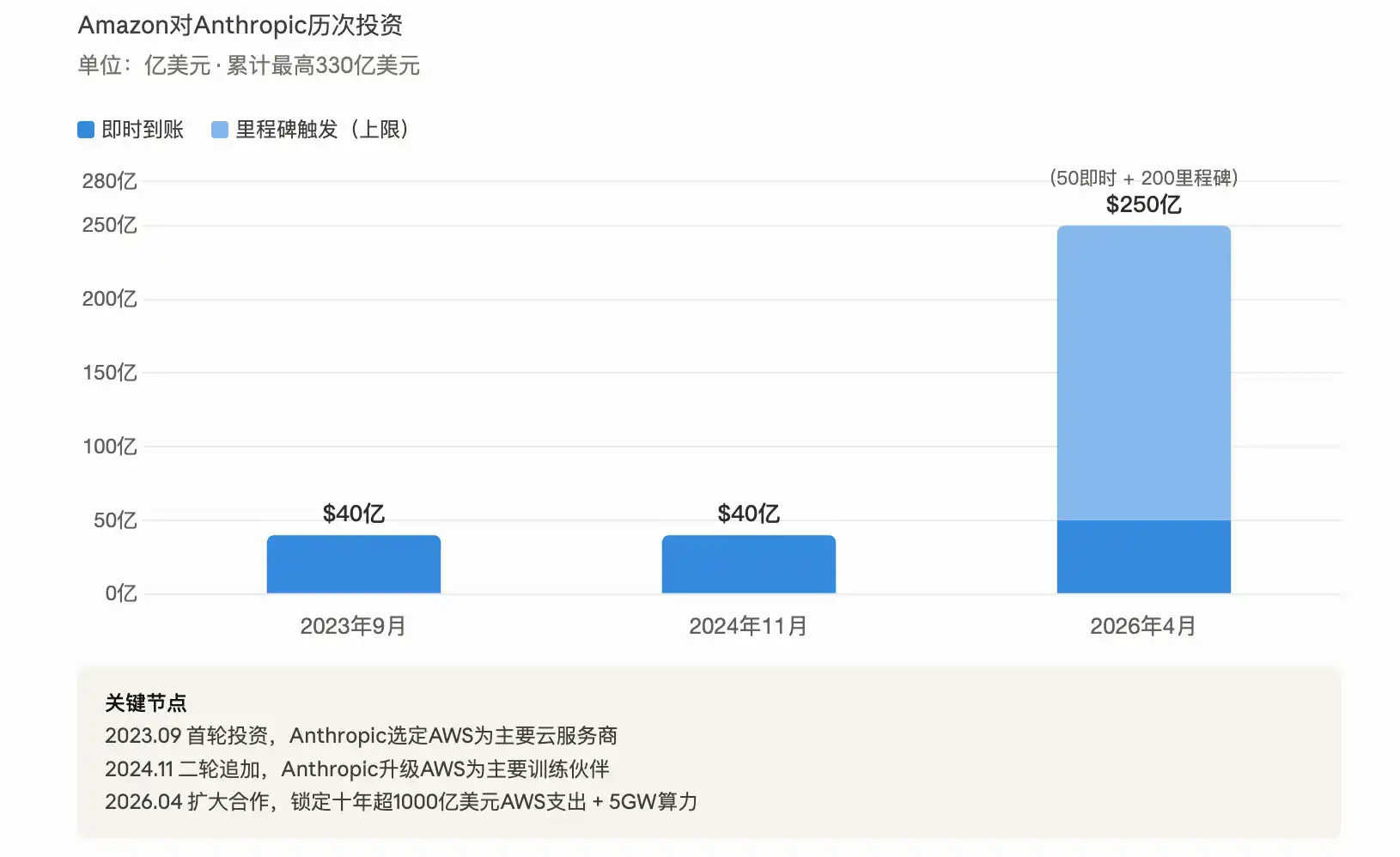
Amazon Writes Hundred-Billion-Dollar Checks to Two AI Labs in Two Months

Amazon's investment strategy is now very clear: bet on both top players in the AI race simultaneously.

In February of this year, Amazon announced an investment of up to $50 billion in OpenAI, also accompanied by a $100 billion AWS cloud service commitment. The structure of the deal with Anthropic is almost identical—$25 billion in investment plus a lock on over $100 billion in cloud spending. According to GeekWire, Amazon is executing the "same playbook" for both labs.

The two major AI companies are also racing to prove their strength to investors. According to CNBC, both Anthropic and OpenAI are preparing for potential IPOs that could land as early as this year. OpenAI's latest funding round valued it at over $850 billion, while Anthropic is valued at $380 billion. Anthropic claims its annualized revenue has exceeded $30 billion (approximately $9 billion at the end of 2025), while OpenAI's memo alleged that this figure was inflated by about $8 billion because Anthropic accounted for revenue from cloud partnerships with Amazon and Google on a gross rather than net basis.

Microsoft is also betting on both sides—it had already invested over $13 billion in OpenAI and in November 2025 invested up to $5 billion in Anthropic, which committed to purchasing $30 billion in Azure computing power.
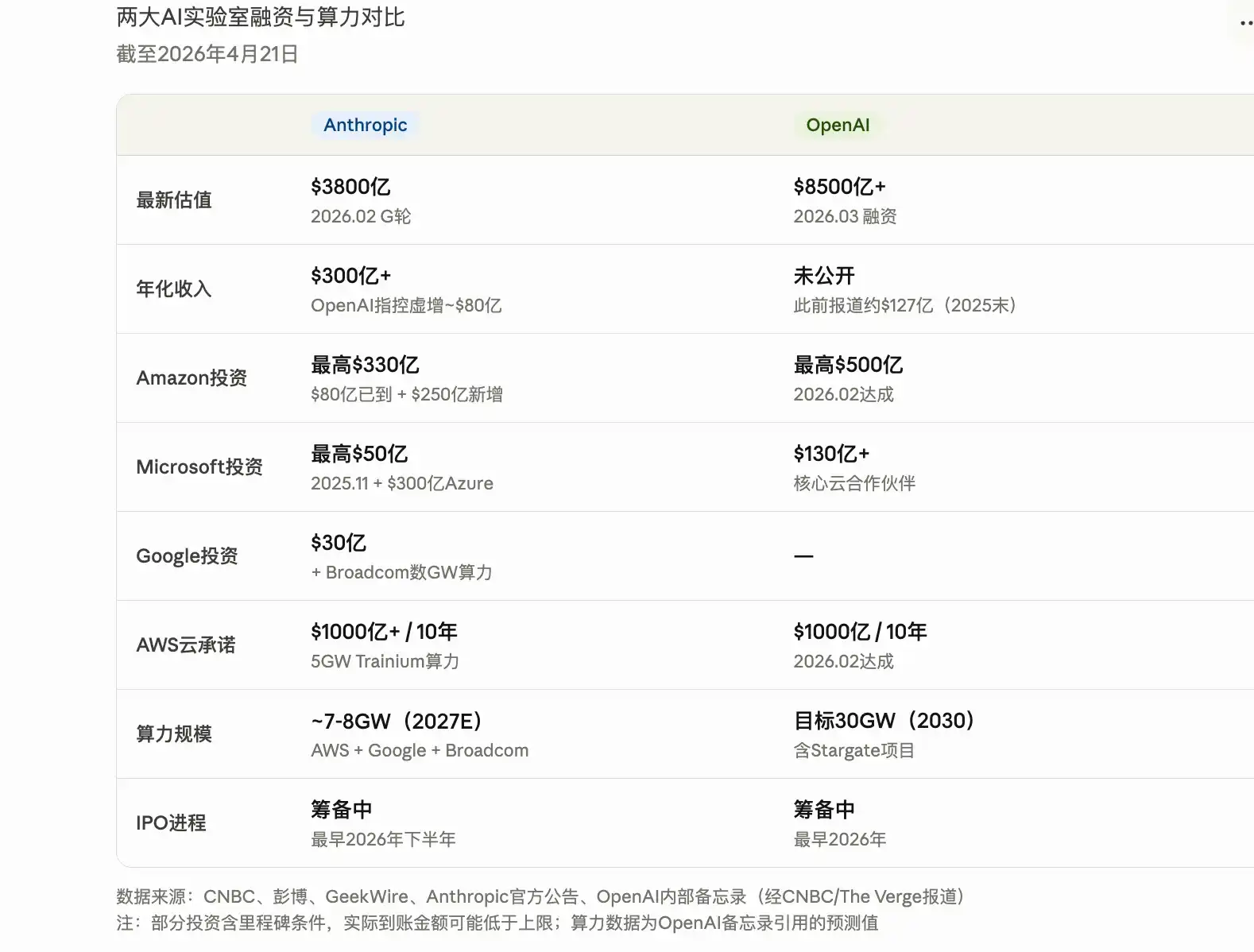
Claude Platform Integrates with AWS, Battle for Over 100,000 Customers

Beyond investment, integration at the product level is also deepening.

According to the announcement, the native Claude platform will be directly embedded into AWS. Users will be able to access the full Claude console through their existing AWS accounts, permission controls, and billing systems, without needing additional registration or new contracts. This goes a step further than the previous offering of Claude services through the Amazon Bedrock marketplace. Amazon disclosed that over 100,000 organizations are currently running Claude models on Amazon Bedrock.

Anthropic also emphasized in its blog that Claude is the only frontier AI model simultaneously available on all three major global cloud platforms (AWS Bedrock, Google Cloud Vertex AI, Microsoft Azure Foundry). This multi-platform strategy allows enterprise customers to flexibly choose their deployment path based on needs and is also one of Anthropic's differentiated advantages in competing with OpenAI.

On the client side, after Lyft used Claude via Amazon Bedrock to power its customer service AI assistant, the average resolution time for customer service was reduced by 87%. Pfizer uses Claude to help scientists perform voice searches in drug development documents, saving approximately 16,000 hours of retrieval time per year.

AI Infrastructure Race: Amazon's Capital Expenditure Expected to Reach $200 Billion This Year

The larger context embedding this deal is the AI infrastructure arms race among cloud computing giants.

Amazon stated in February that it expects capital expenditure to reach approximately $200 billion in 2026, with the vast majority directed toward AI infrastructure. The previously co-developed Project Rainier (a super-large-scale computing cluster with nearly 500,000 Trainium2 chips) was once one of the world's largest AI computing clusters, which Anthropic is using to train and deploy current and future versions of Claude.

Earlier this month, Anthropic also expanded its cooperation with Google and Broadcom, locking in computing power on the scale of "several gigawatts," expected to come online starting in 2027. Combined with this 5-gigawatt agreement with Amazon, Anthropic is expanding its computing power reserves across multiple lines simultaneously.

Amazon's custom chip business itself is also accelerating. Jassy recently revealed that the business's annualized revenue has exceeded $20 billion, doubling from the $10 billion reported earlier this year, which in his words is "on fire."


Пов'язані питання

QWhat is the total maximum investment commitment Amazon has made to Anthropic after the latest $25 billion addition?

AAmazon's total investment commitment to Anthropic has reached a maximum of $33 billion, which includes the previous $8 billion and the newly added up to $25 billion.

QWhat is the core infrastructure agreement between Amazon and Anthropic, and what does Anthropic receive in exchange?

AAnthropic commits to spending over $100 billion on AWS technology over the next decade, including Amazon's custom AI chips and CPU cores. In exchange, Anthropic will receive up to 5 gigawatts of computing capacity for training and deploying Claude models.

QHow does Amazon's investment strategy in AI labs appear, based on recent deals with Anthropic and OpenAI?

AAmazon is simultaneously betting on both leading AI labs, having invested up to $50 billion in OpenAI and up to $25 billion in Anthropic, each accompanied by a $100 billion cloud service commitment, following a similar playbook.

QWhat product integration advancement was announced between Anthropic's Claude platform and AWS?

AThe native Claude platform will be directly embedded into AWS, allowing users to access the full Claude console through their existing AWS accounts, permissions, and billing systems without needing separate registration or contracts.

QWhat is Amazon's projected capital expenditure for 2026, and what is the primary focus of this spending?

AAmazon expects its capital expenditure to reach approximately $200 billion in 2026, with the majority allocated towards AI infrastructure investments.

Пов'язані матеріали

From South Korea to the United States: Blue-Collar Jobs Are Becoming Increasingly Popular, Thanks to AI

AI is reshaping the labor market's value proposition. The traditional four-year college degree is losing its appeal as a guaranteed career path, while skilled blue-collar trades like electricians, welders, and plumbers are experiencing historic demand and wage premiums. This shift is driven by dual pressures: AI's displacement of certain white-collar roles and a booming need for physical infrastructure and data center construction. Data confirms the trend. In the U.S., vocational school revenue surged, and a significant portion of recent layoffs are AI-related. Surveys show a majority of Gen Z adults plan to pursue blue-collar work, citing better job security against AI automation. Vocational education interest has exploded recently. Experts cite a psychological shift as younger generations seek tangible, AI-resistant careers and avoid high student debt. In many cases, salaries for skilled trades now match or exceed those requiring a bachelor's degree. In South Korea, semiconductor vocational high schools boast near-total employment, with graduates securing high-paying roles at companies like Samsung. The shortage is structural, exacerbated by a retiring baby boomer workforce and massive infrastructure projects. Companies like JPMorgan Chase, Meta, and Lowe's are investing heavily in training programs. However, overcoming historical stigma and a "perception gap" around trade careers remains a key challenge to closing the talent gap.

marsbit20 хв тому

From South Korea to the United States: Blue-Collar Jobs Are Becoming Increasingly Popular, Thanks to AI

marsbit20 хв тому

Qualcomm: AI Hype Subsides, When Will Smartphones Emerge from the Gloom?

Qualcomm reported its Q3 FY2026 results (ending June 2026), with revenue of $9.95B, down 4% YoY but above expectations. Gross margin declined to 53.1%, pressured by rising costs across manufacturing and memory. Key business segments showed mixed performance: Handset revenue fell 19.6% YoY to $5.09B, dragged by an 11% decline in non-Apple Android shipments and weaker high-end mix. Conversely, Automotive revenue surged 61% to $1.59B, and IoT grew 9% to $1.83B. Core operating profit dropped 41% YoY due to margin compression and higher expenses. Management's Q4 FY2026 guidance projects revenue of $9.7B-$10.5B, in line with consensus, but Non-GAAP EPS guidance of $2.05-$2.25 fell short of expectations. Amidst persistent weakness in its core handset market, Qualcomm is pursuing growth in AI, focusing on Edge AI (smartphones, PCs, automotive) and Data Center AI. Its data center strategy includes four pillars: AI accelerators (e.g., AI200), commercial CPUs (Dragonfly C1000), custom silicon, and connectivity solutions. While these initiatives initially boosted its stock, concerns over AI capital expenditure sustainability have since erased those gains. The company targets $5B in data center revenue for FY2027 and $15B for FY2029. The report concludes that with the traditional handset business still under pressure, the data center opportunity is currently viewed as a longer-term option, and a more conservative valuation based on core operations may be warranted until AI contributions materialize.

marsbit24 хв тому

Qualcomm: AI Hype Subsides, When Will Smartphones Emerge from the Gloom?

marsbit24 хв тому

From TPU to Self-Evolving Agents: How Jeff Dean Predicts the Next Step in AI

At the 2026 YC Startup School, Jeff Dean outlined his vision for AI's next phase, shifting focus from simply scaling models to building intelligent, autonomous systems. He believes AI's progress is no longer just about creating smarter models, but about integrating them into systems capable of long-term, iterative work, automated experimentation, and continuous learning. This evolution moves the competition from "who has the bigger model" to "who can best organize intelligence." Dean suggests AI capabilities are now comparable to a junior engineer, enabling the automation of complex workflows. However, the true challenge and opportunity lie in managing these AI "workers" at scale. He emphasizes the importance of **context engineering**—structuring tools, memory, and feedback loops—over raw model power. For startups, this means building deep expertise in niche domains where general models currently fail (near 0-1% success rates), leveraging proprietary data, specialized tools, and domain-specific evaluators. A recurring theme is re-examining fundamental constraints. Dean's past work, like moving Google's search index to memory or creating the TPU, stemmed from questioning outdated assumptions about hardware and cost. He sees similar inflection points today, particularly in **specialized inference hardware** to drastically reduce latency and energy consumption for real-time Agent operation. Notably, he points out that in modern AI systems, the dominant cost is often not computation but **data movement**. Reliable, long-running Agents require robust system design, borrowing concepts from distributed computing like checkpointing, state management, and parallel exploration to handle failures and maintain progress over days or weeks. As AI automates execution, the scarcest human skills will shift to **defining clear specifications**, **judging what problems are worth solving** (taste), and designing effective feedback loops. Ultimately, Dean's framework prioritizes understanding the problem deeply, identifying the true bottlenecks, and systematically building closed-loop systems where AI can not only perform tasks but also improve AI itself.

marsbit24 хв тому

From TPU to Self-Evolving Agents: How Jeff Dean Predicts the Next Step in AI

marsbit24 хв тому

Торгівля

Спот
活动图片




