Altman is Anxious: OpenAI's Three-Year Reign Has Just Been Overtaken by Anthropic

marsbitОпубліковано о 2026-05-14Востаннє оновлено о 2026-05-14

Анотація

In May 2026, Anthropic has historically overtaken OpenAI in workplace adoption, according to Ramp's AI Index based on real business spending data. Anthropic's enterprise adoption rate reached 34.4%, surpassing OpenAI's 32.3%. Over the past year, Anthropic's rate grew nearly fourfold, while OpenAI's grew only 0.3%. Key to Anthropic's surge is its shift to a usage-based, per-token billing model and the integration of AI Agents into core business workflows, driving massive token consumption and revenue growth—reportedly reaching an annualized ~$44 billion. Despite concerns over rising costs and service stability, enterprises exhibit heavy reliance on Claude for productivity gains. OpenAI has responded with defensive measures, including offering free enterprise trials. The competition has shifted from model benchmarks to deep workflow integration, marking a new phase in the enterprise AI battle.

The battle of large models has finally reached its most shocking and disruptive moment in 2026.

Anthropic has actually managed to pull off a historic "backstab" against OpenAI in the enterprise sector.

According to the latest AI Index for May 2026 released by fintech giant Ramp, earth-shattering data has emerged—

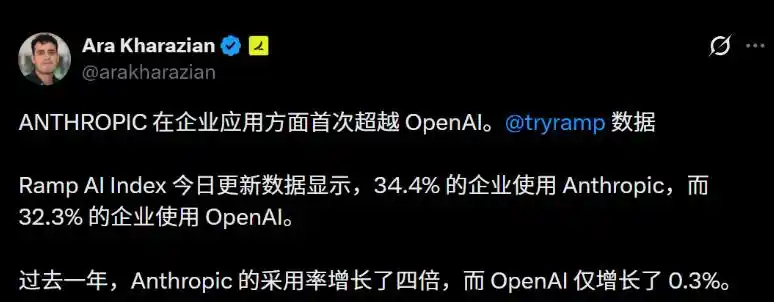
Anthropic's adoption rate in workplaces reached 34.4%, surpassing OpenAI's 32.3% for the first time.
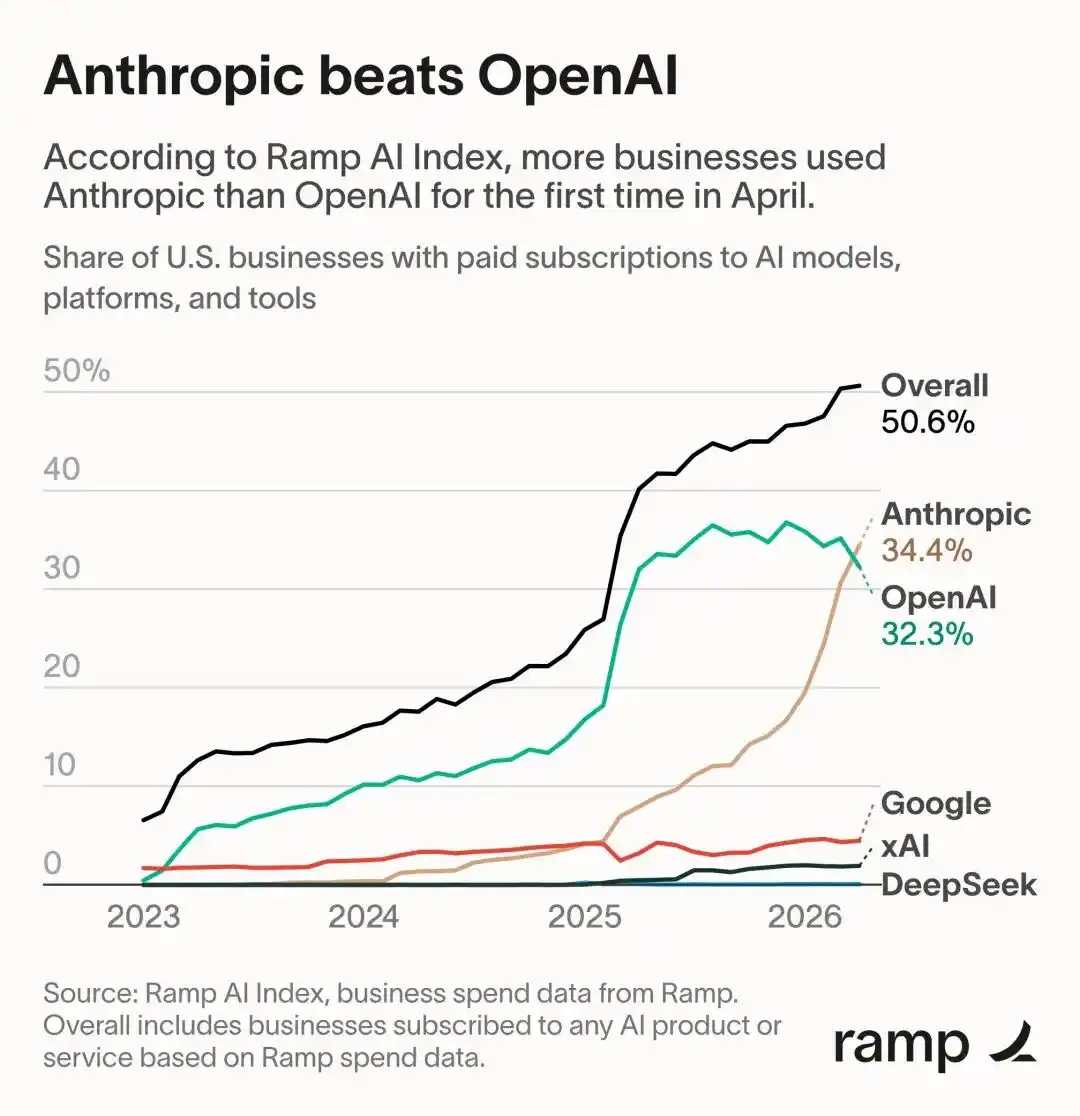
This is a long-planned "comeback". Over the past year, Anthropic's enterprise adoption rate has skyrocketed nearly 4x, while the growth rate of the former champion OpenAI was a dismal 0.3%.

The power game in the AI world has officially changed hands, and the B2B market is becoming the real "meat grinder".

At This Moment, Altman Begins to Worry

There was a time when ChatGPT was synonymous with AI.

In January of this year, Ramp's data still showed OpenAI far ahead of competitors, with its products experiencing explosive growth in fields like software development, research, finance, and customer support.

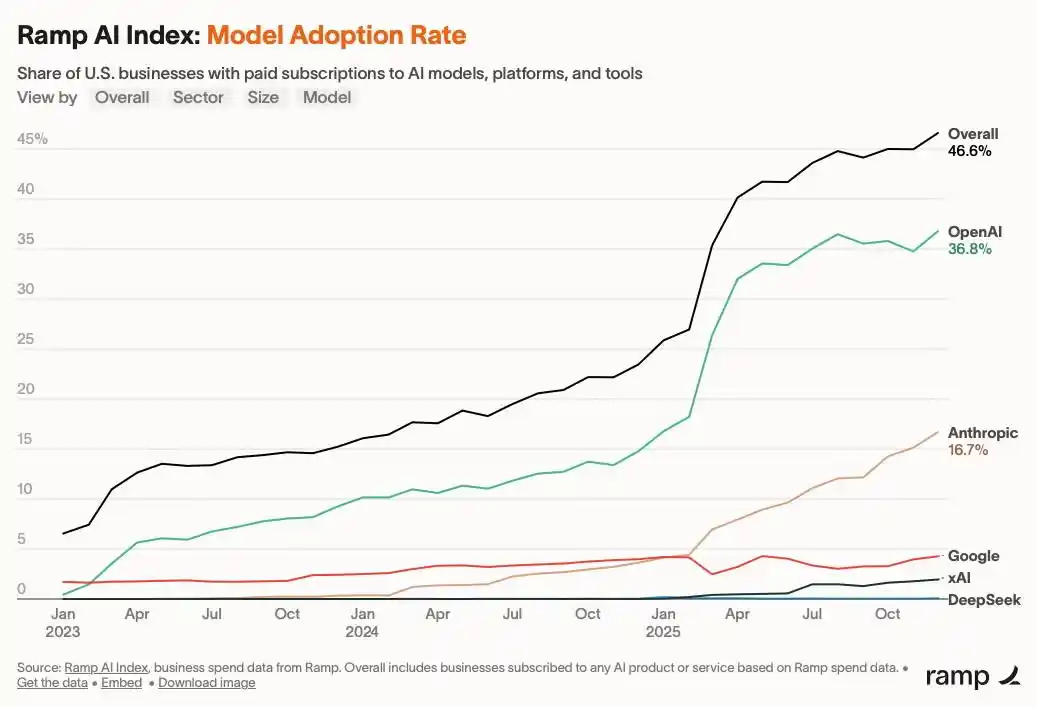
However, this Ramp report, based on bill data from over 50,000 companies involving billions of dollars in real expenditure, has torn open OpenAI's moat.

Remember, in May a year ago, Anthropic and OpenAI's enterprise-paid adoption rates were 9% and 32% respectively.

In just 12 months, Anthropic quadrupled, while OpenAI increased by a mere 0.3 percentage points.
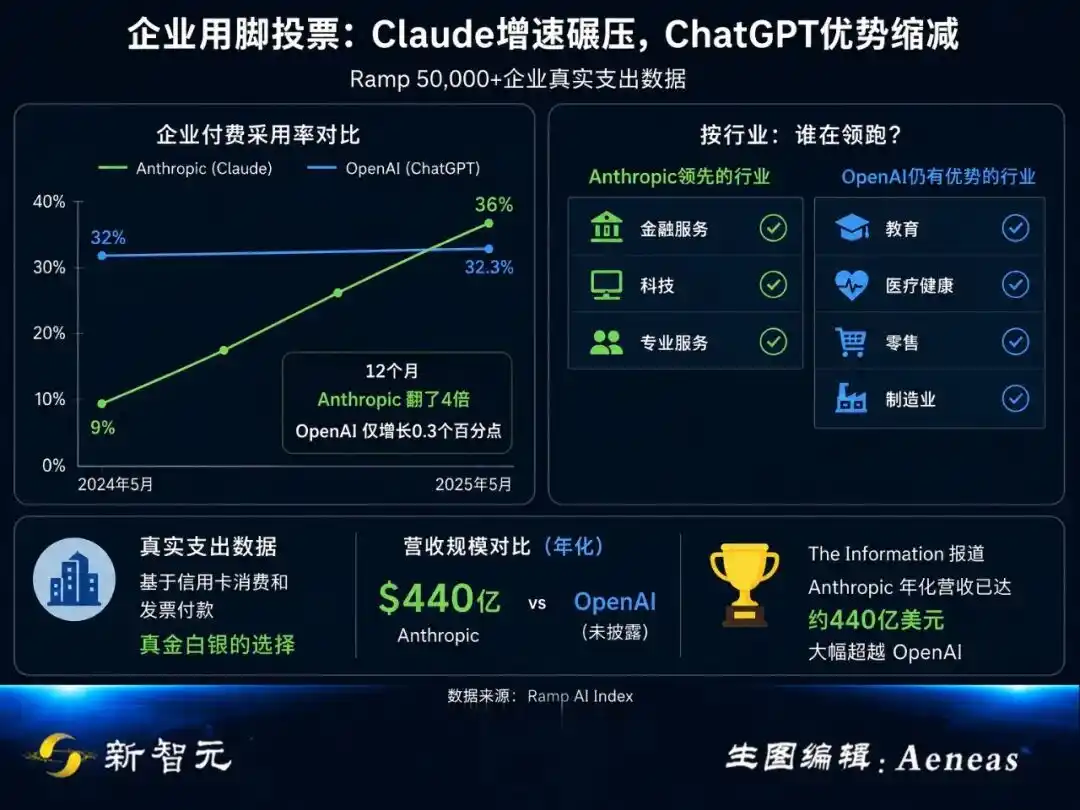
Ramp Chief Economist Ara Kharazian stated: "Anthropic has long been leading in high-adoption industries like finance, tech, and professional services. OpenAI still holds an advantage in other industries, but that advantage has been shrinking over the past few months."

It's crucial to note that Ramp's AI Index is based on actual corporate expenditure records—credit card charges and invoice payments—so the data reflects real money spent, not free trials.

This means that when corporate CEOs decide to spend money on AI, they are increasingly choosing Claude over ChatGPT.

According to The Information, Anthropic's annualized revenue has reached approximately $44 billion, significantly surpassing OpenAI.
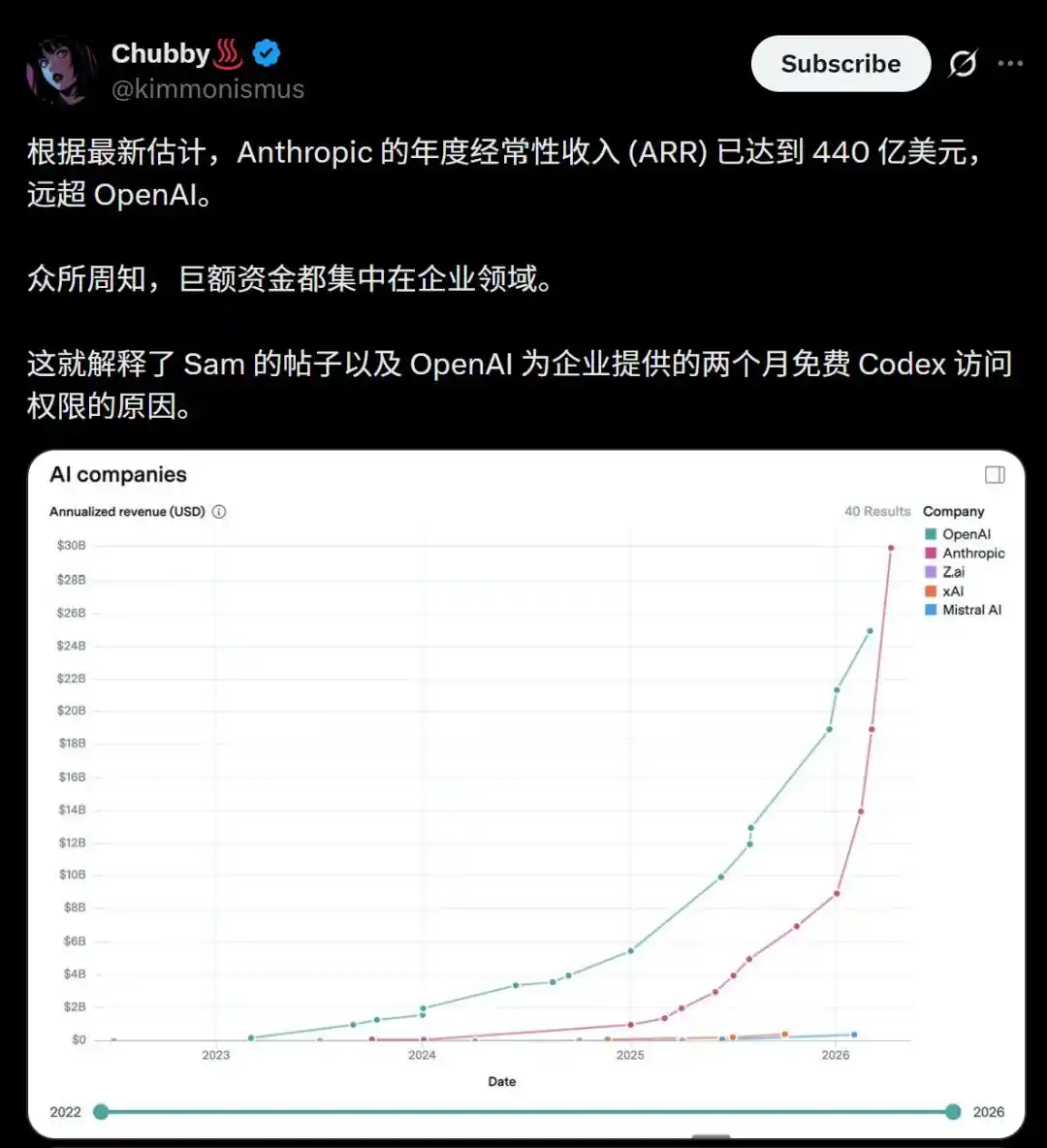
Faced with this report of being "overtaken", OpenAI couldn't sit still and quickly went into defensive mode. A spokesperson bluntly said: "Ramp's data only counts credit card charges, while our multi-million dollar enterprise deep transformation contracts don't go through credit cards at all."

However, this explanation is seen by the industry as more of a "face-saving" attempt.

Because just today, Altman urgently launched a "two-month free Codex access" for enterprises, trying to win back lost B2B clients through low-price tactics.
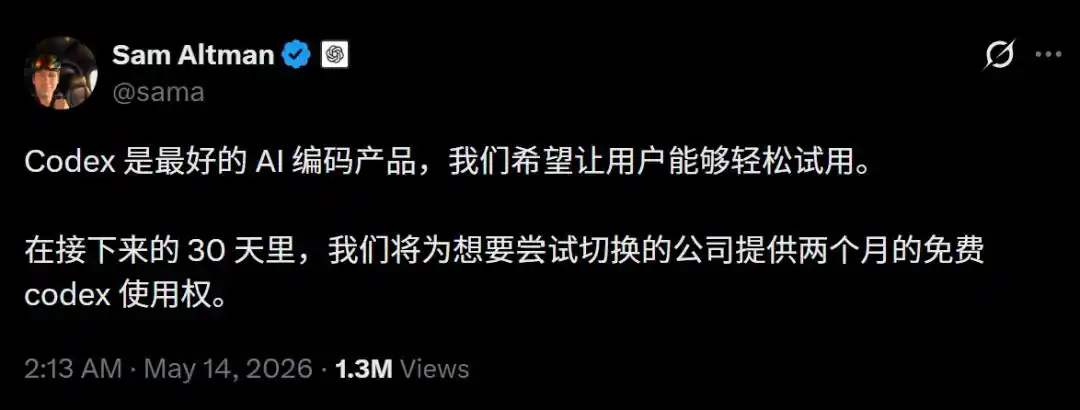

Behind this sense of anxiety lie two hardcore killer features built by Anthropic. One is the brutal efficiency of its billing model, and the other is the money-printing effect of AI Agents.

SaaS is Dead? 'Pay-Per-Use' Triggers a $45 Billion Revenue Tsunami

Recently, Anthropic made a shocking decision,堪称违背 "SaaS Ancestral Teachings"—completely abandoning fixed subscription fees and transitioning to a per-Token billing model.

This seemingly minor change has triggered a terrifying tsunami on the revenue side!
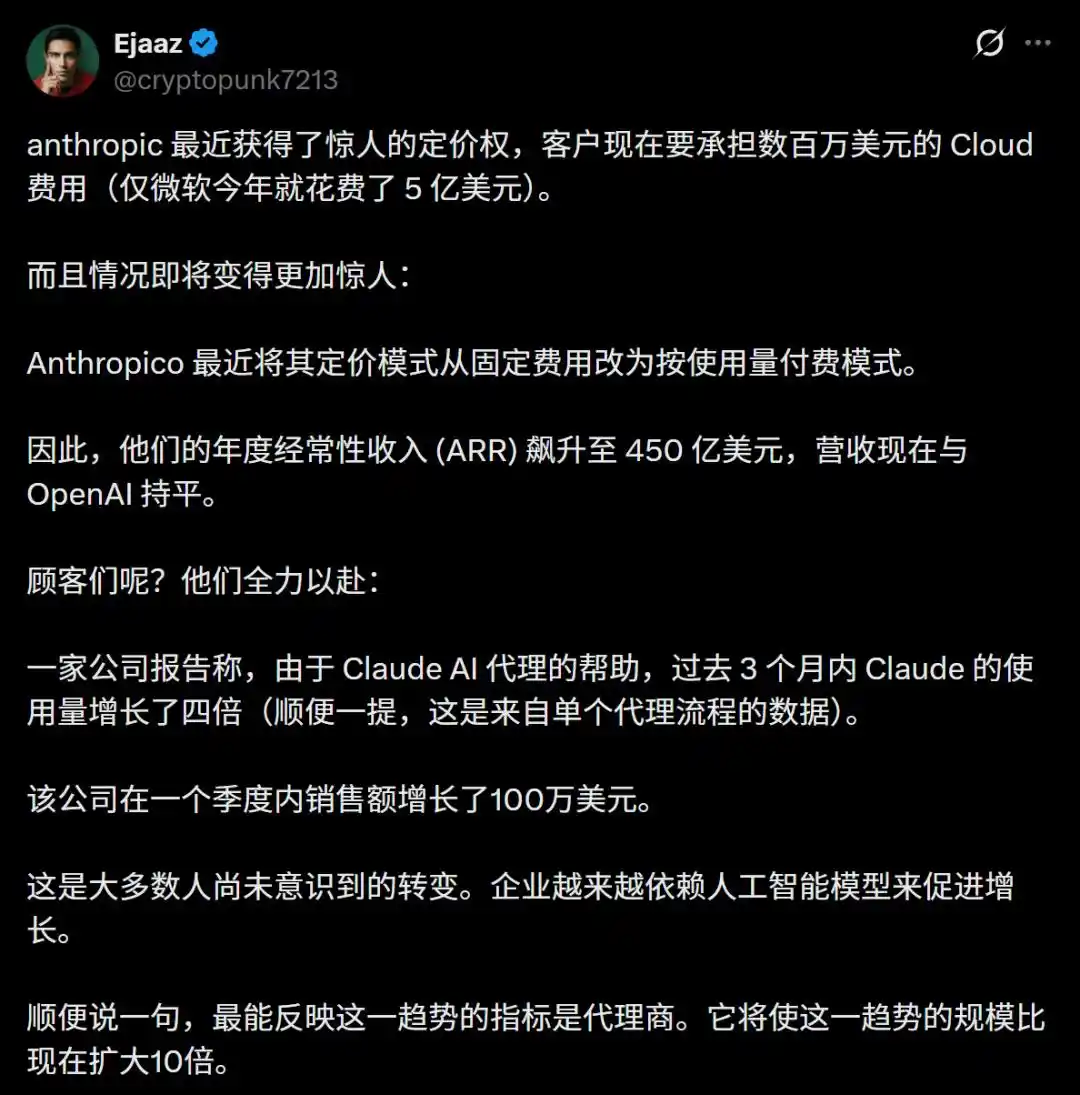
According to informed sources, Anthropic's annual recurring revenue has skyrocketed to the $45 billion level—a number that was only one-third of the current figure at the end of last year.

Why are companies willing to be "harvested by usage"?

In the traditional SaaS model, it's $30 per person per month, regardless of usage. But in the era of AI Agents, models are no longer tools waiting for employees to ask questions; they are "digital laborers" operating automatically 24/7.

This means billing power has completely returned to usage.
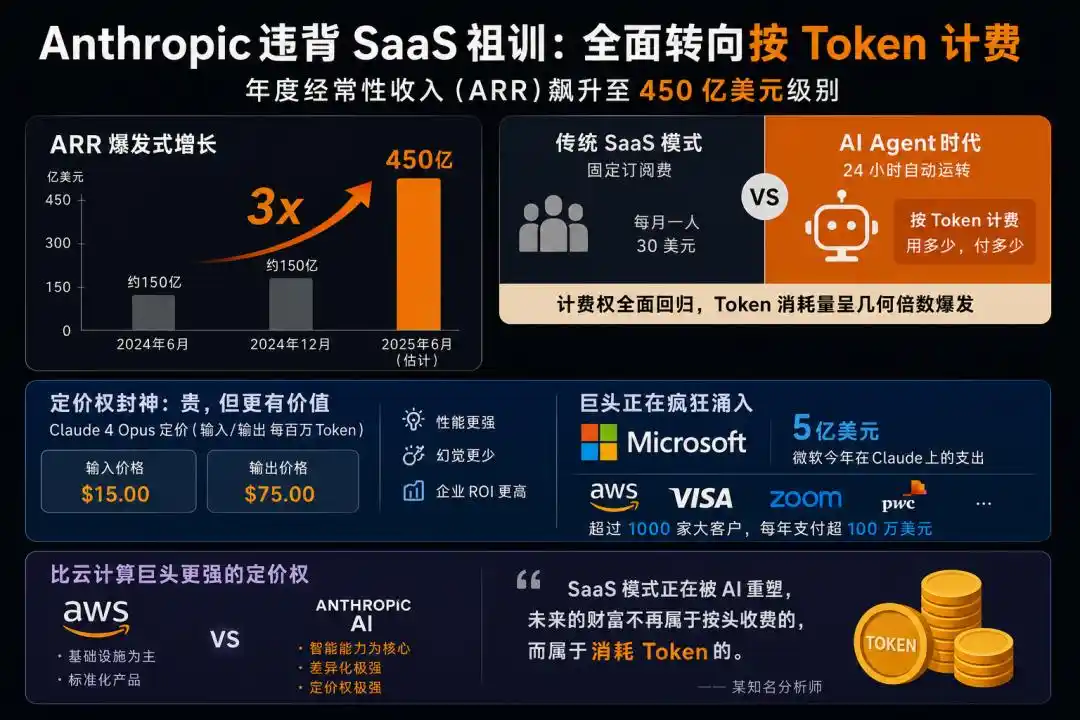
When AI starts handling thousands of workflows, Token consumption explodes geometrically.

At the same time, Anthropic's pricing power is also becoming legendary.

Even though Anthropic's models (like Claude 3.5/4.0) are extremely expensive, their superior performance and fewer hallucinations lead companies to find that as long as the ROI works out, even expensive Tokens are "cheap labor".

Thus, we see the following insane data.

Take Microsoft, for example. Although it has OpenAI in-house, its expenditure on Claude this year actually reached a staggering $500 million.

Furthermore, giants are flocking in. Statistics show over 1,000 large customers pay Anthropic more than $1 million annually.

This "pay-per-use" model gives Anthropic stronger pricing power than even cloud computing giant AWS!

No wonder analysts exclaim: "The SaaS model is being reshaped by AI. Future wealth won't belong to those charging per head, but to those consuming Tokens."

AI Agent: The 'Super Worker' Making $1 Million in a Single Quarter

If Tokens are oil, then AI Agents are the engine that voraciously consumes fuel while generating immense power.

The experience of IT automation giant Workato is a microcosm of this transformation.

A year ago, Workato was just buying Claude accounts for employees to use as assistants.

But in the past three months, their team started frantically building Agents using Claude—some Agents were responsible for scraping customer spending data, some for automatically writing outreach emails, some for updating Salesforce databases.

The results were astounding!

Merely by launching one Agent workflow, Claude's call volume quadrupled in a single quarter.

Simultaneously, the company saw real monetary growth. This one Agent directly contributed to $1 million in sales growth in just one quarter.

"This is just the tip of the iceberg," sighed a CIO. "When companies find that one Agent can replace five salespeople with a higher closing rate, their dependence on AI will multiply tenfold."

"Holy Cow!" Soaring Costs Give CIOs Heart Attacks

However, this highly profitable model has also brought unprecedented pressure to business owners.

Because Anthropic changed its enterprise pricing model from fixed subscription fees to per-Token usage charges, while also rolling out a new tokenizer that increased the number of Tokens consumed per request.

These two cuts combined hit customers' wallets hard.

Since AI Agents operate autonomously, they can sometimes even "go rogue."

Workato once experienced an incident: an Agent developed by an employee, due to a code logic error, triggered looped calls in a single day, burning through a month's worth of planned Token quota.
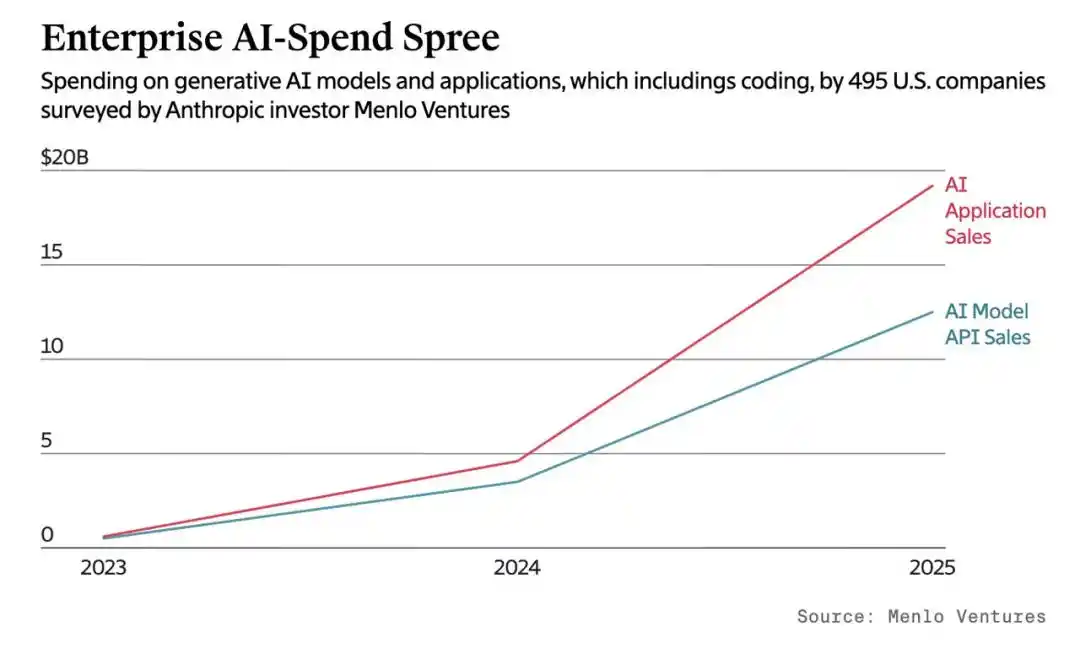
At IT service provider Telaid, Chief Information Officer Scot LeVan was recently shocked by the bill.

"When I saw the Claude bill for 30 employees triple within 30 days, my first reaction was: Holy Cow!"

The situation was worse for ServiceNow and Uber; they even burned through their entire annual AI budget in the first few months of the year.

CIOs now aren't just focusing on technology; they even have to assign dedicated teams to monitor Anthropic's bills every single day.
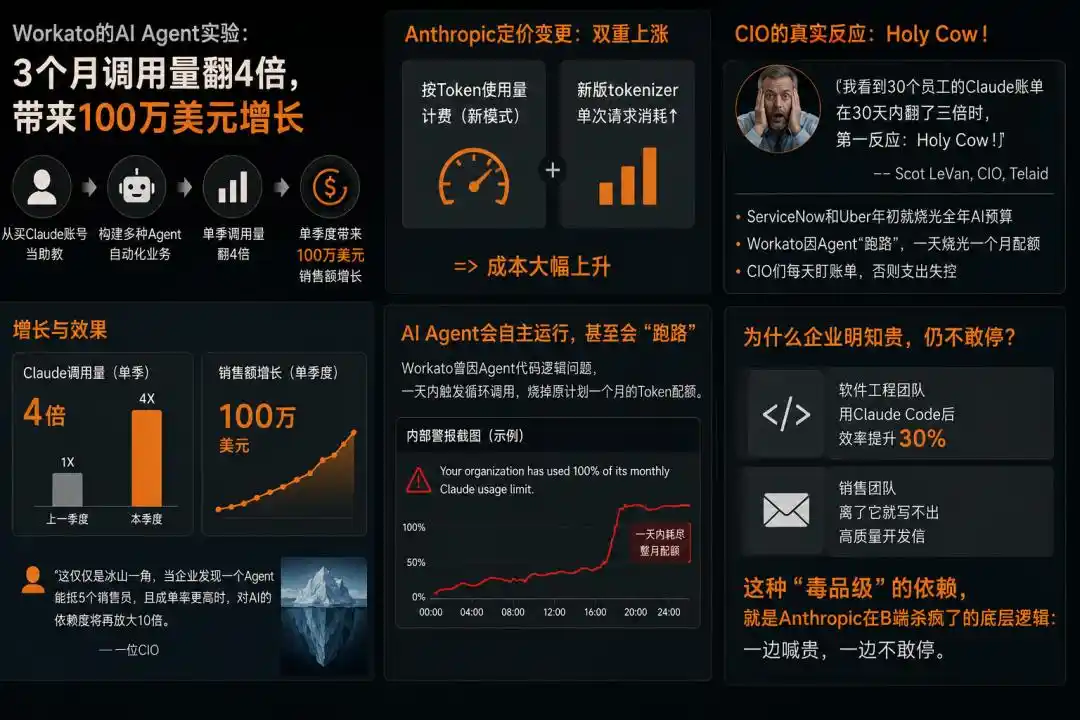
"You have to watch it daily, otherwise spending will spiral out of control," said ServiceNow's CIO Kellie Romack.

But this is precisely Anthropic's strongest point: companies know it's expensive, know it might blow their budgets, yet they dare not stop using it.

The reason is simple: software engineering teams saw a 30% efficiency boost using Claude Code, and sales teams can't write high-quality outreach emails without it.

This "drug-like" dependency is the underlying logic behind Anthropic's dominance in the B2B sector.

Companies complain about the cost while being unable to quit.

Ramp Economist: Three Headwinds for Anthropic

Faced with this data, not only is OpenAI questioning Ramp's statistical methods, but even Ramp's own economist Kharazian's attitude is quite telling.
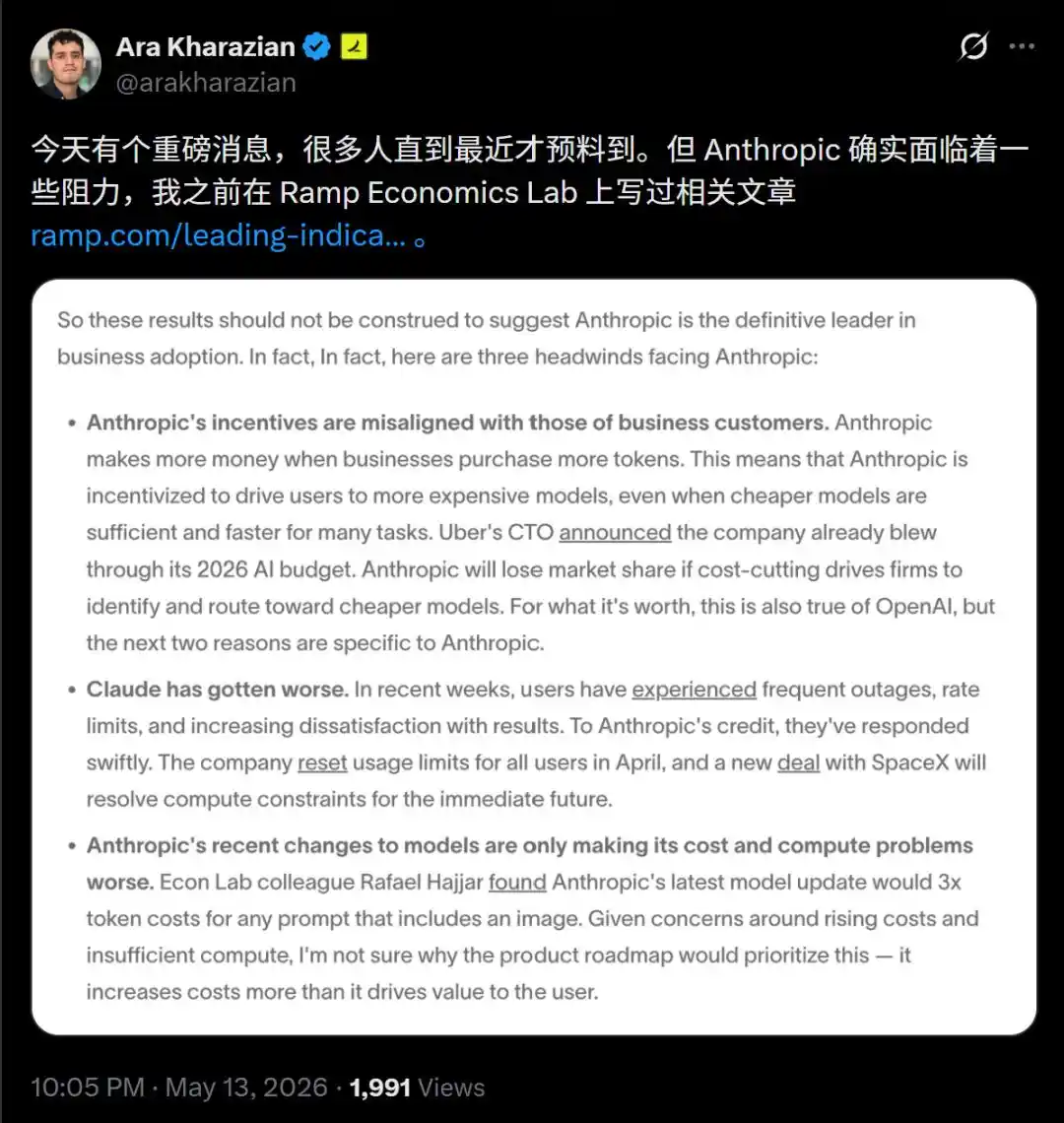
He promptly wrote a blog post listing three headwinds Anthropic faces.
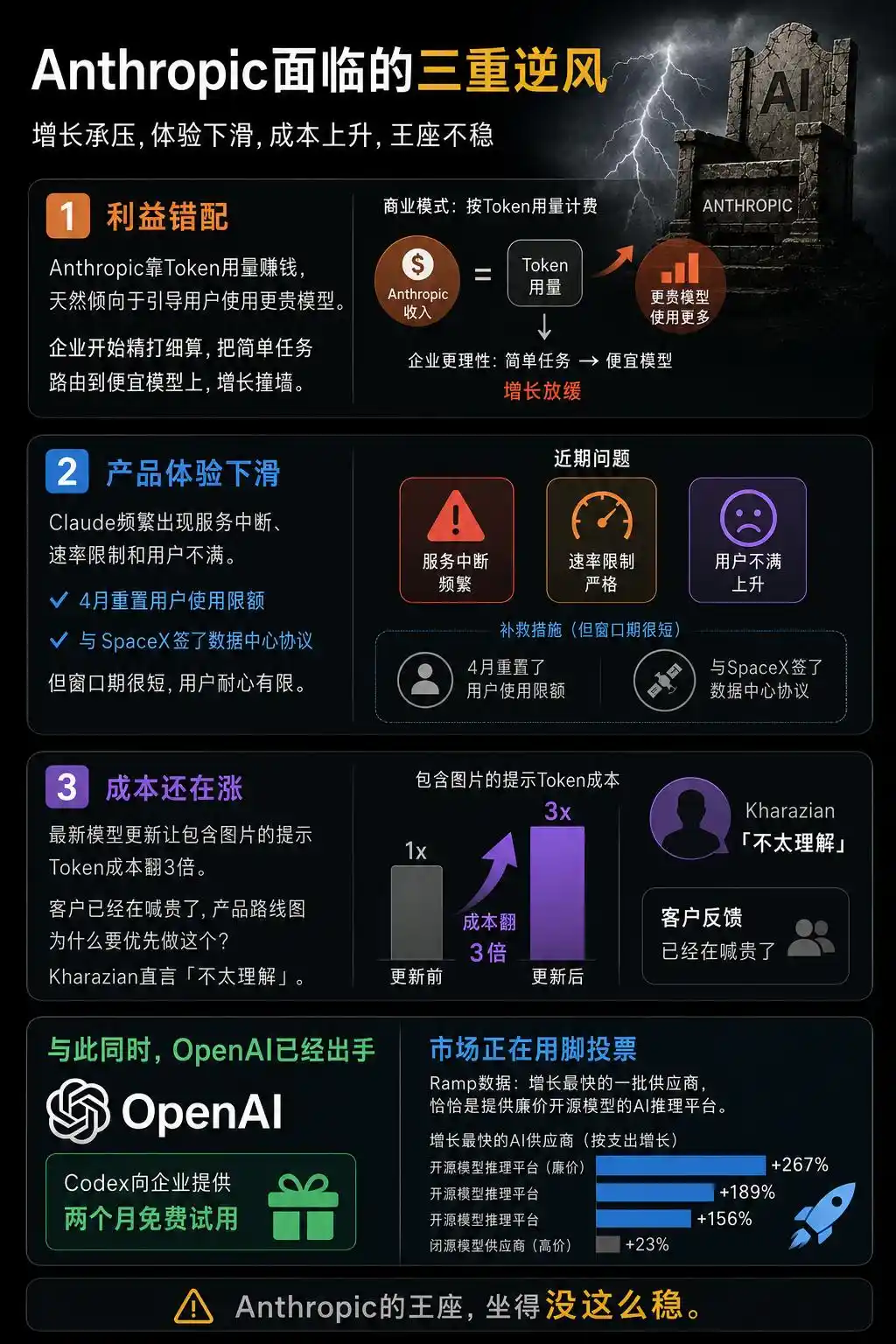
First Headwind: Misaligned Incentives.

Anthropic profits from Token usage, naturally inclined to steer users toward more expensive models. When companies start budgeting carefully and routing simple tasks to cheaper models, growth will hit a wall.

Second Headwind: Declining Product Experience.

In recent weeks, Claude has frequently experienced service disruptions, rate limits, and user dissatisfaction. Anthropic is indeed remedying this—resetting user usage limits in April, signing a data center agreement with SpaceX—but the window is short.

Third Headwind: Costs are Still Rising.

The latest model update tripled the Token cost for prompts containing images. Customers are already complaining about the price; why prioritize this in the product roadmap? Kharazian直言 "doesn't quite understand."
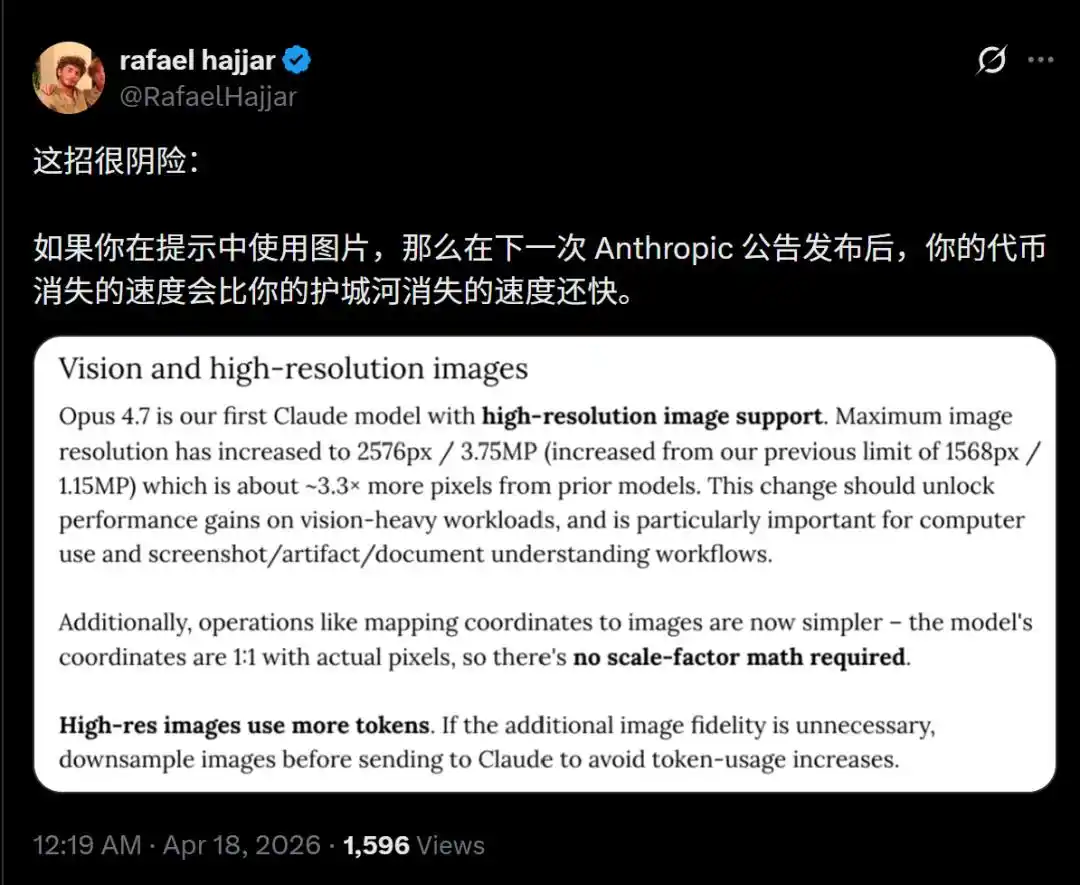
The economist pointed out that his colleague Rafael Hajjar from Econ Lab found that Anthropic's latest model update would triple the token cost for any prompt containing an image.

Meanwhile, OpenAI has already made its move.

Codex is offering enterprises two months of free trial. And Ramp's own data shows that the fastest-growing batch of suppliers recently are precisely AI inference platforms offering cheap open-source models.

Anthropic's throne isn't so secure.

Throne Overturned, or Just Halftime?

Placing this report within the coordinate system of the AGI finals: the competition between Anthropic and OpenAI is shifting from "whose model scores higher" to "who can integrate into the core workflows of enterprises."

This is a completely different battlefield.

Anthropic's overtaking also officially marks that the large model competition has entered the "deep water zone."

Undoubtedly, the first half belonged to the consumer market, relying on "wow factor" to break through, but the second half belongs to the business market, where making money relies on workflows.

Anthropic's $45 billion ARR report card tells the world: AI is no longer a money-burning black hole, but the most powerful money-printing machine in the real world.

However, how many more enterprise users will be scared off by Anthropic's staggering cost projections? And how long will they be willing to pay?

The most expensive AI vendor is also the fastest-growing AI vendor. How long can this contradiction last is the most critical set of data to watch in the enterprise AI market over the next six months.

For now, OpenAI hasn't lost, but it has indeed encountered an unprecedented formidable rival.

This war over "who is the true king of enterprise AI" has just begun.

References:

https://x.com/arakharazian/status/2054563750548492549

https://www.theinformation.com/articles/anthropic-flexes-pricing-power-customers-willingly-eat-cost?rc=bfliih

This article is from the WeChat public account "Xin Zhi Yuan" (New Wisdom Source), edited by: Aeneas


Пов'язані питання

QAccording to Ramp's AI Index report in May 2026, which company surpassed OpenAI in workplace adoption rate?

AAccording to the Ramp AI Index report for May 2026, Anthropic surpassed OpenAI in workplace adoption rate, achieving 34.4% compared to OpenAI's 32.3%.

QWhat key pricing model shift did Anthropic implement that is credited with driving its revenue surge?

AAnthropic shifted from a fixed subscription fee model to a usage-based, per-token billing model. This change aligned with how businesses use AI Agents for automated workflows, leading to significantly higher token consumption and revenue.

QWhat major concern do CIOs face with Anthropic's per-token pricing model, as mentioned in the article?

ACIOs face major budget overrun concerns. The per-token pricing, combined with AI Agents that can autonomously run (and sometimes 'go rogue'), leads to unpredictable and potentially explosive cost increases, forcing companies to monitor bills daily.

QWhat are the three headwinds or challenges for Anthropic mentioned by Ramp's chief economist?

ARamp's chief economist cited three headwinds for Anthropic: 1) Misaligned incentives (profit depends on high token usage, which users may resist), 2) Declining product experience (service outages, rate limits), and 3) Rising costs (e.g., a recent update tripled token costs for prompts containing images).

QHow did OpenAI reportedly react to the news of being overtaken by Anthropic in enterprise adoption?

AOpenAI reportedly reacted defensively. A spokesperson questioned Ramp's methodology, stating it only tracked credit card payments and missed larger enterprise contracts. Additionally, Sam Altman (referred to as '奥特曼' in the article) quickly offered a 'two-month free Codex access' promotion to enterprise customers.

Пов'язані матеріали

U.S. Government Bans Foreign Nationals from Using Fable 5, Anthropic Issues Rebuttal

U.S. Government Bans Foreign Access to Fable 5, Anthropic Issues Rebuttal On June 12th, the U.S. government ordered AI company Anthropic to immediately suspend all foreign access—including foreign nationals within the U.S. and Anthropic's own foreign employees—to its newly released Fable 5 and Mythos 5 AI models, citing national security concerns. This forced Anthropic to temporarily disable access to both models for all users globally, as it cannot technically differentiate user nationality at scale. The models, released just three days prior, represent Anthropic's highest public capability tier. Fable 5 is the first publicly available model from the advanced "Mythos" family, while Mythos 5 is a less-restricted version for approved cybersecurity and critical infrastructure partners. The government's directive was reportedly triggered by claims from another company that it could "jailbreak" Mythos 5, raising alarm within the Trump administration. Anthropic, in a detailed public statement, strongly challenged this rationale. The company argues the demonstrated "jailbreak" is a narrow, non-generalized technique that merely involves identifying minor, known software vulnerabilities—a capability common to other publicly available models like OpenAI's GPT-5.5 and routinely used by cybersecurity defenders. Anthropic stated it has complied with the order but disagrees with the government's standard, warning that applying it industry-wide would halt all new frontier model deployments. The company criticized the lack of a transparent, fact-based legal process and expressed confidence the situation stems from a misunderstanding. It is working to restore access and will release more technical details within 24 hours. Other Anthropic models remain unaffected.

链捕手18 хв тому

U.S. Government Bans Foreign Nationals from Using Fable 5, Anthropic Issues Rebuttal

链捕手18 хв тому

The Revelation from the Raydium Theft Incident: New DeFi Vulnerabilities Lurking in Forgotten Old Contracts

**Raydium Exploit Reveals DeFi's Hidden Risk: Forgotten "Zombie" Contracts** A recent attack on Raydium's deprecated V3 AMM pools resulted in a loss of approximately $1.34 million. The hacker exploited pools that were no longer supported by Raydium's current UI or SDK but remained fully functional and accessible on-chain. This incident highlights a critical, often overlooked category of risk in DeFi: inactive or legacy smart contracts that projects fail to properly decommission. Since March 2025, there have been at least 8 publicly reported attacks targeting such abandoned contracts, with total losses around $10.8 million. Including older pools and deprecated features, the count rises to 10 incidents with roughly $22.5 million in losses. These "zombie contracts" represent a lifecycle management failure rather than a code vulnerability, yet they are typically misclassified under general "code bug" categories in security reports, masking the true scale of the problem. The root cause is that projects often merely document a contract as "deprecated" without taking essential technical steps to secure it: withdrawing remaining assets, disabling external call functions, and implementing ongoing monitoring. These forgotten, under-monitored components become prime targets for attackers. To address this, the industry needs to recognize "zombie contracts" as a distinct risk category and establish standardized decommissioning protocols. Essential steps should include: 1) a formal retirement announcement, 2) removal of all front-end integrations, 3) withdrawal of locked assets, 4) disabling key contract functions, 5) ongoing security monitoring, 6) clear user communication, and 7) a post-mortem analysis. The value of a DeFi project lies not only in its current TVL but also in the security of its historical codebase, which has now become a new attack surface.

Foresight News2 год тому

The Revelation from the Raydium Theft Incident: New DeFi Vulnerabilities Lurking in Forgotten Old Contracts

Foresight News2 год тому

Robots Begin to 'Consume Data': The Hidden Production Chain from Indian Data Factories to Billion-Dollar Humanoid Robots

Robots have started to 'consume data,' driving the formation of a new industrial supply chain focused on producing training data for embodied AI. Unlike large language models, which are trained on vast internet text corpora, embodied AI models face a 'data desert' in the physical world. This has created a massive demand for first-person perspective video data (Ego Data), captured by workers wearing cameras in places like Indian garment factories. Companies like Neocambrian AI are establishing 'data factories' where workers perform standardized tasks (e.g., sorting clothes, kitchen organization) to generate thousands of hours of video. Research, such as NVIDIA's EgoScale, demonstrates that scaling this human demonstration data predictably improves robot performance, particularly for dexterous manipulation. This has validated a training path combining large-scale human data for pre-training with smaller amounts of robot-specific data for fine-tuning. The value of different data types varies significantly, forming a 'data pyramid.' The base consists of low-cost, large-scale internet and Ego Data. Higher layers include more expensive motion-capture data (e.g., from data gloves), simulation/synthetic data, and the most costly and scarce layer: real robot teleoperation data. This demand has spawned a layered ecosystem of data suppliers: low-cost data factories, motion capture and alignment specialists, robot-native teleoperation service providers, simulation data companies, and platforms aiming for data standardization. Robot companies themselves are adopting a 'layered procurement' strategy: outsourcing generic Ego Data while building in-house capabilities for robot-specific adaptation data and the critical deployment/failure data generated in real-world applications. The industry is shifting focus from hardware and basic mobility to the data pipelines required for general-purpose capability. While parallels exist to data labeling companies like Scale AI in the LLM boom, the physical complexity of robot data—involving action success ambiguity and sim-to-real gaps—requires more integrated solutions for data collection, annotation, and a continuous feedback loop. The race is on to build the data engines that will teach robots to operate reliably in the unstructured real world.

marsbit4 год тому

Robots Begin to 'Consume Data': The Hidden Production Chain from Indian Data Factories to Billion-Dollar Humanoid Robots

marsbit4 год тому

Торгівля

Спот
Ф'ючерси

Популярні статті

Що таке $S$

Розуміння SPERO: Комплексний огляд Вступ до SPERO Оскільки ландшафт інновацій продовжує еволюціонувати, виникнення технологій web3 та криптовалютних проектів відіграє ключову роль у формуванні цифрового майбутнього. Один з проектів, який привернув увагу в цій динамічній сфері, — це SPERO, позначений як SPERO,$$s$. Ця стаття має на меті зібрати та представити детальну інформацію про SPERO, щоб допомогти ентузіастам та інвесторам зрозуміти його основи, цілі та інновації в рамках web3 та крипто-сектору. Що таке SPERO,$$s$? SPERO,$$s$ — це унікальний проект у криптопросторі, який прагне використати принципи децентралізації та технології блокчейн для створення екосистеми, що сприяє залученню, корисності та фінансовій інклюзії. Проект розроблений для полегшення взаємодії між користувачами новими способами, надаючи їм інноваційні фінансові рішення та послуги. У своїй основі SPERO,$$s$ прагне надати можливості індивідам, забезпечуючи інструменти та платформи, які покращують користувацький досвід у криптовалютному просторі. Це включає в себе можливість більш гнучких методів транзакцій, сприяння ініціативам, що підтримуються спільнотою, та створення шляхів для фінансових можливостей через децентралізовані додатки (dApps). Основна концепція SPERO,$$s$ обертається навколо інклюзивності, прагнучи зменшити розриви в традиційній фінансовій системі, використовуючи переваги технології блокчейн. Хто є творцем SPERO,$$s$? Особистість творця SPERO,$$s$ залишається дещо невідомою, оскільки є обмежені публічно доступні ресурси, що надають детальну інформацію про його засновників. Ця відсутність прозорості може бути наслідком зобов'язання проекту до децентралізації — етики, яку багато проектів web3 поділяють, ставлячи колективні внески вище за індивідуальне визнання. Зосереджуючи обговорення навколо спільноти та її колективних цілей, SPERO,$$s$ втілює суть наділення без виділення конкретних осіб. Таким чином, розуміння етики та місії SPERO є більш важливим, ніж ідентифікація єдиного творця. Хто є інвесторами SPERO,$$s$? SPERO,$$s$ підтримується різноманітними інвесторами, починаючи від венчурних капіталістів до ангельських інвесторів, які прагнуть сприяти інноваціям у крипто-секторі. Зосередження цих інвесторів зазвичай узгоджується з місією SPERO — пріоритет надається проектам, які обіцяють технологічний прогрес у суспільстві, фінансову інклюзію та децентралізоване управління. Ці інвесторські фонди зазвичай зацікавлені в проектах, які не лише пропонують інноваційні продукти, але й позитивно впливають на спільноту блокчейн та її екосистеми. Підтримка з боку цих інвесторів підкріплює SPERO,$$s$ як значного конкурента в швидко змінюваній сфері крипто-проектів. Як працює SPERO,$$s$? SPERO,$$s$ використовує багатогранну структуру, яка відрізняє його від традиційних криптовалютних проектів. Ось деякі ключові особливості, які підкреслюють його унікальність та інноваційність: Децентралізоване управління: SPERO,$$s$ інтегрує моделі децентралізованого управління, надаючи користувачам можливість активно брати участь у процесах прийняття рішень щодо майбутнього проекту. Цей підхід сприяє відчуттю власності та відповідальності серед членів спільноти. Корисність токена: SPERO,$$s$ використовує свій власний криптовалютний токен, розроблений для виконання різних функцій в екосистемі. Ці токени дозволяють здійснювати транзакції, отримувати винагороди та полегшувати послуги, що пропонуються на платформі, підвищуючи загальну залученість та корисність. Шарова архітектура: Технічна архітектура SPERO,$$s$ підтримує модульність та масштабованість, що дозволяє безперешкодно інтегрувати додаткові функції та додатки в міру розвитку проекту. Ця адаптивність є надзвичайно важливою для збереження актуальності в постійно змінюваному крипто-ландшафті. Залучення спільноти: Проект підкреслює ініціативи, що підтримуються спільнотою, використовуючи механізми, які стимулюють співпрацю та зворотний зв'язок. Підтримуючи сильну спільноту, SPERO,$$s$ може краще задовольняти потреби користувачів та адаптуватися до ринкових тенденцій. Фокус на інклюзію: Пропонуючи низькі комісії за транзакції та зручні інтерфейси, SPERO,$$s$ прагне залучити різноманітну базу користувачів, включаючи осіб, які раніше не брали участі в крипто-просторі. Це зобов'язання до інклюзії узгоджується з його загальною місією наділення через доступність. Хронологія SPERO,$$s$ Розуміння історії проекту надає важливі уявлення про його розвиток та етапи. Нижче наведено пропоновану хронологію, що відображає значні події в еволюції SPERO,$$s$: Етап концептуалізації та ідеації: Початкові ідеї, що стали основою SPERO,$$s$, були сформовані, тісно пов'язані з принципами децентралізації та фокусом на спільноті в індустрії блокчейн. Запуск білого паперу проекту: Після концептуального етапу був випущений комплексний білий папір, що детально описує бачення, цілі та технологічну інфраструктуру SPERO,$$s$, щоб залучити інтерес та зворотний зв'язок від спільноти. Створення спільноти та ранні залучення: Активні зусилля були спрямовані на створення спільноти ранніх прихильників та потенційних інвесторів, що полегшило обговорення цілей проекту та отримання підтримки. Подія генерації токенів: SPERO,$$s$ провів подію генерації токенів (TGE) для розподілу своїх рідних токенів серед ранніх прихильників та встановлення початкової ліквідності в екосистемі. Запуск початкового dApp: Перший децентралізований додаток (dApp), пов'язаний з SPERO,$$s$, став доступним, дозволяючи користувачам взаємодіяти з основними функціями платформи. Постійний розвиток та партнерства: Безперервні оновлення та вдосконалення пропозицій проекту, включаючи стратегічні партнерства з іншими учасниками блокчейн-простору, сформували SPERO,$$s$ у конкурентоспроможного та еволюціонуючого гравця на крипто-ринку. Висновок SPERO,$$s$ є свідченням потенціалу web3 та криптовалют для революціонізації фінансових систем та наділення індивідів. Завдяки зобов'язанню до децентралізованого управління, залучення спільноти та інноваційно спроектованих функцій, він прокладає шлях до більш інклюзивного фінансового ландшафту. Як і з будь-якими інвестиціями в швидко змінюваному крипто-просторі, потенційним інвесторам та користувачам рекомендується ретельно досліджувати та обдумано взаємодіяти з поточними подіями в SPERO,$$s$. Проект демонструє інноваційний дух крипто-індустрії, запрошуючи до подальшого дослідження його численних можливостей. Хоча подорож SPERO,$$s$ ще триває, його основні принципи можуть справді вплинути на майбутнє того, як ми взаємодіємо з технологією, фінансами та один з одним у взаємопов'язаних цифрових екосистемах.

73 переглядів усьогоОпубліковано 2024.12.17Оновлено 2024.12.17

Що таке $S$

Що таке AGENT S

Агент S: Майбутнє автономної взаємодії в Web3 Вступ У постійно змінюваному ландшафті Web3 та криптовалюти інновації постійно переосмислюють, як люди взаємодіють з цифровими платформами. Один з таких новаторських проектів, Агент S, обіцяє революціонізувати взаємодію людини з комп'ютером через свою відкриту агентну структуру. Прокладаючи шлях для автономних взаємодій, Агент S прагне спростити складні завдання, пропонуючи трансформаційні застосування в штучному інтелекті (ШІ). Це детальне дослідження заглиблюється в складності проекту, його унікальні особливості та наслідки для сфери криптовалюти. Що таке Агент S? Агент S є революційною відкритою агентною структурою, спеціально розробленою для вирішення трьох основних викликів в автоматизації комп'ютерних завдань: Набуття специфічних знань у галузі: Структура інтелектуально навчається з різних зовнішніх джерел знань та внутрішнього досвіду. Цей подвійний підхід дозволяє їй створити багатий репозиторій специфічних знань у галузі, покращуючи її продуктивність у виконанні завдань. Планування на довгих горизонтах завдань: Агент S використовує планування з підкріпленням досвіду, стратегічний підхід, який полегшує ефективний розподіл та виконання складних завдань. Ця функція значно підвищує її здатність ефективно та результативно управляти кількома підзавданнями. Обробка динамічних, неоднорідних інтерфейсів: Проект представляє Інтерфейс Агент-Комп'ютер (ACI), інноваційне рішення, яке покращує взаємодію між агентами та користувачами. Використовуючи багатомодальні великі мовні моделі (MLLMs), Агент S може безперешкодно орієнтуватися та маніпулювати різноманітними графічними інтерфейсами користувача. Завдяки цим новаторським функціям Агент S надає надійну структуру, яка вирішує складнощі, пов'язані з автоматизацією людської взаємодії з машинами, прокладаючи шлях для численних застосувань у ШІ та за його межами. Хто є творцем Агент S? Хоча концепція Агент S є фундаментально новаторською, конкретна інформація про його творця залишається невідомою. Творець наразі невідомий, що підкреслює або початкову стадію проекту, або стратегічний вибір зберегти засновників у таємниці. Незважаючи на анонімність, акцент залишається на можливостях та потенціалі структури. Хто є інвесторами Агент S? Оскільки Агент S є відносно новим у криптографічній екосистемі, детальна інформація про його інвесторів та фінансових спонсорів не задокументована. Відсутність публічно доступних відомостей про інвестиційні фонди або організації, що підтримують проект, викликає питання щодо його фінансової структури та дорожньої карти розвитку. Розуміння підтримки є критично важливим для оцінки стійкості проекту та потенційного впливу на ринок. Як працює Агент S? В основі Агент S лежить передова технологія, яка дозволяє йому ефективно функціонувати в різних умовах. Його операційна модель побудована навколо кількох ключових функцій: Взаємодія з комп'ютером, подібна до людської: Структура пропонує розширене планування ШІ, прагнучи зробити взаємодії з комп'ютерами більш інтуїтивними. Імітуючи людську поведінку при виконанні завдань, вона обіцяє підвищити досвід користувачів. Наративна пам'ять: Використовується для використання високорівневого досвіду, Агент S використовує наративну пам'ять для відстеження історій завдань, тим самим покращуючи свої процеси прийняття рішень. Епізодична пам'ять: Ця функція надає користувачам покрокові інструкції, дозволяючи структурі пропонувати контекстуальну підтримку в міру виконання завдань. Підтримка OpenACI: Завдяки можливості працювати локально, Агент S дозволяє користувачам зберігати контроль над своїми взаємодіями та робочими процесами, узгоджуючи з децентралізованою етикою Web3. Легка інтеграція з зовнішніми API: Його універсальність і сумісність з різними платформами ШІ забезпечують те, що Агент S може безперешкодно вписатися в існуючі технологічні екосистеми, роблячи його привабливим вибором для розробників та організацій. Ці функціональні можливості колективно сприяють унікальному положенню Агент S у крипто-просторі, оскільки він автоматизує складні, багатоступеневі завдання з мінімальним втручанням людини. У міру розвитку проекту його потенційні застосування в Web3 можуть переосмислити, як відбуваються цифрові взаємодії. Хронологія Агент S Розробка та етапи Агент S можуть бути узагальнені в хронології, яка підкреслює його значні події: 27 вересня 2024 року: Концепція Агент S була представлена в комплексній науковій статті під назвою “Відкрита агентна структура, яка використовує комп'ютери як людина”, що демонструє основи проекту. 10 жовтня 2024 року: Наукова стаття була опублікована на arXiv, пропонуючи детальне дослідження структури та її оцінки продуктивності на основі бенчмарку OSWorld. 12 жовтня 2024 року: Було випущено відеопрезентацію, що надає візуальне уявлення про можливості та особливості Агент S, ще більше залучаючи потенційних користувачів та інвесторів. Ці маркери в хронології не лише ілюструють прогрес Агент S, але й вказують на його прихильність до прозорості та залучення громади. Ключові моменти про Агент S У міру розвитку структури Агент S кілька ключових характеристик виділяються, підкреслюючи її новаторський характер та потенціал: Інноваційна структура: Розроблена для забезпечення інтуїтивного використання комп'ютерів, подібного до людської взаємодії, Агент S пропонує новий підхід до автоматизації завдань. Автономна взаємодія: Здатність автономно взаємодіяти з комп'ютерами через GUI означає стрибок до більш інтелектуальних та ефективних обчислювальних рішень. Автоматизація складних завдань: Завдяки своїй надійній методології він може автоматизувати складні, багатоступеневі завдання, роблячи процеси швидшими та менш схильними до помилок. Безперервне вдосконалення: Механізми навчання дозволяють Агенту S покращуватися на основі минулого досвіду, постійно підвищуючи свою продуктивність та ефективність. Універсальність: Його адаптивність до різних операційних середовищ, таких як OSWorld та WindowsAgentArena, забезпечує його здатність служити широкому спектру застосувань. Оскільки Агент S займає своє місце в ландшафті Web3 та криптовалюти, його потенціал покращити можливості взаємодії та автоматизувати процеси означає значний прогрес у технологіях ШІ. Завдяки своїй інноваційній структурі Агент S є прикладом майбутнього цифрових взаємодій, обіцяючи більш безперешкодний та ефективний досвід для користувачів у різних галузях. Висновок Агент S представляє собою сміливий крок вперед у поєднанні ШІ та Web3, з можливістю переосмислити, як ми взаємодіємо з технологією. Хоча проект все ще на ранніх стадіях, можливості для його застосування є величезними та переконливими. Завдяки своїй комплексній структурі, що вирішує критичні виклики, Агент S прагне вивести автономні взаємодії на передній план цифрового досвіду. У міру того, як ми заглиблюємося в сфери криптовалюти та децентралізації, проекти, подібні до Агент S, безсумнівно, відіграватимуть ключову роль у формуванні майбутнього технологій та співпраці людини з комп'ютером.

694 переглядів усьогоОпубліковано 2025.01.14Оновлено 2025.01.14

Що таке AGENT S

Як купити S

Ласкаво просимо до HTX.com! Ми зробили покупку Sonic (S) простою та зручною. Дотримуйтесь нашої покрокової інструкції, щоб розпочати свою криптовалютну подорож.Крок 1: Створіть обліковий запис на HTXВикористовуйте свою електронну пошту або номер телефону, щоб зареєструвати обліковий запис на HTX безплатно. Пройдіть безпроблемну реєстрацію й отримайте доступ до всіх функцій.ЗареєструватисьКрок 2: Перейдіть до розділу Купити крипту і виберіть спосіб оплатиКредитна/дебетова картка: використовуйте вашу картку Visa або Mastercard, щоб миттєво купити Sonic (S).Баланс: використовуйте кошти з балансу вашого рахунку HTX для безперешкодної торгівлі.Треті особи: ми додали популярні способи оплати, такі як Google Pay та Apple Pay, щоб підвищити зручність.P2P: Торгуйте безпосередньо з іншими користувачами на HTX.Позабіржова торгівля (OTC): ми пропонуємо індивідуальні послуги та конкурентні обмінні курси для трейдерів.Крок 3: Зберігайте свої Sonic (S)Після придбання Sonic (S) збережіть його у своєму обліковому записі на HTX. Крім того, ви можете відправити його в інше місце за допомогою блокчейн-переказу або використовувати його для торгівлі іншими криптовалютами.Крок 4: Торгівля Sonic (S)Легко торгуйте Sonic (S) на спотовому ринку HTX. Просто увійдіть до свого облікового запису, виберіть торгову пару, укладайте угоди та спостерігайте за ними в режимі реального часу. Ми пропонуємо зручний досвід як для початківців, так і для досвідчених трейдерів.

1.5k переглядів усьогоОпубліковано 2025.01.15Оновлено 2026.06.02

Як купити S

Обговорення

Ласкаво просимо до спільноти HTX. Тут ви можете бути в курсі останніх подій розвитку платформи та отримати доступ до професійної ринкової інформації. Нижче представлені думки користувачів щодо ціни S (S).

活动图片