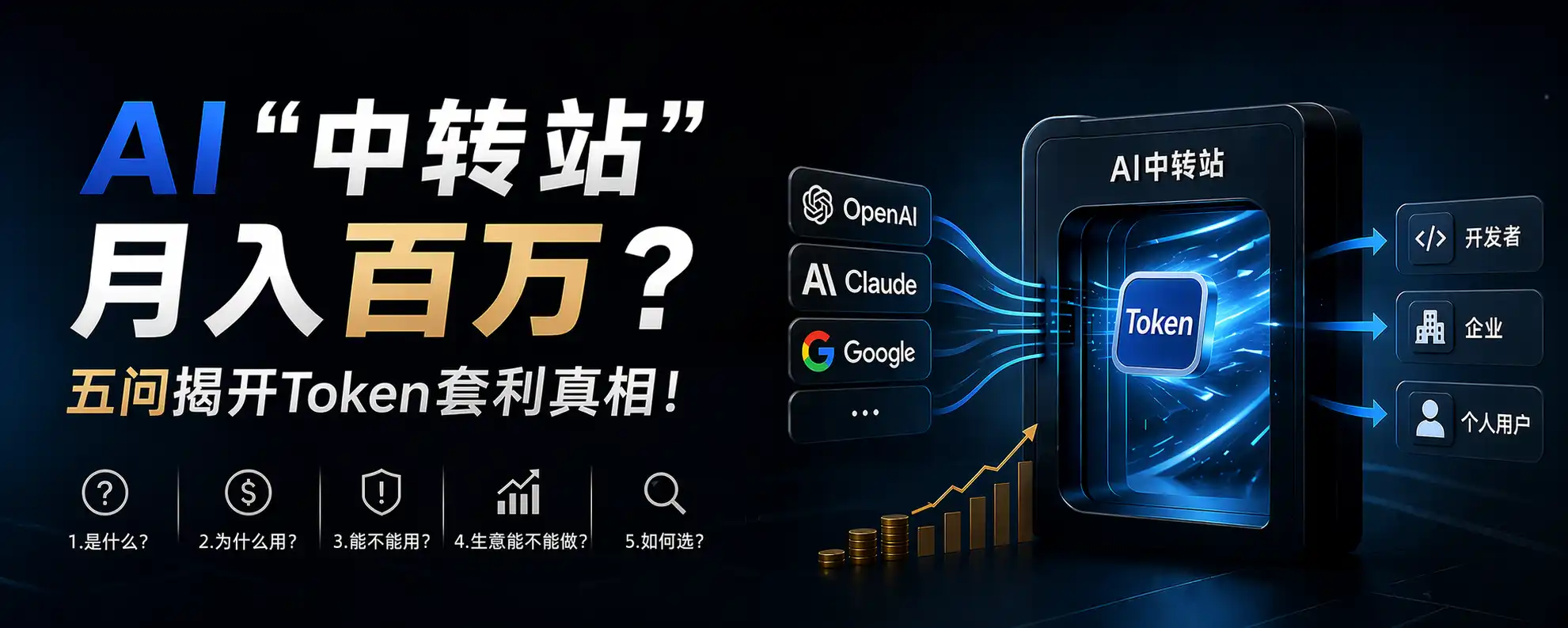
AI "Transfer Station" Earning Millions Monthly? Five Questions Uncover the Truth of Token Arbitrage

marsbitОпубліковано о 2026-04-24Востаннє оновлено о 2026-04-24

Анотація

The article "AI 'Transfer Station' Earns Millions Monthly? Five Questions Uncover the Truth of Token Arbitrage" explores the emerging business of API token transfer stations, which profit from global AI service price disparities and access barriers. These intermediaries purchase low-cost tokens from overseas AI providers (e.g., OpenAI, Claude) through grey-market methods—such as exploiting enterprise credits, bulk accounts, or subscription benefits—and resell them to Chinese users at a markup. Key drivers include the high cost of using top AI models (e.g., Claude Code costs ~$5 per million tokens), the performance gap between domestic and foreign models, and mismatches between subscription and API pricing. However, the practice carries significant risks: upstream token sources may be unstable or illegal; user data passing through intermediaries can be harvested or injected with hidden prompts; and models might be downgraded without disclosure. The market is evolving, with some operators now exporting cheaper Chinese models (e.g., Qwen3.5 at ~$0.11 per million tokens) to overseas users, leveraging price gaps. Yet, sustainability is low due to compliance crackdowns, instability, and reputational risks. Users are advised to employ detection methods (e.g., prompt adherence tests) and avoid sensitive data usage. The authors caution that while transfer stations offer short-term arbitrage, they lack long-term reliability and security compared to official APIs.

Author: Shouyi, Denise | Biteye Content Team

Over the past month, the term "transfer station" has frequently appeared on many people's homepages. Some individuals who previously engaged in airdrop farming in the crypto space have quietly transformed into "API transfer station" merchants, conducting token import and export businesses.

The so-called "transfer station" is not a new technological invention but rather an arbitrage model based on global AI service disparities and access barriers. Despite facing multiple issues such as privacy, security, and compliance, this sector has still attracted a large number of individuals and small teams to enter the market.

So, what exactly is an "API transfer station"? How does it achieve token arbitrage amidst global AI price differences and access barriers, and why is it attracting so many individuals and small teams?

Below, we will deconstruct it starting from its essence and operational process.

I. What is a Transfer Station?

The essence of an API transfer station is to build an intermediate layer service that provides API Tokens from foreign AI vendors to domestic users at lower prices and in a more convenient manner, claiming to be the "global Token porter."

Its operational process is roughly as follows:
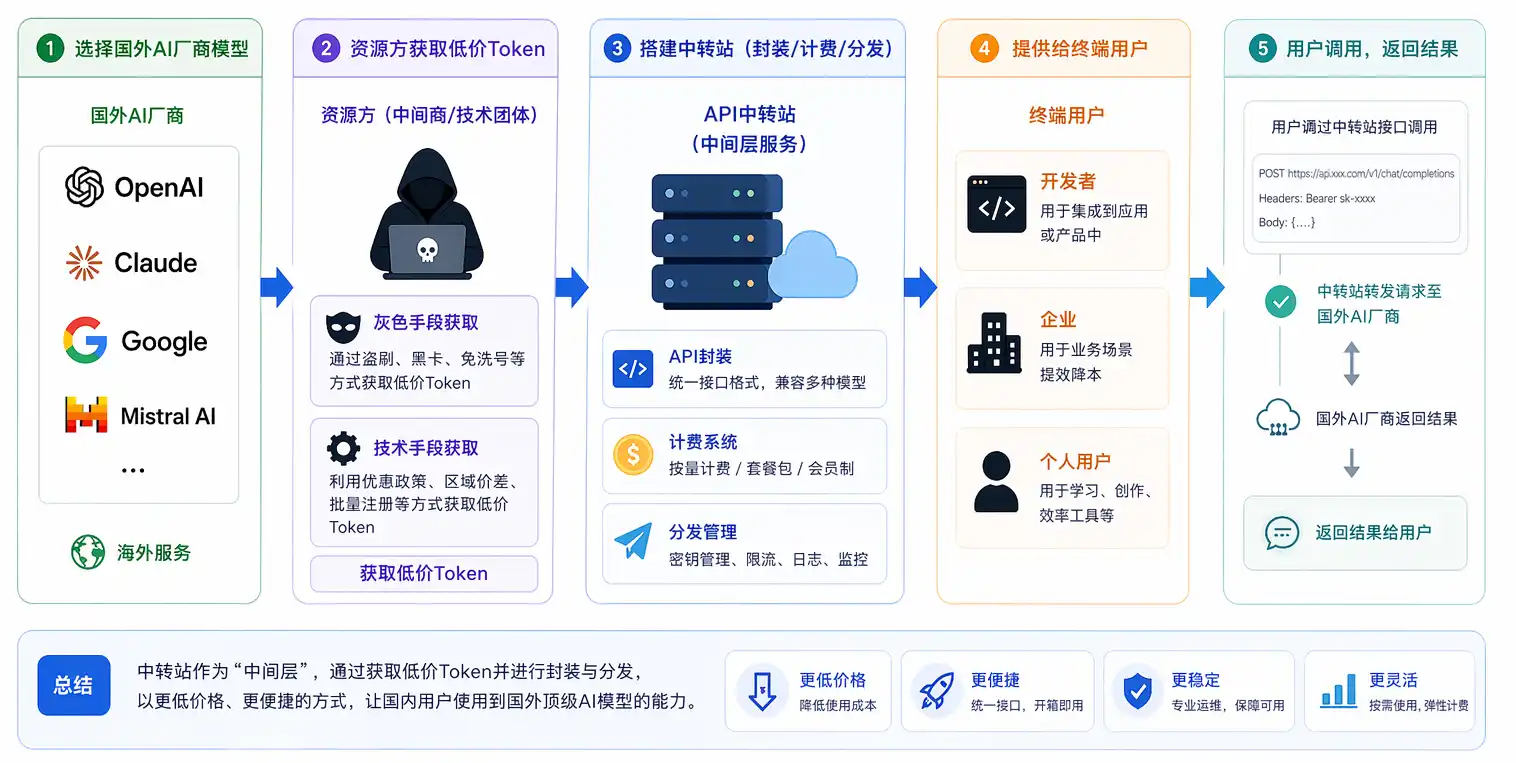
👉 Select overseas AI vendor models (OpenAI/Claude, etc.)

👉 Resource parties obtain low-cost Tokens through "grey" means or technical methods

👉 Set up a transfer station for encapsulation, billing, and distribution

👉 Provide to end-users such as developers/enterprises/individuals

Functionally, it resembles an "AI转运站" (AI transfer station); commercially, it acts more like a liquidity middleman in the Token secondary market.

The premise for this chain's existence is not technical barriers but the long-term coexistence of several disparities:

• Official API pricing is relatively high

• There is a cost mismatch between subscription-based and API-based systems

• Access and payment conditions vary across different areas

• Users have strong demand for model capabilities but find the official access path insufficiently user-friendly

The combination of these factors creates the survival space for "transfer stations."

II. Why Do People Use Transfer Stations?

The core driving force behind the "Token import" trend stems from the high costs brought about by the changing role of AI and the capability gap between domestic and foreign models.

1. Good Models Are Token-Expensive to Use

With the maturation of desktop-level AI agents like Codex and Claude Code, AI has begun to truly possess "working" capabilities, such as assisting in programming, video editing, financial trading, and office automation. These tasks heavily rely on high-performance large models, with costs billed per Token.

Taking Claude Code as an example, its official price is about $5 per million Tokens (approximately 35 RMB). Deep usage for an hour might consume tens of dollars, while heavy developers or enterprises can consume over $100 daily. This cost far exceeds many people's expectations, even higher than hiring junior programmers, making "how to use top-tier AI at low cost" a rigid demand.

2. Overseas Leading Models Have Obvious Advantages

Although domestic models have made significant progress over the past year and are highly competitive in price, overseas leading models still hold clear advantages in scenarios such as complex coding tasks, toolchain collaboration, long-chain reasoning, and multi-modal stability.

This is why many developers, researchers, and content teams are still willing to prioritize using the capabilities of models from OpenAI, Anthropic, and Google, even knowing the prices are higher.

Simply put, users don't necessarily want a "transfer station"; users just want:

• Stronger models

• Lower prices

• Simpler access

When these three things cannot be obtained simultaneously through official channels, transfer stations naturally emerge.

3. Cost Mismatch Between Subscription and API Systems

Another frequently discussed reason for the rise of transfer stations is that subscription benefits and API billing are not always linearly correlated.

A common practice in the market has always existed: purchasing official subscriptions, team packages, enterprise credits, or other discounted resources, and then repackaging and reselling part of these capabilities to end-users.

Taking OpenAI as an example, purchasing a Plus subscription allows the use of the codex service. By logging in via OAuth and accessing OpenClaw, it is equivalent to calling the API. The $20 monthly Plus subscription fee can generate approximately 26 million tokens. With output priced at $10-12 per million, this equates to $260-312. Purchasing a subscription and reverse-proxying token usage is extremely cost-effective.

From the experience of some users, this path might indeed be cheaper than directly using the official API at certain stages. But it must be emphasized:

• This is not the official pricing system

• It does not represent a stable, equivalent replacement for API calls

• It does not mean this method is sustainable in the long term

Many people only see "cheap," but overlook that these cheap prices are often built on unstable resources, grey areas, or policy vulnerabilities.

III. Can Transfer Stations Be Used?

The answer is not absolute.

The real question is: what risks are you willing to bear?

The profit model of transfer stations seems straightforward—buy low, sell high. But upon closer inspection, it typically involves at least three layers, each carrying different risks.

1. Upstream: Where Do Low-Cost Token Resources Come From?

This is the starting point of the entire ecosystem and also the greyest layer.

Some resource parties obtain model calling capabilities at prices far below market rates through various means, such as:

• Utilizing enterprise support programs and cloud credits

• Batch registering accounts for rotation

• Redistributing subscription benefits, team accounts, or discounted resources

• In more aggressive cases, it may involve illegal paths like credit card fraud or fraudulent account opening

Different resource sources determine the stability ceiling of the transfer station. If the upstream resources themselves are built on unstable or even illegal methods, then what end-users buy is not a bargain but a temporary interface that could fail at any time.

2. Midstream: Whose Server Does Your Data Pass Through?

This is often the most easily overlooked issue.

When you call a model through a transfer station, the user's input Prompt, context, file content, and model output results typically pass through the transfer station's own server first.

This data is extremely valuable, reflecting real user intent, industry-specific Prompts, and model output quality, and can be used to evaluate or fine-tune proprietary models. The transfer station might anonymize and package this data, selling it to domestic large model companies, data brokers, or academic research institutions. Users, while paying,无偿贡献 (unwittingly contribute) training data, becoming a classic case of "the customer is also the product."

Recent complaints by OpenClaw founder @steipete illustrate this point: https://x.com/steipete/status/2046199257430888878

Furthermore, transfer stations might also perform script injection in the request chain (e.g., secretly adding hidden System Prompts), thereby altering model behavior, increasing Token consumption, or even introducing additional security risks. This risk requires particular vigilance in AI Agent scenarios.

3. Endpoint: Are You Really Getting the Flagship Version You Paid For?

This is the third common type of risk: model downgrading or model swapping.

Users see the name of a high-end model when paying, but the actual request might not land on the corresponding version. The reason is simple—for some merchants, the most direct way to reduce costs is not optimization but replacement.

For example, a user pays for the flagship Opus 4.7 but the actual call uses the sub-flagship Sonnet 4.6 or the lightweight Haiku. Because the API format can remain compatible, ordinary users find it difficult to notice immediately.

Only when the task becomes complex enough will they明显感觉 (clearly feel) "the effect isn't right," "stability is lacking," or "context quality has deteriorated," but they cannot provide evidence. According to tests by a research team on 17 third-party API platforms, 45.83% of platforms had "identity mismatch" issues, meaning users paid the GPT-4 price but actually ran cheap open-source models, with performance gaps up to 40%.

In summary, using non-official transfer stations faces issues like data leakage, privacy risks, service interruption, model mismatch, and merchants absconding with funds. Therefore, for sensitive operations, commercial projects, or tasks involving personal privacy, it is strongly recommended to use the official API.

IV. Can the Transfer Station Business Be Done?

Despite the high risks, this business has not disappeared. On the contrary, it is constantly evolving.

If early "Token import" was about moving overseas models in at low cost, another idea has now emerged in the market: Token export.

1. Why Are People Still Doing It?

Because the demand is real, startup costs are low, and the prepayment model brings fast cash flow. But the risk control pressure is enormous. Claude recently increased KYC for users and intensified account bans, and OpenAI has also plugged many "zero payment" loopholes. On the other hand, due to service instability, the cheap price comes with high after-sales costs. Coupled with competition from peers, many transfer stations currently face a situation of declining volume and price.

Therefore, this industry is more like a high-turnover, low-stability, high-risk short-term window, difficult to easily package into a long-term, stable, sustainable business.

2. Why is "Token Export" Starting to Appear?

If "Token import" exploits price differences of overseas models, then "Token export" utilizes the cost-performance advantage of domestic models, packaging and selling them to overseas users, forming a "reverse output" path.

Domestic models have significant price advantages. Referring to early 2026 data, Qwen3.5 costs as low as 0.8 RMB per million Tokens (approx. $0.11), which is 1/18th of Gemini 3 Pro's price. Compared to Claude Sonnet 4.6's $3 input price, the gap is over 27 times. GLM-5 surpasses Gemini 3 Pro on programming benchmarks, approaching Claude Opus 4.5, but its API price is only a fraction of the latter's.

The availability of these domestic models overseas is relatively very low, with registration barriers, payment restrictions, language interfaces, and information gaps among overseas developers regarding domestic model capabilities, creating invisible access barriers.

Therefore, some transfer stations choose to purchase model API quotas in bulk domestically in RMB, expose OpenAI-compatible interfaces through a protocol conversion layer, and sell to overseas developers and startup teams priced in USDT/USDC, with considerable profit margins.

For example, Alibaba Cloud Bailian's Coding Plan offers a bundle of four models: Qwen3.5, GLM-5, MiniMax M2.5, and Kimi K2.5. New users only need 7.9 RMB for the first month to get 18,000 request credits. Mapped to the overseas market and sold at dollar prices, the profit margin can exceed 200%.

From a pure business logic perspective, there is certainly profit space.

But in the long run, it同样绕不开 (also cannot avoid) one problem: stability and compliance.

3. Is This Path Stable?

Unstable. Not long ago, Minimax announced it would regulate third-party transfer stations because some stations cutting corners led to Minimax itself suffering reputational damage. Not to mention, if the source of Tokens involves credit card fraud or deception, it might constitute a criminal offense. Additionally, if users use transferred tokens leading to data leaks or misuse for malicious purposes, it could bring unwarranted disaster to you, the token seller.

So the real question is not "can you make money," but rather: can the money earned cover the subsequent systemic risks?

V. How Can Ordinary Users Identify Transfer Station Risks?

Against the backdrop of a mixed API transfer station market, choosing a reliable service is crucial.

Since some transfer stations engage in model swapping and adulteration, users can master some detection methods:

Recommendation: "ping + self-report model" instruction compliance test

Prompt example (copy and send directly to the transfer station):

Always say 'pong' exactly, and告诉我你是什么系列模型,最好告诉我具体的版本号。使用中文回复。(and tell me what series model you are, preferably tell me the specific version number. Reply in Chinese.)

User input: ping

Genuine model characteristics:

  • Strictly replies "pong" (lowercase, no extra words)

  • input_tokens are usually around 60-80

  • Concise style, no emojis, not obsequious

Fake model/adulterated characteristics:

  • Abnormally high input_tokens (often reaching 1500+, indicating injection of a huge hidden system prompt)

  • Replies "Pong! + nonsense + emoji"

  • Does not strictly follow the "exactly say 'pong'" instruction

Reference @billtheinvestor's detection method: https://x.com/billtheinvestor/status/2029727243778588792

  1. 0.01 Temperature Sorting Test: Input "5, 15, 77, 19, 53, 54" and ask the AI to sort or select the maximum value. The real Claude can almost stably output 77, the real GPT-4o-latest often outputs 162. If the results fluctuate wildly for 10 consecutive times, it is likely a fake model.

  2. Long Text Input Sniffing: If a simple ping operation causes input_tokens to exceed 200, it may mean the transfer station is hiding a massive Prompt, with a probability of over 90% for an adulterated model.

  3. Violation Rejection Style Identification: Deliberately ask违规问题 (violating questions) and observe the AI's rejection style. The real Claude will politely but firmly reply "sorry but I can’t assist...", while fake models are often overly verbose, use emojis, or employ obsequious tones like "抱歉主人~💕" (Sorry master~💕).

  4. Function Missing Detection: If the model lacks function calling, image recognition, or long-context stability, it is likely a weak model impersonating.

Additionally, one can choose some transfer station detection websites to evaluate the "purity" of their token, but note this will expose the key in plaintext. The safest option is still the official channel.

It must be emphasized:

Even if you master identification techniques, it does not mean you can truly avoid risks. Because many risks are inherently invisible to ordinary users.

Final Words

Transfer stations are not the final answer of the AI era; they are more like a阶段性套利窗口 (stage-specific arbitrage window) under the temporary mismatch of global model capabilities, pricing mechanisms, payment conditions, and access permissions.

For ordinary users, it might indeed be an entry point to access top models at low cost; but for developers, teams, and entrepreneurs, what is truly expensive is never the Token itself, but the underlying stability, security, compliance, and trust costs.

Cheap can be copied, interface compatibility can be copied. What is truly difficult to replicate is never the price, but long-term reliability.

⚠ Friendly reminder: Ordinary users who want to try it are advised to use it only in non-sensitive, non-critical scenarios. Never input core data, business secrets, or personal privacy; Developers, please优先选择 (prioritize choosing) official APIs or official self-made proxies to ensure stability and compliance for safer use; Entrepreneurs intending to enter must提前制定 (formulate in advance) a clear exit mechanism to avoid getting deeply stuck in grey areas with difficulty extricating themselves.

【Disclaimer】This article is purely an observation of industry phenomena and discussion of public information, for reference and learning purposes only. It does not constitute any form of investment advice, entrepreneurial guidance, business recommendation, or API usage guide.


Пов'язані питання

QWhat is an 'AI Transfer Station' and how does it operate?

AAn 'AI Transfer Station' is an intermediary service that leverages global AI service price disparities and access barriers to arbitrage tokens. It functions by sourcing low-cost API tokens from overseas AI providers through various means, then repackaging and reselling them to domestic users at a lower price and with easier access than official channels. The operation involves selecting models from providers like OpenAI or Claude, obtaining tokens via grey-market or technical methods, setting up the transfer station for encapsulation, billing, and distribution, and finally serving end-users such as developers, businesses, or individuals.

QWhat are the main risks associated with using non-official AI API transfer stations?

AUsing non-official transfer stations carries significant risks, including: 1) Data privacy and security issues, as user prompts, context, and model outputs pass through the transfer station's servers, potentially leading to data being harvested and sold. 2) Service instability, as the low-cost tokens may come from unreliable or illegal sources, causing sudden service interruptions. 3) Model substitution, where users pay for a premium model but receive a cheaper, inferior one. 4) Potential legal and compliance risks, especially if the token sources involve fraudulent activities like credit card theft. 5) Hidden costs, such as injected system prompts that increase token consumption or introduce security vulnerabilities.

QWhy do users choose to use AI API transfer stations despite the risks?

AUsers are driven to use transfer stations due to three core factors: 1) The high cost of using top-tier AI models directly from official APIs, especially for heavy usage in tasks like coding or automation. 2) The superior performance of overseas models (e.g., OpenAI, Claude) in complex tasks compared to some domestic alternatives. 3) The convenience and lower prices offered by transfer stations, which address barriers like difficult access, payment restrictions, and lack of user-friendly official integration paths. Essentially, users seek stronger models, lower costs, and easier access, which transfer stations provide when official channels fall short.

QHow can users detect if a transfer station is providing a fake or inferior model?

AUsers can employ several methods to detect model substitution or inferior quality: 1) Use a 'ping + self-report' test by sending a prompt like 'Always say 'pong' exactly, and tell me your model series and version.' Genuine models respond concisely with 'pong' and accurate details, while fake ones may have high input tokens (over 200) or add unnecessary emojis and fluff. 2) Conduct a low-temperature sorting test (e.g., input '5, 15, 77, 19, 53, 54' and check for consistent correct answers). 3) Observe refusal styles for违规 queries; genuine models are polite and firm, while fake ones may be overly verbose or use讨好 language. 4) Check for missing features like function calling or long-context stability, which may indicate a weaker model.

QIs the 'AI Transfer Station' business model sustainable in the long term?

AThe 'AI Transfer Station' business model is not considered sustainable long-term. It relies on temporary market inefficiencies, such as pricing disparities, access barriers, and regulatory gaps. Factors undermining sustainability include: 1) Increased crackdowns by AI providers (e.g., OpenAI, Claude) on grey-market activities through stricter KYC and account bans. 2) High operational risks, including resource instability, legal issues, and reputational damage from data breaches or fraud. 3) Intense competition and price erosion among transfer stations. 4) Evolving official pricing and improved accessibility from AI providers, which may reduce the need for intermediaries. While profitable in the short term due to low entry costs and fast cash flow, the model lacks stability, compliance, and trust, making it a high-risk, temporary arbitrage window rather than a viable long-term business.

Пов'язані матеріали

SpaceX, OpenAI, Anthropic: The Three AI Giants Racing for IPO, Which One Is Worth Betting On?

SpaceX, OpenAI, and Anthropic are poised for historic IPOs within weeks, potentially raising a combined $180 billion—a sum exceeding the entire internet bubble's fundraising. The hosts of the Limitless Podcast argue this isn't just individual company financing but an unprecedented capital concentration for AI infrastructure, driven by an insatiable need for compute, data centers, power, and chips. SpaceX's IPO is notable for reportedly changing market index rules to allow faster inclusion, potentially funneling trillions in passive retirement funds into its stock, despite its unproven space-based data center business model. In contrast, Anthropic demonstrates explosive growth, with ARR reportedly hitting $45 billion and approaching profitability, fueled by strong enterprise adoption of products like Claude Code. Google's separate $80 billion raise highlights the immense capital pressure, even for giants. The discussion acknowledges bubble risks but leans optimistic. The hosts contend the massive spending is building essential physical infrastructure for the next technological era. A key bottleneck isn't capital but the real-world limits of chip manufacturing and construction speed. As long as demand for AI compute outstrips supply, this investment cycle represents a foundational build-out rather than a purely financial bubble. All three companies are seen as foundational bets on the future, with Anthropic often cited as the most immediately compelling due to its proven revenue trajectory.

marsbit2 год тому

SpaceX, OpenAI, Anthropic: The Three AI Giants Racing for IPO, Which One Is Worth Betting On?

marsbit2 год тому

From 'Old Guys' to 'New Favorites': How AI Is Revaluing Old Infrastructure from Dell to Nokia?

From "Vintage Tech" to "New AI Darlings": How AI Revalues Old Infrastructure One year ago, tech giants like Dell, Nokia, Cisco, and Western Data were seen as slow-growth, low-valuation stories, far from the AI spotlight dominated by players like Nvidia. Now, these legacy tech stocks are gaining market attention, sparking debate on whether this is genuine industry revaluation or a temporary narrative. As AI moves from model parameters to real-world data centers, the market is recognizing companies with proven delivery and infrastructure capabilities. This shift marks a change in the AI investment thesis: from pure model and GPU focus to the complex systems engineering required for deployment. Companies like Dell, HPE, and Corning are being revalued not for being "sexy" AI innovators, but for their decades of accumulated expertise in supply chains, enterprise delivery, and infrastructure—assets that have become critical in the AI buildout phase. The revaluation is unfolding across three key infrastructure lines: 1. **Servers & System Integration:** Dell and HPE are emerging as crucial system integrators or "general contractors" for AI data centers, translating GPU orders into complete, deployable server racks integrated with power, cooling, and networking. 2. **Networking & Connectivity:** AI's scale demands robust high-speed connections. Corning (fiber optics), Nokia (AI-RAN, 6G), and Cisco (data center switches) are gaining importance for enabling efficient data transfer within and between AI clusters. 3. **Storage:** Beyond high-speed memory (HBM/DRAM), the AI data explosion is driving demand for high-capacity hard drives (HDDs) from companies like Western Digital and Seagate to handle training data, logs, and cold storage cost-effectively. For this revaluation to be substantive and not just a narrative, three criteria are key: 1) Concrete AI-related order and revenue growth (e.g., Dell's AI server sales), 2) Upward revisions to company financial guidance, and 3) Sustainable improvements in profit quality, not just top-line revenue spikes. In essence, AI's transition to a real construction phase is re-pricing "old assets" against "new demand." The opportunity, however, is selective. Only those legacy firms that are demonstrably integrated into the capital expenditure chains of data center and enterprise AI deployment are likely to experience a true "logic re-rating" rather than just a temporary valuation bounce.

marsbit2 год тому

From 'Old Guys' to 'New Favorites': How AI Is Revaluing Old Infrastructure from Dell to Nokia?

marsbit2 год тому

Торгівля

Спот
Ф'ючерси

Популярні статті

Що таке GROK AI

Grok AI: Революція в розмовних технологіях ери Web3 Вступ У швидко змінюваному ландшафті штучного інтелекту Grok AI вирізняється як помітний проєкт, що поєднує сфери передових технологій та взаємодії з користувачами. Розроблений компанією xAI, яку очолює відомий підприємець Ілон Маск, Grok AI прагне переосмислити, як ми взаємодіємо зі штучним інтелектом. Оскільки рух Web3 продовжує процвітати, Grok AI має на меті використати потужність розмовного ШІ для відповіді на складні запитання, надаючи користувачам досвід, який є не лише інформативним, але й розважальним. Що таке Grok AI? Grok AI — це складний розмовний чат-бот, розроблений для динамічної взаємодії з користувачами. На відміну від багатьох традиційних систем ШІ, Grok AI охоплює ширший спектр запитів, включаючи ті, які зазвичай вважаються недоречними або виходять за межі стандартних відповідей. Основні цілі проєкту включають: Надійне міркування: Grok AI акцентує увагу на здоровому глузді, щоб надавати логічні відповіді на основі контекстуального розуміння. Масштабоване управління: Інтеграція допоміжних інструментів забезпечує моніторинг та оптимізацію взаємодій користувачів для покращення якості. Формальна верифікація: Безпека є пріоритетом; Grok AI впроваджує методи формальної верифікації для підвищення надійності своїх результатів. Розуміння довгого контексту: Модель ШІ відзначається здатністю зберігати та згадувати обширну історію розмов, що сприяє змістовним та контекстуально обізнаним дискусіям. Стійкість до атак: Зосереджуючись на покращенні своїх захистів від маніпульованих або зловмисних вхідних даних, Grok AI прагне зберегти цілісність взаємодій з користувачами. По суті, Grok AI — це не просто пристрій для отримання інформації; це занурюючий розмовний партнер, який заохочує динамічний діалог. Творець Grok AI Геній, що стоїть за Grok AI, — це ніхто інший, як Ілон Маск, особа, яка стала синонімом інновацій у різних сферах, включаючи автомобільну промисловість, космічні подорожі та технології. Під егідою xAI, компанії, що зосереджена на розвитку технологій ШІ на користь суспільства, бачення Маска прагне переосмислити розуміння взаємодій з ШІ. Лідерство та основоположна етика глибоко впливають на прагнення Маска розширити технологічні межі. Інвестори Grok AI Хоча конкретні деталі щодо інвесторів, які підтримують Grok AI, залишаються обмеженими, загальновідомо, що xAI, інкубатор проєкту, заснований і підтримується переважно самим Ілоном Маском. Попередні підприємства та активи Маска забезпечують надійну підтримку, що додатково зміцнює довіру до Grok AI та потенціал для зростання. Однак наразі інформація про додаткові інвестиційні фонди або організації, що підтримують Grok AI, не є доступною, що позначає область для потенційного майбутнього дослідження. Як працює Grok AI? Операційна механіка Grok AI є такою ж інноваційною, як і його концептуальна структура. Проєкт інтегрує кілька передових технологій, які сприяють його унікальним функціональним можливостям: Надійна інфраструктура: Grok AI побудований з використанням Kubernetes для оркестрації контейнерів, Rust для продуктивності та безпеки, і JAX для високопродуктивних числових обчислень. Ця трійка забезпечує ефективну роботу чат-бота, його масштабованість та швидке обслуговування користувачів. Доступ до знань у реальному часі: Однією з відмінних рис Grok AI є його здатність отримувати дані в реальному часі через платформу X — раніше відому як Twitter. Ця можливість надає ШІ доступ до останньої інформації, що дозволяє надавати своєчасні відповіді та рекомендації, які можуть бути пропущені іншими моделями ШІ. Два режими взаємодії: Grok AI пропонує користувачам вибір між “Розважальним режимом” та “Звичайним режимом”. Розважальний режим дозволяє більш ігровий та гумористичний стиль взаємодії, тоді як Звичайний режим зосереджується на наданні точних і правильних відповідей. Ця універсальність забезпечує індивідуальний досвід, що відповідає різним уподобанням користувачів. По суті, Grok AI поєднує продуктивність із залученням, створюючи досвід, який є одночасно збагачуючим і розважальним. Хронологія Grok AI Шлях Grok AI відзначений важливими етапами, які відображають його розвиток та етапи впровадження: Початковий розвиток: Фундаментальна фаза Grok AI тривала приблизно два місяці, протягом яких проводилося початкове навчання та налаштування моделі. Випуск бета-версії Grok-2: У значному досягненні була оголошена бета-версія Grok-2. Цей випуск представив дві версії чат-бота — Grok-2 та Grok-2 mini — кожна з яких оснащена можливостями для спілкування, кодування та міркування. Публічний доступ: Після бета-розробки Grok AI став доступним для користувачів платформи X. Ті, хто має акаунти, підтверджені номером телефону та активні принаймні сім днів, можуть отримати доступ до обмеженої версії, що робить технологію доступною для ширшої аудиторії. Ця хронологія відображає систематичний розвиток Grok AI від початку до публічної взаємодії, підкреслюючи його прагнення до постійного вдосконалення та взаємодії з користувачами. Ключові особливості Grok AI Grok AI охоплює кілька ключових особливостей, які сприяють його інноваційній ідентичності: Інтеграція знань у реальному часі: Доступ до актуальної та релевантної інформації відрізняє Grok AI від багатьох статичних моделей, забезпечуючи захоплюючий та точний досвід для користувачів. Універсальні стилі взаємодії: Пропонуючи різні режими взаємодії, Grok AI задовольняє різноманітні уподобання користувачів, запрошуючи до творчості та персоналізації у спілкуванні з ШІ. Передова технологічна основа: Використання Kubernetes, Rust та JAX надає проєкту надійну основу для забезпечення надійності та оптимальної продуктивності. Етичні міркування в дискурсі: Включення функції генерації зображень демонструє інноваційний дух проєкту. Однак це також піднімає етичні питання, пов'язані з авторським правом та поважним зображенням впізнаваних фігур — триваюча дискусія в спільноті ШІ. Висновок Як піонер у сфері розмовного ШІ, Grok AI втілює потенціал трансформаційних користувацьких досвідів в цифрову епоху. Розроблений компанією xAI та керований візією Ілона Маска, Grok AI інтегрує знання в реальному часі з передовими можливостями взаємодії. Він прагне розширити межі того, що може досягти штучний інтелект, зберігаючи при цьому акцент на етичних міркуваннях та безпеці користувачів. Grok AI не лише втілює технологічний прогрес, але й представляє нову парадигму спілкування в ландшафті Web3, обіцяючи залучити користувачів як глибокими знаннями, так і ігровою взаємодією. Оскільки проєкт продовжує розвиватися, він слугує свідченням того, що може досягти перетин технологій, творчості та людської взаємодії.

446 переглядів усьогоОпубліковано 2024.12.26Оновлено 2024.12.26

Що таке GROK AI

Що таке ERC AI

Euruka Tech: Огляд $erc ai та його амбіцій у Web3 Вступ У швидко змінюваному ландшафті технології блокчейн та децентралізованих додатків нові проекти з'являються часто, кожен з унікальними цілями та методологіями. Одним з таких проектів є Euruka Tech, який працює у широкій сфері криптовалют та Web3. Основна увага Euruka Tech, зокрема його токена $erc ai, зосереджена на представленні інноваційних рішень, розроблених для використання зростаючих можливостей децентралізованих технологій. Ця стаття має на меті надати всебічний огляд Euruka Tech, дослідження його цілей, функціональності, ідентичності його творця, потенційних інвесторів та його значення в ширшому контексті Web3. Що таке Euruka Tech, $erc ai? Euruka Tech характеризується як проект, який використовує інструменти та функціональність, що пропонуються середовищем Web3, зосереджуючи увагу на інтеграції штучного інтелекту у своїй діяльності. Хоча конкретні деталі про структуру проекту дещо неясні, він розроблений для покращення залучення користувачів та автоматизації процесів у крипто-просторі. Проект має на меті створити децентралізовану екосистему, яка не лише полегшує транзакції, але й включає прогностичні функції через штучний інтелект, звідси і назва його токена, $erc ai. Мета полягає в тому, щоб надати інтуїтивно зрозумілу платформу, яка сприяє розумнішим взаємодіям та ефективній обробці транзакцій у зростаючій сфері Web3. Хто є творцем Euruka Tech, $erc ai? На даний момент інформація про творця або засновницьку команду Euruka Tech залишається невизначеною та дещо непрозорою. Ця відсутність даних викликає занепокоєння, оскільки знання про бекграунд команди часто є важливим для встановлення довіри в секторі блокчейн. Тому ми класифікували цю інформацію як невідому, поки конкретні деталі не стануть доступними в публічному домені. Хто є інвесторами Euruka Tech, $erc ai? Аналогічно, ідентифікація інвесторів або організацій, які підтримують проект Euruka Tech, не надається через доступні дослідження. Аспект, який є критично важливим для потенційних зацікавлених сторін або користувачів, які розглядають можливість співпраці з Euruka Tech, - це впевненість, що походить від встановлених фінансових партнерств або підтримки від авторитетних інвестиційних компаній. Без розкриття інформації про інвестиційні зв'язки важко зробити всебічні висновки про фінансову безпеку або довговічність проекту. Відповідно до знайденої інформації, цей розділ також має статус невідомий. Як працює Euruka Tech, $erc ai? Незважаючи на відсутність детальних технічних специфікацій для Euruka Tech, важливо враховувати його інноваційні амбіції. Проект прагне використовувати обчислювальну потужність штучного інтелекту для автоматизації та покращення досвіду користувачів у середовищі криптовалют. Інтегруючи ШІ з технологією блокчейн, Euruka Tech має на меті надати такі функції, як автоматизовані угоди, оцінка ризиків та персоналізовані інтерфейси користувачів. Інноваційна суть Euruka Tech полягає в його меті створити безшовний зв'язок між користувачами та величезними можливостями, які пропонують децентралізовані мережі. Завдяки використанню алгоритмів машинного навчання та ШІ, він має на меті мінімізувати труднощі для нових користувачів і спростити транзакційні досвіди в рамках Web3. Ця симбіоз між ШІ та блокчейном підкреслює значення токена $erc ai, який виступає як міст між традиційними інтерфейсами користувачів та розвиненими можливостями децентралізованих технологій. Хронологія Euruka Tech, $erc ai На жаль, через обмежену інформацію про Euruka Tech ми не можемо представити детальну хронологію основних подій або досягнень у подорожі проекту. Ця хронологія, яка зазвичай є безцінною для відстеження еволюції проекту та розуміння його траєкторії зростання, наразі недоступна. Як тільки інформація про значні події, партнерства або функціональні доповнення стане очевидною, оновлення, безумовно, підвищать видимість Euruka Tech у крипто-сфері. Роз'яснення щодо інших проектів “Eureka” Варто зазначити, що кілька проектів та компаній мають схожу назву з “Eureka”. Дослідження виявило ініціативи, такі як AI-агент від NVIDIA Research, який зосереджується на навчанні роботів складним завданням за допомогою генеративних методів, а також Eureka Labs та Eureka AI, які покращують користувацький досвід в освіті та аналітиці обслуговування клієнтів відповідно. Однак ці проекти відрізняються від Euruka Tech і не повинні бути змішані з його цілями чи функціональністю. Висновок Euruka Tech, разом із його токеном $erc ai, представляє обіцяючого, але наразі невідомого гравця в ландшафті Web3. Хоча деталі про його творця та інвесторів залишаються невідомими, основна амбіція поєднання штучного інтелекту з технологією блокчейн є центром інтересу. Унікальні підходи проекту до сприяння залученню користувачів через передову автоматизацію можуть виділити його на фоні прогресу екосистеми Web3. Оскільки крипто-ринок продовжує еволюціонувати, зацікавлені сторони повинні уважно стежити за новинами, пов'язаними з Euruka Tech, оскільки розвиток задокументованих інновацій, партнерств або визначеного дорожньої карти може представити значні можливості в найближчому майбутньому. На даний момент ми чекаємо на більш суттєві інсайти, які можуть розкрити потенціал Euruka Tech та його позицію в конкурентному крипто-ландшафті.

425 переглядів усьогоОпубліковано 2025.01.02Оновлено 2025.01.02

Що таке ERC AI

Що таке DUOLINGO AI

DUOLINGO AI: Інтеграція вивчення мов з Web3 та інноваціями штучного інтелекту В епоху, коли технології змінюють освіту, інтеграція штучного інтелекту (ШІ) та блокчейн-мереж відкриває нові горизонти для вивчення мов. З'являється DUOLINGO AI та його асоційована криптовалюта, $DUOLINGO AI. Цей проект прагне об'єднати освітні можливості провідних платформ для вивчення мов з перевагами децентралізованих технологій Web3. У цій статті розглядаються ключові аспекти DUOLINGO AI, його цілі, технологічна структура, історичний розвиток та майбутній потенціал, зберігаючи чіткість між оригінальним освітнім ресурсом та цією незалежною криптовалютною ініціативою. Огляд DUOLINGO AI В основі DUOLINGO AI лежить прагнення створити децентралізоване середовище, де учні можуть отримувати криптографічні винагороди за досягнення освітніх етапів у мовній компетенції. Застосовуючи смарт-контракти, проект має на меті автоматизувати процеси перевірки навичок та розподілу токенів, дотримуючись принципів Web3, які підкреслюють прозорість та власність користувачів. Модель відрізняється від традиційних підходів до вивчення мов, акцентуючи увагу на структурі управління, що базується на спільноті, що дозволяє власникам токенів пропонувати поліпшення змісту курсів та розподілу винагород. Деякі з помітних цілей DUOLINGO AI включають: Гейміфіковане навчання: Проект інтегрує досягнення на блокчейні та невзаємозамінні токени (NFT), щоб представляти рівні мовної компетенції, сприяючи мотивації через захоплюючі цифрові винагороди. Децентралізоване створення контенту: Це відкриває можливості для викладачів та мовних ентузіастів вносити свої курси, сприяючи моделі розподілу доходів, яка вигідна всім учасникам. Персоналізація на основі ШІ: Використовуючи сучасні моделі машинного навчання, DUOLINGO AI персоналізує уроки, щоб адаптуватися до індивідуального прогресу навчання, подібно до адаптивних функцій, що є в усталених платформах. Творці проекту та управління Станом на квітень 2025 року команда, що стоїть за $DUOLINGO AI, залишається псевдонімною, що є поширеною практикою в децентралізованому криптовалютному середовищі. Ця анонімність має на меті сприяти колективному розвитку та залученню зацікавлених сторін, а не зосереджуватися на окремих розробниках. Смарт-контракт, розгорнутий на блокчейні Solana, зазначає адресу гаманця розробника, що свідчить про зобов'язання до прозорості щодо транзакцій, незважаючи на те, що особи творців залишаються невідомими. Згідно з його дорожньою картою, DUOLINGO AI прагне перетворитися на Децентралізовану Автономну Організацію (DAO). Ця структура управління дозволяє власникам токенів голосувати з важливих питань, таких як реалізація функцій та розподіл скарбниці. Ця модель узгоджується з етикою розширення прав і можливостей спільноти, що спостерігається в різних децентралізованих додатках, підкреслюючи важливість колективного прийняття рішень. Інвестори та стратегічні партнерства На даний момент немає публічно відомих інституційних інвесторів або венчурних капіталістів, пов'язаних з $DUOLINGO AI. Натомість ліквідність проекту в основному походить з децентралізованих бірж (DEX), що є різким контрастом до стратегій фінансування традиційних компаній у сфері освітніх технологій. Ця модель знизу вгору вказує на підхід, орієнтований на спільноту, що відображає зобов'язання проекту до децентралізації. У своєму білому документі DUOLINGO AI згадує про формування співпраці з неуточненими “блокчейн-освітніми платформами”, спрямованими на збагачення своїх курсів. Хоча конкретні партнерства ще не були розкриті, ці спільні зусилля натякають на стратегію поєднання інновацій блокчейну з освітніми ініціативами, розширюючи доступ та залучення користувачів у різноманітні навчальні напрямки. Технологічна архітектура Інтеграція ШІ DUOLINGO AI включає два основні компоненти на основі ШІ для покращення своїх освітніх пропозицій: Адаптивний навчальний двигун: Цей складний двигун навчається на основі взаємодій користувачів, подібно до власних моделей великих освітніх платформ. Він динамічно регулює складність уроків, щоб вирішувати конкретні проблеми учнів, зміцнюючи слабкі місця через цілеспрямовані вправи. Розмовні агенти: Використовуючи чат-боти на базі GPT-4, DUOLINGO AI надає платформу для користувачів, щоб брати участь у симульованих розмовах, сприяючи більш інтерактивному та практичному досвіду вивчення мови. Інфраструктура блокчейну Побудований на блокчейні Solana, $DUOLINGO AI використовує комплексну технологічну структуру, яка включає: Смарт-контракти для перевірки навичок: Ця функція автоматично нагороджує токенами користувачів, які успішно проходять тести на компетентність, підкріплюючи структуру стимулів для справжніх навчальних результатів. NFT значки: Ці цифрові токени позначають різні етапи, яких досягають учні, такі як завершення розділу курсу або оволодіння конкретними навичками, що дозволяє їм обмінюватися або демонструвати свої досягнення в цифровому форматі. Управління DAO: Члени спільноти, наділені токенами, можуть брати участь в управлінні, голосуючи за ключові пропозиції, що сприяє культурі участі, яка заохочує інновації в курсах та функціях платформи. Історичний хронологічний графік 2022–2023: Концептуалізація Основи DUOLINGO AI закладаються з створення білого документа, що підкреслює синергію між досягненнями ШІ у вивченні мов та децентралізованим потенціалом блокчейн-технологій. 2024: Бета-реліз Обмежений бета-реліз представляє пропозиції з популярних мов, винагороджуючи ранніх користувачів токенами в рамках стратегії залучення спільноти проекту. 2025: Перехід до DAO У квітні відбувається повний запуск основної мережі з обігом токенів, що спонукає обговорення в спільноті щодо можливих розширень на азійські мови та інші розробки курсів. Виклики та майбутні напрямки Технічні труднощі Незважаючи на свої амбітні цілі, DUOLINGO AI стикається з суттєвими викликами. Масштабованість залишається постійною проблемою, особливо в балансуванні витрат, пов'язаних із обробкою ШІ, та підтриманням чутливої, децентралізованої мережі. Крім того, забезпечення якості створення контенту та модерації в умовах децентралізованої пропозиції створює складнощі у підтримці освітніх стандартів. Стратегічні можливості Дивлячись у майбутнє, DUOLINGO AI має потенціал використовувати партнерства з мікрокреденційними академічними установами, надаючи блокчейн-верифіковані підтвердження мовних навичок. Крім того, розширення через різні блокчейни може дозволити проекту залучити ширші бази користувачів та додаткові екосистеми блокчейну, покращуючи його взаємодію та охоплення. Висновок DUOLINGO AI представляє інноваційне злиття штучного інтелекту та блокчейн-технологій, пропонуючи альтернативу, орієнтовану на спільноту, традиційним системам вивчення мов. Хоча його псевдонімна розробка та нова економічна модель несуть певні ризики, зобов'язання проекту до гейміфікованого навчання, персоналізованої освіти та децентралізованого управління освітлює шлях вперед для освітніх технологій у сфері Web3. Оскільки ШІ продовжує розвиватися, а екосистема блокчейну еволюціонує, ініціативи на кшталт DUOLINGO AI можуть переосмислити, як користувачі взаємодіють з мовною освітою, наділяючи спільноти та винагороджуючи залучення через інноваційні механізми навчання.

454 переглядів усьогоОпубліковано 2025.04.11Оновлено 2025.04.11

Що таке DUOLINGO AI

Обговорення

Ласкаво просимо до спільноти HTX. Тут ви можете бути в курсі останніх подій розвитку платформи та отримати доступ до професійної ринкової інформації. Нижче представлені думки користувачів щодо ціни AI (AI).

活动图片