AI Isn't Smarter Than Humans, It Can Just Afford to Fail; Fields Medalist Highlights 10 OpenAI Breakthroughs

marsbitОпубліковано о 2026-08-17Востаннє оновлено о 2026-08-17

Анотація

"AI isn't smarter than humans, it just loses more." This is the core idea from Fields Medalist Timothy Gowers, analyzing OpenAI's ten new mathematical breakthroughs. These results, including disproving the 80-year-old Erdős unit distance conjecture and finding the first non-sofic group, caused a "Deep Blue moment" among mathematicians, prompting some to question their future role. Gowers argues the distinction between finding counterexamples and proving theorems is artificial. The real difference lies in the search strategy. AI excels in problems with well-defined, data-rich search paths where it can afford countless failed attempts—it "can lose." Its strengths are breadth of knowledge, speed, and resilience in brute-force exploration. However, AI currently struggles with problems requiring deep "pruning" of a vast decision tree—the intuitive judgment of which paths are fruitless. This is because training data consists of polished final proofs, lacking the crucial "natural friction" of human reasoning that highlights difficult steps. As Terence Tao noted, AI often misallocates emphasis, smoothing over this informative friction. True AI breakthrough, per Gowers, will arrive not when it solves isolated hard problems, but when it produces a method so novel and generative that it immediately redirects the research of an entire human mathematical community—like the cap-set problem solution did in 2016. For now, AI's advantage is stamina, not genius.

AI has solved an 80-year-old mathematical problem: the Erdős plane unit distance conjecture.

One afternoon in May, when Timothy Gowers first heard this news, he thought AI had provided a proof.

If true, "mathematicians might be out of a job soon."

He spent the whole night readjusting his worldview.

The next morning, a clarifying email arrived: AI had not proven the conjecture; it had refuted it.

Gowers actually felt "relieved."

Why did finding a counterexample make Gowers feel more at ease than proving a theorem?

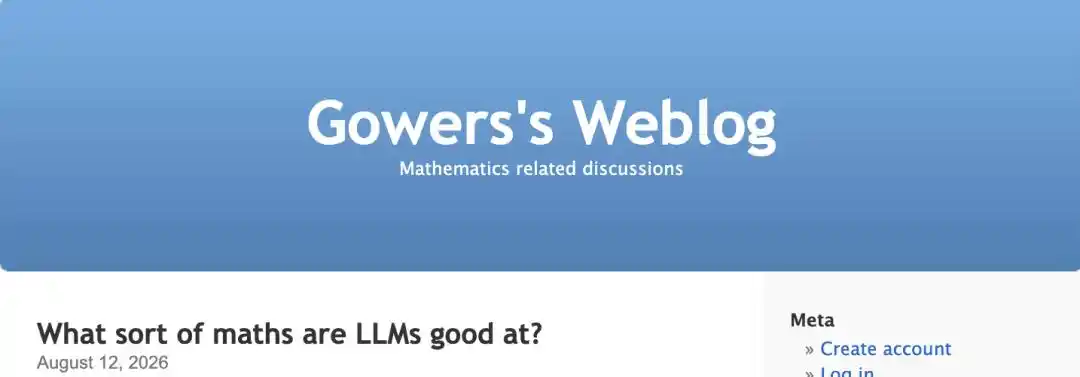
On August 12th, his blog post provided an answer.
It all started on August 1st.

That day, OpenAI dropped ten research achievements in mathematics and theoretical computer science all at once.

In their own words: each one either solves a long-standing open problem or represents a substantial advance on a related problem.

These results came from an unreleased internal version of a model called Astra.

For those few days, social media had only one reaction: this time, it's really different.

As Simon Willison put it, mathematicians online were collectively experiencing a "Deep Blue moment."
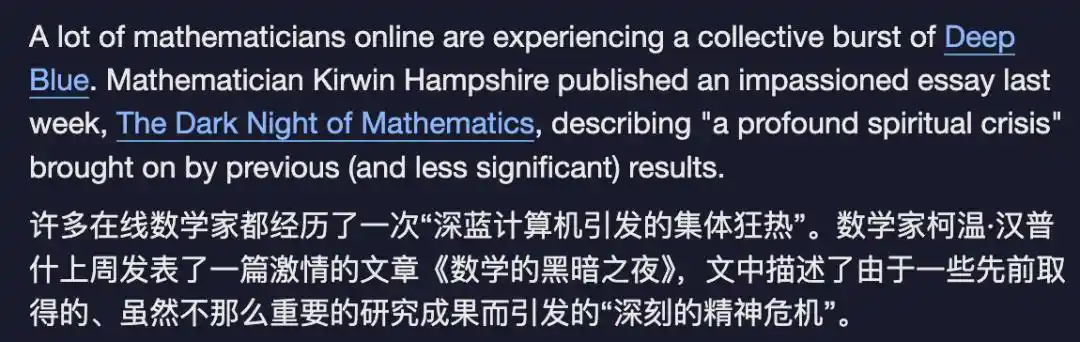
A few days earlier, mathematician Kirwin Hampshire had already written "The Dark Night of Mathematics." What triggered him then were previous, less significant results; he described falling into a profound spiritual crisis.

Gowers first acknowledged that these ten results were extremely impressive, then posed a question:

If large models were already stronger than all humans in all aspects of mathematics, given their speed advantage, results should have flooded out like a deluge.

Why hasn't the deluge arrived?

Two mathematicians immediately wrote papers based on these results

In the 11 days following OpenAI's ten results, two papers appeared on arXiv.

On August 3rd, Cambridge group theorist Francesco Fournier-Facio posted one first.

He took the crucial criterion from OpenAI's proof, bypassed the Leavitt algebra used in the original method, and created from scratch a version that the original method couldn't produce: a torsion-free non-sofic group.

On August 11th, Raphael Steiner modified OpenAI's recursive construction for multicolor Ramsey numbers, generalizing it to all fixed odd cycles.

The fact that people could write follow-up papers based on Astra's research results shows that it provided a method capable of generating new things.

Fournier-Facio also said that from the Kun–Thom result, there are countless possible directions to push forward, many of which simply aren't valid, and many others, even if valid, would be useless.

The specific direction OpenAI chose, most experts familiar with this area could probably prove. The difficulty was thinking, among countless possibilities, to try this particular one.
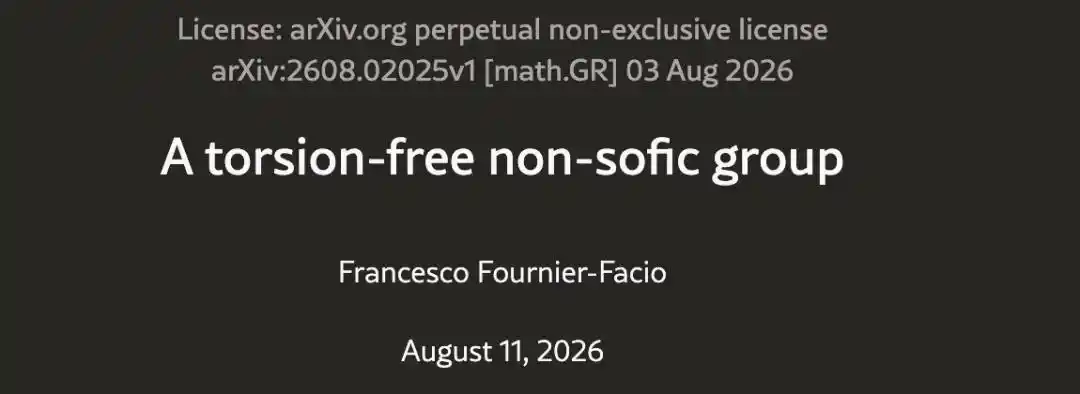
In his paper, Fournier-Facio judged that OpenAI's novelty lay in stating that proposition, not in the proof technique.

He gave a vivid metaphor:

AI is unrestricted by time and resources, so it can keep throwing things at the wall to see what sticks.

Counterexamples and theorems are not two different abilities at all

In a mathematician's intuition, finding a counterexample is a matter of luck.

You just need to cobble together a special case, punch a hole in the conjecture, and the proposition falls. Proving a theorem is hard work; you must guarantee there are no exceptions, and you need those insights that only dawn after much thought.

So it's acceptable if AI is good at finding counterexamples. If AI were good at proving theorems, that would truly signal a changing of the guard.

But what Gowers wants to say is that this line simply doesn't hold. Finding counterexamples and proving theorems are not two different abilities at all.

He first acknowledges that AI's most significant results to date are indeed concentrated on counterexamples.

The unit distance conjecture, the Jacobian conjecture, non-sofic groups, multicolor Ramsey numbers—they all seem to be.

But large models can also prove difficult universal propositions; it's just that those theorems haven't reached the significance of these counterexamples yet.

Then, he presents two results.

Vinogradov proved in 1937: Any sufficiently large integer can be written as the sum of three primes.

Gluskin proved in 1981: In any dimension, there exist two "shapes" of spaces that are extremely far apart.

Translating these two statements into the format mathematicians use for papers, their skeletons are almost identical. Yet no one would say Vinogradov found a counterexample, nor would they say Gluskin proved a theorem.

The difference lies in where the difficult step lands.

Vinogradov's entire effort lies in making three primes add up to exactly the specified number. For Gluskin, constructing two spaces of a specified dimension isn't difficult at all; the difficulty is making them sufficiently far apart.

The same skeleton, different points of difficulty—one becomes a theorem, the other becomes an example.

There's an even subtler layer. The word "counterexample" carries a psychological component. Only when it overturns a proposition that people originally had good reason to believe does it deserve to be called a counterexample.

Non-sofic groups don't count. According to Gowers and Fournier-Facio, the literature already had several construction ideas; few experts really believed all groups were sofic. Therefore, more accurately, OpenAI provided the first explicit instance of a non-sofic group.

Regarding the multicolor Ramsey result, Gowers has more authority. He studied an equivalent form in his youth, and the direction he worked on back then turned out to be the correct one later proven. For him personally, that was an expected example, not a counterexample.

The same result is a counterexample for those who originally believed the conjecture, but just an example for him.

This shows the line follows the person, not the mathematics.

Since counterexamples and theorems are inseparable, AI's strengths and weaknesses in mathematics cannot be drawn along proposition types.

Then, how should they be divided?

Eight methods for finding examples, AI is only good at four

The division is not in proposition type, but in how to search.

Gowers lists eight conventional tactics mathematicians use to find examples:

Go through standard examples on hand and try them one by one.

Assemble from basic examples.

Leave blanks first, then fill in conditions later.

Prove by contradiction that it cannot exist.

Repeatedly revise guesses from the previous version.

Construct step by step according to conditions.

Randomly pick one.

Take a sufficiently generic example.

He judges that large models will be very strong at four of these: trying existing examples, building step by step, random picking, and taking generic examples.

These four share common traits: mature patterns, dense instances in training data, and low cost of failure. As long as the model keeps trying one by one, it will eventually hit upon one.

The other three are different. Leaving blanks and filling later, proving impossibility by contradiction, and repeatedly revising guesses—all three require you to repeatedly judge the same thing mid-process: is the path I'm on now still worth pursuing?

Gowers's explanation is easy to understand.

Large models have two undeniable advantages: First, their knowledge is so broad it almost covers all standard arguments. Second, they are fast, capable of failing countless times before finding a solution.

Together, these create a style completely different from humans: the heavier the luck component of a problem, the more superior it is.

The territory humans can still hold onto is problems with particularly many and deep branches.

Mathematicians call this a search tree.

With each step down, a dozen more branches fork out beneath your feet, widening as you go deeper. You can't travel them all; you must judge midway which ones are根本 worth going down at all and prune them directly.

This action is called pruning. Without pruning, relying on computational power alone, you wouldn't reach the bottom by dawn.

One piece of evidence comes from the collective reaction of experts.

Gowers noticed that everyone's说法 was highly consistent: initially shocked that this problem was solved, but upon closer look, the method wasn't actually that novel; a suitable expert, given a hint, could have found it too.

This isn't belittling AI's discovery; it's giving it a more accurate portrait:

Its advantage lies not in being smarter than humans, but in its ability to "afford to fail."

For the same problem, humans can only try a few paths; it can try hundreds.

Why can't large models develop this sense of smell?

The first reason: the training data simply doesn't include this lesson.

Published proofs are all "clean finished products": which directions the discoverer tried, at which step they thought something was wrong, why they turned back—all erased.

The model sees conclusions, not the process.

Actually, humans aren't formally taught this either. The difference is that mathematicians develop this skill through their own process of getting stuck, going wrong, and turning back. Models can only learn from the curated finished products of others.

The second reason is more counterintuitive: Speed itself is a hindrance.

Humans must prune aggressively because a lifetime is only enough for a few paths.

Large models have speed and breadth of knowledge, able to withstand inefficient searches that humans completely cannot afford. Since they aren't lacking, there's no compelling pressure to prune.

Gowers states plainly: Large models' success today might be using methods humans consider extremely inefficient, but the branches just haven't multiplied enough to overwhelm them yet.

Third, this is hard to experiment on. An idea that seems to come only from deep thought could also just be recalling the deep thought of some human mathematician from the literature.

Gowers's own user experience is also written into the long piece.

Discussing open problems with 5.6 Pro often yields promising-sounding solutions that, upon细想, don't quite work. It also often ends with this line: I couldn't answer your question, but I've reduced it to a narrower, more precise problem.

After five times in a row, no progress is discernible.

Interestingly, another Fields Medalist is saying the same thing.

On July 24th, Terence Tao gave a public lecture at the International Congress of Mathematicians titled "Mathematics in the Age of AI."

He吐槽 that AI-generated mathematics is torturous to read: the emphasis is completely misplaced, capable of spending three pages proving an obvious lemma, then glossing over the truly interesting step in three lines.

Humans don't write proofs like that. Simple parts are passed over briefly; difficult parts pause, carefully organized, minimizing wasted effort. Readers rely on this rhythm to infer where the difficulty lies.

Tao gave it a name: natural friction.
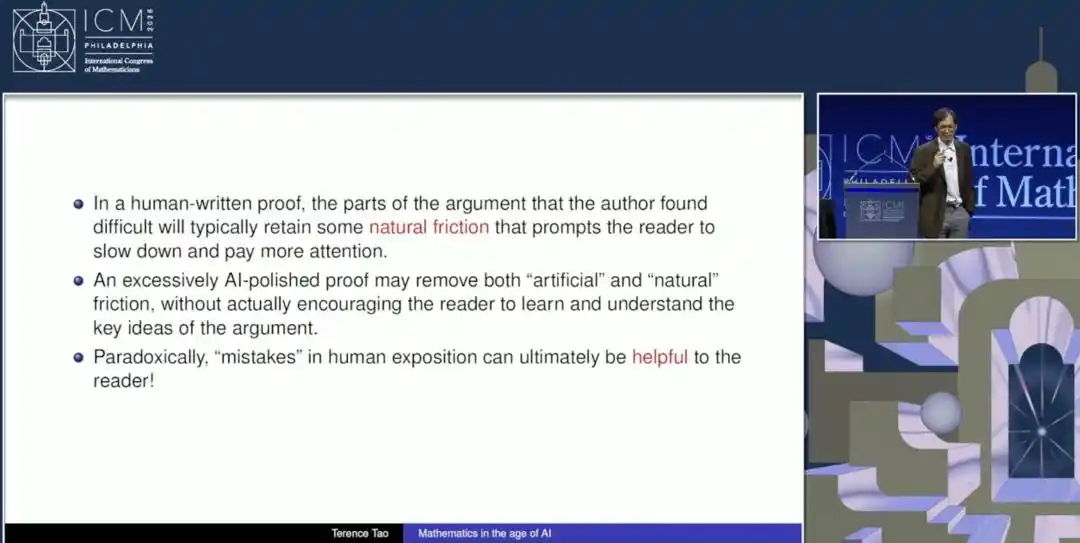
Screenshot from Terence Tao's ICM 2026 lecture: Human-written proofs leave "natural friction" at difficult points, reminding readers to slow down; AI-polished proofs grind it away along with the rest.

AI speeds over both easy and difficult parts uniformly, making everything look the same.

He shared his own example.

As a graduate student grappling with Bourgain's 1991 paper, the margins still bear his annotation from back then: I hate Jean Bourgain.

After struggling through it, he反而 understood the other's way of thinking and later preferred reading his papers.

He said if that proof had been polished by multiple layers of AI, he might not have gotten that training.

The information of "which step is difficult" has never been formally recorded in the tradition of human mathematical writing, so models cannot learn it.

And what AI writes out further grinds away even these remaining traces.

This becomes a vicious cycle: models can't learn judgment, and what they write makes it even harder for the next generation of models to learn it.

Gowers's prescription lands on the model's reward function.

During training, you can't just reward it when it gets the solution; you must also penalize it for two things: exploring too many dead ends, and directly翻ing for ready-made answers in the literature.

Rewarding only results yields only results without process.

This holds true for training, and also for the mathematical community.

What counts as crossing the threshold?

Gowers offers a yardstick that's hardest to fudge.

He cites the cap-set problem from 2016.

This problem asks: In a high-dimensional grid over three elements (ternary), what is the maximum number of points you can select such that no three form an arithmetic progression? For decades, the bounds were only nudged down bit by bit.

That year, a new solution emerged,甩开 the previous best bound by a wide margin, using an approach unlike any he had imagined.

Yet in hindsight, the method clearly should have been done that way; no one had thought of it before.

Immediately, a large group of people rushed in, wanting to understand what else this new technique could do.

A truly good method doesn't just solve the immediate problem; it makes a whole group of people immediately change their current work.

The day a model produces something of equivalent weight on its own, that's when he'll consider the threshold crossed.

This article is from the WeChat public account "新智元" (New Zhiyuan), author: ASI启示录

Трендові криптовалюти

Пов'язані питання

QAccording to Timothy Gowers, why are AI's recent mathematical achievements concentrated in finding counterexamples rather than proving theorems?

AGowers argues that the distinction between finding counterexamples and proving theorems is artificial. Both are essentially about searching for examples. AI excels at certain search strategies that involve trying many possibilities quickly, which is well-suited for tasks where failure is cheap, such as finding counterexamples. However, its current methods may not be as effective for problems requiring deep strategic pruning of search paths, which is often needed for constructing novel proofs.

QWhat is the 'natural friction' that Terence Tao mentions in his ICM 2026 talk, and why is it important?

ATerence Tao describes 'natural friction' as the natural pacing in human-written proofs where difficult steps are given more emphasis and detail, while easier steps are passed over quickly. This pacing helps readers identify where the key challenges lie. AI-generated proofs often lack this 'friction,' treating all steps with uniform speed and detail, which can make them harder to learn from and can erase a crucial signal about mathematical difficulty.

QWhat are the three key reasons Gowers gives for why large language models struggle with developing a sense of mathematical judgment or 'smell'?

AFirst, their training data consists only of polished, finished proofs, lacking information about the trial-and-error process, dead ends, and strategic decisions. Second, their speed and computational power allow them to perform exhaustive searches inefficiently, reducing the pressure to develop efficient pruning strategies. Third, it is difficult to experimentally verify whether an AI's insight comes from deep reasoning or simply from retrieving a human's prior work.

QHow do the subsequent papers by Francesco Fournier-Facio and Raphael Steiner relate to OpenAI's announced results, and what does this indicate?

AFrancesco Fournier-Facio and Raphael Steiner built upon OpenAI's results, writing papers that generalized or modified the AI's constructions (e.g., creating a torsion-free non-sofic group or extending a multi-color Ramsey number construction). This indicates that the AI's work provided a productive method or framework that human mathematicians could understand, extend, and publish, showing it was a 'fertile' discovery rather than just a one-off answer.

QWhat benchmark does Gowers propose for determining when AI has truly 'crossed a threshold' in mathematical research?

AGowers uses the example of the 2016 breakthrough on the cap-set problem. A true threshold is crossed when an AI independently produces a method of comparable significance—one that not only solves a specific problem but also opens up a new line of research, immediately changing how a community of mathematicians works and leading to a flood of follow-up results based on the new technique.

Пов'язані матеріали

Tiger Research: How Far Can the On-Chain Foreign Exchange Settlement Layer Go?

"Tiger Research: How Far Can On-Chain FX Settlement Layers Go?" The article examines KiiChain, a startup aiming to create an on-chain foreign exchange settlement layer, focusing on its potential to address inefficiencies in cross-border payments, especially for emerging markets. The core problem is the slow, costly, and fragmented traditional FX infrastructure, where bank hours, regulations, and thin liquidity for local currencies create delays. KiiChain, founded by OTC veterans, proposes aggregating USD and local currency stablecoin liquidity on one chain to enable 24/7 settlement. The platform consists of four components: 1) The KiiChain App uses an Atomic Quote Network (RFQ-style price discovery with on-chain settlement) to tackle settlement delays, but not underlying liquidity scarcity. 2) The RWA Protocol tokenizes collateral using compliant standards (like ERC-3643), shifting trust from bank relationships to coded rules, though regulatory anchors remain. 3) Kii Oracle uses a decentralized validator network to create consensus pricing from fragmented data, improving transparency but not market depth. 4) KiiChain Pay bundles fiat on/off-ramps and swap services; only the DEX swap bypasses banking bottlenecks, while others still rely on licensed operators. The analysis concludes KiiChain doesn't eliminate intermediaries but creates a unified settlement layer where they can interact without geographic or time constraints. It streamlines the process—three of eight traditional steps are removed—by moving infrastructure on-chain, improving speed and accessibility for digital asset swaps. However, fiat entry/exit points remain subject to off-chain service limitations. Current metrics show over $500M in transaction volume. The future depends on ecosystem growth—attracting liquidity partners and users—to evolve beyond settlement into a broader financial hub. Ultimately, the on-chain structure currently solves settlement friction and time, not liquidity depth. Success will be determined by execution in building partnerships and market presence, not by architectural design alone.

marsbit11 хв тому

Tiger Research: How Far Can the On-Chain Foreign Exchange Settlement Layer Go?

marsbit11 хв тому

'The Idea of Catching the Absolute Bottom Is Wrong': Experts on a New Phase of Bitcoin Capitulation

Analysts from CryptoQuant advise investors against trying to pinpoint the exact bottom of Bitcoin's price. Their data shows the percentage of the Bitcoin supply in profit has fallen to 51.4%, a level historically associated with capitulation phases followed by accumulation. This means approximately 48.6% of circulating coins are held at an unrealized loss. The metric, based on UTXO analysis comparing a coin's last moved price to its current market value, last neared this level in early 2023 when Bitcoin traded between $16,000 and $20,000. CryptoQuant states that the idea of catching the "absolute bottom" is flawed. The decline in the average cost basis during a bear market reflects coins transferring from weak hands to stronger, long-term holders. While some investors realize losses, others may use the decline for gradual accumulation. The accumulation window may last longer than many expect, even as fear drives some participants away. Historically, a supply in profit below 55% has been linked to re-accumulation periods. Separately, Swan Bitcoin CEO Cory Klippsten offered a forecast, suggesting Bitcoin could form a bottom in October 2026, followed by a recovery towards approximately $130,000 ahead of the 2028 halving. This aligns with the historical pattern of local lows forming about 12 months after bull market peaks; Bitcoin hit its all-time high above $126,000 in early October 2025. However, Klippsten cautioned against over-relying on past cycles due to limited historical data.

cryptonews.ru53 хв тому

'The Idea of Catching the Absolute Bottom Is Wrong': Experts on a New Phase of Bitcoin Capitulation

cryptonews.ru53 хв тому

How Does FalconX Bring Institutional Lending On-Chain? Deep Dive into the FALX Operational Mechanism

FALX is a structured credit facility that brings institutional prime brokerage loans on-chain as fixed-income assets. It works by having FalconX originate overcollateralized loans to institutional clients (e.g., quant funds, market makers). These loan exposures enter a bankruptcy-remote SPV. The Pareto protocol provides the on-chain credit vault infrastructure, while M11 Credit acts as the credit curator, administrative agent, and collateral agent. Platforms like Plume, Ethereum, and Solana serve as distribution channels for investors. Investors deposit USDC into the vault, receiving an estimated ~7.4% net yield (after a 10% performance fee). This yield represents a premium over low-risk on-chain alternatives (like tokenized Treasuries at ~4%) to compensate for risks including FalconX operational risk, collateral liquidation risk, SPV legal risk, M11's execution risk, a 31-day redemption notice period, and potential contagion from DeFi re-collateralization. The structure incorporates multiple risk mitigations: overcollateralized underlying loans, a first-loss capital contribution from FalconX, and independent oversight by M11. However, challenges remain, such as scaling investor demand (current AUM is ~$148M against a ~$1B potential capacity), managing redemption liquidity, and addressing new risks from the vault token's use as collateral in DeFi lending protocols like Morpho. FALX demonstrates a pragmatic path for on-chain credit by leveraging existing institutional loan origination and combining it with legal structures, external curation, and blockchain-based distribution.

marsbit55 хв тому

How Does FalconX Bring Institutional Lending On-Chain? Deep Dive into the FALX Operational Mechanism

marsbit55 хв тому

Торгівля

Спот

Популярні статті

Що таке GROK AI

Grok AI: Революція в розмовних технологіях ери Web3 Вступ У швидко змінюваному ландшафті штучного інтелекту Grok AI вирізняється як помітний проєкт, що поєднує сфери передових технологій та взаємодії з користувачами. Розроблений компанією xAI, яку очолює відомий підприємець Ілон Маск, Grok AI прагне переосмислити, як ми взаємодіємо зі штучним інтелектом. Оскільки рух Web3 продовжує процвітати, Grok AI має на меті використати потужність розмовного ШІ для відповіді на складні запитання, надаючи користувачам досвід, який є не лише інформативним, але й розважальним. Що таке Grok AI? Grok AI — це складний розмовний чат-бот, розроблений для динамічної взаємодії з користувачами. На відміну від багатьох традиційних систем ШІ, Grok AI охоплює ширший спектр запитів, включаючи ті, які зазвичай вважаються недоречними або виходять за межі стандартних відповідей. Основні цілі проєкту включають: Надійне міркування: Grok AI акцентує увагу на здоровому глузді, щоб надавати логічні відповіді на основі контекстуального розуміння. Масштабоване управління: Інтеграція допоміжних інструментів забезпечує моніторинг та оптимізацію взаємодій користувачів для покращення якості. Формальна верифікація: Безпека є пріоритетом; Grok AI впроваджує методи формальної верифікації для підвищення надійності своїх результатів. Розуміння довгого контексту: Модель ШІ відзначається здатністю зберігати та згадувати обширну історію розмов, що сприяє змістовним та контекстуально обізнаним дискусіям. Стійкість до атак: Зосереджуючись на покращенні своїх захистів від маніпульованих або зловмисних вхідних даних, Grok AI прагне зберегти цілісність взаємодій з користувачами. По суті, Grok AI — це не просто пристрій для отримання інформації; це занурюючий розмовний партнер, який заохочує динамічний діалог. Творець Grok AI Геній, що стоїть за Grok AI, — це ніхто інший, як Ілон Маск, особа, яка стала синонімом інновацій у різних сферах, включаючи автомобільну промисловість, космічні подорожі та технології. Під егідою xAI, компанії, що зосереджена на розвитку технологій ШІ на користь суспільства, бачення Маска прагне переосмислити розуміння взаємодій з ШІ. Лідерство та основоположна етика глибоко впливають на прагнення Маска розширити технологічні межі. Інвестори Grok AI Хоча конкретні деталі щодо інвесторів, які підтримують Grok AI, залишаються обмеженими, загальновідомо, що xAI, інкубатор проєкту, заснований і підтримується переважно самим Ілоном Маском. Попередні підприємства та активи Маска забезпечують надійну підтримку, що додатково зміцнює довіру до Grok AI та потенціал для зростання. Однак наразі інформація про додаткові інвестиційні фонди або організації, що підтримують Grok AI, не є доступною, що позначає область для потенційного майбутнього дослідження. Як працює Grok AI? Операційна механіка Grok AI є такою ж інноваційною, як і його концептуальна структура. Проєкт інтегрує кілька передових технологій, які сприяють його унікальним функціональним можливостям: Надійна інфраструктура: Grok AI побудований з використанням Kubernetes для оркестрації контейнерів, Rust для продуктивності та безпеки, і JAX для високопродуктивних числових обчислень. Ця трійка забезпечує ефективну роботу чат-бота, його масштабованість та швидке обслуговування користувачів. Доступ до знань у реальному часі: Однією з відмінних рис Grok AI є його здатність отримувати дані в реальному часі через платформу X — раніше відому як Twitter. Ця можливість надає ШІ доступ до останньої інформації, що дозволяє надавати своєчасні відповіді та рекомендації, які можуть бути пропущені іншими моделями ШІ. Два режими взаємодії: Grok AI пропонує користувачам вибір між “Розважальним режимом” та “Звичайним режимом”. Розважальний режим дозволяє більш ігровий та гумористичний стиль взаємодії, тоді як Звичайний режим зосереджується на наданні точних і правильних відповідей. Ця універсальність забезпечує індивідуальний досвід, що відповідає різним уподобанням користувачів. По суті, Grok AI поєднує продуктивність із залученням, створюючи досвід, який є одночасно збагачуючим і розважальним. Хронологія Grok AI Шлях Grok AI відзначений важливими етапами, які відображають його розвиток та етапи впровадження: Початковий розвиток: Фундаментальна фаза Grok AI тривала приблизно два місяці, протягом яких проводилося початкове навчання та налаштування моделі. Випуск бета-версії Grok-2: У значному досягненні була оголошена бета-версія Grok-2. Цей випуск представив дві версії чат-бота — Grok-2 та Grok-2 mini — кожна з яких оснащена можливостями для спілкування, кодування та міркування. Публічний доступ: Після бета-розробки Grok AI став доступним для користувачів платформи X. Ті, хто має акаунти, підтверджені номером телефону та активні принаймні сім днів, можуть отримати доступ до обмеженої версії, що робить технологію доступною для ширшої аудиторії. Ця хронологія відображає систематичний розвиток Grok AI від початку до публічної взаємодії, підкреслюючи його прагнення до постійного вдосконалення та взаємодії з користувачами. Ключові особливості Grok AI Grok AI охоплює кілька ключових особливостей, які сприяють його інноваційній ідентичності: Інтеграція знань у реальному часі: Доступ до актуальної та релевантної інформації відрізняє Grok AI від багатьох статичних моделей, забезпечуючи захоплюючий та точний досвід для користувачів. Універсальні стилі взаємодії: Пропонуючи різні режими взаємодії, Grok AI задовольняє різноманітні уподобання користувачів, запрошуючи до творчості та персоналізації у спілкуванні з ШІ. Передова технологічна основа: Використання Kubernetes, Rust та JAX надає проєкту надійну основу для забезпечення надійності та оптимальної продуктивності. Етичні міркування в дискурсі: Включення функції генерації зображень демонструє інноваційний дух проєкту. Однак це також піднімає етичні питання, пов'язані з авторським правом та поважним зображенням впізнаваних фігур — триваюча дискусія в спільноті ШІ. Висновок Як піонер у сфері розмовного ШІ, Grok AI втілює потенціал трансформаційних користувацьких досвідів в цифрову епоху. Розроблений компанією xAI та керований візією Ілона Маска, Grok AI інтегрує знання в реальному часі з передовими можливостями взаємодії. Він прагне розширити межі того, що може досягти штучний інтелект, зберігаючи при цьому акцент на етичних міркуваннях та безпеці користувачів. Grok AI не лише втілює технологічний прогрес, але й представляє нову парадигму спілкування в ландшафті Web3, обіцяючи залучити користувачів як глибокими знаннями, так і ігровою взаємодією. Оскільки проєкт продовжує розвиватися, він слугує свідченням того, що може досягти перетин технологій, творчості та людської взаємодії.

640 переглядів усьогоОпубліковано 2024.12.26Оновлено 2024.12.26

Що таке GROK AI

Що таке ERC AI

Euruka Tech: Огляд $erc ai та його амбіцій у Web3 Вступ У швидко змінюваному ландшафті технології блокчейн та децентралізованих додатків нові проекти з'являються часто, кожен з унікальними цілями та методологіями. Одним з таких проектів є Euruka Tech, який працює у широкій сфері криптовалют та Web3. Основна увага Euruka Tech, зокрема його токена $erc ai, зосереджена на представленні інноваційних рішень, розроблених для використання зростаючих можливостей децентралізованих технологій. Ця стаття має на меті надати всебічний огляд Euruka Tech, дослідження його цілей, функціональності, ідентичності його творця, потенційних інвесторів та його значення в ширшому контексті Web3. Що таке Euruka Tech, $erc ai? Euruka Tech характеризується як проект, який використовує інструменти та функціональність, що пропонуються середовищем Web3, зосереджуючи увагу на інтеграції штучного інтелекту у своїй діяльності. Хоча конкретні деталі про структуру проекту дещо неясні, він розроблений для покращення залучення користувачів та автоматизації процесів у крипто-просторі. Проект має на меті створити децентралізовану екосистему, яка не лише полегшує транзакції, але й включає прогностичні функції через штучний інтелект, звідси і назва його токена, $erc ai. Мета полягає в тому, щоб надати інтуїтивно зрозумілу платформу, яка сприяє розумнішим взаємодіям та ефективній обробці транзакцій у зростаючій сфері Web3. Хто є творцем Euruka Tech, $erc ai? На даний момент інформація про творця або засновницьку команду Euruka Tech залишається невизначеною та дещо непрозорою. Ця відсутність даних викликає занепокоєння, оскільки знання про бекграунд команди часто є важливим для встановлення довіри в секторі блокчейн. Тому ми класифікували цю інформацію як невідому, поки конкретні деталі не стануть доступними в публічному домені. Хто є інвесторами Euruka Tech, $erc ai? Аналогічно, ідентифікація інвесторів або організацій, які підтримують проект Euruka Tech, не надається через доступні дослідження. Аспект, який є критично важливим для потенційних зацікавлених сторін або користувачів, які розглядають можливість співпраці з Euruka Tech, - це впевненість, що походить від встановлених фінансових партнерств або підтримки від авторитетних інвестиційних компаній. Без розкриття інформації про інвестиційні зв'язки важко зробити всебічні висновки про фінансову безпеку або довговічність проекту. Відповідно до знайденої інформації, цей розділ також має статус невідомий. Як працює Euruka Tech, $erc ai? Незважаючи на відсутність детальних технічних специфікацій для Euruka Tech, важливо враховувати його інноваційні амбіції. Проект прагне використовувати обчислювальну потужність штучного інтелекту для автоматизації та покращення досвіду користувачів у середовищі криптовалют. Інтегруючи ШІ з технологією блокчейн, Euruka Tech має на меті надати такі функції, як автоматизовані угоди, оцінка ризиків та персоналізовані інтерфейси користувачів. Інноваційна суть Euruka Tech полягає в його меті створити безшовний зв'язок між користувачами та величезними можливостями, які пропонують децентралізовані мережі. Завдяки використанню алгоритмів машинного навчання та ШІ, він має на меті мінімізувати труднощі для нових користувачів і спростити транзакційні досвіди в рамках Web3. Ця симбіоз між ШІ та блокчейном підкреслює значення токена $erc ai, який виступає як міст між традиційними інтерфейсами користувачів та розвиненими можливостями децентралізованих технологій. Хронологія Euruka Tech, $erc ai На жаль, через обмежену інформацію про Euruka Tech ми не можемо представити детальну хронологію основних подій або досягнень у подорожі проекту. Ця хронологія, яка зазвичай є безцінною для відстеження еволюції проекту та розуміння його траєкторії зростання, наразі недоступна. Як тільки інформація про значні події, партнерства або функціональні доповнення стане очевидною, оновлення, безумовно, підвищать видимість Euruka Tech у крипто-сфері. Роз'яснення щодо інших проектів “Eureka” Варто зазначити, що кілька проектів та компаній мають схожу назву з “Eureka”. Дослідження виявило ініціативи, такі як AI-агент від NVIDIA Research, який зосереджується на навчанні роботів складним завданням за допомогою генеративних методів, а також Eureka Labs та Eureka AI, які покращують користувацький досвід в освіті та аналітиці обслуговування клієнтів відповідно. Однак ці проекти відрізняються від Euruka Tech і не повинні бути змішані з його цілями чи функціональністю. Висновок Euruka Tech, разом із його токеном $erc ai, представляє обіцяючого, але наразі невідомого гравця в ландшафті Web3. Хоча деталі про його творця та інвесторів залишаються невідомими, основна амбіція поєднання штучного інтелекту з технологією блокчейн є центром інтересу. Унікальні підходи проекту до сприяння залученню користувачів через передову автоматизацію можуть виділити його на фоні прогресу екосистеми Web3. Оскільки крипто-ринок продовжує еволюціонувати, зацікавлені сторони повинні уважно стежити за новинами, пов'язаними з Euruka Tech, оскільки розвиток задокументованих інновацій, партнерств або визначеного дорожньої карти може представити значні можливості в найближчому майбутньому. На даний момент ми чекаємо на більш суттєві інсайти, які можуть розкрити потенціал Euruka Tech та його позицію в конкурентному крипто-ландшафті.

620 переглядів усьогоОпубліковано 2025.01.02Оновлено 2025.01.02

Що таке ERC AI

Що таке DUOLINGO AI

DUOLINGO AI: Інтеграція вивчення мов з Web3 та інноваціями штучного інтелекту В епоху, коли технології змінюють освіту, інтеграція штучного інтелекту (ШІ) та блокчейн-мереж відкриває нові горизонти для вивчення мов. З'являється DUOLINGO AI та його асоційована криптовалюта, $DUOLINGO AI. Цей проект прагне об'єднати освітні можливості провідних платформ для вивчення мов з перевагами децентралізованих технологій Web3. У цій статті розглядаються ключові аспекти DUOLINGO AI, його цілі, технологічна структура, історичний розвиток та майбутній потенціал, зберігаючи чіткість між оригінальним освітнім ресурсом та цією незалежною криптовалютною ініціативою. Огляд DUOLINGO AI В основі DUOLINGO AI лежить прагнення створити децентралізоване середовище, де учні можуть отримувати криптографічні винагороди за досягнення освітніх етапів у мовній компетенції. Застосовуючи смарт-контракти, проект має на меті автоматизувати процеси перевірки навичок та розподілу токенів, дотримуючись принципів Web3, які підкреслюють прозорість та власність користувачів. Модель відрізняється від традиційних підходів до вивчення мов, акцентуючи увагу на структурі управління, що базується на спільноті, що дозволяє власникам токенів пропонувати поліпшення змісту курсів та розподілу винагород. Деякі з помітних цілей DUOLINGO AI включають: Гейміфіковане навчання: Проект інтегрує досягнення на блокчейні та невзаємозамінні токени (NFT), щоб представляти рівні мовної компетенції, сприяючи мотивації через захоплюючі цифрові винагороди. Децентралізоване створення контенту: Це відкриває можливості для викладачів та мовних ентузіастів вносити свої курси, сприяючи моделі розподілу доходів, яка вигідна всім учасникам. Персоналізація на основі ШІ: Використовуючи сучасні моделі машинного навчання, DUOLINGO AI персоналізує уроки, щоб адаптуватися до індивідуального прогресу навчання, подібно до адаптивних функцій, що є в усталених платформах. Творці проекту та управління Станом на квітень 2025 року команда, що стоїть за $DUOLINGO AI, залишається псевдонімною, що є поширеною практикою в децентралізованому криптовалютному середовищі. Ця анонімність має на меті сприяти колективному розвитку та залученню зацікавлених сторін, а не зосереджуватися на окремих розробниках. Смарт-контракт, розгорнутий на блокчейні Solana, зазначає адресу гаманця розробника, що свідчить про зобов'язання до прозорості щодо транзакцій, незважаючи на те, що особи творців залишаються невідомими. Згідно з його дорожньою картою, DUOLINGO AI прагне перетворитися на Децентралізовану Автономну Організацію (DAO). Ця структура управління дозволяє власникам токенів голосувати з важливих питань, таких як реалізація функцій та розподіл скарбниці. Ця модель узгоджується з етикою розширення прав і можливостей спільноти, що спостерігається в різних децентралізованих додатках, підкреслюючи важливість колективного прийняття рішень. Інвестори та стратегічні партнерства На даний момент немає публічно відомих інституційних інвесторів або венчурних капіталістів, пов'язаних з $DUOLINGO AI. Натомість ліквідність проекту в основному походить з децентралізованих бірж (DEX), що є різким контрастом до стратегій фінансування традиційних компаній у сфері освітніх технологій. Ця модель знизу вгору вказує на підхід, орієнтований на спільноту, що відображає зобов'язання проекту до децентралізації. У своєму білому документі DUOLINGO AI згадує про формування співпраці з неуточненими “блокчейн-освітніми платформами”, спрямованими на збагачення своїх курсів. Хоча конкретні партнерства ще не були розкриті, ці спільні зусилля натякають на стратегію поєднання інновацій блокчейну з освітніми ініціативами, розширюючи доступ та залучення користувачів у різноманітні навчальні напрямки. Технологічна архітектура Інтеграція ШІ DUOLINGO AI включає два основні компоненти на основі ШІ для покращення своїх освітніх пропозицій: Адаптивний навчальний двигун: Цей складний двигун навчається на основі взаємодій користувачів, подібно до власних моделей великих освітніх платформ. Він динамічно регулює складність уроків, щоб вирішувати конкретні проблеми учнів, зміцнюючи слабкі місця через цілеспрямовані вправи. Розмовні агенти: Використовуючи чат-боти на базі GPT-4, DUOLINGO AI надає платформу для користувачів, щоб брати участь у симульованих розмовах, сприяючи більш інтерактивному та практичному досвіду вивчення мови. Інфраструктура блокчейну Побудований на блокчейні Solana, $DUOLINGO AI використовує комплексну технологічну структуру, яка включає: Смарт-контракти для перевірки навичок: Ця функція автоматично нагороджує токенами користувачів, які успішно проходять тести на компетентність, підкріплюючи структуру стимулів для справжніх навчальних результатів. NFT значки: Ці цифрові токени позначають різні етапи, яких досягають учні, такі як завершення розділу курсу або оволодіння конкретними навичками, що дозволяє їм обмінюватися або демонструвати свої досягнення в цифровому форматі. Управління DAO: Члени спільноти, наділені токенами, можуть брати участь в управлінні, голосуючи за ключові пропозиції, що сприяє культурі участі, яка заохочує інновації в курсах та функціях платформи. Історичний хронологічний графік 2022–2023: Концептуалізація Основи DUOLINGO AI закладаються з створення білого документа, що підкреслює синергію між досягненнями ШІ у вивченні мов та децентралізованим потенціалом блокчейн-технологій. 2024: Бета-реліз Обмежений бета-реліз представляє пропозиції з популярних мов, винагороджуючи ранніх користувачів токенами в рамках стратегії залучення спільноти проекту. 2025: Перехід до DAO У квітні відбувається повний запуск основної мережі з обігом токенів, що спонукає обговорення в спільноті щодо можливих розширень на азійські мови та інші розробки курсів. Виклики та майбутні напрямки Технічні труднощі Незважаючи на свої амбітні цілі, DUOLINGO AI стикається з суттєвими викликами. Масштабованість залишається постійною проблемою, особливо в балансуванні витрат, пов'язаних із обробкою ШІ, та підтриманням чутливої, децентралізованої мережі. Крім того, забезпечення якості створення контенту та модерації в умовах децентралізованої пропозиції створює складнощі у підтримці освітніх стандартів. Стратегічні можливості Дивлячись у майбутнє, DUOLINGO AI має потенціал використовувати партнерства з мікрокреденційними академічними установами, надаючи блокчейн-верифіковані підтвердження мовних навичок. Крім того, розширення через різні блокчейни може дозволити проекту залучити ширші бази користувачів та додаткові екосистеми блокчейну, покращуючи його взаємодію та охоплення. Висновок DUOLINGO AI представляє інноваційне злиття штучного інтелекту та блокчейн-технологій, пропонуючи альтернативу, орієнтовану на спільноту, традиційним системам вивчення мов. Хоча його псевдонімна розробка та нова економічна модель несуть певні ризики, зобов'язання проекту до гейміфікованого навчання, персоналізованої освіти та децентралізованого управління освітлює шлях вперед для освітніх технологій у сфері Web3. Оскільки ШІ продовжує розвиватися, а екосистема блокчейну еволюціонує, ініціативи на кшталт DUOLINGO AI можуть переосмислити, як користувачі взаємодіють з мовною освітою, наділяючи спільноти та винагороджуючи залучення через інноваційні механізми навчання.

653 переглядів усьогоОпубліковано 2025.04.11Оновлено 2025.04.11

Що таке DUOLINGO AI

Обговорення

Ласкаво просимо до спільноти HTX. Тут ви можете бути в курсі останніх подій розвитку платформи та отримати доступ до професійної ринкової інформації. Нижче представлені думки користувачів щодо ціни AI (AI).

活动图片