AI Inference Bills Soar, Shopify and Roblox Warn: Savings from Layoffs Not Enough to Cover Chip Costs

marsbitОпубліковано о 2026-05-11Востаннє оновлено о 2026-05-11

Анотація

The 2026 Q1 earnings season reveals a paradox: while AI helps companies freeze hiring and boost productivity, the soaring costs of AI inference—token consumption and GPU depreciation—are eroding savings from workforce reductions. Shopify reported that AI now writes over 50% of its code, enabling significant output with stable headcount. However, LLM costs, driven by heavy usage of its AI assistant Sidekick, are pressuring its subscription毛利率. Similarly, Roblox attributed a quarter of its full-year利润率下调 to increased AI investment. The article highlights a broader industry imbalance: combined AI capital expenditure for Amazon, Meta, Microsoft, and Google is projected to reach $725 billion in 2026, vastly outpacing potential savings from layoffs. For instance, Meta's planned裁员 would save about $2.4 billion annually, offsetting only ~12% of its incremental AI depreciation. While底层 model and chip suppliers like NVIDIA maintain high profitability, application-layer companies face a pricing squeeze. Their strategies now involve要么 tightly linking AI costs to user engagement (like Shopify) or introducing fees for advanced AI features (like Roblox), as covering AI bills with裁员 savings alone is financially unsustainable.

Author: Claude, Deep Chao TechFlow

Deep Chao Introduction: The Q1 2026 earnings season for tech giants reveals a new phenomenon: while AI helps companies freeze hiring and cut positions, its own token consumption and GPU depreciation are inversely eroding gross margins. Shopify's subscription business gross margin is being suppressed by LLM costs, with about a quarter of Roblox's full-year margin guidance downgrade directly attributed to incremental AI investments. The combined AI capital expenditures of Amazon, Meta, Microsoft, and Google will reach $725 billion in 2026, a 77% year-over-year increase. For the first time, the two ends of the AI dividend—labor savings and compute consumption—are being accounted for on the same balance sheet in the same quarter, with the latter clearly larger.

The first-quarter earnings season is applying a corrective patch to the simplistic narrative of 'AI replacing labor.'

While a group of tech companies report successes in hiring freezes and accelerated product iteration, they are forced to explain a more棘手 question to investors: soaring AI chip depreciation and unpredictable token consumption are inversely eating up the money saved from layoffs.

Shopify President Harley Finkelstein stated at the May 5, 2026 earnings call that AI now handles over 50% of the company's code writing and helped Shopify deliver over 300 products and features while keeping headcount flat. However, in the same call, management also acknowledged that the gross margin of subscription solutions is being partially offset by large language model (LLM) costs, and this dynamic will persist.

Shopify: The LLM Cost Black Hole Behind an 80% Gross Margin

Shopify's Q1 subscription solutions gross margin was 80%, flat year-over-year, but the cost of maintaining this figure is changing.

According to Shopify's 10-Q filing with the SEC, subscription solutions costs grew 20% year-over-year in Q1 2026, reaching $148 million, compared to $123 million in the same period last year. Cloud and infrastructure costs (including AI-related usage) increased by $22 million as a single line item, being the primary driver of cost expansion. Shopify CFO Jeff Hoffmeister said on the earnings call that scale effects and support efficiency improvements were "partially offset by increased LLM costs, primarily driven by merchant usage of Sidekick, and we expect this dynamic to continue."

Sidekick is Shopify's AI assistant embedded in the platform. Its weekly active shops grew 385% year-over-year this quarter. Merchants used Sidekick to create over 12,000 custom apps this quarter, up more than 200% sequentially, with nearly half of Shopify Flows being AI-generated. AI-driven store traffic grew 8x year-over-year, and orders from AI search grew nearly 13x year-over-year.

But this explosion in usage means exponential growth in AI inference calls. Every interaction a merchant has with Sidekick, every proactive suggestion generated by the Pulse feature, corresponds to a token bill paid to upstream model providers.

Shopify explained the books for "internal AI" and "external AI" separately to investors: using AI internally for coding and controlling personnel expenses is a victory in the "cost game," while providing AI products externally to merchants is a strategic choice to "deeply tie infrastructure costs to merchant usage." Finkelstein summarized this logic on the earnings call as "AI is a structural advantage, not just a cost."

Roblox: One-Quarter of Margin Downgrade Directly from AI

Roblox CFO Naveen Chopra explicitly disclosed at the Q1 2026 earnings call on April 30 that about one-quarter of the full-year margin downgrade relative to prior guidance stems from incremental AI investment and adjustments to DevEx (Developer Exchange) for U.S. users aged 18 and above.

Roblox currently runs over 400 AI models on its own and cloud GPUs, processing 1.5 million inference calls per second, covering scenarios like discovery recommendations, communication safety, marketplace recommendations, and 3D generation.

Management is attempting to slice through inference costs via business model adjustments. Roblox Co-founder and CEO David Baszucki said on the earnings call that the company's upcoming "Roblox Reality" project, a technology capable of running 2K real-time photorealistic video models at 60Hz, will not be offered for free. "This will use cloud compute resources. We will have some form of subscription or payment mechanism, so we believe we can offset the costs on the real-time inference side," Baszucki explained.

Chopra added that the company's 2026 capital expenditure guidance remains unchanged, relying primarily on deploying GPUs in its own data centers to meet inference demand for the year, while some training tasks will still use the cloud. Roblox previously disclosed that by migrating some AI inference workloads from third-party clouds to its own data centers by the end of 2025, it had already achieved a 10x efficiency improvement in specific workloads like safety review and content discovery.

However, Roblox's quarterly full-year guidance includes multiple pressures: the aforementioned incremental AI investment, deleveraging of fixed costs due to lower-than-expected bookings scale, and the DevEx rate increase for 18+ adult content creators to 37.8%, ultimately triggering a market repricing of its full-year margin.

Industry Ledger: $725 Billion Capex vs. $2.7 Billion Salary Savings

The micro cases of Shopify and Roblox sit within a larger macro structural imbalance.

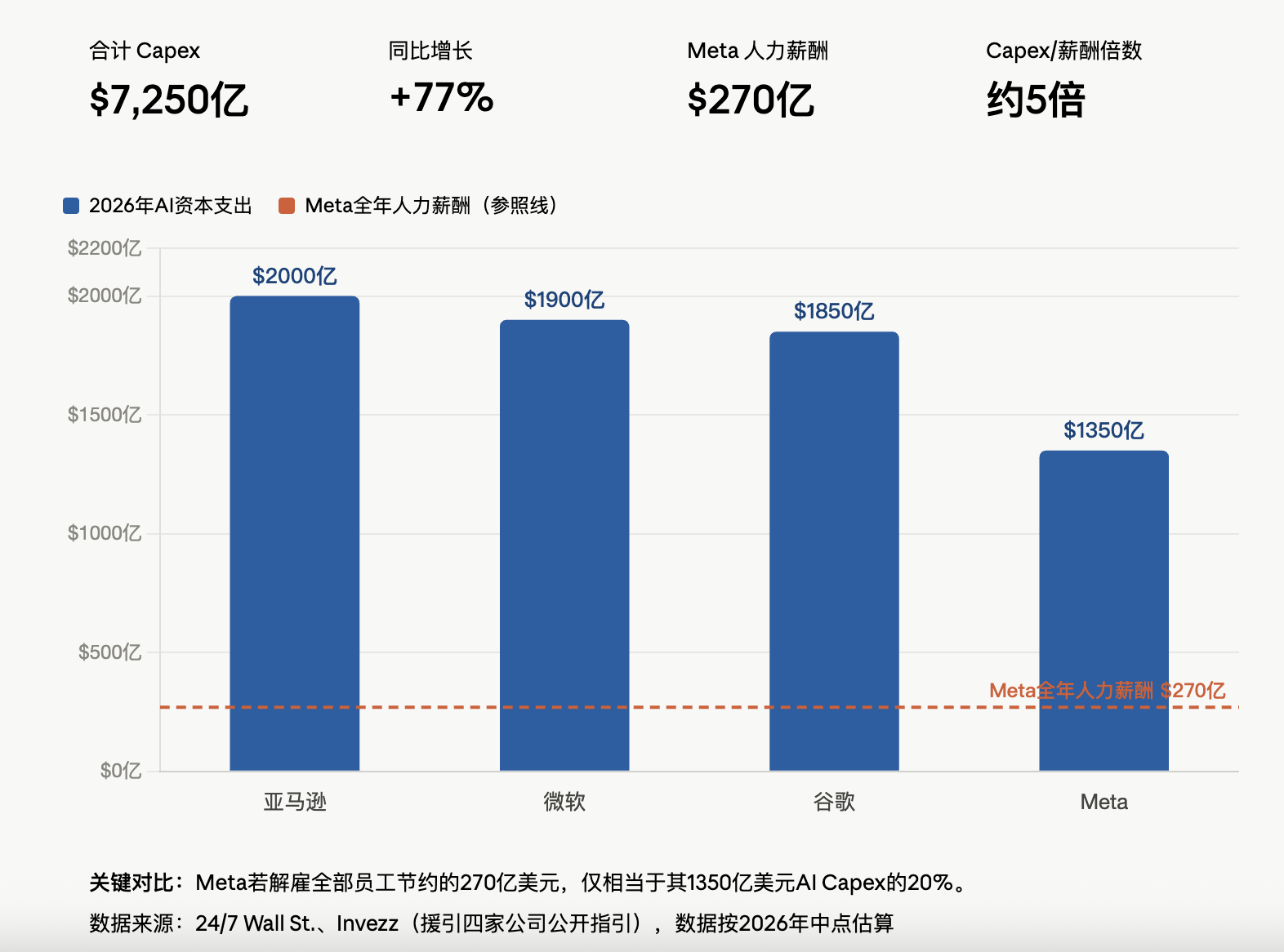
According to data cited by 24/7 Wall St., the combined AI capital expenditures of Amazon, Meta, Microsoft, and Google will reach $725 billion in 2026, a 77% year-over-year increase. Among them, Meta's full-year capex guidance is between $125 billion and $145 billion, meaning a daily expenditure of $370 million on data center construction; Microsoft's 2026 calendar year capex is $190 billion, with Amazon committing $200 billion.

This calculation is quite disproportionate compared to personnel expenses. Meta's total human compensation—all wages, benefits, stock-based compensation—amounts to approximately $27 billion. Even if Meta fired all its employees tomorrow, the savings would be less than one-fifth of its 2026 infrastructure expenditure.

Wedbush Securities analyst Dan Ives estimated in an April 25 research note that Meta's upcoming layoff of 8,000 people could free up about $2.4 billion in annual operating expenses, only offsetting about 12% of the incremental depreciation drag expected in 2026. In other words, for every dollar of financial pressure from AI compute expenditure, nearly ten dollars of human cost savings would be needed to fully offset it.

Meta CFO Susan Li positioned Meta's headcount reduction on the Q4 2025 earnings call as "building a leaner operating model to help offset the massive investments we are making." This statement clearly characterizes layoffs as a financial tool for AI capital expenditure, not a byproduct of productivity gains.
Victory for Model Providers, Dilemma for the Application Layer

The biggest beneficiaries of this ledger博弈 are the underlying model and compute suppliers. Microsoft Cloud gross margin held at 69% under the pressure of AI infrastructure expansion; OpenAI's gross margin is externally estimated at around 50%, Anthropic's at around 60%. Nvidia continued to report a gross margin level of about 70% in fiscal year 2026.

Application-layer companies, especially SaaS players that both consume AI and package AI capabilities into subscription products for sale, are facing a new financial structure: revenue is highly correlated with AI usage intensity, but the cost curve is dictated by upstream model provider pricing, and every model upgrade can bring new token consumption.

In his analysis of AI gross margins, Tanay Jaipuria points out that although the inference cost for a single model is declining at 80%-90% annually, the price of frontier models remains stable or even rises. If application-layer companies insist on calling the strongest model for every request, their Cost of Goods Sold (COGS) is effectively being led by the model providers' price cards.

Shopify's response is to position AI products as a strategic gateway deeply binding traffic and merchants, making the growth in inference costs a proxy indicator for "platform embed depth." Roblox's solution is to strip high-end AI experiences out of the free tier, forcing users to pay for inference costs. Behind both paths lies the same consensus: purely covering AI compute bills with savings from layoffs simply doesn't add up mathematically.


Пов'язані питання

QAccording to the article, what is the main financial challenge that companies like Shopify and Roblox are facing despite using AI to reduce labor costs?

ACompanies are facing the challenge that the soaring costs of AI chip depreciation and unpredictable token consumption for AI inference are eating up the money saved from layoffs and headcount reductions, creating a negative impact on their profit margins.

QHow much of Shopify's subscription solution cost increase in Q1 2026 was driven by AI-related usage?

AIn Shopify's Q1 2026 subscription solution costs, the 'cloud and infrastructure costs (including AI-related usage)' line item increased by $22 million, which was the primary driver of the total cost expansion compared to the previous year.

QWhat proportion of Roblox's downward revision to its full-year profit margin guidance is directly attributed to AI investments?

AApproximately one-quarter of Roblox's downward revision to its full-year profit margin guidance is directly attributed to incremental AI investments.

QWhat is the estimated total AI capital expenditure for Amazon, Meta, Microsoft, and Google in 2026 according to the data cited?

AThe combined AI capital expenditure for Amazon, Meta, Microsoft, and Google is estimated to reach $725 billion in 2026.

QAccording to the Wedbush Securities analyst's estimate mentioned, how does the cost savings from Meta's potential 8,000-person layoff compare to its incremental AI depreciation cost?

AThe estimated annual operating expense savings from Meta's potential 8,000-person layoff is about $2.4 billion, which would only offset approximately 12% of the incremental depreciation drag expected in 2026 from its AI investments.

Пов'язані матеріали

The Shutdown of Claude Mythos Revealed the True Cost of Renting AI to Me

The sudden shutdown of Claude Mythos this week starkly highlights a critical, often overlooked risk for founders: when your core capability relies entirely on someone else's platform, your fate is not in your own hands. The key question becomes: who truly owns the intelligence your product depends on? For years, the debate around open-source models focused on cost. Now, the evidence is clear: fine-tuned open-source models can achieve frontier-level quality for specific, mission-critical tasks at a fraction of the cost. However, the deeper issue is control. Relying on a third-party API is like renting; it works until the landlord changes the rules, raises the rent, or asks you to leave—as Mythos experienced. The lesson is not to stop using frontier models—they are incredible infrastructure. The goal is ownership. Ownership means starting with a powerful open-source model and shaping it around what makes your company unique: your data, workflows, domain expertise, and definition of "good." Over time, the model becomes less generic and more reflective of your business, creating durable value. The optimistic conclusion is that AI's future doesn't hinge on one superior model. There is no single frontier. The frontier includes proprietary models, models fine-tuned on company-specific knowledge, specialized models for narrow problems, and intelligent routers orchestrating model ensembles. The most interesting development is not models getting smarter, but intelligence becoming increasingly customizable. The winning companies will be those that transform intelligence into a unique, owned asset. Looking ahead, the vision is not one model dominating all, but many teams owning the part of the frontier that matters most to them.

marsbit28 хв тому

The Shutdown of Claude Mythos Revealed the True Cost of Renting AI to Me

marsbit28 хв тому

Tiger Research: U.S. Strategic Bitcoin Reserve - Should the Market Be Happy or Disappointed?

Tiger Research analyzes the evolution of U.S. legislative efforts regarding a strategic Bitcoin reserve, concluding the market impact is limited in the short term but potentially positive long-term. The core event was a March 2025 executive order by former President Trump, which designated confiscated Bitcoin as a strategic reserve and promised not to sell existing holdings (approx. 190k BTC). As it contained no mandate to purchase new Bitcoin, the market reacted negatively, with prices dropping 5.7%. Legislative history shows a significant retreat from initial ambitions. The 2024 "BITCOIN Act" proposed mandatory purchases of 1 million BTC over five years. Reintroduced in 2025, it stalled due to high fiscal costs, concerns over dollar hegemony, and opposition from the Treasury Secretary. The current frontrunner, the 2026 "American Retirement and Monetary Advancement (ARMA) Act," is a compromise. It lacks any purchase requirement, instead focusing on consolidating existing government-held Bitcoin and legally prohibiting its sale for at least 20 years. While ARMA has higher passage odds due to bipartisan support and no purchase mandate, its immediate market effect is neutral. It eliminates potential government selling pressure but creates no new demand. The long-term significance is that formally establishing Bitcoin as a national reserve asset in law could later reignite debates on mandatory purchases. Therefore, the path to a government buyer is longer than initially priced by the market, but the directional narrative remains intact.

marsbit31 хв тому

Tiger Research: U.S. Strategic Bitcoin Reserve - Should the Market Be Happy or Disappointed?

marsbit31 хв тому

US Stock Market Trend (June 16): SpaceX Rises 42% in Two Days, New Fed Chairman Takes Office Today

**U.S. Stocks Trend (June 16): SpaceX Soars 42% in Two Days, New Fed Chair Takes Office Today** Markets surged on Monday following former President Trump's social media announcement of a completed U.S.-Iran deal to reopen the Strait of Hormuz, pending a June 19 signing. The news triggered a broad risk-on rally: oil prices crashed, tech stocks soared, bond yields fell, and defensive sectors lagged. **Market Performance:** The Nasdaq jumped 3.07%, led by semiconductor stocks like Micron (+9.2%). The S&P 500 gained 1.65%, and the Dow rose 0.92% to a record high. However, the Russell 2000 small-cap index underperformed (+0.72%). SpaceX continued its hot streak, rising another 5% pre-market after disclosures of large buys by an Australian billionaire and Cathie Wood's ARK. Boeing also rallied on the transportation optimism. Conversely, energy stocks like Chevron fell over 3% on the oil price plunge, with other defensive sectors also selling off. The day's action showed a clear rotation of funds from energy/defensive plays into AI and tech narratives. **Macro & Outlook:** The VIX fear index fell 8.37%. Treasury yields declined, and WTI crude dropped over 5%. Attention now shifts to a packed schedule: the Bank of Japan is widely expected to hike rates to 1.0% on Tuesday. The Fed's June meeting concludes Wednesday, marking new Chair Wash's debut. While rates are expected to hold, his tone on stubborn inflation and the "dot plot" will be crucial for gauging the 2024 rate path. The formal Iran deal signing is set for Friday. **Trend Perspective:** While the peace deal is a genuine positive, Monday's explosive rally may have gotten ahead of itself, pricing in a swift resolution to inflation concerns. The shortened trading week faces a triple test: BoJ tightening, the Fed's policy stance, and deal implementation details. Tech and semiconductors, which led the surge, remain vulnerable to any disappointment from these key events. The real price discovery begins with the central banks' communications this week.

marsbit52 хв тому

US Stock Market Trend (June 16): SpaceX Rises 42% in Two Days, New Fed Chairman Takes Office Today

marsbit52 хв тому

Торгівля

Спот
Ф'ючерси

Популярні статті

Як купити CHIP

Ласкаво просимо до HTX.com! Ми зробили покупку USD.AI (CHIP) простою та зручною. Дотримуйтесь нашої покрокової інструкції, щоб розпочати свою криптовалютну подорож.Крок 1: Створіть обліковий запис на HTXВикористовуйте свою електронну пошту або номер телефону, щоб зареєструвати обліковий запис на HTX безплатно. Пройдіть безпроблемну реєстрацію й отримайте доступ до всіх функцій.ЗареєструватисьКрок 2: Перейдіть до розділу Купити крипту і виберіть спосіб оплатиКредитна/дебетова картка: використовуйте вашу картку Visa або Mastercard, щоб миттєво купити USD.AI (CHIP).Баланс: використовуйте кошти з балансу вашого рахунку HTX для безперешкодної торгівлі.Треті особи: ми додали популярні способи оплати, такі як Google Pay та Apple Pay, щоб підвищити зручність.P2P: Торгуйте безпосередньо з іншими користувачами на HTX.Позабіржова торгівля (OTC): ми пропонуємо індивідуальні послуги та конкурентні обмінні курси для трейдерів.Крок 3: Зберігайте свої USD.AI (CHIP)Після придбання USD.AI (CHIP) збережіть його у своєму обліковому записі на HTX. Крім того, ви можете відправити його в інше місце за допомогою блокчейн-переказу або використовувати його для торгівлі іншими криптовалютами.Крок 4: Торгівля USD.AI (CHIP)Легко торгуйте USD.AI (CHIP) на спотовому ринку HTX. Просто увійдіть до свого облікового запису, виберіть торгову пару, укладайте угоди та спостерігайте за ними в режимі реального часу. Ми пропонуємо зручний досвід як для початківців, так і для досвідчених трейдерів.

377 переглядів усьогоОпубліковано 2026.04.21Оновлено 2026.06.02

Як купити CHIP

Обговорення

Ласкаво просимо до спільноти HTX. Тут ви можете бути в курсі останніх подій розвитку платформи та отримати доступ до професійної ринкової інформації. Нижче представлені думки користувачів щодо ціни CHIP (CHIP).

活动图片












