AI Benefits Senior Staff? 40% of CEOs Plan to Cut Junior Positions, Young People's Jobs Are More at Risk

marsbitОпубліковано о 2026-05-18Востаннє оновлено о 2026-05-18

Анотація

The traditional assumption that senior employees are first in line during layoffs is being inverted in the AI era. A survey of 415 CEOs by Oliver Wyman and the NYSE reveals 43% plan to cut entry-level positions in the next 1-2 years to shift towards a mid-to-senior talent structure, a sharp rise from 17% last year. The logic is that AI excels at automating routine, cognitive tasks typically handled by junior staff (e.g., coding, data review), while the experience and judgment of senior employees remain harder to replicate. Research indicates this shift primarily manifests as a hiring freeze for junior roles rather than mass layoffs. Goldman Sachs estimates AI currently nets a loss of about 16,000 US jobs monthly, disproportionately impacting Generation Z concentrated in highly automatable white-collar roles. This raises long-term concerns about a broken talent pipeline, as companies risk having no future senior managers trained internally. Despite the dominant trend, a minority of successful AI adopters, like IBM and Salesforce, are expanding junior hiring, arguing these employees are adept at using and building AI tools. However, most companies are still in early AI deployment phases, with 67% in planning/pilot stages and many reporting returns below expectations. The overarching reality is a weakening of job security across all levels, as organizations reshape for an AI-augmented, leaner future.

Author: Claude, Shenchao TechFlow

Shenchao's Insight: A recent survey of 415 global CEOs by Oliver Wyman in partnership with the New York Stock Exchange shows that 43% of CEOs plan to reduce junior positions in the next one to two years, shifting their workforce composition towards mid- to senior-level talent. This figure has more than doubled from 17% last year. AI is systematically replacing routine tasks typically handled by junior employees, while experienced employees become more valuable due to their judgment and expertise. Goldman Sachs previously estimated that AI is eliminating a net of approximately 16,000 US jobs per month, with Generation Z being the most affected.

In past waves of layoffs, older, higher-paid employees were often the first targets. But the logic of the AI era is reversing this trend.

According to a Bloomberg report on May 16th, the 2026 CEO Agenda survey released by management consultancy Oliver Wyman and the New York Stock Exchange reveals that over 40% of CEOs plan to reduce junior positions in the next one to two years, tilting their workforce structure towards more mid- to senior-level employees; only 17% of CEOs indicated they would increase the proportion of junior roles. A year ago, these numbers were almost the opposite.

The survey covered 415 CEOs (266 from public companies, 149 from private companies), with the public company sample representing about 10% of global market capitalization, including 65 Fortune 500 CEOs.

John Romeo, Head of the Oliver Wyman Forum, told Bloomberg in an interview, "The difficulty for junior employees to enter the workforce is indeed increasing. CEOs now place greater emphasis on mid- to senior-level employees to drive productivity."
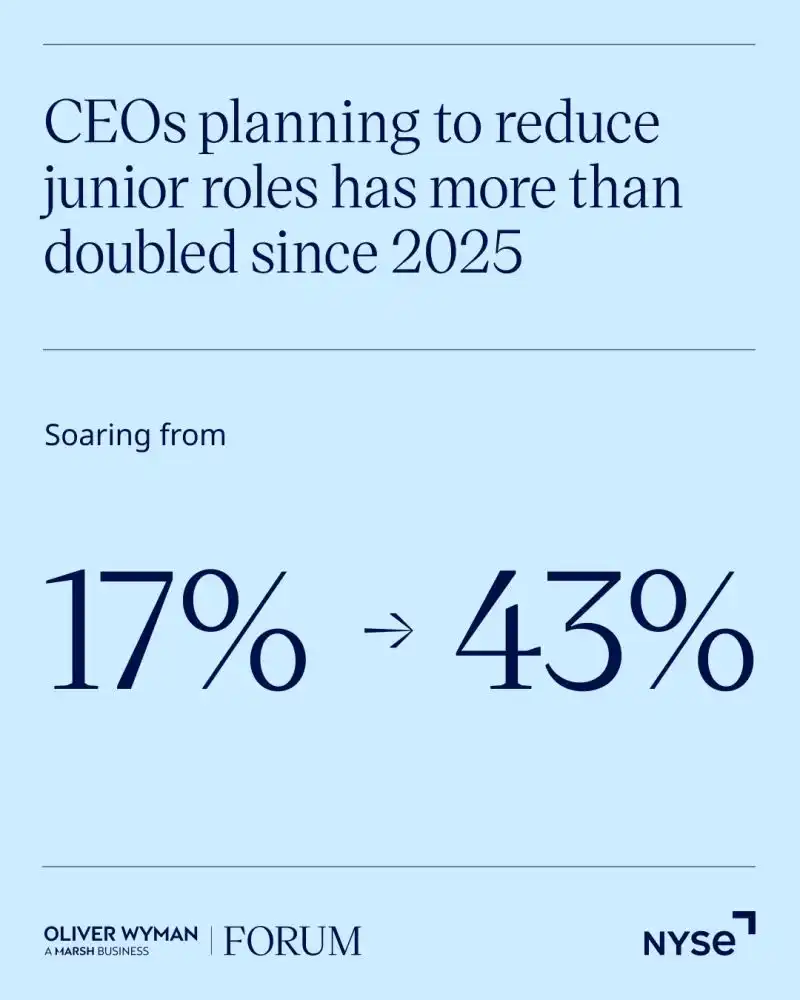
43% of CEOs Plan to Cut Junior Positions, AI's 'Experience Bias' Effect Emerges

The logic behind this shift is not hard to understand: the tasks that AI agents are currently capable of performing are highly concentrated in the typical scope of work for junior employees. Writing code, evaluating sales leads, reviewing documents, compiling data reports—these routine cognitive tasks previously handled by junior staff are being rapidly replaced by AI systems.

However, what AI currently cannot replicate is the judgment formed through years of industry experience. Future of work advisor Ravin Jesuthasan told Bloomberg that the corporate attitude is shifting to "I need someone who has actually done this, because her experience, judgment, and problem-solving ability make her more valuable than the AI."

This phenomenon has data support in academia. A paper by Harvard University researchers Seyed M. Hosseini and Guy Lichtinger analyzed resume and hiring data covering 62 million employees and 285,000 US companies. The results show that since early 2023, among companies actively adopting generative AI, the number of junior employees decreased by 7.7% over six quarters compared to non-adopting firms, while the number of senior employees was largely unaffected. A key finding is that this decline primarily stems from a hiring slowdown, not large-scale layoffs. In other words, they are not firing people, but simply not hiring them.
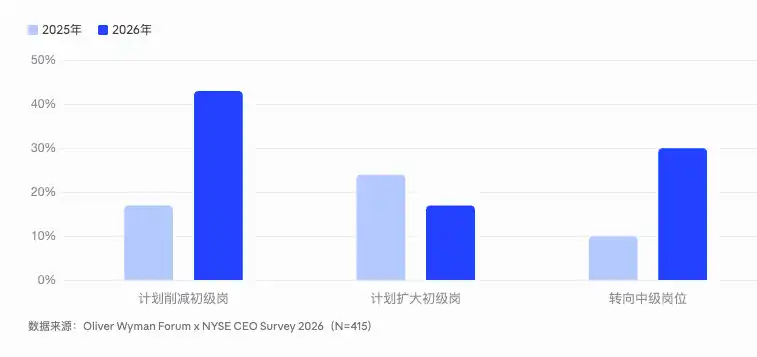
The Oliver Wyman report states the implication of this trend more bluntly: "CEOs with the longest planning horizons are the most likely to plan for headcount reductions. This suggests they anticipate that organizations will become leaner, enhanced by AI, not as a cost-cutting measure, but as an end-state."

Goldman Sachs Estimates: AI Net Eliminates 16,000 US Jobs Monthly, Generation Z Bears the Brunt

Goldman Sachs economist Elsie Peng estimated in an April research report that the AI substitution effect eliminated about 25,000 jobs per month over the past year, while the AI augmentation effect created about 9,000 jobs per month in the same period, resulting in a net elimination of about 16,000 jobs. Frontierbeat

The impact is highly unevenly distributed. In occupations with the highest exposure to AI substitution, the unemployment rate gap between entry-level workers under 30 and experienced workers aged 31 to 50 has widened significantly compared to pre-pandemic levels. The wage gap has also worsened concurrently; Goldman's regression analysis estimates that for every one standard deviation increase in AI substitution exposure, the wage gap between entry-level and experienced workers widens by approximately 3.3 percentage points. Fortune

Generation Z is disproportionately concentrated in routine white-collar roles such as data entry, customer service, legal support, and billing processing—precisely the areas AI is most adept at automating. They lack the experiential buffer that senior employees possess. Fortune

A Stanford University study from last November further confirms this: in fields with the highest AI exposure, young employees are 16% more likely to be unemployed than other groups. Fortune

Long-Term Risks of a Broken Talent Pipeline

While cutting junior positions can lower costs and improve efficiency in the short term, the hidden costs are raising alarms.

Helen Leis, Global Head of Leadership and Change at Oliver Wyman, pointed out to Bloomberg that if companies want to have mid- to senior-level talent to manage AI-driven workflows in the future, "these people need to first learn the job within the company." Not hiring junior employees is akin to cutting off one's own talent pipeline.

Andrew McAfee, co-director of MIT's Initiative on the Digital Economy, previously expressed similar concerns to the Harvard Business Review: "Other than on-the-job learning and apprenticeship training, how are people supposed to learn how to do a job?"

Monster survey data shows that nearly 90% of the class of 2026 are worried that AI or automation will replace entry-level positions, a sharp rise from 64% in 2025. Fortune

These concerns are not unfounded. According to a SignalFire report, from 2023 to 2024, the hiring volume for junior positions at the 15 largest US tech companies fell by 25%. The situation in the UK is more severe, with graduate roles in the tech sector decreasing by 46% in 2024, projected to drop another 53% by 2026. IEEE SpectrumRezi

A Few Companies Go Against the Grain: AI 'Winners' Actually Value Junior Employees More

Interestingly, companies most successful in AI deployment are adopting a different talent strategy.

The Oliver Wyman report points out that "a cohort of contrarian, advanced AI adopters believe this technology is increasing the value of junior talent, not displacing them." Among companies with higher ROI from AI investments, the proportion leaning towards increasing junior positions is higher than among those not yet seeing returns.

IBM announced in February this year its plan to triple its hiring of US junior positions and rewrite job descriptions for the AI era. Salesforce CEO Marc Benioff announced this week the hiring of 1,000 recent graduates and interns to build its AI systems, writing on platform X: "They say AI will kill junior jobs. But these grads & interns are BUILDING AI." Amazon Web Services CEO Matt Garman publicly stated that replacing junior employees with AI is "one of the dumbest decisions a company can make," reasoning that junior employees are often the most proficient users of AI tools.

However, these cases remain the minority in the overall trend. The Oliver Wyman survey shows that 74% of CEOs are freezing or reducing headcount, up from 67% last year. The most aggressive cuts are happening in the technology, media, and telecom industries.

AI's ROI Dilemma: Most Companies Still in the 'Money-Burning Experimentation' Stage

There is a significant gap between CEOs' confidence in AI's ability to change workforce structures and the actual returns AI is delivering.

The Oliver Wyman survey reveals that 67% of corporate AI deployments remain in the planning and pilot stages. 53% of CEOs say it is too early to assess AI investment returns, a figure that has increased from 41% last year. Only 27% of CEOs report that AI investment returns meet or exceed expectations, down from 38% last year. Nearly a quarter say AI has had no impact on revenue whatsoever.

The report describes this as "not a crisis of confidence, but a recognition that redesigning work at scale is slower and more difficult than initial enthusiasm anticipated."

However, the report also notes that companies deploying AI across more than two application areas report cost savings and revenue growth roughly double that of companies with single-scenario deployments. The value curve for AI is non-linear, with real returns concentrated after scaled deployment.

A statement by economist Teresa Ghilarducci of The New School to Bloomberg perhaps sums up the current situation: Even if AI tilts the workplace balance in favor of experienced employees, it does not mean they have gained job security. "Companies are increasingly less committed to their employees."


Пов'язані питання

QAccording to the Oliver Wyman survey, what is the key change in CEO hiring plans for junior positions?

AOver 40% of CEOs plan to reduce junior positions over the next one to two years, shifting their workforce structure towards more mid- to senior-level talent. This figure has more than doubled from 17% the previous year, representing a significant reversal in hiring strategy.

QWhat is the 'seniority bias' effect of AI on the workforce mentioned in the article?

AThe 'seniority bias' effect refers to the trend where AI is systematically automating routine, cognitive tasks typically performed by junior employees (e.g., coding, document review, data reporting). Meanwhile, senior employees, whose value lies in experience, judgment, and complex problem-solving abilities that AI cannot yet replicate, are becoming more valuable and less likely to be replaced.

QWhat does the Goldman Sachs research cited in the article say about AI's net impact on US jobs?

AGoldman Sachs economists estimate that AI is currently displacing about 25,000 US jobs per month while simultaneously creating around 9,000 new ones. This results in a net loss of approximately 16,000 jobs per month, with Generation Z workers being disproportionately affected.

QWhat long-term risk does cutting junior positions pose to companies, according to experts in the article?

ACutting junior positions risks severing a company's talent pipeline. Experts warn that future mid- and senior-level leaders, who will need to manage AI-driven workflows, must first learn the business from within the company. By not hiring and training junior employees, companies are undermining their own long-term succession planning and leadership development.

QHow do the most successful AI-adopting companies differ in their approach to hiring junior staff, according to the article?

AA minority of successful, advanced AI adopters are taking a counter-trend approach. Companies like IBM, Salesforce, and Amazon Web Services are expanding hiring for junior roles. They view AI as a tool that enhances the value of junior talent (who often become skilled AI users) rather than simply replacing them, and they are actively recruiting graduates to help build and work with AI systems.

Пов'язані матеріали

Why Not Short Even When Bearish? Munger Did the Math on a 'Losing Trade'

Why Not Short Even When Bearish? Charlie Munger's Calculated "Loss-Making Account" Many traders, drawn to speculative tools like futures contracts, often face repeated failures. As the article notes, unless one is a genius, such instruments should be avoided for long-term profit-seeking. Similarly, the practice of short selling is viewed with caution. The author firmly states a policy of not shorting, even when bearish, preferring to simply wait. The core reason? Successful short selling requires exceptionally difficult conditions to profit. Legendary investors Warren Buffett and Charlie Munger have themselves reflected on painful short-selling experiences. Munger highlights two critical flaws in the mathematical logic of shorting: 1. Asymmetrical Risk/Reward: A long position has a maximum loss of 100% but unlimited upside. A short position caps profit at 100% (if a stock falls to zero) but carries theoretically unlimited loss potential. 2. The "Promoter" Problem: Fraudulent or struggling companies can prolong their decline. As Munger said, "You can run out of money before the promoter runs out of ideas," meaning short sellers may be forced to cover positions at a loss before the company's true fate unfolds. The article cites Stanley Druckenmiller, a famed hedge fund manager. He once shorted 12 companies that all eventually went bankrupt. However, intense market rallies forced him to cover his positions within three weeks, resulting in massive losses—$200 million of his capital plus an additional $600 million. He concluded he likely never made money shorting in his career. His experience perfectly illustrates Munger's points: facing unlimited losses and being wiped out before being proven right. The conclusion is clear: for most investors, complex instruments like short selling and derivatives are not viable paths to stable, long-term gains. Self-reflection is advised before repeatedly wasting time and capital on such speculative strategies.

marsbit1 хв тому

Why Not Short Even When Bearish? Munger Did the Math on a 'Losing Trade'

marsbit1 хв тому

For Hedging, Buy Gold and Oil; For Explosive Growth, Buy AI; Bitcoin, the 'Outdated' Asset, Enters a Bear Market

Bitcoin’s price has recently fallen sharply, hitting a two-month low near $66,000, with Ethereum also dropping to a three-month low. While surface explanations point to ETF outflows, geopolitical tensions, and corporate selling, a deeper issue is emerging: Bitcoin is losing a crucial asset competition. For years, Bitcoin thrived in a low-rate environment where investors sought alternatives amid inflation fears and dissatisfaction with traditional options. Now, the market landscape has shifted, leaving Bitcoin stuck in an "awkward middle ground," facing challenges on three fronts: 1. **As an inflation hedge, gold is winning.** Investors worried about persistent inflation are turning to tangible assets like gold, energy stocks, and commodity producers, which offer more direct pricing power and physical backing. 2. **For growth exposure, AI is winning.** Those seeking high growth now favor AI-related companies with actual revenues and profits, an area where Bitcoin's lack of cash flow puts it at a disadvantage. 3. **Within crypto, infrastructure and stablecoins are winning.** Even investors wanting crypto exposure have alternatives like exchanges, stablecoin issuers, and tokenization firms, whose performance is directly tied to real-world adoption and offers clearer operational leverage. The recent market reaction to inflation warnings highlights this shift. Instead of boosting Bitcoin as "digital gold," such news now drives flows toward traditional inflation-sensitive assets. Therefore, recent events like ETF outflows and corporate selling are seen not as causes, but as symptoms of this new reality. Capital has more compelling options, and investors are becoming more selective. The emerging bear case for Bitcoin is no longer about it being a fraud or failed technology, but rather that **scarcity alone is no longer enough**. It is no longer seen as the best hedge, the best growth asset, or the only crypto play.

marsbit17 хв тому

For Hedging, Buy Gold and Oil; For Explosive Growth, Buy AI; Bitcoin, the 'Outdated' Asset, Enters a Bear Market

marsbit17 хв тому

SaaS Battle Royale: The Survivors Who Win All Share One Common Trait

**Summary** The AI revolution has triggered a "SaaS apocalypse," forcing a brutal market shakeout. The key dividing line is the pricing model. Companies like Snowflake and Datadog, which charge based on consumption (e.g., data processed or compute used), are thriving. AI workloads actively *generate* more demand for their services, fueling growth. Datadog's accelerating revenue is a prime example. Microsoft and Palantir, as platform/ecosystem players, also benefit by acting as essential channels for AI deployment. In contrast, traditional SaaS firms built on per-seat or per-task licensing (e.g., Intuit, Adobe) face direct pressure, as AI threatens to automate the very human tasks their software supports. Companies like Salesforce, a per-seat giant, are caught in the middle. While showing strong AI monetization (e.g., its Agentforce platform) and experimenting with consumption-based "Flex Credits," its stock remains under pressure, illustrating that the market rewards *completed* transitions, not just the intent. The recent Microsoft Build conference underscored key trends: AI is evolving from an assistant to an autonomous "agent," and platform providers like Microsoft are consolidating their control. The market's recovery is highly selective, focused on identifying which companies are "fed by AI" versus "eaten by AI." Future focus will be on the diffusion of this recovery to transforming companies and the real-world adoption data of AI agents like Microsoft Copilot.

marsbit34 хв тому

SaaS Battle Royale: The Survivors Who Win All Share One Common Trait

marsbit34 хв тому

Торгівля

Спот
Ф'ючерси

Популярні статті

Як купити PEOPLE

Ласкаво просимо до HTX.com! Ми зробили покупку ConstitutionDAO (PEOPLE) простою та зручною. Дотримуйтесь нашої покрокової інструкції, щоб розпочати свою криптовалютну подорож.Крок 1: Створіть обліковий запис на HTXВикористовуйте свою електронну пошту або номер телефону, щоб зареєструвати обліковий запис на HTX безплатно. Пройдіть безпроблемну реєстрацію й отримайте доступ до всіх функцій.ЗареєструватисьКрок 2: Перейдіть до розділу Купити крипту і виберіть спосіб оплатиКредитна/дебетова картка: використовуйте вашу картку Visa або Mastercard, щоб миттєво купити ConstitutionDAO (PEOPLE).Баланс: використовуйте кошти з балансу вашого рахунку HTX для безперешкодної торгівлі.Треті особи: ми додали популярні способи оплати, такі як Google Pay та Apple Pay, щоб підвищити зручність.P2P: Торгуйте безпосередньо з іншими користувачами на HTX.Позабіржова торгівля (OTC): ми пропонуємо індивідуальні послуги та конкурентні обмінні курси для трейдерів.Крок 3: Зберігайте свої ConstitutionDAO (PEOPLE)Після придбання ConstitutionDAO (PEOPLE) збережіть його у своєму обліковому записі на HTX. Крім того, ви можете відправити його в інше місце за допомогою блокчейн-переказу або використовувати його для торгівлі іншими криптовалютами.Крок 4: Торгівля ConstitutionDAO (PEOPLE)Легко торгуйте ConstitutionDAO (PEOPLE) на спотовому ринку HTX. Просто увійдіть до свого облікового запису, виберіть торгову пару, укладайте угоди та спостерігайте за ними в режимі реального часу. Ми пропонуємо зручний досвід як для початківців, так і для досвідчених трейдерів.

467 переглядів усьогоОпубліковано 2024.12.12Оновлено 2026.06.02

Як купити PEOPLE

Обговорення

Ласкаво просимо до спільноти HTX. Тут ви можете бути в курсі останніх подій розвитку платформи та отримати доступ до професійної ринкової інформації. Нижче представлені думки користувачів щодо ціни PEOPLE (PEOPLE).

活动图片












