AI at a Crossroads: Why Wall Street is Saying "No" to ChatGPT and Claude?

链捕手Опубліковано о 2026-07-13Востаннє оновлено о 2026-07-13

Анотація

The article "AI at a Crossroads: Why Wall Street Says 'No' to ChatGPT and Claude" explores the growing tension between the adoption of powerful, closed-source AI models and the imperative for data privacy and intellectual property (IP) protection in enterprises, particularly in high-stakes sectors like finance. It details how the fundamental architecture of services like OpenAI and Anthropic involves sending user data in plaintext to the vendors' servers, creating risks of IP leakage ("alpha transfer"). While enterprise contracts with "zero-data-retention" clauses offer some assurance, they rely on trust. A significant problem is "shadow AI," where employees use personal accounts, bypassing corporate policies and leading to data breaches. For consumers, the article highlights that AI conversations lack legal protections like attorney-client privilege and can be subpoenaed in legal cases, a fact many users are unaware of. The core of the piece analyzes the technical spectrum of privacy solutions, contrasting **protocol-level privacy** (contracts, anonymous proxies) with more robust **structural-level privacy**. The latter includes: * **TEEs (Trusted Execution Environments) / Confidential Computing:** Running models in hardware-sealed enclaves with remote attestation. * **End-to-End Encryption (E2EE):** Encrypting prompts so only the target enclave can read them. * **Fully Homomorphic Encryption (FHE):** Performing computations on encrypted data without decryption (cur...

Author: Jeff @IOSG


Why Private AI is Needed

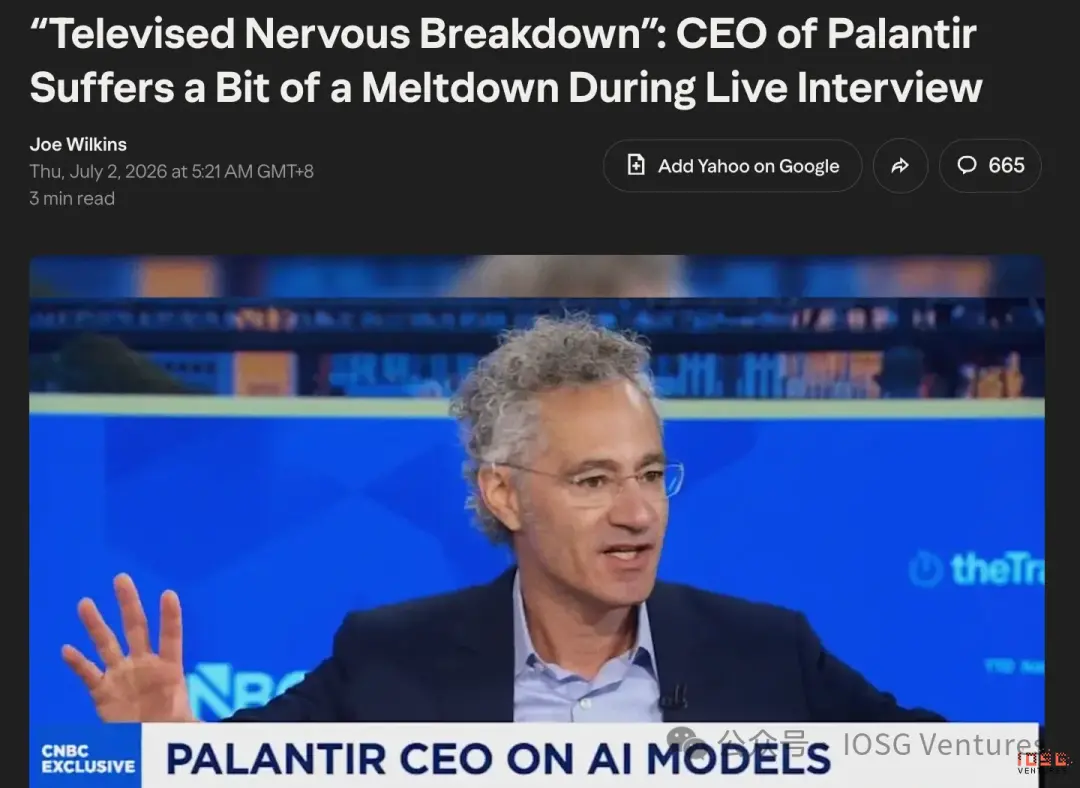
On July 1st, Palantir CEO Alex Karp gave a 20-minute interview on CNBC, which some media described as "a mental breakdown." According to Karp, enterprises are paying a token premium to frontier labs while watching their own IP flow to the model providers. He called this leakage a transfer of alpha, occurring at the architectural layer: every request sent to a closed-source model arrives in plaintext on the service provider's servers. Just days before the broadcast, Palantir announced a partnership with NVIDIA to run the open-source Nemotron model in a customer-controlled environment, accompanied by a nine-point AI sovereignty declaration. PLTR's stock jumped 8% after the CNBC segment aired.
For the past two decades, enterprises adopted cloud software based on trust at the protocol level, and it worked. Each SaaS vendor saw only a slice of enterprise data, and most had little incentive to use customer data to enhance their core products. Salesforce saw sales pipelines, Workday saw personnel, Jira saw development iterations, and AWS provided the storage and compute foundation. Today's AI workflows, however, advocate uploading the entire corpus, along with structured context linking all departments, to maximize productivity. Regardless of intent, upstream providers can now use this data for new features rather than letting it sit idle on servers.

No one is slowing down. Anthropic's annualized revenue reached $47 billion in May, a significant jump from $9 billion at the end of 2025. OpenAI surpassed 900 million weekly active users in February. Both companies completed new funding rounds this spring, with valuations nearing $1 trillion and expected to IPO at even higher market caps. Years of privacy and IP allegations have not dented their momentum.

Some enterprises acted long ago. By February 2023, less than three months after ChatGPT's release, major Wall Street banks had restricted its use. In May 2023, after Samsung engineers leaked chip source code into ChatGPT, the company banned generative AI across its network. In response, OpenAI launched ChatGPT Enterprise in August 2023, promising not to use business data for training and offering a zero-data-retention (ZDR) agreement, which later became a standard requirement for enterprise procurement.

But contracts only lock down corporate accounts. IBM found that by 2025, shadow AI (employees feeding company data into unauthorized AI tools via personal accounts) was involved in one-fifth of data breaches, with heavy shadow AI use adding an average of $670,000 to breach costs. In a 2025 survey by security training company Anagram, 40% of employees said they were willing to violate AI usage policies to complete tasks faster.

Enterprises can at least buy their way out with ZDR contracts, non-training service tiers, and sovereign deployments for governments or Palantir's clients. For ordinary users like us, the debate over whether private AI matters continues—until a court subpoena arrives.

In May 2025, a court order forced OpenAI to retain even deleted consumer chats. In November, a judge ordered 20 million of those records to be handed over to *The New York Times*'s lawyers as evidence. Then came criminal cases: ChatGPT records of a defendant in the Palisades arson case entered evidence, and an affidavit for a Florida double homicide cited a suspect's queries about body disposal. In a July 2025 interview, Sam Altman also acknowledged that ChatGPT conversations are not protected by legal privilege, and OpenAI "could be compelled to hand over" user chat logs in litigation.

The point isn't that only criminals need private conversations. The fact that people's AI conversations are logged and subpoenable is a surveillance surface most users don't know exists. A Kolmogorov Law survey of 1,000 U.S. AI users in October 2025 found that 50% didn't know these conversations could be subpoenaed, while two-thirds believed such chats should receive protections equal to consulting a lawyer or doctor.

Self-hosted or open-source models running in verifiable environments are catching up fast, but the strongest ones still lag the frontier closed-source models by about 4 months in general capability. This puts token-maximizing enterprises and individuals at a crossroads: either forfeit a few months of model quality for privacy, or continue sending sensitive material to Anthropic's servers because that's what competitors are doing to seize productivity advantages.
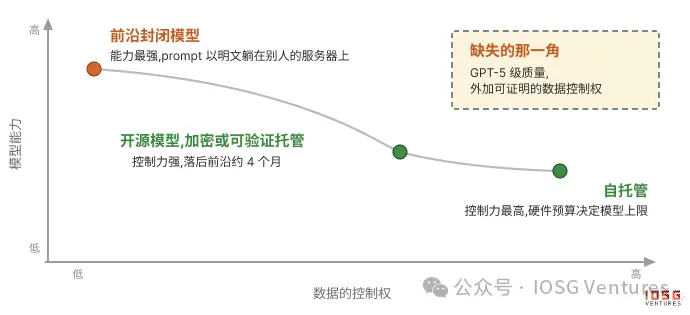
Currently, there is no perfect solution. This report examines attempts to bridge the gap, observing how far frontier intelligence with provable privacy is from being delivered to enterprises and ordinary users.

How Privacy is Currently Achieved

Private AI is not a single engineering feat, but each mechanism in the market today addresses the same event: a prompt leaves your device, travels over the network, lands on a machine running a model, and a response returns. The differences lie in where plaintext exists on this path, who can read it there, and what verifies the privacy of the response.

Protocol-Level Privacy

At this layer, someone other than you reads your plaintext prompt. What happens next relies entirely on a promise.
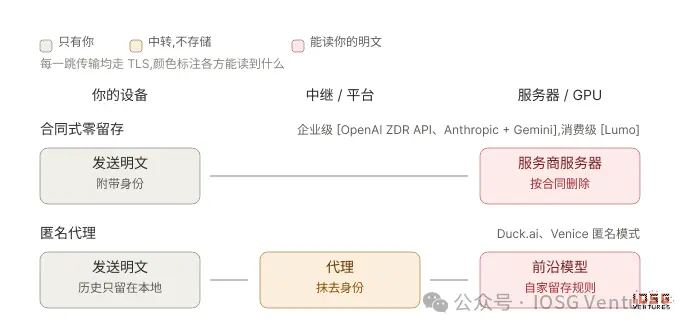
  • Contractual Zero-Retention is the enterprise version. The service provider knows who you are, processes your prompt, and promises not to retain it, enforced by contract and reputation.

  • Anonymous Proxy erases who you are but does not encrypt what you say; the downstream provider still handles plaintext per their own policy. Terms vary: proxies like Duck.ai (DuckDuckGo's chatbot) negotiate deletion agreements with model providers, while Venice advises users to assume providers keep everything. Neither side can verify.

Every segment of the machine-to-machine path runs over TLS, which only encrypts the pipe; the receiving party can read all information. Relays typically use Oblivious HTTP (RFC 9458) to split this knowledge, like asking a friend to pass a note. The friend knows who passed it but can't read the content; the recipient can read the content but doesn't know who wrote it. OHTTP became an IETF standard in January 2024, and many companies now run production traffic over OHTTP relays rented from Cloudflare and Fastly.

This is also the privacy ceiling for accessing closed-source models, due to a matter of arithmetic. A single flagship training run now costs billions of dollars, and these labs' near-trillion-dollar valuations hinge on exclusive ownership of model weights. The duration of the capability gap sustains the premium, so labs guard the weight files like state secrets.

Meta has already unwittingly conducted this experiment. The LLaMA model released in February 2023 was initially available only to researchers, but within a week, its weights were leaked as a torrent on 4chan. Another week later, llama.cpp allowed the smallest 7B model to run locally on a MacBook. Three days after that, Stanford fine-tuned a chat assistant, Alpaca, on the same model for under $600. This leak brought the cost of running Llama down to electricity; anyone with the file could run it at home. In July 2023, Meta officially open-sourced Llama 2 under a commercial license with a 700-million-monthly-active-user exclusion clause. The weights leaked, and the premium followed.

Frontier labs could theoretically provide attestation (remote attestation) for closed-source model inference, but attestation can only prove which piece of code read the prompt, not what that code did with it. To determine if the server retained data, we would need to audit the serving code and reconstruct it to the hash reported by the hardware. But once the serving code is handed over, the lab also surrenders the batching and caching techniques underpinning its profit margins—techniques that will migrate to every future model generation. Apple and Meta can provide remote attestation for the service stacks behind iPhone and WhatsApp because their profits come from devices and ads; revealing the service code costs them almost nothing.

This is why flagship model weights and serving code don't reach external operators. Without external operators, there is no third-party attestation; without attestation, verifiable privacy only exists for open-source models.

Structural-Level Privacy

Each mechanism in this category replaces trust promises with proofs based on hardware, cryptography, or physics. However, each pays a different price for the privacy upgrade, the primary one being that they can only run open-source models.
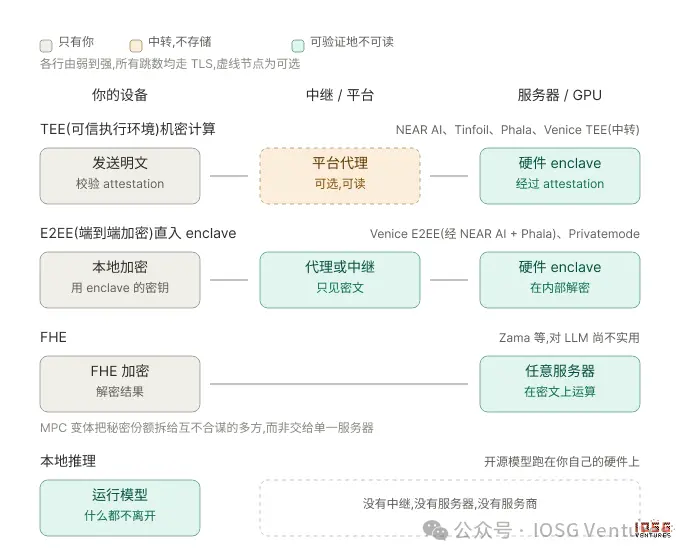
  • TEE (Trusted Execution Environment) Confidential Computing runs inference inside a hardware enclave (a sealed compartment on the chip that even the machine operator cannot open). The chip signs an attestation stating exactly which model and which code were run.

  • The prompt is only sealed at the destination. On the path relayed by the platform proxy, there remains a party that can read plaintext, and what prevents the proxy from logging or leaking the relayed content is only the protocol.
  • E2EE (End-to-End Encryption) seals the readable relay. The user's device encrypts the prompt using the enclave's key; every hop in between carries a sealed envelope only the enclave can open.

  • Trust is placed in the client. The code responsible for encrypting the prompt and verifying the attestation also has the power to revoke this guarantee. Therefore, verifiable E2EE requires both a proven enclave and open, reproducible client code.

  • Compared to TEE's simplicity, E2EE's cost is engineering overhead, which slows feature integration. E2EE turns the proxy into a blind messenger, so all features that rely on reading plaintext must be rebuilt around the client key or reconstructed solely within the enclave.

  • FHE (Fully Homomorphic Encryption, and MPC variants) removes the trusted party entirely. The server performs computations on ciphertext within a locked box it can never open; the key stays with you. MPC (Multi-Party Computation) splits the prompt into secret shares distributed among multiple parties; unless all participants collude, the effect is the same.

  • The cost is speed. FHE natively only performs addition and multiplication, so the non-linear steps required for transformer operation must be rebuilt at high cost. Inference on ciphertext is 10,000 to 100,000 times more expensive than on plaintext, taking seconds to minutes per token for small models, compared to milliseconds unencrypted.

  • Chips customized for encrypted operations promise to narrow the gap, but the first prototype was demoed only in early 2026, with commercial versions still years away.

  • Local Inference removes the path entirely. The model runs on your own hardware. No relay, no server, no service provider, and no verification needed.

  • The obvious costs are expense and model capability. gpt-oss-120b scores about half of GLM-5.2 on the Artificial Analysis index but is 65GB in size, exceeding the combined VRAM of two flagship gaming graphics cards. The full-precision GLM-5.2 can only run on 8-card data center nodes, with GPUs alone costing over $300,000.

Beyond these structural limitations, the cost of putting inference into an enclave is shrinking. For single-card inference, benchmarks from enclave cloud provider Phala show that enclave-mode H100 throughput loss averages less than 7%, and approaches zero for large models because the main cost is moving data onto the chip, not computing within it. For multi-card inference, NVIDIA's new Blackwell GPU supports direct encryption of inter-chip traffic, whereas older H100s can only achieve the same effect by routing through the CPU host at one-seventh the bandwidth. NVIDIA's own benchmarks on Blackwell show less than 8% throughput loss for a 397B model in enclave mode. With these advancements, the performance penalty of private inference itself is no longer a decisive constraint.

In fact, the enclave itself adds almost no extra operating cost for the provider. Every H100 shipped since 2023 has enclave mode built-in; the extra cost is the throughput loss from encryption, not additional chips. Currently, confidential H100 SKUs on Azure rent for $8.90 per hour, compared to $6.98 without enclave, a 27% premium over traditional cloud infrastructure. On the other hand, specialized enclave providers like Phala rent confidential-mode H100s starting at $3.80 per hour, lower than Lambda's price range of $3.99 to $4.29 for regular SXM cards. For managed API solutions, NEAR AI offers gpt-oss-120b endpoints with attestation at $0.15 per million input tokens and $0.55 per million output tokens, on par with plaintext routes from Amazon Bedrock, Together, and Groq. Even for models requiring multiple chips, NEAR AI's pricing for GLM 5.2 matches Fireworks exactly and is 15% cheaper for input and 4% cheaper for output on the larger Kimi K2.6.

While these new private inference providers may be burning profits to gain market share (a statement that holds for any company seeking growth), the structural trend is that the cost of privacy is decreasing for both consumers and operators.

How Can Open-Source Models Win?

Despite shrinking performance overhead, a visible gap remains between frontier models and SOTA open-source models. An entity pursuing maximum productivity must still trust frontier labs not to steal its IP to stay in the top tier.

The gap persists, but Bridgewater's AIA Labs and Thinking Machines presented a case on June 30: an open model fine-tuned with expert annotations beat frontier models in both accuracy and cost.

In the study, the team fine-tuned Qwen3-235B on Tinker (Thinking Machines' managed fine-tuning API service). They first sourced annotations from vendors, used that data for initial training, then sent disputed samples to the firm's investment professionals for re-labeling. Training used reinforcement learning (GRPO) with three modifications: round-robin batching (each task takes turns providing a batch), CISPO loss (limiting how far a single answer can shift the model), and on-policy distillation (anchoring to the current best checkpoint to prevent the model from learning from weaker copies).

Tasks were all from investment professionals' daily workflows: determining if a news article was important for C-suite investment professionals, if a central bank document hinted at future interest rate changes, and where templated language began in a document or email. Scores came from an independent test set. Frontier models averaged about 50% with simple prompts and only reached 78.2% with expert prompts, below the 80% threshold set by investment professionals. The fine-tuned Qwen achieved 84.7%, which, per the original wording, means making 29.8% fewer errors than the frontier best, at 13.8x lower inference cost.
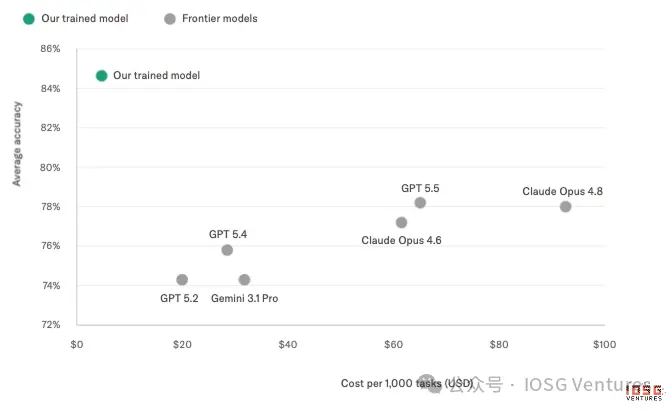
https://thinkingmachines.ai/news/learning-to-replicate-expert-judgment-in-financial-tasks/

This case proves open-source models can win in accuracy and cost, but the training process was still not private. The expert annotations used were Bridgewater's private data, passing through Tinker's third-party service, residing at the same trust level as ZDR agreements. The fund also rented compute; the entire training ran on machines it never controlled. Buyers wanting this recipe without trust assumptions have few choices today. Renting bare GPU clusters leaves the training process readable to the cloud operator. Buying the cluster solves data hosting but sends costs skyrocketing.

Routes with attestation have just arrived. In March, Workshop Labs and Tinfoil released Silo, a post-training stack running in Tinfoil enclaves on a single 8-card node, with keys controlled only by the customer. The article states the enclave cost adds 11 minutes to a two-hour training run, and by freezing base weights and training only small adapters on top, the stack can accommodate a trillion-parameter model (Kimi K2 Thinking). The challenge is that reinforcement learning requires moving data back and forth between components, precisely where enclave costs lie.

Less than a month after Silo's release, Workshop Labs was acquired by Thinking Machines. The components needed to run the next Bridgewater-style RL loop within an enclave are now under the same roof.

Privacy at the Harness Layer

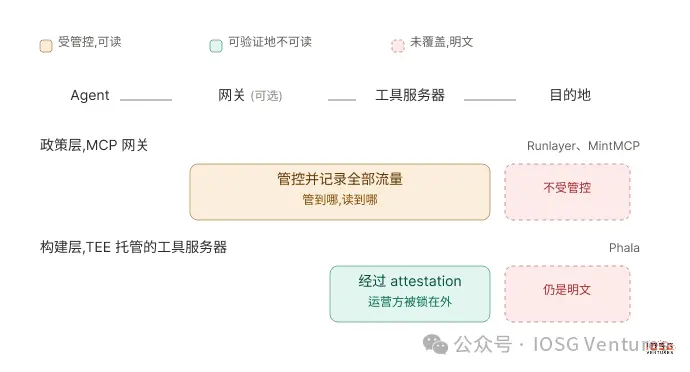
Another problem exists outside all private inference mechanisms. These mechanisms manage the path from prompt to model, but every external tool call initiated by an agent opens a path the inference layer cannot touch. The recent harness engineering trend magnifies the problem: every tool, memory store, and data source connected to the model is another destination that reads its slice of the workflow in plaintext. The calendar server reads schedules, the database server reads queries. A fully local agent needing anything outside its training set must still send search terms in plaintext to a search engine; the server cannot answer without reading the plaintext.

Mainstream solutions still default to the protocol layer. Companies like Runlayer and MintMCP use a central gateway to manage all tool traffic, stripping personally identifiable information (PII) before requests leave. The gateway also decides which servers receive traffic, blocking unvetted ones, and logs each call's destination and content for forensics. Even with independent audits (SOC 2), the tool server must still read the plaintext query to respond; whether it retains a copy depends on its own retention terms, multiplied by every tool in the harness. Furthermore, the gateway itself is an additional trust-dependent reader on the path, not a verification.

Structural solutions target the middle layer. For example, Phala hosts MCP servers directly in TEEs, with directories covering wallets, code execution, and data sources; users can verify privacy claims via attestation rather than trusting the operator. However, TEE-hosted tools ultimately must pass queries in plaintext to the service provider; the enclave seals only the messenger, not the destination.
Only a few destinations have learned to respond without reading, but only for structured queries. Apple provides Private Information Retrieval for iPhones, allowing phone number checks against spam databases without exposing the number; Microsoft uses the same scheme for passwords in Edge. MongoDB's Queryable Encryption encrypts fields client-side before they leave, enabling the server to perform equality and range matches on ciphertext alone.

For open-ended search, today's best answer stops at trust; verifiable encrypted search hasn't left the lab. Brave promises zero data retention on its own 40-billion-page index (not Google's), but it's still at the protocol layer. Exa built a neural index that embeds user keywords into semantics, ranking results by semantic match, but the embedding step still computes from plaintext on Exa's servers. MIT's 2023 Tiptoe paper ranked results on 360 million web pages without exposing the query, but each search burned significant server compute, with ranking quality lagging unencrypted search. Apple's 2024 Wally paper hid real queries among decoys, reducing communication cost up to 31x, but this math only becomes cheap at millions of concurrent queries—a scale no private search system has today.

Encrypted search is possible; it's just that performance and price aren't commercially viable yet.

Outlook

Demand for private AI is growing. Venice AI recently surpassed 3.5 million registered users and 1.3 trillion monthly tokens, followed by a Series A equity funding round at a $1 billion valuation. Proton is a direct competitor; its chat product Lumo surpassed 10 million users within a year of launch. On the infrastructure side, Phala currently processes 2 to 3 billion tokens daily on OpenRouter. Duck.ai routes gpt-oss-120b and Gemma into Tinfoil enclaves, providing verifiable privacy beyond proxy anonymity. This doesn't even count self-hosting, likely the largest channel for private inference, as models run on one's own hardware, leaving no usage trail.

Yet within the massive wave of mainstream AI, private AI occupies only a tiny fraction, and this gap will only close if frontier labs intentionally meet this demand. In May, Google's entire product line processed 3,200 trillion tokens; by that measure, Venice's monthly throughput equals about 18 minutes of Google's. Last November, Google launched Private AI Compute (PAC), running some Gemini-powered features in sealed TPU enclaves isolated from the company itself, with the design independently audited by NCC Group. But the issue is that PAC only covers a few Pixel features like personalized recommendations and recording summaries, not the Gemini app used by hundreds of millions. Google dares to submit the design for audit because these features monetize via devices and ads, not token sales.

Current hosting solutions are also imperfect. Users seeking maximum privacy via E2EE must wait for new features to be rebuilt where the service provider can't read. Private harnesses still rely on protocols at the service layer. Affordable post-training still requires trusting third-party vendors for the best fine-tuning results. Self-hosting sheds all service providers at once, but running the strongest open-source model locally may cost more than the house it's in.

Flaws aside, private AI is already a real and affordable option, and the remaining gaps are narrowing. For ordinary consumers, private chats with open models under no-logging promises cost nothing on Lumo and Venice, while $18–$20 subscriptions from Venice or Tinfoil seal the same chat into enclaves, no more expensive than a ChatGPT subscription. For enterprise workflows, attested endpoints are now even cheaper than plaintext routes. Endpoints like NEAR's E2EE API can already bring encrypted context into enclaves; memory, file uploads, and custom instructions can now operate over E2EE. For attested post-training, NVIDIA's upcoming Vera Rubin NVL72 will expand confidential computing from Blackwell's 8-card nodes to 72-card racks, making frontier RL loops more feasible without exposing IP.

However, the crucial value capture lies beyond these layers of price compression. Privacy is nearly free where it already exists, but it hasn't covered mainstream agentic workflows. Operators focused on renting/selling enclaves hold a switch on standard chips, not a moat, while protocol-layer gateways compete with traditional middleware. The defensible ground is the half of the problem not yet solved in this report: training loops locked in enclaves, end-to-end sealed tool calls, search indexes that cannot see terms. Whoever builds one of these first sells something no price war can commoditize. Capital chasing private AI should buy the gap, not the switch.

So, trust or verify? For execution-heavy, agent-heavy tasks, choose trust, because each tool call already hands plaintext to destinations an enclave cannot seal, and frontier models deserve their price in such loops. For the high-order thinking that distinguishes a company from its competitors, choose verification. Strategy, planning, and judgment distilled from years of professional experience are precisely the alpha in dispute. The path forward is fine-tuning open-source models with these proprietary insights within company-controlled boundaries. In areas central to a company's alpha, expert-tuned open models have already beaten the frontier in both accuracy and cost, and the infrastructure to build them in privacy is arriving node by node.

Трендові криптовалюти

Пов'язані питання

QWhy are Wall Street banks and corporations increasingly saying 'no' to using models like ChatGPT and Claude, according to the article?

APrimarily due to intellectual property and data privacy concerns. The article highlights that when using closed-source AI models, every prompt is sent as plaintext to the vendor's servers, creating a risk of IP and sensitive data leakage ('alpha transfer'). This is especially critical for industries like finance and for companies whose competitive edge relies on proprietary data and strategies.

QWhat are the main approaches to achieving private AI, as outlined in the article?

AThe article categorizes private AI approaches into two main layers: 1) **Protocol-level privacy**: Relying on trust and contracts, such as Zero Data Retention (ZDR) agreements and anonymous proxies. 2) **Structural-level privacy**: Using technology to enforce privacy, including TEE (Trusted Execution Environment) confidential computing, End-to-End Encryption (E2EE), Fully Homomorphic Encryption (FHE), and local (on-premise) inference. Structural methods can only be used with open-source models.

QWhat case study does the article provide to show that open-source models can outperform frontier models?

AThe article cites a study by Bridgewater's AIA Labs and Thinking Machines. They fine-tuned the open-source model Qwen3-235B on expert-annotated financial tasks (e.g., analyzing news importance, central bank documents). The fine-tuned model achieved an 84.7% accuracy rate, surpassing the best frontier model's 78.2% (with expert prompting), while also being 13.8x cheaper in inference costs, demonstrating superior accuracy and cost-effectiveness for specialized domains.

QWhat is the 'harness layer' privacy challenge mentioned in the article, and why is it difficult to solve?

AThe 'harness layer' challenge refers to the privacy risks when AI agents interact with external tools (e.g., databases, search engines, calendars). Even if the core model inference is private, every tool call sends a plaintext query to an external server, creating new data leakage points. Solving this with structural privacy is hard because most tools need to read the plaintext query to function. Truly private, verifiable solutions for complex tasks like open-ended web search are still in the research phase and not commercially viable due to performance and cost barriers.

QWhat is the article's conclusion regarding the future and investment opportunity in private AI?

AThe article concludes that while basic private inference is becoming affordable and commoditized, the significant value and investment opportunity lie in solving the remaining, harder technical gaps. These include: 1) Private training/fine-tuning loops within enclaves, 2) End-to-end private tool/agent calls, and 3) Private search over encrypted indexes. Capital chasing private AI should focus on these unsolved problems ('the gap'), not just the enabling infrastructure ('the switch'), as solutions here will create defensible, non-commoditized value.

Пов'язані матеріали

DistributeX Unveils DX Coin Ecosystem Roadmap, Advancing Preparations for Its On-Chain Launch

DistributeX has unveiled the DX Coin Ecosystem Roadmap, detailing its preparations for the upcoming on-chain launch of DX Coin. The roadmap outlines key phases focusing on community governance, technical readiness, blockchain deployment, and ecosystem growth. Current efforts are centered on building community consensus and completing technical groundwork. This includes launching community votes to select the official DX Coin logo and decide on the preferred blockchain network for integration. The platform will also implement features like on-chain wallet binding and contribution tracking to prepare for future data synchronization and rewards. Before the official launch, DistributeX will publish a Tokenomics White Paper detailing the token's issuance, governance, and long-term strategy, and will take a snapshot of eligible community accounts for future asset allocation. The subsequent deployment phase will involve smart contract deployment, security audits, community airdrops, and developing liquidity on decentralized exchanges. Looking further ahead, planned utilities for DX Coin encompass cross-chain interoperability, decentralized governance, digital rights, staking, and other Web3 applications. This roadmap aims to provide the community with clear visibility into the platform's plans, as DistributeX works to establish a solid foundation for DX Coin's on-chain ecosystem and long-term expansion.

TheNewsCrypto1 год тому

DistributeX Unveils DX Coin Ecosystem Roadmap, Advancing Preparations for Its On-Chain Launch

TheNewsCrypto1 год тому

Торгівля

Спот

Популярні статті

Що таке GROK AI

Grok AI: Революція в розмовних технологіях ери Web3 Вступ У швидко змінюваному ландшафті штучного інтелекту Grok AI вирізняється як помітний проєкт, що поєднує сфери передових технологій та взаємодії з користувачами. Розроблений компанією xAI, яку очолює відомий підприємець Ілон Маск, Grok AI прагне переосмислити, як ми взаємодіємо зі штучним інтелектом. Оскільки рух Web3 продовжує процвітати, Grok AI має на меті використати потужність розмовного ШІ для відповіді на складні запитання, надаючи користувачам досвід, який є не лише інформативним, але й розважальним. Що таке Grok AI? Grok AI — це складний розмовний чат-бот, розроблений для динамічної взаємодії з користувачами. На відміну від багатьох традиційних систем ШІ, Grok AI охоплює ширший спектр запитів, включаючи ті, які зазвичай вважаються недоречними або виходять за межі стандартних відповідей. Основні цілі проєкту включають: Надійне міркування: Grok AI акцентує увагу на здоровому глузді, щоб надавати логічні відповіді на основі контекстуального розуміння. Масштабоване управління: Інтеграція допоміжних інструментів забезпечує моніторинг та оптимізацію взаємодій користувачів для покращення якості. Формальна верифікація: Безпека є пріоритетом; Grok AI впроваджує методи формальної верифікації для підвищення надійності своїх результатів. Розуміння довгого контексту: Модель ШІ відзначається здатністю зберігати та згадувати обширну історію розмов, що сприяє змістовним та контекстуально обізнаним дискусіям. Стійкість до атак: Зосереджуючись на покращенні своїх захистів від маніпульованих або зловмисних вхідних даних, Grok AI прагне зберегти цілісність взаємодій з користувачами. По суті, Grok AI — це не просто пристрій для отримання інформації; це занурюючий розмовний партнер, який заохочує динамічний діалог. Творець Grok AI Геній, що стоїть за Grok AI, — це ніхто інший, як Ілон Маск, особа, яка стала синонімом інновацій у різних сферах, включаючи автомобільну промисловість, космічні подорожі та технології. Під егідою xAI, компанії, що зосереджена на розвитку технологій ШІ на користь суспільства, бачення Маска прагне переосмислити розуміння взаємодій з ШІ. Лідерство та основоположна етика глибоко впливають на прагнення Маска розширити технологічні межі. Інвестори Grok AI Хоча конкретні деталі щодо інвесторів, які підтримують Grok AI, залишаються обмеженими, загальновідомо, що xAI, інкубатор проєкту, заснований і підтримується переважно самим Ілоном Маском. Попередні підприємства та активи Маска забезпечують надійну підтримку, що додатково зміцнює довіру до Grok AI та потенціал для зростання. Однак наразі інформація про додаткові інвестиційні фонди або організації, що підтримують Grok AI, не є доступною, що позначає область для потенційного майбутнього дослідження. Як працює Grok AI? Операційна механіка Grok AI є такою ж інноваційною, як і його концептуальна структура. Проєкт інтегрує кілька передових технологій, які сприяють його унікальним функціональним можливостям: Надійна інфраструктура: Grok AI побудований з використанням Kubernetes для оркестрації контейнерів, Rust для продуктивності та безпеки, і JAX для високопродуктивних числових обчислень. Ця трійка забезпечує ефективну роботу чат-бота, його масштабованість та швидке обслуговування користувачів. Доступ до знань у реальному часі: Однією з відмінних рис Grok AI є його здатність отримувати дані в реальному часі через платформу X — раніше відому як Twitter. Ця можливість надає ШІ доступ до останньої інформації, що дозволяє надавати своєчасні відповіді та рекомендації, які можуть бути пропущені іншими моделями ШІ. Два режими взаємодії: Grok AI пропонує користувачам вибір між “Розважальним режимом” та “Звичайним режимом”. Розважальний режим дозволяє більш ігровий та гумористичний стиль взаємодії, тоді як Звичайний режим зосереджується на наданні точних і правильних відповідей. Ця універсальність забезпечує індивідуальний досвід, що відповідає різним уподобанням користувачів. По суті, Grok AI поєднує продуктивність із залученням, створюючи досвід, який є одночасно збагачуючим і розважальним. Хронологія Grok AI Шлях Grok AI відзначений важливими етапами, які відображають його розвиток та етапи впровадження: Початковий розвиток: Фундаментальна фаза Grok AI тривала приблизно два місяці, протягом яких проводилося початкове навчання та налаштування моделі. Випуск бета-версії Grok-2: У значному досягненні була оголошена бета-версія Grok-2. Цей випуск представив дві версії чат-бота — Grok-2 та Grok-2 mini — кожна з яких оснащена можливостями для спілкування, кодування та міркування. Публічний доступ: Після бета-розробки Grok AI став доступним для користувачів платформи X. Ті, хто має акаунти, підтверджені номером телефону та активні принаймні сім днів, можуть отримати доступ до обмеженої версії, що робить технологію доступною для ширшої аудиторії. Ця хронологія відображає систематичний розвиток Grok AI від початку до публічної взаємодії, підкреслюючи його прагнення до постійного вдосконалення та взаємодії з користувачами. Ключові особливості Grok AI Grok AI охоплює кілька ключових особливостей, які сприяють його інноваційній ідентичності: Інтеграція знань у реальному часі: Доступ до актуальної та релевантної інформації відрізняє Grok AI від багатьох статичних моделей, забезпечуючи захоплюючий та точний досвід для користувачів. Універсальні стилі взаємодії: Пропонуючи різні режими взаємодії, Grok AI задовольняє різноманітні уподобання користувачів, запрошуючи до творчості та персоналізації у спілкуванні з ШІ. Передова технологічна основа: Використання Kubernetes, Rust та JAX надає проєкту надійну основу для забезпечення надійності та оптимальної продуктивності. Етичні міркування в дискурсі: Включення функції генерації зображень демонструє інноваційний дух проєкту. Однак це також піднімає етичні питання, пов'язані з авторським правом та поважним зображенням впізнаваних фігур — триваюча дискусія в спільноті ШІ. Висновок Як піонер у сфері розмовного ШІ, Grok AI втілює потенціал трансформаційних користувацьких досвідів в цифрову епоху. Розроблений компанією xAI та керований візією Ілона Маска, Grok AI інтегрує знання в реальному часі з передовими можливостями взаємодії. Він прагне розширити межі того, що може досягти штучний інтелект, зберігаючи при цьому акцент на етичних міркуваннях та безпеці користувачів. Grok AI не лише втілює технологічний прогрес, але й представляє нову парадигму спілкування в ландшафті Web3, обіцяючи залучити користувачів як глибокими знаннями, так і ігровою взаємодією. Оскільки проєкт продовжує розвиватися, він слугує свідченням того, що може досягти перетин технологій, творчості та людської взаємодії.

483 переглядів усьогоОпубліковано 2024.12.26Оновлено 2024.12.26

Що таке GROK AI

Що таке ERC AI

Euruka Tech: Огляд $erc ai та його амбіцій у Web3 Вступ У швидко змінюваному ландшафті технології блокчейн та децентралізованих додатків нові проекти з'являються часто, кожен з унікальними цілями та методологіями. Одним з таких проектів є Euruka Tech, який працює у широкій сфері криптовалют та Web3. Основна увага Euruka Tech, зокрема його токена $erc ai, зосереджена на представленні інноваційних рішень, розроблених для використання зростаючих можливостей децентралізованих технологій. Ця стаття має на меті надати всебічний огляд Euruka Tech, дослідження його цілей, функціональності, ідентичності його творця, потенційних інвесторів та його значення в ширшому контексті Web3. Що таке Euruka Tech, $erc ai? Euruka Tech характеризується як проект, який використовує інструменти та функціональність, що пропонуються середовищем Web3, зосереджуючи увагу на інтеграції штучного інтелекту у своїй діяльності. Хоча конкретні деталі про структуру проекту дещо неясні, він розроблений для покращення залучення користувачів та автоматизації процесів у крипто-просторі. Проект має на меті створити децентралізовану екосистему, яка не лише полегшує транзакції, але й включає прогностичні функції через штучний інтелект, звідси і назва його токена, $erc ai. Мета полягає в тому, щоб надати інтуїтивно зрозумілу платформу, яка сприяє розумнішим взаємодіям та ефективній обробці транзакцій у зростаючій сфері Web3. Хто є творцем Euruka Tech, $erc ai? На даний момент інформація про творця або засновницьку команду Euruka Tech залишається невизначеною та дещо непрозорою. Ця відсутність даних викликає занепокоєння, оскільки знання про бекграунд команди часто є важливим для встановлення довіри в секторі блокчейн. Тому ми класифікували цю інформацію як невідому, поки конкретні деталі не стануть доступними в публічному домені. Хто є інвесторами Euruka Tech, $erc ai? Аналогічно, ідентифікація інвесторів або організацій, які підтримують проект Euruka Tech, не надається через доступні дослідження. Аспект, який є критично важливим для потенційних зацікавлених сторін або користувачів, які розглядають можливість співпраці з Euruka Tech, - це впевненість, що походить від встановлених фінансових партнерств або підтримки від авторитетних інвестиційних компаній. Без розкриття інформації про інвестиційні зв'язки важко зробити всебічні висновки про фінансову безпеку або довговічність проекту. Відповідно до знайденої інформації, цей розділ також має статус невідомий. Як працює Euruka Tech, $erc ai? Незважаючи на відсутність детальних технічних специфікацій для Euruka Tech, важливо враховувати його інноваційні амбіції. Проект прагне використовувати обчислювальну потужність штучного інтелекту для автоматизації та покращення досвіду користувачів у середовищі криптовалют. Інтегруючи ШІ з технологією блокчейн, Euruka Tech має на меті надати такі функції, як автоматизовані угоди, оцінка ризиків та персоналізовані інтерфейси користувачів. Інноваційна суть Euruka Tech полягає в його меті створити безшовний зв'язок між користувачами та величезними можливостями, які пропонують децентралізовані мережі. Завдяки використанню алгоритмів машинного навчання та ШІ, він має на меті мінімізувати труднощі для нових користувачів і спростити транзакційні досвіди в рамках Web3. Ця симбіоз між ШІ та блокчейном підкреслює значення токена $erc ai, який виступає як міст між традиційними інтерфейсами користувачів та розвиненими можливостями децентралізованих технологій. Хронологія Euruka Tech, $erc ai На жаль, через обмежену інформацію про Euruka Tech ми не можемо представити детальну хронологію основних подій або досягнень у подорожі проекту. Ця хронологія, яка зазвичай є безцінною для відстеження еволюції проекту та розуміння його траєкторії зростання, наразі недоступна. Як тільки інформація про значні події, партнерства або функціональні доповнення стане очевидною, оновлення, безумовно, підвищать видимість Euruka Tech у крипто-сфері. Роз'яснення щодо інших проектів “Eureka” Варто зазначити, що кілька проектів та компаній мають схожу назву з “Eureka”. Дослідження виявило ініціативи, такі як AI-агент від NVIDIA Research, який зосереджується на навчанні роботів складним завданням за допомогою генеративних методів, а також Eureka Labs та Eureka AI, які покращують користувацький досвід в освіті та аналітиці обслуговування клієнтів відповідно. Однак ці проекти відрізняються від Euruka Tech і не повинні бути змішані з його цілями чи функціональністю. Висновок Euruka Tech, разом із його токеном $erc ai, представляє обіцяючого, але наразі невідомого гравця в ландшафті Web3. Хоча деталі про його творця та інвесторів залишаються невідомими, основна амбіція поєднання штучного інтелекту з технологією блокчейн є центром інтересу. Унікальні підходи проекту до сприяння залученню користувачів через передову автоматизацію можуть виділити його на фоні прогресу екосистеми Web3. Оскільки крипто-ринок продовжує еволюціонувати, зацікавлені сторони повинні уважно стежити за новинами, пов'язаними з Euruka Tech, оскільки розвиток задокументованих інновацій, партнерств або визначеного дорожньої карти може представити значні можливості в найближчому майбутньому. На даний момент ми чекаємо на більш суттєві інсайти, які можуть розкрити потенціал Euruka Tech та його позицію в конкурентному крипто-ландшафті.

459 переглядів усьогоОпубліковано 2025.01.02Оновлено 2025.01.02

Що таке ERC AI

Що таке DUOLINGO AI

DUOLINGO AI: Інтеграція вивчення мов з Web3 та інноваціями штучного інтелекту В епоху, коли технології змінюють освіту, інтеграція штучного інтелекту (ШІ) та блокчейн-мереж відкриває нові горизонти для вивчення мов. З'являється DUOLINGO AI та його асоційована криптовалюта, $DUOLINGO AI. Цей проект прагне об'єднати освітні можливості провідних платформ для вивчення мов з перевагами децентралізованих технологій Web3. У цій статті розглядаються ключові аспекти DUOLINGO AI, його цілі, технологічна структура, історичний розвиток та майбутній потенціал, зберігаючи чіткість між оригінальним освітнім ресурсом та цією незалежною криптовалютною ініціативою. Огляд DUOLINGO AI В основі DUOLINGO AI лежить прагнення створити децентралізоване середовище, де учні можуть отримувати криптографічні винагороди за досягнення освітніх етапів у мовній компетенції. Застосовуючи смарт-контракти, проект має на меті автоматизувати процеси перевірки навичок та розподілу токенів, дотримуючись принципів Web3, які підкреслюють прозорість та власність користувачів. Модель відрізняється від традиційних підходів до вивчення мов, акцентуючи увагу на структурі управління, що базується на спільноті, що дозволяє власникам токенів пропонувати поліпшення змісту курсів та розподілу винагород. Деякі з помітних цілей DUOLINGO AI включають: Гейміфіковане навчання: Проект інтегрує досягнення на блокчейні та невзаємозамінні токени (NFT), щоб представляти рівні мовної компетенції, сприяючи мотивації через захоплюючі цифрові винагороди. Децентралізоване створення контенту: Це відкриває можливості для викладачів та мовних ентузіастів вносити свої курси, сприяючи моделі розподілу доходів, яка вигідна всім учасникам. Персоналізація на основі ШІ: Використовуючи сучасні моделі машинного навчання, DUOLINGO AI персоналізує уроки, щоб адаптуватися до індивідуального прогресу навчання, подібно до адаптивних функцій, що є в усталених платформах. Творці проекту та управління Станом на квітень 2025 року команда, що стоїть за $DUOLINGO AI, залишається псевдонімною, що є поширеною практикою в децентралізованому криптовалютному середовищі. Ця анонімність має на меті сприяти колективному розвитку та залученню зацікавлених сторін, а не зосереджуватися на окремих розробниках. Смарт-контракт, розгорнутий на блокчейні Solana, зазначає адресу гаманця розробника, що свідчить про зобов'язання до прозорості щодо транзакцій, незважаючи на те, що особи творців залишаються невідомими. Згідно з його дорожньою картою, DUOLINGO AI прагне перетворитися на Децентралізовану Автономну Організацію (DAO). Ця структура управління дозволяє власникам токенів голосувати з важливих питань, таких як реалізація функцій та розподіл скарбниці. Ця модель узгоджується з етикою розширення прав і можливостей спільноти, що спостерігається в різних децентралізованих додатках, підкреслюючи важливість колективного прийняття рішень. Інвестори та стратегічні партнерства На даний момент немає публічно відомих інституційних інвесторів або венчурних капіталістів, пов'язаних з $DUOLINGO AI. Натомість ліквідність проекту в основному походить з децентралізованих бірж (DEX), що є різким контрастом до стратегій фінансування традиційних компаній у сфері освітніх технологій. Ця модель знизу вгору вказує на підхід, орієнтований на спільноту, що відображає зобов'язання проекту до децентралізації. У своєму білому документі DUOLINGO AI згадує про формування співпраці з неуточненими “блокчейн-освітніми платформами”, спрямованими на збагачення своїх курсів. Хоча конкретні партнерства ще не були розкриті, ці спільні зусилля натякають на стратегію поєднання інновацій блокчейну з освітніми ініціативами, розширюючи доступ та залучення користувачів у різноманітні навчальні напрямки. Технологічна архітектура Інтеграція ШІ DUOLINGO AI включає два основні компоненти на основі ШІ для покращення своїх освітніх пропозицій: Адаптивний навчальний двигун: Цей складний двигун навчається на основі взаємодій користувачів, подібно до власних моделей великих освітніх платформ. Він динамічно регулює складність уроків, щоб вирішувати конкретні проблеми учнів, зміцнюючи слабкі місця через цілеспрямовані вправи. Розмовні агенти: Використовуючи чат-боти на базі GPT-4, DUOLINGO AI надає платформу для користувачів, щоб брати участь у симульованих розмовах, сприяючи більш інтерактивному та практичному досвіду вивчення мови. Інфраструктура блокчейну Побудований на блокчейні Solana, $DUOLINGO AI використовує комплексну технологічну структуру, яка включає: Смарт-контракти для перевірки навичок: Ця функція автоматично нагороджує токенами користувачів, які успішно проходять тести на компетентність, підкріплюючи структуру стимулів для справжніх навчальних результатів. NFT значки: Ці цифрові токени позначають різні етапи, яких досягають учні, такі як завершення розділу курсу або оволодіння конкретними навичками, що дозволяє їм обмінюватися або демонструвати свої досягнення в цифровому форматі. Управління DAO: Члени спільноти, наділені токенами, можуть брати участь в управлінні, голосуючи за ключові пропозиції, що сприяє культурі участі, яка заохочує інновації в курсах та функціях платформи. Історичний хронологічний графік 2022–2023: Концептуалізація Основи DUOLINGO AI закладаються з створення білого документа, що підкреслює синергію між досягненнями ШІ у вивченні мов та децентралізованим потенціалом блокчейн-технологій. 2024: Бета-реліз Обмежений бета-реліз представляє пропозиції з популярних мов, винагороджуючи ранніх користувачів токенами в рамках стратегії залучення спільноти проекту. 2025: Перехід до DAO У квітні відбувається повний запуск основної мережі з обігом токенів, що спонукає обговорення в спільноті щодо можливих розширень на азійські мови та інші розробки курсів. Виклики та майбутні напрямки Технічні труднощі Незважаючи на свої амбітні цілі, DUOLINGO AI стикається з суттєвими викликами. Масштабованість залишається постійною проблемою, особливо в балансуванні витрат, пов'язаних із обробкою ШІ, та підтриманням чутливої, децентралізованої мережі. Крім того, забезпечення якості створення контенту та модерації в умовах децентралізованої пропозиції створює складнощі у підтримці освітніх стандартів. Стратегічні можливості Дивлячись у майбутнє, DUOLINGO AI має потенціал використовувати партнерства з мікрокреденційними академічними установами, надаючи блокчейн-верифіковані підтвердження мовних навичок. Крім того, розширення через різні блокчейни може дозволити проекту залучити ширші бази користувачів та додаткові екосистеми блокчейну, покращуючи його взаємодію та охоплення. Висновок DUOLINGO AI представляє інноваційне злиття штучного інтелекту та блокчейн-технологій, пропонуючи альтернативу, орієнтовану на спільноту, традиційним системам вивчення мов. Хоча його псевдонімна розробка та нова економічна модель несуть певні ризики, зобов'язання проекту до гейміфікованого навчання, персоналізованої освіти та децентралізованого управління освітлює шлях вперед для освітніх технологій у сфері Web3. Оскільки ШІ продовжує розвиватися, а екосистема блокчейну еволюціонує, ініціативи на кшталт DUOLINGO AI можуть переосмислити, як користувачі взаємодіють з мовною освітою, наділяючи спільноти та винагороджуючи залучення через інноваційні механізми навчання.

496 переглядів усьогоОпубліковано 2025.04.11Оновлено 2025.04.11

Що таке DUOLINGO AI

Обговорення

Ласкаво просимо до спільноти HTX. Тут ви можете бути в курсі останніх подій розвитку платформи та отримати доступ до професійної ринкової інформації. Нижче представлені думки користувачів щодо ціни AI (AI).

活动图片