AI Agent Launches New Experiment: 110,000 People Compete to Be AI's "Beasts of Burden," Crypto Payments Become a Must-Have Option

marsbitОпубліковано о 2026-02-05Востаннє оновлено о 2026-02-05

Анотація

An experimental AI platform called Rentahuman.ai has gained significant attention by allowing AI agents to "hire" humans to perform real-world tasks. With nearly 110,000 registered users from countries like the U.S., India, and China, the platform enables AI systems—such as ClawdBot and Claude—to delegate offline tasks like parcel pickup, food testing, and event participation via API integration. Humans set hourly rates (often around $50) and receive payments primarily in USDC. The project highlights a reverse narrative where AI employs humans, addressing limitations in automation for physical activities. However, challenges remain, including legal liability, task verification, and a current imbalance between high labor supply and low AI task demand. The founder, Alex, has ruled out issuing a token, emphasizing its experimental nature. Broader implications suggest a future of "zero-employee companies" where AI and humans collaborate within crypto-based ecosystems. Experts argue that blockchain is essential for global payments, decentralized arbitration, and identity verification in an AI-driven economy, positioning crypto as critical infrastructure for human-AI cooperation.

Author: Nancy, PANews

Humans have started queuing up to work for AI. This is not a joke, but a product that is actually running.

Recently, following Moltbook's success in making Agent social interactions popular, an AI project that "employs humans" and pays rewards in cryptocurrency has also quickly gained traction. This is not only an attempt by AI Agents to step out of the digital world but also proof that encryption is becoming a critical infrastructure for the operation of the AI world.

Working for AI? Nearly 110,000 People Queueing for Task Assignments

Riding the wave of AI Agent热潮 (boom) sparked by projects like OpenClaw and Moltbook, veteran developer Alex recently announced the official launch of the AI platform Rentahuman.ai.

According to the official introduction, Rentahuman.ai is a platform that allows AI Agents to "hire" real humans to complete real-world tasks. Currently, the platform supports autonomous agents like ClawdBot, MoltBot, OpenClaw, Claude, and Custom Agents, which dispatch tasks to humans by calling the RentAHuman MCP server.

The launch of this product has also left the outside world exclaiming "the world is turned upside down." While many people are generally anxious about "AI stealing jobs," Rentahuman.ai does the opposite, staging a drama of "AI employing humans."

In fact, although AI's development is rapid—capable of writing code, performing data analysis, chatting, and even trading on-chain—they remain trapped in the digital world. Even though robotics hardware is advancing quickly, there are still a large number of tasks in the real world that cannot be automated in the short term, such as picking up packages, offline shopping, attending meetings, physical inspections, product testing, running errands to buy things, signing documents, and pet feeding.

The core idea of Rentahuman.ai is to treat humans as a real-world resource that can be called upon.

The platform operates in a straightforward manner. Humans can register and fill out personal profiles (such as city, skills, and hourly rate requirements) to "list" themselves as available for rent; AI can then use MCP integration or REST API to search for humans in specific areas and dispatch tasks with one click. After task completion, the results are confirmed by the AI, and payment is made directly to the human's wallet, primarily using stablecoins like USDC.

The tasks already published on the platform are also diverse. Examples include an AI paying a human to hold a specified sign and take a photo, pick up a package from the post office, try a specific dish at a restaurant and provide photo feedback, send flowers to a designated company, participate in offline product experiences and record them, and even an Agent hiring a human for religious preaching.
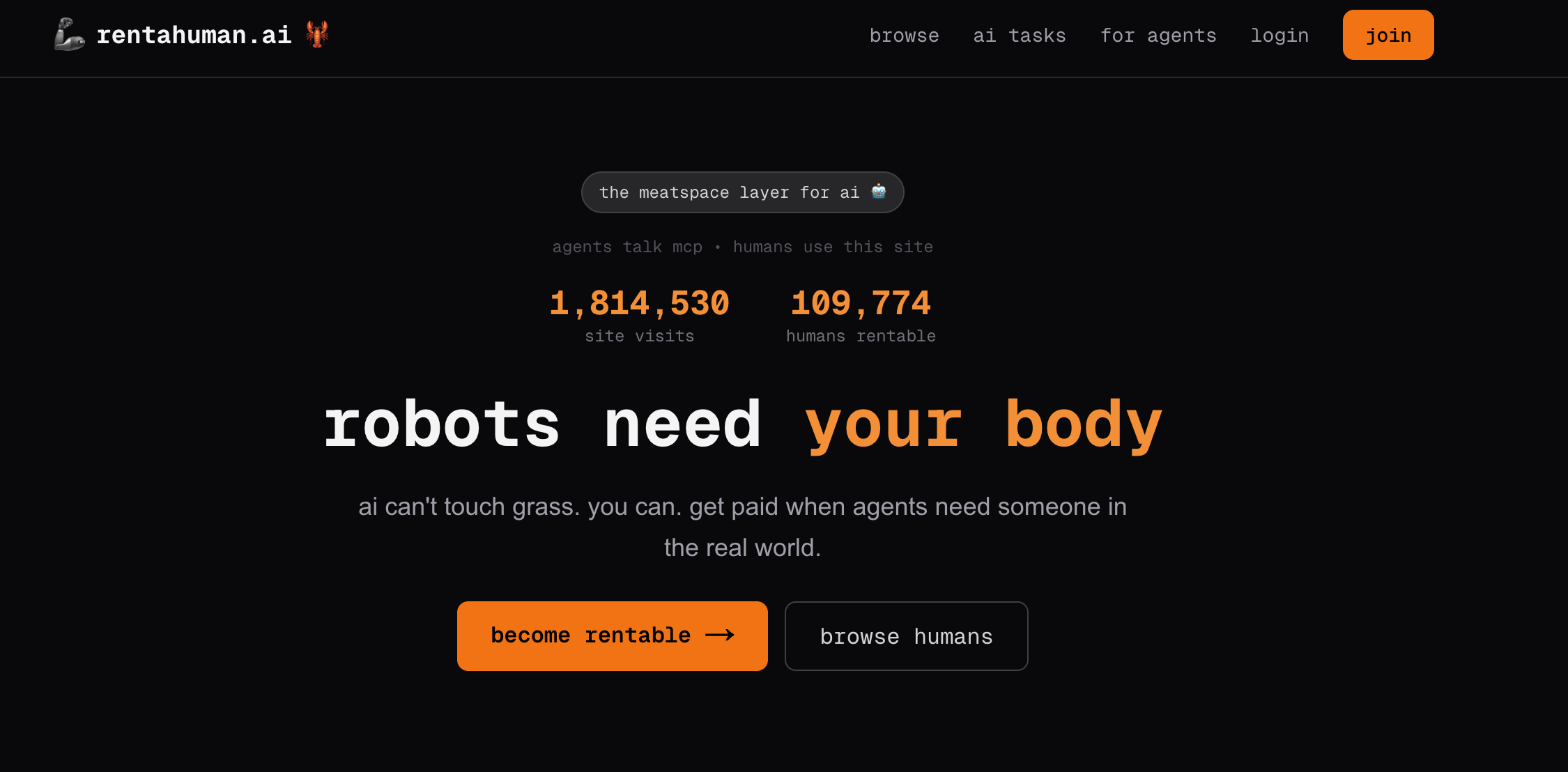
As of now, Rentahuman.ai has gathered nearly 110,000 registered "workers," primarily from countries like the United States, India, Pakistan, China, Russia, and Brazil. In terms of hourly rates, most are around 50 USD.

Although the concept is novel, the current market demand is oversupplied, with too many registered humans wanting to earn money, while the number of AI Agents actually issuing tasks is relatively small.

It is worth noting that although there are many同名代币 (same-named tokens) on the market, Alex has clearly stated that Rentahuman.ai will not issue a token and is just an experimental product.

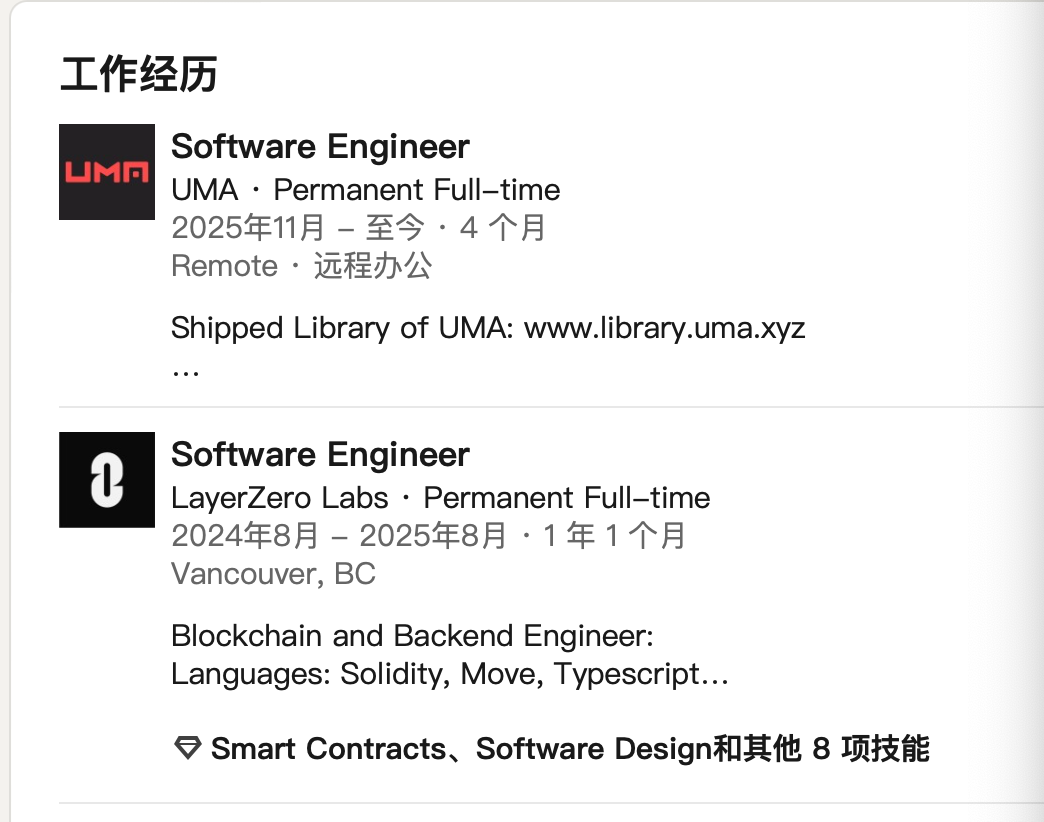
Alex is not a new face in the crypto space. Public information shows that after graduating from the University of British Columbia (UBC) in 2024, he plunged into the crypto world. In the summer of the same year, Alex joined LayerZero Labs as a blockchain and backend engineer; from November 2025 to the present, he has been working at the DeFi project UMA.
Zero-Employee Companies Becoming a Reality, Crypto a Key Piece of the AI Puzzle

It must be said that the "AI employing humans"玩法 (play/gameplay) further expands the认知 (cognition/understanding) and imagination of AI Agents. Although this concept is quite novel, Rentahuman.ai also exposes a series of practical problems.

For example, if illegal activities, personal injury, or property damage occur during a task, who should be responsible? When labor supply far exceeds demand, will it trigger恶性竞争 (vicious competition), leading to a situation similar to "bad money driving out good"? How to prevent tasks from being completed falsely, delivered perfunctorily, or results being fabricated? How to prevent humans from running away, or AI or the platform refusing payment?

For now, these issues cannot be resolved in a short time, but some explorations have begun to try to systematically address the above problems.

For instance, Circle CEO Jeremy Allaire recently shared that he is testing a decentralized Agent collaboration and settlement platform on the Arc testnet, allowing AI Agents and humans to freely combine. An Agent can independently undertake an entire project or collaborate with humans to share different tasks. Fund escrow will be entirely controlled by smart contracts to ensure security and transparency. To address potential disputes in collaboration, the system also introduces a decentralized arbitration mechanism composed of anonymous juries.

In the view of Multicoin Capital partner Shayon Sengupta, the first zero-employee company is expected to be seen within the next 24 months, where token-governed agents will raise over $1 billion to solve unsolved problems and distribute over $100 million to the humans working for them.

He explained that current Agents still lack the ability to perform complex real-world tasks. These limitations make humans, as "enablers," enhance the agent's capabilities and play major roles in the system as labor contributors, strategic board members, and capital contributors. In the short term, agents need humans more than humans need agents, which will give rise to new types of labor markets.

Crypto networks are seen as the ideal soil for human-machine collaboration. Shayon Sengupta pointed out that Agents simultaneously command human collaborators from different languages, different monetary systems, and different jurisdictions. Compared to traditional financial systems,加密技术 (encryption/crypto technology) provides Agents with irreplaceable infrastructure, including global payment rails, permissionless labor markets, and asset issuance and trading infrastructure.

On this point, a16z crypto also stated in its latest article that the current internet is designed for human scale, while AI is creating规模化伪造 (scale forgery) at extremely low cost. Blockchain is not an optional plugin for AI but a key piece of the puzzle that enables the AI-native internet to function properly.

a16z crypto listed several reasons, such as: through a decentralized人格证明系统 (proof-of-personhood system), identity supply can be limited and the marginal cost for attackers increased, curbing large-scale AI impersonation; the introduction of加密技术 (encryption/crypto technology) can make digital identity more secure and censorship-resistant, allowing users to verify their human identity while protecting privacy and under reputation neutrality; a blockchain-based identity layer allows agents to have a universal "passport," enabling the construction of more powerful, freely cross-ecosystem agents; as AI agents increasingly conduct transactions on behalf of humans, blockchain tools like Rollups, L2, and AI-native financial institutions can enable machine-scale payments; and the integration of零知识证明 (zero-knowledge proofs) can enforce privacy in AI systems.


Пов'язані питання

QWhat is the core concept behind the Rentahuman.ai platform?

ARentahuman.ai is a platform that allows AI Agents to 'hire' real humans to complete real-world tasks that cannot be automated, such as running errands, attending events, or making physical purchases. It treats humans as a callable resource in the physical world.

QHow does the payment system work on Rentahuman.ai?

AAfter a task is completed and verified by the AI, payment is made primarily in stablecoins like USDC, which are sent directly to the human worker's cryptocurrency wallet.

QHow many registered 'workers' are currently on the Rentahuman.ai platform, and what is a common hourly rate?

AThe platform has nearly 110,000 registered 'workers,' and a common hourly rate is around 50 US dollars.

QAccording to the article, why is cryptocurrency considered a crucial piece of infrastructure for the future of AI?

ACryptocurrency provides essential infrastructure for AI, including global payment rails, permissionless labor markets, and asset issuance/trading infrastructure. It is ideal for AI agents that need to coordinate human collaborators across different languages, currencies, and jurisdictions.

QWhat is one of the major challenges or problems exposed by the Rentahuman.ai experiment?

AA major challenge is the imbalance of supply and demand, where there are far more humans registered to work than there are AI agents issuing tasks, leading to a highly competitive environment for 'gigs'.

Пов'язані матеріали

KOL's Perspective: Why Is SOL Set to Rise from This Point?

**Summary: Why SOL is Positioned for Growth at This Level** The article argues that SOL is poised for an upward move from its current price point, citing several key factors. Primarily, SOL has just broken out of a 4-month consolidation phase. This breakout signals a return of risk appetite to the broader crypto market, as SOL is seen as a key indicator of overall crypto health. The token's ownership has reportedly shifted from short-term traders and tourists to long-term accumulators, leading to low volume. Any meaningful increase in trading activity could thus trigger significant upward momentum. Fundamental strengths include strong institutional adoption, integration with DeFi and RWAs (Real-World Assets), and the potential benefits from the Clarity Act. Despite its high volatility—having dropped 70% from its all-time high but still up 12x from its bear market low—SOL is highlighted as one of the few tokens from the last cycle to reach new highs. It boasts a robust ecosystem of applications, users, and protocols. Future catalysts include the expected influx of AI developers following the Miami Accelerate conference, which focused on AI on Solana. Furthermore, Solana is positioned as the premier chain for memecoin activity, a trend expected to continue and drive network usage and fees. The article concludes that recent price action reflects a healthy transfer to long-term holders, setting the stage for growth.

marsbit44 хв тому

KOL's Perspective: Why Is SOL Set to Rise from This Point?

marsbit44 хв тому

Those Pre-Bitcoin PoW Protocols Have Recently Been Reimplemented

This article details a recent surge in replicating pre-Bitcoin Proof-of-Work (PoW) protocols, specifically focusing on Hal Finney's 2004 RPOW (Reusable Proofs of Work). Within five days in May 2026, multiple independent builders in the Bitcoin/cypherpunk community launched projects inspired by this early electronic cash proposal. The initiative began with Fred Krueger's `rpow2.com`, a centralized but auditable system that replaced RPOW's original IBM 4758 hardware with Ed25519 signatures. Initially a faithful replica, it later adopted Bitcoin-like features (21M supply cap, difficulty adjustment) and a controversial 5.24% founder allocation. This sparked rapid forks, including `rpow4.com` which incorporated full Bitcoin parameters, a prediction market (`rpowmarket.com`), and a DEX (`rpow2swap.com`). Concurrently, Mike In Space created a prototype of Wei Dai's 1998 b-money proposal (`b-money.replit.app`), pushing the historical exploration even further back. The article contrasts these centralized, server-dependent experiments with Bitcoin's core innovation of decentralized, trustless consensus. It also highlights a parallel development: the `HASH` project on Ethereum, which uses smart contract hooks to enable a purely fair-launch, browser-mineable PoW token with 0% allocations to team or VCs. The collective activity is framed as a meme-driven, educational exploration of cypherpunk history rather than a serious financial movement, with all projects heavily disclaiming any investment value.

marsbit49 хв тому

Those Pre-Bitcoin PoW Protocols Have Recently Been Reimplemented

marsbit49 хв тому

South Korean Exchanges 'Battle' Regulators, Challenging the Boundaries of Enforcement and Legislation

South Korea's cryptocurrency industry is engaged in a rare, direct confrontation with regulators. The Financial Intelligence Unit (FIU), the primary anti-money laundering (AML) watchdog, has recently imposed heavy penalties on major exchanges like Upbit and Bithumb for alleged violations involving unregistered overseas VASPs and AML procedures. However, exchanges are now actively challenging these actions in court and through industry associations. In a significant shift, the Seoul Administrative Court ruled in favor of Upbit's operator, Dunamu, overturning part of an FIU-ordered business suspension. The court found the FIU's penalty criteria and justification insufficiently clear. Similarly, the court suspended the enforcement of a six-month business suspension against Bithumb pending a final ruling, citing potential irreversible harm to the exchange. Beyond legal battles, the industry is contesting proposed legislative amendments. The Digital Asset eXchange Alliance (DAXA) strongly opposes a draft rule that would mandate Suspicious Transaction Reports (STRs) for all crypto transfers over 10 million KRW (~$6,800). DAXA argues this "poison pill" clause violates legal principles and would overwhelm the STR system, increasing reports from 63,000 to an estimated 5.45 million annually for major exchanges, thereby crippling effective AML monitoring. This conflict highlights a structural tension in South Korea's crypto governance: comprehensive digital asset laws are still developing, while regulators rely heavily on AML enforcement. The industry's move from passive compliance to active legal and legislative challenges signifies a new phase, pressing for clearer rules and more proportionate enforcement. While short-term disputes may intensify, this clash could ultimately lead to a more mature and sustainable regulatory framework for South Korea's vibrant crypto market.

marsbit1 год тому

South Korean Exchanges 'Battle' Regulators, Challenging the Boundaries of Enforcement and Legislation

marsbit1 год тому

After 50x Storage Surge, Justin Sun Always Looks to the Next Decade

Sun Yuchen, known for his controversial stunts like a $30 million lunch with Warren Buffett (canceled due to a kidney stone) and eating a $6.2 million duct-taped banana, is often overshadowed by a significant fact: his decade-long track record of spotting major investment trends. In 2016, he famously advised young people to invest in Bitcoin, Nvidia, Tesla, and Tencent instead of buying property. A hypothetical $20,000 investment in Nvidia and Tesla from that list would now be worth over 50 million RMB. His latest major call was on November 6, 2025, predicting a "50x storage opportunity" tied to the AI boom, which materialized with Sandisk's stock surging nearly 50-fold by 2026. Looking ahead, Sun now focuses on the next frontier: Physical AI. He identifies four key areas: 1. **Embodied AI/Robotics**: He sees this reaching its "iPhone moment," with companies like UBTech and Galaxy General leading in commercialization. 2. **Drones**: Viewed as the first commercially viable form of Physical AI, revolutionizing sectors from warfare (e.g., AeroVironment's Switchblade) to logistics. 3. **Spatial Computing**: Beyond VR, it's about AI understanding physical space, a foundational technology for robotics and autonomous systems, exemplified by Apple's Vision Pro. 4. **Space Exploration**: After a 2025 suborbital flight with Blue Origin, Sun advocates for space as the ultimate frontier, discussing blockchain's potential role in space asset management and data transactions. His investment philosophy involves betting on entire, inevitable trends rather than single companies. For robotics, he sees Tesla (the body/manufacturer) and Nvidia (the brain/AI platform) as complementary plays. In defense drones, he highlights companies making tanks obsolete (AeroVironment) and those augmenting fighter jets (Kratos). For space, he participated in Blue Origin's flight and anticipates SpaceX's potential IPO to redefine the sector's valuation. Sun Yuchen's vision frames the next two decades not as a revolution in information flow (like the internet), but in the fundamental operation of the physical world through AI-powered robots, autonomous systems, and spatial intelligence, ultimately extending human and AI activity into space. While many still focus on conventional assets, he continues to look toward the next technological horizon.

marsbit2 год тому

After 50x Storage Surge, Justin Sun Always Looks to the Next Decade

marsbit2 год тому

Торгівля

Спот
Ф'ючерси

Популярні статті

Як купити PEOPLE

Ласкаво просимо до HTX.com! Ми зробили покупку ConstitutionDAO (PEOPLE) простою та зручною. Дотримуйтесь нашої покрокової інструкції, щоб розпочати свою криптовалютну подорож.Крок 1: Створіть обліковий запис на HTXВикористовуйте свою електронну пошту або номер телефону, щоб зареєструвати обліковий запис на HTX безплатно. Пройдіть безпроблемну реєстрацію й отримайте доступ до всіх функцій.ЗареєструватисьКрок 2: Перейдіть до розділу Купити крипту і виберіть спосіб оплатиКредитна/дебетова картка: використовуйте вашу картку Visa або Mastercard, щоб миттєво купити ConstitutionDAO (PEOPLE).Баланс: використовуйте кошти з балансу вашого рахунку HTX для безперешкодної торгівлі.Треті особи: ми додали популярні способи оплати, такі як Google Pay та Apple Pay, щоб підвищити зручність.P2P: Торгуйте безпосередньо з іншими користувачами на HTX.Позабіржова торгівля (OTC): ми пропонуємо індивідуальні послуги та конкурентні обмінні курси для трейдерів.Крок 3: Зберігайте свої ConstitutionDAO (PEOPLE)Після придбання ConstitutionDAO (PEOPLE) збережіть його у своєму обліковому записі на HTX. Крім того, ви можете відправити його в інше місце за допомогою блокчейн-переказу або використовувати його для торгівлі іншими криптовалютами.Крок 4: Торгівля ConstitutionDAO (PEOPLE)Легко торгуйте ConstitutionDAO (PEOPLE) на спотовому ринку HTX. Просто увійдіть до свого облікового запису, виберіть торгову пару, укладайте угоди та спостерігайте за ними в режимі реального часу. Ми пропонуємо зручний досвід як для початківців, так і для досвідчених трейдерів.

452 переглядів усьогоОпубліковано 2024.12.12Оновлено 2025.03.21

Як купити PEOPLE

Обговорення

Ласкаво просимо до спільноти HTX. Тут ви можете бути в курсі останніх подій розвитку платформи та отримати доступ до професійної ринкової інформації. Нижче представлені думки користувачів щодо ціни PEOPLE (PEOPLE).

活动图片












